


Global AI In Ophthalmology Market By Application (Disease Detection and Monitoring (Retinal Disease Detection (Diabetic Retinopathy, Diabetic Macular Edema (DME), Age-related Macular Degeneration (AMD) and Retinal Vein Occlusion (RVO)) and Glaucoma Detection & Monitoring), Surgical Planning & Outcome Prediction, AI for Ophthalmic Imaging Workflow Automation and Others), By Deployment Mode (On-Premise and Cloud-based), By Technology (Machine Learning (Deep learning, Supervised, Unsupervised and Others), Natural Language Processing (Clinical Documentation, OCR, Auto-coding, Text Analytics and Speech-to-Text), Context-Aware Computing and Computer Vision), By End-use (Hospitals, Specialty Ophthalmology Clinics, Academic & Research Institutions, Payers & Insurance Companies and Others), Region and Companies – Industry Segment Outlook, Market Assessment, Competition Scenario, Trends and Forecast 2026-2035
- Published date: March 2026
- Report ID: 181387
- Number of Pages: 342
- Format:
-
keyboard_arrow_up
Quick Navigation
Report Overview
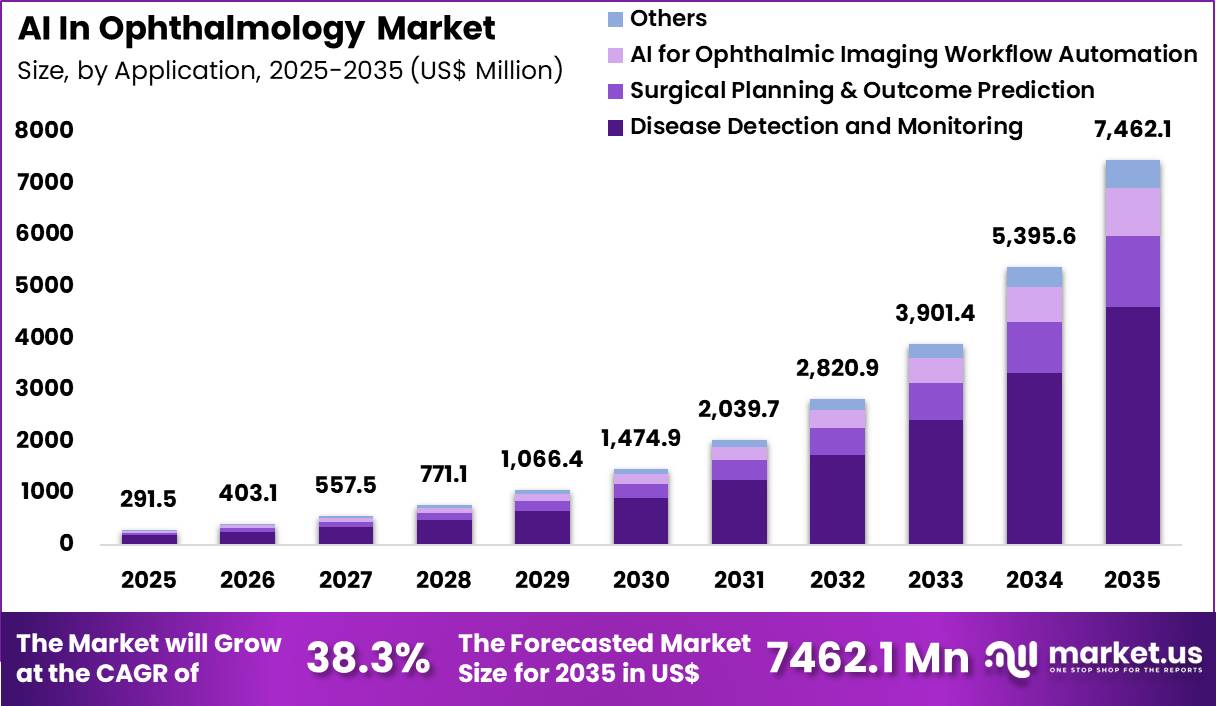
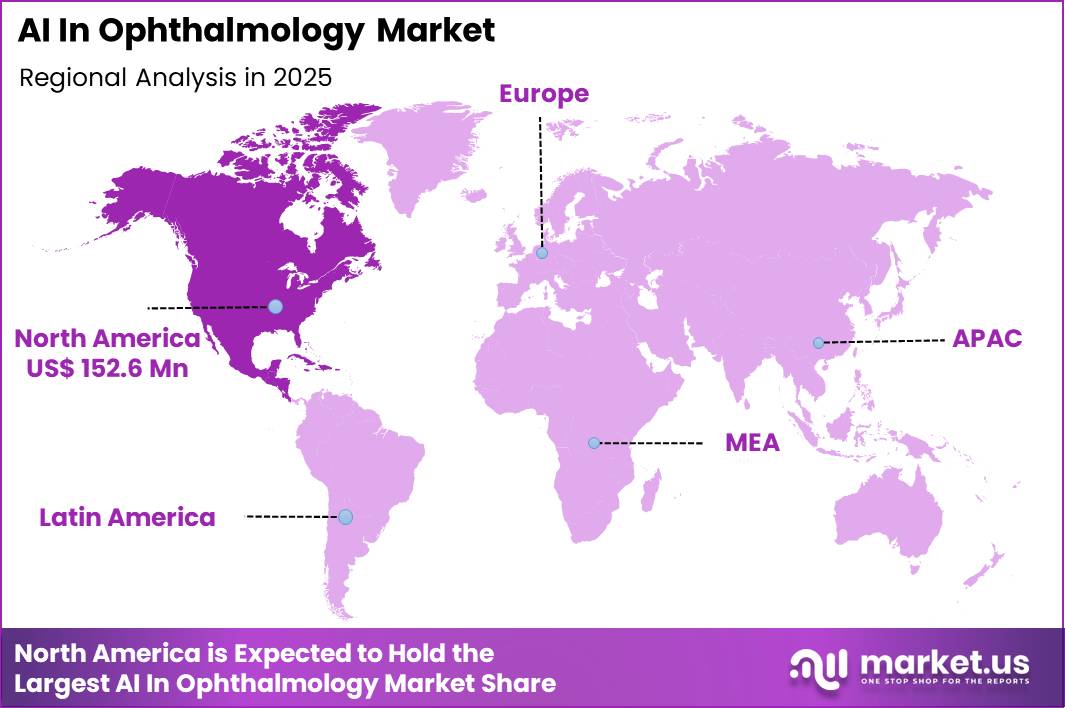
The Global AI In Ophthalmology Market size is expected to be worth around US$ 7462.1 Million by 2035 from US$ 291.5 Million in 2025, growing at a CAGR of 38.3% during the forecast period 2026-2035. In 2025, North America led the market, achieving over 52.4% share with a revenue of US$ 152.6 Million.
Increasing integration of artificial intelligence into ophthalmic diagnostics drives the AI in Ophthalmology market as eye care professionals seek tools that enhance early detection, improve diagnostic accuracy, and streamline clinical workflows.
Ophthalmologists increasingly apply AI algorithms to analyze retinal fundus images for diabetic retinopathy screening, identifying microaneurysms, hemorrhages, and exudates with high sensitivity to support timely intervention in diabetic patients.
These systems support glaucoma detection by quantifying optic nerve head parameters and retinal nerve fiber layer thickness from optical coherence tomography scans, enabling earlier identification of structural changes and progression monitoring. AI-powered platforms assist in age-related macular degeneration evaluation, classifying drusen patterns and geographic atrophy to guide anti-VEGF therapy decisions and predict vision loss risk.
Retinal specialists utilize AI for retinopathy of prematurity screening in neonatal intensive care units, analyzing wide-field retinal images to detect plus disease and zone I involvement with consistency comparable to expert graders. In refractive surgery planning, AI assists in corneal topography analysis, predicting postoperative outcomes and optimizing laser ablation profiles for LASIK and PRK procedures.
Manufacturers pursue opportunities to develop multimodal AI systems that combine fundus photography, OCT, and visual field data, expanding applications in comprehensive retinal disease management and supporting teleophthalmology initiatives. Developers advance cardiovascular risk assessment tools that derive heart disease indicators from routine retinal images, broadening utility in primary eye care settings where optometrists screen for systemic conditions.
These innovations facilitate integration with electronic health records and cloud-based platforms for seamless data sharing and collaborative care. Opportunities emerge in AI-driven triage systems that prioritize urgent cases in high-volume clinics, improving access for patients with sight-threatening conditions. Companies invest in explainable AI models that provide transparent reasoning, building clinician trust and supporting regulatory acceptance.
In January 2026, Toku, an AI-imaging specialist, entered into a validation study with Mayo Clinic for its CLAiR technology. As per the study objectives, the AI uses a standard retinal image to generate a cardiovascular risk score, potentially allowing optometrists to identify patients at high risk of heart disease during routine eye examinations.
Recent trends emphasize preventive screening, multimodal analysis, and systemic health applications, positioning AI in Ophthalmology as a transformative force in early detection, personalized care, and interdisciplinary collaboration.
Key Takeaways
- In 2025, the market generated a revenue of US$ 291.5 Million, with a CAGR of 38.3%, and is expected to reach US$ 7462.1 Million by the year 2035.
- The application segment is divided into disease detection and monitoring, surgical planning & outcome prediction, AI for ophthalmic imaging workflow automation and others, with disease detection and monitoring taking the lead with a market share of 61.8%.
- Considering deployment mode, the market is divided into on-premise and cloud-based. Among these, cloud-based held a significant share of 84.8%.
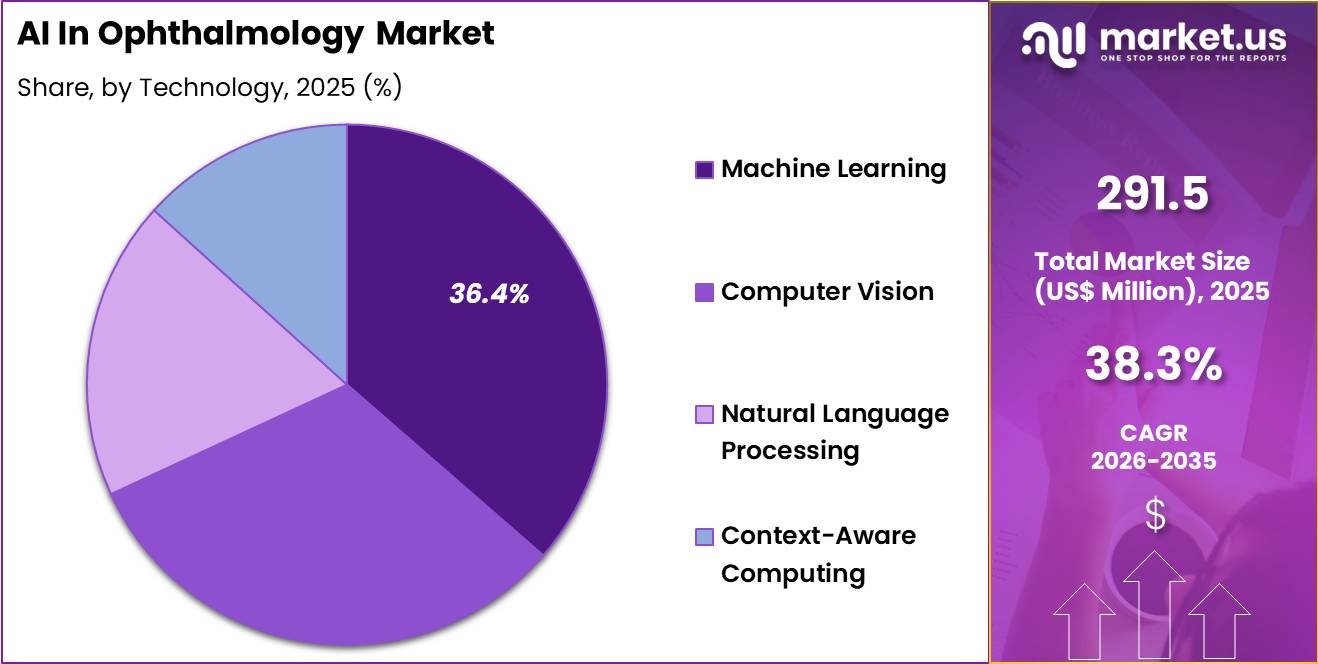
- Furthermore, concerning the technology segment, the market is segregated into machine learning, natural language processing, context-aware computing and computer vision. The machine learning sector stands out as the dominant player, holding the largest revenue share of 36.4% in the market.
- The end-use segment is segregated into hospitals, specialty ophthalmology clinics, academic & research institutions, payers & insurance companies and others, with the hospitals segment leading the market, holding a revenue share of 38.2%.
- North America led the market by securing a market share of 52.4%.
Application Analysis
Disease detection and monitoring accounted for 61.8% of growth within application and dominate the AI in ophthalmology market because artificial intelligence significantly improves the early identification of eye diseases through automated image analysis.
AI platforms analyze retinal images, optical coherence tomography scans, and fundus photographs to detect conditions such as diabetic retinopathy, glaucoma, and age related macular degeneration. The International Diabetes Federation estimates that more than 537 million adults globally live with diabetes, which increases the risk of diabetic retinopathy and other vision complications.
Healthcare providers increasingly integrate AI screening tools into ophthalmic diagnostic workflows to identify disease progression earlier. Hospitals and eye clinics are projected to expand AI deployment as automated screening reduces diagnostic time and improves clinical accuracy. Continuous growth in retinal imaging data and advances in algorithm development are likely to strengthen adoption across global eye care systems.
Deployment Mode Analysis
Cloud-based deployment accounted for 84.8% of growth within deployment mode and dominate the AI in ophthalmology market due to the scalability and accessibility offered by cloud computing infrastructure. Cloud platforms allow ophthalmologists to upload imaging data and instantly receive AI-driven diagnostic insights without installing complex software systems locally.
Healthcare organizations increasingly prefer cloud solutions because they support real time collaboration among specialists and remote consultation across geographic regions. Cloud architecture also enables continuous software updates and integration with electronic health record systems.
The segment is expected to expand as digital healthcare ecosystems increasingly rely on cloud infrastructure to store and process large volumes of ophthalmic imaging data. Rising investment in teleophthalmology programs and remote diagnostic platforms further strengthens the adoption of cloud-based AI solutions.
Technology Analysis
Machine learning accounted for 36.4% of growth within technology and dominate the AI in ophthalmology market because these algorithms learn from extensive ophthalmic image datasets to identify patterns associated with eye diseases. Machine learning models analyze retinal scans, patient history, and diagnostic records to assist ophthalmologists in identifying abnormalities.
Research institutions increasingly train AI models using labeled ophthalmic imaging datasets to improve diagnostic performance. According to studies published by the National Eye Institute, AI models demonstrate high accuracy in detecting diabetic retinopathy through retinal imaging analysis.
Healthcare providers increasingly rely on machine learning systems to enhance screening efficiency and reduce diagnostic workload. The segment is anticipated to expand as healthcare organizations integrate AI algorithms into clinical decision support platforms and ophthalmic imaging equipment.
End-Use Analysis
Hospitals accounted for 38.2% of growth within end use and dominate the AI in ophthalmology market because hospitals operate advanced diagnostic infrastructure and manage high volumes of ophthalmic patients. These healthcare facilities frequently perform retinal imaging, glaucoma testing, and vision screening procedures that generate large datasets suitable for AI analysis.
Hospitals also collaborate with technology developers and research institutions to deploy AI-assisted diagnostic systems. The National Eye Institute reports that millions of individuals experience vision impairment globally due to preventable eye diseases, which encourages healthcare providers to adopt advanced diagnostic technologies.
Hospitals are projected to remain key adopters as they integrate AI solutions into ophthalmology departments to enhance screening programs and clinical decision support systems. Continuous investment in hospital digital health infrastructure further supports market expansion.
Key Market Segments
By Application
- Disease Detection and Monitoring
- Retinal Disease Detection
- Diabetic Retinopathy
- Diabetic Macular Edema (DME)
- Age-related Macular Degeneration (AMD)
- Retinal Vein Occlusion (RVO)
- Glaucoma Detection & Monitoring
- Retinal Disease Detection
- Surgical Planning & Outcome Prediction
- AI for Ophthalmic Imaging Workflow Automation
- Others
By Deployment Mode
- On-Premise
- Cloud-based
By Technology
- Machine Learning (Deep learning, Supervised, Unsupervised, Others)
- Natural Language Processing (Clinical Documentation, OCR, Auto-coding, Text Analytics, Speech-to-Text)
- Context-Aware Computing
- Computer Vision
By End-use
- Hospitals
- Specialty Ophthalmology Clinics
- Academic & Research Institutions
- Payers & Insurance Companies
- Others
Drivers
Rising integration of AI-assisted diagnostic imaging is driving the market.
The AI in ophthalmology market experiences sustained expansion through increased adoption of artificial intelligence algorithms for retinal image analysis in clinical settings. These systems process fundus photographs and optical coherence tomography scans to detect diabetic retinopathy, age-related macular degeneration, and glaucoma with high sensitivity.
Ophthalmologists utilize AI tools as adjuncts to enhance screening efficiency in high-volume practices. The driver aligns with growing global prevalence of vision-threatening diseases requiring early intervention. Healthcare facilities report improved diagnostic consistency through standardized AI interpretation. The technology supports teleophthalmology programs by enabling remote grading of retinal images.
Regulatory approvals for multiple AI-based diagnostic aids have facilitated broader clinical implementation. The trend corresponds with investments in cloud-based platforms for real-time image processing. Enhanced workflow integration reduces interpretation time for routine screenings. This factor maintains consistent demand for AI-enhanced imaging solutions across ophthalmic care.
Restraints
High development and validation costs for AI algorithms are restraining the market.
Development of robust AI models for ophthalmology requires extensive annotated datasets from diverse patient populations and imaging devices. The annotation process demands significant involvement from fellowship-trained ophthalmologists, elevating resource requirements.
Validation studies necessitate large-scale prospective trials to demonstrate generalizability across ethnicities and imaging equipment. The restraint limits entry for smaller developers lacking substantial capital. Regulatory pathways demand rigorous evidence of performance in real-world settings, extending time to market.
The factor contributes to concentrated market presence among established players with existing datasets. Ongoing maintenance of model performance through continuous retraining adds recurring expenses. Facilities hesitate to adopt solutions without long-term performance guarantees. This dynamic moderates innovation velocity in resource-constrained environments. The limitation persists in constraining broader market penetration during recent years.
Opportunities
Expansion of AI-driven screening programs in underserved regions is creating growth opportunities.
Public health initiatives increasingly deploy AI-based retinal screening in primary care and community settings to address diabetic retinopathy detection gaps. These programs utilize portable fundus cameras paired with cloud-based AI analysis for point-of-care results. Opportunities arise for scalable deployment in low-resource environments through cost-effective hardware integration.
The framework supports partnerships between technology providers and governmental health agencies. Enhanced accessibility improves early detection rates in populations with limited specialist availability. The development facilitates data collection for continuous model refinement in diverse demographics.
Such initiatives promote adoption of lightweight AI applications compatible with smartphone-based imaging. Stakeholders anticipate improved health outcomes through timely referral pathways. The opportunity fosters differentiation through localized language support and offline processing capabilities. This advancement positions participants for expansion in global public health applications.
Impact of Macroeconomic / Geopolitical Factors
Macroeconomic conditions influence the AI in ophthalmology market through healthcare IT investment, hospital digitization budgets, and funding for medical AI research. Inflation raises costs for high-resolution imaging devices, cloud infrastructure, data storage, and AI model development, which increases operational expenses for technology providers.
Higher interest rates limit venture capital availability and slow expansion of startups developing AI diagnostic platforms. Geopolitical tensions affect global access to semiconductors, GPUs, and advanced imaging components used in ophthalmic AI systems.
Current US tariffs on imported electronics, optical components, and computing hardware increase deployment costs for hospitals and diagnostic centers. These pressures can delay technology upgrades in smaller clinics and emerging healthcare markets.
At the same time, companies strengthen domestic technology partnerships and invest in localized data infrastructure to reduce supply risk. Growing demand for early detection of retinal diseases and automated diagnostic support continues to sustain strong and confident market growth.
Latest Trends
FDA clearances for multiple autonomous AI diagnostic systems are driving the market.
The U.S. Food and Drug Administration granted 510(k) clearances to several autonomous AI systems for diabetic retinopathy screening in 2024-2025. These clearances cover platforms capable of independent image interpretation without mandatory physician review for certain use cases.
The approvals validate substantial equivalence to predicate devices while demonstrating high sensitivity and specificity. Ophthalmic practices benefit from streamlined screening workflows in primary care integration. The 2024-2025 regulatory advancements align with increasing emphasis on population-level diabetic eye disease management.
Facilities report potential reductions in specialist workload through triage of normal cases. The development stimulates educational initiatives on AI implementation in clinical practice. Early adopters demonstrate consistent performance in community screening programs.
The clearances facilitate reimbursement discussions with payers for AI-assisted services. Overall, these regulatory milestones accelerate mainstream adoption of autonomous AI in ophthalmic diagnostics.
Regional Analysis
Asia Pacific is leading the AI In Ophthalmology Market
North America accounted for 40.7% of the AI in ophthalmology market in 2025 as healthcare providers and eye care institutions increasingly integrated artificial intelligence tools into diagnostic imaging and disease detection workflows.
Ophthalmologists across the United States and Canada are adopting AI-enabled retinal imaging systems that analyze fundus photographs and optical coherence tomography scans to detect eye diseases earlier and improve treatment planning.
According to the Centers for Disease Control and Prevention, about 12 million adults aged 40 years and older in the United States had vision impairment in 2023, including 1 million individuals who were blind, highlighting a substantial patient population requiring early screening and monitoring.
Rising prevalence of diabetic retinopathy, glaucoma, and age-related macular degeneration has encouraged clinics to adopt automated screening technologies that improve diagnostic accuracy and reduce physician workload. Hospitals and teleophthalmology networks are expanding digital eye screening programs that rely on AI algorithms to interpret retinal images quickly.
Medical technology companies are introducing advanced software platforms that assist ophthalmologists in identifying subtle disease patterns in large imaging datasets. Academic research institutions across the region are collaborating with technology firms to develop deep learning models for retinal disease prediction.
These developments collectively strengthened the adoption of intelligent ophthalmic diagnostic technologies across North America in 2025.
North America is expected to experience the highest CAGR during the forecast period
Asia Pacific is expected to witness strong expansion during the forecast period as governments and healthcare providers adopt digital health technologies to address rising eye disease prevalence. Countries such as China, India, Japan, and South Korea are investing in artificial intelligence and telemedicine platforms to improve access to ophthalmic screening services, particularly in rural populations.
The International Diabetes Federation reported that about 206 million adults were living with diabetes in the Western Pacific region in 2023, increasing the risk of diabetic retinopathy and driving demand for automated retinal screening solutions.
Healthcare systems across the region are therefore expanding digital eye screening programs that allow large populations to be screened efficiently using AI-assisted image analysis. Technology companies and research institutes are developing advanced algorithms capable of detecting retinal abnormalities with high accuracy.
Governments are also supporting national digital health initiatives that promote early detection of vision-threatening diseases. Hospitals and mobile eye care clinics are adopting AI-enabled diagnostic platforms to extend specialist services to underserved communities.
Universities and biotechnology companies are strengthening research in medical imaging and machine learning for ophthalmology applications. These developments are expected to accelerate adoption of intelligent eye care diagnostic technologies across Asia Pacific in the coming years.
Key Regions and Countries
North America
- The US
- Canada
Europe
- Germany
- France
- The U.K.
- Italy
- Spain
- Russia & CIS
- Rest of Europe
Asia Pacific
- China
- India
- Japan
- South Korea
- ASEAN
- Australia & New Zealand
- Rest of Asia Pacific
Middle East & Africa
- GCC
- South Africa
- Rest of Middle East & Africa
Latin America
- Brazil
- Mexico
- Rest of Latin America
Key Players Analysis
Key participants in the AI In Ophthalmology Market expand their footprint by developing advanced image analysis algorithms, integrating diagnostic software with retinal imaging devices, and collaborating with hospitals and eye care clinics to improve early disease detection. Companies focus on AI-driven screening tools that help clinicians identify diabetic retinopathy, glaucoma, and age-related macular degeneration with greater speed and accuracy.
They also strengthen growth through regulatory approvals, cloud-based diagnostic platforms, and partnerships with healthcare providers that support remote eye screening programs. Topcon Healthcare represents a notable participant in the AI In Ophthalmology Market and operates as a global medical technology company headquartered in Japan that develops ophthalmic imaging systems, digital healthcare platforms, and diagnostic solutions for eye care professionals.
The company emphasizes data-driven eye health technologies and AI-enabled imaging analytics to enhance clinical decision support. Industry competitors continue to introduce intelligent diagnostic software, expand tele-ophthalmology collaborations, and invest in research initiatives that advance automated eye disease detection.
Top Key Players
- Eyenuk, Inc.
- Google LLC
- IBM Corporation
- Optos plc
- Zeiss
- Topcon Healthcare
- Ikerian AG (RetinAi)
- Nidek Co., Ltd.
- Altris AI
- Siemens Healthineers
- Haag-Streit Group
Recent Developments
- In April 2025, AEYE Health announced a strategic partnership with Topcon Healthcare to integrate its fully autonomous AI for diabetic retinopathy screening into the Topcon NW500 robotic fundus camera. This integration allows non-specialist clinics to perform diagnostic eye exams in under 60 seconds, with the AI providing a definitive “refer” or “no-refer” result on-site.
- In August 2025, Digital Diagnostics (formerly IDx) announced that its LumineticsCore (formerly IDx-DR) autonomous AI system successfully completed its 1 millionth clinical screening for diabetic retinopathy in the US. According to company data, this milestone reflects the accelerated adoption of AI in primary care settings to address the shortage of specialized ophthalmologists.
Report Scope
Report Features Description Market Value (2025) US$ 291.5 Million Forecast Revenue (2035) US$ 7462.1 Million CAGR (2026-2035) 38.3% Base Year for Estimation 2025 Historic Period 2020-2024 Forecast Period 2026-2035 Report Coverage Revenue Forecast, Market Dynamics, COVID-19 Impact, Competitive Landscape, Recent Developments Segments Covered By Application (Disease Detection and Monitoring (Retinal Disease Detection (Diabetic Retinopathy, Diabetic Macular Edema (DME), Age-related Macular Degeneration (AMD) and Retinal Vein Occlusion (RVO)) and Glaucoma Detection & Monitoring), Surgical Planning & Outcome Prediction, AI for Ophthalmic Imaging Workflow Automation and Others), By Deployment Mode (On-Premise and Cloud-based), By Technology (Machine Learning (Deep learning, Supervised, Unsupervised and Others), Natural Language Processing (Clinical Documentation, OCR, Auto-coding, Text Analytics and Speech-to-Text), Context-Aware Computing and Computer Vision), By End-use (Hospitals, Specialty Ophthalmology Clinics, Academic & Research Institutions, Payers & Insurance Companies and Others) Regional Analysis North America – The US, Canada; Europe – Germany, France, The U.K., Italy, Spain, Russia & CIS, Rest of Europe; Asia Pacific – China, India, Japan, South Korea, ASEAN, Australia & New Zealand, Rest of Asia Pacific; Middle East & Africa – GCC, South Africa, Rest of Middle East & Africa; Latin America – Brazil, Mexico, Rest of Latin America Competitive Landscape Eyenuk, Inc., Google LLC, IBM Corporation, Optos plc, Zeiss, Topcon Healthcare, Ikerian AG (RetinAi), Nidek Co., Ltd., Altris AI, Siemens Healthineers, Haag-Streit Group. Customization Scope Customization for segments, region/country-level will be provided. Moreover, additional customization can be done based on the requirements. Purchase Options We have three licenses to opt for: Single User License, Multi-User License (Up to 5 Users), Corporate Use License (Unlimited User and Printable PDF)  AI In Ophthalmology MarketPublished date: March 2026add_shopping_cartBuy Now get_appDownload Sample
 -
-
- Eyenuk, Inc.
- Google LLC
- IBM Corporation
- Optos plc
- Zeiss
- Topcon Healthcare
- Ikerian AG (RetinAi)
- Nidek Co., Ltd.
- Altris AI
- Siemens Healthineers
- Haag-Streit Group
Our Clients

- 181387
- March 2026






