


Global AI in Nanotechnology Market Size, Share Report By Type (Nanosensor (Biosensors, Chemical Nanosensor, Optical Nanosensor, Physical Nanosensor, Others), Nanodevice (Nanomanipulator, Nanomechanical Test Instruments, Nanoscale Infrared Spectrometers, Others), By Technology (Machine Learning & Deep Learning, Natural Language Processing, Robotics, Others), By Application (Biomedical Applications, Energy Storage and Conversion, Electronics and Sensors, Advanced Materials, Others), By End-User Industry (Electronics & Semiconductor, Healthcare & Pharmaceuticals, Biotechnology, Textile, Chemicals and Advanced materials, Automobiles, Others), By Regional Analysis, Global Trends and Opportunity, Future Outlook By 2025-2034
- Published date: Dec. 2025
- Report ID: 132984
- Number of Pages: 338
- Format:
-
keyboard_arrow_up
Quick Navigation
Report Overview
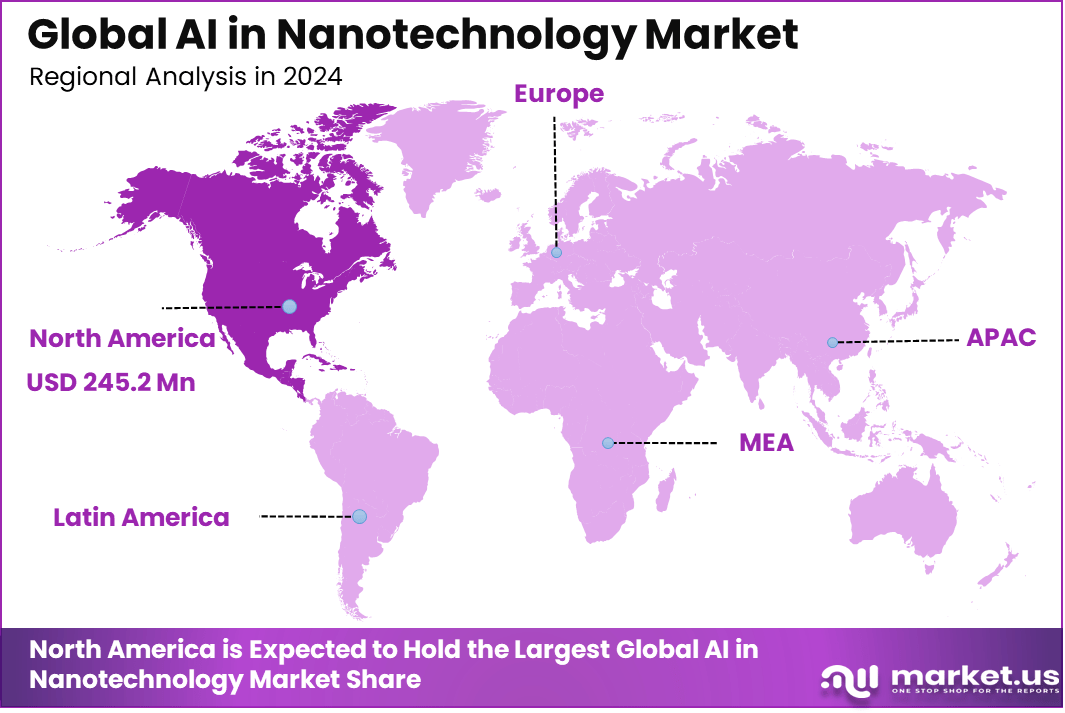
The Global AI in Nanotechnology Market generated USD 622.5 Million in 2024 and is predicted to register growth from USD 859.7 Million in 2025 to about USD 25,725.8 Million by 2034, recording a CAGR of 45.9% throughout the forecast span. In 2024, North America held a dominan market position, capturing more than a 39.4% share, holding USD 245.2 Million revenue.
The AI in nanotechnology market has expanded as research institutions and industrial manufacturers combine artificial intelligence with nanoscale science to improve material design, process control and product performance. Growth reflects rising data complexity in nanotech research and the need for faster discovery cycles. AI systems now support simulation, modelling and automation across nanomaterials, nanomedicine and nanoelectronics development.
The growth of the market can be attributed to increasing demand for precision engineering at the nanoscale, rising research spending and the need to reduce development time for advanced materials. Traditional trial and error methods are no longer efficient for nanotechnology research. AI enables faster pattern detection, property prediction and optimisation of experimental conditions, which strengthens its adoption across laboratories and manufacturing sites.
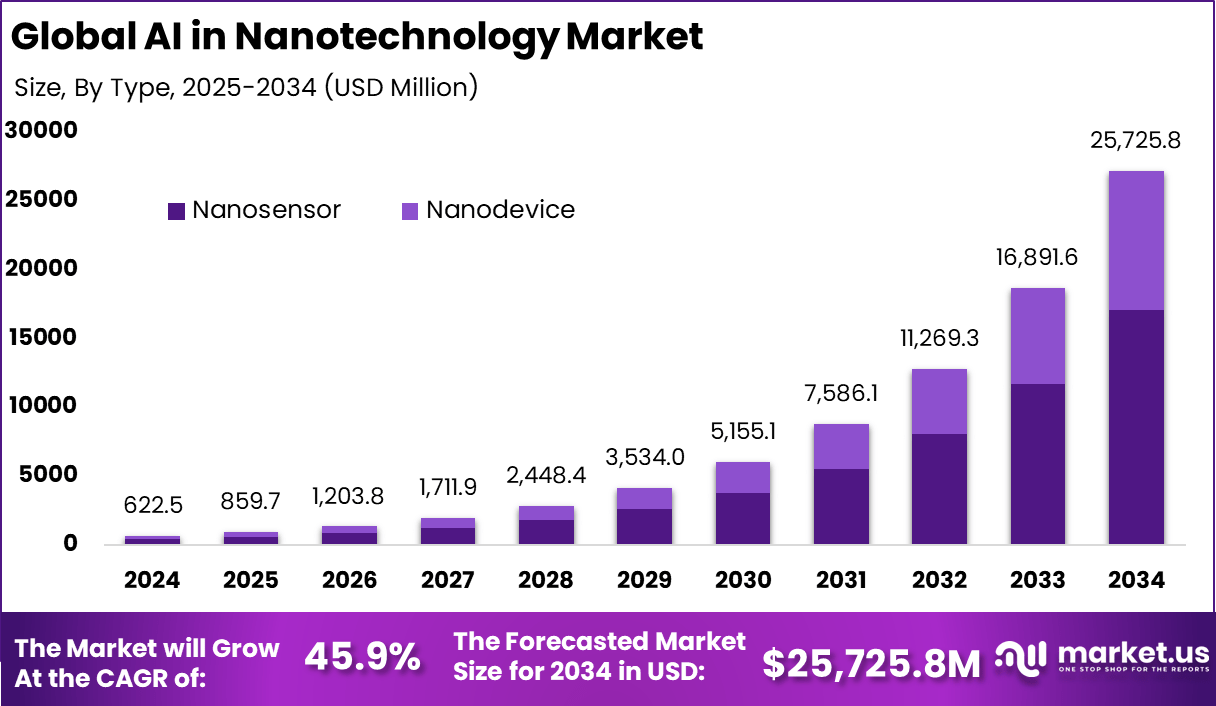
Technological advancements in AI and nanotechnology are primarily focused on increasing the accuracy and speed of nanoscale manipulations and analyses. Innovations like atomic force microscopy (AFM) enhanced with AI algorithms showcase the practical integration of these technologies, significantly improving the quality of nanoscale imaging and diagnostics.
AI-enhanced nanotechnology is largely fueled by its potential to solve complex problems in sectors such as electronics, where it aids in developing smaller, faster, and more energy-efficient components. Additionally, the technology’s implications for sustainable energy solutions and advanced medical therapies are creating substantial market opportunities.
Key Takeaways
- Nanosensors led the market with a 62.8% share, showing their strong suitability for high-precision detection and real-time monitoring.
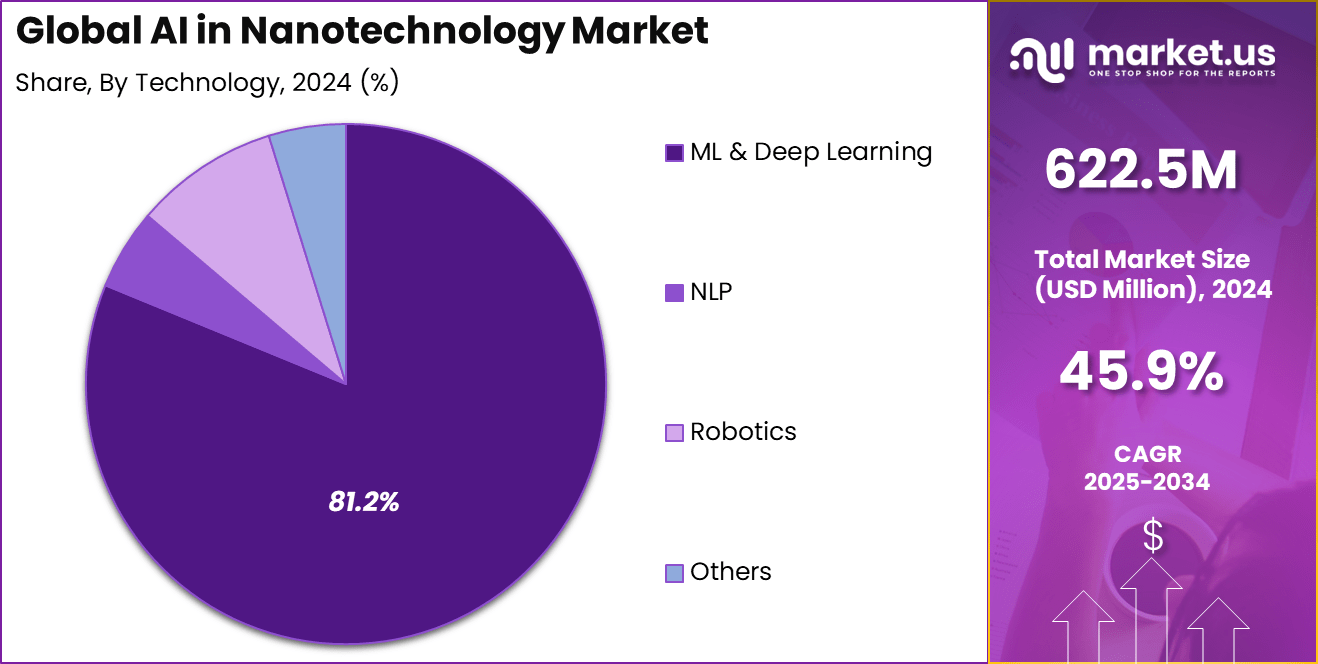
- Machine learning and deep learning dominated with 81.2%, confirming that advanced AI models are central to data processing and pattern recognition in this segment.
- Biomedical applications captured 43.5%, reflecting growing demand for early diagnosis, continuous health monitoring, and precision treatment.
- The healthcare and pharmaceutical industry accounted for 29.5%, driven by rising investments in smart diagnostics and digital therapeutics.
- North America held 39.4%, supported by strong research funding and early adoption of advanced sensing technologies.
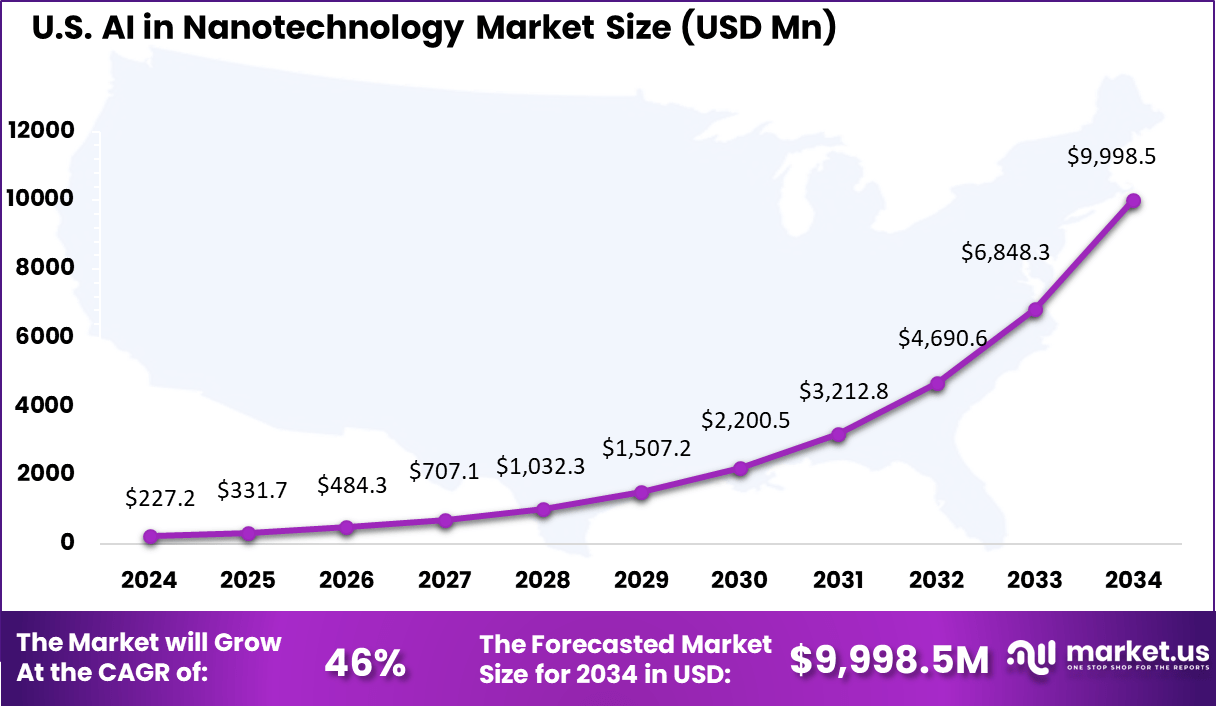
- The U.S. market reached USD 227.2 million with a powerful 46.0% CAGR, highlighting rapid commercialization and scaling across medical and life science use cases.
By Type
The nanosensor segment holds a strong position with a 62.8% share, showing its central role in AI-driven nanotechnology systems. Nanosensors are designed to detect very small chemical, physical, and biological signals at the molecular level. Their ability to capture precise data makes them highly suitable for AI-based analysis, especially where accuracy and sensitivity are critical.
The dominance of this segment is linked to rising use in medical diagnostics, environmental testing, and industrial monitoring. When combined with AI, nanosensors can process large volumes of real-time data and identify patterns that are difficult to detect using traditional systems. This capability improves reliability and speeds up decision-making.
Market Share (%), By Type (2020-2024)
By Type 2020 2021 2022 2023 2024 Nanosensor 60.7% 61.2% 61.8% 62.3% 62.8% – Optical Nanosensor 13.4% 13.4% 13.3% 13.3% 13.3% – Chemical Nanosensor 23.7% 23.6% 23.4% 23.2% 23.0% – Physical Nanosensor 7.6% 7.4% 7.2% 7.0% 6.8% – Biosensors 50.4% 50.9% 51.5% 52.1% 52.7% – Others 4.9% 4.7% 4.6% 4.4% 4.2% Nanodevice 39.3% 38.8% 38.2% 37.7% 37.2% – Nanomanipulator 18.2% 18.3% 18.4% 18.5% 18.5% – Test Instruments 23.2% 23.0% 22.9% 22.8% 22.7% – Infrared Spectrometers 31.1% 31.6% 32.1% 32.6% 33.1% – Others 27.5% 27.1% 26.6% 26.1% 25.7% Technology Analysis
Machine learning and deep learning together account for a high 81.2% share, confirming their importance within AI-powered nanotechnology. These technologies are used to analyze complex data sets generated by nanoscale systems. They help in detecting patterns, improving predictions, and reducing processing errors across multiple applications.
Market Share (%), By Technology Analysis (2020-2024)
By Technology 2020 2021 2022 2023 2024 Machine Learning 79.8% 80.1% 80.5% 80.8% 81.2% Natural Language Processing 9.1% 9.0% 8.8% 8.6% 8.4% Robotics 6.5% 6.4% 6.3% 6.3% 6.2% Others 4.6% 4.5% 4.4% 4.3% 4.3% Their strong adoption is driven by the need for faster data interpretation and better system learning. In nanotechnology, where experiments generate multi-layered data, these tools allow accurate modeling of material behavior and biological responses. This supports higher efficiency in research, testing, and application development.
Application Analysis
Biomedical applications represent a major share of 43.5%, showing how strongly AI-based nanotechnology is linked with healthcare use cases. This includes early disease detection, drug targeting, biosensing, and patient monitoring. The small size of nanomaterials allows interaction at the cellular level, while AI improves data interpretation.
The growth of this segment is supported by rising demand for precision diagnostics and personalized treatment methods. AI systems improve analysis of biological signals collected through nanosensors, allowing faster diagnosis and better treatment planning. This improves outcomes while reducing diagnosis time and uncertainty.
Market Share (%), By Application Analysis (2020-2024)
By Application 2020 2021 2022 2023 2024 Biomedical Applications 41.7% 42.2% 42.6% 43.1% 43.5% Energy Storage and Systems 9.1% 8.9% 8.8% 8.7% 8.6% Electronics and Sensors 18.2% 18.2% 18.1% 18.1% 18.0% Advanced Materials 26.5% 26.3% 26.2% 26.0% 25.8% Others 4.5% 4.4% 4.3% 4.2% 4.1% End-User Industry Analysis
The healthcare and pharmaceuticals industry holds a 29.5% share, making it one of the strongest end-user segments in this market. Hospitals, diagnostic labs, and drug developers rely on AI-powered nanotechnology for detection, testing, and controlled drug delivery systems.
Demand is driven by rising chronic diseases, the need for early diagnosis, and improved treatment tracking. AI strengthens the performance of nanotechnology by reducing errors in data analysis and helping doctors make better decisions based on accurate biological signals.
Market Share (%), By End-User Industry Analysis (2020-2024)
By End-User Industry 2020 2021 2022 2023 2024 Electronics and Semiconductors 17.8% 17.8% 17.8% 17.7% 17.7% Healthcare and Pharmaceuticals 28.7% 28.9% 29.1% 29.3% 29.5% Biotechnology 18.1% 18.5% 19.0% 19.5% 19.9% Textile 0.7% 0.6% 0.6% 0.6% 0.6% Chemicals and Advanced Materials 17.0% 16.9% 16.8% 16.6% 16.5% Automobiles 5.3% 5.2% 5.0% 4.9% 4.7% IT & Telecom 3.6% 3.5% 3.4% 3.4% 3.3% Aerospace 4.4% 4.3% 4.2% 4.1% 4.0% Others 4.4% 4.2% 4.1% 3.9% 3.8% Regional Insights
North America holds a 39.4% regional share, showing its leadership in AI-driven nanotechnology adoption. The region benefits from strong research activity, advanced healthcare infrastructure, and high investment in AI and nanoscience. These factors support faster development and real-world use across biomedical and industrial fields.
By Region Market Share (%), 2020–2024
By Region 2020 2021 2022 2023 2024 North America 39.5% 39.5% 39.5% 39.4% 39.4% Europe 26.3% 26.1% 26.0% 25.8% 25.6% Asia Pacific 29.0% 29.3% 29.5% 29.8% 30.1% Latin America 3.3% 3.2% 3.2% 3.2% 3.1% Middle East & Africa 2.0% 1.9% 1.9% 1.8% 1.7% Government-backed research programs and university-led innovation also play a key role in strengthening regional performance. Public and private funding in nanomedicine, AI-based diagnostics, and smart sensing technologies continues to rise. This environment encourages continuous trials, validation studies, and early-stage deployment of AI-nanotechnology solutions.
Another important factor supporting regional growth is the early adoption of digital health platforms and automated laboratory systems. Hospitals and research organizations increasingly depend on AI-powered tools to manage large volumes of biological data generated by nanoscale devices. This strengthens workflow efficiency and improves clinical decision accuracy.
The United States alone recorded USD 227.2 Mn with a strong CAGR of 46.0%, reflecting rapid expansion in this domain. Growth is being supported by rising adoption of AI-powered diagnostics, drug research platforms, and nanosensor-based medical tools across healthcare institutions.
Key Market Segments
By Type
- Nanosensor
- Biosensors
- Chemical Nanosensor
- Optical Nanosensor
- Physical Nanosensor
- Others
- Nanodevice
- Nanomanipulator
- Nanomechanical Test Instruments
- Nanoscale Infrared Spectrometers
- Others
By Technology
- Machine Learning and Deep Learning
- Natural Language Processing
- Other Technologies
- Robotics
By Application
- Biomedical Applications
- Energy Storage and Conversion
- Electronics and Sensors
- Advanced Materials
- Other Applications
By End-User Industry
- Electronics & Semiconductor
- Healthcare & Pharmaceuticals
- Biotechnology
- Textile
- Chemicals and Advanced materials
- Automobiles
- IT & Telecom
- Aerospace
- Others
Regional Analysis and Coverage
- North America
- US
- Canada
- Europe
- Germany
- France
- The UK
- Spain
- Italy
- Russia
- Netherlands
- Rest of Europe
- Asia Pacific
- China
- Japan
- South Korea
- India
- Australia
- Singapore
- Thailand
- Vietnam
- Rest of Latin America
- Latin America
- Brazil
- Mexico
- Rest of Latin America
- Middle East & Africa
- South Africa
- Saudi Arabia
- UAE
- Rest of MEA
Drivers
A key driver in the AI in nanotechnology market is the need to speed up research and material development. Work at the nanoscale often requires many physical tests to understand how materials behave, which can take a long time and increase costs.
AI helps researchers study material properties through predictive models before running experiments. This reduces the number of tests needed and helps scientists focus on the most promising options. Studies show that AI tools are increasingly used to support decisions in nanomaterial selection and design.
Another driver comes from rising demand for advanced materials across healthcare, electronics, energy, and manufacturing. Many of these applications require materials that are smaller, lighter, and more efficient. Nanotechnology supports this need, but the work is complex.
Restraints
A major restraint is the limited availability of reliable data in nanotechnology research. AI models depend on structured datasets, but many experiments at the nanoscale produce small or inconsistent sets of results. This makes training accurate models more difficult and reduces confidence in predictions for new materials. Researchers often need to create new datasets before AI tools can be fully effective, which slows adoption.
Another restraint is the cost and complexity of translating AI results into real materials. Even when AI helps identify a promising design, creating the material requires advanced equipment, controlled environments, and skilled staff. These resources are expensive and not available in every research setting, which can limit the practical use of AI-supported nanotechnology.
Opportunities
There is strong opportunity in medical and healthcare applications. AI-supported nanotechnology can help design nanoparticles for drug delivery, imaging, and treatment systems. These materials can be shaped to move through the body safely and reach specific targets. As healthcare systems increase their focus on treatments that are precise and personalized, AI-guided nanotechnology offers clear benefits for improving patient outcomes.
Another opportunity exists in electronics and sensor technology. As devices become smaller and more efficient, manufacturers require materials with very specific electrical or mechanical properties. AI can help identify nanoscale structures that support these needs. This opens paths for improved chips, batteries, coatings, and high-performance components used in many growing industries.
Challenges
One major challenge is the gap between predicted performance and real behavior. AI can suggest material combinations that look promising, but actual synthesis may produce different outcomes because nanoscale processes are sensitive to very small variations. This means experimental validation is still necessary, adding time and complexity.
Another challenge is a shortage of professionals skilled in both AI and nanotechnology. The work requires knowledge of computational techniques as well as laboratory methods. Many organizations struggle to find or train staff who can work at this intersection. Until this shortage is addressed, adoption of AI-supported nanotechnology may move more slowly than expected.
Latest Trends
Increase in the AI-based nanotechnologies in the healthcare sector
The revolutionary potential of AI-based nanotechnology is driving a growth in demand for the technology within the healthcare sector. In the field of nanotechnology, this development is changing AI in several ways. The precision and effectiveness of healthcare applications of nanotechnology are enhanced by AI.
Researchers can build nano-devices for targeted medication delivery, early illness diagnosis, and personalized therapy by utilizing machine learning algorithms to examine massive volumes of data. This accuracy optimizes the therapeutic advantages and reduces adverse consequences.
Healthcare innovation is occurring at a faster rate due to AI-based nanotechnology. Scientists can rapidly develop nano-devices due to AI’s capacity to predict chemical interactions and optimize the properties of nanomaterials. This motivates the creation of innovative remedies to urgent problems in healthcare.
Real-time monitoring and diagnostics are made possible by the combination of nanotechnology and AI. With higher sensitivity and specificity, biological markers and physiological changes can be detected by Nanosensors equipped with AI algorithms. The development of AI in the nanotechnology industry is being driven by the growing demand for AI-based nanotechnology in the healthcare sector, which points to a paradigm change towards more accurate, efficient, and personalized healthcare solutions.
Applications of AI in Nanotechnology
- Nanomedicine: AI is revolutionizing the field of nanomedicine by enhancing the design and optimization of nanoparticles for targeted drug delivery. For instance, AI algorithms analyze large datasets to identify patterns that help in creating nanoparticles specifically designed to target cancer cells while minimizing damage to healthy tissues.
- Smart Materials: The synergy between AI and nanotechnology facilitates the development of smart materials with enhanced properties. These materials can adapt to environmental changes, making them suitable for applications in various sectors including electronics and construction.
- Energy Solutions: AI-driven nanomaterials are being developed for next-generation batteries that offer higher energy density and faster charging times. This advancement is crucial for improving energy efficiency and sustainability.
- Diagnostics and Imaging: AI enhances diagnostic techniques by processing complex data from nanoscale imaging technologies. For example, nanoparticle-based imaging agents can provide real-time insights into disease progression, such as atherosclerosis, by targeting specific biological markers.
- Environmental Applications: The combination of AI and nanotechnology is also addressing environmental challenges through the creation of eco-friendly materials and efficient waste management solutions.
Key Players Analysis
NVIDIA Corporation, Alphabet Inc. (Google), Intel Corporation, Microsoft Corporation, and Amazon.com, Inc. (AWS) lead the AI in nanotechnology market through high-performance computing, cloud AI platforms, and advanced data analytics. Their technologies support nanoscale simulation, material modeling, and image-based defect detection. These companies focus on accelerating research cycles, improving accuracy in nanofabrication, and enabling large-scale nanodata processing.
Fujitsu Limited, Thermo Fisher Scientific Inc., General Electric (GE), Bruker Corporation, and IBM Corporation strengthen the market with AI-enabled nanoinstrumentation, electron microscopy analytics, and intelligent manufacturing systems. Their solutions support real-time imaging, automated sample analysis, and predictive maintenance in nanoscale production. These providers focus on improving resolution, throughput, and process stability.
Kleindiek Nanotechnik GmbH, Accenture plc, eSpin Technologies, Samsung Electronics Co. Ltd., Infineon Technologies AG, ANP Corporation, and other players expand the landscape with specialized nanorobotics, consulting-led AI deployments, and nanoelectronics innovation. Their offerings enable precise material handling, process optimization, and intelligent sensor development. These companies focus on applied AI use cases in electronics, energy storage, and biomedical nanotechnology.
Cross Industry Commercial Applications
Company Name AI in Nanotechnology Use Case Key Benefits NVIDIA Corporation GPU platforms and software stacks used to train and run AI models for nanomaterials design, image analysis, and nanomanufacturing simulations. Faster screening of nanomaterials, large-scale simulations, and shorter R&D cycles. Alphabet Inc. (Google) Cloud AI and custom chips used for modeling nanoscale structures and analyzing microscopy data. Scalable computing, better image interpretation, and improved research collaboration. Intel Corporation AI used to improve semiconductor nanomanufacturing, process control, and nanoscale device design. Higher yield, better process stability, and efficient use of fabrication tools. Fujitsu Limited AI platforms and HPC systems supporting nano-simulation and smart materials research. Accurate nanoscale modeling and reduced trial-and-error in R&D. Thermo Fisher Scientific Inc. AI integrated with electron microscopes for automated nanoscale imaging and characterization. Faster image analysis, higher throughput, and better defect detection. Microsoft Corporation Cloud AI tools used for nanomaterial discovery, data management, and global research collaboration. On-demand computing, unified data pipelines, and easy scalability. General Electric (GE) AI and nanomaterials applied in energy, healthcare, and industrial equipment for coatings and sensors. Longer asset life, better sensing, and higher operational efficiency. Kleindiek Nanotechnik GmbH AI-assisted nanomanipulation and probing systems for positioning and nanoscale measurements. Precise nanoassembly, reduced workload, and higher repeatability. Bruker Corporation AI-enhanced nanoscale imaging and spectroscopy platforms for semiconductors and life sciences. Improved resolution, higher throughput, and faster data interpretation. IBM Corporation AI-driven virtual screening of nanomaterials and process optimization in nanomanufacturing. Discovery of new materials and more efficient production strategies. Accenture plc Consulting and integration of AI with nanotechnology for healthcare, electronics, and industry. Faster commercialization and smoother adoption of nano-enabled solutions. eSpin Technologies, Inc. AI-based design and control of electrospun nanofiber materials for filters and textiles. Consistent fiber properties, tailored performance, and reduced development time. Samsung Electronics Co. Ltd. AI-driven design and fabrication of nanoelectronics and memory devices. Higher device density, improved power efficiency, and better manufacturing yield. Infineon Technologies AG AI-assisted development of nanoscale power and sensor devices. Efficient power components and compact, sensitive sensors. Amazon.com, Inc. (AWS) Cloud AI services used for nanotech simulations, data analysis, and lab automation. Elastic computing, integrated data lakes, and lower entry costs for startups. ANP Corporation AI-supported development of nano inks, coatings, and powders. Faster formula optimization, better coating performance, and lower testing costs. Other Key Players Various nanotech and software firms applying AI to discovery and nano-enabled products. Specialized solutions for biomedical, textile, sensor, and environmental applications. Top Key Players in the Market
- NVIDIA Corporation
- Alphabet Inc. (Google)
- Intel Corporation
- Fujitsu Limited
- Thermo Fisher Scientific Inc.
- Microsoft Corporation
- General Electric (GE)
- Kleindiek Nanotechnik GmbH
- Bruker Corporation
- IBM Corporation
- Accenture plc
- eSpin Technologies, Inc.
- Samsung Electronics Co. Ltd.
- Infineon Technologies AG
- Amazon.com, Inc. (AWS)
- ANP CORPORATION
- Other Key Players
Recent Developments
- In January 2025, the NVIDIA company launched the Nvidia Cosmos Platform at CES. It targets physical AI for robotics and vision systems, with uses in nanoscale simulation and manufacturing.
- Fujitsu advances quantum-AI hybrids relevant to nano-scale computing. In February 2024, it secured an order for the ABCI-Q quantum-AI cloud from Japan’s AIST. The system goes live in early 2025 to speed materials discovery at atomic levels.
- Thermo Fisher Scientific blends AI with lab tools for nano-analysis. In October 2025, it partnered with OpenAI to cut clinical trial times using AI on microscopy data. This aids nanoscale drug delivery research.
Report Scope
Report Features Description Market Value (2024) USD 622.5 Mn Forecast Revenue (2034) USD 25,725.8 Mn CAGR (2025-2034) 45.9% Largest Market North America Base Year for Estimation 2024 Historic Period 2020-2023 Forecast Period 2025-2034 Report Coverage Revenue forecast, AI impact on Market trends, Share Insights, Company ranking, competitive landscape, Recent Developments, Market Dynamics and Emerging Trends Segments Covered By Type (Nanosensor (Biosensors, Chemical Nanosensor, Optical Nanosensor, Physical Nanosensor, Others), Nanodevice (Nanomanipulator, Nanomechanical Test Instruments, Nanoscale Infrared Spectrometers, Others), By Technology (Machine Learning & Deep Learning, Natural Language Processing, Robotics, Others), By Application (Biomedical Applications, Energy Storage and Conversion, Electronics and Sensors, Advanced Materials, Others), By End-User Industry (Electronics & Semiconductor, Healthcare & Pharmaceuticals, Biotechnology, Textile, Chemicals and Advanced materials, Automobiles, Others) Regional Analysis North America – US, Canada; Europe – Germany, France, The UK, Spain, Italy, Russia, Netherlands, Rest of Europe; Asia Pacific – China, Japan, South Korea, India, New Zealand, Singapore, Thailand, Vietnam, Rest of Latin America; Latin America – Brazil, Mexico, Rest of Latin America; Middle East & Africa – South Africa, Saudi Arabia, UAE, Rest of MEA Competitive Landscape NVIDIA Corporation, Alphabet Inc. (Google), Intel Corporation, Fujitsu Limited, Thermo Fisher Scientific Inc., Microsoft Corporation, General Electric (GE), Kleindiek Nanotechnik GmbH, Bruker Corporation, IBM Corporation, Accenture plc, eSpin Technologies, Inc., Samsung Electronics Co. Ltd., Infineon Technologies AG, Amazon.com, Inc. (AWS), ANP CORPORATION, Other Key Players. Customization Scope Customization for segments, region/country-level will be provided. Moreover, additional customization can be done based on the requirements. Purchase Options We have three licenses to opt for: Single User License, Multi-User License (Up to 5 Users), Corporate Use License (Unlimited User and Printable PDF)  AI in Nanotechnology MarketPublished date: Dec. 2025add_shopping_cartBuy Now get_appDownload Sample
 -
-
- IBM Corporation
- Google LLC
- Microsoft Corporation
- Intel Corporation
- NVIDIA Corporation
- Amazon Web Services (AWS)
- Siemens AG
- Thermo Fisher Scientific Inc.
- ABB Ltd.
- General Electric (GE)
- Samsung Electronics Co. Ltd.
- IBM Research
- NanoString Technologies, Inc.
- Accenture plc Fujitsu Limited
- Other Key Players
Our Clients

- 132984
- Dec. 2025









