Global AI-Enabled Personality Development Market Size, Share and Analysis By Offerings (Solution, Services), By Focus Area (Mental Health, Motivation & Inspiration, Physical Health, Self-Awareness, Skillset Enhancement, Others), By Technology (Deep Learning, Machine Learning, Natural Language Processing (NLP), Machine Vision, Generative AI, Others), By Skillset Enhancement Sub Type (Communication, Teamwork, Decision Making, Analytical and Problem Solving, Empowerment, Others), By Regional Analysis, Global Trends and Opportunity, Future Outlook By 2025-2035
- Published date: March 2026
- Report ID: 180061
- Number of Pages: 214
- Format:
-
keyboard_arrow_up
Quick Navigation
- Report Overview
- Key Takeaway
- Key Statistics
- By Offerings
- By Focus Area
- By Technology
- By Skillset Enhancement Sub Type
- By Region
- Top Emerging Trends
- Growth Factors
- Customer Impact: Trends and Disruptors
- Key Market Segments
- Key Regions and Countries
- Drivers
- Restraint
- Opportunities
- Challenges
- Key Players Analysis
- Recent Developments
- Report Scope
Report Overview
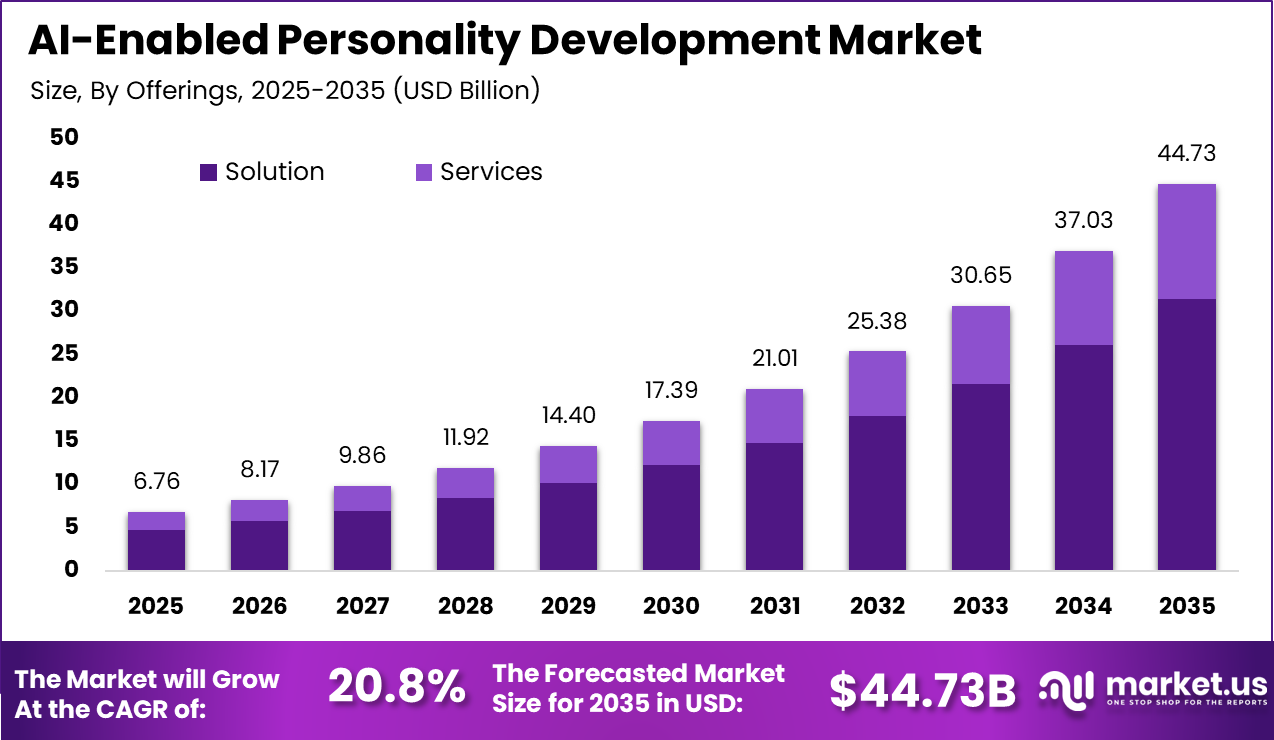
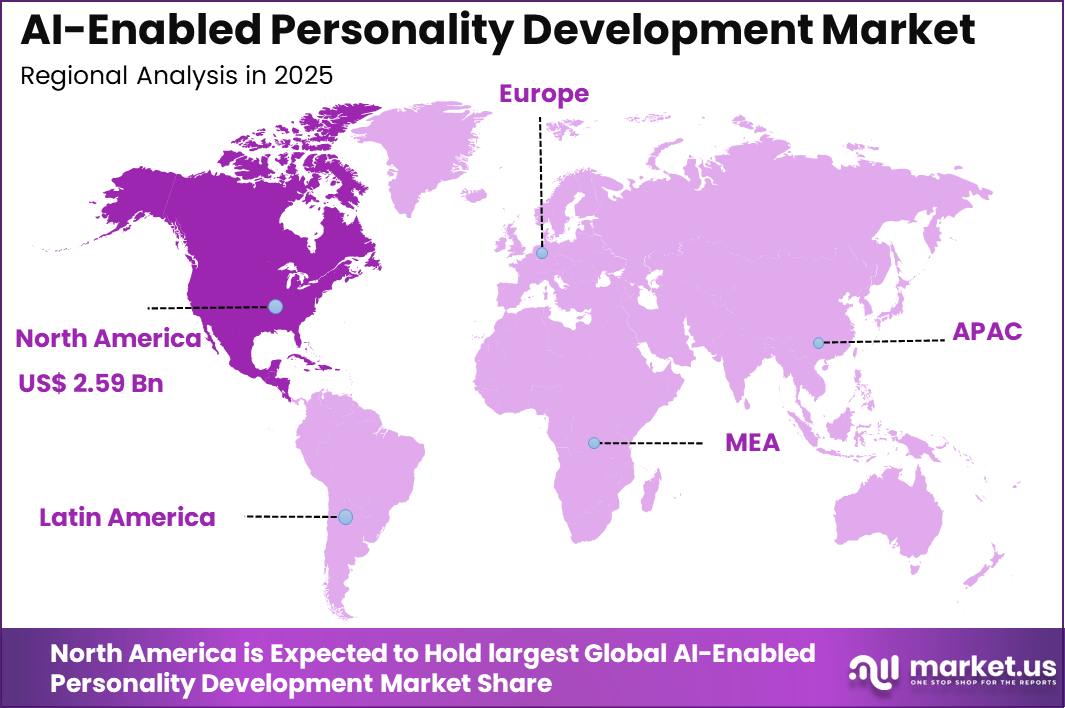
The Global AI-Enabled Personality Development Market size is expected to be worth around USD 44.73 billion by 2035, from USD 6.76 billion in 2025, growing at a CAGR of 20.8% during the forecast period from 2025 to 2035. North America held a dominant market position, capturing more than a 38.4% share, holding USD 2.59 billion in revenue.
The AI-enabled personality development market refers to digital platforms and applications that use artificial intelligence to improve soft skills, communication abilities, emotional intelligence, leadership traits, and personal behavior patterns. These systems analyze user interactions, learning progress, and behavioral signals to deliver personalized coaching, feedback, and development programs.
AI technologies such as natural language processing, behavioral analytics, and conversational interfaces enable users to receive continuous guidance tailored to their personality growth goals. The market is emerging from the convergence of digital learning, coaching platforms, and AI-based analytics. Traditional personality development programs rely heavily on classroom training or human coaching, which limits scalability and accessibility.
Businesses are increasingly investing in AI personalities to build trust faster with customers. Research shows that users spend nearly 40% more time interacting with friendly and relatable bots compared to neutral systems. And also indicate that AI systems can detect emotional intelligence traits with about 88% to 90% accuracy, while AI agents trained on interview data can replicate human personality responses in surveys with nearly 85% accuracy.
A major growth driver is the increasing demand for personalized self-development tools. Individuals and professionals seek tailored guidance that addresses specific behavioral patterns, communication styles, and career goals. AI-driven platforms analyze user data and deliver customized recommendations, learning activities, and coaching sessions that align with individual development paths.
For instance, in December 2025, Success Resources launched AI-enhanced virtual seminars featuring speakers like Tony Robbins with real-time translation and personalized action plans. The platform analyzes attendee responses for tailored follow-ups. This boosted engagement by 40% in personality development programs.
Key Takeaway
- In 2025, the Solution segment led the Global AI Enabled Personality Development Market, accounting for 70.4% of total share.
- In 2025, Motivation and Inspiration represented the leading application area, capturing 36.6% of the market.
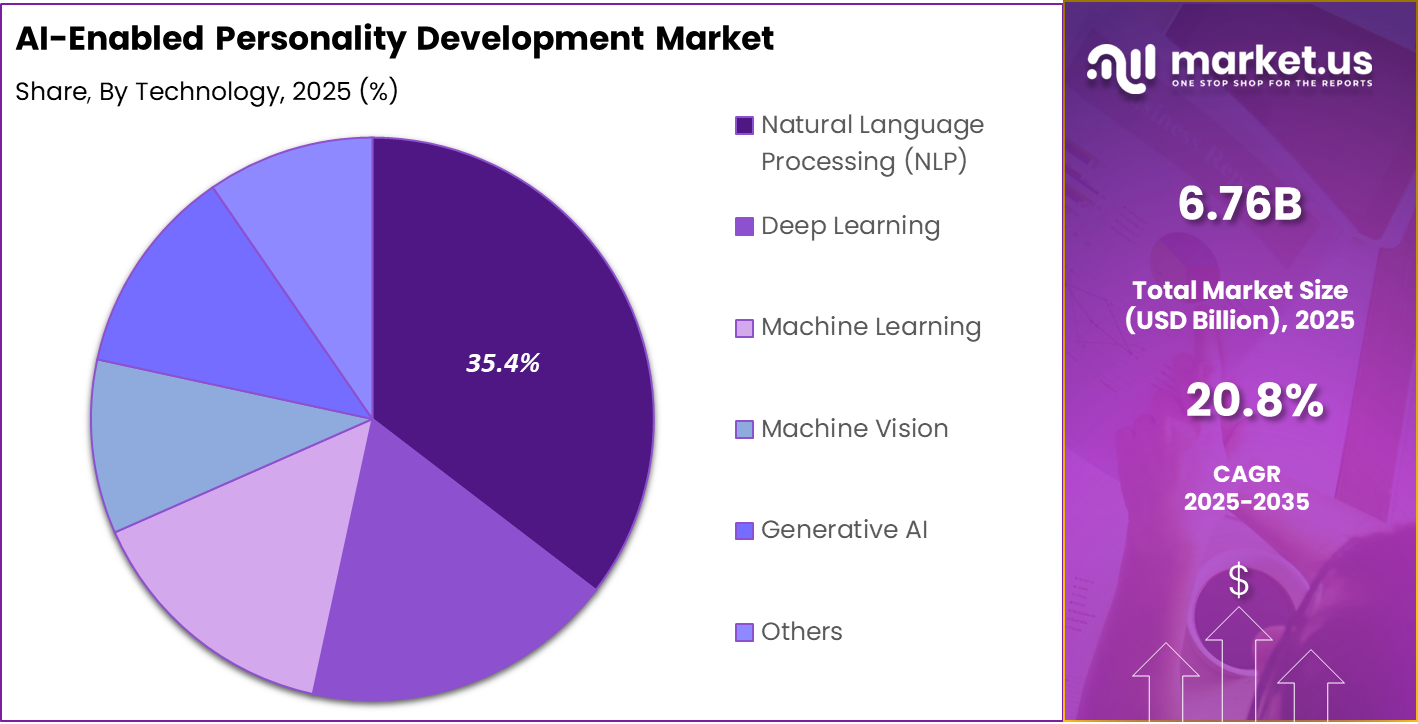
- In 2025, Natural Language Processing technology held a dominant 35.4% share within the technology segment.
- In 2025, Teamwork focused solutions contributed 38.8% of overall demand.
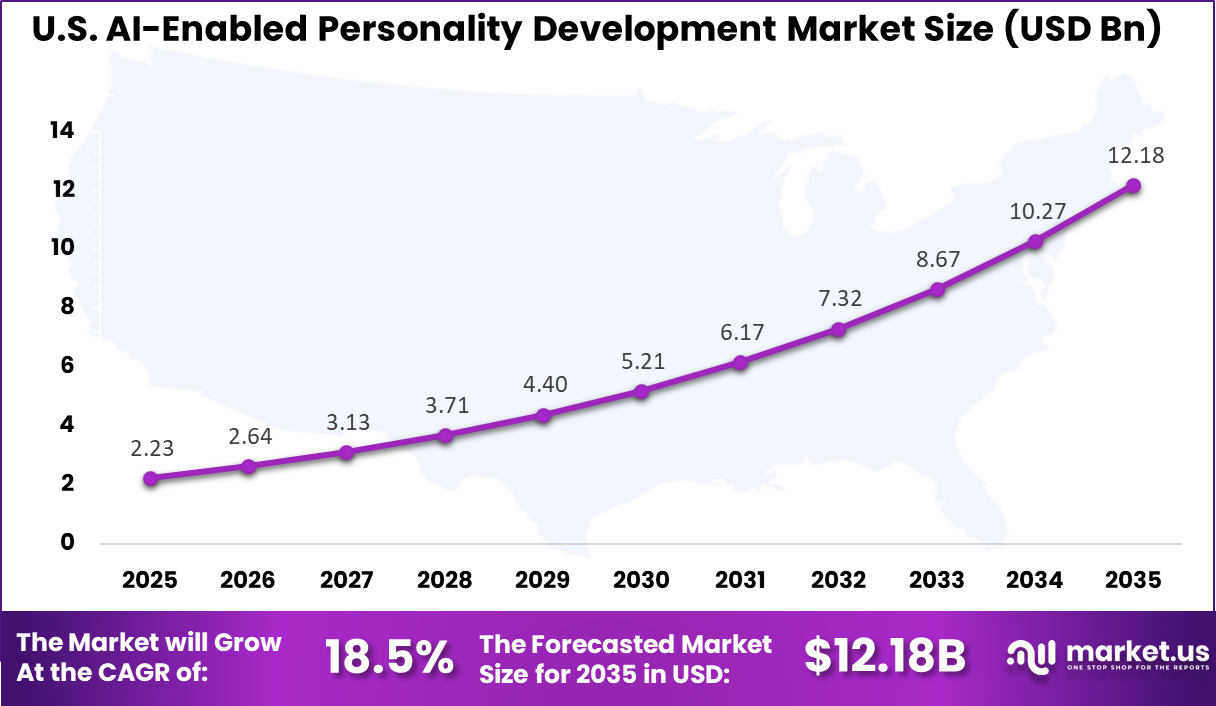
- In 2025, the U.S. market reached USD 2.23 billion and recorded a strong growth rate of 18.5%.
- In 2025, North America maintained regional leadership, securing more than 38.4% of the Global AI Enabled Personality Development Market.
Key Statistics
- Generative AI agents demonstrate 85% accuracy in replicating human survey responses and show an 80% correlation with Big Five personality assessments.
- In structured, multi round economic simulations, AI behavior aligns with human decision patterns at a 66% correlation rate.
- AI driven personality tools identify emotional intelligence traits with 88% to 90% accuracy, although they remain less precise in interpreting complex psychological nuances.
- Greater dependence on AI systems is statistically associated with reduced self concept clarity at -0.50, lower autonomy at -0.31, and increased Fear of Missing Out at 0.24.
- Public perception is divided, with 41% expressing support for AI applications and 22% indicating opposition, while younger and more educated groups show higher acceptance levels.
- More than 80% of individuals aged 18 to 25 report no experience using large language models, whereas 30.8% of those aged 61 and above use virtual assistants on a weekly basis.
By Offerings
Solutions account for 70.4% of the market, reflecting the strong preference for integrated digital platforms that combine coaching tools, behavioral analytics, and learning modules. These platforms are designed to assess personality traits, track individual progress, and provide structured guidance to users. Organizations and individual learners are increasingly adopting AI enabled solutions to support leadership training, career development, and personal productivity.
The dominance of solution platforms is also supported by their ability to deliver personalized feedback through data analysis. AI driven systems evaluate communication style, emotional responses, and engagement levels to recommend targeted improvement strategies. As professional development becomes more technology driven, solution based platforms continue to expand their influence within the market.
For Instance, in February 2026, Dale Carnegie & Associates, Inc. launched new AI-driven solution modules for personalized training paths. These tools adapt in real time to user habits, making growth feel natural and steady. Teams love how it tracks progress without extra effort, fitting right into daily routines for better results all around.
By Focus Area
Motivation and inspiration account for 36.6% of the market focus, highlighting the importance of psychological reinforcement in personality development programs. AI enabled platforms use behavioral data to deliver motivational content and goal tracking systems that encourage consistent improvement. Personalized prompts and progress monitoring help individuals maintain engagement with development programs.
These systems are widely used in educational institutions, corporate training environments, and self improvement applications. AI algorithms analyze user responses to determine the most effective motivational techniques for each individual. As digital learning environments expand, motivation centered personality development solutions are gaining stronger adoption.
For instance, in January 2026, Franklin Covey Co. rolled out an AI app focused on daily inspiration boosts tied to personal goals. It sends custom messages that lift spirits during low moments, helping users stay committed. This approach resonates because it feels like a personal cheerleader, keeping motivation alive in busy lives.
By Technology
Natural language processing represents 35.4% of technology adoption within the market. NLP enables AI systems to interpret user input, evaluate communication patterns, and provide conversational feedback. Through chat based interactions, users can receive guidance on language clarity, emotional expression, and professional communication skills.
NLP technology also supports real time feedback during simulated conversations and coaching sessions. By analyzing linguistic structures and sentiment patterns, AI systems help users improve interpersonal communication and confidence. As conversational AI becomes more sophisticated, NLP continues to play a central role in digital personality development platforms.
For Instance, in March 2026, Skillsoft Corporation enhanced its NLP tech for smoother coaching chats that read user tones accurately. The update makes conversations flow like real talks, offering spot-on advice without feeling robotic. Users stick with it for the genuine feedback that builds confidence step by step.
By Skillset Enhancement Sub Type
Teamwork skill development accounts for 38.8% of skill enhancement applications in the market. Organizations increasingly emphasize collaboration and communication skills within professional environments. AI driven training tools analyze group interactions and provide insights that help individuals improve coordination and collaborative decision making.
Interactive simulations and role based learning modules are commonly used to strengthen teamwork capabilities. AI platforms evaluate participant engagement and behavioral patterns during these exercises to identify improvement areas. As modern workplaces rely heavily on cross functional collaboration, teamwork focused personality development programs continue to gain traction.
For Instance, in February 2026, Toastmasters International introduced AI teamwork simulators for virtual group practice sessions. These scenarios help spot collaboration gaps and suggest fixes on the fly, strengthening bonds fast. It’s gaining traction as pros seek quick ways to improve group dynamics in hybrid setups.
By Region
North America holds 38.4% of the market share due to strong adoption of digital learning technologies and corporate training programs. Organizations in the region actively invest in AI powered coaching platforms to enhance employee performance and leadership capabilities. The presence of advanced technology infrastructure and widespread digital education initiatives has supported regional growth.
For instance, in February 2026, Toastmasters launched an AI speech analysis companion app that provides personalized feedback on delivery style and emotional intelligence. This positions North America as the epicenter of AI-driven public speaking training, expanding Toastmasters’ global reach through intelligent personality development tools.
Within North America, the United States contributes USD 2.23 billion with a growth rate of 18.5%. High awareness of professional development tools and widespread integration of AI based learning applications have strengthened national adoption. Continued expansion of remote learning and digital coaching platforms is expected to sustain demand for AI enabled personality development solutions.
For instance, in February 2026, Nutrisystem expanded into holistic wellness with AI personality profiling for customized nutrition and mindset coaching programs. This move highlights North America’s forefront position, merging behavioral science with AI to drive comprehensive lifestyle transformation and sustained behavior change.
Top Emerging Trends
One emerging trend is the development of AI conversational coaches that simulate human-like mentoring experiences. These systems use dialogue interfaces to deliver daily advice, behavioral insights, and reflective exercises that support continuous self-improvement. Some self-help experts are even launching AI chatbots that replicate their coaching style, enabling users to access guidance at any time.
Another trend involves immersive training simulations that allow users to practice communication and leadership skills in realistic scenarios. AI-driven role-play environments enable individuals to test responses to workplace situations and receive instant feedback on performance. Such simulations help strengthen interpersonal competencies and confidence.
Growth Factors
The rapid expansion of digital communication platforms through mobile apps is a key growth factor. As businesses rely more on chatbots and virtual assistants, the need for engaging and trustworthy AI personalities continues to increase across industries such as retail, healthcare, and education. Nearly 60% of users begin using AI personality tools because they fit naturally into daily phone routines.
Rising user expectations also drive growth in this field. People now prefer interactive systems that understand context and emotion. Companies recognize that personality driven AI improves customer satisfaction, strengthens loyalty, and encourages repeated platform usage, supporting long term digital engagement strategies.
Customer Impact: Trends and Disruptors
For individual users, AI-enabled personality development platforms provide accessible and affordable coaching support. Instead of scheduling limited sessions with human mentors, users can receive continuous guidance, feedback, and habit-building exercises through digital interfaces. This accessibility expands participation in personal growth activities.
For organizations, AI-based development tools enable scalable workforce training. Companies can deploy AI coaching systems to support leadership development, communication training, and team performance improvement across large employee populations. By combining behavioral insights with personalized learning pathways, organizations gain structured methods to cultivate professional competencies and improve workplace collaboration.
Key Market Segments
By Offerings
- Solution
- Personalised Learning and Skill Enhancement
- Behavioural Insights and Goal Setting
- Emotional and Mental Health Support
- Time Management and Productivity
- Others
- Services
- Professional Services
- Managed Services
By Focus Area
- Mental Health
- Motivation & Inspiration
- Physical Health
- Self-Awareness
- Skillset Enhancement
- Others
By Technology
- Natural Language Processing (NLP)
- Deep Learning
- Machine Learning
- Machine Vision
- Generative AI
- Others
By Skillset Enhancement Sub Type
- Communication
- Teamwork
- Decision Making
- Analytical and Problem Solving
- Empowerment
- Others
Key Regions and Countries
North America
- US
- Canada
Europe
- Germany
- France
- The UK
- Spain
- Italy
- Russia
- Netherlands
- Rest of Europe
Asia Pacific
- China
- Japan
- South Korea
- India
- Australia
- Singapore
- Thailand
- Vietnam
- Rest of APAC
Latin America
- Brazil
- Mexico
- Rest of Latin America
Middle East & Africa
- South Africa
- Saudi Arabia
- UAE
- Rest of MEA
Drivers
Rising Demand for Personalized Self-Improvement
A major driver of the AI-enabled personality development market is the increasing demand for personalized learning experiences. Traditional personal development programs often follow standardized structures that do not account for individual personality traits or skill gaps. AI systems evaluate behavioral inputs, engagement levels, and learning outcomes to tailor development pathways for each user. This personalized approach improves engagement and enables individuals to develop soft skills more effectively.
Another driver is the growing emphasis on continuous professional development in workplaces and educational environments. Organizations are adopting AI-driven learning platforms to identify skill gaps and recommend targeted training programs for employees. These systems use predictive analytics to align learning objectives with career development goals, which improves workforce capability and productivity.
For instance, in November 2025, Dale Carnegie rolled out their Human by Design program, blending classic training with AI tools to make leadership chats feel warm and real. Leaders now practice responses that mimic everyday talks, helping teams connect better in hybrid setups. This move taps right into folks wanting tech that acts like a trusted colleague, not a cold machine.
Restraint
Ethical Concerns and Data Privacy Issues
One restraint in this market involves ethical and privacy considerations. AI-enabled personality development platforms collect behavioral data, communication patterns, and performance metrics to personalize coaching experiences. Managing this sensitive information requires strong governance frameworks to protect user privacy and prevent misuse of personal insights.
Another restraint relates to the risk of overreliance on automated coaching systems. While AI can provide useful guidance and feedback, personal development often requires human mentorship and emotional understanding. Experts emphasize that AI tools should complement human interaction rather than replace it entirely to ensure balanced development outcomes.
For instance, in February 2026, Franklin Covey paused a new app feature that tracked user habits for custom habit plans, after feedback on data sharing worries. People liked the personalization but feared that daily logs could leak personal goals. The company now focuses on local storage to ease those valid fears and rebuild trust step by step.
Opportunities
AI Coaching and Behavioral Analytics
A significant opportunity exists in the development of AI-powered coaching assistants that provide real-time feedback and motivational support. Intelligent systems can monitor progress, recommend daily goals, and track habit formation to encourage consistent improvement. Such digital coaching environments allow individuals to develop communication, leadership, and emotional skills through continuous interaction and guidance.
Another opportunity lies in integrating personality analytics with immersive learning simulations. AI-based role-play platforms can create realistic scenarios where users practise negotiation, teamwork, and problem-solving skills. Interactive simulations help individuals refine soft skills and receive immediate feedback, improving learning retention and confidence.
For instance, in January 2026, Hay House teamed up with wellness apps to add AI-guided meditation scripts tailored to users’ moods from journal entries. This fits neatly into daily self-care routines, helping readers find calm through voices that adapt like a personal guide. It opens fresh paths for emotional growth in digital spaces.
Challenges
Algorithm Bias and Personalization Accuracy
A key challenge in the market is ensuring fairness and accuracy in AI-driven personality assessments. Machine learning models rely on training datasets that may contain biases, which can influence recommendations or behavioral analysis outcomes. Organizations must implement transparent algorithms and validation processes to maintain fairness and reliability in development programs.
Another challenge involves maintaining the balance between personalization and ethical boundaries. Systems designed to analyze personality traits and emotional patterns must operate responsibly to avoid intrusive monitoring or psychological manipulation. Clear guidelines and governance frameworks are necessary to ensure that AI tools support well-being while respecting user autonomy.
For instance, in April 2025, OpenSesame updated its training platform after spotting AI recommendations favoring certain leadership traits from limited data sets. Workers from varied backgrounds got mismatched modules, shaking trust. The fix involves wider feedback loops to cut biases and make suggestions fairer for all.
Key Players Analysis
The AI Enabled Personality Development Market includes established training organizations that provide structured learning programs for leadership, communication, and personal growth. Dale Carnegie & Associates, Inc., Franklin Covey Co., and Landmark Worldwide Enterprises Inc. are widely recognized for professional development frameworks used by corporate clients. Their programs increasingly integrate AI driven learning platforms and personalized coaching tools.
Digital learning and content platforms are expanding the use of AI in self development and skill enhancement programs. Skillsoft Corporation, OpenSesame Inc., and SkillPath offer large libraries of online training modules supported by adaptive learning technologies. Their platforms analyze learner progress and recommend customized courses based on performance data.
Community based training networks and personal growth organizations further contribute to market expansion. Toastmasters International, Success Resources America Pty Ltd, and Hay House Publishing focus on motivation, communication, and confidence building programs. These institutions are gradually adopting AI powered coaching tools, virtual mentors, and digital assessment platforms.
Top Key Players in the Market
- Dale Carnegie & Associates, Inc.
- Franklin Covey Co.
- Hay House Publishing
- Landmark Worldwide Enterprises Inc.
- Nutrisystem, Inc.
- OpenSesame Inc.
- SkillPath
- Skillsoft Corporation
- Success Resources America Pty Ltd
- Toastmasters International
- Others
Recent Developments
- In March 2025, FranklinCovey launched the FranklinCovey AI Coach, a virtual mentor integrated into its learning platform. It offers personalized feedback, simulated scenarios, and quick skill tips for leadership growth. Thousands of users adopted it within a week, proving its value in making personality development more accessible and interactive.
- In November 2025, Nutrisystem introduced AI-driven mindset coaching alongside their weight management plans, focusing on confidence and habit formation. The app uses personality assessments to deliver customized motivational content. Early users saw 25% better adherence rates, bridging wellness with behavioral change.
Report Scope
Report Features Description Market Value (2025) USD 6.7 Bn Forecast Revenue (2035) USD 44.7 Bn CAGR (2026-2035) 20.8% Base Year for Estimation 2025 Historic Period 2020-2024 Forecast Period 2026-2035 Report Coverage Revenue forecast, AI impact on Market trends, Share Insights, Company ranking, competitive landscape, Recent Developments, Market Dynamics and Emerging Trends Segments Covered By Offerings (Solution, Services), By Focus Area (Mental Health, Motivation & Inspiration, Physical Health, Self-Awareness, Skillset Enhancement, Others), By Technology (Deep Learning, Machine Learning, Natural Language Processing (NLP), Machine Vision, Generative AI, Others), By Skillset Enhancement Sub Type (Communication, Teamwork, Decision Making, Analytical and Problem Solving, Empowerment, Others) Regional Analysis North America – US, Canada; Europe – Germany, France, The UK, Spain, Italy, Russia, Netherlands, Rest of Europe; Asia Pacific – China, Japan, South Korea, India, New Zealand, Singapore, Thailand, Vietnam, Rest of Latin America; Latin America – Brazil, Mexico, Rest of Latin America; Middle East & Africa – South Africa, Saudi Arabia, UAE, Rest of MEA Competitive Landscape Dale Carnegie & Associates, Inc., Franklin Covey Co., Hay House Publishing, Landmark Worldwide Enterprises Inc., Nutrisystem, Inc., OpenSesame Inc., SkillPath, Skillsoft Corporation, Success Resources America Pty Ltd, Toastmasters International, Others Customization Scope Customization for segments, region/country-level will be provided. Moreover, additional customization can be done based on the requirements. Purchase Options We have three license to opt for: Single User License, Multi-User License (Up to 5 Users), Corporate Use License (Unlimited User and Printable PDF)  AI-Enabled Personality Development MarketPublished date: March 2026add_shopping_cartBuy Now get_appDownload Sample
 -
-
- Dale Carnegie & Associates, Inc.
- Franklin Covey Co.
- Hay House Publishing
- Landmark Worldwide Enterprises Inc.
- Nutrisystem, Inc.
- OpenSesame Inc.
- SkillPath
- Skillsoft Corporation
- Success Resources America Pty Ltd
- Toastmasters International
- Others
Our Clients

- 180061
- March 2026