Quick Navigation
Report Overview
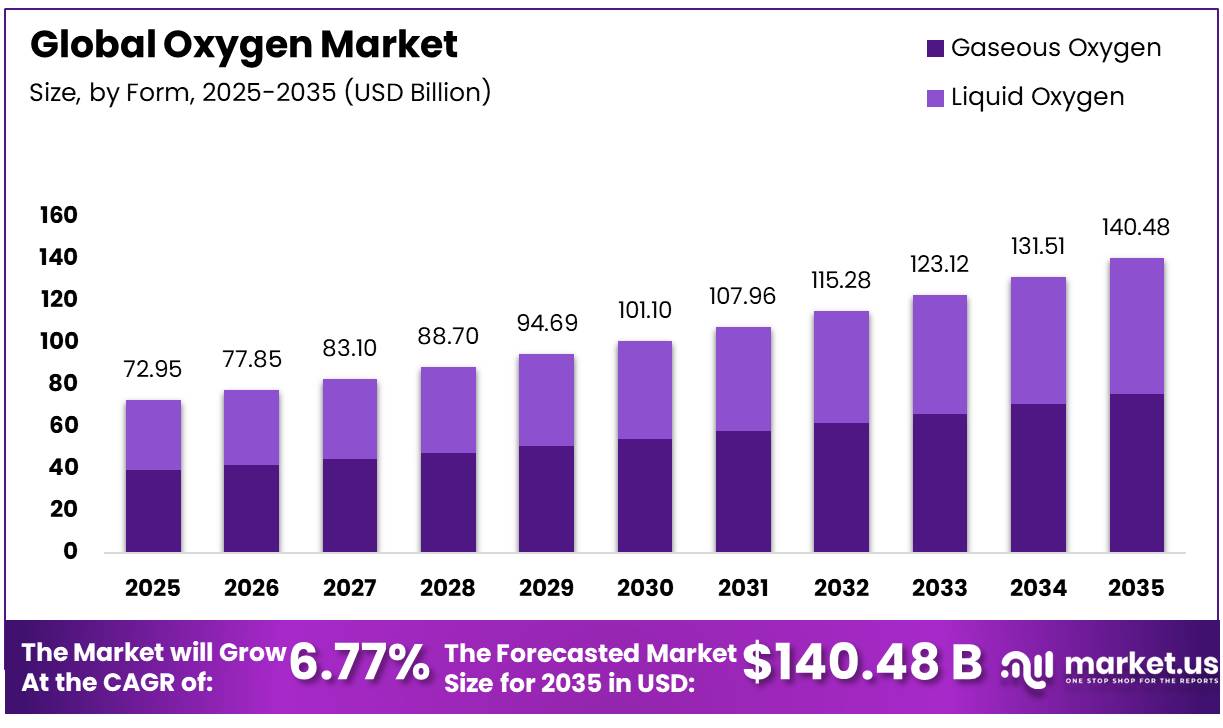
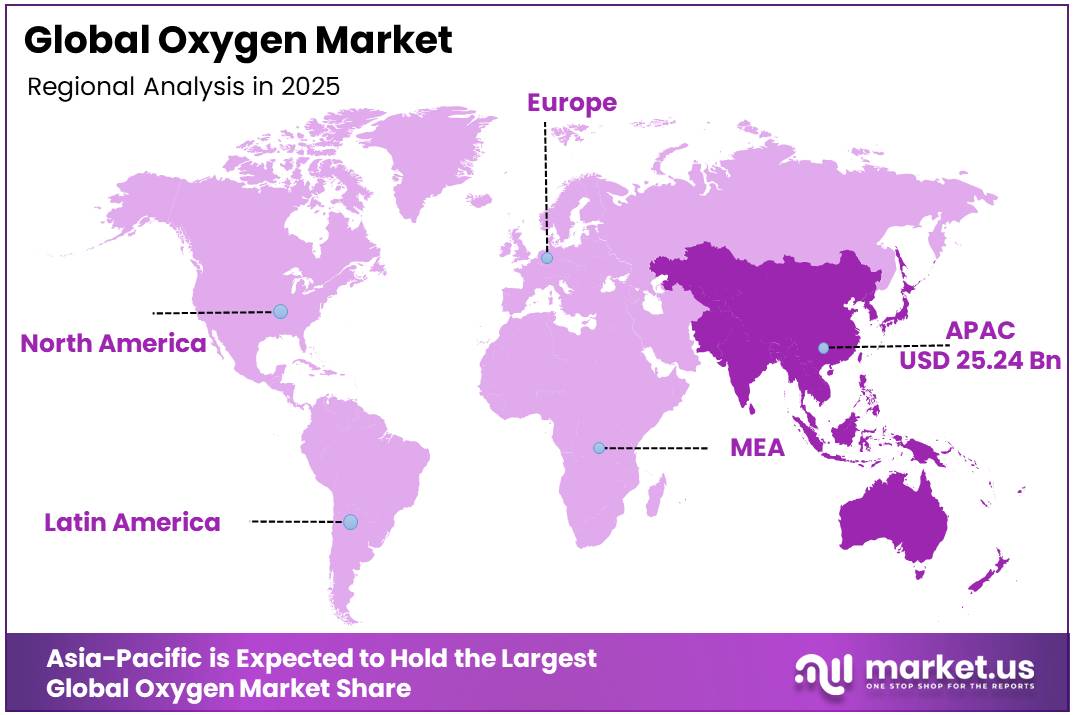
In 2025, the Global Oxygen Market was valued at US$72.95 billion, and between 2026 and 2035, this market is estimated to register a CAGR of 6.77%, reaching about US$140.48 billion by 2035. In 2025, Asia Pacific led the market, achieving over 34.60% share with a revenue of US$25.24 billion.
Key Takeaways
- The Global Oxygen Market was valued at US$72.95 billion in 2025.
- The market is projected to grow at a CAGR of 6.77% and is estimated to reach US$140.48 billion by 2035.
- Gaseous Oxygen held a 53.80% share in the form segment, driven by its widespread industrial use.
- 995% Purity accounted for a 36.18% share in the purity level segment, supported by demand for specialty medical applications.
- On-Site Generation captured a 43.74% share in the supply mode segment, driven by reliable supply for industrial users.
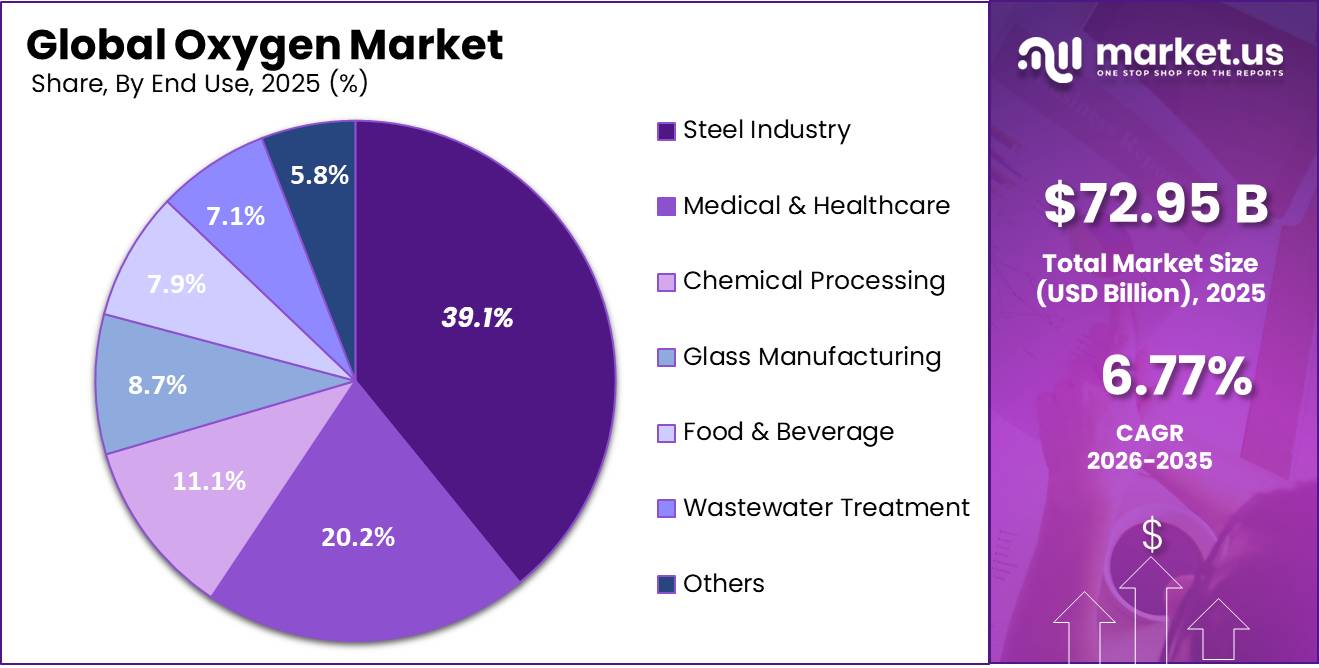
- Steel Industry held a 39.13% share in the end-use segment, driven by its critical role in steel production.
- Asia Pacific held a 34.60% share in the regional landscape, supported by strong steel production and expanding healthcare infrastructure.
Oxygen is a high-purity industrial gas used as an oxidizing and process-support medium across steelmaking, chemical production, refining, glass manufacturing, non-ferrous metals, wastewater treatment, healthcare and advanced manufacturing. According to NASA Earth Observatory (Updated 2024), oxygen constitutes approximately 20.95% of Earth’s atmosphere by volume, making it the second most abundant gas after nitrogen.
Large consumers generally receive oxygen from cryogenic air-separation units through dedicated pipelines, while smaller facilities use liquid tankers, compressed cylinders or pressure-swing adsorption systems. This supply structure makes the industry capital-intensive and closely dependent on electricity prices, long-term contracts and plant utilization. The current industrial scenario remains strongly supported by metals and heavy processing. The World Steel Association reported that global crude steel production reached 1,849.4 million tonnes in 2025. Its industry data also show that the basic oxygen furnace route represented 70.4% of global steel production, while electric-arc furnaces can use injected oxygen to improve melting efficiency.
Steel producers therefore remain among the largest continuous consumers of tonnage oxygen. The wider industrial-gases industry is also well established. Growth is being driven by steel output, battery-material manufacturing, chemical processing, healthcare requirements and the replacement of older air-separation equipment with more efficient units. The U.S. Department of Energy’s fiscal 2026 funding request included USD 50 million for point-source carbon-capture activities covering oxy-combustion and related technologies. Suppliers with long-term agreements with steel, chemical, semiconductor, healthcare and clean-energy customers are therefore positioned to capture the strongest future opportunities.
Form Analysis
Gaseous Oxygen dominates with a 53.80% share, supported by continuous industrial consumption.
In 2025, Gaseous Oxygen held a dominant market position, capturing more than a 53.80% share. Its leadership was supported by continuous demand from steel plants, refineries, chemical facilities, metal-fabrication units and wastewater-treatment operations. Large industrial users generally consume oxygen through on-site generation systems or pipelines, as the gaseous form can be supplied directly into furnaces, reactors and oxidation processes without separate storage conversion. The high and continuous consumption levels strengthen the commercial position of gaseous oxygen, particularly at large integrated industrial sites.
- The U.S. Energy Information Administration’s 2025 industrial model also identifies oxygen as a major steelmaking input, with blast furnace/basic oxygen furnace technologies requiring approximately 145 to 154 metric tons of oxygen per 1,000 metric tons of steel.
Liquid Oxygen is the fastest-growing segment. Its growth is supported by rising requirements from hospitals, metal-processing facilities, remote industrial locations and customers without access to dedicated oxygen pipelines. Liquid oxygen provides a practical way to transport and store large quantities before converting the product back into gas at the point of use. This makes it suitable for facilities with changing consumption patterns or limited space for on-site oxygen-generation equipment.
Purity Level Analysis
99.995% Purity dominates the Oxygen Market with a 38.18% share due to its strong demand in healthcare and high-precision industries
In 2025, 99.995% Purity held a dominant market position, capturing more than a 38.18% share of the global oxygen market. The segment maintained its leading position because it meets the stringent purity requirements of hospitals, pharmaceutical manufacturing, electronics production, and laboratory applications. High-purity oxygen is widely used in medical treatments, semiconductor fabrication, and specialty manufacturing processes where even small impurities can affect product quality and operational safety. Its consistent quality, regulatory compliance, and suitability for critical applications helped this segment remain the largest by purity level.
99.9% Purity is the fastest-growing segment in the oxygen market in 2025 as industries increasingly seek a balance between performance and operating cost. This purity level is widely used in metal fabrication, welding, glass production, chemical manufacturing, wastewater treatment, and general industrial processes where ultra-high purity is not essential. Rising investments in manufacturing capacity, infrastructure projects, and industrial gas distribution networks have accelerated the adoption of 99.9% purity oxygen. Its lower production cost compared to ultra-high-purity grades and its suitability for large-scale industrial applications are expected to support continued growth during the forecast period.
Supply Mode Analysis
On-Site Generation leads the Oxygen Market with a 43.74% share due to its reliable and cost-efficient oxygen supply
In 2025, On-Site Generation held a dominant market position, capturing more than a 43.74% share of the global oxygen market by supply mode. The segment remained the preferred choice for industries that require a continuous and uninterrupted oxygen supply, including steel manufacturing, healthcare, wastewater treatment, glass production, and chemical processing. On-site oxygen generation eliminates the need for frequent cylinder deliveries, lowers transportation costs, and improves supply reliability. Large manufacturing facilities and hospitals increasingly installed on-site oxygen generation units to improve operational efficiency and reduce dependence on external logistics, helping the segment maintain its leading position.
Cylinder Supply is the fastest-growing segment in the oxygen market in 2025 because it provides a flexible and convenient oxygen source for hospitals, clinics, laboratories, emergency medical services, and small-scale industries. The segment is expanding as healthcare infrastructure grows in developing regions and emergency preparedness programs continue to increase oxygen storage capacity. Cylinder supply requires lower initial investment than on-site generation and is suitable for facilities with lower or variable oxygen consumption. Rising demand from rural healthcare centers, construction activities, welding operations, and mobile medical applications is expected to support the segment’s growth throughout the forecast period.
End Use Analysis
Steel Industry dominates the Oxygen Market with a 39.13% share driven by high oxygen consumption in steel production
In 2025, the Steel Industry held a dominant market position, capturing more than a 39.13% share of the global oxygen market by end use. The segment maintained its leadership because oxygen is an essential input in basic oxygen furnace (BOF) steelmaking, electric arc furnace operations, continuous casting, and secondary metallurgy. High-purity oxygen improves combustion efficiency, reduces impurities, shortens production cycles, and lowers fuel consumption during steel manufacturing. Continued infrastructure development, construction activities, automotive production, and industrial expansion supported stable steel output in 2025, resulting in sustained demand for industrial oxygen. The widespread use of oxygen across integrated steel plants and metal processing facilities helped the steel industry remain the largest end-use segment.
Medical & Healthcare is the fastest-growing segment in the oxygen market in 2025 as healthcare systems continue to expand their oxygen supply capacity for hospitals, emergency care, surgical procedures, intensive care units, and home healthcare services. Increasing investments in healthcare infrastructure, ageing populations, and the growing prevalence of respiratory diseases are driving demand for medical oxygen worldwide. The expansion of hospital facilities, oxygen pipeline systems, and home oxygen therapy services is further supporting market growth. In addition, governments continue to strengthen emergency medical preparedness, creating sustained demand for reliable oxygen supply across healthcare facilities during the forecast period.
Key Market Segments
By Form
- Gaseous Oxygen
- Liquid Oxygen
By Purity Level
- 9% Purity
- 99% Purity
- 995% Purity
- 999% Purity
By Supply Mode
- On-Site Generation
- Cylinder Supply
- Bulk Liquid Supply
By End Use
- Steel Industry
- Medical & Healthcare
- Chemical Processing
- Glass Manufacturing
- Food & Beverage
- Wastewater Treatment
- Others
Driver Analysis
Medical oxygen resilience and hospital self-generation
Medical oxygen demand is no longer treated only as emergency surge capacity; it has become a permanent health-system resilience category after large public investments in onsite generation and cylinder logistics. In India alone, the Prime Minister’s Office stated that 1,224 PSA oxygen plants were funded under PM CARES and more than 1,100 had already been commissioned, together providing over 1,750 metric tons per day of oxygen output, while an earlier PM CARES tranche allocated Rs.201.58 crore for 162 dedicated plants with 154.19 MT combined capacity.
This changes the business model for suppliers from episodic bulk-liquid delivery toward hybrid service contracts covering onsite PSA systems, maintenance, backup cylinders, telemetry, and purity assurance, and the growth effect is strongest in India, South Asia, Africa, and other underpenetrated care systems where the 2025 oxygen-access agenda increasingly links oxygen and pulse oximetry to routine newborn, emergency, and universal health coverage pathways.
Driver Impact Analysis
| Driver | (~) % Impact on CAGR Forecast | Geographic Relevance | Impact Timeline |
|---|---|---|---|
| Steel oxygen intensity in BF-BOF fleets | +1.6% | China core, India core, ASEAN, MENA spill-over, North America residual | Medium term (2-4 years) |
| Medical oxygen resilience and hospital self-generation | +1.2% | India, Sub-Saharan Africa, South Asia, Latin America, selective North America rural | Short term (≤ 2 years) |
| Hydrogen electrolysis creating merchant oxygen optionality | +1.0% | EU core, Nordics, Iberia, North America hubs, Middle East projects | Medium term (2-4 years) |
| Water and wastewater aeration / ozonation upgrades | +0.8% | North America municipal, EU compliance markets, Gulf desalination corridors, APAC urban belts | Medium term (2-4 years) |
| Chemical oxidation and sulfuric-acid linked oxygen pull | +0.7% | North America, China, India, Chile-Peru mining belt, Middle East chemicals | Short term (≤ 2 years) |
| Supply security via onsite PSA and distributed ASU investments | +0.9% | India core, Southeast Asia, Africa, remote healthcare/mining clusters globally | Short term (≤ 2 years) |
Restraint Analysis
Power cost intensity
Electricity remains the single largest controllable operating cost in cryogenic air separation, so even when oxygen demand is structurally intact, margin capture weakens when industrial power tariffs stay elevated or volatile; Eurostat reported non-household electricity prices in the EU at €0.2075/kWh in H1 2025 and €0.2059/kWh in H2 2025, while U.S. EIA data showed average U.S. industrial electricity prices around 8.66 cents/kWh in the 2026 monthly update, creating a persistent regional cost spread that can materially alter merchant oxygen competitiveness, especially for plants where power commonly drives roughly 35% to 55% of cash cost.
In practical terms, a 10% to 15% adverse move in industrial electricity cost can compress EBITDA margins by roughly 120 to 250 basis points for standalone or merchant-oriented oxygen assets, push contract repricing disputes into 1 to 3 quarter renegotiation windows, and delay final investment decisions on new ASUs by 6 to 12 months, which is why this restraint is modeled as a roughly 1.2 percentage-point drag on 2026-baselined CAGR in higher-cost grids.
Restraint Impact Analysis
| Restraint | (~) % Impact on CAGR Forecast | Geographic Relevance | Impact Timeline |
|---|---|---|---|
| Power cost intensity | -1.2% | EU, North America, Japan, Korea | Short term (≤ 2 years) |
| Medical CGMP compliance burden | -0.8% | North America core, EU, regulated APAC | Short term (≤ 2 years) |
| Cylinder logistics bottleneck | -0.7% | North America, India, ASEAN, Africa | Medium term (2-4 years) |
| Steel & equipment cost inflation | -0.9% | EU, North America, India, APAC corridors | Medium term (2-4 years) |
| Carbon-cost pass-through | -0.6% | EU core, UK-linked trade, export hubs | Medium term (2-4 years) |
| Merchant demand cyclicality | -1.0% | China, EU, North America, steel-heavy Asia | Short term (≤ 2 years) |
Opportunity Analysis
Green steel process retrofits
This is an opportunity rather than a current driver because conventional oxygen use in steel is already embedded in the baseline, but the upside comes from new retrofit architectures tied to decarbonization, higher oxygen intensity, and hybrid flowsheets linking direct reduced iron, EAF optimization, and high-temperature process integration. DOE explicitly identifies steel manufacturing as one of the new end markets that affordable clean hydrogen can unlock, and its electrolysis assessment notes that O-SOEC systems can thermally integrate with industrial processes such as steel production.
At the same time, EU public material on steel shows the continuing importance of blast furnace-basic oxygen furnace routes, meaning a large incumbent asset base still exists for oxygen-focused productivity upgrades and transitional decarbonization retrofits rather than only greenfield replacement. The white space is in premium oxygen supply solutions for staged decarbonization projects: higher-purity streams, flexible peak-flow systems, and bundled oxygen-plus-heat integration contracts that raise furnace productivity, reduce coke dependency at the margin, and support partial route conversion before full hydrogen economics are mature. If even 10-15% of BF-BOF and adjacent steel assets in Europe, India, and North America adopt higher-value oxygen-intensive retrofit programs, suppliers could see 15-25% revenue per site expansion versus standard tonnage contracts, implying an oxygen market CAGR uplift of about 2.1%.
Opportunity Impact Analysis
| Opportunity | (~) % Potential CAGR Upside | Geographic Relevance | Execution Window |
|---|---|---|---|
| Electrolyzer O2 monetization | +2.4% | North America core, EU, Gulf, APAC clean-hydrogen hubs | Short term (≤ 2 years) |
| On-site hospital service contracts | +1.6% | India, ASEAN, Africa, LATAM | Short term (≤ 2 years) |
| Wastewater oxygenation shift | +1.3% | EU, North America, developed APAC | Medium term (2-4 years) |
| Green steel process retrofits | +2.1% | EU, India, North America | Medium term (2-4 years) |
| Modular captive oxygen parks | +1.8% | APAC emerging markets, Middle East, Africa | Medium term (2-4 years) |
| Nuclear-linked high-purity O2 clusters | +1.1% | U.S., Canada, France, Korea, Japan | Long term (≥ 4 years) |
Challenges Analysis
Power Cost Volatility
Cryogenic oxygen production is structurally exposed to electricity because air separation is a continuous, power-intensive process, and the U.S. EIA’s industrial modeling framework explicitly identifies electricity use for oxygen production as a notable industrial input pathway, meaning oxygen suppliers cannot easily delink margin stability from grid price behavior. With U.S. final-demand producer prices rising 3.0% in 2025 and core producer-price pressure still elevated into 2026, oxygen contracts indexed imperfectly to energy costs face a recurring spread-risk problem in which 6% to 15% delivered-cost swings can emerge even when end-market volumes remain intact, particularly in merchant liquid oxygen networks where power, liquefaction, storage losses, and trucking are all cost-sensitive.
A reasonable 2026 friction estimate is a -1.2 percentage-point drag on maximum market CAGR because suppliers respond by widening bid spreads, prioritizing take-or-pay structures, and delaying marginal capacity additions in power-volatile regions; the required strategic response is more dynamic electricity hedging, co-location near lower-volatility industrial load centers, greater on-site PSA/VSA optimization where purity thresholds allow, and contract redesign that improves pass-through cadence without undermining customer retention.
Challenges Impact Analysis
| Challenge | (~) % CAGR Friction Drag | Geographic Relevance | Mitigation Horizon |
|---|---|---|---|
| Power Cost Volatility | -1.2% | North America core, EU power-cost markets, APAC import-dependent grids | Medium term (2-4 years) |
| ASU Reliability Aging | -0.9% | North America legacy clusters, EU industrial basins, Japan-Korea mature sites | Medium term (2-4 years) |
| Cryogenic Logistics Tightness | -1.0% | APAC logistics corridors, North America rural medical zones, Latin America secondary markets | Short term (≤ 2 years) |
| Skilled Operator Shortage | -0.8% | North America core, EU regulatory hubs, Middle East project ramps | Long term (≥ 4 years) |
| Medical Purity Compliance Burden | -0.7% | North America healthcare channels, EU hospital networks, APAC urban care systems | Medium term (2-4 years) |
| Site Decarbonization Pressure | -0.6% | EU regulatory hubs, North America ESG-sensitive buyers, East Asia export manufacturers | Long term (≥ 4 years) |
Geopolitical Impact Analysis
Geopolitical Tensions and Trade Disruptions Are Reshaping the Global Oxygen Market
The ongoing geopolitical conflicts, including the Russia–Ukraine war and continued instability across parts of the Middle East, have influenced the global oxygen market by affecting industrial production, energy prices, and cross-border supply chains. Oxygen itself is generally produced close to where it is consumed because transporting large volumes over long distances is expensive. However, the equipment used to produce, store, and distribute oxygen including air separation units, cryogenic tanks, cylinders, valves, and compressors depends on international supply networks. Delays in sourcing these components have increased project timelines and operating costs in several regions.
Higher electricity and natural gas prices, particularly in Europe during periods of supply uncertainty, have also raised the cost of oxygen production, as air separation is an energy-intensive process. Some industrial gas producers have adjusted production schedules to manage rising operating expenses. At the same time, governments have placed greater emphasis on strengthening domestic medical oxygen infrastructure to improve emergency preparedness and reduce dependence on imported equipment.
Despite these challenges, demand from steel manufacturing, healthcare, chemicals, and wastewater treatment has remained resilient. Many manufacturers are expanding on-site oxygen generation systems to improve supply security and reduce transportation risks. As geopolitical uncertainty continues through 2025 and 2026, companies are increasingly diversifying suppliers, investing in local production capacity, and building more resilient supply chains to ensure uninterrupted oxygen availability.
Regional Analysis
Asia-Pacific led the Oxygen Market with a 34.60% share, valued at USD 72.95 Billion, supported by rapid industrial expansion and growing healthcare demand
In 2025, Asia-Pacific held a dominant market position, accounting for 34.60% of the global oxygen market and reaching a value of USD 25.24 billion. The region maintained its leadership due to its large steel manufacturing base, expanding chemical industry, and growing healthcare infrastructure across China, India, Japan, and South Korea. China remained the world’s largest steel producer, with the World Steel Association reporting that the country produced approximately 1.01 billion metric tons of crude steel in 2025, representing more than half of global steel output. Since oxygen is a critical input in basic oxygen furnace steelmaking, this significantly supported regional demand. According to the Asian Development Bank (ADB), developing Asia is projected to grow by 4.9% in 2025, reflecting sustained industrial activity that supports demand for industrial gases. In addition, government investments in healthcare infrastructure and medical oxygen systems following the pandemic have strengthened long-term demand across the region. The presence of major manufacturing hubs, improving industrial automation, and expanding wastewater treatment projects further reinforced Asia-Pacific’s leading position in the global oxygen market.
North America is expected to register the fastest growth during the forecast period, driven by rising investments in healthcare modernization, clean manufacturing, semiconductor production, and industrial automation. The United States continues to expand domestic manufacturing through supportive industrial policies, increasing the demand for high-purity oxygen across electronics, aerospace, chemicals, and metal fabrication. Growing adoption of on-site oxygen generation systems, combined with investments in advanced manufacturing and healthcare infrastructure, is expected to accelerate regional market growth.
Key Regions and Countries Covered
- North America
- The US
- Canada
- Europe
- Germany
- France
- The UK
- Spain
- Italy
- Russia & CIS
- Rest of Europe
- APAC
- China
- Japan
- South Korea
- India
- ASEAN
- Rest of APAC
- Latin America
- Brazil
- Mexico
- Rest of Latin America
- Middle East & Africa
- GCC
- South Africa
- Rest of MEA
Key Players Analysis
The global oxygen market exhibits a moderately consolidated competitive structure, with a handful of multinational industrial gas companies accounting for a significant share of global revenue, while numerous regional producers and local gas distributors serve country-specific and niche markets. Air Products reported USD 12.0 billion in fiscal 2025 sales, operating 750-plus production facilities across nearly 50 countries and serving 250,000 customers. Its oxygen capabilities span cryogenic plants, onsite generation, pipeline networks, bulk systems, and medical and industrial supply globally.
Messer generated EUR 4.5 billion in 2025 revenue and EUR 1.4 billion in EBITDA, maintaining a 31% margin. It invested EUR 747 million in production facilities and infrastructure, strengthening oxygen availability for healthcare, electronics, metals, food, and environmental applications worldwide. Taiyo Nippon Sanso operates within Nippon Sanso Holdings, whose fiscal 2025 revenue reached JPY 1.308 trillion and core operating income totaled JPY 189.149 billion. Its oxygen position benefits from air-separation gas operations, electronics demand, industrial projects, and Japanese distribution capabilities.
The Major Players in The Industry
- Linde plc
- Air Liquide S.A.
- Air Products and Chemicals, Inc.
- Messer Group GmbH
- Taiyo Nippon Sanso Corporation
- Matheson Tri-Gas Inc.
- Gulf Cryo
- SOL S.p.A.
- Air Water Inc.
- Showa Denko K.K.
- Ellenbarrie Industrial Gases Ltd.
- Other Key Players
Key Development
- In April 2026, Air Liquide signed a long-term agreement with HYUNDAI-POSCO Louisiana LLC to supply oxygen, nitrogen and argon to a low-carbon steel facility. It committed over US$350 million to build an additional air separation unit and expand pipeline infrastructure, with gas deliveries planned from 2028.
- In April 2026, Linde plc announced an investment of more than USD 75 million to build, own and operate a new air separation unit in Garysburg, North Carolina. The facility will produce liquid oxygen, nitrogen and argon for regional customers across healthcare, electronics, chemicals and food processing.
Report Scope
| Report Features | Description |
|---|---|
| Market Value (2025) | US$72.95 Bn |
| Forecast Revenue (2035) | US$140.48 Bn |
| CAGR (2026-2035) | 6.77% |
| Base Year for Estimation | 2025 |
| Historic Period | 2020-2024 |
| Forecast Period | 2026-2035 |
| Report Coverage | Revenue Forecast, Market Dynamics, Competitive Landscape, Recent Developments |
| Segments Covered | By Form (Gaseous Oxygen and Liquid Oxygen), By Purity Level (99.9% Purity, 99.99% Purity, 99.995% Purity, and 99.999% Purity), By Supply Mode (On-Site Generation, Cylinder Supply, and Bulk Liquid Supply), By End Use (Steel Industry, Medical & Healthcare, Chemical Processing, Glass Manufacturing, Food & Beverage, Wastewater Treatment, and Others) |
| Regional Analysis | North America – The US & Canada; Europe – Germany, France, The UK, Spain, Italy, Russia & CIS, Rest of Europe; APAC– China, Japan, South Korea, India, ASEAN & Rest of APAC; Latin America– Brazil, Mexico & Rest of Latin America; Middle East & Africa– GCC, South Africa, & Rest of MEA |
| Competitive Landscape | Linde plc, Air Liquide S.A., Air Products and Chemicals, Inc., Messer Group GmbH, Taiyo Nippon Sanso Corporation, Matheson Tri-Gas Inc., Gulf Cryo, SOL S.p.A., Air Water Inc., Showa Denko K.K., Ellenbarrie Industrial Gases Ltd., and other key players. |
| Customization Scope | Customization for segments, region/country-level will be provided. Moreover, additional customization can be done based on the requirements. |
| Purchase Options | We have three licenses to opt for: Single User License, Multi-User License (Up to 5 Users), Corporate Use License (Unlimited Users and Printable PDF) |
Frequently Asked Questions (FAQ)
INOX-Air Products Inc., Messer North America, Inc, Bhuruka Gases Limited, Air Products Inc., Gulf Cryo, Matheson Tri-Gas, Inc, TAIYO NIPPON SANSO CORPORATION, Airgas, Inc., AIR WATER INC, Gasworld, Air Liquide, Yingde Gases Group Co. Ltd., Gulf Cryo
Oxygen Market size is expected to be worth around USD 132.4 billion by 2033, from USD 46.2 billion in 2023