


Report Overview
Global Pocket Lighter Market size is expected to be worth around USD 9.3 Billion by 2035 from USD 6.9 Billion in 2025, growing at a CAGR of 3.0% during the forecast period 2026 to 2035.
The pocket lighter market covers flame-producing ignition devices designed for portability and single-handed use, spanning disposable and refillable formats across butane, flint, and electric ignition systems. The market serves tobacco consumers, outdoor users, culinary applications, and household ignition needs. Product variety spans ultra-low-cost disposables, mid-range branded formats, and premium refillable units sold across convenience, specialty, and online retail channels.
Key Takeaways
- The global pocket lighter market is valued at USD 6.9 Billion in 2025 and is forecast to reach USD 9.3 Billion by 2035.
- The market grows at a CAGR of 3.0% from 2026 to 2035.
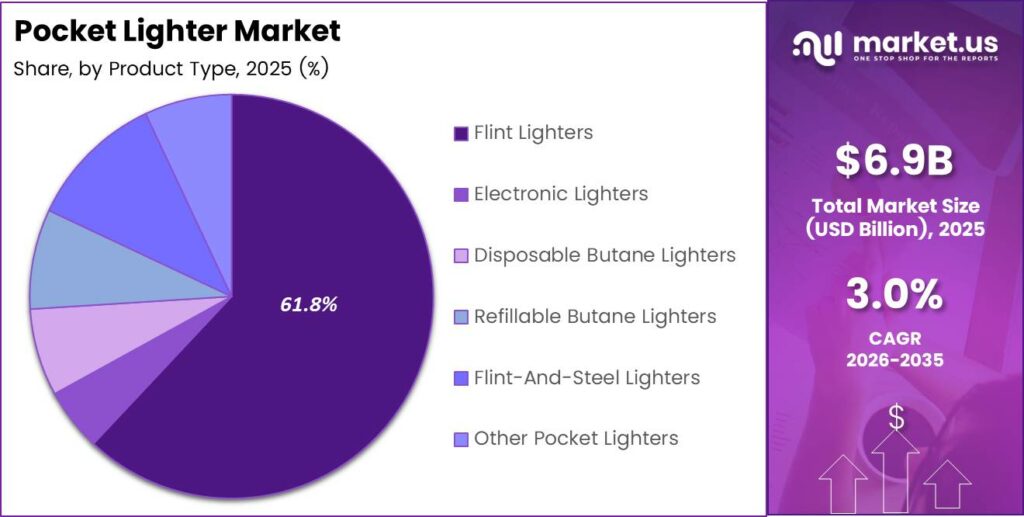
- Flint Lighters dominate the By Product Type segment with a 61.80% market share.
- Plastic dominates the By Material segment with a 65.30% market share.
- Butane dominates the By Fuel Source segment with a 76.00% market share.
- Offline dominates the By Distribution Channel segment with a 70.00% market share.
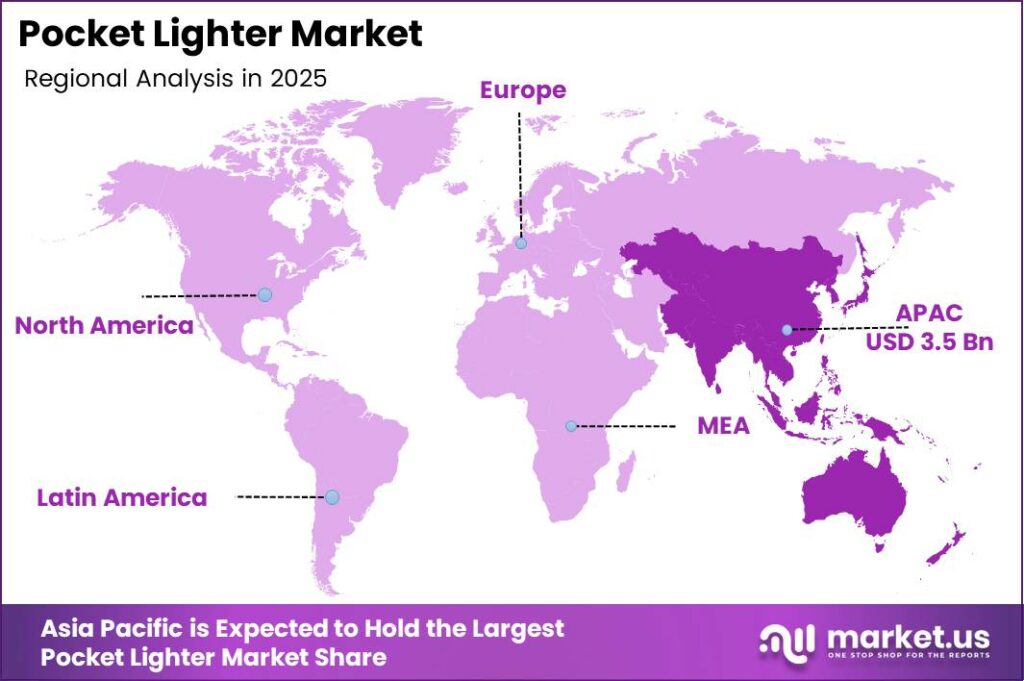
- Asia Pacific is the dominant region with a 52.10% market share, valued at USD 3.5 Billion.
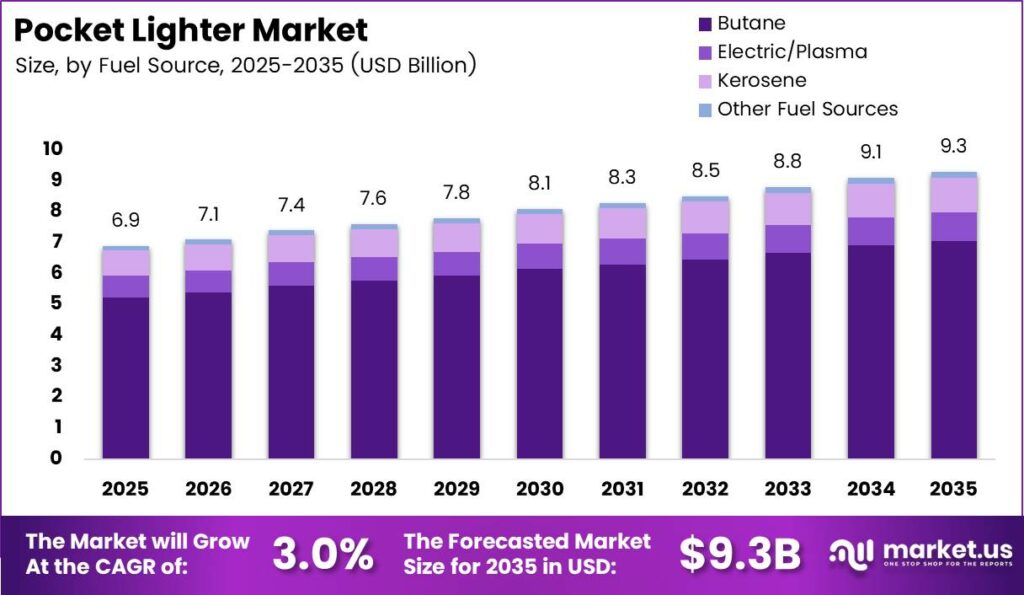
As per our research, BIC’s Flame for Life division sold 1,536 million units in 2024, down from 1,603 million units in 2023. This unit decline reflects reduced cigarette-lighting occasions in mature markets. Suppliers that diversify use cases beyond tobacco, including outdoor, culinary, and cannabis applications, will reduce their exposure to tobacco-linked volume erosion.
According to UNCTAD, global trade was projected to exceed USD 35 trillion in 2025, rising by approximately USD 2.2 trillion or 7% from 2024. Broader trade expansion creates favorable conditions for cross-border lighter shipments, particularly from Asian manufacturing hubs. This means brands with established import relationships and logistics infrastructure can access new retail footprints faster than regional-only competitors.
The IMF projected global economic growth of 3.2% in 2025. Moderate macroeconomic expansion supports continued consumer spending on low-ticket impulse categories like pocket lighters. However, this growth rate signals a cautious environment where unit-price increases must be managed carefully to avoid trading down to unbranded alternatives.
Product Type Analysis
Flint Lighters dominate with 61.80% due to low cost, wide retail availability, and durability.
In 2025, Flint Lighters held a dominant market position in the By Product Type segment of the Pocket Lighter Market, with a 61.80% share. Flint-based ignition combines mechanical simplicity with low unit cost, making these lighters the default choice across convenience, kiosk, and independent retail formats. This structural dominance means brands that lead in flint lighter distribution retain the strongest shelf presence across high-frequency replenishment channels globally.
Electronic Lighters occupy a growing but smaller share of the product type segment. Arc and plasma ignition systems appeal to wind-resistant outdoor use cases and younger urban consumers seeking rechargeable alternatives. As per our research, goods trade contributed approximately USD 1.5 trillion to global trade growth in 2025. This expansion signals that cross-border electronic lighter shipments from Asian manufacturers can reach new retail markets at competitive landed costs, benefiting brands with established import logistics.
Disposable Butane Lighters serve as the primary high-volume unit in tobacco-adjacent retail. These lighters are priced at or below branded thresholds, making them the default replacement purchase in price-sensitive convenience channels. As per our research, global maritime trade grew 2.2% in 2024 but was projected to slow to 0.5% growth in 2025. This deceleration increases freight sensitivity for manufacturers reliant on sea routes for disposable butane lighter distribution from Asia to Western markets.
Refillable Butane Lighters and Flint-and-Steel Lighters together address premium outdoor and heritage-use segments. Refillable formats command higher per-unit margins and repeat fuel purchase attachment. Other Pocket Lighters collectively hold the remaining share and serve niche ignition use cases across specialty retail and gift channels.
Material Analysis
Plastic dominates with 65.30% due to low input cost, high moldability, and mass-market compatibility.
In 2025, Plastic held a dominant market position in the By Material segment of the Pocket Lighter Market, with a 65.30% share. Plastic construction enables high-volume injection molding, fast assembly cycles, and consistent unit economics across mid-to-low price tiers. This production advantage means plastic-bodied lighters remain the default format for global branded suppliers and private-label manufacturers competing on shelf-price compliance.
Metal lighters serve a distinct buyer segment seeking durability, collectability, and premium aesthetics. Metal-bodied products typically carry higher retail prices and generate stronger per-unit margin contributions. Buyers in this segment are less price-elastic and more likely to purchase refills and accessories, creating recurring revenue potential that plastic disposables cannot replicate.
Other Materials, including composite and hybrid polymer formats, hold the remaining market share. These products target specialized outdoor, industrial, or gift-use applications where impact resistance or heat tolerance is a purchasing criterion. This segment remains small but represents a differentiation pathway for manufacturers seeking to move above commodity price tiers.
Fuel Source Analysis
Butane dominates with 76.00% due to established supply chains, consistent combustion, and low retail pricing.
In 2025, Butane held a dominant market position in the By Fuel Source segment of the Pocket Lighter Market, with a 76.00% share. Butane’s dominance reflects decades of supply chain optimization, widely available refill infrastructure, and consumer familiarity with adjustable flame formats. This entrenched position means non-butane formats must offer a clear performance or environmental advantage to displace shelf space held by butane products.
Electric and Plasma lighters represent the fastest-evolving fuel source alternative in the pocket lighter category. Rechargeable arc and plasma ignition systems eliminate fuel dependency and reduce per-use cost over a product’s lifetime. This positions electric formats as the primary challenger to butane dominance among environmentally aware urban consumers and frequent outdoor users with reliable USB charging access.
Kerosene and Other Fuel Sources collectively hold the remaining share in the fuel source segment. Kerosene lighters remain relevant in markets where butane supply infrastructure is limited or cost-prohibitive. Other fuel sources serve heritage and specialty ignition use cases, including survival and camping applications, where flame reliability under extreme conditions takes priority over convenience.
Distribution Channel Analysis
Offline dominates with 70.00% due to impulse proximity, immediate availability, and tobacco channel integration.
In 2025, Offline held a dominant market position in the By Distribution Channel segment of the Pocket Lighter Market, with a 70.00% share. Convenience stores, fuel stations, tobacco retailers, and kiosks generate the majority of pocket lighter transactions because lighters are a high-frequency impulse purchase driven by proximity rather than deliberate shopping intent. Brands with strong direct-store-delivery infrastructure maintain the most durable retail advantage in this channel.
Online distribution accounts for the remaining 30% share of the distribution channel segment. E-commerce platforms serve premium, refillable, and collectible lighter segments where consumers research before purchasing and tolerate longer fulfillment cycles. This means online channels create a disproportionately high opportunity for margin-accretive premium and limited-edition products that are difficult to merchandise effectively in convenience-format retail.
Key Market Segments
By Product Type
- Flint Lighters
- Electronic Lighters
- Disposable Butane Lighters
- Refillable Butane Lighters
- Flint-And-Steel Lighters
- Other Pocket Lighters
By Material
- Plastic
- Metal
- Other Materials
By Fuel Source
- Butane
- Electric/Plasma
- Kerosene
- Other Fuel Sources
By Distribution Channel
- Online
- Offline
Regional Analysis
Asia Pacific Dominates the Pocket Lighter Market with a Market Share of 52.10%, Valued at USD 3.5 Billion
Asia Pacific commands 52.10% of the global pocket lighter market, valued at USD 3.5 Billion in 2025. The region houses the world’s largest lighter manufacturing base, concentrated in China, alongside high-volume consumer demand driven by large adult smoking populations across Southeast Asia and South Asia. This dual role as both production hub and consumption market makes Asia Pacific structurally irreplaceable in global lighter supply chains. In October 2025, Zippo Manufacturing Company expanded its product line with the rollout of the American-made Bit Safe USA 4-in-1 Screwdriver Lighter Insert, signaling that product innovation targeting outdoor and utility use cases continues to attract investment across established markets.
The remaining regions collectively account for the other 47.90% of global pocket lighter demand. North America and Europe represent the most developed branded lighter markets, with established distribution networks and strong consumer recognition for premium and collectible formats. Latin America, the Middle East, and Africa serve as high-growth secondary markets where informal retail penetration and expanding convenience channel infrastructure drive volume gains for value-tier products.
Key Regions and Countries
North America
- US
- Canada
Europe
- Germany
- France
- The UK
- Spain
- Italy
- Rest of Europe
Asia Pacific
- China
- Japan
- South Korea
- India
- Australia
- Rest of APAC
Latin America
- Brazil
- Mexico
- Rest of Latin America
Middle East and Africa
- GCC
- South Africa
- Rest of MEA
Drivers
Convenience-channel replenishment remains the largest active growth contributor because pocket lighters are a low-ticket, high-frequency impulse category that retailers replenish rapidly through tobacco, fuel-station, kiosk, grocery, and independent-store networks. Shelf availability, inventory normalization, and disciplined pack-price architecture support unit turnover even in subdued discretionary spending environments. This means brands that prioritize direct-store-delivery coverage and reduce stock-outs can lift sell-through by roughly 2–4% at participating outlets.
| Driver | (~) % Impact on CAGR Forecast | Geographic Relevance | Impact Timeline |
|---|---|---|---|
| Convenience-channel replenishment | +0.8% | North America, Europe, urban Asia | Short term (≤ 2 years) |
| Emerging-market distribution expansion | +0.7% | Middle East, Africa, South Asia | Medium term (2–4 years) |
| Smoking-adjacent impulse demand | +0.5% | Global, concentrated in adult-smoking markets | Short term (≤ 2 years) |
| Safety-certified product mix | +0.4% | North America, Europe, developed Asia | Medium term (2–4 years) |
| Value-tier premiumization | +0.3% | Latin America, Southeast Asia, Africa | Short term (≤ 2 years) |
| Outdoor-use consumption recovery | +0.3% | North America, Europe, Australia | Medium term (2–4 years) |
Restraints
Cigarette-volume contraction is the clearest structural restraint because cigarette lighting remains a core use occasion for disposable and pocket-format flame products in mature markets. As reported by Market.us, the United States pocket-lighter market declined by 6.8% in value during the first quarter of 2025 and by 3.7% for full-year 2025. A volume loss in the mid-single digits pressures factory utilization by roughly 3–6 percentage points, forcing promotional support and delayed investment in new tooling and regional warehousing, creating an estimated -0.9% drag on overall market trajectory.
| Restraint | (~) % Impact on CAGR Forecast | Geographic Relevance | Impact Timeline |
|---|---|---|---|
| Cigarette-volume contraction | -0.9% | North America, Western Europe, developed Asia | Medium term (2–4 years) |
| Single-use waste restrictions | -0.7% | Europe, selected North American jurisdictions | Medium term (2–4 years) |
| Youth-access enforcement | -0.5% | North America, Europe, Australia | Short term (≤ 2 years) |
| Low-cost informal imports | -0.4% | South Asia, Africa, Latin America | Short term (≤ 2 years) |
| Adult-use nicotine substitution | -0.3% | North America, Europe, East Asia | Long term (≥ 4 years) |
| Retailer private-label pressure | -0.3% | Europe, North America | Medium term (2–4 years) |
Challenges
Butane sourcing volatility creates the most material ongoing operational friction because fuel represents a direct input cost that moves faster than retail price resets for low-value pocket lighters. A fuel-cost increase of 10% raises unit conversion cost by roughly 1–3%, depending on fill volume, procurement geography, and contract coverage. Manufacturers that cannot pass through input cost movements risk margin compression of approximately 50–150 basis points during volatile periods, limiting achievable growth by an estimated -0.7%.
| Challenge | (~) % CAGR Friction Drag | Geographic Relevance | Mitigation Horizon |
|---|---|---|---|
| Butane sourcing volatility | -0.7% | Global, highest exposure in import-dependent markets | Medium term (2–4 years) |
| Safety testing complexity | -0.6% | North America, Europe, developed Asia | Medium term (2–4 years) |
| Maritime freight disruption | -0.5% | Asia-to-Europe, Asia-to-Americas trade lanes | Short term (≤ 2 years) |
| Counterfeit traceability gaps | -0.4% | South Asia, Africa, Latin America | Long term (≥ 4 years) |
| Component quality consistency | -0.3% | Global contract-manufacturing hubs | Medium term (2–4 years) |
| Hazardous-goods logistics limits | -0.3% | Global, especially air-freight constrained routes | Short term (≤ 2 years) |
Opportunities
Refillable premium pocket formats represent the largest unexploited revenue stream because capturing this segment requires deliberate redesign, refill ecosystem development, and specialty distribution rather than simple substitution of low-price disposables. A refillable format priced at a premium can produce gross-margin expansion of roughly 5–12 percentage points when component durability, personalization, and refill attachment rates are managed effectively. A refill transaction can cost 30–60% less to manufacture than a complete new lighter, generating repeat-purchase economics unavailable in the disposable segment.
| Opportunity | (~) % Potential CAGR Upside | Geographic Relevance | Execution Window |
|---|---|---|---|
| Refillable premium pocket formats | +1.0% | Europe, North America, affluent Asia-Pacific | Medium term (2–4 years) |
| Branded accessory monetization | +0.7% | Global urban consumer markets | Medium term (2–4 years) |
| Legal cannabis retail bundles | +0.6% | North America, selected European markets | Short term (≤ 2 years) |
| Digital traceability platforms | +0.5% | South Asia, Africa, Latin America | Long term (≥ 4 years) |
| Travel-retail gift assortments | +0.4% | Europe, Middle East, Asia-Pacific | Medium term (2–4 years) |
| Regional contract-manufacturing roll-ups | +0.4% | Asia-Pacific, Eastern Europe, Latin America | Long term (≥ 4 years) |
Key Company Insights
BIC Corporation reported Flame for Life net sales of €723 million in 2025, down from €810 million in 2024, with net sales declining 6.7% at constant currency for the full year. The adjusted EBIT margin contracted to 29.9% from 33.3% in 2024. This margin compression signals that BIC faces structural pressure from tobacco-volume contraction and must accelerate format diversification to defend profitability.
In March 2026, Philip Morris completed the sale of its Swedish Match Light division, with the Cricket lighter business acquired by a company under Tokai International Holdings Inc. Tokai Corporation gains a globally recognized value-tier brand with broad emerging-market distribution. This acquisition positions Tokai as a direct volume competitor to BIC across convenience channels in Europe, Asia, and Latin America.
Key Players
- BIC Corporation
- Zippo Manufacturing Company
- Tokai Corporation
- Flamagas S.A. (Clipper)
- Swedish Match Lighters B.V. (Cricket)
- S.T. Dupont
- Colibri Group
- Visol Products
- Xikar, Inc.
- Ronson Consumer Products Corporation
- Ningbo Xinhai Electric Co., Ltd.
- Zhuoye Lighter Manufacturing Co., Ltd.
- BAIDE International Enterprise
- Benxi Fenghe Lighter Co., Ltd.
- Hebei Yiyang Lighter Manufacturing Co., Ltd.
Recent Developments
- February 2026 – BIC launched the EZ Load refillable utility lighter in several countries in 2025, expanding its refillable product portfolio as the Flame for Life division reported €723 million in net sales for the full year.
- September 2025 – Société BIC appointed Rob Versloot as its new Chief Executive Officer, marking a leadership transition at the world’s largest pocket lighter manufacturer by volume.
- April 2026 – Zippo Manufacturing Company introduced its 2026 Collectible of the Year windproof lighter featuring an Armor Black Ice case, a red epoxy-filled flame icon, and a MultiCut radiating ripple design.
Report Scope
| Report Features | Description |
|---|---|
| Market Value (2025) | USD 6.9 Billion |
| Forecast Revenue (2035) | USD 9.3 Billion |
| CAGR (2026-2035) | 3.0% |
| Base Year for Estimation | 2025 |
| Historic Period | 2020-2024 |
| Forecast Period | 2026-2035 |
| Report Coverage | Revenue Forecast, Market Dynamics, Market Opportunity Analysis, Technology and Innovation Landscape, Competitive Landscape, Recent Developments |
| Segments Covered | By Product Type (Flint Lighters, Electronic Lighters, Disposable Butane Lighters, Refillable Butane Lighters, Flint-And-Steel Lighters, Other Pocket Lighters), By Material (Plastic, Metal, Other Materials), By Fuel Source (Butane, Electric/Plasma, Kerosene, Other Fuel Sources), By Distribution Channel (Online, Offline) |
| Regional Analysis | North America (US and Canada), Europe (Germany, France, The UK, Spain, Italy, and Rest of Europe), Asia Pacific (China, Japan, South Korea, India, Australia, and Rest of APAC), Latin America (Brazil, Mexico, and Rest of Latin America), Middle East and Africa (GCC, South Africa, and Rest of MEA) |
| Competitive Landscape | BIC Corporation, Zippo Manufacturing Company, Tokai Corporation, Flamagas S.A. (Clipper), Swedish Match Lighters B.V. (Cricket), S.T. Dupont, Colibri Group, Visol Products, Xikar, Inc., Ronson Consumer Products Corporation, Ningbo Xinhai Electric Co., Ltd., Zhuoye Lighter Manufacturing Co., Ltd., BAIDE International Enterprise, Benxi Fenghe Lighter Co., Ltd., Hebei Yiyang Lighter Manufacturing Co., Ltd. |
| Customization Scope | Customization for segments, region/country-level will be provided. Additional customization can be done based on requirements. |
| Purchase Options | We have three licenses to opt for: Single User License, Multi-User License (Up to 5 Users), Corporate Use License (Unlimited User and Printable PDF) |





































