


Quick Navigation
- Report Overview
- Key Takeaways
- Technology Analysis
- Component Analysis
- System Analysis
- Vehicle Type Analysis
- Propulsion Analysis
- Sales Channel Analysis
- Key Market Segments
- Regional Analysis
- Key Regions and Countries
- Market Dynamics
- Drivers
- Restraints
- Challenges
- Opportunities
- Key Company Insights
- Recent Developments
- Geopolitical Impact Analysis
- Report Scope
Report Overview
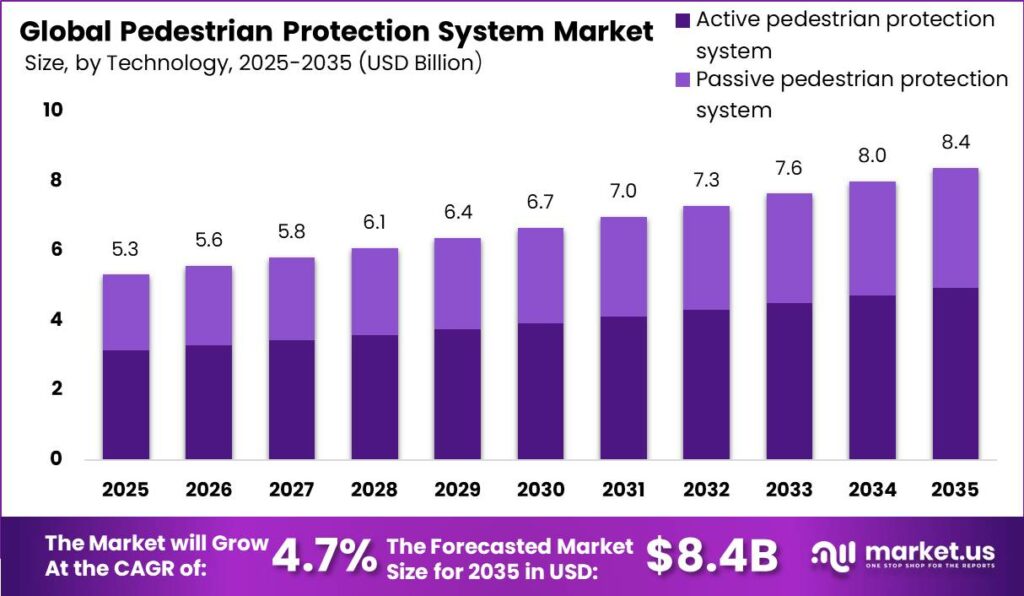
Global Pedestrian Protection System Market size is expected to be worth around USD 8.4 Billion by 2035 from USD 5.30 Billion in 2025, growing at a CAGR of 4.7% during the forecast period 2026 to 2035. As per our research, the expansion reflects rising regulatory pressure on vehicle makers to protect vulnerable road users. Suppliers that lock multiyear sensor and braking content early will protect volume against cycle swings.
Therefore, the market covers active and passive hardware that detects pedestrians and lowers injury risk in a crash. Active systems sense people and can brake or warn drivers before impact. Passive systems reshape hoods and exterior structures after contact begins. Demand ties to passenger cars, commercial fleets, OEM fitment, and limited aftermarket work.
Key Takeaways
- The market is valued at USD 5.30 Billion in 2025 and is expected to reach USD 8.4 Billion by 2035.
- The market is expected to grow at a CAGR of 4.7% during the forecast period 2026 to 2035.
- By Technology, Active pedestrian protection system leads with a 59.00% share.
- By Component, Sensors lead with a 27.00% share.
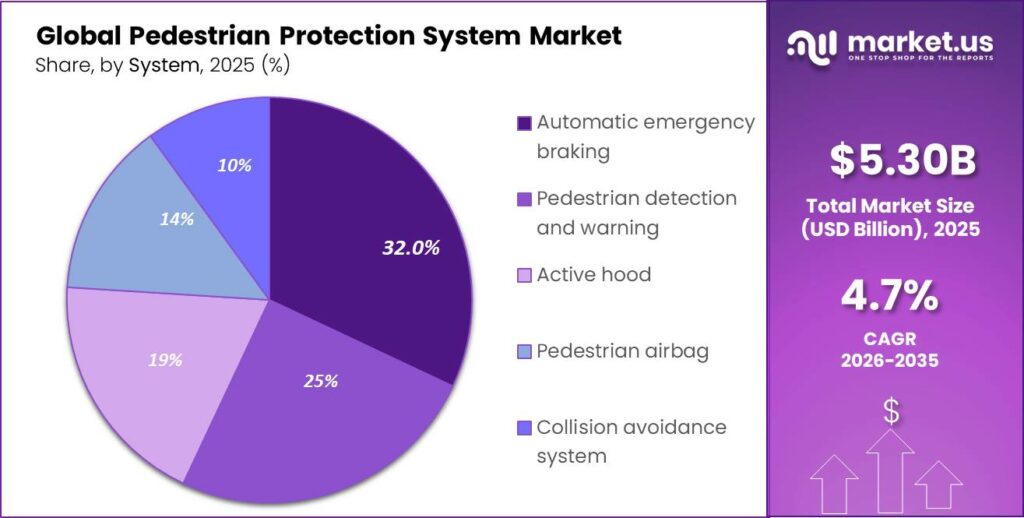
- By System, Automatic emergency braking leads with a 32.00% share.
- By Vehicle Type, Passenger cars lead with a 74.00% share.
- By Propulsion, Internal combustion engine vehicles lead with a 66.00% share.
- By Sales Channel, OEM leads with a 92.00% share.
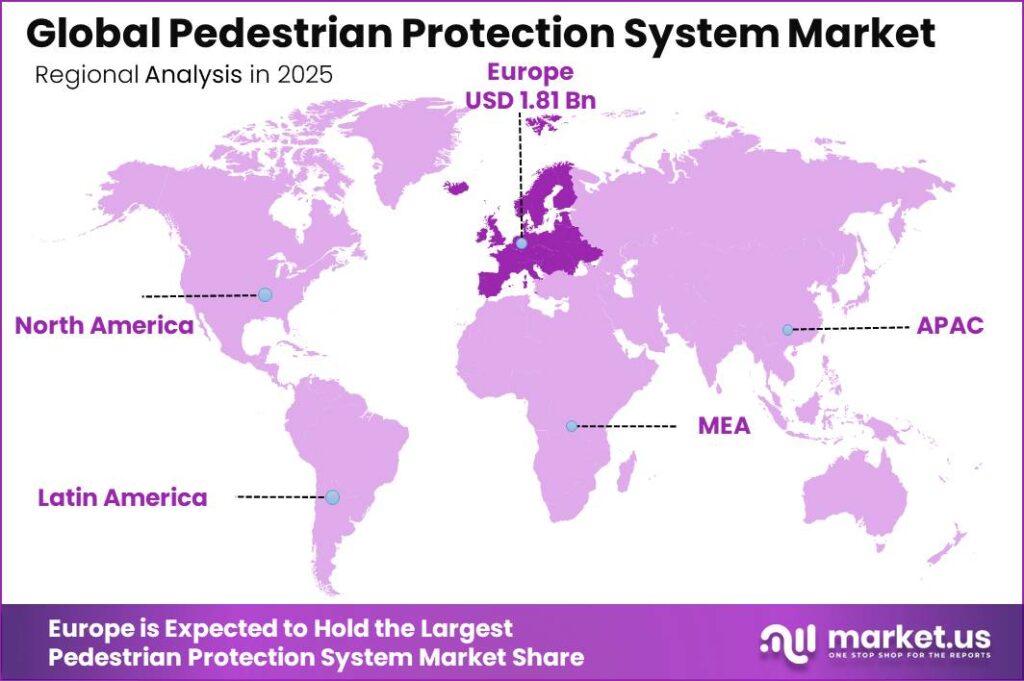
- Europe dominates with a 34.00% share, valued at USD 1.81 Billion.
Government type-approval rules now treat pedestrian protection as a gate for vehicle sales rather than a trim option. EU General Safety Regulation stages and UNECE pedestrian rules push makers to fit detection and braking on mainstream models. This means program buyers must secure sensing and actuator capacity years before launch. Fleet growth in urban markets then multiplies the same content across higher unit volumes.
According to PARTS, pedestrian AEB cut single-vehicle frontal crashes involving pedestrians and other non-motorists by 9%. That measured safety gain strengthens the business case for standard fitment on high-volume platforms. As a result, Tier-1 order books shift from optional packages toward guaranteed per-vehicle content.
Data from PARTS shows overall AEB effectiveness rose from 46% for model-year 2015 to 2017 vehicles to 52% for model-year 2021 to 2023 vehicles. Better real-world performance rewards suppliers that refresh algorithms without full hardware swaps. Carmakers that delay software updates risk weaker safety scores against peers already shipping improved stacks.
Technology Analysis
Active pedestrian protection system dominates with 59.00% due to mandatory AEB and detection fitment.
In 2025, Active pedestrian protection system held a dominant market position in the By Technology segment of Pedestrian Protection System Market, with a 59.00% share. OICA reports global vehicle production reached 96.4 million units in 2025, up 3.9% from 92.7 million in 2024. Active sensing and braking scale with each new unit that must meet pedestrian rules. Suppliers aligned to active platforms capture the largest share of mandated content.
Passive pedestrian protection system is the fastest growing technology path as hoods, absorbers, and exterior structures still absorb residual impact energy. ACEA data show global car manufacturing totalled 75.5 million units in 2024, keeping a large installed base that needs structural protection layers. Passive hardware remains essential where active braking cannot fully clear a collision. Investors should treat passive content as complementary revenue, not a substitute for active stacks.
Component Analysis
Sensors dominate with 27.00% due to mandatory detection hardware on new vehicles.
In 2025, Sensors held a dominant market position in the By Component segment of Pedestrian Protection System Market, with a 27.00% share. NHTSA final rule FMVSS No. 127 requires automatic emergency braking, including pedestrian AEB, on nearly all U.S. light vehicles by September 2029 and projects at least 360 lives saved yearly. Sensor packs become non-discretionary bill-of-materials items under that timeline. Component makers that qualify early lock multiyear OEM awards.
Cameras supply the visual classification layer that separates pedestrians from other roadside objects in urban scenes. ACEA figures show global car sales reached 74.6 million units in 2024, up 2.5% from 2023. Higher car throughput multiplies camera attach opportunities on each safety domain controller. Vendors that cut night false alerts will win more dual-sourcing slots.
Radar maintains range and weather resilience when camera vision degrades in rain or glare. OICA data show Asia-Pacific production rose 7.6% to about 59.2 million vehicles in 2025 and held more than 61% of global output. Dense Asian build volumes favor radar modules that ship at stable unit cost. This creates scale advantages for radar suppliers already localized in that production belt.
Control units fuse sensor inputs and trigger braking or hood commands under tight latency limits. Actuators and other components complete the chain with pyro or mechanical release hardware. In January 2026, Aptiv introduced the PULSE sensor, integrating camera and radar technologies in a compact unit for advanced driver-assistance systems. Integrated modules can shrink packaging space and simplify harness design for crowded front ends.
System Analysis
Automatic emergency braking dominates with 32.00% due to regulation-backed crash avoidance value.
In 2025, Automatic emergency braking held a dominant market position in the By System segment of Pedestrian Protection System Market, with a 32.00% share. NHTSA projects FMVSS No. 127 will prevent at least 24,000 injuries each year once standard fitment is complete. That injury reduction anchors AEB as the primary system budget line for pedestrian safety. Platform teams that standardize AEB software across trims lower validation cost per vehicle.
Pedestrian detection and warning systems alert drivers before full brake intervention and feed the same perception stack used by AEB. IEA data show electric car sales exceeded 20 million globally in 2025 and reached a 25% sales share. Electrified platforms still need equal VRU detection performance in quiet low-speed zones. Warning features remain a lower-cost entry layer in markets waiting on full AEB mandates.
Active hood, pedestrian airbag, and collision avoidance system lines hold the remaining system demand as secondary and tertiary protection layers. Active hoods lift to create head-impact clearance after a confirmed strike. Pedestrian airbags and broader collision avoidance functions extend protection when braking alone is not enough. Suppliers bundling these with core AEB can raise content value per vehicle without a second sensor suite.
Vehicle Type Analysis
Passenger cars dominate with 74.00% due to high light-vehicle production and safety ratings.
In 2025, Passenger cars held a dominant market position in the By Vehicle Type segment of Pedestrian Protection System Market, with a 74.00% share. OICA reports global vehicle sales climbed to 99.8 million units in 2025, up 4.7% from 95.3 million in 2024. Passenger models absorb most mandated pedestrian content because they dominate registrations. Safety rating programs further concentrate spend on this vehicle class.
Light commercial vehicles add pedestrian protection as city delivery fleets face dense walkway exposure. OICA notes the United States produced 10.24 million vehicles and sold 16.7 million in 2025, supporting a large light-duty commercial parc. Fleet buyers weigh downtime and insurance cost when specifying AEB packages. Suppliers that document lower urban incident rates will win fleet-standard awards.
Heavy commercial vehicles form a smaller but structurally important slice of demand for front detection on trucks and buses. Longer stopping distances raise the value of earlier pedestrian classification at range. Body builders and chassis makers need modular kits that fit varied cab designs. This signals a niche for ruggedized sensors rather than passenger-car modules alone.
Propulsion Analysis
Internal combustion engine vehicles dominate with 66.00% due to still-majority global powertrain mix.
In 2025, Internal combustion engine vehicles held a dominant market position in the By Propulsion segment of Pedestrian Protection System Market, with a 66.00% share. IEA figures show electric cars were one-quarter of new cars sold in 2025, so combustion models still fill most showrooms. Pedestrian systems must therefore ship first on ICE architectures that remain the volume base. Ignoring ICE programs would forfeit the largest near-term attach pool.
Electric vehicles are reshaping front-end packaging as quiet low-speed operation increases reliance on electronic detection. IEA data show global electric car sales grew about 20% to more than 20 million units in 2025. EV platforms free packaging space yet still require full pedestrian AEB performance for type approval. Suppliers that tune perception for silent approach scenarios gain an EV-specific edge.
Hybrid electric vehicles split the remaining propulsion demand as makers blend electric drive with combustion range. Europe recorded electric car sales rising more than 30% to a 28% sales share in 2025, per IEA, which pulls hybrids and pure EVs into the same safety validation queue. Shared control software across hybrid and ICE variants cuts duplicate homologation work. This means powertrain diversity need not multiply full system redesign cost.
Sales Channel Analysis
OEM dominates with 92.00% due to factory fitment under type-approval rules.
In 2025, OEM held a dominant market position in the By Sales Channel segment of Pedestrian Protection System Market, with a 92.00% share. OICA reports China produced 34.53 million vehicles in 2025, reinforcing factory-installed safety content at unmatched scale. Mandates attach at the production line, so OEM channels capture nearly all system revenue. Aftermarket paths cannot match that regulatory pull-through.
Aftermarket demand covers repair, replacement sensors, and limited retrofit where platforms allow. UNCTAD notes ships move over 80% of world merchandise trade, so parts logistics still depend on stable ocean lanes for actuators and modules. Long repair cycles and calibration needs keep service revenue tied to dealer networks. Channel players that offer certified calibration tools will hold more post-crash replacement share.
Key Market Segments
By Technology
- Active pedestrian protection system
- Passive pedestrian protection system
By Component
- Sensors
- Cameras
- Radar
- Control units
- Actuators
- Other components
By System
- Automatic emergency braking
- Pedestrian detection and warning
- Active hood
- Pedestrian airbag
- Collision avoidance system
By Vehicle Type
- Passenger cars
- Light commercial vehicles
- Heavy commercial vehicles
By Propulsion
- Internal combustion engine vehicles
- Electric vehicles
- Hybrid electric vehicles
By Sales Channel
- OEM
- Aftermarket
Regional Analysis
Europe Dominates the Pedestrian Protection System Market with a Market Share of 34.00%, Valued at USD 1.81 Billion
Europe leads because binding EU General Safety Regulation stages and UNECE pedestrian rules force early fitment across M1 and N1 vehicles. OICA data show European production near 17.2 million vehicles in 2025 even as output slipped 0.8%, so safety content still rides a large registered base. IIHS reported in January 2025 that pedestrian AEB reduces pedestrian crashes of all severities by 27%, although its crash-reduction effect on dark roads was negligible. Proven injury cuts keep European buyers and regulators insistent on higher system performance.
Asia Pacific is the fastest volume growth arena as China and India expand vehicle output and urban VRU exposure. OICA reports India production rose to 6.49 million vehicles while China added roughly 3.25 million units in a single year. In May 2026, Valeo secured an order from a leading Indian automaker for its Smart Safety 360 system, which protects pedestrians and cyclists during vehicle pull-away and provides automatic emergency braking. Local awards show suppliers can convert emerging-market programs before full national mandates arrive.
North America adds a large compliance pool through voluntary pledges ahead of federal standard fitment. Based on IIHS data, the industry U.S. voluntary AEB commitment for the production year beginning September 1, 2025 requires participating makers to equip at least 95% of light-vehicle production volume, including vehicles weighing 8,500 to 10,000 pounds. That threshold pulls heavier light trucks into the same content race as passenger cars. Suppliers ready for wider sensor fields will capture more of this U.S. volume step-up.
Key Regions and Countries
North America
- US
- Canada
Europe
- Germany
- France
- The UK
- Spain
- Italy
- Rest of Europe
Asia Pacific
- China
- Japan
- South Korea
- India
- Australia
- Rest of APAC
Latin America
- Brazil
- Mexico
- Rest of Latin America
Middle East and Africa
- GCC
- South Africa
- Rest of MEA
Market Dynamics
Market Opportunity Analysis - Passive systems, aftermarket service, and heavy commercial niches remain open entry points.
Passive pedestrian protection remains the fastest growing technology path while active systems already hold 59.00% share. Many platforms still under-specify exterior energy management beyond minimum hood rules. New entrants can pair low-cost absorbers with existing OEM sensors rather than rebuild full AEB stacks. This reflects a lower capital route into programs that already bought active content.
Aftermarket channels sit outside the OEM grip of 92.00% factory fitment and focus on replacement sensors, actuators, and calibration. Crash repair volumes rise as more cars carry pyro and camera hardware that must be reset after deployment. Independent service networks that certify pedestrian-system calibration can take wallet share dealers leave unserved. Therefore, tooling and training become the real moat, not catalog breadth alone.
Heavy commercial vehicles receive far less pedestrian content than passenger cars, which hold 74.00% share. Urban bus and truck routes still concentrate pedestrian exposure at low speed. Suppliers offering rugged front detection kits for varied cab geometries address a thin but sticky fleet budget. Early movers can define interface standards before large fleet tenders standardize on one design.
India and broader Asia Pacific production growth outpace mandate maturity, leaving pre-regulation white space. Europe already commands 34.00% value share, so incremental share fights there are costlier. Localized low-cost actuators aimed at high-volume Asian B-segment cars can win before rules tighten. This signals a timing advantage for regional manufacturers over pure import models.
Technology and Innovation Landscape - Sensor fusion, deployable exteriors, and software validation redefine supplier edges
Camera and radar fusion is becoming the default perception approach for pedestrian classification in complex city scenes. Control units must merge streams fast enough to trigger braking before impact zones close. Hardware winners will be those who shrink dual-mode modules without raising false-positive rates. Buyers should score vendors on night and junction tests, not brochure range alone.
Active hood actuators and pedestrian airbags extend protection when automatic emergency braking cannot clear a crash fully. Pyrotechnic release speed and reset cost shape total ownership economics for fleets and insurers. Manufacturers that cut replacement cost while holding deployment reliability will ease residual resistance in mid-price models. This creates room for second-source actuator specialists beside full-stack Tier-1s.
Collision avoidance software is shifting from fixed release code to updatable logic that tracks new VRU behaviors such as scooters. Over-the-air tuning can lift field performance without waiting for a full platform redesign. Suppliers that own the software lifecycle gain recurring revenue after the initial hardware award. Investors should value data-loop quality as highly as sensor count.
Virtual homologation tools now sit beside physical tracks as Euro NCAP and regulators accept correlated simulation evidence. Scenario libraries covering junctions, glare, and mixed VRUs reduce late-program surprises. Firms selling validated digital twins can attach services to every new vehicle program. As a result, innovation spend is moving from metal toward software and test infrastructure.
Drivers
EU GSR and UN R127 deadlines contribute roughly +2.1% to the CAGR path by turning pedestrian protection into a legal type-approval gate. UNECE Regulation No. 127 enlarged head-impact wrap-around distance from 2,100mm to 2,500mm, mandatory for new types on 7 July 2024 and all new registrations on 7 July 2026. The EU General Safety Regulation reaches its Stage D new-type threshold on 7 January 2026. This removes elasticity from OEM sourcing and forces pedestrian-capable AEB under UN Regulation No. 152 on M1 and N1 vehicles.
Consequently, supplier revenue shifts from discretionary trim upsell toward guaranteed per-unit content on nearly every registered vehicle. Sensing modules, active-bonnet actuators, and deployable systems gain a protected demand floor. Investors can treat this compliance calendar as insulation against normal ADAS attach-rate cyclicality. Buyers who secure capacity early avoid last-cycle shortages when multiple platforms hit the same registration dates.
| Driver | (~) % Impact on CAGR Forecast | Geographic Relevance | Impact Timeline |
|---|---|---|---|
| EU GSR & UN R127 mandatory fitment deadlines | +2.1% | EU, UNECE-aligned markets | Short term (2 years or less) |
| Pedestrian-capable AEB standardization | +1.4% | Global | Short term (2 years or less) |
| NCAP star-rating competitive pressure | +1.0% | EU, North America, Japan | Medium term (2 to 4 years) |
| SUV/crossover mix shift raising hood-height risk | +0.7% | Global | Medium term (2 to 4 years) |
| Rising urban VRU fatality mitigation mandates | +0.6% | Asia-Pacific, Latin America | Medium term (2 to 4 years) |
Restraints
High system bill-of-materials cost exerts about -1.6% drag on the CAGR path in price-sensitive vehicle bands. Honda Pop-up Hood documentation confirms the system fires a pyrotechnic actuator above 25 km/h, and Lexus LX service listings place single-use pyro actuator replacement near an MSRP of $510 to $540 per unit. Entry models in Asia-Pacific cannot absorb that cost without cutting other features. This slows attach rates exactly where unit volume is highest.
As a result, suppliers that refuse to localize actuator manufacturing face margin compression and frozen sales in mandate-free markets. World Bank vehicle-affordability patterns in lower-middle-income countries show every extra dollar of content is contested at the showroom. Delayed adoption keeps the installed base smaller for longer. Investors should model longer payback where national rules do not yet force fitment.
| Restraint | (~) % Impact on CAGR Forecast | Geographic Relevance | Impact Timeline |
|---|---|---|---|
| High system BOM cost on price-sensitive segments | -1.6% | Asia-Pacific, Africa, Latin America | Short term (2 years or less) |
| Elevated interest rates suppressing new-vehicle sales | -1.1% | Global | Short term (2 years or less) |
| OEM legal challenge to AEB mandate scope | -0.8% | North America | Short term (2 years or less) |
| Pyro-actuator repair & insurance cost backlash | -0.7% | EU, North America | Medium term (2 to 4 years) |
| Absence of mandate in key emerging markets | -0.6% | India, Southeast Asia | Medium term (2 to 4 years) |
| Retrofit incompatibility with legacy platforms | -0.4% | Global | Long term (4 years or more) |
Challenges
Sensor false-positive calibration creates about -0.9% continuous friction as test envelopes widen without costly false deployments. Euro NCAP 2026 is described as its largest revision since 2009, raising test speeds and adding junction and degraded-condition scenarios while extending road validation to 2,000 km for speed functions. Virtual homologation demands roughly ±1.0 KPI correlation with at least 75% of spot-checks passing per scenario cluster. Engineering teams must keep spending on fusion datasets even while unit volumes rise.
This creates a paid validation and software-services layer around core hardware sales. The Alliance for Automotive Innovation 2025 legal challenge to NHTSA FMVSS No. 127 ahead of the September 2029 deadline adds North American program uncertainty. Firms that sell closed-loop test tools and scenario libraries can monetize the same friction that erodes pure hardware margins. Early movers in validation infrastructure gain recurring revenue tied to every new protocol revision.
| Challenge | (~) % CAGR Friction Drag | Geographic Relevance | Mitigation Horizon |
|---|---|---|---|
| Sensor false-positive calibration drag | -0.9% | Global | Medium term (2 to 4 years) |
| ADAS software validation talent deficit | -0.7% | Global | Long term (4 years or more) |
| Semiconductor & actuator supply volatility | -0.6% | Global | Medium term (2 to 4 years) |
| Virtual-testing homologation complexity | -0.5% | EU, North America | Medium term (2 to 4 years) |
| Cyclist & VRU edge-case coverage | -0.4% | EU, Japan | Long term (4 years or more) |
| Multi-region standard fragmentation | -0.3% | Global | Long term (4 years or more) |
Opportunities
External deployable airbag productization offers about +1.9% potential CAGR upside as a still-underexploited protection tier. Subaru introduced an external cyclist airbag on the 2025 Forester limited to Japan, leaving most of the global vehicle parc without exterior deployable coverage. Autoliv product documentation positions the deployable airbag above passive hood measures as an added mitigation layer. This opens a higher content tier than a single pyro actuator near $510.
Capturing that tier can lift per-unit revenue by an estimated 2 to 3 times versus passive-only systems while reusing sensing already required under UN Regulation No. 152. Early movers convert a compliance cost base into incremental margin across unmet VRU-protection demand. Japan, the EU, and North America are the first monetization windows. Portfolio leaders that industrialize modules now will set the reference design for later copy markets.
| Opportunity | (~) % Potential CAGR Upside | Geographic Relevance | Execution Window |
|---|---|---|---|
| External deployable airbag productization | +1.9% | Japan, EU, North America | Medium term (2 to 4 years) |
| Cyclist & micromobility-specific protection systems | +1.2% | EU, Japan | Medium term (2 to 4 years) |
| Localized low-cost actuator manufacturing | +0.9% | India, Southeast Asia | Long term (4 years or more) |
| Software-defined sensing over-the-air upsell | +0.8% | Global | Long term (4 years or more) |
| Emerging-market pre-mandate first-mover positioning | +0.6% | Latin America, Africa | Long term (4 years or more) |
Key Company Insights
Robert Bosch GmbH competes at the center of pedestrian sensing and braking stacks that OEMs now treat as standard content. Figures from the U.S. Department of Transportation show a 100-degree AEB sensor configuration completed 99.28% of simulated cyclist-crossing runs without a collision and cut collisions by 86.98% from baseline. Wide, reliable detection performance is the buying criterion for Tier-1 awards. Bosch positioning around high-coverage perception supports share defense as mandates widen.
Continental AG / Aumovio targets the same ADAS safety domain where junction and turn scenarios decide real-world scores. The same U.S. Department of Transportation simulation found a right-turn crossing-cyclist case cut crashes by 58.35% at 100 degrees, versus 93.22% at 180 degrees and 93.92% at 210 degrees. Broader sensor opening angles clearly raise avoidance rates. Continental programs that ship wider fields of view can claim a measurable safety edge in OEM benchmarking.
Key Players
- Robert Bosch GmbH
- Continental AG / Aumovio
- DENSO Corporation
- ZF Friedrichshafen AG
- Autoliv Inc.
- Aptiv PLC
- Valeo SA
- Magna International Inc.
- Forvia Hella
- Mobileye Global Inc.
- Toyota Motor Corporation
- Honda Motor Co., Ltd.
- Mercedes-Benz Group AG
- Volkswagen AG
- General Motors Company
Recent Developments
- 2025: Autoliv launched the world’s first cyclist pedestrian protection airbag.
- April 2025: FORVIA HELLA introduced a detection solution capable of identifying pedestrians, scooters, and e scooters and providing timely warnings.
Geopolitical Impact Analysis
According to UNCTAD, seaborne trade growth is expected to stall near 0.5% in 2025 after 2.2% growth in 2024, while rerouting lifted ton-miles about 6%. Pedestrian system actuators, radar modules, and camera assemblies move on these same container lanes. Longer Cape routes raise landed cost and stretch safety-stock needs for pyro and semiconductor parts. OEMs that dual-source critical chips reduce launch risk when Red Sea disruption persists.
Data from WTO-linked trade reporting shows India sought consultations over U.S. 25% ad valorem tariffs on certain automobile components and vehicles, while U.S. auto parts imports reached about USD 89 billion in 2024. Tariff friction directly hits cross-border sensor and controller flows used in pedestrian AEB packs. Consequently, regional localization of control units and actuators becomes a hedge, not only a cost play. Suppliers with multi-continent plants can rebalance builds faster than single-site exporters.
Report Scope
| Report Features | Description |
|---|---|
| Market Value (2025) | USD 5.30 Billion |
| Forecast Revenue (2035) | USD 8.4 Billion |
| CAGR (2026-2035) | 4.7% |
| Base Year for Estimation | 2025 |
| Historic Period | 2020-2024 |
| Forecast Period | 2026-2035 |
| Report Coverage | Revenue Forecast, Market Dynamics, Market Opportunity Analysis, Technology and Innovation Landscape, Competitive Landscape, Recent Developments |
| Segments Covered | By Technology (Active pedestrian protection system, Passive pedestrian protection system), By Component (Sensors, Cameras, Radar, Control units, Actuators, Other components), By System (Automatic emergency braking, Pedestrian detection and warning, Active hood, Pedestrian airbag, Collision avoidance system), By Vehicle Type (Passenger cars, Light commercial vehicles, Heavy commercial vehicles), By Propulsion (Internal combustion engine vehicles, Electric vehicles, Hybrid electric vehicles), By Sales Channel (OEM, Aftermarket) |
| Regional Analysis | North America (US and Canada), Europe (Germany, France, The UK, Spain, Italy, and Rest of Europe), Asia Pacific (China, Japan, South Korea, India, Australia, and Rest of APAC), Latin America (Brazil, Mexico, and Rest of Latin America), Middle East and Africa (GCC, South Africa, and Rest of MEA) |
| Competitive Landscape | Robert Bosch GmbH, Continental AG / Aumovio, DENSO Corporation, ZF Friedrichshafen AG, Autoliv Inc., Aptiv PLC, Valeo SA, Magna International Inc., Forvia Hella, Mobileye Global Inc., Toyota Motor Corporation, Honda Motor Co., Ltd., Mercedes-Benz Group AG, Volkswagen AG, General Motors Company |
| Customization Scope | Customization for segments, region / country-level will be provided. Additional customization can be done based on requirements. |
| Purchase Options | We have three licenses to opt for: Single User License | Multi-User License (Up to 5 Users) | Corporate Use License (Unlimited User and Printable PDF) |





































