Market Overview
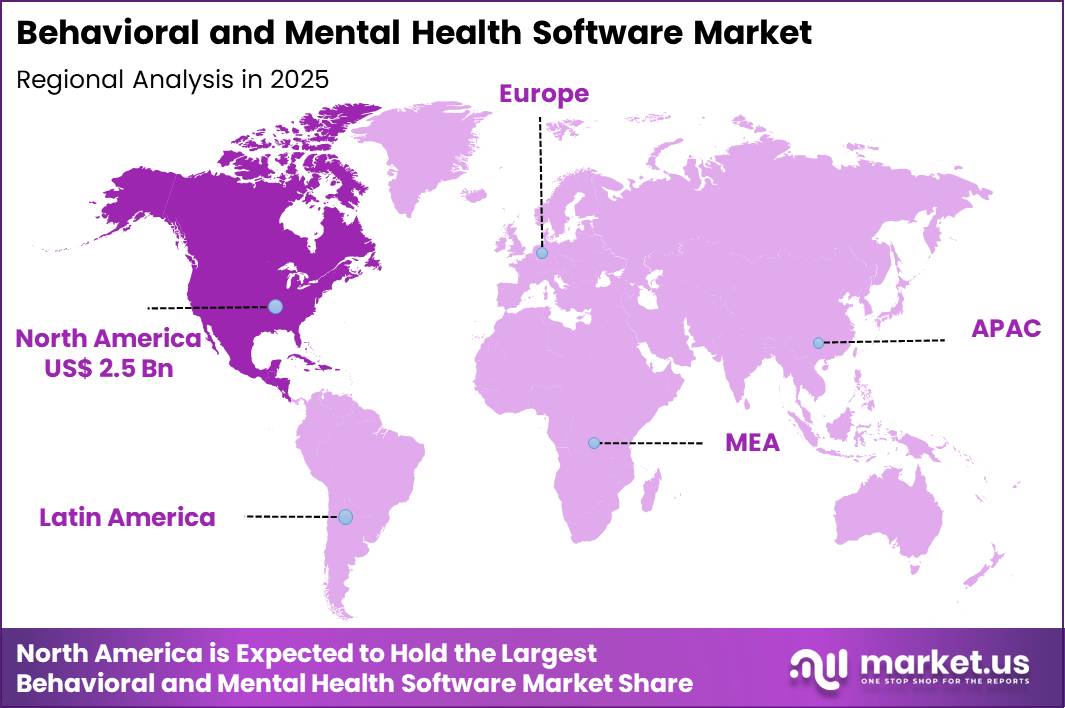
Global Behavioral and Mental Health Software Market size is expected to be worth around US$ 23.2 Billion by 2035 from US$ 5.5 Billion in 2025, growing at a CAGR of 15.6% during the forecast period from 2026 to 2035. In 2025, North America led the market, achieving over 45.0% share with a revenue of US$ 2.5 Billion.
The global Behavioral and Mental Health Software market is witnessing strong momentum as healthcare providers, governments, and behavioral health organizations increasingly adopt digital technologies to improve mental healthcare delivery, patient engagement, and clinical outcomes.
Behavioral and mental health software includes electronic health records (EHRs), tele-mental health platforms, practice management systems, clinical decision support tools, patient engagement applications, billing solutions, and analytics platforms specifically designed for psychiatric, psychological, and substance use treatment settings.
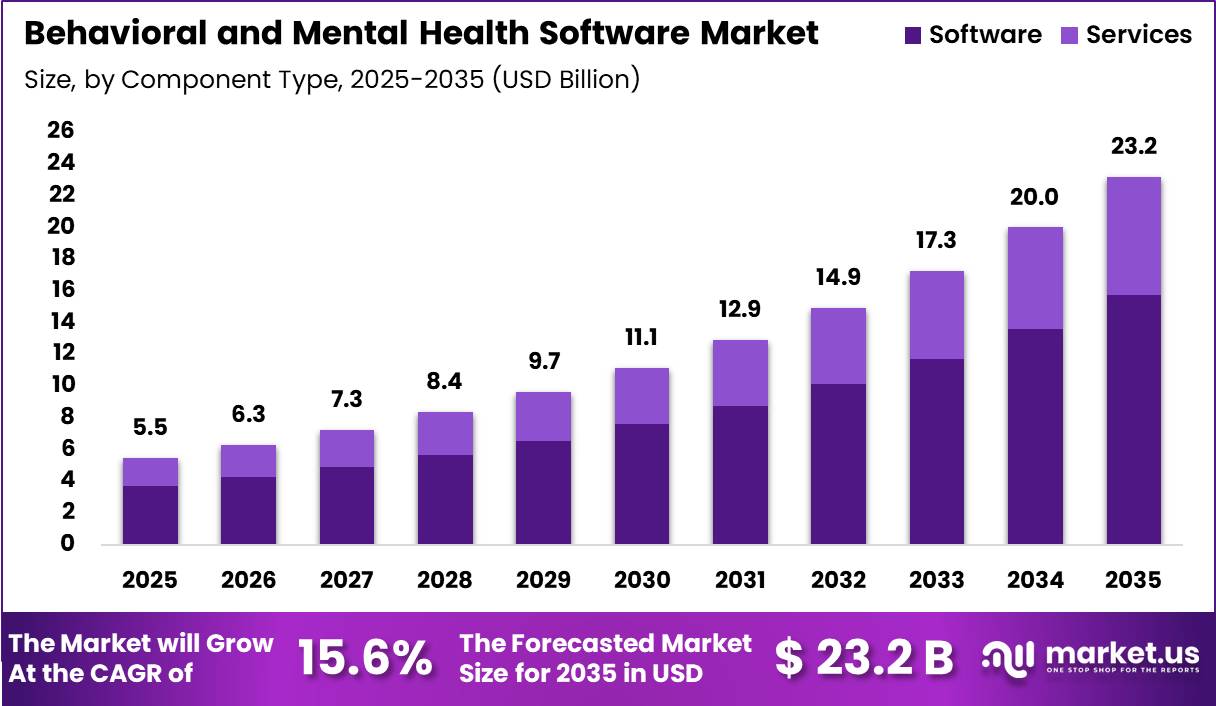
The growing need for behavioral health software is supported by the rising burden of mental disorders globally. According to the World Health Organization (WHO), approximately 1 in every 8 people worldwide—around 970 million individuals—were living with a mental disorder, with anxiety and depression representing the largest share.
The WHO also estimates that depression and anxiety result in the loss of approximately 12 billion working days every year, costing the global economy nearly US$ 1 trillion annually in lost productivity. Meanwhile, the U.S. Centers for Disease Control and Prevention (CDC) reports that nearly 1 in 5 U.S. adults experience a mental illness each year, highlighting the sustained demand for accessible and coordinated behavioral healthcare services.
Governments and healthcare systems are also accelerating investments in digital health infrastructure. The Office of the National Coordinator for Health Information Technology (ONC) reports that certified electronic health record adoption among U.S. office-based physicians exceeds 85%, creating a favorable environment for specialized behavioral health software integration.
Additionally, expanding telehealth utilization, interoperability initiatives, value-based care models, and increasing awareness of mental health are encouraging providers to implement secure, cloud-based behavioral health platforms that improve care coordination, regulatory compliance, remote patient monitoring, and data-driven clinical decision-making across hospitals, community mental health centers, and private practices.
Key Takeaways
- Market Size: The Behavioral and Mental Health Software Market size was US$ 5.5 Billion in 2025.The market is estimated to grow to US$ 23.2 Billion by 2035.
- Market Share: The Compound Annual Growth Rate (CAGR) of the market from 2026 to 2035 will be 15.6%.
- By Component: Software has the largest market share, accounting for 68.0% of total sales.
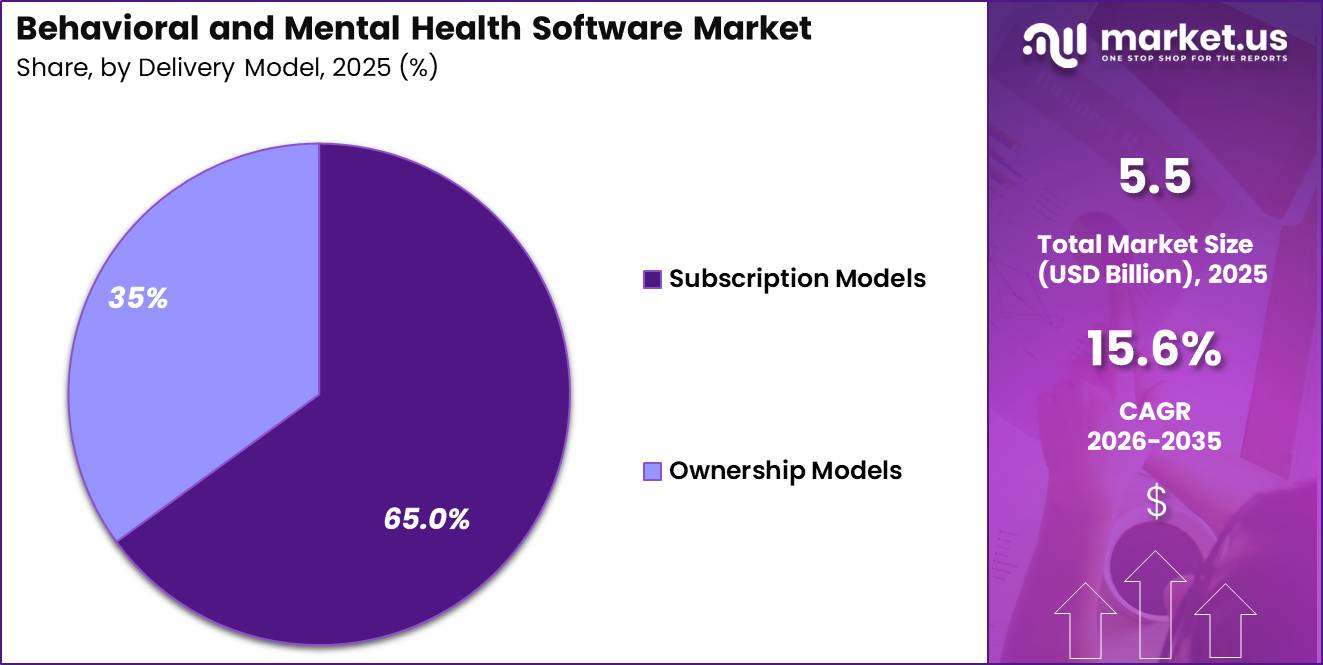
- By Delivery Model: Subscription Models dominate the segment, accounting for 65.0% of total revenue.
- By Function: Clinical Function leads the segment, accounting for 55.0% of total revenue.
- By End User: Hospitals and Clinics lead the segment, accounting for 52.0% of total revenue.
- Regional Analysis: North America is the dominant regional market, accounting for 45.0% of global sales.
Component Analysis
The software segment dominated the Behavioral and Mental Health Software Market in 2025, accounting for 68% of the total market share. Its leadership is driven by the increasing adoption of integrated digital platforms that streamline clinical, administrative, and financial operations across behavioral healthcare organizations.
Mental health providers are investing in software solutions that support electronic health records (EHR), telepsychiatry, appointment scheduling, clinical documentation, patient engagement, e-prescribing, billing, and regulatory compliance within a unified ecosystem.
The growing emphasis on outcome-based care and interoperability has further accelerated software implementation, enabling providers to improve workflow efficiency while delivering personalized treatment plans. Cloud-enabled software, artificial intelligence-assisted clinical decision support, and data analytics capabilities are also strengthening the value proposition of comprehensive behavioral health platforms.
The services segment represented the remaining 32% of the market in 2025. Demand for consulting, implementation, customization, training, technical support, and system maintenance continues to expand as healthcare organizations deploy increasingly sophisticated digital solutions.
Service providers play a critical role in integrating behavioral health software with existing hospital information systems, ensuring regulatory compliance, minimizing operational disruptions, and optimizing software performance. As digital transformation initiatives accelerate globally, managed services and ongoing technical support are expected to remain essential for maximizing long-term software utilization and return on investment.
Delivery Model Analysis
The subscription models segment held the largest share of the Behavioral and Mental Health Software Market in 2025, capturing 65% of total revenue. Subscription-based delivery has become the preferred approach because it offers lower upfront investment, predictable operating expenses, automatic software updates, and scalable deployment for organizations of all sizes.
Healthcare providers increasingly favor subscription solutions that support cloud-based access, remote patient care, cybersecurity enhancements, and seamless integration with evolving clinical workflows.
The model also enables vendors to continuously introduce new features, regulatory updates, and artificial intelligence capabilities without requiring major system replacements, making it highly attractive for behavioral healthcare organizations undergoing digital modernization.
The ownership models segment accounted for the remaining 35% of the market in 2025. These solutions continue to be adopted by large hospitals, government healthcare institutions, and organizations with extensive internal IT infrastructure seeking greater control over data management, customization, and long-term software assets.
Ownership models remain relevant in regions with strict data governance requirements or where healthcare providers prefer on-premises deployment for enhanced security and operational independence. Although adoption is growing at a slower pace than subscription offerings, ownership-based solutions continue to serve organizations requiring extensive customization, dedicated infrastructure, and complete control over software environments.
Function Analysis
The clinical function segment dominated the Behavioral and Mental Health Software Market in 2025, accounting for 55% of the overall market. Growth is supported by increasing demand for digital tools that enhance patient care, improve clinical decision-making, and optimize treatment outcomes.
Clinical software modules facilitate electronic health records, therapy documentation, medication management, telebehavioral health consultations, treatment planning, clinical assessments, and patient monitoring within integrated platforms.
Healthcare providers are prioritizing solutions that reduce administrative burden while improving care coordination, patient engagement, and compliance with clinical guidelines. Artificial intelligence-assisted documentation, predictive analytics, and measurement-based care tools are further strengthening the clinical software landscape by enabling more personalized and evidence-driven behavioral health interventions.
The remaining market share is represented by administrative, financial, operational, and analytics functions that support healthcare organizations in managing scheduling, billing, claims processing, revenue cycle management, reporting, workforce management, and regulatory compliance.
These operational capabilities help behavioral health providers improve efficiency, reduce manual workloads, and maintain financial sustainability while supporting expanding patient volumes. As healthcare organizations continue investing in integrated digital ecosystems, both clinical and operational functions are increasingly being combined into comprehensive platforms that enable seamless information exchange and coordinated behavioral healthcare delivery.
End User Analysis
The hospitals and clinics segment led the Behavioral and Mental Health Software Market in 2025, capturing 52.0% of the total market share. Their dominance reflects widespread adoption of digital behavioral health platforms to improve patient management, enhance clinical documentation, streamline care coordination, and support integrated mental healthcare delivery.
Hospitals and specialty clinics increasingly utilize software solutions for electronic health records, telepsychiatry, appointment scheduling, medication management, billing, and regulatory compliance.
Growing patient volumes, increasing prevalence of mental health disorders, and expanding integration of behavioral health services into primary care settings continue to strengthen software demand across these healthcare facilities. Advanced analytics and artificial intelligence are also supporting better clinical outcomes through personalized treatment planning and predictive care management.
The remaining market consists of community mental health centers, private behavioral health practices, rehabilitation facilities, academic institutions, government healthcare organizations, and other specialty care providers.
These end users are steadily increasing software investments to improve operational efficiency, expand virtual care services, enhance patient engagement, and comply with evolving healthcare regulations. Rising digital transformation initiatives, combined with greater emphasis on accessible and coordinated mental healthcare, are expected to support continued adoption of behavioral health software across diverse healthcare delivery settings throughout the forecast period.
Market Segmentations
By Component
- Software
- Services
By Delivery Model
- Subscription Models
- Ownership Models
By Function
- Clinical Function
- Administrative Function
- Financial Function
By End User
- Hospitals and Clinics
- Patients / Individuals
- Others
Drivers
Reimbursed tele mental health and home based access expansion
CMS preserved key behavioral health tele health flexibilities through 2025, including audio only pathways for behavioral health and delayed in person requirements for certain settings, while maintaining permanent room for mental health visits via live video or audio only in FQHC and RHC contexts under defined conditions; that matters because software demand rises fastest where reimbursement is claimable, scheduling friction falls, and no show recovery improves.
In practical terms, this expands the addressable software stack beyond video visits into intake automation, eligibility checks, virtual group therapy coordination, remote care documentation, e prescribing support, and longitudinal engagement workflows; vendors capture value not just from visit software seats, but from recurring revenue tied to tele triage, patient messaging, digital front doors, and clinician utilization management.
The economic logic is strong: when a provider can convert previously unbillable follow up touch points into reimbursable virtual encounters, software spend becomes easier to justify as a percentage of recovered visit volume, especially in psychiatry, counseling, substance use treatment, and rural access models where labor scarcity is severe.
| Driver | (~) % Impact on CAGR Forecast | Geographic Relevance | Impact Timeline |
|---|---|---|---|
| Reimbursed tele-mental health and home-based access expansion | +2.4% | North America core, rural US, Canada, UK, Australia | Short term (≤ 2 years) |
| Parity enforcement and payer utilization analytics build-out | +1.9% | US core, EU selective, employer-sponsored markets | Medium term (2-4 years) |
| Ambient AI documentation and clinician productivity recovery | +1.6% | US core, Canada, Western Europe, advanced APAC | Short term (≤ 2 years) |
| Integrated behavioral-physical care and Medicaid value-based workflows | +1.7% | US Medicaid-heavy states, EU integrated systems, APAC public corridors | Medium term (2-4 years) |
| Digital mental health treatment reimbursement and regulated device onboarding | +1.3% | US core first, EU regulated follow-on, Japan selective | Medium term (2-4 years) |
| Rising prevalence, youth demand, and chronic access gaps | +2.1% | Global broad-based, North America and EMEA strongest monetization | Long term (≥ 4 years) |
Challenges
Fragmented clinical workflows limiting scalable software utilization
Underlying workflow fragmentation in behavioral health practices where 25 to 40% of small and mid sized providers still juggle separate systems for scheduling, notes, tele health, billing, and measurement based care creates persistent friction that shaves an estimated 1.6% points off achievable CAGR by depressing user satisfaction, slowing rollouts, and increasing churn.
On a typical outpatient clinic panel of 15 to 20 sessions per clinician per day, context switching across three to five unintegrated tools can consume 20 to 35 minutes of non reimbursable time daily, effectively reducing appointment capacity by 5 to 8% and inflating fully loaded cost per encounter by 6 to 10% when salary, overhead, and license fees are combined.
This friction manifests in elongating implementation cycles enterprise deployments stretching from an ideal 4 to 6 months to 9 to 14 months and in 10 to 15% under utilization of licensed seats in the first year, which directly dampens realized ARR relative to booked contract value and forces vendors to spend an extra 8 to 12% of revenue on customer success and training to drive adoption.
Strategically, vendors are forced to invest in deeper workflow orchestration, building native integrations to practice management, payers, and telehealth platforms, while also introducing role specific interfaces and configurable templates that can reduce average documentation time per session by 1 to 2 minutes and increase first year active user ratios by 10 to 20% points.
Gradually normalizing this drag over a 2 to 4 year horizon as mature playbooks propagate through North American, European, and ANZ provider networks.
| Challenge | (~) % CAGR Friction Drag | Geographic Relevance | Mitigation Horizon |
|---|---|---|---|
| Fragmented clinical workflows | -1.6% | North America, Europe, ANZ | Medium term (2-4 years) |
| Chronic clinician capacity gap | -1.8% | US, Canada, Western Europe | Long term (≥ 4 years) |
| Data privacy and cyber exposure | -1.2% | US, EU regulatory hubs | Medium term (2-4 years) |
| Interoperability and standards lag | -1.4% | US, EU, APAC hospitals | Long term (≥ 4 years) |
| Reimbursement and outcome proofing | -1.0% | US, UK, selected OECD payers | Medium term (2-4 years) |
| AI/analytics governance and bias risk | -0.9% | US, EU, advanced APAC | Long term (≥ 4 years) |
Restraints
Persistent integration, interoperability and interface fragmentation risks
Fragmented interoperability across EHRs, payers, labs, and tele health systems remains a key restraint for behavioral and mental health software. Most platforms still depend on mixed HL7 v2 feeds, proprietary APIs, and partial FHIR adoption, which forces costly custom integrations and services work.
Integration typically consumes 25 to 40 percent of implementation budgets and can extend deployments from 3 to 4 months to 9 to 12 months in multi system or cross border settings.
Vendors must maintain multiple interfaces, each requiring significant engineering effort, which slows scaling and increases support costs. Even regulatory interoperability efforts such as FHIR mandates and TEFCA participation add short term complexity by layering new requirements over legacy systems.
This increases time to value, extends payback periods toward 30 months or more, and reduces adoption speed in budget constrained healthcare systems. Overall, this friction is estimated to reduce global CAGR by about 1.8 percentage points.
| Restraint | (~) % Impact on CAGR Forecast | Geographic Relevance | Impact Timeline |
|---|---|---|---|
| Escalating compliance & audit burden | -2.0% | North America core, EU | Short–Medium term |
| Fragmented integration & interoperability | -1.8% | North America, EU, APAC corridors | Medium–Long term |
| Clinical workforce shortages & adoption gaps | -1.5% | North America, EU, Emerging APAC | Medium–Long term |
| Underfunded public mental health & reimbursement lag | -1.0% | EU, Emerging APAC, Latin America | Short–Medium term |
| Cybersecurity, privacy & trust incidents | -0.8% | North America, EU | Short–Medium term |
| Capital intensity & vendor consolidation risk | -0.7% | North America, EU, Global enterprise | Medium–Long term |
Opportunity
Value-based, outcomes linked behavioral health software platforms
This opportunity shifts behavioral health software from per seat or per visit pricing to outcomes based monetization tied to clinical and functional results such as symptom reduction, relapse prevention, and productivity gains.
While current revenue is mainly driven by digitizing scheduling, documentation, tele health, and billing workflows, the larger upside is capturing value from improved patient outcomes and downstream cost savings. By 2030 to 2035, payers in North America and Western Europe are expected to expand value based reimbursement in behavioral health, potentially linking 15 to 25% of spend to outcomes metrics.
Platforms that demonstrate 15 to 30% reductions in readmissions or 10 to 20 percent lower total cost of care can earn performance based fees on a share of savings, creating a second revenue layer above core software licensing.
If adopted across 10 to 15% of deployments, this model could add low tens of billions in addressable revenue and about 2 percentage points of incremental CAGR over baseline forecasts. It remains an opportunity rather than a driver because most systems still lack standardized outcomes data, payer integration, and mature risk based contracting infrastructure.
| Opportunity | (~) % Potential CAGR Upside | Geographic Relevance | Execution Window |
|---|---|---|---|
| Value-based, outcomes-linked platforms | +2.0% | North America, Western Europe | Medium term (2–4 years) |
| Employer and payer B2B2C integration | +1.8% | North America, EU, APAC developed | Short term (≤ 2 years) |
| AI-first, low-touch stepped-care automation | +2.5% | North America, EU, APAC emerging | Medium term (2–4 years) |
| Public-sector and low-income population stacks | +1.7% | APAC emerging, Latin America, Middle East, Africa | Long term (≥ 4 years) |
| Specialty and comorbidity-focused vertical suites | +1.5% | North America, Europe | Short–medium term (≤ 4 years) |
| M&A roll-up of fragmented point solutions | +1.2% | North America, Europe, select APAC | Medium–long term (≥ 3 years) |
Regional Analysis
In 2025, North America led the market, achieving over 45.0% share with a revenue of US$ 2.5 Billion.
In 2025, North America dominated the Behavioral and Mental Health Software Market, supported by advanced healthcare IT infrastructure, widespread adoption of electronic health records (EHRs), and increasing demand for digital behavioral health solutions.
The region benefits from favorable reimbursement policies, strong investment in tele psychiatry platforms, and growing integration of artificial intelligence and analytics into mental healthcare workflows. Rising prevalence of anxiety, depression, substance use disorders, and other behavioral conditions continues to encourage healthcare providers to modernize clinical operations through cloud-based and interoperable software platforms.
Europe represented the second-largest regional market, driven by expanding digital health initiatives, government-backed mental health strategies, and increasing adoption of interoperable healthcare information systems. Countries across Western Europe are investing in integrated behavioral care, remote patient monitoring, and secure data-sharing frameworks, supporting sustained demand for mental health software solutions.
Asia-Pacific is projected to register the fastest growth during the forecast period. Rapid healthcare digitalization, improving internet connectivity, expanding telemedicine services, and increasing awareness of mental health are accelerating software adoption across countries such as China, Japan, Australia, and South Korea. Public and private investments in healthcare technology further strengthen regional market expansion.
Latin America and the Middle East & Africa are emerging markets, supported by gradual improvements in healthcare infrastructure, growing implementation of digital health platforms, and increasing government focus on expanding access to behavioral and mental healthcare services.
Although adoption remains comparatively lower, ongoing investments in healthcare modernization and cloud-based solutions are expected to create significant long-term growth opportunities across these regions.
Key Regions and Countries
North America
- The US
- Canada
Europe
- Germany
- France
- The U.K.
- Italy
- Spain
- Russia & CIS
- Rest of Europe
Asia Pacific
- China
- India
- Japan
- South Korea
- ASEAN
- Australia & New Zealand
- Rest of Asia Pacific
Middle East & Africa
- GCC
- South Africa
- Rest of Middle East & Africa
Latin America
- Brazil
- Mexico
- Rest of Latin America
Key Player Analysis
The Behavioral and Mental Health Software Market is moderately consolidated, with competition driven by a combination of established healthcare IT vendors and specialized behavioral health software providers. The market has reached a mature stage in core electronic health record (EHR) functionality.
While innovation continues to accelerate in areas such as cloud-based platforms, artificial intelligence-assisted clinical documentation, telebehavioral health, patient engagement, interoperability, and value-based care analytics. Vendors increasingly focus on improving care coordination, regulatory compliance, and data-driven decision-making while integrating behavioral health workflows into broader healthcare ecosystems.
The competitive landscape can be viewed across three strategic tiers. Large healthcare IT companies, including Epic Systems Corporation, Cerner Corporation, McKesson Corporation, and Allscripts Healthcare Solutions Inc., leverage enterprise-scale EHR platforms, interoperability capabilities, and extensive provider networks to support integrated behavioral healthcare delivery.
Specialized behavioral health software providers, such as Qualifacts Systems Inc., Netsmart Technologies Inc., Valant Medical Solutions Inc., MindLinc, Welligent Inc., The Echo Group, Core Solutions Inc., TherapyNotes LLC, Therapy Brands, Accumedic Computer Systems Inc., and Advanced Data Systems, concentrate on outpatient behavioral health, community mental health organizations, and specialty provider workflows through tailored clinical and administrative solutions.
Competition is primarily based on continuous product innovation, cloud deployment, AI-enabled documentation, configurable clinical workflows, revenue cycle optimization, and regulatory compliance. Vendors strengthen their market positions through strategic collaborations with healthcare providers, telehealth platforms, payer organizations, and interoperability networks to enhance integrated care delivery.
Increasing investment in analytics, patient engagement technologies, population health management, and workflow automation further differentiates market participants, while scalable subscription-based platforms and ecosystem integration remain central to long-term competitive positioning in the evolving behavioral and mental health software market.
Top Key Players
- Qualifacts Systems Inc.
- Netsmart Technologies Inc.
- Epic Systems Corporation
- Cerner Corporation
- McKesson Corporation
- Allscripts Healthcare Solutions Inc.
- Valant Medical Solutions Inc.
- MindLinc
- Welligent Inc.
- The Echo Group
- Core Solutions Inc.
- TherapyNotes LLC
- Therapy Brands
- Accumedic Computer Systems Inc.
- Advanced Data Systems
Recent Developments
- In January 2025, Innovaccer raised US$ 275 million in a Series F funding round to accelerate development of its AI-powered healthcare platform, expand enterprise AI capabilities, and strengthen behavioral health and population health solutions.
- In August 2025, Oracle Health launched its next-generation AI-powered electronic health record (EHR), featuring conversational AI, voice-enabled workflows, and clinical decision support designed to improve mental and behavioral healthcare documentation and clinician efficiency.
- In September 2025, Innovaccer, a leading healthcare AI platform, acquired virtual specialty care company Story Health. This strategic deal extended Innovaccer’s Healthcare Intelligence Cloud into “agentic care” to scale continuous, AI-assisted specialty care nationwide.
Report Scope
| Report Features | Description |
|---|---|
| Market Value (2025) | US$ 5.5 Billion |
| Forecast Revenue (2035) | US$ 23.2 Billion |
| CAGR (2026-2035) | 15.6% |
| Base Year for Estimation | 2025 |
| Historic Period | 2020-2024 |
| Forecast Period | 2026-2035 |
| Report Coverage | Revenue Forecast, Market Dynamics, Competitive Landscape, Recent Developments |
| Segments Covered | By Component (Software, Services) By Delivery Model (Subscription Models, Ownership Models) By Function (Clinical Function, Administrative Function, Financial Function)By End User(Hospitals and Clinics, Patients / Individuals, Others) |
| Regional Analysis | North America – The US, Canada; Europe – Germany, France, U.K., Italy, Spain, Russia & CIS, Rest of Europe; Asia Pacific – China, India, Japan, South Korea, ASEAN, Australia & New Zealand, Rest of Asia Pacific; Middle East & Africa – GCC, South Africa, Rest of Middle East & Africa; Latin America – Brazil, Mexico, Rest of Latin America |
| Competitive Landscape | Qualifacts Systems Inc.,Netsmart Technologies Inc.,Epic Systems Corporation,Cerner Corporation,McKesson Corporation,Allscripts Healthcare Solutions Inc.,Valant Medical Solutions Inc.,MindLinc,Welligent Inc.,The Echo Group,Core Solutions Inc.,TherapyNotes LLC,Therapy Brands, Accumedic Computer Systems Inc.,Advanced Data Systems |
| Customization Scope | Customization for segments, region/country-level will be provided. Moreover, additional customization can be done based on the requirements. |
| Purchase Options | We have three licenses to opt for: Single User License, Multi-User License (Up to 5 Users), Corporate Use License (Unlimited User and Printable PDF) |