
Introduction
Samsung Statistics: Samsung Electronics Co. Ltd. is a multinational electronics corporation based in South Korea and serves as the flagship subsidiary of the Samsung Group. Founded in 1969, it ranks as a leading global information technology firm by revenue and is recognized for its extensive range of consumer electronics, IT and mobile communication devices, as well as semiconductors. Samsung is structured into two primary divisions: Device eXperience (DX) and Device Solutions (DS).
Providing a diverse selection of products that includes smartphones, tablets, displays, and semiconductors, Samsung Electronics stands as one of the largest technology giants globally, with a significant presence in the consumer electronics, semiconductor, telecommunications, smartphone brands, and digital media sectors. Staying abreast of the latest advancements in the ever-evolving technology landscape, from artificial intelligence (AI) to foldable smartphones, the company has adeptly navigated these trends, launching its foldable product line and integrating Galaxy AI into the newest S24 series.
Editor’s Choice
- In the first quarter of 2025, Samsung announced a revenue of around $53.7 billion.
- In the first quarter of 2023, Samsung Electronics generated revenue of USD 54.3 billion, accompanied by an operating profit of USD 11.1 billion.
- In 2022, the company sold 200 million units, a decrease of 72.3 million compared to 2021.
- In the first quarter of 2023, Samsung’s global smartphone market share was recorded at 27.01%.
- Samsung’s net worth was assessed at USD 276.45 billion at the end of the first quarter of 2024.
- As of January 2023, the proportion of male users stands at 59.78%, while female users account for 40.22%.
Historical Facts
- Samsung was founded in 1938 as a trading company by Lee Byung-chul. Situated in a city known as Taegu, Samsung initially functioned as a grocery store, involved in the trade and export of locally produced goods.
- In the late 1960s, the firm ventured into the electronics industry.
- Moreover, Samsung diversified into the shipbuilding sector during the mid-1970s.
- During this same period, the company produced its first black-and-white televisions.
- Throughout the 1970s, Samsung manufactured transistor black-and-white TVs, color televisions, refrigerators, electric desk calculators, and air conditioning units.
- In 1978, Samsung reached the notable achievement of producing 5 million televisions.
- Before the decade ended, the company launched Samsung Electronics America and the Suwon R&D Center.
- In 1982, Samsung Printing Solutions was established to offer digital solutions for the printing industry.
- The company began the production of personal computers in 1983, and in the subsequent year, Samsung’s sales hit one trillion won.
- By the end of the decade, Samsung had earned the title of the global leader in semiconductor manufacturing.
Later 1900’s
- In the 1990s, Samsung emerged as a global leader in chip manufacturing, established Samsung Motors, and commenced the production of digital televisions.
- At the dawn of the new millennium, Samsung introduced the SPH-1300, an early prototype featuring touch-screen technology.
- Additionally, in 2005, it developed its inaugural speech-recognition mobile phone.
- In 2011, Samsung unveiled the Galaxy S II, which was succeeded in 2012 by the Galaxy S III, recognized as one of the most popular smartphones worldwide.
- In 2012, Samsung acquired mSpot, solidifying its position as the largest smartphone manufacturer globally.
- In 2014, the company launched the Gear VR, a virtual reality device designed for compatibility with the Galaxy Note 4.
- By 2017, Samsung initiated tests on a self-driving vehicle.
- The Samsung Group is involved in the operation of hotels and hospitals and manages South Korea’s largest life insurance company, overseeing more than 80 subsidiaries.
- In 2021, Samsung revealed its intention to invest $17 billion in the construction of a new semiconductor manufacturing plant in Taylor, Texas, as part of its strategy to enhance its chip production capabilities in response to the global semiconductor shortage.
General Samsung Electronics Statistics and Facts
- In the first quarter of 2025, Samsung announced a revenue of around $53.7 billion.
- As of April 2025, Samsung held a 22.88% share of the global smartphone market.
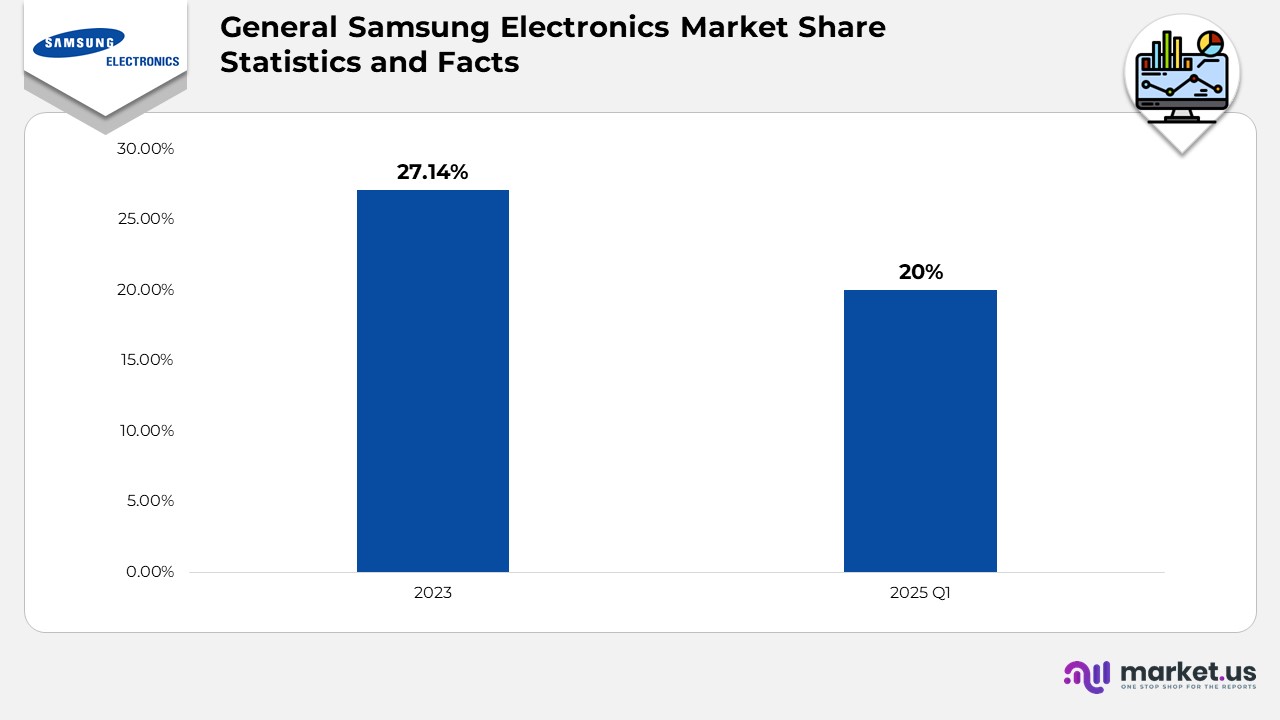
- In the first quarter of 2025, Samsung led global smartphone shipments with 60.5 million units, achieving a 20% market share.
- The company achieved an operating profit of about $4.7 billion in Q1 2025, showing a slight increase from the previous year.
- Samsung’s total capital expenditures amounted to ₩6 trillion in the fiscal year 2024, with ₩46.3 trillion allocated to the Device Solutions (DS) Division and ₩4.8 trillion for Samsung Display Corporation (SDC).
- In the first quarter of 2025, the company increased its R&D expenditure by 16% compared to the same period last year, reaching ₩9 trillion or $6.56 billion.
- In 2024, Samsung dedicated approximately ₩35 trillion (around $24.09 billion) to research and development, reflecting a 23.5% rise from the prior year.
- The Samsung Galaxy Watch 7 has become the most favored smartwatch among Android users in 2024.
- In 2020, Samsung reported an impressive revenue of $197,958,785,633, marking the first year of the pandemic.
Moreover
- By 2022, Samsung had established itself as the leading supplier of 5G smartphones globally, capturing a 31.1% market share. The company shipped a total of 90.2 million 5G smartphones, achieving a remarkable growth of 136% compared to 2021.
- When the Galaxy S3 was introduced, it achieved sales of 500 smartphones every minute.
- The fourth quarter of 2022 marked the least successful period for Samsung in the past decade, with year-on-year sales declining by 17%.
- Despite this, Samsung’s brand value rose by 17% year-over-year, reaching $87.7 billion in 2022, securing fifth place in Interbrand’s Best Global Brands.
- Fewer than 3% of smartphone enthusiasts prefer the Galaxy F series.
- Phantom Black is the most sought-after color for Samsung Galaxy S21 smartphones.
- More than 42% of Samsung Electronics’ workforce is based in the Korean region.
- At the start of 2023, Samsung commanded a 27.14% market share, trailing only Apple by a margin of 0.58%.
Earnings Statistics of Samsung
- In the fourth quarter of 2023, Samsung’s consolidated revenue amounted to 67.78 trillion won (USD 50.78 billion), reflecting a decrease of 3.8% compared to the previous year, while showing an increase of 0.56% from the prior quarter.
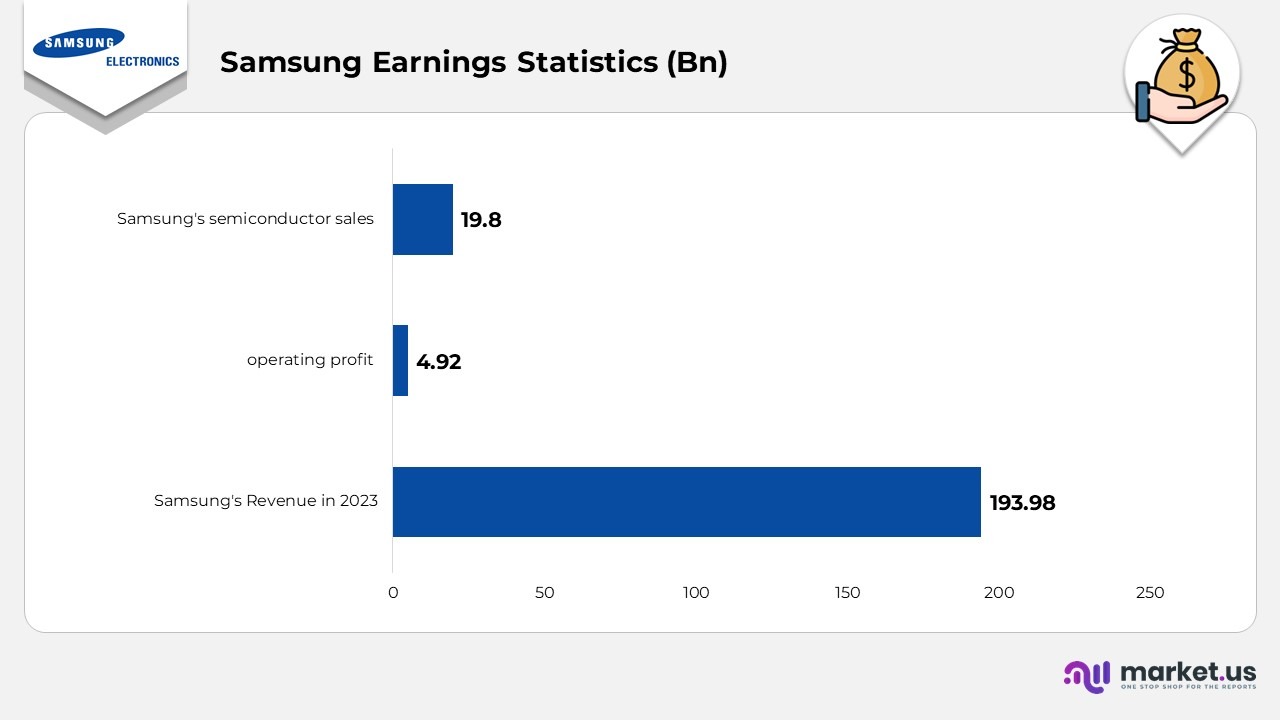
- As of 2023, Samsung’s total consolidated revenue reached 258.94 trillion won (USD 193.98 billion), marking a year-over-year decline of 13.32%, with an operating profit of 6.57 trillion won (USD 4.92 billion), which represents a significant reduction of 84.85% year-over-year.
- In the first quarter of 2023, Samsung Electronics generated revenue of USD 54.3 billion, accompanied by an operating profit of USD 11.1 billion.
- Based on Samsung’s sales data, the company has achieved the leading position among Android tablet manufacturers, capturing a market share of 23% in the first quarter of 2023.
- During the same quarter, Samsung’s semiconductor division reported sales of USD 19.8 billion, reflecting a growth of 23% compared to the previous year.
- Samsung’s consumer electronics segment, which includes televisions and home appliances, generated revenue of USD 13.3 billion, representing a 5% increase from the first quarter of 2022.
- The mobile division of Samsung reported total sales of USD 20.4 billion, indicating a year-over-year increase of 4%.
Samsung Annual Revenue Statistics
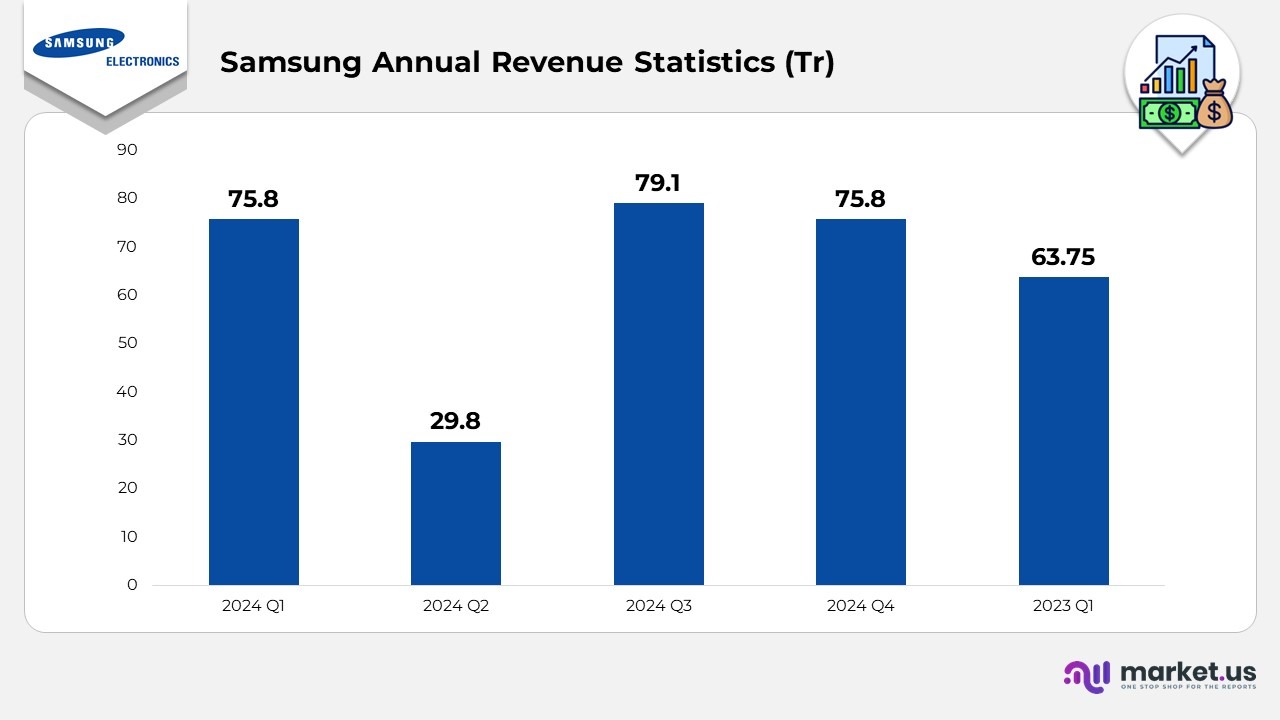
- In the first quarter of 2024, Samsung announced consolidated revenue amounting to KRW 75.8 trillion (USD 52.09 billion) alongside an operating profit of KRW 6.5 trillion (USD 4.46 billion).
- During the second quarter of 2024, the company recorded a gross profit of KRW 29.8 trillion (USD 20.46 billion), reflecting an increase of KRW 3.7 trillion (USD 2.54 billion) compared to the prior quarter.
- In the third quarter of 2024, Samsung’s total revenue rose to KRW 79.1 trillion (USD 54.37 billion), marking a 7% increase compared to the prior quarter. The operating profit for this quarter amounted to KRW 9.18 trillion (USD 6.31 billion).
- In the fourth quarter of 2024, the company announced consolidated revenue amounting to KRW 75.8 trillion (USD 52.09 billion) and an operating profit of KRW 6.5 trillion (equivalent to USD 4.46 billion).
- For the full year of 2024, Samsung’s total annual revenue reached KRW 300.9 trillion (USD 206.86 billion).
- In the first quarter of 2023, Samsung’s total income from the sale of goods and services was ₩75 trillion, equivalent to approximately USD 45.57 billion.
- During this period, the company’s operating profit was ₩640 billion, or USD 478.55 million, which represented a significant 95% decline from the previous year.
- In the third quarter of 2023, Samsung reported a remarkable operating profit increase of 262.6% compared to the preceding quarter, despite experiencing a 77.6% decrease relative to the same quarter of the previous year.
- The second-quarter earnings for 2023 indicated a sharp decline, with a 95% drop in profit attributed to persistently low demand for memory chips.
- Revenue for the second quarter was slightly below expectations at ₩01 trillion (approximately USD 47.21 billion), while the operating profit exceeded forecasts at ₩0.67 trillion.
Samsung Smartphones Annual Sales
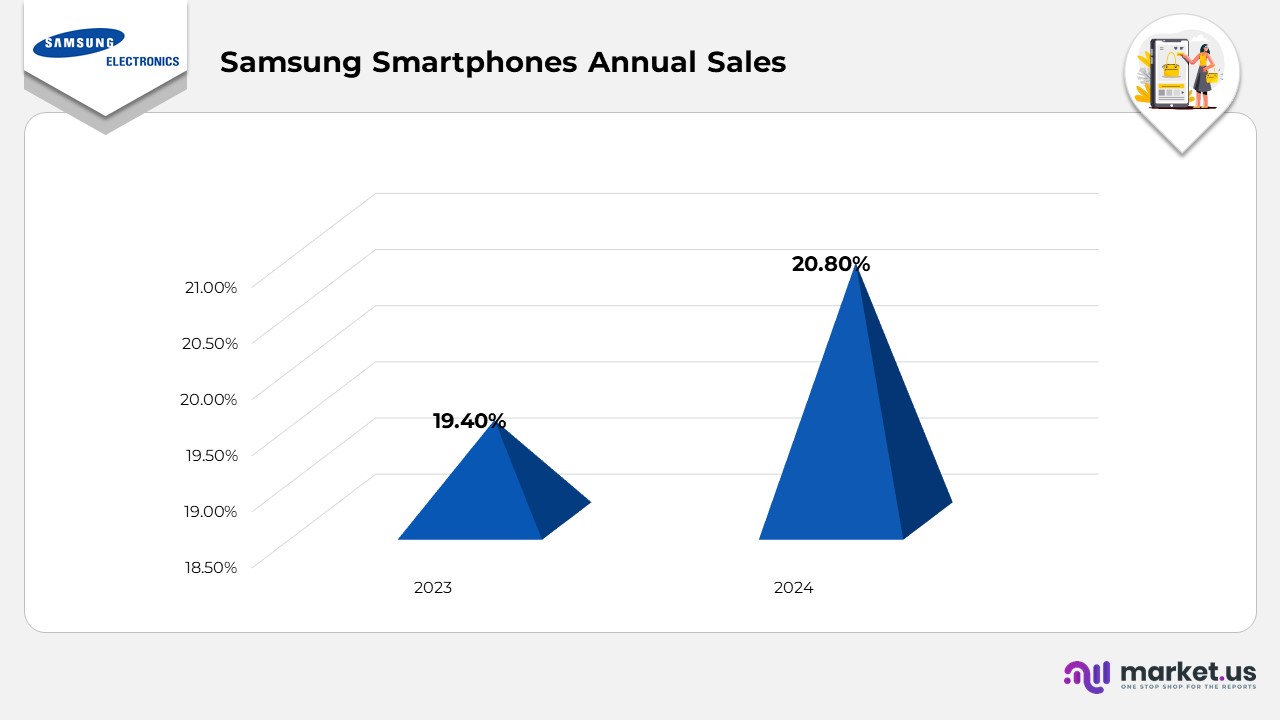
- In 2023, Samsung experienced a decline in smartphone shipments, totaling 226.6 million units, which represented a 19.4% share of the market. This was the first occasion on which Apple outperformed Samsung in global smartphone shipments.
- In the first quarter of 2024, Samsung reclaimed its top position by shipping 60.2 million units, which accounted for a 20.8% market share.
- In 2022, the company sold 200 million units, a decrease of 72.3 million compared to 2021.
- The peak year for the company was 2019, during which it sold 295 million phones.
- Although 2019 began slowly, with an 8.56% drop in sales during the first quarter compared to the previous year, Samsung ultimately experienced a significant surge in sales.
- From early 2019 to early 2021, Samsung’s smartphone sales increased dramatically by 382.61%.
Market Share of Samsung Smartphones
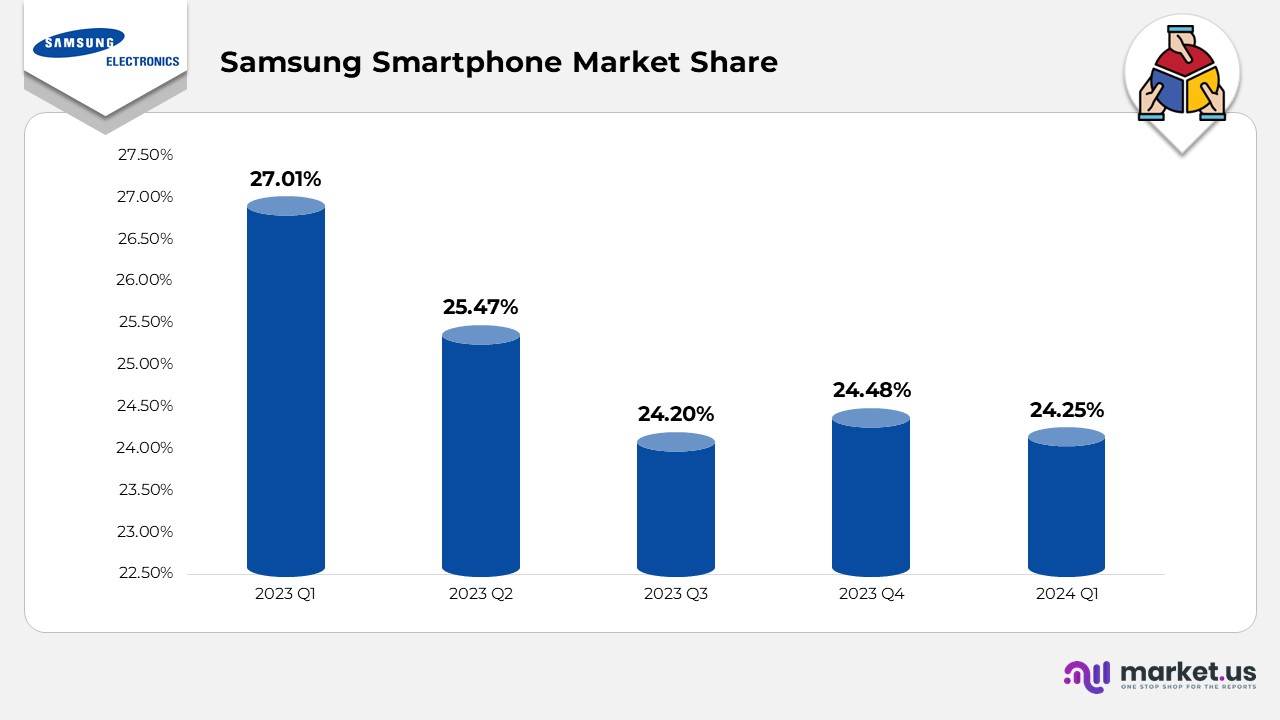
- In the first quarter of 2023, Samsung’s global smartphone market share was recorded at 27.01%.
- Additionally, the quarterly shares for 2023 are as follows: Q2 at 25.47%, Q3 at 24.20%, and Q4 at 24.48%.
- A report from bankmycwll.com indicates that in Q1 of 2024, the expected market share for Samsung smartphones will be 24.25%.
- Throughout 2023, Samsung smartphones maintained a substantial market presence across various continents.
- In North America, the market share began at 28.82% in January and experienced a decline to 22.71% by December, followed by a slight recovery to 23.1% in January 2024.
- Europe exhibited greater stability, with Samsung starting at 31.45% in January 2023, dipping to 29.5% in May, and stabilizing around 31% towards the year’s end, ultimately reaching 31.6% in January 2024.
- In South Africa, Samsung was the leading brand, commencing the year with a market share of 33.91% and concluding at 31.03% in December, followed by a further decrease to 30.63% in January 2024.
- The Asian markets experienced a more pronounced decline, starting at 22.95% in January 2023 and decreasing each month, ultimately falling to a low of 18.78% by January 2024.
Samsung Shipment by Segment
- Samsung has successfully sold 1.01 million units of its OLED TV lineup by 2023, capturing a market share of 22.7%, with expectations to increase this share in 2024.
- In the United States, only 23% of Samsung refrigerators were sold in 2023.
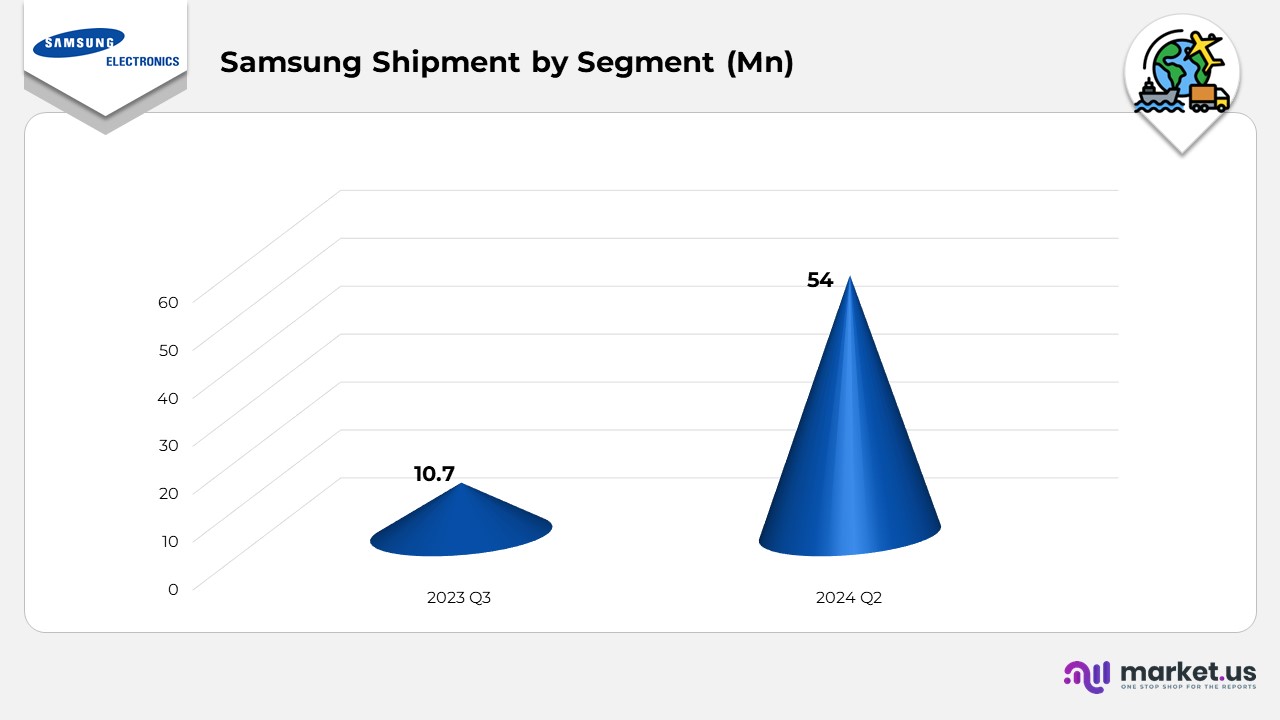
- Overall, Samsung’s wearable shipments in the third quarter of 2023 totaled 10.7 million units, representing a market share of 7.2%.
- The year-over-year growth rate for total shipments has declined by 9.1%.
- In 2023, the company’s capital expenditure reached approximately KRW 53.1 trillion, which includes KRW 48.4 trillion for the Device Solutions Division and KRW 2.4 trillion for Samsung Display Corporation.
- In the semiconductor sector, Samsung secured third place due to an 8% revenue growth in the second quarter of 2023.
- At the same time, Samsung Foundry’s market share fell to 11%.
- Samsung MX reported an operating profit of KRW 3.3 trillion ($2.44 billion) in the second quarter of 2023.
- In the third quarter of 2023, the global TV market share rose to 30%, indicating potential growth for the 18th consecutive year.
- From 2011 to 2021, these segments exhibited varying trends in revenue generation.
- Samsung Semiconductors experienced consistent growth, achieving a peak revenue of USD 79.36 billion in 2021, up from USD 32.51 billion in 2011.
- The Samsung Communication segment also experienced growth, starting at USD 46.95 billion in 2011 and increasing to USD 88.24 billion in 2021, with its highest revenue recorded at USD 117.53 billion in 2013.
- Samsung Consumer Electronics experienced revenue fluctuations, peaking at USD 52.29 billion in 2011 and declining to USD 47.06 billion in 2021.
- Samsung shipped 54 million smartphones in the second quarter of 2024, reflecting a decrease compared to both the previous quarter and the same period last year.
Samsung Net Worth Statistics
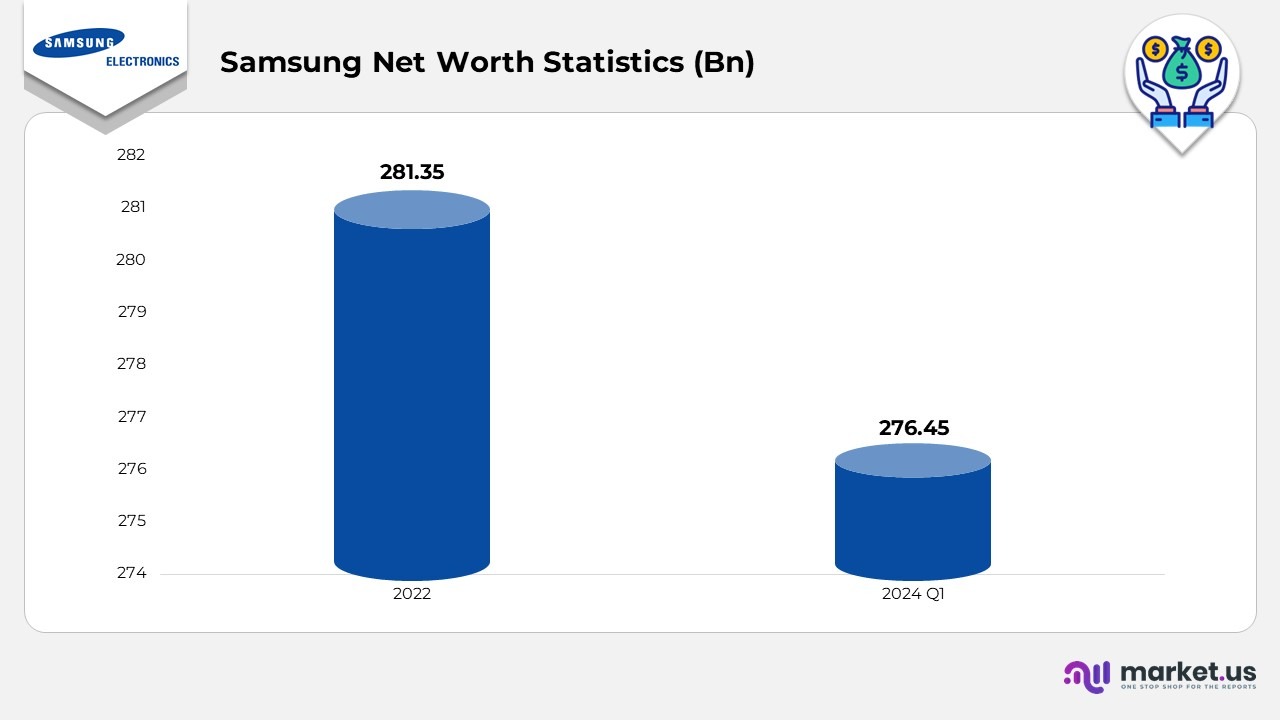
- Samsung’s net worth was assessed at USD 276.45 billion at the end of the first quarter of 2024.
- This indicates a decline of 1.67% compared to the end of 2023.
- In 2023, the net worth remained nearly stable in relation to 2022, reflecting a slight decrease of 0.07%.
- The company’s net worth in 2022 was recorded at USD 281.35 billion, representing a growth of 9.8%.
- Since 2005, the value commenced at USD 41.54 billion and has risen considerably over the years.
- Significant growth was noted in various years, including a 33.22% increase in 2012 and a 25.69% increase in 2017.
- The peak value prior to 2024 was in 2022.
- There have been variations throughout the years, including a 16.17% decline in 2008.
Statistics of Samsung Life Insurance
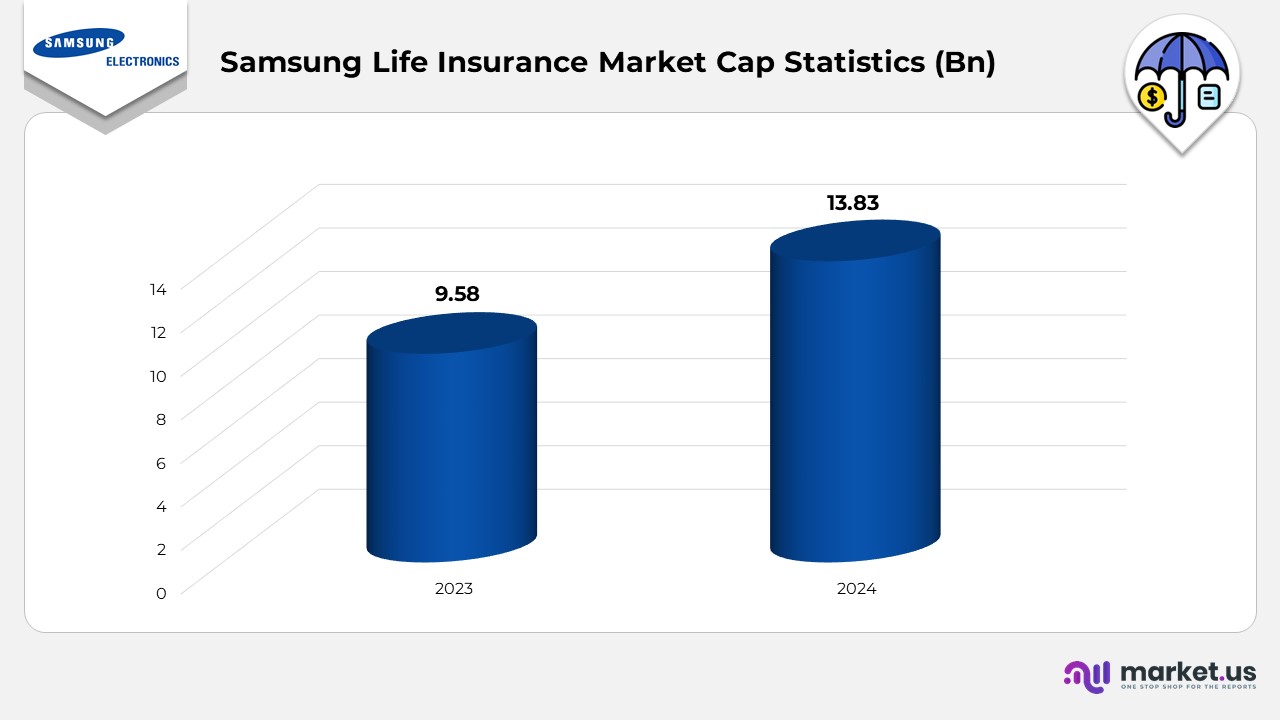
- Samsung Life Insurance has been ranked 1239th and is projected to achieve a market capitalisation of USD 13.83 billion, reflecting a 44.37% change in February 2024.
- In 2023, the overall market capitalisation stood at $9.58 billion, which represents a decline of 4.65%.
- The market capitalisation has begun to rise again since 2024, with figures recorded on 13 January (USD 8.65 billion) and 3 February (USD 11.19 billion).
- Annual earnings for 2023 amounted to USD 3.16 billion, marking an increase of 32.95% compared to the previous year.
- As per the most recent financial report, the company’s revenue reached USD 18.49 billion during the same timeframe.
Samsung Website Traffic by Device
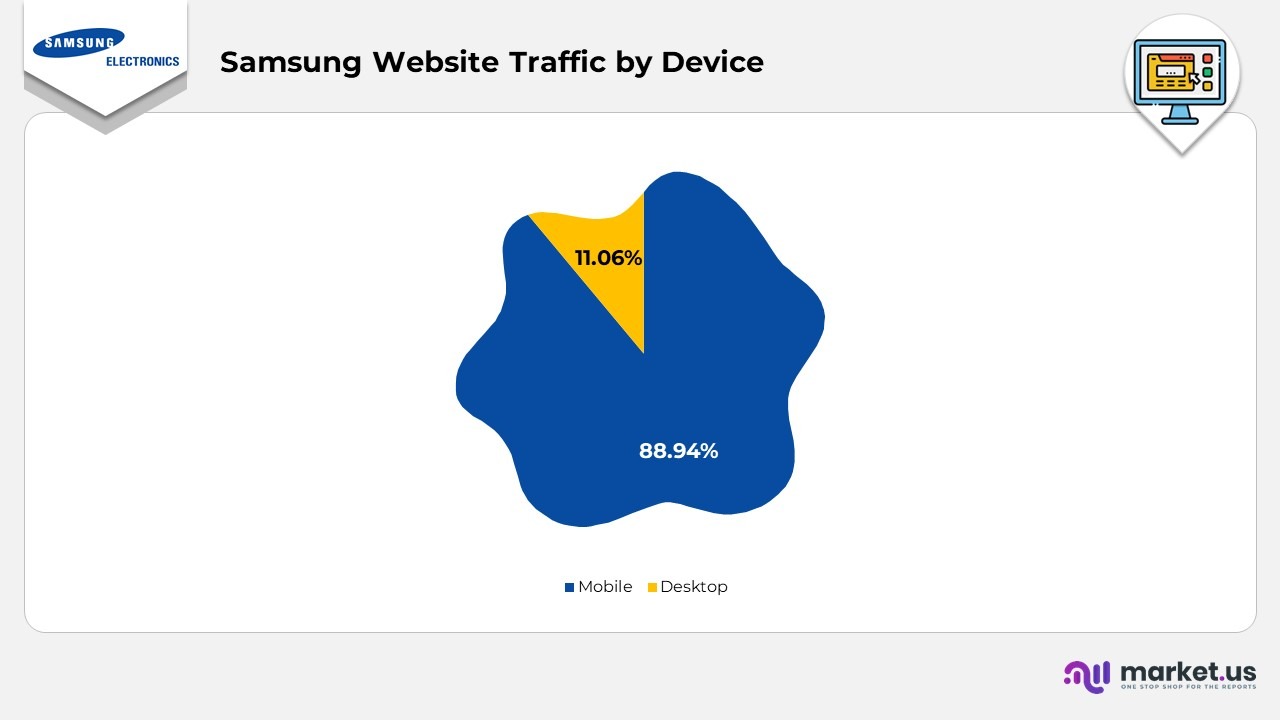
- Globally, 88.94% of users are mobile Samsung users, while 11.06% are desktop users.
- 41% of all Samsung users are located in the United States, which equates to 178.26 million users; among these, 12.12% utilize desktop devices, and 87.88% use mobile devices.
- India has a total of 100.84 million users, which accounts for 12.11% of the total; of these, 5.49% are desktop users, and 94.51% are mobile users.
- Among the total player base, 5.25% are from Indonesia, amounting to 43.71 million users, with 3.05% accessing the desktop version and 96.95% using mobile devices.
- Brazil and the United Kingdom have approximately 43.24 million and 30.21 million users, respectively, representing 5.19% and 3.63% of the total.
- In Brazil, 16.35% of users are desktop users, while 83.65% are mobile users; in the United Kingdom, 14.91% access the site via desktop, and 85.09% do so through mobile devices.
Samsung Website Traffic by Demographics
- As of January 2023, the proportion of male users stands at 59.78%, while female users account for 40.22%.
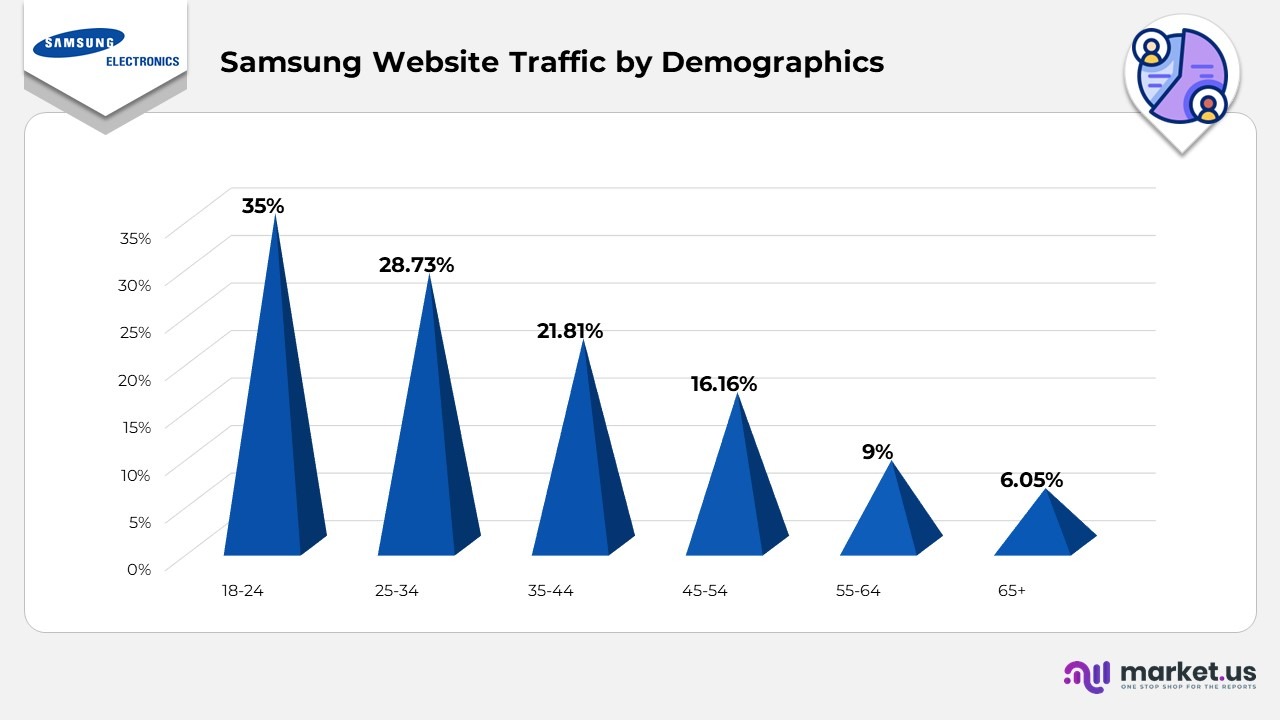
- According to Samsung Statistics by demographic, the largest segment of website users is within the age range of 25 to 34 years, comprising 28.73%.
- Among the users, 21.81% fall within the age brackets of 35 to 44 years.
- Additionally, 35% of users are aged between 18 and 24 years, and 16.16% are in the 45 to 54 years category.
- Furthermore, 9% of the website users are aged 55 to 64 years.
- Lastly, approximately 6.05% of the user base is represented by individuals aged 65 years and older.
Employees Statistics
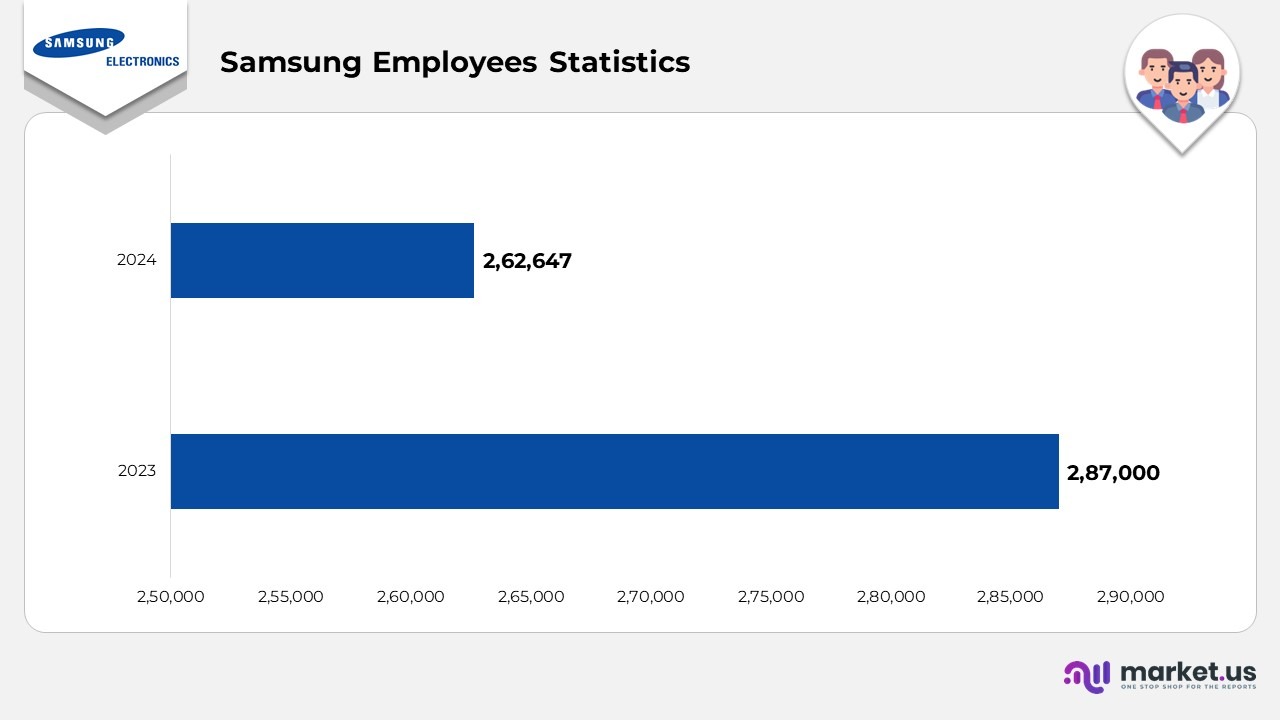
- In 2023, Samsung’s statistics indicated that the company employed more than 287,000 people globally, with around two-thirds of them based outside of South Korea.
- As of September 30, 2024, Samsung Electronics disclosed a total workforce of 262,647 individuals.
- Notwithstanding earlier layoffs, Samsung intends to recruit over 10,000 new employees by the year 2025.
- Over the past two years, Samsung Electronics has notably decreased its workforce by almost 50%.
Samsung Electronics Fun Facts
- Samsung was founded in 1938 by Lee Byung-chul as a trading company dealing in groceries, dried fish, and noodles in Korea, which was under Japanese occupation.
- In Korean hanja, the term “Samsung” translates to “three stars,” representing something that is powerful and enduring.
- As of March 2023, Samsung operates in 74 countries and has a workforce of over 267,000 individuals globally.
- In 2014, Samsung introduced the Galaxy Note Edge, marking the debut of the first smartphone equipped with a curved edge-to-edge display.
- The Samsung SCH-V200, which was launched in 2000, became the first mobile phone to incorporate a built-in camera.
- In 2024, the most economical Samsung Smart TV available on Amazon is listed at a mere $259.
- Samsung was established 38 years prior to Apple, creating a foundational legacy in the technology sector that continues to shape its development and innovation.
Recent Developments
- At CES 2024, Samsung showcased Ballie, an AI-driven home robot intended to aid with everyday tasks, oversee pets, and connect with smart home devices.
- In 2024, Samsung remains at the forefront of consumer electronics, semiconductors, and AI innovation, influencing technology through its advancements in smart homes, interconnected devices, and eco-friendly energy solutions.
- On March 25, 2025, Han Jong-hee, who served as co-CEO of Samsung Electronics, passed away due to a heart attack at the age of 63. Consequently, Jun Young-hyun, who had been appointed CEO just a week prior to Han Jong-hee’s passing, became the sole leader of the company.
Samsung Electronics Future Electronics
- Samsung’s product strategy for 2026 encompasses the introduction of the Galaxy S26 series in January or February, the presentation of innovative AI-driven technologies, and a cohesive home ecosystem at CES 2026. Additionally, the company will persist in advancing technologies such as quantum-safe encryption, extended reality (XR) headsets, and automotive-grade storage.
- At CES 2026, which will take place from January 7-10 at the Wynn and Encore in Las Vegas, Samsung is set to occupy its largest exhibition space to date.
- Furthermore, Samsung aims to achieve an average reduction of 30% in power consumption across major models of seven key consumer electronics products by the year 2030.
Conclusion
Samsung Electronics stands as a worldwide leader in technology, specializing in consumer electronics, mobile devices, and semiconductors, and it retains its status as the largest vendor of smartphones and televisions globally. In spite of market fluctuations, the company remains committed to innovation, especially in products that integrate artificial intelligence, to foster growth across its various business sectors. Following the completion of its documentation, Samsung encompasses a range of product lines; however, in recent times, it has emerged as the foremost brand in the smartphone market, offering high-end specifications and cutting-edge features. The company has significantly advanced in the technological landscape with its latest innovations and offerings.