


Global Women's Night and Underwear Market Size, Share, Growth Analysis By Product Type (Lingerie, Sleepwear, Robes, Shapewear), By Fiber (Cotton, Polyester, Cellulosic, Others), By Distribution Channel (Offline, Online), By Region and Companies - Industry Segment Outlook, Market Assessment, Competition Scenario, Statistics, Trends and Forecast 2026-2035
- Published date: Feb 2026
- Report ID: 177545
- Number of Pages: 236
- Format:
-
keyboard_arrow_up
Quick Navigation
Report Overview
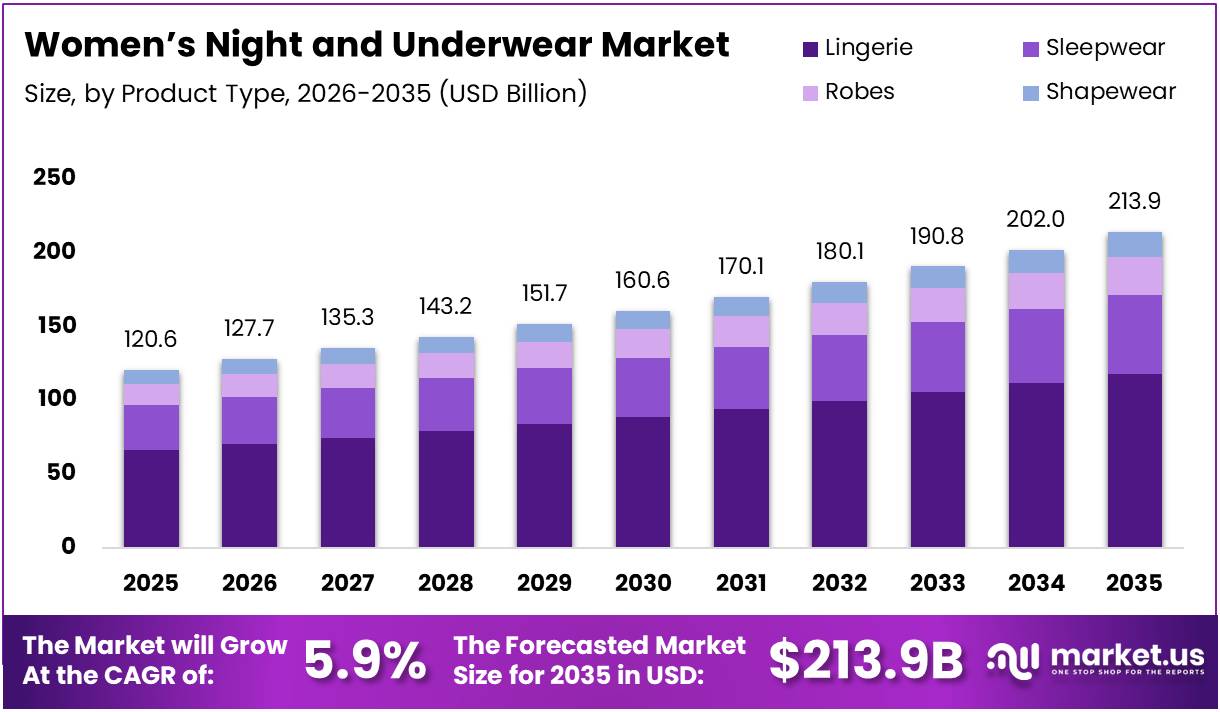
The Global Women’s Night and Underwear Market size is expected to be worth around USD 213.9 Billion by 2035 from USD 120.6 Billion in 2025, growing at a CAGR of 5.9% during the forecast period 2026 to 2035.
The women’s night and underwear market encompasses intimate apparel designed for nighttime comfort and daily wear. This includes lingerie, sleepwear, robes, and shapewear products tailored to women’s diverse needs. Moreover, the market serves multiple purposes from functional support to aesthetic appeal and self-expression.
Market growth stems from evolving consumer preferences toward premium quality and comfort-focused designs. Additionally, rising female workforce participation globally drives increased spending power on intimate wear categories. Therefore, brands are expanding their offerings to meet sophisticated consumer demands.
The body positivity movement significantly influences market dynamics by encouraging inclusive sizing and diverse design options. Consequently, manufacturers develop products catering to various body types and personal preferences. Furthermore, social awareness campaigns promote acceptance and celebration of different body shapes.
E-commerce platforms revolutionize market accessibility by connecting consumers with global lingerie brands seamlessly. However, online channels face challenges with product return rates due to sizing inconsistencies. Additionally, technological innovations address fit issues through AI-based sizing solutions and virtual try-on features.
According to a UK national survey, 51% of women rated comfort as the most important factor when buying lingerie, followed by fit at 28%. This data underscores the shifting priority toward functionality over purely aesthetic considerations in purchasing decisions.
According to YouGov research, around half (49%) of 18-24 year old women wear underwear beneath their pyjamas to bed, compared to a fifth (19%) of women aged 65+. Moreover, women in the UK buy an average of four bras and eight pairs of underwear per year.
According to Pour Moi research, 4% of women mix and match their bras and panties rather than buying coordinated sets. This trend reflects personalized styling preferences and practical wardrobe management. Therefore, brands increasingly offer separates alongside traditional matched sets to accommodate diverse consumer shopping habits.
Key Takeaways
- Global Women’s Night and Underwear Market valued at USD 120.6 Billion in 2025, projected to reach USD 213.9 Billion by 2035
- Market growing at a CAGR of 5.9% during the forecast period 2026-2035
- Lingerie segment dominates by product type with 55.2% market share in 2025
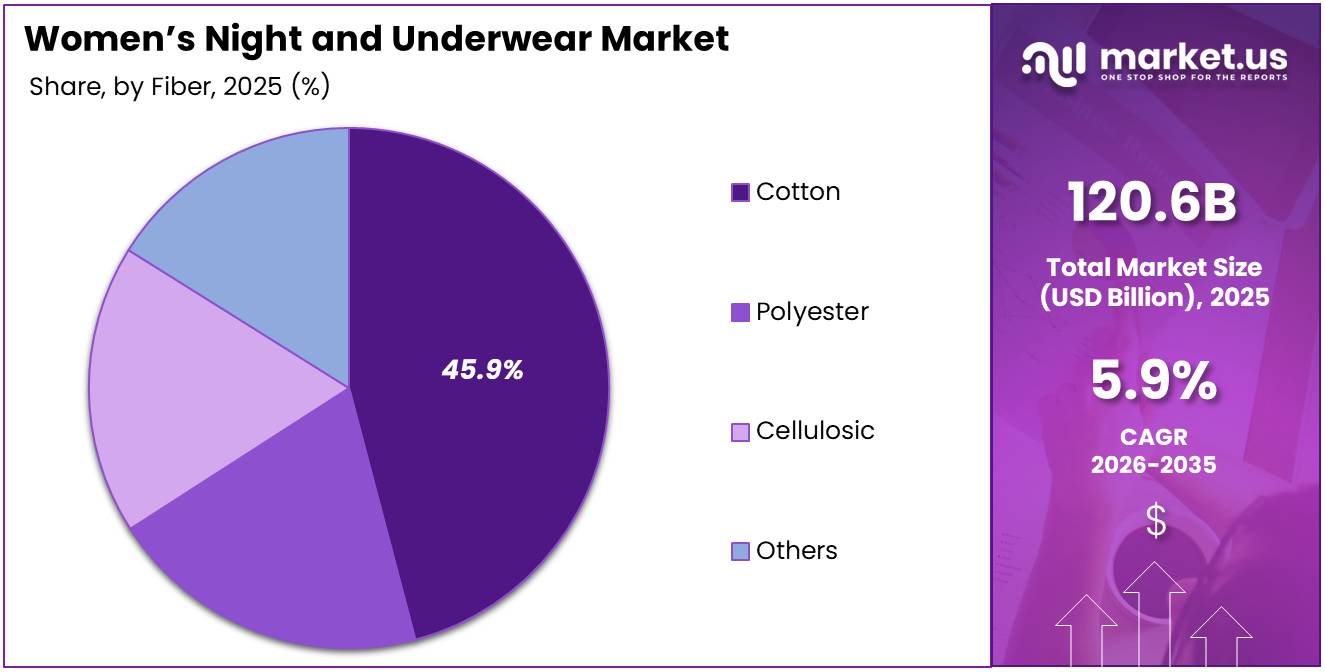
- Cotton fiber segment leads with 45.9% market share in 2025
- Offline distribution channel holds 67.3% market share in 2025
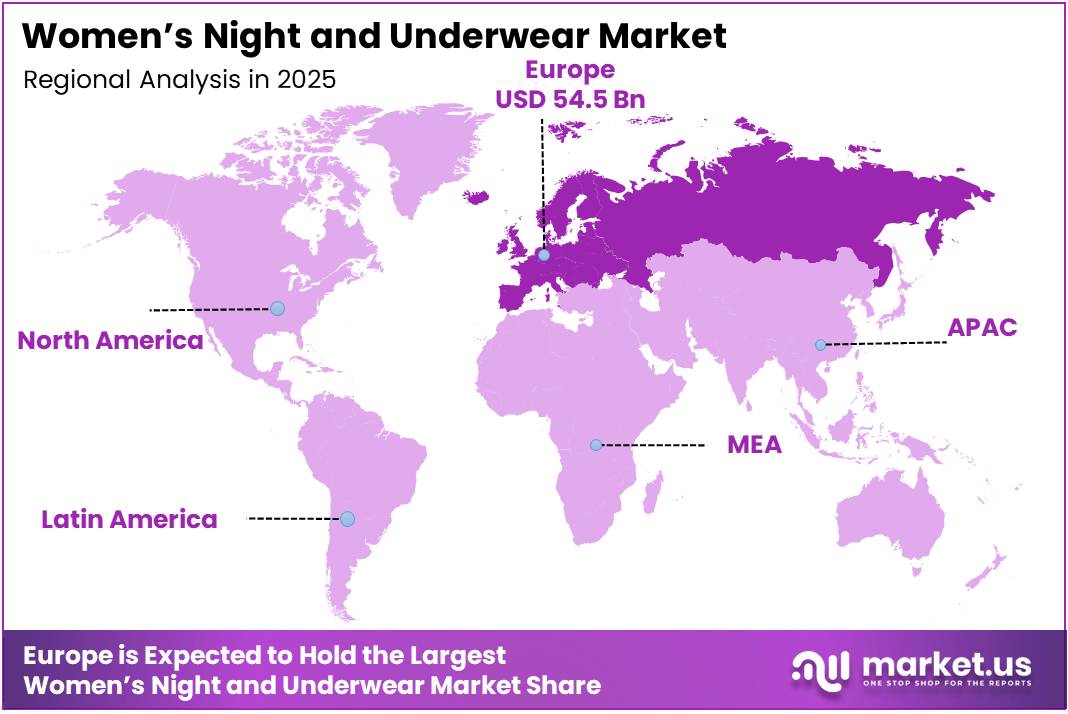
- Europe dominates regionally with 45.20% market share, valued at USD 54.5 Billion
Product Type Analysis
Lingerie dominates with 55.2% due to diverse consumer preferences and expanding design innovations.
In 2025, Lingerie held a dominant market position in the By Product Type segment of Women’s Night and Underwear Market, with a 55.2% share. This segment benefits from continuous fashion evolution and premium brand positioning. Moreover, lingerie offerings range from everyday basics to luxury designs, appealing to broad consumer demographics and occasions.
Sleepwear represents a significant category focused on comfort and nighttime relaxation needs. Additionally, this segment experiences growth through innovative fabric technologies offering breathability and moisture management. Consequently, consumers increasingly prioritize quality sleepwear for better rest and wellness benefits.
Robes serve as transitional garments combining functionality with aesthetic appeal for home wear. Furthermore, premium robe designs incorporate luxury materials and sophisticated styling. Therefore, this segment attracts consumers seeking elevated at-home comfort experiences.
Shapewear addresses body contouring and support requirements with technologically advanced compression fabrics. Moreover, modern shapewear emphasizes comfort alongside shaping benefits, moving beyond restrictive traditional designs. Additionally, inclusive sizing options expand market reach across diverse body types and consumer preferences.
Fiber Analysis
Cotton dominates with 45.9% due to natural breathability, comfort properties, and consumer preference for skin-friendly materials.
In 2025, Cotton held a dominant market position in the By Fiber segment of Women’s Night and Underwear Market, with a 45.9% share. Cotton’s natural properties provide superior moisture absorption and hypoallergenic benefits. Additionally, sustainable cotton sourcing aligns with environmentally conscious consumer values and purchasing decisions.
Polyester offers durability, wrinkle resistance, and cost-effectiveness in intimate apparel manufacturing. Furthermore, polyester blends enable enhanced stretch and shape retention properties. Consequently, this fiber supports performance-oriented designs and maintains affordability across product ranges.
Cellulosic fibers including modal, viscose, and bamboo provide eco-friendly alternatives with luxurious textures. Moreover, cellulosic materials offer excellent drape and softness comparable to silk. Therefore, premium brands incorporate these fibers for sustainable yet indulgent product lines.
Others category encompasses specialty fibers including silk, lace materials, and innovative technical fabrics. Additionally, this segment features moisture-wicking, antimicrobial, and temperature-regulating fiber technologies. Furthermore, niche fiber innovations target specific consumer needs and premium market segments.
Distribution Channel Analysis
Offline dominates with 67.3% due to tactile shopping preferences and immediate product availability benefits.
In 2025, Offline held a dominant market position in the By Distribution Channel segment of Women’s Night and Underwear Market, with a 67.3% share. Physical retail enables customers to assess fabric quality, fit, and construction before purchasing. Moreover, in-store fitting services and professional consultations enhance customer satisfaction and reduce return rates significantly.
Online channels demonstrate rapid growth through enhanced accessibility and expanding global brand reach. Additionally, digital platforms offer extensive product variety and convenient shopping experiences. However, sizing challenges and fit uncertainties drive higher return rates. Consequently, retailers implement virtual fitting technologies and detailed size guides to improve online conversion rates and customer confidence.
Key Market Segments
By Product Type
- Lingerie
- Sleepwear
- Robes
- Shapewear
By Fiber
- Cotton
- Polyester
- Cellulosic
- Others
By Distribution Channel
- Offline
- Online
Drivers
Rising Female Workforce Participation and Growing Body Positivity Movement Drive Market Expansion
Rising female workforce participation globally increases disposable income and spending power on premium intimate wear categories. Additionally, working women prioritize quality, comfort, and durability in their intimate apparel purchases. Consequently, brands develop sophisticated product lines catering to professional women’s lifestyle needs and aesthetic preferences.
The growing body positivity movement encourages manufacturers to offer diverse size ranges and inclusive fit options. Moreover, marketing campaigns celebrate different body types, fostering consumer confidence and brand loyalty. Therefore, inclusive sizing strategies expand market reach and attract previously underserved consumer segments.
Expansion of e-commerce platforms enhances accessibility to global lingerie brands and specialized products. Furthermore, online channels provide convenient shopping experiences with extensive variety and competitive pricing. Additionally, digital platforms enable direct-to-consumer models, reducing intermediary costs and improving profit margins for brands.
Restraints
Intense Competition and High Product Return Rates Challenge Market Profitability
Intense competition from unorganized and private label brands limits brand differentiation and pricing power. Additionally, smaller players offer competitive pricing through lower operational costs and streamlined supply chains. Consequently, established brands face pressure to maintain market share while managing profitability margins.
Private label products from major retailers challenge premium brand positioning with quality improvements and attractive pricing. Moreover, consumer willingness to experiment with lesser-known brands increases competitive intensity. Therefore, brand loyalty becomes harder to maintain in saturated market conditions.
High product return rates in online channels due to fit and sizing challenges impact operational efficiency and profitability. Furthermore, inconsistent sizing standards across brands create consumer confusion and purchase hesitation. Additionally, return logistics and restocking costs burden e-commerce operations, reducing overall channel profitability and sustainability.
Growth Factors
Technological Innovations and Sustainability Initiatives Create New Market Opportunities
Technologically advanced fabrics offering breathable, moisture-wicking, and skin-friendly features enhance product performance and consumer satisfaction. Additionally, innovative materials provide superior comfort throughout extended wear periods. Consequently, premium pricing justified through functional benefits drives revenue growth for technology-focused brands.
Custom-fit and AI-based sizing solutions reduce return rates in online purchases by improving size accuracy. Moreover, virtual fitting technologies enable consumers to identify correct sizes confidently before ordering. Therefore, enhanced digital tools improve conversion rates and customer retention in e-commerce channels.
Sustainable and eco-friendly lingerie lines targeting environmentally conscious consumers create competitive differentiation opportunities. Furthermore, organic materials and ethical manufacturing processes appeal to values-driven purchasing decisions. Additionally, transparent supply chains and circular economy initiatives strengthen brand reputation and consumer trust across demographic segments.
Emerging Trends
Seamless Designs and Influencer Collaborations Reshape Consumer Preferences
Surge in demand for seamless and wire-free designs prioritizing everyday comfort reflects evolving consumer priorities. Additionally, minimalist construction techniques eliminate visible lines and pressure points for enhanced wearability. Consequently, comfort-focused innovations gain market traction across age groups and lifestyle categories.
Celebrity and influencer-led brand collaborations driving social commerce sales leverage digital marketing effectiveness. Moreover, limited-edition collections create urgency and exclusivity, stimulating impulse purchases. Therefore, strategic partnerships with influential personalities expand brand reach and engagement with younger demographics.
Rising popularity of gender-neutral and inclusive intimate apparel collections broadens market appeal beyond traditional boundaries. Furthermore, diverse representation in marketing campaigns resonates with socially progressive consumers. Additionally, inclusive product development strategies demonstrate brand commitment to equality and representation, strengthening consumer loyalty and advocacy.
Regional Analysis
Europe Dominates the Women’s Night and Underwear Market with a Market Share of 45.20%, Valued at USD 54.5 Billion
Europe leads the global market with a 45.20% share, valued at USD 54.5 Billion, driven by established fashion industries and premium brand presence. Additionally, European consumers demonstrate strong preference for quality craftsmanship and sustainable production practices. Moreover, diverse cultural influences create varied design aesthetics across regional markets.
North America Women’s Night and Underwear Market Trends
North America exhibits robust market growth through e-commerce expansion and direct-to-consumer brand innovation. Furthermore, American consumers prioritize comfort and inclusivity in intimate apparel purchases. Additionally, strategic marketing campaigns emphasizing body positivity resonate strongly with regional demographics, driving market penetration.
Asia Pacific Women’s Night and Underwear Market Trends
Asia Pacific demonstrates rapid expansion fueled by rising disposable incomes and westernization of fashion preferences. Moreover, expanding middle-class populations increase demand for premium intimate wear categories. Additionally, local manufacturers combine traditional craftsmanship with modern designs, creating unique competitive advantages.
Latin America Women’s Night and Underwear Market Trends
Latin America experiences steady growth through increasing urbanization and fashion consciousness among female consumers. Furthermore, regional brands incorporate culturally relevant designs and vibrant aesthetics. Additionally, expanding retail infrastructure improves product accessibility across diverse geographic markets.
Middle East & Africa Women’s Night and Underwear Market Trends
Middle East and Africa show emerging potential through growing retail sectors and increasing consumer awareness. Moreover, premium international brands expand presence in affluent urban centers. Additionally, modest fashion trends create specialized market segments requiring culturally appropriate intimate wear designs.
Key Regions and Countries
North America
- US
- Canada
Europe
- Germany
- France
- The UK
- Spain
- Italy
- Rest of Europe
Asia Pacific
- China
- Japan
- South Korea
- India
- Australia
- Rest of APAC
Latin America
- Brazil
- Mexico
- Rest of Latin America
Middle East & Africa
- GCC
- South Africa
- Rest of MEA
Key Company Insights
AGENT PROVOCATEUR LIMITED maintains premium positioning through provocative designs and luxury materials catering to sophisticated consumers. Additionally, the brand emphasizes craftsmanship and exclusive retail experiences across global markets. Moreover, strategic collaborations with designers enhance brand prestige and market differentiation. Furthermore, AGENT PROVOCATEUR continues expanding digital presence while maintaining boutique retail exclusivity.
Dior leverages haute couture heritage to deliver exceptional intimate apparel combining elegance with innovative construction. Additionally, Dior’s lingerie collections feature exquisite lace detailing and premium fabrics. Moreover, the brand targets affluent consumers seeking luxury intimate wear aligned with high-fashion aesthetics. Furthermore, Dior maintains strong brand equity through limited availability and premium pricing strategies.
H&M Hennes & Mauritz AB democratizes fashion through affordable intimate wear collections emphasizing sustainability and inclusive sizing. Additionally, H&M implements circular fashion initiatives including garment recycling programs. Moreover, the brand rapidly adapts to trend shifts with frequent collection updates. Furthermore, extensive global retail network ensures widespread accessibility across diverse consumer segments.
Guccio Gucci S.p.A. elevates intimate apparel through iconic branding and distinctive design elements reflecting Italian luxury craftsmanship. Additionally, Gucci incorporates signature motifs and bold aesthetics into lingerie collections. Moreover, the brand attracts fashion-forward consumers seeking statement pieces. Furthermore, Gucci’s marketing strategies leverage celebrity endorsements and social media influence effectively.
Key Players
- AGENT PROVOCATEUR LIMITED
- Dior
- H&M Hennes & Mauritz AB
- Guccio Gucci S.p.A.
- PRADA
- Burberry Group Plc
- Dolce & Gabbana S.r.l.
- Calvin Klein
- Gianni Versace S.r.l.
- Louis Vuitton, Inc.
Recent Developments
- January 2026 – Savage X Fenty unveiled its “Love So Savage” Valentine’s Day collection, inspired by the goddess Aphrodite to blend romantic lace with Savage X Satin textures, expanding seasonal offerings and reinforcing brand positioning in premium lingerie segment.
- January 2026 – Sydney Sweeney launched a new lingerie brand called SYRN, entering the competitive intimate apparel market with celebrity-backed credibility and leveraging social media influence to attract younger consumer demographics through innovative marketing strategies.
- November 2025 – Kim Kardashian’s Skims raised $225 million in funding, increasing its valuation to approximately $5 billion and supporting international expansion and product innovation, solidifying position as major disruptor in shapewear and intimate apparel industry.
- January 2025 – Krvvy, a women’s functional innerwear brand, raised Rs 6.1 crore in pre-seed funding led by Titan Capital and All In Capital, enabling expansion of innovative product lines and market penetration in growing Indian intimate apparel sector.
Report Scope
Report Features Description Market Value (2025) USD 120.6 Billion Forecast Revenue (2035) USD 213.9 Billion CAGR (2026-2035) 5.9% Base Year for Estimation 2025 Historic Period 2020-2024 Forecast Period 2026-2035 Report Coverage Revenue Forecast, Market Dynamics, Competitive Landscape, Recent Developments Segments Covered By Product Type (Lingerie, Sleepwear, Robes, Shapewear), By Fiber (Cotton, Polyester, Cellulosic, Others), By Distribution Channel (Offline, Online) Regional Analysis North America (US and Canada), Europe (Germany, France, The UK, Spain, Italy, and Rest of Europe), Asia Pacific (China, Japan, South Korea, India, Australia, and Rest of APAC), Latin America (Brazil, Mexico, and Rest of Latin America), Middle East & Africa (GCC, South Africa, and Rest of MEA) Competitive Landscape AGENT PROVOCATEUR LIMITED, Dior, H&M Hennes & Mauritz AB, Guccio Gucci S.p.A., PRADA, Burberry Group Plc, Dolce & Gabbana S.r.l., Calvin Klein, Gianni Versace S.r.l., Louis Vuitton, Inc. Customization Scope Customization for segments, region/country-level will be provided. Moreover, additional customization can be done based on the requirements. Purchase Options We have three licenses to opt for: Single User License, Multi-User License (Up to 5 Users), Corporate Use License (Unlimited User and Printable PDF)  Women’s Night and Underwear MarketPublished date: Feb 2026add_shopping_cartBuy Now get_appDownload Sample
 -
-
- AGENT PROVOCATEUR LIMITED
- Dior
- H&M Hennes & Mauritz AB
- Guccio Gucci S.p.A.
- PRADA
- Burberry Group Plc
- Dolce & Gabbana S.r.l.
- Calvin Klein
- Gianni Versace S.r.l.
- Louis Vuitton, Inc.
Our Clients

- 177545
- Feb 2026






