


Report Overview
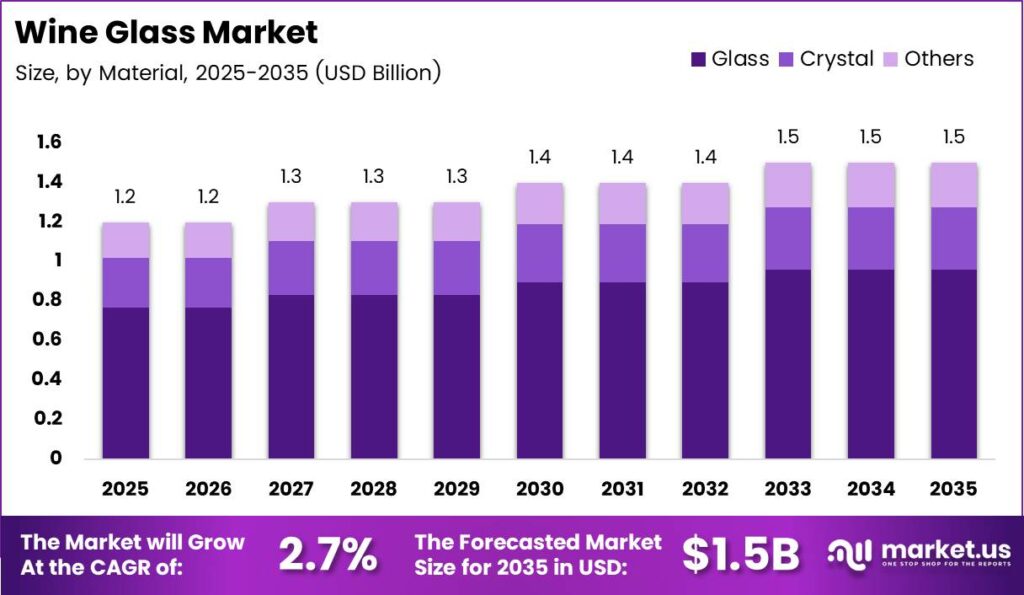
Global Wine Glass Market size is expected to be worth around USD 1.5 Billion by 2035 from USD 1.2 Billion in 2025, growing at a CAGR of 2.7% during the forecast period 2026 to 2035. This steady rate points to a category led by replacement rather than a volume boom. Investors should expect returns from pricing discipline, premium mix, and channel efficiency more than from new household penetration.
Consequently, the market must be read through its structure. The Wine Glass Market covers vessels made for serving and tasting wine across homes and venues. Glass, crystal, and other materials set the price ladder, while commercial and residential buyers set order size and frequency. Offline stores and online platforms then decide who controls the customer, so channel ownership shapes margins as much as design.
Key Takeaways
- The Global Wine Glass Market was valued at USD 1.2 Billion in 2025 and is expected to reach USD 1.5 Billion by 2035, at a CAGR of 2.7%.
- Glass led the By Material segment with a 63.90% share and is also the fastest growing material.
- Commercial led the By Application segment with a 67.90% share, while Residential is the fastest growing application.
- Offline led the By Distribution Channel segment with an 83.23% share, while Online is the fastest growing channel.
- Asia-Pacific dominated with a 53.23% share, valued at USD 0.636 Billion.
- Latin America is the fastest growing region in the Wine Glass Market.
However, carbon policy now shapes furnace costs across European glassmaking. As reported by Reuters, EU countries backed an extra 121 million free CO2 permits for heavy industries, including glass makers, over 2026 to 2030. The move could save these sectors about EUR 8.25 Billion in carbon costs, easing price pressure on European stemware. As hotels and restaurants restock, lower compliance costs let EU producers bid more competitively for those orders.
This signals that scale still decides who wins contracts. According to Zwiesel Glas, its Zwiesel and Hungarian sites produce up to 60 million crystal glasses a year with about 800 employees. The company showed that craft depth in February 2025 with Kolibri, a mouth-blown line made with chef Tim Raue. As fine dining expands, chef-linked collections turn restaurant growth into premium stemware orders for scaled producers.
Material Analysis
Glass dominates with 63.90% due to lower cost and easier mass production.
In 2025, Glass held a dominant market position in the By Material segment of Wine Glass Market, with a 63.90% share. Data from Glass Alliance Europe shows 40 million tonnes of EU glass output each year, with domestic glass at about 4% of that total. This deep furnace base keeps glass stemware cheap for volume buyers. Brands can still lift price, as Zwiesel Glas did in June 2025 by adding colored stems to its Enoteca collection.
Crystal serves buyers who pay extra for clarity, weight, and brilliance at the dinner table. According to EU Council Directive 69/493/EEC, full lead crystal needs at least 30% lead oxide, while lead crystal needs 24%. Lead-free crystal glass sold under brand names sits outside these legal categories. Certified producers can therefore defend premium pricing, while lead-free brands must win trust through reputation and performance.
Application Analysis
Commercial dominates with 67.90% due to constant restaurant breakage and replacement cycles.
In 2025, Commercial held a dominant market position in the By Application segment of Wine Glass Market, with a 67.90% share. According to the National Restaurant Association, US restaurant and foodservice sales should reach USD 1.55 Trillion in 2026, up 4.8%. Each new cover adds stemware wear, so venues reorder glass on fixed cycles. RCR Cristalleria Italiana targeted this buyer in May 2026 with Magnum goblets holding 140 cl and 160 cl.
Residential buyers purchase wine glasses in small sets for home use and gifting. Data from the US Bureau of Labor Statistics shows households spent USD 2,414 on furnishings and equipment in 2024, down 3.7%. Figures from the US Census Bureau show August 2026 housing completions at an annual rate of 1,128,000, down 27.1%. This means residential growth must come from upgrades and gifting rather than new home setups.
Distribution Channel Analysis
Offline dominates with 83.23% due to buyers judging fragile stemware weight in person.
In 2025, Offline held a dominant market position in the By Distribution Channel segment of Wine Glass Market, with an 83.23% share. Figures from the US Census Bureau show e-commerce made up 17.1% of US retail sales in Q2 2026, or USD 340.2 Billion. Stores still hold most spending, so physical shelf space stays the main sales gate. Retailers with strong store networks therefore keep control of most wine glass buyers.
Online buyers compare designs, prices, and reviews before ordering fragile stemware for delivery. As reported by the US Census Bureau, US e-commerce sales rose 12.2% year on year in Q2 2026, while total retail grew 6.7%. Online spending is rising nearly twice as fast as total retail, which supports Online’s role as the fastest growing wine glass channel. Brands that invest in breakage-proof packaging can capture this shift at lower cost than opening new stores.
Key Market Segments
By Material
- Glass
- Crystal
- Others
By Application
- Commercial
- Residential
By Distribution Channel
- Offline
- Online
Regional Analysis
Asia-Pacific Dominates the Wine Glass Market with a Market Share of 53.23%, Valued at USD 0.636 Billion
Asia-Pacific controls more than half of global wine glass value, and hospitality recovery keeps that lead intact. Data from UN Tourism shows Asia and the Pacific received 331 million international arrivals in 2025, up 6%. The region still sits at about 91% of pre-pandemic levels, which leaves room for more hotel and restaurant fitouts. Consequently, suppliers with local stock near Asian venues can capture refill orders before distant rivals deliver.
Japan stands out as a wine market inside Asia-Pacific. The International Organisation of Vine and Wine found that Japan ranked among key growth markets for wine consumption in 2025. As reported by UN Tourism, North-East Asia arrivals rose 5% and Oceania arrivals rose 9% in Q1 2026. This means premium stemware brands should prioritize Japanese and Oceanian hospitality accounts within the region.
By contrast, Latin America is the fastest growing region, and Brazil anchors that momentum. According to the International Organisation of Vine and Wine, Brazil was a key 2025 growth market for wine consumption. Brazil’s wine production also reached 2.8 million hectolitres, up 80.6% after a weak 2024 harvest. More local wine and more drinking occasions create direct demand for restaurant and household stemware.
Europe remains the largest tourism market and a mature home for premium glassmaking. Based on UN Tourism data, Europe received 793 million international arrivals in 2025, up 4% and 6% above 2019. Zwiesel Fortessa added luxury brand Eisch to its portfolio in October 2025, deepening its premium refinement skills. This signals consolidation among European crystal makers, which raises scale barriers for smaller independents.
North America shows softer hospitality traffic but strong digital buying. Figures from UN Tourism show the Americas grew arrivals by just 1% in 2025, with weak results in the United States. Maison Lehmann responded in September 2026 with a US online store offering nearly 90 products and delivery across all 50 states. As a result, North American growth will lean on direct online sales more than new venue fitouts.
Key Regions and Countries
North America
- US
- Canada
Europe
- Germany
- France
- The UK
- Spain
- Italy
- Rest of Europe
Asia Pacific
- China
- Japan
- South Korea
- India
- Australia
- Rest of APAC
Latin America
- Brazil
- Mexico
- Rest of Latin America
Middle East and Africa
- GCC
- South Africa
- Rest of MEA
Market Dynamics
Market Opportunity Analysis - Home upgrades, certified crystal, direct online sales, and Japan and Brazil offer open ground
Residential is the fastest growing application, yet most suppliers still build catalogs around restaurant and hotel buyers. This growth persists even as new home completions fall, so households are upgrading rather than furnishing from scratch. This creates room for gift sets and premium replacement lines aimed at existing homes. Entrants that market directly to these owners can win share that hospitality-focused incumbents overlook.
Crystal remains underexploited outside certified European producers. EU law protects crystal labels through minimum lead oxide content, which keeps imitation glass from claiming the name. However, lead-free crystal brands compete outside those legal categories, creating a middle tier between soda-lime glass and full lead crystal. Entrants that offer certified clarity at mid-market prices can fill this gap without battling mass producers on cost.
Online remains the smallest channel, yet e-commerce is outpacing total retail. Fragile stemware makes direct shipping costly, so delivery quality becomes the real barrier to entry. Consequently, sellers that solve breakage and returns can turn the fastest growing channel into a margin advantage. Investors should favor brands building direct platforms rather than relying only on marketplace listings.
Japan and Brazil stand out as underexploited country markets within growing regions. Both ranked among key wine consumption growth markets in 2025, while most global attention stays on mature European demand. This creates an opening for stemware brands to build dedicated local distribution before competition intensifies. Early entrants that sign sommelier, hotel, and retail partners now can lock in accounts before larger rivals redirect resources.
Technology and Innovation Landscape - Lighter forming and larger bowls redefine stemware value
Mouth-blowing and machine-making now compete on weight, not just looks. Four Magazine found that the machine-made Gabriel-Glas StandArt weighs about 150 g, while the mouth-blown Gold Edition weighs about 90 g. Both share a universal bowl of roughly 510 mL. This means makers can offer one shape at two price points, serving both busy venues and premium home buyers.
Lightweight machine forming is closing the gap with handmade stemware. According to Maison Lehmann, its Psyché universal glass uses Ultralight fabrication, holding 56 cL at 245 mm tall and 97 mm wide. Machine production keeps unit costs low while delivering a finer feel. As a result, buyers can get near-premium handling without paying handmade prices, which pressures pure craft brands.
Oversized bowl engineering targets aeration for bold wines in restaurants. As reported by Riedel, its Superleggero Burgundy Grand Cru holds 1,022 mL at 276 mm tall and 114 mm wide. The Veloce Cabernet/Merlot glass holds 829 mL, standing 247 mm with a 104 mm diameter. These larger formats raise ticket sizes for suppliers, but they demand careful handling, washing, and storage planning in venues.
Fast multi-category launches let glassmakers spread development work across more products. Based on Maison Lehmann data, the company announced 14 new glassware creations in June 2026 across wine, Champagne, cocktail, and spirits glasses. This broad launch spreads mold and design costs across many more serving occasions. Consequently, multi-category makers can refresh hospitality catalogs faster than rivals focused only on wine.
Drivers
Global tourism is reopening a major end-use channel for wine glass sales. According to UN Tourism, international arrivals reached about 1.4 billion in 2024, up 11%, then about 1.52 billion in 2025, up a further 4%. More hotel stays and restaurant covers trigger first-time glassware fitouts and steady assortment refills. Suppliers therefore gain most from contracted hospitality accounts rather than one-off household buying.
As per our research, each percentage-point rise in arrivals lifts glass procurement by 0.05 to 0.10 points. That scenario adds about 0.20 to 0.40 percentage points of growth support, with +0.30% as the midpoint. Arrivals do not convert one-to-one into wine glass orders. Investors should treat this lift as already built into the 2.7% baseline, not as extra growth.
| Driver | (~) % Impact on CAGR Forecast | Geographic Relevance | Impact Timeline |
|---|---|---|---|
| Tourism-led hospitality glassware procurement | +0.30% | Global; tourism-intensive destinations | Short term (≤ 2 years) |
| Routine replacement of broken stemware | +0.16% | Global; high-throughput restaurants | Short term (≤ 2 years) |
| Premium mix within existing glassware purchases | +0.12% | North America; Europe; affluent Asian cities | Medium term (2–4 years) |
| Existing online retail channel penetration | +0.10% | North America; Europe; urban Asia | Short term (≤ 2 years) |
| Established gifting and celebration demand | +0.07% | Global; discretionary consumer markets | Short term (≤ 2 years) |
Restraints
Lower wine drinking is the most direct brake on wine glass sales. Data from the International Organisation of Vine and Wine shows global consumption fell 3.3% in 2024 to 214.2 million hectolitres. That volume would be the lowest since 1961 if confirmed. Fewer wine occasions push retailers and wine bars to trim refill orders, which raises promotional pressure on every supplier.
As per our research, a demand sensitivity of 0.06 to 0.12 turns that decline into 0.20 to 0.40 points of yearly growth pressure. The selected -0.30% sits inside that range because gifting and replacement do not track wine volumes. However, even if every restraint and challenge hit at once, modeled growth would stay near 1.60%. Brands face slower sell-through, not a shrinking market.
| Restraint | (~) % Impact on CAGR Forecast | Geographic Relevance | Impact Timeline |
|---|---|---|---|
| Declining wine-consumption volumes | -0.30% | Global; mature wine-consuming markets | Short term (≤ 2 years) |
| Saturated household glassware ownership | -0.12% | Europe; North America | Long term (≥ 4 years) |
| Premium-product affordability ceilings | -0.10% | Price-sensitive households; emerging markets | Short term (≤ 2 years) |
| Unbreakable drinkware substitution | -0.08% | Outdoor venues; pools; festivals | Medium term (2–4 years) |
| Alcohol-service licensing restrictions | -0.05% | Restricted alcohol-service jurisdictions | Long term (≥ 4 years) |
Challenges
Fragile, bulky stemware makes imported assortments sensitive to shipping shocks. As reported by UN Trade and Development, Suez Canal transit tonnage fell 70% by mid 2024, while Cape of Good Hope arrivals rose 89%. Rerouting raised container ship demand by 12%, and the Shanghai freight index more than doubled from late 2023. Importers that book capacity early and hold regional stock protect service, but they tie up more working capital.
As per our research, a freight share of 5% to 8% with a 50% to 100% rate jump lifts landed cost by 2.5% to 8%. Extending inventory cover from 8 to 10 weeks also raises funding needs by 25%. The net drag stays near -0.16% after domestic output and contracted freight. This creates revenue for regional warehousing and freight clauses that sell supply certainty.
| Challenge | (~) % CAGR Friction Drag | Geographic Relevance | Mitigation Horizon |
|---|---|---|---|
| Ocean freight route volatility | -0.16% | Asia–Europe; intercontinental sourcing routes | Short term (≤ 2 years) |
| Furnace energy intensity management | -0.10% | Global; energy-exposed manufacturing clusters | Medium term (2–4 years) |
| Thin-wall manufacturing yield variability | -0.08% | Premium stemware manufacturing hubs | Medium term (2–4 years) |
| Specialist forming skills shortages | -0.06% | Handcrafted glassmaking clusters | Long term (≥ 4 years) |
| Assortment forecasting inventory complexity | -0.05% | Global; multi-channel suppliers | Medium term (2–4 years) |
Opportunities
Purpose-designed glassware for alcohol-free wine and sparkling alternatives is a new adjacency, not a driver already priced into the baseline. As per our research, specialized products reaching 2% of category revenue with 11% extra spend would add about 0.22 points of growth. Success needs new specifications, consumer testing, and dedicated distribution. Early movers that build real serving performance can claim this shelf before larger rivals react.
Unit margins strengthen the commercial case for dedicated glassware. A price index rising from 100 to 110, with cost moving from 60 to 63, lifts gross margin from 40% to about 42.7%. Capturing every listed opportunity would add 0.65 points, taking modeled CAGR to about 3.35%. This signals that true product design, not simple relabeling, will decide which brands earn the premium.
| Opportunity | (~) % Potential CAGR Upside | Geographic Relevance | Execution Window |
|---|---|---|---|
| Purpose-designed alcohol-free tasting glassware | +0.22% | Europe; North America; urban Asia | Medium term (2–4 years) |
| Paid personalization and branded editions | +0.15% | Global; corporate and specialty channels | Short term (≤ 2 years) |
| Glassware rental for temporary events | +0.12% | Dense urban event markets | Medium term (2–4 years) |
| Artisan consolidation and shared distribution | +0.09% | European and Asian craft clusters | Long term (≥ 4 years) |
| Modular storage and care accessories | +0.07% | Space-constrained urban households | Medium term (2–4 years) |
Key Company Insights
Riedel anchors the premium restaurant tier with large format wine stemware. Its 2026 brochure lists the Superleggero Bordeaux Grand Cru at 953 mL, 282 mm tall and 106 mm wide. In January 2026, Riedel added Manufaktur Vitis, a handmade grape-specific line with engraved bases. This varietal depth wins sommelier loyalty and pricing power, but handmade output limits volume against machine-made rivals.
Spiegelau builds its position on durable crystal designed for everyday and professional use. A 2026 Spiegelau catalog states its glasses use lead-free crystal that is dishwasher safe and highly break resistant. For 2026, Spiegelau is adding new shapes, carafes, and packaging across its Hi-Lite, Ultra, Beer Classics, and Winelovers series. This practical range suits busy venues, but beer and value lines may blur its premium wine image.
Key Players
- Riedel
- Spiegelau
- Libbey
- Luminarc
- Baccarat
- Christofle
- Kagami Crystal Co. Ltd.
- Zwiesel Fortessa AG (formerly Zwiesel Kristallglas)
- Arc International
- Denby Pottery
- Other Key Players
Recent Developments
- July 2025: Lehmann and Gold Plast announced a collaboration to supply Moët & Chandon with unbreakable champagne tasting glasses made from Eastman Tritan Renew copolyester, extending Lehmann tasting glass expertise into reusable polymer stemware.
- October 2025: Zwiesel Kristallglas AG officially adopted the name Zwiesel Fortessa AG, aligning its German business with Zwiesel Fortessa Americas under one global identity covering Zwiesel Glas, Schott Zwiesel, Fortessa, and Eisch.
- January 2026: Riedel presented the reintroduction of Bellorotondo within its Manufaktur range at Milano Home. First introduced in 1989, the collection returned with handmade wine glasses designed to give wine space and aeration.
- January 2026: Arc International unveiled the Luminarc 2026 collections in a new catalogue for its consumer brand, refreshing its everyday glassware and tableware range for household buyers.
- March 2026: Zwiesel Glas introduced Perfect Match by Antoine Pétrus, a 2 glass tasting collection developed with the French sommelier. Glass No. 1 targets red and white wines, while No. 2 targets rosé and sparkling wines.
- 2026: Riedel marked its 270th anniversary and relaunched Superleggero to honor the 50th anniversary of its Sommeliers series, offering 8 grape varietal shapes with the look and feel of handmade glass.
Geopolitical Impact Analysis
The Middle East war is driving furnace energy costs higher for glassmakers. The World Bank indicates that energy prices will surge 24% in 2026, reaching their highest level since 2022. Overall commodity prices should rise 16%, adding pressure on packaging and transport inputs. Glass melting runs on gas and power, so stemware makers without energy hedges must raise prices or accept thinner margins.
However, the gas shock hit glass clusters in Europe and Asia hard. Data from the IEA shows the Strait of Hormuz closure removed almost 20% of global LNG supply from March 2026. European TTF prices averaged USD 18/MBtu that month, while TTF volatility reached 160%. This means European crystal and glass makers face unstable furnace costs, which favors producers holding long-term gas contracts.
Report Scope
| Report Features | Description |
|---|---|
| Market Value (2025) | USD 1.2 Billion |
| Forecast Revenue (2035) | USD 1.5 Billion |
| CAGR (2026-2035) | 2.7% |
| Base Year for Estimation | 2025 |
| Historic Period | 2020-2024 |
| Forecast Period | 2026-2035 |
| Report Coverage | Revenue Forecast, Market Dynamics, Market Opportunity Analysis, Technology and Innovation Landscape, Competitive Landscape, Recent Developments |
| Segments Covered | By Material (Glass, Crystal, Others), By Application (Commercial, Residential), By Distribution Channel (Offline, Online) |
| Regional Analysis | North America (US and Canada), Europe (Germany, France, The UK, Spain, Italy, and Rest of Europe), Asia Pacific (China, Japan, South Korea, India, Australia, and Rest of APAC), Latin America (Brazil, Mexico, and Rest of Latin America), Middle East and Africa (GCC, South Africa, and Rest of MEA) |
| Competitive Landscape | Riedel, Spiegelau, Libbey, Luminarc, Baccarat, Christofle, Kagami Crystal Co. Ltd., Zwiesel Fortessa AG (formerly Zwiesel Kristallglas), Arc International, Denby Pottery, Other Key Players |
| Customization Scope | Customization for segments, region / country-level will be provided. Additional customization can be done based on requirements. |
| Purchase Options | We have three licenses to opt for: Single User License | Multi-User License (Up to 5 Users) | Corporate Use License (Unlimited User and Printable PDF) |





































