Global Warehouse Simulation Market Size, Share and Analysis Report By Type (Discrete Event Simulation (DES), Agent-Based Simulation (ABS), System Dynamics Simulation, Hybrid Simulation), By Deployment (On-Premises, Cloud-Based), By Industry Vertical (Automotive, Consumer Electronics, Healthcare and Pharmaceuticals, Food and Beverage, Retail and E-commerce, Logistics and Transportation, Others), By Regional Analysis, Global Trends and Opportunity, Future Outlook By 2025-2035
- Published date: Feb. 2026
- Report ID: 179434
- Number of Pages: 264
- Format:
-
keyboard_arrow_up
Quick Navigation
Report Overview
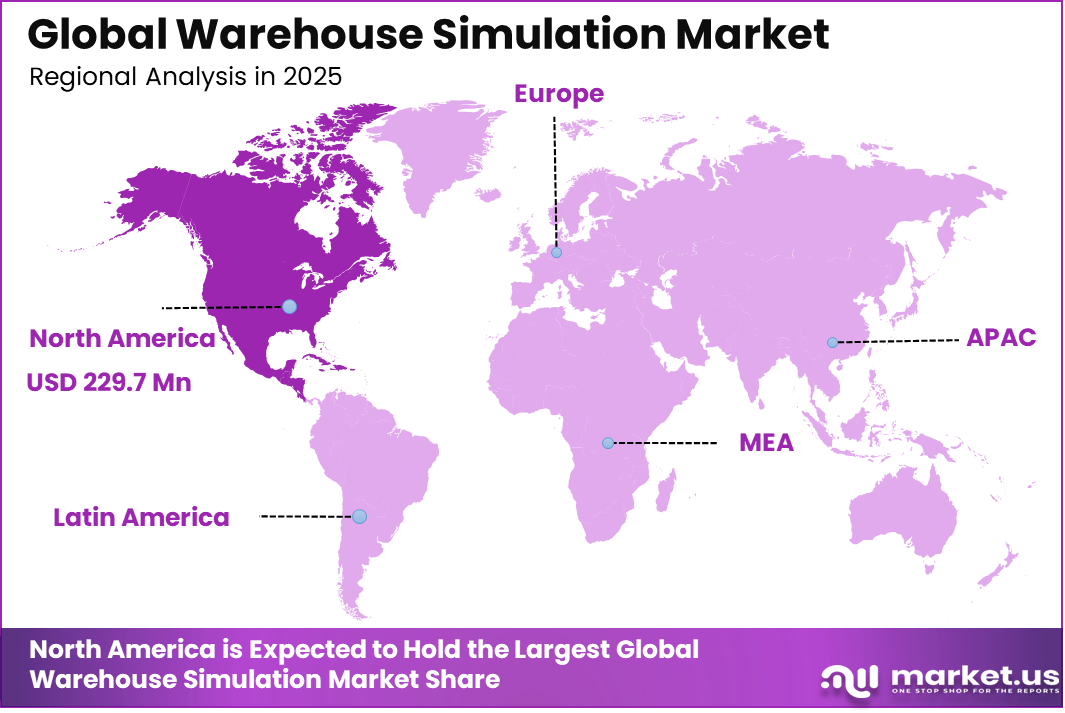
The Global Warehouse Simulation Market size is expected to be worth around USD 2,392.4 million by 2035, from USD 617.7 million in 2025, growing at a CAGR of 14.5% during the forecast period from 2025 to 2035. North America held a dominant market position, capturing more than a 37.2% share, holding USD 229.7 million in revenue.
Warehouse simulation allows businesses to model warehouse operations virtually, including picking, storage, and movement of goods. Using actual operational data, it helps test different scenarios without disrupting daily activities. Companies can optimize layouts, labor allocation, and workflows, reducing errors and improving efficiency. Simulation tools range from simple layout testing to full digital models, including human and robotic interactions.
Top driving factors for warehouse simulation include increasing complexity in supply chains, rapid e‑commerce growth, and customer demand for faster delivery. Businesses use simulation to identify bottlenecks and optimize performance before investing in automation or layout changes. Adoption is also driven by real‑time analytics and digital twin technologies that connect physical operations to virtual planning, helping managers make informed decisions.
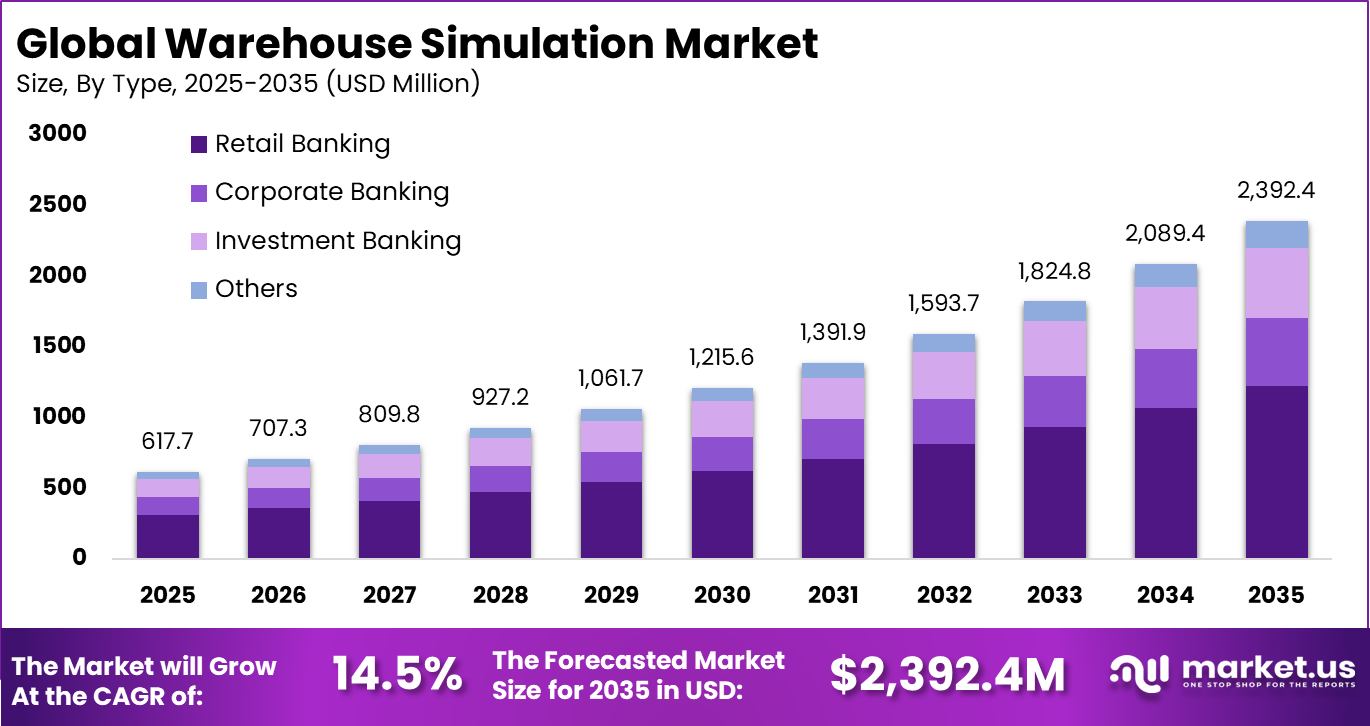
The market for warehouse simulation is driven by the need for greater efficiency and accuracy in warehouse operations. Businesses face rising order volumes and faster delivery demands, making it essential to optimize workflows, layouts, and labor allocation. Simulation tools allow companies to test scenarios virtually, reduce errors, improve resource planning, and enhance overall operational performance without disrupting daily activities.
Demand for warehouse simulation is rising among high-throughput and diverse product warehouses. Retailers and third-party logistics providers adopt it to manage complex picking patterns and stock keeping units efficiently. Labor shortages and rising costs push organizations to explore simulation for better workforce planning. Cloud-based solutions have also enabled small and medium enterprises to adopt simulation tools without heavy upfront investment.
For instance, in April 2024, Manhattan Associates partnered with TeamViewer to integrate vision picking into its Manhattan Active Warehouse Management platform. The collaboration tackles labor shortages and boosts picking accuracy in warehouses through enhanced robotics and AR guidance.
Key Takeaway
- In 2025, Discrete Event Simulation led the Global Warehouse Simulation Market, accounting for 51.24% of total adoption.
- In 2025, On-Premises deployment remained the preferred model, securing a dominant 74.61% market share.
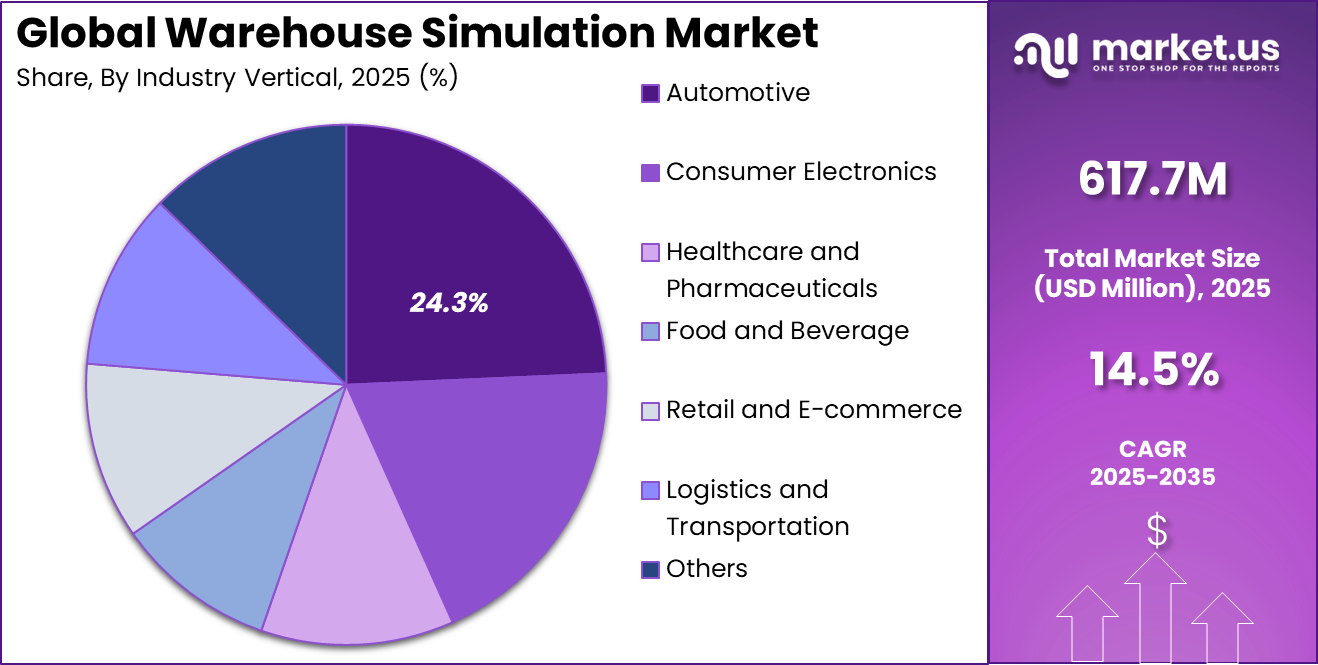
- In 2025, the Automotive sector emerged as the leading industry segment, contributing 24.3% of overall demand.
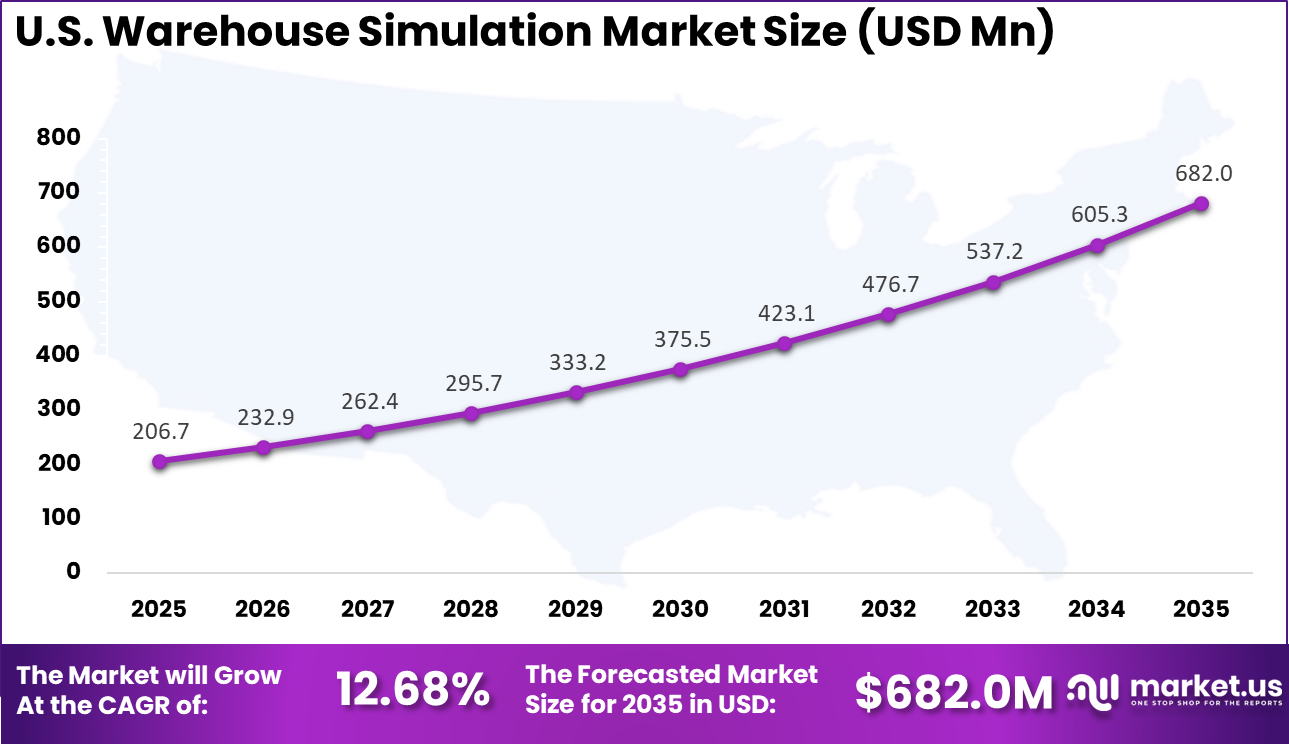
- In 2025, the U.S. Warehouse Simulation Market reached USD 206.7 million and registered a steady growth rate of 12.68%.
- In 2025, North America held a leading regional position, capturing more than 37.2% of the Global Warehouse Simulation Market.
Key Insights Summary
- Warehouse simulation and digital twin tools can increase labor productivity by up to 40% through optimized picking and storage processes.
- 3D visualization and layout modeling can improve warehouse space utilization by around 15%.
- Robotics programs validated through simulation can reduce labor and manufacturing costs by 25% to 30%.
- Automated tracking systems supported by digital tools can achieve up to 99.9% bin accuracy.
- Simulation-based layout changes can raise overall productivity by 30% and increase box-picking volume by 15%.
- Equipment utilization has improved from 58% to 94% after simulation-driven optimization.
- Order batching improvements modeled in simulations can reduce travel distance by up to 44%.
- Neural network models integrated with simulations can predict order completion times with an error rate of 5.4%.
By Type
Discrete Event Simulation accounts for 51.24% of total adoption in the Warehouse Simulation Market. This dominance reflects its ability to model warehouse operations as a sequence of time based events. Each movement, delay, and task can be evaluated with precision, improving operational visibility.
The preference for Discrete Event Simulation is driven by its effectiveness in testing layout changes and workflow adjustments. Warehouse managers use it to identify bottlenecks and optimize throughput before implementing physical modifications. This reduces risk and capital expenditure.
The method also supports scenario analysis under varying demand conditions. Seasonal fluctuations and order surges can be simulated without disrupting live operations. These advantages sustain its leading position within the market.
For Instance, in December 2024, FlexSim released version 2025 with a new Container object and Task Sequence Queues tailored for DES in warehouses. These tools let modelers simulate precise event sequences like order processing and storage moves, improving accuracy for complex flows. Users can now analyze utilization hourly, helping optimize real ops without trials.
By Deployment
On premises deployment represents 74.61% of overall adoption. This dominance reflects the need for direct control over sensitive operational data and simulation models. Large warehouses prefer to maintain internal infrastructure for security and customization. The reliance on on premises systems is also influenced by integration complexity.
Warehouse simulation platforms often connect with enterprise resource planning and warehouse management systems. Local deployment simplifies compatibility and performance management. Performance consistency is another key factor. On premises infrastructure provides stable computing capacity for large scale simulations. These considerations reinforce its strong adoption rate.
For instance, in August 2025, Rockwell partnered with Bastian on an on-premises warehouse automation using Emulate3D emulation. Installed PLCs and sensors, tested fully on-site, and cut commissioning by five weeks. This on-prem approach reduced risks and sped up installs for conveyor systems in fashion distribution.
By Industry Vertical
The automotive industry accounts for 24.3% of total market demand. Automotive manufacturing and distribution involve complex supply chains with high precision requirements. Simulation tools are used to optimize storage, picking sequences, and material flow. The automotive sector also operates under strict efficiency targets.
Reducing downtime and improving space utilization are strategic priorities. Simulation enables evaluation of layout changes without interrupting production. High inventory value further increases the importance of operational accuracy. Simulation tools support better forecasting and workflow planning. These factors maintain strong adoption within the automotive vertical.
For Instance, in April 2025, Siemens rolled out Factory & Warehousing Planning tools tailored for automotive lines. Digital models simulate parts flows and capacity, spotting bottlenecks in assembly feeds. This helps car makers test layouts risk-free, optimizing throughput for just-in-time demands in massive facilities.
Regional Perspective
North America holds a leading position in the Warehouse Simulation Market, accounting for 37.2% of total activity. The region benefits from advanced logistics infrastructure and high adoption of automation technologies. Simulation tools are widely used to improve efficiency and reduce operational risk. Warehousing operations in the region are increasingly data driven.
For instance, in April 2025, FlexSim released Update 1 for its 2025 software from Orem, Utah, adding dynamic AGV load types, timed travel, and USD exports for warehouse models. These features enable precise simulation of variable speeds and control points, helping logistics teams optimize robot paths and reduce real-world errors in high-volume facilities. North American adopters gain faster testing for scalable operations.
The United States represents the largest contributor within North America, with a market value of USD 206.7 Million and a growth rate of 12.68% CAGR. Expansion is supported by rising investment in warehouse automation and digital transformation initiatives. Simulation tools are integrated into planning processes.
U.S. warehouses face increasing pressure to improve speed and accuracy. E commerce growth further intensifies operational demands. Simulation platforms help organizations evaluate strategies before implementation. The focus on operational resilience and cost control drives continued adoption. These dynamics collectively support steady growth in the U.S. market segment.
For instance, in April 2025, Rockwell Automation in Milwaukee advanced Emulate3D digital twins for warehouse retrofits, partnering with Cartesian Kinetics. Simulations predict peak disruptions, yielding 5x productivity and 10x error cuts in existing facilities. This showcases U.S. leadership in automation upgrades without full rebuilds.
Emerging Trends
A clear trend is being observed toward digital twin enabled simulation that stays connected to operational data, so that scenario testing can be repeated as conditions change. Digital twins have been described as virtual replicas used to simulate outcomes and support better operational decisions across supply chains, including warehousing and distribution.
Practical benefits have been reported from these models, including improved utilization and reduced fulfillment costs when layout and inventory decisions are tested in a virtual model first. Another trend is being observed in the closer coupling of simulation with automation planning, especially for mobile robots and high mix picking.
Industrial robot installations reached 542,000 units in 2024, showing the broader momentum of automation that increases the need to validate traffic flow, slotting, and labor allocation virtually before deployment. Simulation is also being used more often to test dynamic policies, such as zoning or task assignment for mobile robots, because small rule changes can create congestion in dense facilities.
Growth Factors
E commerce growth continues to raise the operational burden on warehouses by increasing order line volume and SKU variety, which makes manual trial and error changes expensive. When the online share remains structurally high, warehouses are pushed to redesign layouts, picking methods, and replenishment rules more frequently than in traditional retail cycles.
In this setting, simulation is being adopted because risk can be reduced by validating throughput, queue build up, and labor requirements before capital is committed. Workforce pressure is also a practical growth factor, since warehousing and storage remains a major employer within transportation and warehousing, and operations are sensitive to labor availability and training time.
In the United States, warehousing and storage represented about 26.9% of transportation and warehousing jobs as of June 2024, which underlines how strongly performance depends on workforce planning. Simulation is being used more often to test staffing plans and shift designs because service levels can be protected even when hiring becomes difficult.
Key Market Segments
By Type
- Discrete Event Simulation (DES)
- Agent-Based Simulation (ABS)
- System Dynamics Simulation
- Hybrid Simulation
By Deployment
- On-Premises
- Cloud-Based
By Industry Vertical
- Automotive
- Consumer Electronics
- Healthcare and Pharmaceuticals
- Food and Beverage
- Retail and E-commerce
- Logistics and Transportation
- Others
Key Regions and Countries
North America
- US
- Canada
Europe
- Germany
- France
- The UK
- Spain
- Italy
- Russia
- Netherlands
- Rest of Europe
Asia Pacific
- China
- Japan
- South Korea
- India
- Australia
- Singapore
- Thailand
- Vietnam
- Rest of APAC
Latin America
- Brazil
- Mexico
- Rest of Latin America
Middle East & Africa
- South Africa
- Saudi Arabia
- UAE
- Rest of MEA
Drivers
Increasing Need for Efficient Operations
The warehouse simulation market is driven by the rising demand for more efficient operations. Businesses face increasing order volumes and tighter delivery expectations, and simulation allows them to test layouts, workflows, and labor allocation virtually. This helps identify bottlenecks and improve efficiency before implementing changes in the actual warehouse.
Online shopping and complex supply chains further push companies toward simulation tools. As customer expectations grow, warehouses must handle a variety of products while keeping costs under control. Simulation provides clear insights into process improvements, helping organizations maintain faster and smoother operations.
For instance, in January 2026, Oracle rolled out a new update to its supply chain tools, focusing on virtual warehouse testing to handle rising order volumes without real-world hiccups. Managers now run daily simulations that mirror peak seasons, helping teams rearrange picking paths and storage zones ahead of time. This keeps goods moving fast while cutting errors that slow down shipments.
Restraint
Integration and Implementation Barriers
Integration challenges slow warehouse simulation adoption, as older management systems often cannot connect seamlessly with advanced platforms. Customization and additional IT support are required, increasing complexity and time. Businesses may hesitate to implement new systems if they risk disrupting ongoing operations or creating inefficiencies.
Implementation also requires accurate operational data and skilled personnel. Without proper training or expertise, simulation models may deliver unreliable results or fail to provide actionable insights. These barriers are particularly impactful for smaller warehouses with limited IT resources, slowing overall market adoption and limiting potential benefits.
For instance, in October 2025, SAP shared details on challenges faced during a major rollout of its warehouse module at a large distribution center. Linking the simulation layer to older inventory trackers took extra months due to mismatched data flows and custom tweaks needed for legacy hardware. Staff had to pause live ops briefly, showing how these setups demand upfront planning to avoid workflow stalls.
Opportunities
Integration with Advanced Technologies
Warehouse simulation has significant opportunities through integration with AI and machine learning. These technologies enhance models by predicting demand fluctuations, optimizing workflows, and offering scenario testing that reflects real-world variability. Businesses can plan resources more effectively and improve operational efficiency.
The rise of digital twins and real-time IoT data further expands opportunities. Simulation platforms can continuously monitor warehouse operations, test changes safely, and provide actionable insights. This supports better decision-making, allows dynamic planning, and strengthens the integration of automation and advanced technologies across warehouse operations.
For instance, in February 2026, Siemens announced a partnership blending its simulation platform with AI-driven robotics for virtual warehouse trials. The combo lets users test robot-human handoffs and smart shelving in 3D models, spotting tweaks before hardware arrives. Early users report quicker adoption as teams visualize and refine mixed-tech layouts right from the start.
Challenges
Cost and Skill Constraints
Cost remains a major challenge for warehouse simulation adoption. Advanced software requires investment in licenses, infrastructure, and training, which may deter smaller companies. Without immediate visible returns, businesses often hesitate to commit budgets for these tools despite potential operational benefits.
Skill shortages also impact implementation. Developing and managing accurate simulation models needs technical expertise to collect data, build models, and interpret results. Organizations lacking trained personnel face delays or reduced effectiveness, limiting the overall impact of warehouse simulation on improving operational efficiency and decision-making.
For instance, in November 2025, FlexSim highlighted training gaps in a recent user forum, where operators struggled to customize models without extra help. High setup fees also deterred smaller sites from full adoption, leaving tools idle despite their promise. Firms sought affordable ways to build skills.
Key Players Analysis
The Warehouse Simulation Market is supported by established enterprise technology providers and engineering software companies. Coupa, Oracle, and SAP offer warehouse simulation capabilities within broader supply chain and enterprise resource planning platforms. Siemens and Dassault Systèmes utilize digital twin and industrial engineering expertise to strengthen warehouse layout planning and process validation.
Autodesk Inc contributes through advanced 3D design and visualization tools that enhance modeling accuracy and facility planning efficiency. Specialized simulation vendors hold a significant position in this market by delivering focused modeling platforms. Simio LLC, FlexSim Software Products, Inc., The AnyLogic Company, and ProModel Corporation provide discrete event and hybrid simulation tools designed for warehouse operations. These platforms enable scenario analysis, labor planning, capacity testing, and workflow optimization.
Lanner also offers advanced logistics modeling solutions that support complex distribution networks and operational risk assessment. Automation and warehouse management solution providers further intensify competitive dynamics. Rockwell Automation and Honeywell International Inc integrate simulation capabilities with automation systems, robotics, and control technologies.
Manhattan Associates strengthens its position through warehouse management systems that support operational testing and process refinement. Market participants are increasingly focusing on cloud deployment, system integration, and scalable platforms to address rising warehouse complexity and evolving supply chain requirements.
Top Key Players in the Market
- Coupa
- Oracle
- SAP
- Siemens
- Simio
- FlexSim Software Products, Inc.
- Simio LLC
- The AnyLogic Company
- Rockwell Automation
- Dassault Systèmes
- Autodesk Inc
- Lanner
- Manhattan Associates
- Honeywell International Inc
- ProModel Corporation
- Others
Recent Developments
- In January 2026, PepsiCo started deploying AI based digital twin technology across its supply chain through a multi year partnership with Siemens and NVIDIA. The initiative was positioned by the company as an industry first approach for a global consumer packaged goods enterprise.
- In January 2026, Siemens introduced Digital Twin Composer, a software solution designed to create Industrial Metaverse environments at scale. It enables organizations to combine industrial AI, simulation, and real time physical data so that decisions can be tested and validated virtually with greater speed and consistency.
Report Scope
Report Features Description Market Value (2025) USD 617.7 Mn Forecast Revenue (2035) USD 2,392.4 Mn CAGR (2026-2035) 14.5% Base Year for Estimation 2025 Historic Period 2020-2024 Forecast Period 2026-2035 Report Coverage Revenue forecast, AI impact on Market trends, Share Insights, Company ranking, competitive landscape, Recent Developments, Market Dynamics and Emerging Trends Segments Covered By Type (Discrete Event Simulation (DES), Agent-Based Simulation (ABS), System Dynamics Simulation, Hybrid Simulation), By Deployment (On-Premises, Cloud-Based), By Industry Vertical (Automotive, Consumer Electronics, Healthcare and Pharmaceuticals, Food and Beverage, Retail and E-commerce, Logistics and Transportation, Others) Regional Analysis North America – US, Canada; Europe – Germany, France, The UK, Spain, Italy, Russia, Netherlands, Rest of Europe; Asia Pacific – China, Japan, South Korea, India, New Zealand, Singapore, Thailand, Vietnam, Rest of Latin America; Latin America – Brazil, Mexico, Rest of Latin America; Middle East & Africa – South Africa, Saudi Arabia, UAE, Rest of MEA Competitive Landscape Coupa, Oracle, SAP, Siemens, Simio, FlexSim Software Products, Inc., Simio LLC, The AnyLogic Company, Rockwell Automation, Dassault Systèmes, Autodesk Inc, Lanner, Manhattan Associates, Honeywell International Inc, ProModel Corporation, Others Customization Scope Customization for segments, region/country-level will be provided. Moreover, additional customization can be done based on the requirements. Purchase Options We have three license to opt for: Single User License, Multi-User License (Up to 5 Users), Corporate Use License (Unlimited User and Printable PDF)  Warehouse Simulation MarketPublished date: Feb. 2026add_shopping_cartBuy Now get_appDownload Sample
 -
-
- Coupa
- Oracle
- SAP
- Siemens
- Simio
- FlexSim Software Products, Inc.
- Simio LLC
- The AnyLogic Company
- Rockwell Automation
- Dassault Systèmes
- Autodesk Inc
- Lanner
- Manhattan Associates
- Honeywell International Inc
- ProModel Corporation
- Others
Our Clients

- 179434
- Feb. 2026