Report Overview
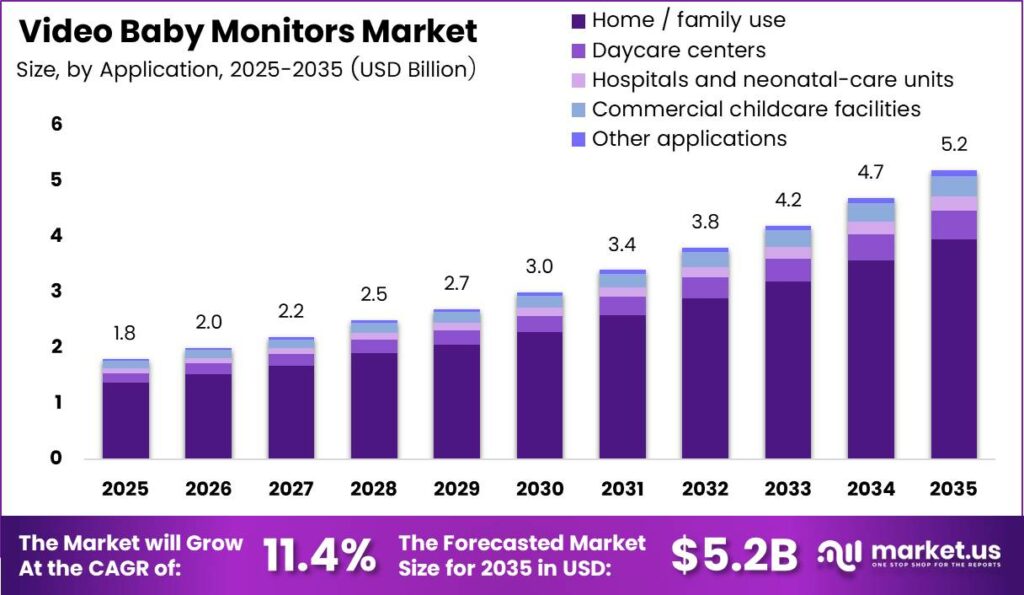
Global Video Baby Monitors Market size is expected to be worth around USD 5.2 Billion by 2035 from USD 1.8 Billion in 2025, growing at a CAGR of 11.4% during the forecast period 2026 to 2035.
The video baby monitor market covers devices that allow caregivers to watch, hear, and communicate with infants remotely. Products range from basic wired units to Wi-Fi-enabled cameras with smartphone integration, AI-powered sleep analytics, and smart home connectivity. This market spans home use, daycare facilities, and neonatal care environments across both consumer and institutional buyer groups.
Key Takeaways
- The global Video Baby Monitors Market is valued at USD 1.8 Billion in 2025 and is forecast to reach USD 5.2 Billion by 2035.
- The market is growing at a CAGR of 11.4% during the forecast period 2026 to 2035.
- By Product Type, Standard Video Baby Monitors dominate with a 31.0% share in 2025.
- By Connectivity, Wireless Video Baby Monitors hold the dominant position with a 71.0% share.
- By Application, Home/Family Use leads the market with a 76.0% share.
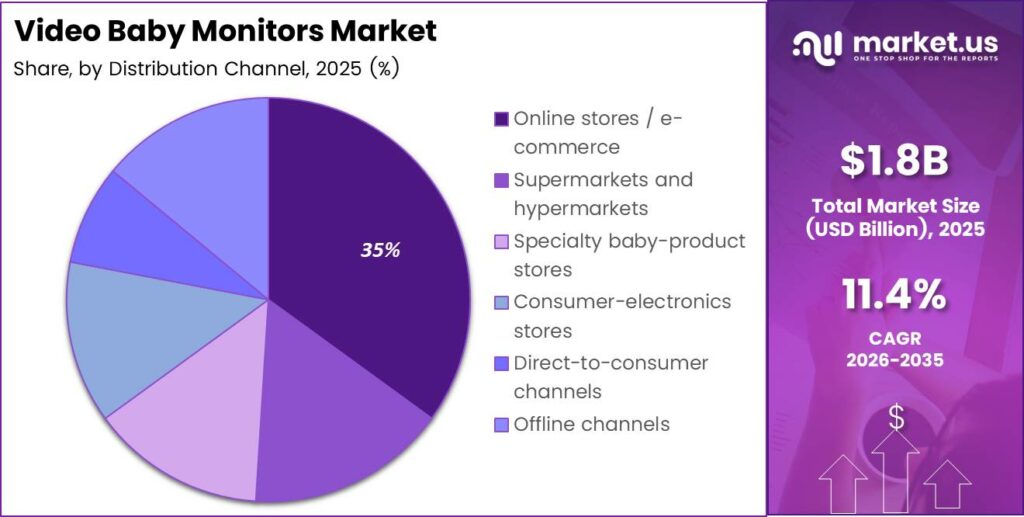
- By Distribution Channel, Online Stores/E-commerce holds a 35.0% share.
- North America is the dominant region, capturing 38.0% of the global market, valued at USD 0.68 Billion in 2025.
As per our research, approximately three-quarters of US children younger than six lived with two parents in 2023. Dual-income households create consistent need for remote infant supervision tools. This structural household pattern sustains first-purchase demand for video monitors across the core North American market.
According to ITU, 6 billion people, representing 74% of the global population, used the internet in 2025. This connectivity base expands the addressable market for Wi-Fi-enabled and app-integrated video monitors. As per our research, global fixed-broadband penetration reached 20 subscriptions per 100 inhabitants in 2025, creating the infrastructure backbone that smart monitor adoption depends on.
Based on ITU data, shipping route disruptions pushed Suez Canal vessel tonnage down 70% by mid-2024 compared to late 2023. This forced manufacturers to reroute components, raising landed costs and extending lead times. In December 2025, Nanit rolled out its Sleep Score feature to subscribers, signaling that product differentiation is now shifting from hardware specifications toward software-defined value.
Product Type Analysis
Standard Video Baby Monitors dominate with 31.0% due to low price point and wide retail availability.
In 2025, Standard Video Baby Monitors held a dominant market position in the By Product Type segment of the Video Baby Monitors Market, with a 31.0% share. These units deliver reliable video and audio without requiring a home Wi-Fi network, appealing to cost-conscious first-time parents. Their lower retail price removes the connectivity barrier and supports broad distribution across mass-market retail channels.
Wi-Fi-enabled video baby monitors represent the fastest-growing sub-segment within product type. App-based remote access allows both parents to monitor from separate locations simultaneously. This shared-access feature drives upgrade purchases among households that already own a standard unit, compressing replacement cycles and expanding average selling prices.
Smart and AI-enabled video baby monitors occupy the premium tier, commanding higher retail prices through features such as sleep analytics, cry classification, and breathing pattern detection. In February 2025, CuboAi launched the Smart Baby Monitor 3 with 2.5K QHD video and automatic height measurement, confirming active product development at the high end. This tier attracts health-conscious parents willing to pay for clinical-adjacent insights.
Audio and video baby monitors serve price-sensitive buyers who need dual-mode functionality without smart features. In February 2025, Momcozy launched the BM04 Dual-Mode Smart Baby Monitor combining dedicated parent-screen viewing with smartphone app access, demonstrating that non-Wi-Fi hybrid designs retain commercial relevance. The EU total fertility rate of 1.34 live births per woman in 2024 signals that European parents are purchasing fewer but higher-specification products per birth event.
Connectivity Analysis
Wireless Video Baby Monitors dominate with 71.0% due to flexible placement and smartphone integration capability.
In 2025, Wireless Video Baby Monitors held a dominant market position in the By Connectivity segment of the Video Baby Monitors Market, with a 71.0% share. Wireless units eliminate cable routing constraints, enabling camera placement in any room without proximity to a fixed connection point. This flexibility drives adoption in multi-room households and rental properties where permanent installations are impractical.
Wired video baby monitors retain a niche position among buyers who prioritize signal stability over placement flexibility. These units face no wireless interference or network dependency, making them the preferred choice in dense urban housing where Wi-Fi congestion affects reliability. By contrast, their fixed installation requirement limits adoption in households that rearrange nursery setups frequently.
Application Analysis
Home/Family Use dominates with 76.0% due to direct caregiver purchasing behavior and broad product compatibility.
In 2025, Home/Family Use held a dominant market position in the By Application segment of the Video Baby Monitors Market, with a 76.0% share. Direct consumer purchasing decisions drive this segment, with product selection guided by price, ease of setup, and app compatibility. This concentration means product roadmaps built around parent preferences capture the majority of revenue without requiring institutional sales infrastructure.
Daycare centers represent a distinct application with higher per-unit revenue potential due to multi-camera deployments. According to Eurostat, 68.5% of EU children aged between three years and the minimum compulsory school age received formal childcare for at least 25 hours per week in 2024. This institutionalization of childcare creates a procurement channel separate from the consumer market, favoring vendors with commercial pricing tiers and centralized management platforms.
Hospitals and neonatal care units constitute a specialized segment requiring clinical-grade monitoring reliability. WHO estimated that 13.4 million babies were born preterm worldwide in 2020, establishing a large installed base of high-risk newborns requiring continuous observation. This clinical demand positions vendors with medical-adjacent features to pursue institutional procurement contracts alongside their consumer product lines.
Distribution Channel Analysis
Online Stores/E-commerce dominate with 35.0% due to product variety, customer reviews, and direct-to-parent reach.
In 2025, Online Stores/E-commerce held a dominant market position in the By Distribution Channel segment of the Video Baby Monitors Market, with a 35.0% share. Digital retail allows parents to compare technical specifications, read verified reviews, and complete purchases without visiting a store. According to the US Census Bureau, e-commerce accounted for 16.4% of total US retail sales in Q2 2026, confirming that digital channel share across all consumer goods continues to expand.
Supermarkets, hypermarkets, specialty baby-product stores, and consumer-electronics stores serve buyers who prefer in-person evaluation before purchasing. Physical retail provides tactile product assessment and immediate fulfillment, advantages that sustain offline channel relevance despite e-commerce growth. Specialty baby-product stores carry deeper brand assortments and trained staff, supporting higher-value consultative purchases.
Key Market Segments
By Product Type
- Standard Video Baby Monitors
- Wi-Fi-Enabled Video Baby Monitors
- Smart/AI-Enabled Video Baby Monitors
- Audio and Video Baby Monitors
- Other Video Baby Monitors
By Connectivity
- Wired Video Baby Monitors
- Wireless Video Baby Monitors
- Others
By Application
- Home/Family Use
- Daycare Centers
- Hospitals and Neonatal-Care Units
- Commercial Childcare Facilities
- Other Applications
By Distribution Channel
- Online Stores/E-Commerce
- Supermarkets and Hypermarkets
- Specialty Baby-Product Stores
- Consumer-Electronics Stores
- Direct-to-Consumer Channels
- Offline Channels
Regional Analysis
North America Dominates the Video Baby Monitors Market with a Market Share of 38.0%, Valued at USD 0.68 Billion
North America commands 38.0% of the global video baby monitors market, valued at USD 0.68 Billion in 2025. High household income levels, strong smartphone penetration, and established e-commerce infrastructure support premium product adoption. The region’s regulatory environment for connected devices also incentivizes vendors to lead product compliance investments here before deploying them globally.
Asia Pacific is the fastest-growing regional market, driven by urban household formation, rising disposable incomes, and expanding organized retail in economies including China, India, and South Korea. In October 2025, Owlet announced plans to introduce Dream Sight, Dream Duo, and Dream Sock in India in early 2026 following CDSCO regulatory approval, confirming that Asia Pacific has moved from an exploratory market to an active commercial expansion target for leading brands.
Key Regions and Countries
North America
- US
- Canada
Europe
- Germany
- France
- The UK
- Spain
- Italy
- Rest of Europe
Asia Pacific
- China
- Japan
- South Korea
- India
- Australia
- Rest of APAC
Latin America
- Brazil
- Mexico
- Rest of Latin America
Middle East and Africa
- GCC
- South Africa
- Rest of MEA
Market Dynamics
Market Opportunity Analysis - Underserved applications and regions offer entry points for vendors ready to move beyond the consumer home segment
Daycare centers and commercial childcare facilities collectively represent a procurement channel that most video baby monitor vendors have not built dedicated product tiers to serve. Eurostat data confirmed that 68.5% of EU children aged between three years and the minimum compulsory school age received formal childcare for at least 25 hours per week in 2024. Vendors that offer centralized multi-camera management and role-based caregiver access can access this institutional channel without entering the clinical device space.
Hospitals and neonatal care units remain structurally underserved by consumer-grade monitor manufacturers despite a documented preterm birth population requiring continuous observation. WHO data placed global preterm births at 13.4 million in 2020, representing a large addressable base of high-risk newborns in institutional settings. This segment requires reliability certifications and procurement relationship investment, creating a barrier that protects early institutional entrants from the consumer-market price competition that dominates the home segment.
Asia Pacific is the fastest-growing regional market but remains underpenetrated relative to North America’s 38.0% global share. Urban household formation across India, Southeast Asia, and South Korea creates consistent demand entry points for value-tier and mid-tier products. Vendors entering with offline-compatible designs priced for local income levels can establish distribution ahead of premium brand expansion into these markets.
The Offline-First Emerging Markets opportunity targets Africa, South Asia, Southeast Asia, and Latin America, regions where broadband penetration remains below the global average of 20 subscriptions per 100 inhabitants. Products designed without cloud dependency remove the connectivity barrier that blocks Wi-Fi-enabled monitors from reaching these households. This approach opens a first-purchase funnel in markets where birth rates remain higher than those recorded in Europe and East Asia.
Technology and Innovation Landscape - AI-powered analytics, edge inference, and hardware-software integration define the next competitive tier
AI-enabled sleep and breathing analytics represent the most commercially active technology front in this market. Philips Avent launched its Premium Connected Baby Monitor with AI-powered SenseIQ sleep and breathing tracking in October 2024, while Nanit introduced its Sleep Score feature in December 2025. These launches confirm that algorithmic interpretation of camera-captured data has become a primary product differentiator, with vendors competing on model accuracy rather than hardware specifications alone.
On-device edge inference is the next architectural shift under development. Adjacent consumer-device deployments demonstrated local foundation-model processing in 2024, followed by offline inference developer access in 2025. Shifting detection workloads from cloud to local silicon reduces alert latency by an estimated 50–80% and could expand connected-product gross margin by 3–6 percentage points, creating a compelling case for manufacturers to invest in proprietary edge chipsets or partnerships with semiconductor vendors.
Hardware innovation has moved toward higher-resolution imaging and extended battery life as baseline differentiators. The eufy E21 launched at 4K video with 8x zoom and a 5,000mAh battery in November 2024, while CuboAi’s Smart Baby Monitor 3 introduced automatic height measurement using camera-based computer vision in February 2025. These additions extend the functional window of a monitor beyond infancy, reducing the short use-cycle restraint by giving parents a reason to keep devices active through toddler development stages.
Software-defined service layers are emerging as a parallel revenue architecture alongside hardware sales. Nanit’s partnership with Summer Health enabled parents to share monitor-captured sleep metrics and care logs with on-demand pediatricians for USD 129 annually. This integration positions the monitor as a clinical data-collection endpoint, expanding its value proposition from surveillance to health management and creating a recurring subscription stream that hardware-only competitors cannot replicate without equivalent software infrastructure.
Drivers
Working parents require real-time infant visibility across the workday, and global female labor-force participation of approximately 49.1% in 2024 sustains a large household base with this need. A 2025 policy brief estimated that caregiving responsibilities kept 708 million working-age women outside formal employment in 2023. Every percentage point of participation growth translates into additional monitor-purchasing households entering the market.
A hardware-plus-service model targeting an 8–12% paid-feature attachment rate could raise gross profit per connected unit by an estimated 6–10%. This shifts vendor economics away from replacement-device dependency toward recurring subscription retention. Vendors who build this revenue architecture early will carry structural margin advantages as the connected-device installed base scales through the forecast period.
| Driver | (~) % Impact on CAGR Forecast | Geographic Relevance | Impact Timeline |
|---|---|---|---|
| Working-Parent Monitoring Demand | +1.6% | Global; strongest in North America, Europe and urban Asia-Pacific | Short term (≤ 2 years) |
| Smartphone-First Remote Access | +1.2% | North America, Europe, East Asia and Gulf states | Short term (≤ 2 years) |
| Premium Video Feature Mix | +0.9% | North America, Western Europe, Japan and South Korea | Short term (≤ 2 years) |
| Direct Digital Retail Reach | +0.7% | Global; strongest in digitally mature urban markets | Short term (≤ 2 years) |
| Multi-Room Camera Expansion | +0.5% | North America, Europe and affluent Asia-Pacific | Medium term (2–4 years) |
| Residential Smart-Home Adoption | +0.4% | North America, Europe, China and Gulf states | Medium term (2–4 years) |
Restraints
Declining birth cohorts directly reduce first-purchase demand in the market’s highest-spending regions. The European Union recorded 3.55 million births in 2024, down 3.3% from 3.67 million in 2023. China contracted more sharply, falling from 9.54 million births in 2024 to 7.92 million in 2025, a contraction of approximately 17.0%.
Each lost birth removes a prospective household from the immediate purchase funnel. The model applies a -1.7 percentage-point deduction, reducing the isolated CAGR case from 11.4% to approximately 9.7%. Manufacturers must extend product relevance into toddler monitoring and home-security use cases to offset shrinking birth-cohort volume; otherwise lower factory utilization could compress gross margins by an estimated 2–4 percentage points.
| Restraint | (~) % Impact on CAGR Forecast | Geographic Relevance | Impact Timeline |
|---|---|---|---|
| Falling Birth Cohorts | -1.7% | Europe, China, Japan, South Korea and North America | Long term (≥ 4 years) |
| Household Discretionary Pressure | -1.2% | Global; strongest among lower-income households | Short term (≤ 2 years) |
| Product Safety Recalls | -0.9% | North America and other tightly regulated markets | Short term (≤ 2 years) |
| Medical-Claim Restrictions | -0.7% | United States and regulated healthcare markets | Short term (≤ 2 years) |
| Refurbished Device Substitution | -0.5% | North America, Europe and urban Asia-Pacific | Medium term (2–4 years) |
| Short Infant Use Cycle | -0.4% | Global | Long term (≥ 4 years) |
Challenges
Fragmented cybersecurity compliance across major markets creates a structural cost burden for connected-monitor manufacturers. The European cybersecurity framework entered into force on December 10, 2024, with mandatory incident reporting beginning September 11, 2026. Manufacturers must issue early warnings within 24 hours, fuller notifications within 72 hours, and final reports within 14 days of a corrective measure.
The United States established its voluntary consumer-IoT labeling framework in March 2024, adding accredited testing, software-support disclosure, and registry requirements for participating baby monitors. Maintaining compliance infrastructure across both frameworks could increase the break-even shipment volume for a connected-monitor platform by an estimated 10–15%. This compliance cost gap creates a revenue opportunity for third-party security certification and managed-compliance service providers targeting mid-size monitor brands.
| Challenge | (~) % CAGR Friction Drag | Geographic Relevance | Mitigation Horizon |
|---|---|---|---|
| Fragmented Cybersecurity Compliance | -1.4% | European Union, United States and other advanced markets | Medium term (2–4 years) |
| False-Alert Model Validation | -1.1% | Global; highest relevance for analytics-enabled devices | Medium term (2–4 years) |
| Semiconductor Supply Concentration | -0.9% | Global; concentrated in Asian manufacturing networks | Medium term (2–4 years) |
| Wireless Reliability Variability | -0.7% | Global; elevated in dense urban housing | Short term (≤ 2 years) |
| Multilingual Support Scaling | -0.5% | Asia-Pacific, Latin America, Europe and Middle East | Medium term (2–4 years) |
| Retail Return Complexity | -0.4% | North America and Europe | Short term (≤ 2 years) |
Opportunities
On-device edge intelligence represents the highest-value untapped opportunity in this market. Adjacent consumer-device deployments demonstrated on-device foundation-model processing in 2024, and developer access to offline inference followed in 2025. Shifting detection workloads from cloud servers to local silicon could reduce annual cloud expense per camera by an estimated USD 8 to USD 18 and cut actionable-alert latency by approximately 50–80%.
Combining edge-processing cost savings with an optional analytics subscription at a modeled 6–10% paid attachment rate could lift the standalone CAGR case from 11.4% to approximately 13.2%. This opportunity adds approximately +1.8 percentage points above the baseline. Early movers who establish edge-first architectures before compliance costs rise will hold a durable manufacturing and margin advantage over cloud-dependent competitors.
| Opportunity | (~) % Potential CAGR Upside | Geographic Relevance | Execution Window |
|---|---|---|---|
| On-Device Edge Intelligence | +1.8% | North America, Europe and advanced Asia-Pacific | Medium term (2–4 years) |
| Institutional Childcare Platforms | +1.2% | Global urban centers and organized childcare networks | Medium term (2–4 years) |
| Subscription Sleep Analytics | +0.9% | North America, Europe and affluent Asia-Pacific | Short term (≤ 2 years) |
| Offline-First Emerging Markets | +0.7% | Africa, South Asia, Southeast Asia and Latin America | Medium term (2–4 years) |
| Travel Monitor Rental Networks | +0.5% | North America, Europe, Gulf states and tourism hubs | Medium term (2–4 years) |
| Telecom Bundle Distribution | +0.4% | Asia-Pacific, Middle East, Europe and Latin America | Long term (≥ 4 years) |
Key Company Insights
Motorola Mobility/Hubble Connected operates through the Hubble Connected platform, positioning its monitors as part of a broader home-visibility ecosystem. This multi-device architecture supports upsell from single-camera households to multi-room setups. UNICEF estimated that 2.3 million newborns died during their first month of life in 2024, reinforcing the emotional urgency that sustains premium monitor adoption among first-time parents.
VTech Holdings/VTech Communications reported group revenue of USD 2,027.5 million for the financial year ended March 31, 2026, a decline of 6.9%. This revenue contraction signals pricing pressure and category maturation across its core consumer-electronics portfolio. In October 2024, Philips Avent launched its Premium Connected Baby Monitor with AI-powered SenseIQ sleep and breathing tracking, intensifying competition at the premium tier where VTech must now compete on analytics depth rather than price alone.
Key Players
- Motorola Mobility/Hubble Connected
- VTech Holdings Limited
- Koninklijke Philips N.V./Philips Avent
- Nanit
- Owlet Baby Care, Inc.
- Samsung Electronics Co., Ltd.
- Infant Optics
- Angelcare Monitors Inc.
- Kids2, Inc./Summer Infant
- Arlo Technologies, Inc.
- iBaby Labs, Inc.
- Dorel Industries Inc./Safety 1st
- CuboAi
- Babysense
- Anker Innovations/Eufy
Recent Developments
- December 2025 – Nanit announced a USD 50 million growth-capital round led by Springcoast Partners, with participation from Upfront Ventures and JVP, to accelerate development of its AI-powered Parenting Intelligence System, with rollout planned for 2026.
- December 2025 – Anker Japan launched the eufy Baby Monitor C10 in Japan at ¥15,990 including tax, combining a 2K camera with a dedicated 4.5-inch display, 351-degree pan, 60-degree tilt, and 4x digital zoom.
- November 2025 – Nanit introduced its Home 8-inch Display, a dedicated touchscreen companion for the Nanit Pro Baby Monitor supporting 1080p live video, two-way audio, and split-screen viewing of two cameras.
- September 2025 – Owlet launched the Dream Sight video baby monitor at USD 99.99, featuring 2K HD video, motion and cry detection, two-way audio, and temperature monitoring. The Dream Duo bundle combining Dream Sight with the Dream Sock wearable was priced at USD 379.99.
- September 2024 – Owlet announced the closing of a public offering and debt refinancing providing potential total gross proceeds of up to USD 46.6 million, comprising approximately USD 11.6 million from the equity offering and up to USD 35 million from debt financing.
- November 2024 – Anker Innovations’ eufy brand launched the E20 and E21 baby monitors at USD 169.99 and USD 249.99 respectively. The E20 featured 2K video and the E21 offered 4K video with 8x zoom; both included a 5,000mAh camera battery.
- March 2025 – Nanit and Summer Health announced a partnership integrating baby-monitor data with on-demand pediatric care, offering Nanit users unlimited family coverage for USD 129 annually and access to pediatricians within 15 minutes.
Report Scope
| Report Features | Description |
|---|---|
| Market Value (2025) | USD 1.8 Billion |
| Forecast Revenue (2035) | USD 5.2 Billion |
| CAGR (2026-2035) | 11.4% |
| Base Year for Estimation | 2025 |
| Historic Period | 2020-2024 |
| Forecast Period | 2026-2035 |
| Report Coverage | Revenue Forecast, Market Dynamics, Market Opportunity Analysis, Technology and Innovation Landscape, Competitive Landscape, Recent Developments |
| Segments Covered | By Product Type (Standard Video Baby Monitors, Wi-Fi-Enabled Video Baby Monitors, Smart/AI-Enabled Video Baby Monitors, Audio and Video Baby Monitors, Other Video Baby Monitors), By Connectivity (Wired Video Baby Monitors, Wireless Video Baby Monitors, Others), By Application (Home/Family Use, Daycare Centers, Hospitals and Neonatal-Care Units, Commercial Childcare Facilities, Other Applications), By Distribution Channel (Online Stores/E-Commerce, Supermarkets and Hypermarkets, Specialty Baby-Product Stores, Consumer-Electronics Stores, Direct-to-Consumer Channels, Offline Channels) |
| Regional Analysis | North America (US and Canada), Europe (Germany, France, The UK, Spain, Italy, and Rest of Europe), Asia Pacific (China, Japan, South Korea, India, Australia, and Rest of APAC), Latin America (Brazil, Mexico, and Rest of Latin America), Middle East and Africa (GCC, South Africa, and Rest of MEA) |
| Competitive Landscape | Motorola Mobility/Hubble Connected, VTech Holdings Limited/VTech Communications, Koninklijke Philips N.V./Philips Avent, Nanit, Owlet Baby Care Inc., Samsung Electronics Co. Ltd., Infant Optics, Angelcare Monitors Inc., Kids2 Inc./Summer Infant, Arlo Technologies Inc., iBaby Labs Inc., Dorel Industries Inc./Safety 1st, CuboAi, Babysense, Anker Innovations/Eufy |
| Customization Scope | Customization for segments, region/country-level will be provided. Additional customization can be done based on requirements. |
| Purchase Options | We have three licenses to opt for: Single User License, Multi-User License (Up to 5 Users), Corporate Use License (Unlimited User and Printable PDF) |