Report Overview
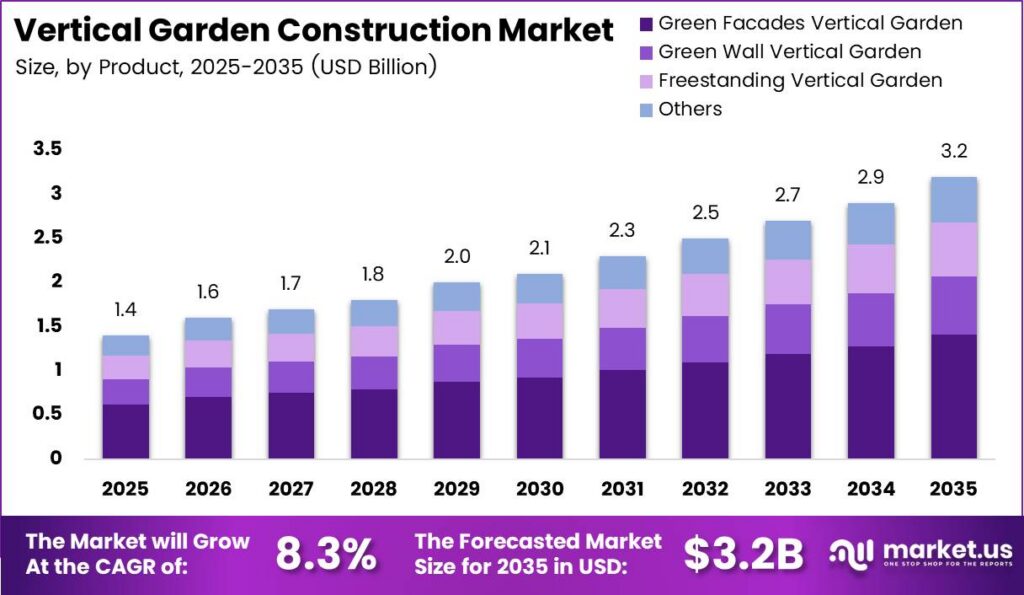
Global Vertical Garden Construction Market size is expected to be worth around USD 3.2 Billion by 2035 from USD 1.4 Billion in 2025, growing at a CAGR of 8.3% during the forecast period 2026 to 2035. Vertical garden construction systems consist of engineered structural sub-frames, automated fertigation networks, and biological growing substrates that attach live vegetation onto indoor and outdoor building envelopes. Therefore, commercial developers use these assemblies to cool facades, filter air, and meet urban zoning rules.
Commercial offices, transit hubs, retail centers, and multi-family residential towers form the primary buyer base for vertical greenery. According to United Nations Environment Programme (UNEP), the global buildings and construction sector consumed 32% of global energy and contributed 34% of global carbon dioxide emissions, while structural materials like cement and steel drove 18% of building emissions. Consequently, real estate owners install vegetated wall systems to insulate concrete exteriors and cut mechanical cooling loads.
Key Takeaways
- The global Vertical Garden Construction Market was valued at USD 1.4 Billion in 2025.
- Market revenue will reach USD 3.2 Billion by 2035.
- The industry will expand at a CAGR of 8.3% during the forecast period from 2026 to 2035.
- By Type, Outdoor Vertical Garden Wall led the segment with a 65.89% share in 2025, while Indoor Vertical Garden Wall represents the fastest growing category.
- By Application, Commercial Construction captured the dominant 78.67% share in 2025 and also registers the fastest growth rate.
- By Product, Green Facades Vertical Garden held the largest share of 43.89% in 2025 and stands as the fastest growing product segment.
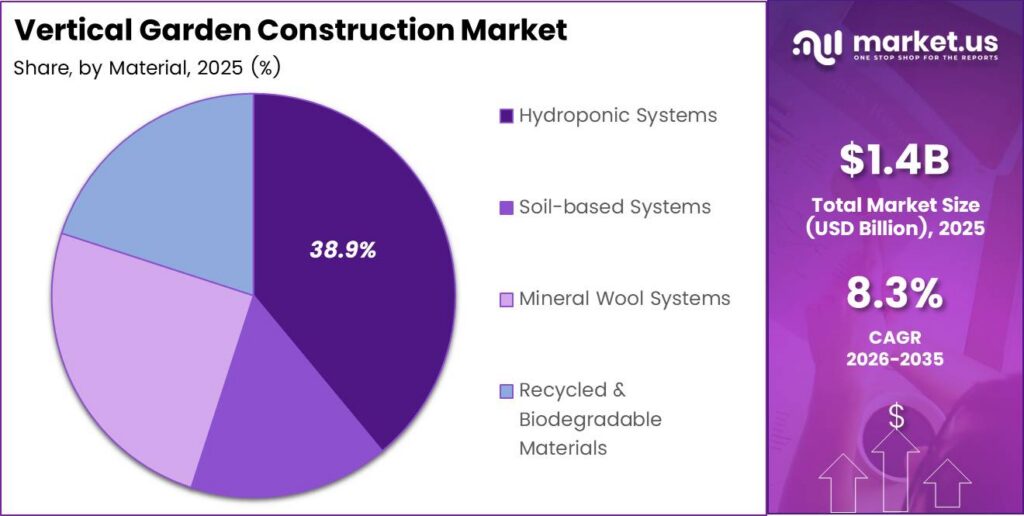
- By Material, Hydroponic Systems accounted for the leading 38.89% share in 2025, whereas Soil-based Systems represent the fastest growing material category.
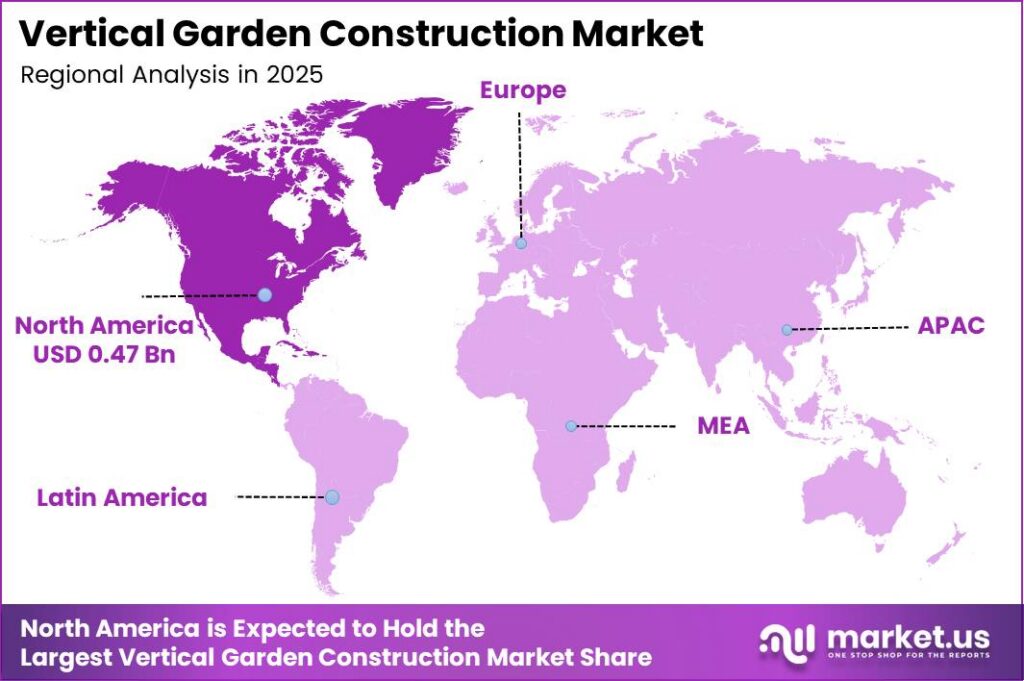
- North America dominated the regional landscape in 2025 with a 33.89% market share valued at USD 0.47 Billion, while Asia-Pacific is the fastest growing region.
Municipal green plot mandates and energy decarbonization codes actively compel property developers to fund exterior vegetative retrofits. As reported by United Nations Environment Programme (UNEP), global buildings floor area expanded by 1.7% in 2024 to reach 273 billion square meters, while annual investment in building energy efficiency hit USD 275 billion and reached USD 2.3 trillion cumulatively since 2015. This means facade contractors can capture capital directly from core building efficiency budgets rather than discretionary landscaping funds.
In October 2026, GWS Living Art and Vidacity unveiled a 1,035.4 square meter biodiverse living wall featuring 400 plant cultivars and the modular GaiaWall 2.0 system at JTC LaunchPad in Singapore . The project partners executed this installation alongside NParks, JTC Corporation, and the National University of Singapore to test urban heat mitigation. This signals that commercial landlords now favor engineered modular wall platforms that verify ecological performance across dense industrial parks.
North America holds the leading position in the global market, capturing a 33.89% share valued at USD 0.47 Billion in 2025. Data from Organisation for Economic Co-operation and Development (OECD) shows that green buildings represent a USD 24.7 trillion investment opportunity across emerging cities with populations over 500,000 by 2030, delivering up to 37% lower operating expenses. High corporate sustainability budgets and strict municipal stormwater credits across North American metropolitan corridors drive heavy institutional procurement of modular living facades.
In August 2026, Green Living Tech launched the Living Infrastructure Intelligence Platform, an engineering and financial decision tool built on 25 years of green roof and living wall deployment . This software models operational, environmental, and financial returns over a 40 year analysis horizon for structural architects and property owners. As a result, system suppliers that back their hardware with long-term lifecycle return calculators win specifications much earlier in the architectural design phase.
Type Analysis
Outdoor Vertical Garden Wall dominates with 65.89% share in 2025 due to mandatory municipal exterior greening codes.
In 2025, Outdoor Vertical Garden Wall held a 65.89% share in the Type segment of the Vertical Garden Construction Market. JTC Corporation found that sensors on a 1,035.4 square meter wall with 400 cultivars recorded a 1°C cooling effect, keeping facades below 30.0°C against 32.7°C bare concrete. In March 2026, Biotecture launched its EN 13501-1 B-s2,d0 Aluminium BioPanel after an 18 month program for buildings over 11 meters . Exterior foliage blocks solar radiation, so vendors with fire-rated metal panels win high-rise tenders.
Indoor Vertical Garden Wall functions as the fastest growing category within the Type segment as corporate employers upgrade interior workplace wellness infrastructure. Based on United States Environmental Protection Agency (US EPA) data, volatile organic compound and indoor pollutant concentrations sit 2 to 5 times higher indoors than outdoors, while citizens spend 90% of their day inside buildings. Consequently, interior rhizosphere microbes metabolize airborne toxins and buffer ambient room humidity. This creates steady recurring maintenance contracts for interior plantscaping providers.
In October 2025, Biotecture retrofitted a 134 square meter internal hydroponic BioPanel living wall containing 8,257 plants across 4 species onto cladding rails set at 600 millimeter centers inside a London office atrium . Dense indoor plant canopies and moist mineral substrates absorb reverberant mid-frequency acoustic energy across glass and concrete corporate lobbies. Therefore, commercial interior fit-out contractors specify modular indoor living walls to solve open-plan office noise complaints while earning green building wellness points.
Application Analysis
Commercial Construction dominates with 78.67% share in 2025 due to corporate carbon disclosure mandates.
In 2025, Commercial Construction held a 78.67% share in the Application segment of the Vertical Garden Construction Market and represents the fastest growing application category. U.S. Census Bureau indicates that private nonresidential construction spending rose 1.1% monthly to an annual rate of USD 790.6 billion in September 2026, while total nonresidential spending reached USD 1,324.95 billion. Commercial steel and glass curtain walls trap solar heat, requiring exterior vegetative shading. Therefore, commercial facade contractors secure high-value turnkey installation contracts.
In January 2026, LiveWall installed 2 custom outdoor perennial vertical garden walls at Breton Village, an upscale 200,000 square foot open-air retail shopping center located in Grand Rapids, Michigan . Retail and hospitality property owners deploy exterior living walls at pedestrian entrances to increase shopper dwell times and differentiate physical storefronts. As a result, system manufacturers that engineer frost-tolerant perennial plant cassettes capture strong repeat orders from national commercial real estate investment trusts.
Residential Construction encompasses multi-family apartment towers, urban condominium complexes, and luxury single-family residences that integrate vertical greenery into balconies and perimeter walls. Figures from U.S. Census Bureau show that full-year private residential construction spending in the United States reached USD 917.9 billion in 2024, marking a 5.9% gain over USD 866.9 billion in 2023. High-density urban housing footprints lack ground-level yard space, forcing architects to place communal greenery onto vertical facades. This creates demand for low-maintenance residential irrigation kits.
Product Analysis
Green Facades Vertical Garden dominates with 43.89% share in 2025 due to lower structural installation costs.
In 2025, Green Facades Vertical Garden held a 43.89% share in the Product segment of the Vertical Garden Construction Market and stands as the fastest growing product category. According to International Energy Agency (IEA) , global buildings consume over 450 EJ, representing 30% of global energy demand, split between 30% commercial and 70% residential buildings. In July 2025, Jakob Rope Systems installed a 390 square meter Webnet stainless steel trellis facade at the Rosenbergsau wastewater plant . Tensioned steel cables shed wind loads and cut framing expenses for buyers.
Green Wall Vertical Garden systems utilize continuous modular trays, felt pockets, or carrier panels pre-planted with dense root-zone media across the structural wall surface. As reported by Eurostat , annual production volume in the construction of buildings across the European Union increased by 3.6% year-over-year in July 2025, while specialized construction activities rose by 2.7%. Pre-vegetated modular panels deliver instant 100% foliage coverage upon handover, allowing general contractors to pass municipal green envelope inspections immediately. This supports premium pricing for nursery growers.
Freestanding Vertical Garden units provide self-supporting, movable vegetative partitions for transit stations, semi-outdoor plazas, and flexible commercial floor plates. Data from Eurostat shows that euro area construction production rose 1.7% monthly and 3.0% annually in April 2025, led by a 1.7% monthly gain in specialized construction and 0.9% in building construction. In November 2025, Biotecture installed 2 BioPanel walls totaling 60 square meters with 4,000 plants across 14 species at the 650 space Richmond Cycle Hub . Modular frames remove wall drilling costs for tenants.
Material Analysis
Hydroponic Systems dominates with 38.89% share in 2025 due to lightweight structural load profiles.
In 2025, Hydroponic Systems held a 38.89% share in the Material segment of the Vertical Garden Construction Market. Food and Agriculture Organization of the United Nations (FAO) found that hydroponic and aeroponic cultivation systems reduce water consumption by more than 90% and decrease fertilizer usage by 60% compared to conventional soil farming. Soilless inert mats eliminate heavy wet earth loads on curtain walls while delivering dissolved nutrients directly to roots. Consequently, structural engineers specify hydroponic panels on weight-restricted facade retrofits.
Soil-based Systems represent the fastest growing category within the Material segment because natural organo-mineral substrates buffer root zones against sudden pump or power failures. Based on U.S. Geological Survey (USGS) data , domestic processed crude perlite sold and used reached 440,000 metric tons valued at USD 33 million across 53 plants in 29 states, with construction capturing 47% and horticultural aggregates taking 16%. Expanded perlite granules create porous air pockets inside modular soil trays, preventing root rot and cutting plant warranty replacement costs.
Mineral Wool Systems provide fire-resistant, sterile rock fiber blocks that maintain uniform capillary moisture distribution across tall vertical installations. U.S. Geological Survey (USGS) indicates that domestic crude perlite mine output reached 730,000 metric tons in 2025 with horticultural media using 15% or 69,000 metric tons, alongside 100,000 metric tons of vermiculite. In March 2025, ROCKWOOL International invested EUR 100 million to expand stone wool capacity at its Cigacice plant in Poland across 40 countries . Non-combustible basalt fibers help contractors pass strict high-rise fire audits.
Key Market Segments
By Type
- Outdoor Vertical Garden Wall
- Indoor Vertical Garden Wall
By Application
- Commercial Construction
- Residential Construction
By Product
- Green Facades Vertical Garden
- Green Wall Vertical Garden
- Freestanding Vertical Garden
- Others
By Material
- Hydroponic Systems
- Soil-based Systems
- Mineral Wool Systems
- Recycled & Biodegradable Materials
Regional Analysis
North America Dominates the Vertical Garden Construction Market with a Market Share of 33.89% in 2025, Valued at USD 0.47 Billion
North America leads the global market, capturing a 33.89% share valued at USD 0.47 Billion in 2025. Figures from U.S. Census Bureau show that total United States construction spending reached a seasonally adjusted annual rate of USD 2,186.1 billion in September 2026, while nine-month cumulative spending totaled USD 1,649.6 billion. Large-scale commercial office, healthcare, and hyperscale data center builds across the United States require vegetated facades to earn municipal stormwater retention credits and LEED certification points. This sustains high margins for regional turnkey installers.
Europe represents a mature, regulation-driven market where strict fire cladding statutes and municipal biodiversity laws dictate product engineering. According to U.S. Census Bureau , full-year construction put in place across the United States reached USD 2,154.4 billion in 2024, up 6.5% over USD 2,023.7 billion in 2023, establishing a benchmark that European green infrastructure programs match through binding urban renovation directives. European building codes mandate non-combustible aluminum and stone wool assemblies on multi-story facades, forcing suppliers to upgrade material specifications.
Asia-Pacific operates as the fastest growing region in the global vertical garden construction landscape. As reported by Organisation for Economic Co-operation and Development (OECD) , East Asia and Pacific accounts for USD 17.8 trillion of the USD 24.7 trillion emerging-market green buildings investment opportunity through 2030. Rapid high-rise urbanization and mandatory green plot ratio statutes in Singapore, Tokyo, and major Chinese metropolitan hubs compel developers to integrate vertical foliage into new commercial towers. Consequently, global facade manufacturers are establishing localized Asian nursery partnerships.
Key Regions and Countries
North America
- US
- Canada
Europe
- Germany
- France
- The UK
- Spain
- Italy
- Rest of Europe
Asia Pacific
- China
- Japan
- South Korea
- India
- Australia
- Rest of APAC
Latin America
- Brazil
- Mexico
- Rest of Latin America
Middle East and Africa
- GCC
- South Africa
- Rest of MEA
Market Dynamics
Urban heat island intensification, building energy decarbonization rules, and strict high-rise fire safety laws actively reshape vertical garden procurement strategies. Data from International Energy Agency (IEA) shows that global electricity consumption in the buildings sector increased by more than 600 TWh or 5% in 2024, accounting for nearly 60% of total global electricity demand growth due to air-conditioning loads and data centers. Consequently, commercial facility managers deploy exterior vegetated cladding to cut peak summer cooling electricity bills.
Drivers
Urban zoning laws enacted between 2024 and 2025 made vertical gardens mandatory for commercial building permits. After the United Kingdom enforced 10% biodiversity net gain rules in January 2024, Singapore, Tokyo, and Paris expanded green plot minimums in 2025. New commercial buildings over 5,000 square meters must maintain 30% to 45% vegetation coverage, pushing architects toward modular walls. This +2.6% CAGR driver shifts vendors to 5 to 10 year lifecycle contracts and cuts customer acquisition costs by 18% to 24%.
General contractors now lock in living facade suppliers during early schematic design rather than post-construction fit-out. Standardized modular trellis and irrigated panel systems capture 62% of compliant facade allocations across regulated metropolitan corridors. Therefore, early specification accelerates baseline project conversion timelines by 3.5 months for system manufacturers. Bundled design, build, and maintenance agreements also lift recurring service revenue attachments to 35% of total contract value, giving investors predictable multi-year cash flows.
| Driver | (~) % Impact on CAGR Forecast | Geographic Relevance | Impact Timeline |
|---|---|---|---|
| Mandatory Municipal Green Envelope Ratio Mandates | +2.6% | Western Europe & Asia-Pacific | Short term (≤ 2 years) |
| Corporate Embodied Carbon & Biodiversity Disclosures | +1.9% | North America & Europe | Short term (≤ 2 years) |
| Commercial HVAC Thermal Load Reduction Retrofits | +1.5% | Middle East & Southern Europe | Medium term (2–4 years) |
| Hospitality & High-End Retail Biophilic Redesigns | +1.2% | Global | Short term (≤ 2 years) |
| Acoustic Attenuation Specifying in Transit Hubs | +0.8% | Asia-Pacific & North America | Medium term (2–4 years) |
| Prefabricated Hydroponic Felt Panel Standardization | +0.6% | Global | Long term (≥ 4 years) |
Restraints
Strict national fire safety revisions on multi-occupancy buildings exceeding 11 to 18 meters in height block polymeric and organic vertical garden substrates across urban jurisdictions. Under European EN 13501-1 Class A1 and A2-s1,d0 fire rules enforced through 2025 and 2026, traditional polyethylene modules, geotextile felts, and peat media fail flame and smoke tests. This –2.1% CAGR restraint forces suppliers to replace polymer trays with anodized aluminum, stainless steel, and mineral wool assemblies.
Switching to fire-compliant metal and mineral systems raises material fabrication costs by USD 280 to USD 420 per square meter. Consequently, fully installed exterior living wall prices climb to between USD 1,150 and USD 1,650 per square meter, triggering value-engineering cancellations across 28% to 34% of planned high-rise exterior tenders. Specialty facade contractors suffer gross margin compression of 450 to 600 basis points on metallic systems while losing high-rise bids to static architectural louvers.
| Restraint | (~) % Impact on CAGR Forecast | Geographic Relevance | Impact Timeline |
|---|---|---|---|
| High-Rise Exterior Fire Cladding Statutory Prohibitions | -2.1% | Europe, UK & Australia | Short term (≤ 2 years) |
| Elevated Upfront Structural & Waterproofing CapEx | -1.7% | Global | Short term (≤ 2 years) |
| Commercial Office Vacancy & Refinancing Freezes | -1.3% | North America & Western Europe | Medium term (2–4 years) |
| Municipal Potable Water Irrigation Bans | -0.9% | Southwestern US, Southern Europe & MENA | Medium term (2–4 years) |
| Commercial Property Underwriting & Premium Surcharges | -0.7% | North America & Europe | Short term (≤ 2 years) |
| Historic District Facade Alteration Moratoriums | -0.4% | Europe | Long term (≥ 4 years) |
Challenges
Thermodynamic and aerodynamic shear stresses on building envelopes above the 8th floor expose wall plants to wind velocities over 55 kilometers per hour and intense solar glazing reflection. These microclimatic spikes accelerate evapotranspiration rates by 140% to 210% compared to ground nurseries, causing root desiccation and winter freeze dieback. This –1.4% CAGR drag drives annual plant replacement rates of 18% to 26% during the first 24 months post-handover.
Managing high-altitude plant mortality forces vertical garden contractors to absorb warranty replacement costs averaging USD 95 to USD 160 per square meter annually. Pre-installation wind-hardening acclimation in specialized nurseries also extends project commissioning timelines by 12 to 16 weeks. To protect margins and brand reputation, operators must redirect 6% to 9% of operating budgets toward computational fluid dynamics microclimate modeling and hold buffer nursery stock equal to 20% of installed square footage.
| Challenge | (~) % CAGR Friction Drag | Geographic Relevance | Mitigation Horizon |
|---|---|---|---|
| High-Altitude Microclimate Plant Mortality | -1.4% | Global | Medium term (2–4 years) |
| Emitter Biofouling & Fertigation Scaling | -1.1% | Global | Short term (≤ 2 years) |
| Certified Abseiling Agronomist Labor Deficit | -0.9% | North America, Europe & Middle East | Medium term (2–4 years) |
| Custom Structural Sub-Frame Lead Delays | -0.7% | Global | Short term (≤ 2 years) |
| Substrate Compaction & Root Overgrowth | -0.5% | Global | Long term (≥ 4 years) |
| Sensor Corrosion & Telemetry Drift | -0.4% | Asia-Pacific & Middle East | Medium term (2–4 years) |
Opportunities
Re-engineering exterior modular walls from passive ornamental cladding into active biological greywater treatment reactors unlocks commercial high-rise and hospitality demand. Integrating porous ceramic bio-media, rhizosphere microbial inoculants, and trickling filter hydraulics into facade panels enables a 200 square meter wall to polish 4,500 to 7,000 liters of shower and washbasin greywater daily. Building operators reuse this treated water for toilet flushing and cooling towers, supporting a +2.2% CAGR upside.
Selling functional water-treatment facades allows engineering contractors to bypass ornamental landscaping budgets and tap core mechanical, electrical, and plumbing capital allocations. This positioning raises average system selling prices by 38% to 52% per square meter. Early movers capture gross margins of 42% to 48% compared to 24% to 29% on standard walls, while cutting building municipal water and sewer fees by 30% to 45% over a 10 year lifecycle.
| Opportunity | (~) % Potential CAGR Upside | Geographic Relevance | Execution Window |
|---|---|---|---|
| Decentralized Greywater Phytoremediation Facade Systems | +2.2% | Global | Medium term (2–4 years) |
| AI-Driven Predictive Fertigation SaaS Monetization | +1.6% | North America, Europe & East Asia | Short term (≤ 2 years) |
| Highway & Rail Particulate Bio-Filtration Barriers | +1.3% | Europe & Asia-Pacific | Medium term (2–4 years) |
| Mycelium & Biochar Zero-Waste Substrate Modules | +1.0% | Europe & North America | Long term (≥ 4 years) |
| Data Center Waste-Heat Vertical Greenhouses | +0.8% | Northern Europe & North America | Long term (≥ 4 years) |
| Post-Installation Maintenance Contractor M&A Roll-Ups | +0.6% | North America & Western Europe | Short term (≤ 2 years) |
Key Company Insights
Sempergreen
Sempergreen operates as a premier global developer of pre-cultivated modular living walls, green roof blankets, and automated irrigation controls across Europe, North America, and Asia-Pacific. Sempergreen Corporate Releases found that its SemperGreenwall modular facade system absorbs 2.3 kilograms of carbon dioxide and produces 1.7 kilograms of oxygen per square meter annually while holding Bronze Cradle to Cradle certification and employing 101 to 250 staff. This verified environmental performance helps commercial architects meet municipal carbon mandates.
In October 2026, Sempergreen published an independently verified Environmental Product Declaration for its SemperGreenwall facade system under ISO 14025:2006 and EN 15804:2012+A2:2019/AC:2021 lifecycle standards . Based on Sempergreen data , this certification quantifies embodied carbon and lifecycle environmental impacts for commercial developers pursuing LEED, BREEAM, and DGNB building ratings. Consequently, providing third-party verified lifecycle transparency protects Sempergreen from price competition during institutional public and commercial facade tenders.
ZTC International Landscape Solutions
ZTC International Landscape Solutions engineers and executes large-scale vertical gardens, podium roof landscapes, and rainwater harvesting infrastructure across commercial, information technology, and hospitality developments. While ZTC International leads domestic Indian landscape engineering, global waterproofing giant American Hydrotech anchors the international structural envelope tier. Sika AG and American Hydrotech Official Releases indicate that American Hydrotech generated CHF 83 million in annual sales before integration and installed over 2 billion square feet of Monolithic Membrane 6125 across 86 countries. Proven waterproofing prevents facade leaks.
In June 2026, Sika Corporation and American Hydrotech launched the unified Sikalastic Rapid polymethyl methacrylate liquid-applied flashing and waterproofing membrane line across 86 countries . Figures from American Hydrotech and Sika show that this product rollout followed the full operational integration of American Hydrotech into Sika’s Roofing and Waterproofing division in 2025. Pairing fast-curing liquid flashing membranes with vegetated wall assemblies reduces structural moisture liability for commercial general contractors.
Key Players
- Sempergreen
- ZTC International Landscape Solutions
- American Hydrotech
- Livewall
- Four Leaf Landscape
- A+ Lawn & Landscape
- Biotecture
- The Greenwall Company
- ANS Group Global
- GreenWalls Bioengineering
- Other Key Players
Recent Developments
2026
- May 2026: Viritopia (ANS Group Global) capacity expansion advanced 10 hyperscale data center living wall projects totaling 30,000 square meters into active production and reduced summer HVAC energy consumption by 12% on a 500 square meter London office wall according to Viritopia .
- April 2026: Sempergreen project installation completed a 79 square meter exterior vertical garden facade using Sempergreen Flexipanels for the Green Hotel renovation in Genk, Belgium, absorbing 2.3 kilograms of CO2 per square meter annually according to Sempergreen .
2025
- November 2025: Sempergreen and Armada Groupe partnership and capacity expansion established Sempergreen Türkiye with localized manufacturing near Istanbul to supply SemperGreenwall systems across 6 major Turkish metropolitan markets according to Sempergreen .
- October 2025: Biotecture Ltd project installation completed 2 multi-floor rooftop hydroponic BioPanel living walls spanning 110 square meters with 6,270 plants across 10 species and Grodan stone wool substrate in Moorgate, London according to Biotecture UK .
- September 2025: Ambius acquisition purchased 2 Austin, Texas plantscaping and vertical greenery companies, Creative Plant Designs and Plant Management Associates, both operating for 40 years since 1978, according to Lawn & Landscape .
- June 2025: Viritopia (ANS Group Global) project installation delivered 2,252 square meters of modular living walls across 3 AI-ready data center buildings (990 m², 590 m², and 672 m²) at Ark’s 56,000 square meter Union Park campus in Hayes, UK, alongside a 1,000 square meter wall with 50,000 plants at Equinix FR10 in Frankfurt according to Viritopia .
2024
- November 2024: Sotech Limited and Vertical Meadow Limited partnership and product launch introduced the Optima Meadow hook-on living wall rainscreen cladding system built from 94% recycled aluminum to meet the 10% UK Biodiversity Net Gain mandate according to Sotech Optima .
- October 2024: Biotecture Ltd project installation delivered a 229 square meter exterior BioPanel facade containing 22,000 plants across 9 species for the Gaumont Building in Sheffield alongside a 115 square meter wall with 9,300 plants across 15 species at New Bridge Street House in London according to Biotecture UK .
Geopolitical Impact Analysis
Trade tariff shifts and maritime chokepoint disruptions directly impact the landed cost of anodized aluminum sub-frames, stainless steel wire ropes, and automated fertigation pumps used in vertical garden construction. According to World Trade Organization (WTO) , world merchandise trade volume grew by 4.6% in 2025 and is forecast to expand by 3.9% in 2026 and 4.1% in 2027, up from the 1.9% baseline projection made in March 2026. As reported by UN Trade and Development (UNCTAD), global seaborne trade volume rose 2.2% in 2024 while distance-adjusted maritime trade surged 5.9% to 66,781 billion ton-miles due to Red Sea rerouting around the Cape of Good Hope, pushing the Shanghai Containerized Freight Index up 149% to an average of 2,496 points as maritime trade growth slowed to 0.5% in 2025. Extended ocean transit times inflate freight surcharges on imported hydroponic felt panels and mineral wool blocks, forcing facade contractors to localize metal fabrication.
Macroeconomic inflation and oceanic cargo losses further pressure working capital and inventory buffers for design-build-maintain living wall providers. Data from International Monetary Fund (IMF) shows that global real GDP growth will decelerate from 3.5% in 2025 to 3.1% in 2026 before reaching 3.4% in 2027, while global headline inflation climbs from 4.1% in 2025 to 4.7% in 2026 on elevated energy costs. World Shipping Council (WSC) found that 1,478 shipping containers were lost at sea in 2025 out of 280 million transported worldwide, representing 0.0005% of volume, up from 576 containers lost out of 250 million in 2024. Higher energy prices raise kiln smelting expenses for basalt stone wool and expanded perlite substrates, while sea transit delays damage temperature-sensitive nursery plant stock. Consequently, living wall distributors must hold larger domestic hardware inventories and add raw material escalation clauses into multi-year commercial construction bids.
Report Scope
| Report Features | Description |
|---|---|
| Market Value (2025) | USD 1.4 Billion |
| Forecast Revenue (2035) | USD 3.2 Billion |
| CAGR (2026-2035) | 8.3% |
| Base Year for Estimation | 2025 |
| Historic Period | 2021-2025 |
| Forecast Period | 2026-2035 |
| Report Coverage | Revenue Forecast, Market Dynamics, Market Opportunity Analysis, Technology and Innovation Landscape, Competitive Landscape, Recent Developments |
| Segments Covered | By Type (Outdoor Vertical Garden Wall, Indoor Vertical Garden Wall), By Application (Commercial Construction, Residential Construction), By Product (Green Facades Vertical Garden, Green Wall Vertical Garden, Freestanding Vertical Garden, Others), By Material (Hydroponic Systems, Soil-based Systems, Mineral Wool Systems, Recycled & Biodegradable Materials) |
| Regional Analysis | North America (US and Canada), Europe (Germany, France, The UK, Spain, Italy, and Rest of Europe), Asia Pacific (China, Japan, South Korea, India, Australia, and Rest of APAC), Latin America (Brazil, Mexico, and Rest of Latin America), Middle East and Africa (GCC, South Africa, and Rest of MEA) |
| Competitive Landscape | Sempergreen, ZTC International Landscape Solutions, American Hydrotech, Livewall, Four Leaf Landscape, A+ Lawn & Landscape, Biotecture, The Greenwall Company, ANS Group Global, GreenWalls Bioengineering, Other Key Players |
| Customization Scope | Customization for segments, region / country-level will be provided. Additional customization can be done based on requirements. |
| Purchase Options | We have three licenses to opt for: Single User License | Multi-User License (Up to 5 Users) | Corporate Use License (Unlimited User and Printable PDF) |