


U.S. Customized Sneakers Market Size, Share, Growth Analysis By End User (Men, Women), By Distribution Channel (Direct to Consumer, Online Marketplaces, Independent Designer & Brand Builder Platform), By Region and Companies - Industry Segment Outlook, Market Assessment, Competition Scenario, Statistics, Trends and Forecast 2026-2035
- Published date: Feb 2026
- Report ID: 176616
- Number of Pages: 268
- Format:
-
keyboard_arrow_up
Quick Navigation
U.S. Customized Sneakers Market Overview
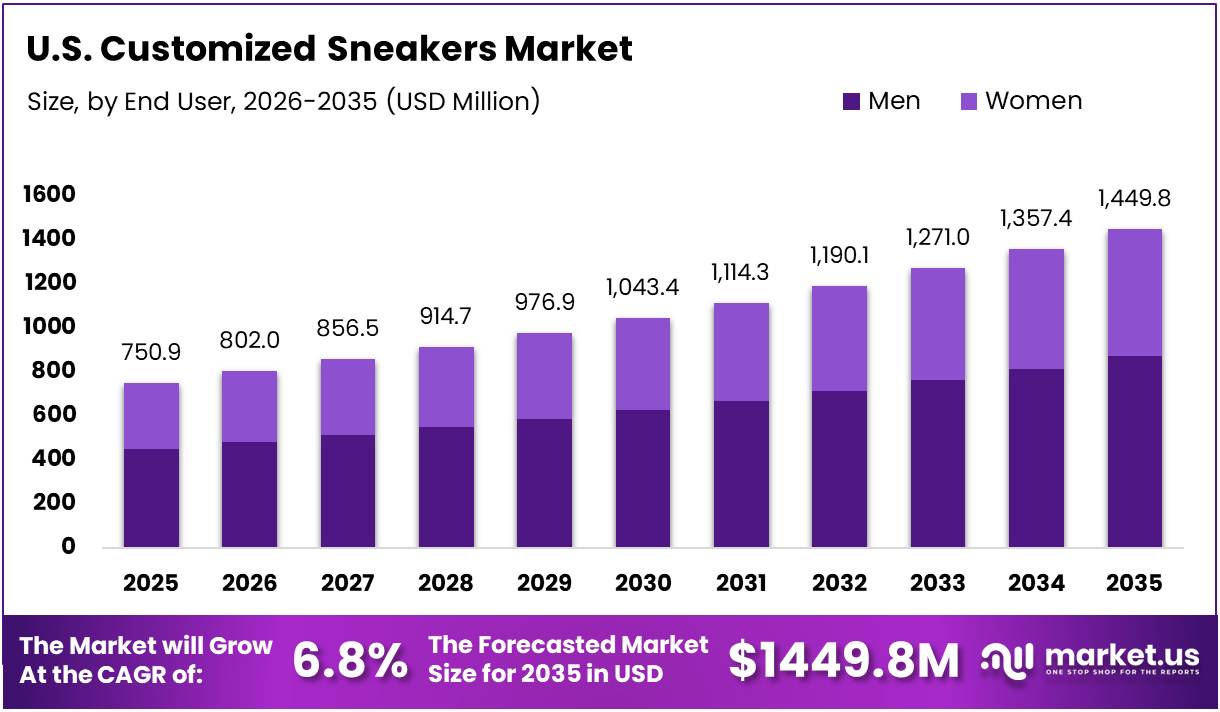
The U.S. Customized Sneakers Market size is expected to be worth around USD 1449.8 Million by 2035 from USD 750.9 Million in 2025, growing at a CAGR of 6.8% during the forecast period 2026 to 2035.
The customized sneakers market represents a specialized segment of footwear focused on personalized design and individual expression. Consumers can modify colors, materials, logos, and graphics to create unique products. This market combines traditional craftsmanship with modern digital platforms, enabling both mass customization and artisan-level personalization. Increasingly, sneaker trading platforms allow enthusiasts to buy, sell, and showcase custom sneakers, adding a secondary marketplace for exclusive designs.
Market growth stems from increasing consumer demand for exclusive products that reflect personal style and identity. Moreover, sneaker culture has evolved beyond functionality into lifestyle statements and collectible assets. Consequently, customization allows buyers to differentiate themselves in fashion-conscious communities while supporting self-expression through footwear choices, including high-end luxury shoes.
Digital transformation drives significant market expansion through user-friendly online design tools and virtual preview capabilities. Additionally, social media platforms amplify visibility of custom designs, creating viral trends and organic marketing. Therefore, brands leverage direct-to-consumer channels to offer seamless customization experiences without traditional retail intermediaries.
Investment opportunities continue expanding as established athletic brands and independent designers enhance customization infrastructure. However, regulatory standards for sustainable materials and ethical production practices influence manufacturing processes. Government initiatives promoting domestic manufacturing also support job creation within specialized footwear production facilities.
According to Custom Shoe, 73% of Gen Z under-30 consumers prefer unique sneaker designs that aren’t widely available. Furthermore, advanced 3D printing technology can cut prototyping lead times by 50-70% in consumer products like custom sneakers compared with traditional methods, according to Leierwo Casting. According to NY Post, 70% of AI-designed shoe design is generated by artificial intelligence, demonstrating direct AI integration into customized footwear processes.
Key Takeaways
- U.S. Customized Sneakers Market projected to reach USD 1449.8 Million by 2035 from USD 750.9 Million in 2025
- Market expected to grow at a CAGR of 6.8% during the forecast period 2026-2035
- Men segment dominates by end user with 58.4% market share in 2025
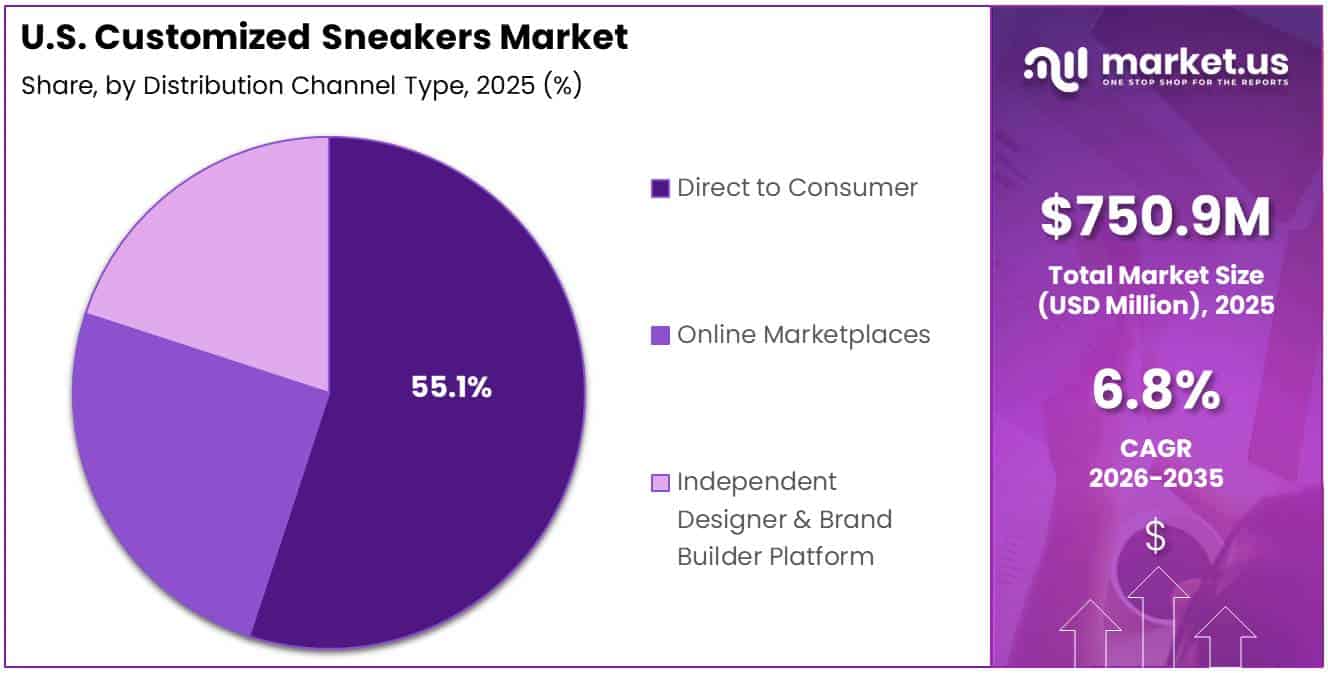
- Direct to Consumer channel leads distribution segment with 55.1% share in 2025
End User Analysis
Men dominates with 58.4% due to higher engagement in sneaker collecting culture and streetwear fashion trends.
In 2025, Men held a dominant market position in the By End User segment of U.S. Customized Sneakers Market, with a 58.4% share. Male consumers demonstrate stronger affinity toward sneaker culture, collectibles, and limited-edition releases. Additionally, men allocate higher discretionary spending on premium customized footwear for both casual and athletic purposes. Therefore, brands prioritize male-focused designs, collaborations, and marketing campaigns to capture this dominant demographic segment.
Women represent a rapidly growing segment with increasing participation in sneaker customization trends. Female consumers seek personalized designs that blend fashion versatility with individual style preferences. Moreover, brands now offer expanded size ranges and gender-specific customization options to attract this demographic. Consequently, the women’s segment exhibits strong growth potential as fashion-forward customization gains mainstream acceptance among female buyers.
Distribution Channel Analysis
Direct to Consumer dominates with 55.1% due to enhanced personalization control and seamless digital design interfaces.
In 2025, Direct to Consumer held a dominant market position in the By Distribution Channel segment of U.S. Customized Sneakers Market, with a 55.1% share. This channel enables brands to maintain complete control over customer experience and design processes. Furthermore, direct platforms eliminate intermediary costs, allowing competitive pricing and higher profit margins. Therefore, major brands invest heavily in proprietary customization platforms that offer real-time visualization and instant order processing capabilities.
Online Marketplaces provide alternative access points for independent designers and smaller custom sneaker businesses. These platforms aggregate multiple vendors, offering consumers diverse design options and competitive pricing structures. Additionally, marketplace infrastructure handles payment processing, logistics, and customer service, reducing operational burdens for emerging brands. Consequently, this channel supports market democratization by enabling artisan customizers to reach national audiences.
Independent Designer and Brand Builder Platforms cater to niche creative communities and boutique customization services. These specialized platforms focus on artistic collaboration, limited-edition drops, and ultra-premium customization experiences. Moreover, they attract collectors seeking exclusive partnerships with renowned artists and designers. Therefore, this segment commands premium pricing while fostering innovation in custom sneaker design methodologies and cultural relevance.
Key Market Segments
By End User
- Men
- Women
By Distribution Channel
- Direct to Consumer
- Online Marketplaces
- Independent Designer & Brand Builder Platform
Drivers
Rising Demand for Individualized Fashion and Self-Expression in Footwear Drives Market Growth
Consumer preferences increasingly shift toward personalized products that reflect individual identity and unique style perspectives. Customized sneakers enable buyers to participate actively in design processes, creating footwear that aligns with personal aesthetics. Moreover, social media amplifies visibility of custom designs, encouraging self-expression through distinctive footwear choices. Therefore, brands respond by expanding customization options and simplifying digital design interfaces for broader consumer accessibility.
Streetwear culture and sneaker collecting communities exert strong influence on purchasing decisions and brand loyalty patterns. Additionally, these communities value exclusivity, limited releases, and collaborative designs with artists and athletes. Consequently, customization satisfies demand for unique products unavailable through traditional retail channels. Furthermore, community-driven trends accelerate adoption as enthusiasts showcase personalized designs across digital platforms and physical events.
Digital customization platforms expand market reach by offering seamless direct-to-consumer experiences with real-time visualization tools. These platforms eliminate geographic barriers, enabling nationwide access to premium customization services. Moreover, growing preference for limited-edition and exclusive designs drives premium pricing and repeat purchases. Therefore, brands leverage technology to deliver personalized experiences while maintaining operational efficiency and customer satisfaction throughout the design journey.
Restraints
Longer Production and Delivery Timelines Compared to Standard Sneakers Limit Market Adoption
Customized sneakers require extended manufacturing cycles due to personalized design specifications and individualized production processes. Consequently, delivery timelines often exceed standard footwear by several weeks, reducing impulse purchase conversions. Moreover, consumers accustomed to fast shipping expectations may abandon customization for immediate availability. Therefore, brands face challenges balancing personalization quality with competitive delivery speeds in e-commerce environments.
Operational complexity increases significantly when managing high levels of design variability across diverse customer orders. Additionally, inventory management becomes challenging as customized products cannot be pre-manufactured or stocked efficiently. Consequently, production facilities require flexible manufacturing systems and skilled labor capable of handling unique specifications. Furthermore, quality control processes demand greater attention to prevent errors in personalized designs.
These constraints elevate operational costs and resource allocation requirements for custom sneaker manufacturers. Moreover, smaller brands struggle to achieve economies of scale when producing individualized products. Therefore, market participants invest in automation technologies and streamlined workflows to mitigate complexity. However, balancing customization depth with operational efficiency remains an ongoing challenge affecting profitability and market penetration rates.
Growth Factors
Integration of AI-Driven Design Tools for Real-Time Sneaker Personalization Accelerates Market Expansion
Artificial intelligence technologies revolutionize customization by offering intelligent design suggestions and automated pattern generation capabilities. These tools enable consumers to create sophisticated designs without professional expertise. Moreover, AI reduces design time while expanding creative possibilities through machine learning algorithms. Therefore, brands adopting AI-powered platforms gain competitive advantages in user experience and customer satisfaction metrics.
Collaborations between custom sneaker brands and artists, athletes, and influencers generate significant market visibility and cultural relevance. Additionally, these partnerships produce limited-edition collections that drive demand among collectors and enthusiasts. Consequently, collaborative designs command premium pricing while enhancing brand prestige and market positioning. Furthermore, influencer marketing amplifies reach across target demographics through authentic endorsements and social media engagement.
Growing adoption of sustainable and eco-friendly custom materials addresses environmental concerns among conscious consumers. Moreover, increasing use of custom sneakers in corporate gifting and promotional branding expands market applications beyond individual purchases. Therefore, businesses leverage customized footwear for employee recognition programs and brand marketing initiatives. Additionally, sustainable practices differentiate brands in competitive markets while supporting long-term growth through responsible manufacturing approaches.
Emerging Trends
Popularity of One-of-One and Small-Batch Custom Sneaker Drops Reshapes Market Landscape
Limited-production releases and unique custom designs create urgency and exclusivity that drive consumer engagement and premium pricing. These drops leverage scarcity marketing to build anticipation and community excitement around new releases. Moreover, one-of-one customs attract collectors seeking investment-grade footwear with appreciation potential. Therefore, brands strategically release small batches to maintain market interest while controlling supply dynamics and brand perception.
Advanced manufacturing technologies transform production capabilities through 3D printing applications in custom sole and upper design. These innovations enable complex geometries and personalized fit specifications previously impossible with traditional methods. Additionally, 3D printing reduces material waste and accelerates prototyping cycles significantly. Consequently, manufacturers achieve greater design freedom while improving sustainability metrics and production efficiency across customization workflows.
Rising demand for custom performance sneakers extends market applications into sports and fitness categories beyond lifestyle fashion. Furthermore, online custom sneaker communities and social media platforms drive design trends through viral content and collaborative creativity. Therefore, digital-first engagement models reshape how consumers discover, design, and purchase customized footwear. Additionally, these communities foster brand loyalty and repeat purchases through shared enthusiasm and collective cultural participation.
Key Company Insights
Nike, Inc. leads the customized sneakers market through its Nike By You platform, offering extensive design options across performance and lifestyle categories. The company leverages advanced digital interfaces and global manufacturing networks to deliver personalized footwear at scale. Moreover, Nike collaborates with athletes and designers to create exclusive custom collections. Therefore, Nike maintains market leadership through brand strength, technological innovation, and comprehensive customization capabilities that appeal to diverse consumer segments.
adidas America, Inc. competes strongly through its miadidas customization platform, emphasizing performance customization and sustainable material options. The company integrates 3D printing technologies and digital design tools to enhance consumer experiences. Additionally, adidas partners with influential designers and cultural icons to produce limited-edition custom releases. Consequently, adidas captures significant market share through innovation, sustainability initiatives, and strategic collaborations that resonate with environmentally conscious and fashion-forward consumers.
Vans differentiates itself by targeting creative communities and artistic expression through accessible customization platforms. The brand emphasizes affordability and creative freedom, allowing consumers to design unique footwear without premium pricing barriers. Moreover, Vans cultivates strong relationships with skateboarding and alternative culture communities. Therefore, Vans appeals to younger demographics seeking authentic self-expression through customizable canvas and suede sneaker options that reflect individual artistic sensibilities.
Converse maintains market presence through its iconic Chuck Taylor silhouette customization options, blending heritage design with modern personalization features. The brand offers straightforward customization interfaces that appeal to both traditional fans and new consumers. Additionally, Converse collaborates with artists and musicians to create culturally relevant custom collections. Consequently, Converse sustains brand loyalty through timeless design foundations, accessible customization, and authentic connections to music and artistic communities worldwide.
Key Players
- Nike, Inc.
- adidas America, Inc.
- Vans
- Converse
- Puma
- Surgeon Worldwide Inc.
- Mache Customs
- JBFcustoms
- Sneaker Queens Customs
- GMRT Customs
Recent Developments
- March 2025 – Nike x Bode Rec. released two new Nike Astrograbber sneaker colorways including Chlorophyll and Black Mesh, further pushing vintage-inspired customized sneaker offerings in the U.S. sneaker space. This collaboration demonstrates continued brand investment in heritage-inspired custom designs appealing to collectors.
- June 2025 – Koobz secured $7.2 Million in funding to expand U.S. footwear manufacturing capabilities, strengthening domestic production infrastructure for customized sneakers. This investment supports growing demand for locally manufactured personalized footwear while reducing supply chain dependencies on international facilities.
- July 2025 – Custom Chuck Taylors launched in brat mode through Charli XCX’s Converse collaboration, leveraging pop culture influence to drive customization trends. This partnership illustrates effective celebrity collaboration strategies that merge music culture with personalized footwear design for mainstream consumer appeal.
- September 2025 – Skechers officially became a private company after $9 Billion deal with 3G Capital closed, potentially reshaping competitive dynamics in customized footwear segments. This significant acquisition provides Skechers with strategic flexibility to invest in customization technologies and expand market presence through private ownership structure.
Report Scope
Report Features Description Market Value (2025) USD 750.9 Million Forecast Revenue (2035) USD 1449.8 Million CAGR (2026-2035) 6.8% Base Year for Estimation 2025 Historic Period 2020-2024 Forecast Period 2026-2035 Report Coverage Revenue Forecast, Market Dynamics, Competitive Landscape, Recent Developments Segments Covered By End User (Men, Women), By Distribution Channel (Direct to Consumer, Online Marketplaces, Independent Designer & Brand Builder Platform) Regional Analysis North America (US and Canada), Europe (Germany, France, The UK, Spain, Italy, and Rest of Europe), Asia Pacific (China, Japan, South Korea, India, Australia, and Rest of APAC), Latin America (Brazil, Mexico, and Rest of Latin America), Middle East & Africa (GCC, South Africa, and Rest of MEA) Competitive Landscape Nike, Inc., adidas America, Inc., Vans, Converse, Puma, Surgeon Worldwide Inc., Mache Customs, JBFcustoms, Sneaker Queens Customs, GMRT Customs Customization Scope Customization for segments, region/country-level will be provided. Moreover, additional customization can be done based on the requirements. Purchase Options We have three licenses to opt for: Single User License, Multi-User License (Up to 5 Users), Corporate Use License (Unlimited User and Printable PDF)  US Customized Sneakers MarketPublished date: Feb 2026add_shopping_cartBuy Now get_appDownload Sample
 -
-
- Nike, Inc.
- adidas America, Inc.
- Vans
- Converse
- Puma
- Surgeon Worldwide Inc.
- Mache Customs
- JBFcustoms
- Sneaker Queens Customs
- GMRT Customs
Our Clients

- 176616
- Feb 2026






