


Global Upcycled Cosmetic Ingredients Market Size, Share, Growth Analysis By Source (Food Waste, Plant Waste, Others), By Ingredient-type (Oils, Extracts, Powders, Active Ingredients), By Application (Skincare, Haircare, Makeup, Others), By Region and Companies - Industry Segment Outlook, Market Assessment, Competition Scenario, Statistics, Trends and Forecast 2025-2034
- Published date: Dec 2025
- Report ID: 171590
- Number of Pages: 295
- Format:
-
keyboard_arrow_up
Quick Navigation
Report Overview
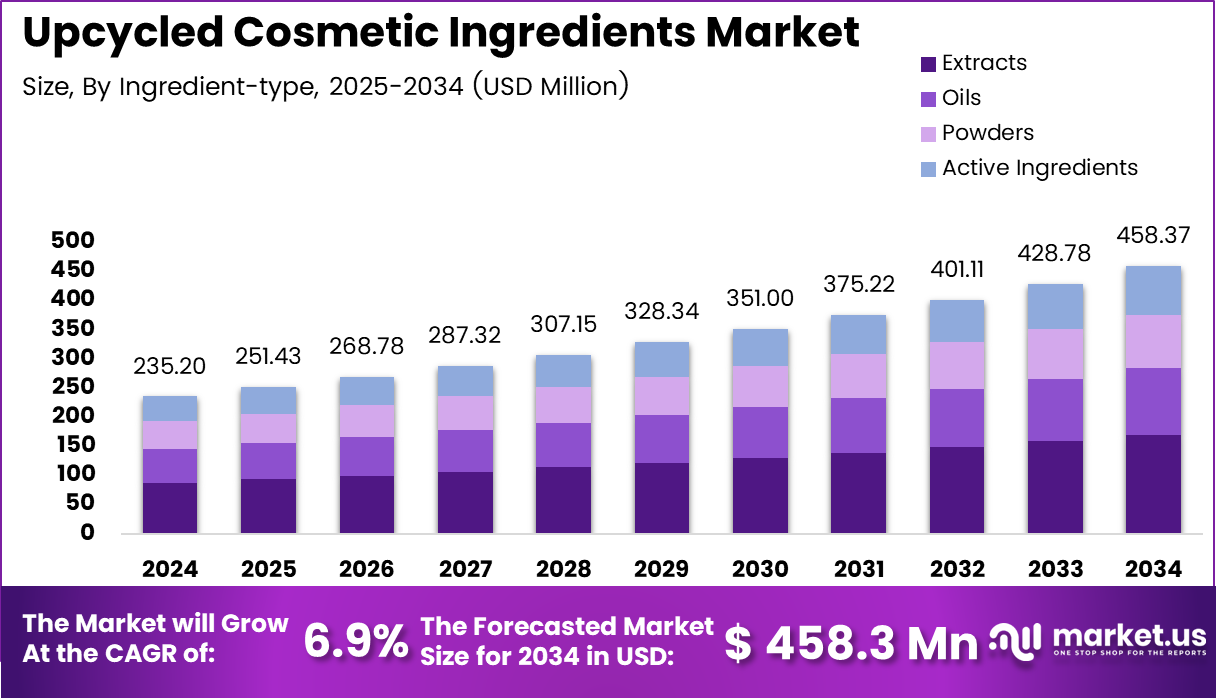
The Global Upcycled Cosmetic Ingredients Market size is expected to be worth around USD 458.3 million by 2034, from USD 235.2 million in 2024, growing at a CAGR of 6.9% during the forecast period from 2025 to 2034.
The Upcycled Cosmetic Ingredients market refers to cosmetic raw materials derived from repurposed agricultural, food, forestry, or industrial by streams that retain functional value. These ingredients support sustainable beauty, circular economy cosmetics, and clean label formulations. As a result, brands increasingly integrate upcycled actives, oils, waxes, and bio based intermediates into mainstream personal care products.
Upcycled Cosmetic Ingredients represent both a sustainability lever and a cost optimization strategy. Moreover, formulators gain access to differentiated textures, bioactive profiles, and traceable sourcing narratives. Consequently, demand expands across skincare, haircare, and color cosmetics, supported by rising consumer awareness of waste reduction and ethical ingredient sourcing.
Growth momentum strengthens as governments promote bio economy development and waste valorization. For instance, public funding programs in Europe and Asia support agricultural residue conversion into high value cosmetic ingredients. In parallel, regulatory frameworks increasingly favor renewable and low impact raw materials, accelerating commercial adoption within regulated cosmetic supply chains.
Opportunities further emerge from certification driven product positioning. According survey, organic cosmetic products require 95% certified organic ingredients excluding water, while made with organics formulations contain 70–95% certified organic inputs. Meanwhile, 100% organic products mandate complete reliance on certified organic ingredients and processing aids, reinforcing premium market segmentation.
natural cosmetic formulations continue to expand. According to cosmetic , natural products rely on ingredients of plant, animal, or mineral origin, whether certified or not. Furthermore, linear liquid hydrocarbons with molecular weights between 200 and 1000 Dalton enable advanced cosmetic applications, including emulsifiers, waxes, and conditioning agents, enhancing formulation flexibility.
Scientific advancements also shape the market landscape. According studies, approximately 12% of nanoparticles used in cosmetic products comprise silver nanoparticles. Although research confirms cosmetic safety thresholds, studies indicate that smaller particle sizes elevate toxicity risk, encouraging stricter regulatory oversight and safer formulation innovation.
Overall, the Upcycled Cosmetic Ingredients market aligns sustainability goals with commercial scalability. Transitioning toward circular raw material sourcing, supported by regulatory incentives and certification standards, enhances long term growth potential. Consequently, brands leveraging upcycled beauty ingredients, sustainable cosmetic raw materials, and eco friendly formulation strategies position themselves strongly within future conscious consumer markets.
Key Takeaways
- The global Upcycled Cosmetic Ingredients Market is projected to reach USD 458.3 million by 2034, expanding from USD 235.2 million in 2024 at a CAGR of 6.9%.
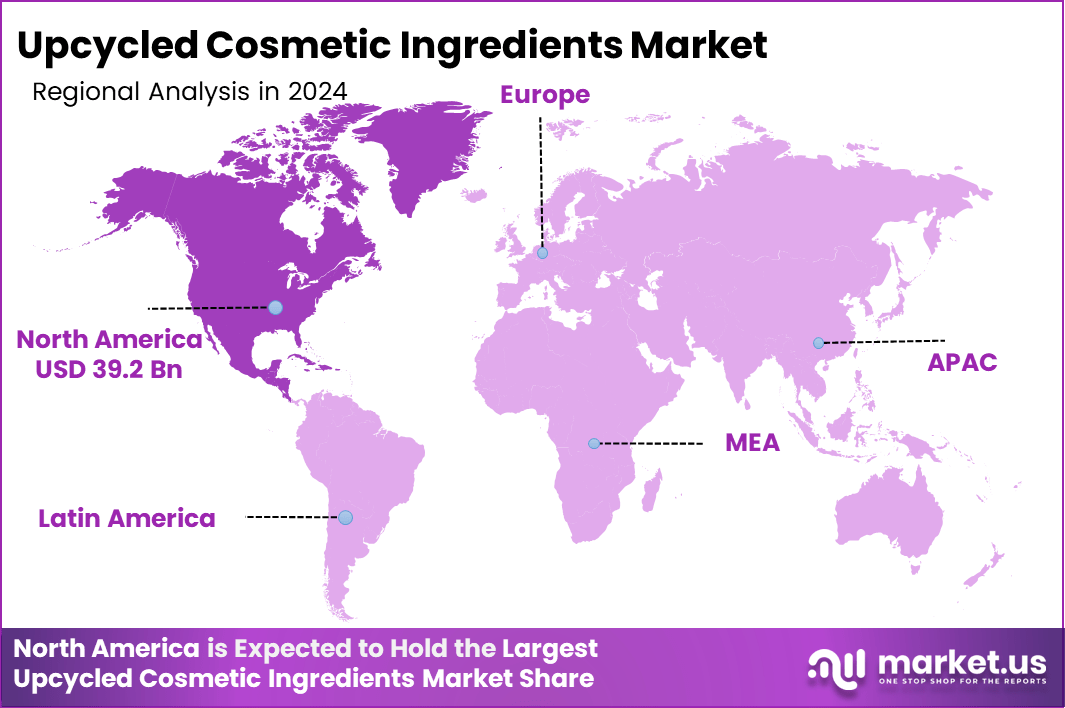
- North America emerged as the dominant region, accounting for 39.2% share and valued at USD 92.1 million, driven by strong circular economy adoption.
- By source, Food Waste represented the leading segment with a dominant share of 59.2%, supported by high availability and cost efficiency.
- By ingredient-type, Extracts held the largest share at 36.9%, reflecting strong demand for high-functionality bioactive ingredients.
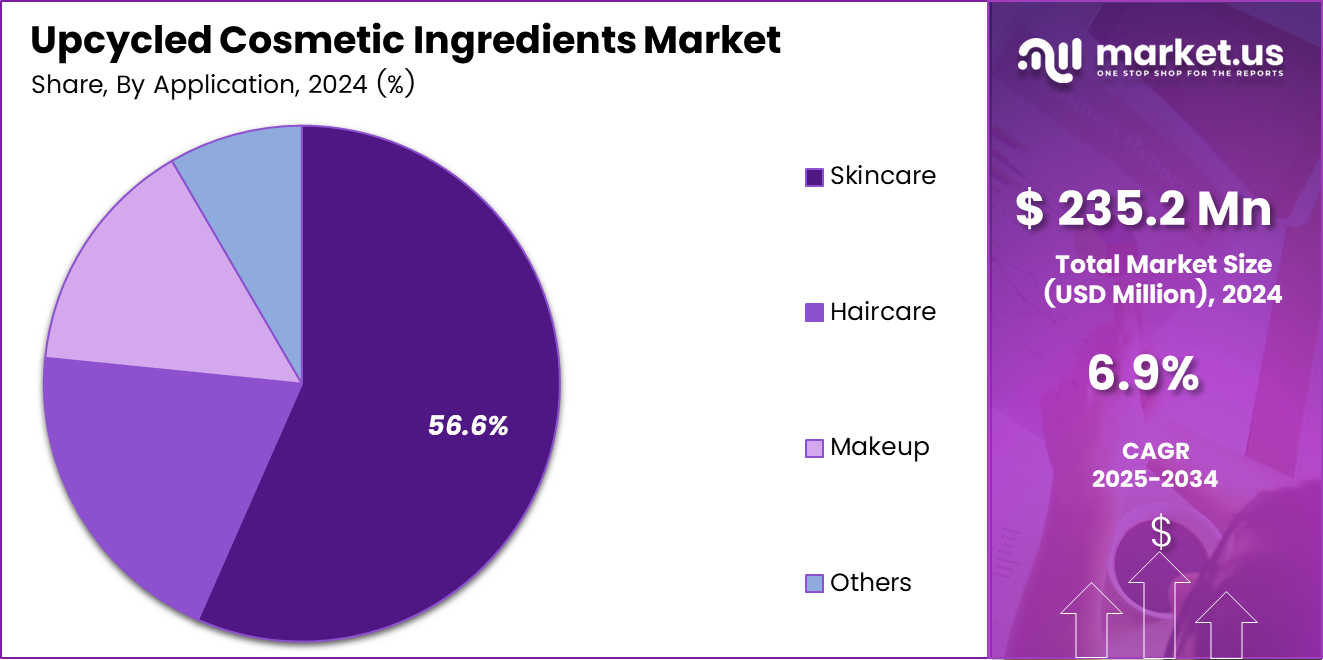
- By application, Skincare dominated the market with a share of 56.6%, driven by sustainability-focused product innovation.
- The market growth outlook from 2025 to 2034 is supported by expanding clean-label cosmetics and circular raw material sourcing.
By Source Analysis
Food Waste dominates with 59.2% due to its wide availability, cost efficiency, and strong alignment with circular economy practices.
In 2024, Food Waste held a dominant market position in the By Source Analysis segment of Upcycled Cosmetic Ingredients Market, with a 59.2% share. Manufacturers increasingly valorize fruit peels, oilseeds, and pulp residues from food processing. Consequently, brands benefit from traceable sourcing, reduced raw material costs, and strong sustainability storytelling that resonates with conscious consumers.
Plant Waste held a competitive position in the By Source Analysis segment of Upcycled Cosmetic Ingredients Market. Leaves, stems, husks, and agricultural by-products support stable ingredient pipelines. Moreover, plant waste enables consistent bioactive recovery, supports botanical positioning, and aligns well with clean beauty formulations focused on renewable plant-based origins.
Others held a developing position in the By Source Analysis segment of Upcycled Cosmetic Ingredients Market. This category includes marine by-products and fermentation residues. Gradually, innovation partnerships and biotechnology investments are expanding utilization, while brands explore differentiated sourcing narratives to enhance product uniqueness and premium positioning.
By Ingredient-Type Analysis
Extracts dominate with 36.9% driven by their high functional value and compatibility with modern cosmetic formulations.
In 2024, Extracts held a dominant market position in the By Ingredient-Type Analysis segment of Upcycled Cosmetic Ingredients Market, with a 36.9% share. Extracts deliver concentrated antioxidants, polyphenols, and vitamins. As a result, formulators adopt them widely across performance-driven skincare and haircare products.
Oils held a significant position in the By Ingredient-Type Analysis segment of Upcycled Cosmetic Ingredients Market. Upcycled oils sourced from fruit kernels and seeds support emollient functionality. Additionally, they enhance skin barrier repair, offer natural lipid profiles, and strengthen sustainability-focused product claims.
Powders held a growing position in the By Ingredient-Type Analysis segment of Upcycled Cosmetic Ingredients Market. These ingredients improve exfoliation, oil absorption, and texture. Gradually, powders gain traction in masks and cleansers due to formulation stability and extended shelf-life advantages.
Active Ingredients held a niche position in the By Ingredient-Type Analysis segment of Upcycled Cosmetic Ingredients Market. These bioactives target anti-aging and skin repair. Consequently, clinical validation and efficacy testing increasingly support their adoption in premium cosmetic formulations.
By Application Analysis
Skincare dominates with 56.6% supported by strong consumer demand for sustainable and high-performance products.
In 2024, Skincare held a dominant market position in the By Application Analysis segment of Upcycled Cosmetic Ingredients Market, with a 56.6% share. Brands integrate upcycled actives into creams, serums, and masks. Therefore, sustainability-driven skincare remains the primary growth engine.
Haircare held a steady position in the By Application Analysis segment of Upcycled Cosmetic Ingredients Market. Upcycled proteins, oils, and extracts enhance scalp health and hair strength. Moreover, clean-label haircare trends support wider adoption across shampoos and conditioners.
Makeup held an emerging position in the By Application Analysis segment of Upcycled Cosmetic Ingredients Market. Pigments, oils, and powders from upcycled sources improve texture and appeal. Gradually, color cosmetics adopt sustainability as a differentiating brand attribute.
Others held a developing position in the By Application Analysis segment of Upcycled Cosmetic Ingredients Market. This segment includes fragrances and personal care. Over time, innovation and regulatory clarity are expected to support broader commercial integration.
Key Market Segments
By Source
- Food Waste
- Plant Waste
- Others
By Ingredient-type
- Oils
- Extracts
- Powders
- Active Ingredients
By Application
- Skincare
- Haircare
- Makeup
- Others
Drivers
Escalating Regulatory Pressure on Cosmetic Manufacturers Drives Market Growth
Regulatory pressure on cosmetic companies continues to increase as governments push waste reduction and sustainable sourcing. As a result, manufacturers actively seek alternatives that reduce landfill waste. Upcycled cosmetic ingredients help brands comply with environmental rules while improving raw material efficiency across production cycles.
At the same time, global beauty brands strengthen commitments toward circular economy sourcing. Therefore, using recovered food and plant by-products supports sustainability targets. This shift improves corporate responsibility reporting and enhances long-term supply resilience within personal care ingredient portfolios.
In addition, rising cost volatility of virgin cosmetic-grade raw materials impacts procurement planning. Consequently, upcycled ingredients provide cost stability by converting waste streams into valuable inputs. This approach reduces dependence on fluctuating agricultural yields and petrochemical-derived cosmetic components.
Moreover, consumer trust in sustainability-certified ingredients continues to grow. Shoppers increasingly evaluate sourcing transparency when purchasing beauty products. As a result, upcycled ingredients strengthen brand credibility and influence buying decisions across skincare, haircare, and cosmetic categories.
Restraints
Limited Standardization in Quality Benchmarking Restrains Market Expansion
A key restraint in the market involves limited standardization of quality benchmarks. Upcycled ingredients often vary based on waste origin and processing methods. Consequently, cosmetic formulators face challenges in maintaining consistent performance across product batches.
Traceability also remains complex across food, agriculture, and cosmetic waste value chains. Each stage requires documentation and verification. Therefore, compliance management increases operational complexity and slows large-scale adoption for multinational cosmetic manufacturers.
Additionally, formulation compatibility testing costs remain high for repurposed bio-based actives. Brands must conduct repeated stability and safety testing. As a result, development timelines extend, increasing upfront investment requirements for new product launches.
Together, these challenges limit rapid scaling of upcycled ingredients. However, ongoing industry collaboration and regulatory alignment are expected to gradually improve quality consistency and supply chain transparency.
Growth Factors
Expansion of Upcycled Actives in Premium Skincare Creates New Opportunities
Premium skincare and anti-aging products increasingly adopt upcycled actives. These ingredients offer strong efficacy stories alongside sustainability benefits. As a result, brands differentiate high-value formulations using responsibly sourced bioactive compounds.
Strategic partnerships between food processors and cosmetic ingredient manufacturers also create growth opportunities. These collaborations ensure steady waste feedstock supply. Consequently, both industries benefit from improved resource utilization and shared sustainability goals.
Demand for upcycled botanical extracts continues to rise in clean-label beauty products. Consumers seek natural, traceable ingredients. Therefore, plant-derived upcycled extracts gain relevance in transparent and minimal-ingredient cosmetic formulations.
Indie and direct-to-consumer brands further accelerate adoption. These companies prioritize sustainability storytelling and agile innovation. As a result, upcycled ingredients become central to brand identity and market differentiation strategies.
Emerging Trends
Increased Use of Fermentation Technologies Shapes Market Trends
Fermentation and biotransformation technologies increasingly enhance upcycled ingredient efficacy. These processes improve bioavailability and stability. Consequently, cosmetic manufacturers achieve higher performance from recovered raw materials.
Blockchain-based traceability systems also gain attention across supply chains. These tools improve transparency from waste source to finished ingredient. Therefore, brands strengthen consumer trust and regulatory compliance through verifiable sourcing data.
The market also shifts toward multifunctional upcycled ingredients. These materials deliver performance benefits while supporting sustainability goals. As a result, formulators simplify ingredient lists without compromising product effectiveness.
Furthermore, upcycled ingredient claims gain visibility in labeling and marketing campaigns. Clear communication strengthens consumer awareness. Over time, this trend reinforces upcycled ingredients as a core value driver in cosmetic product positioning.
Regional Analysis
North America Dominates the Upcycled Cosmetic Ingredients Market with a Market Share of 39.2%, Valued at USD 92.1 million
North America holds the leading position driven by strong sustainability regulations and early adoption of circular economy practices. In 2024, the region accounted for a dominant share of 39.2%, with a market value of USD 92.1 million. High consumer awareness and brand-level commitments toward waste reduction continue to support steady regional demand.
Europe Upcycled Cosmetic Ingredients Market Trends
Europe represents a mature and regulation-driven market for upcycled cosmetic ingredients. The region benefits from strict environmental policies and strong clean beauty adoption. Moreover, European consumers actively support transparency and certified sustainable sourcing, encouraging cosmetic manufacturers to integrate upcycled raw materials into formulations.
Asia Pacific Upcycled Cosmetic Ingredients Market Trends
Asia Pacific shows strong growth potential due to expanding cosmetic manufacturing and rising sustainability awareness. Increasing availability of agricultural and food processing waste supports raw material sourcing. Additionally, emerging clean-label beauty brands contribute to broader regional adoption of upcycled cosmetic ingredients.
Middle East and Africa Upcycled Cosmetic Ingredients Market Trends
The Middle East and Africa market remains at a developing stage with gradual adoption. Growing interest in sustainable personal care and improving waste management practices support market entry. Over time, regional policy alignment and infrastructure development are expected to improve ingredient traceability and utilization.
Latin America Upcycled Cosmetic Ingredients Market Trends
Latin America benefits from abundant agricultural by-products suitable for upcycled ingredient extraction. Regional beauty brands increasingly explore sustainable sourcing models. As environmental awareness grows, upcycled cosmetic ingredients gain relevance across skincare and haircare product lines.
U.S. Upcycled Cosmetic Ingredients Market Trends
The U.S. market reflects strong innovation-led adoption of upcycled cosmetic ingredients. Brands focus on sustainability storytelling and certified sourcing to attract conscious consumers. Additionally, advancements in processing technologies support consistent ingredient quality and wider commercial use.
Key Regions and Countries
North America
- US
- Canada
Europe
- Germany
- France
- The UK
- Spain
- Italy
- Rest of Europe
Asia Pacific
- China
- Japan
- South Korea
- India
- Australia
- Rest of APAC
Latin America
- Brazil
- Mexico
- Rest of Latin America
Middle East & Africa
- GCC
- South Africa
- Rest of MEA
Key Upcycled Cosmetic Ingredients Company Insights
In the global Upcycled Cosmetic Ingredients Market in 2024, industry dynamics are shaped by established players pushing sustainability and innovation.
L’Oréal continues to leverage its extensive R&D capabilities to integrate upcycled ingredients into mainstream beauty formulations, driving consumer interest in eco-friendly products while maintaining high performance. The company’s commitment to circular beauty initiatives reinforces its strategic positioning in a market increasingly focused on responsible sourcing and waste reduction.
Givaudan remains a key contributor with a strong emphasis on sustainable raw materials, actively expanding its portfolio of upcycled cosmetic ingredients through collaborations and supply chain partnerships. Its expertise in sensory and functional ingredients enables it to offer differentiated solutions that align with consumer demand for green formulations without compromising efficacy.
BASF plays a pivotal role by applying its chemical and biotechnological expertise to develop upcycled ingredients that enhance texture, stability, and sensory appeal in personal care products. The company’s broad industrial reach and commitment to sustainability goals allow it to scale up innovations rapidly, supporting brand partners in delivering environmentally responsible products.
Symrise is advancing the market with a focus on upcycled actives and botanical extracts that cater to clean beauty trends and sustainability benchmarks. Its investments in ingredient traceability and eco-friendly processes help drive transparency, appealing to conscious consumers who prioritize ethical and sustainable ingredient sourcing. Symrise’s strategic initiatives underline its aim to be a preferred supplier for brands seeking high-quality upcycled cosmetic solutions.
Collectively, these key players are instrumental in mainstreaming upcycled ingredients, fostering innovation, and meeting evolving consumer expectations around sustainability and performance in the cosmetics industry.
Top Key Players in the Market
- L’Oréal
- Givaudan
- BASF
- Symrise
- Croda International
- Clariant
- Firmenich
- Seppic
- Akott Evolution
- IFF
Recent Developments
- In Nov 2025, FAE Beauty has secured USD 2 million in a fresh funding round led by Spring Marketing Capital. The round also saw participation from its existing investors Titan Capital Winners Fund, Arihant Patni and a group of angel back.
- In April 2024, Smalt Capital, a long term partner of Sophim since 2014, participated as the sole financial investor in a funding round valued at $4.8 million. This investment reinforces confidence in Sophim’s upcycled cosmetic ingredient strategy and long term growth roadmap.
Report Scope
Report Features Description Market Value (2024) USD 235.2 million Forecast Revenue (2034) USD 458.3 million CAGR (2025-2034) 6.9% Base Year for Estimation 2024 Historic Period 2020-2023 Forecast Period 2025-2034 Report Coverage Revenue Forecast, Market Dynamics, Competitive Landscape, Recent Developments Segments Covered By Source (Food Waste, Plant Waste, Others), By Ingredient-type (Oils, Extracts, Powders, Active Ingredients), By Application (Skincare, Haircare, Makeup, Others) Regional Analysis North America (US and Canada), Europe (Germany, France, The UK, Spain, Italy, and Rest of Europe), Asia Pacific (China, Japan, South Korea, India, Australia, and Rest of APAC), Latin America (Brazil, Mexico, and Rest of Latin America), Middle East & Africa (GCC, South Africa, and Rest of MEA) Competitive Landscape L’Oréal, Givaudan, BASF, Symrise, Croda International, Clariant, Firmenich, Seppic, Akott Evolution, IFF Customization Scope Customization for segments, region/country-level will be provided. Moreover, additional customization can be done based on the requirements. Purchase Options We have three licenses to opt for: Single User License, Multi-User License (Up to 5 Users), Corporate Use License (Unlimited User and Printable PDF)  Upcycled Cosmetic Ingredients MarketPublished date: Dec 2025add_shopping_cartBuy Now get_appDownload Sample
 -
-
- L'Oréal
- Givaudan
- BASF
- Symrise
- Croda International
- Clariant
- Firmenich
- Seppic
- Akott Evolution
- IFF
Our Clients

- 171590
- Dec 2025






