


Report Overview
Global Train Dispatching Market size is expected to be worth around USD 2.50 Billion by 2035 from USD 1.20 Billion in 2025, growing at a CAGR of 7.7% during the forecast period 2026 to 2035. This expansion rewards vendors who sell software-led control stacks rather than one-time hardware kits. Operators that lock multi-year dispatch platforms early will set the default standard on busy corridors.
Therefore, train dispatching covers the software, control rooms, and field systems that plan, authorize, and supervise train movements across freight and passenger networks. The market structure splits by technology, dispatching method, railroad type, and deployment application. Buyers treat these layers as a single operating system for capacity, safety, and on-time delivery.
Key Takeaways
- The market reaches USD 1.20 Billion in 2025 and USD 2.50 Billion by 2035 at a 7.7% CAGR.
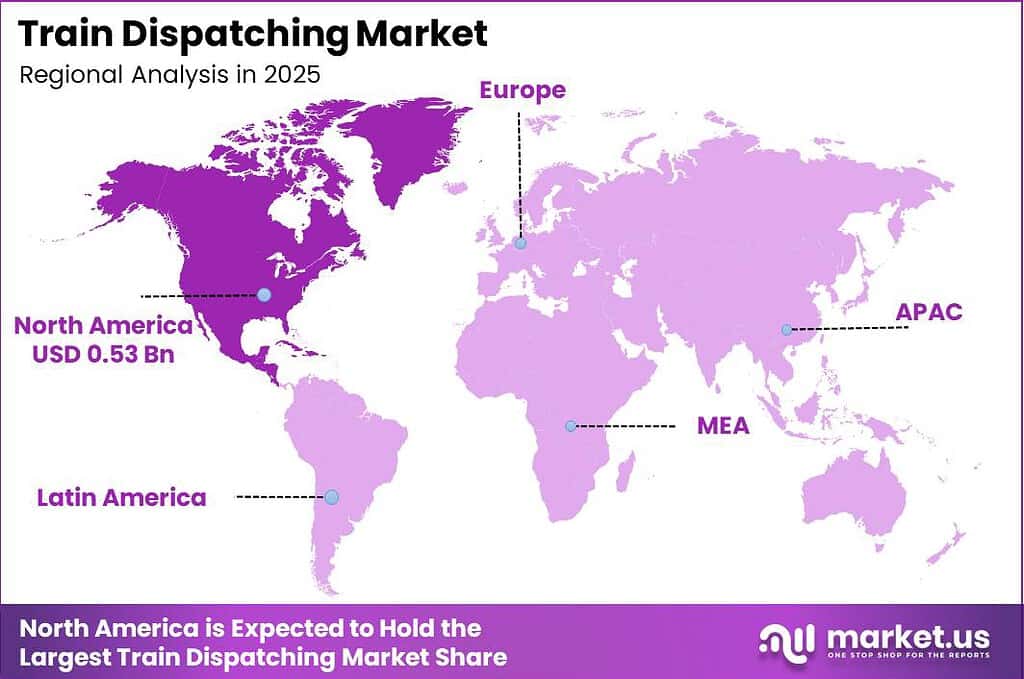
- North America leads with a 44.3% share valued at USD 0.53 Billion.
- Computer-Aided Dispatch leads technology with a 43.3% share.
- Centralized dispatching leads method with a 66.6% share and is the fastest growing method.
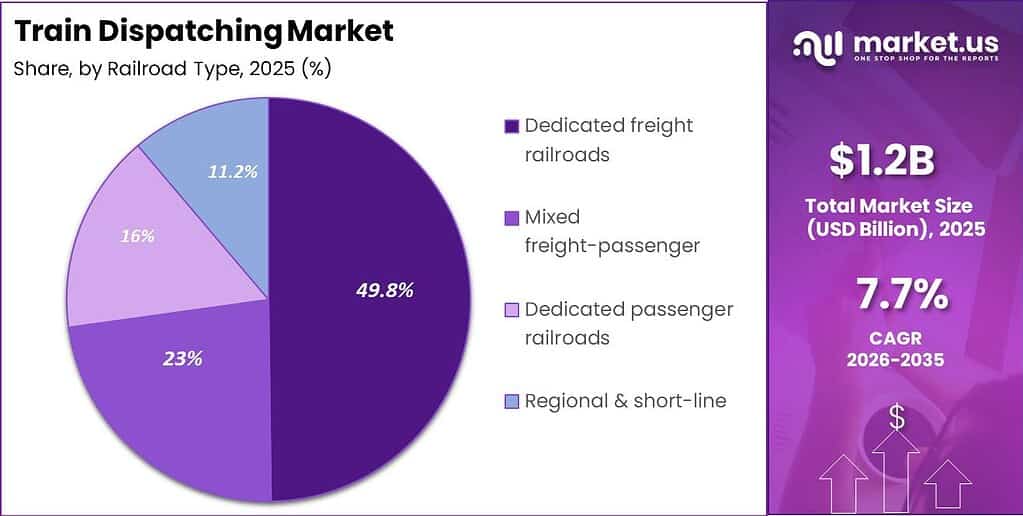
- Dedicated freight railroads lead railroad type with a 49.8% share.
- Dispatch unit management leads deployment with a 48.8% share.
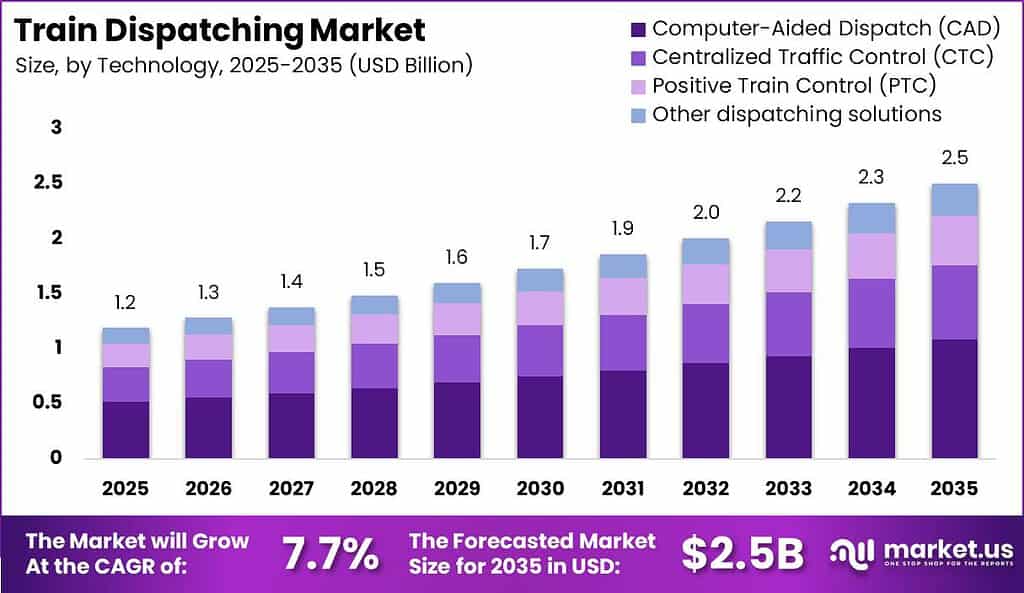
According to Federal Railroad Administration reporting, Amtrak systemwide customer on-time performance reached 78% in October to December 2025, five points above the prior quarter. This gain raises pressure on hosts to tighten slotting and conflict resolution inside dispatch software. Vendors that prove measurable punctuality lift will win renewal budgets tied to service quality scorecards.
As reported by Network Rail, 84.3% of passenger trains met the Time-to-3 punctuality measure at the end of 2024/25 against an 84.9% target. This narrow miss keeps UK operators focused on delay attribution and traffic management upgrades. Suppliers who connect dispatch decisions to minute-level recovery tools gain an edge in regulated performance regimes.
This means public safety rules and corridor investment continue to convert dispatch from a back-office tool into a board-level control asset. Freight density and metro capacity needs pull the same platforms into both heavy-haul and urban rail programs. Investors should favor portfolios that span compliance software and live traffic optimization rather than isolated radio or interlocking products.
Technology Analysis
Computer-Aided Dispatch (CAD) dominates with 43.3% due to real-time software tools for train coordination.
In 2025, Computer-Aided Dispatch (CAD) held a dominant market position in the By Technology segment of Train Dispatching Market, with a 43.3% share. The Federal Railroad Administration reports positive train control already runs on all 57,536 required US route miles, creating a dense data layer CAD systems must orchestrate. This installed base turns CAD into the daily decision cockpit for slotting and incident recovery. Vendors that open clean interfaces to PTC feeds will lock multi-year software seats.
Centralized Traffic Control remains the fastest growing technology because operators want one desk to set routes, holds, and meets across long territories. Association of American Railroads data show Class I carriers still generate about 94% of US freight rail revenue, so CTC upgrades concentrate where traffic density pays back fastest. This creates a premium for platforms that scale from division desks to network control centers without re-training whole crews.
Positive Train Control technology anchors the safety overlay that dispatch engines must respect on high-risk freight and passenger mains. As per PIB India data, Indian Railways had electrical or electronic interlocking with centralized control at 6,660 stations by December 2025. This scale shows how PTC-class overlays and station interlocking expand together. Suppliers who bundle enforcement logic with dispatcher workflows reduce integration risk for national programs.
Other dispatching solutions fill niche overlays where full CAD or CTC stacks are not yet funded. In November 2025, Alstom SA began trials of a new ERTMS application for low-density lines using satellite positioning and public telecommunications networks. This trial path lowers trackside cost on thin routes. Challengers that productize low-density kits can win secondary lines without waiting for full corridor resignalling.
Dispatching Method Analysis
Centralized dispatching dominates with 66.6% due to unified control rooms spanning full networks.
In 2025, Centralized dispatching held a dominant market position in the By Dispatching Method segment of Train Dispatching Market, with a 66.6% share, and it is also the fastest growing method. IEA analysis notes rail already moves about 8% of world passengers and 7% of global freight while using only 2% of transport energy. Central desks convert that efficiency advantage into higher path utilization. Operators will keep collapsing regional towers into network centers to cut decision latency.
Decentralized and regional dispatching still matters where local knowledge and short territories beat a distant control room. FRA freight rail overview counts seven Class I railroads plus 22 regional and 584 local and short line railroads in the US structure. This fragmented map keeps regional desks alive on branch and industrial tracks. Vendors who offer light clients that federate into a central system can sell both layers without forcing a full rip-and-replace.
Regional method buyers also watch connectivity cost before they surrender local authority. AAR figures show the US freight network spans nearly 140,000 miles, so pure centralization is not practical on every spur on day one. This creates staged migration deals with hybrid failover. Integrators that prove safe handoff between regional and central modes will clear procurement gates faster.
Railroad Type Analysis
Dedicated freight railroads dominate with 49.8% due to high volume freight corridor control needs.
In 2025, Dedicated freight railroads held a dominant market position in the By Railroad Type segment of Train Dispatching Market, with a 49.8% share. AAR data show freight rail moves roughly 40% of US long-distance ton-miles and hauls around 1.5 billion tons in a typical year. That density forces continuous meet-pass planning and crew-law management inside dispatch tools. Suppliers who optimize heavy-haul velocity protect shipper contracts and fuel budgets at once.
Mixed freight-passenger networks need conflict logic that protects passenger slots without stranding freight. AAR notes about 70% of Amtrak train-miles run on freight-owned tracks across a system of more than 21,400 miles. This shared-use reality makes priority rules and host-tenant data exchange non-negotiable features. Platforms that automate host-tenant coordination reduce dispute time when delays cascade.
Dedicated passenger railroads are the fastest growing railroad type as metros and high-speed corridors add automated supervision. UIC reporting identifies almost 56,000 km of high-speed lines in operation worldwide. This buildout multiplies demand for timetable-tight dispatch and recovery tools. Vendors with metro and high-speed references will shortlist first on new passenger concessions.
Regional and short-line operators complete the map with thinner traffic but many handoffs. AAR counts about 615 short line railroads beside six US Class I carriers. This long tail needs affordable dispatch seats rather than full Class I control palaces. Cloud multi-tenant offers fit this buyer group when capital budgets stay tight.
Deployment Analysis
Dispatch unit management dominates with 48.8% due to core dispatcher seat and crew workflows.
In 2025, Dispatch unit management held a dominant market position in the By Deployment segment of Train Dispatching Market, with a 48.8% share. Class I railroads reinvested USD 26.8 Billion in 2023 on infrastructure, safety, and reliability programs per AAR figures. A large slice of digital spend lands on the desks that assign units, crews, and authorities each shift. Vendors who cut click-paths on the primary seat raise productivity without adding headcount.
Reporting and analysis modules turn raw movement logs into delay codes, KPI packs, and regulator-ready evidence. US rail intermodal volume reached 12.7 million units in 2023, so exception analytics must scale with traffic spikes. This volume rewards deployment packs that auto-build performance narratives for shippers and agencies. Sellers who productize audit-ready reports shorten monthly operations reviews.
Call management tools structure voice and data exchanges between dispatchers, crews, and field staff during disruptions. Advanced train-handling software already improves fuel efficiency by up to 14% through better speed and spacing choices, per AAR environmental metrics. Linking call workflows to those optimization prompts multiplies savings during incidents. Buyers will prefer suites where communications and movement plans share one incident timeline. Reporting, call management, and other applications together hold the remaining deployment demand beyond unit management.
Key Market Segments
By Technology
- Computer-Aided Dispatch (CAD)
- Centralized Traffic Control (CTC)
- Positive Train Control (PTC)
- Other dispatching solutions
By Dispatching Method
- Centralized dispatching
- Decentralized / regional
By Railroad Type
- Dedicated freight railroads
- Mixed freight-passenger
- Dedicated passenger railroads
- Regional and short-line
By Deployment
- Dispatch unit management
- Reporting and analysis
- Call management
- Other applications
Regional Analysis
North America Dominates the Train Dispatching Market with a Market Share of 44.3%, Valued at USD 0.53 Billion
North America holds the lead because Class I freight density and passenger host rules keep dispatch software on continuous upgrade cycles. Figures from Federal Railroad Administration performance reporting show 313 Amtrak trains, or 58% of those assessed across FY2025 Q4 and FY2026 Q1, met the regulatory 80% customer on-time standard, while 135 trains, or 25%, failed it. This split keeps pressure on host-tenant dispatch quality. Vendors that prove on-time recovery features will defend NA share.
Asia Pacific deepens spend through national train-protection and centralized monitoring rollouts on expanding networks. Based on Press Information Bureau India data, Indian Railways installed Kavach 4.0 equipment over 472.3 route-km in January 2026, lifting total Version 4.0 coverage to 1,306.3 route-km across five zones. This pace signals multi-year software and wayside attach rates. Global suppliers who localize support beside domestic integrators will capture corridor packages.
Key Regions and Countries
North America
- US
- Canada
Europe
- Germany
- France
- The UK
- Spain
- Italy
- Rest of Europe
Asia Pacific
- China
- Japan
- South Korea
- India
- Australia
- Rest of APAC
Latin America
- Brazil
- Mexico
- Rest of Latin America
Middle East and Africa
- GCC
- South Africa
- Rest of MEA
Market Dynamics
Market Opportunity Analysis - Regional freight tails, passenger corridors, and hybrid desks still sit under-digitized
Decentralized and regional dispatching remains under-sold relative to the 66.6% centralized lead, especially on short-line territories that still keep local desks. Many of these operators lack capital for full control-center builds. This leaves room for federated clients that report into a network brain. New entrants can win with low-seat cloud bundles before Class I vendors simplify their offers.
Dedicated passenger railroads are the fastest growing railroad type, yet many mixed freight-passenger hosts still run passenger paths on freight-owned rails. Shared-use conflict tools remain uneven across corridors. This gap favors software that encodes host-tenant priority without manual workarounds. Investors can back specialists who own the mixed-use rule engine layer.
Asia Pacific deployment depth around national train-protection overlays shows corridor packages still open outside the North American 44.3% lead. Local interlocking density is rising faster than fully integrated traffic optimization in several zones. This means attach rates for CAD analytics can follow protection hardware with a lag. Early movers who partner with domestic installers secure the software layer after wayside awards.
By contrast, dispatch unit management already holds 48.8% of deployment, while reporting and call layers trail as bolt-ons. Many buyers still export logs to offline spreadsheets for regulator packs. This underuse of live analytics is a clear upsell lane inside installed CAD estates. Vendors should price insight modules as performance insurance tied to punctuality clauses.
Technology and Innovation Landscape - Cloud control, solver engines, and energy-aware intervals redefine vendor edges
Siemens demonstrated a centralized, cloud-ready Signaling X control platform in a November 2025 live metro setting with energy savings of up to 30% from centralized control and closer, safely managed train intervals. This pairs capacity with power cost in one business case. Operators facing energy audits will shortlist platforms that quantify both metrics. Hardware-only signalling houses lose share when power desks join procurement.
Constraint-based in-station dispatching research in 2025 tested 150 realistic instances, including 141 newly generated cases, covering one to 50 trains and horizons near 170 minutes. This shows algorithmic dispatch is moving from lab demos to station-scale decision support. Suppliers who embed proven solvers inside CAD reduce reliance on purely manual re-planning during disruptions.
In that same 2025 study, the virtual-best Chuffed solver configuration proved optimal solutions for 145 dispatching instances with an average runtime of 15 seconds under a 300 second cap. Sub-minute solves fit live dispatcher workflows rather than overnight batch jobs. This speed threshold becomes a procurement filter for AI traffic modules. Vendors without hard runtime proof will struggle in timed operational demos.
Computer-Aided Dispatch already leads technology at 43.3%, so innovation now centers on deeper integration with interlocking, timetable, and optimization layers rather than basic screen replacement. Cloud-ready control rooms let operators scale seats without building new towers for every corridor. This shifts capex toward software lifecycle fees. Investors should track recurring revenue mix as the true innovation scorecard.
Drivers
Statutory interoperability deadlines push operators to buy dispatch software as a compliance system, not a optional upgrade. Amended EU ERTMS Regulation 2016/919 and FRA positive train control rules forced major Class I carriers toward full cross-carrier interoperability certification around 2024. TEN-T core operators signed new dispatch software contracts through 2024 and 2025 to hit ERTMS baseline milestones. This converts one-time interlocking sales into recurring compliance subscriptions.
As a result, signalling vendors report software and update revenue lifting gross margins from about 40% on hardware-heavy sales toward 65% to 70% on subscription models. Customer cycles shorten because renewal of compliance software replaces full re-signalling tenders as the main sales trigger. Investors should weight portfolios toward vendors with certified ERTMS and PTC software stacks and multi-year update contracts.
| Driver | (~) % Impact on CAGR Forecast | Geographic Relevance | Impact Timeline |
|---|---|---|---|
| Safety Mandate Compliance & ETCS/PTC Rollout | +2.2% | North America & Europe | Short term (2 years or less) |
| AI-Based Traffic Optimization Platforms | +1.8% | Global | Short term (2 years or less) |
| Urban Metro CBTC/UTO Capacity Expansion | +1.5% | Asia-Pacific | Medium term (2 to 4 years) |
| High-Speed Rail Corridor Investment | +1.2% | Asia-Pacific & Europe | Medium term (2 to 4 years) |
| Freight Volume Growth & Logistics Digitization | +0.6% | North America & Europe | Short term (2 years or less) |
| Cloud-Native Dispatch Platform Migration | +0.4% | Global | Short term (2 years or less) |
Restraints
Higher policy rates from 2023 to 2025 raised the cost of capital on signalling projects that amortize over 10 years or more. World Bank infrastructure lending indices show public rail borrowing costs up more than 150 to 200 basis points in that window. OECD tracking records tender-to-award delays of 12 to 18 months on large CTC and ETCS modernizations. This freezes near-term unit sales rather than only trimming the long-run ceiling.
Consequently, order-backlog-to-revenue conversion slows and integrator margins compress on deferred programs. International Union of Railways capital-expenditure surveys show several national rail bodies re-phasing dispatch tenders into later budget cycles. Sellers must offer phased software starts and financing support to keep pilots alive. Buyers with approved multi-year envelopes will extract better pricing while peers wait.
| Restraint | (~) % Impact on CAGR Forecast | Geographic Relevance | Impact Timeline |
|---|---|---|---|
| Elevated Interest Rates Freezing Signalling CapEx | -1.6% | Global | Short term (2 years or less) |
| Cross-Border ETCS Certification Delays | -1.0% | Europe | Short term (2 years or less) |
| Cybersecurity Certification Stalling Go-Live | -0.7% | North America & Europe | Short term (2 years or less) |
| Import Tariffs on Signalling Hardware | -0.6% | North America | Short term (2 years or less) |
| National Rail Budget Freezes | -0.5% | Europe & Latin America | Short term (2 years or less) |
Challenges
Relay-based and early electronic interlocking assets often run 30 to 40 years and still sit on large route shares worldwide. International Union of Railways registries and European Union Agency for Railways audits indicate about 35% of surveyed signalling assets remain pre-digital or early electronic. Middleware bridges then add 12 to 24 months beyond standard deployment timelines per corridor. This friction drags growth without stopping current dispatch sales.
This creates a durable services pool around modular retrofit kits and digital-twin commissioning. National rail bodies and integrators adopt platform-agnostic layers to cut recurring integration cost per corridor. Firms that industrialize brownfield playbooks can bill high-margin engineering while product rivals wait for greenfield awards. Early movers turn a structural headache into multi-year service annuity.
| Challenge | (~) % CAGR Friction Drag | Geographic Relevance | Mitigation Horizon |
|---|---|---|---|
| Legacy Interlocking Integration Complexity | -0.9% | Global | Medium term (2 to 4 years) |
| Persistent OT Cyber Threat Surface | -0.7% | Global | Long term (4 years or more) |
| Signalling Engineer Talent Shortage | -0.6% | North America & Europe | Medium term (2 to 4 years) |
| Multi-Vendor Baseline Fragmentation | -0.5% | Europe | Medium term (2 to 4 years) |
| Specialized Hardware Lead-Time Volatility | -0.4% | Global | Medium term (2 to 4 years) |
Opportunities
Most short-line and mid-tier regional freight operators in North America and Latin America still run manual or analog dispatch outside Class I and metro digitization spend. Association of American Railroads short-line and regional data frame this white space as unmet demand beyond today’s install base. Dispatch-as-a-service replaces perpetual licenses with subscription seats that lower the entry bar. This opens a medium-term path to expand the addressable base without waiting for full CTC tenders.
Company disclosures from rail-technology suppliers show cloud multi-tenant architectures lifting gross margins from roughly 35% to 45% under hardware models toward 70% to 80% under software-as-a-service contracts. Cost per dispatch seat falls as tenancy scales. Early movers who fund rail-broadband onboarding and simple go-live packages will own the regional freight long tail. Late entrants will face higher customer acquisition cost once standards settle.
| Opportunity | (~) % Potential CAGR Upside | Geographic Relevance | Execution Window |
|---|---|---|---|
| Dispatch-as-a-Service for Underpenetrated Freight Operators | +1.0% | North America & Latin America | Medium term (2 to 4 years) |
| Autonomous Dispatch Expansion Beyond Metro UTO | +0.8% | Asia-Pacific & Europe | Long term (4 years or more) |
| Greenfield Digitization in Emerging Rail Networks | +0.7% | Africa, Southeast Asia & Middle East | Long term (4 years or more) |
| M&A Roll-Up of Fragmented Regional Vendors | +0.5% | Global | Medium term (2 to 4 years) |
| Cross-Modal MaaS Data Monetization | +0.4% | Europe & North America | Medium term (2 to 4 years) |
| Digital Twin Simulation-as-a-Service Upsell | +0.3% | Global | Medium term (2 to 4 years) |
Key Company Insights
Hitachi Rail Ltd. strengthened its monitoring and optimization stack in August 2025 by completing the acquisition of Omnicom’s digital rail-monitoring business from Balfour Beatty to expand HMAX for signalling monitoring and rail-traffic optimization. This move ties wayside condition data to dispatch decisions on live networks. The approach raises switching costs once operators feed HMAX into daily traffic plans.
Siemens AG is pushing centralized, cloud-ready control as a capacity product. Data from Siemens show its Signaling X platform can deliver up to 20% higher operational efficiency by integrating signalling, interlocking, timetable management, and traffic optimization. This bundle positions Siemens to sell efficiency gains, not only safety compliance. Rivals without a unified control layer risk losing metro and mainline refresh deals.
Key Players
- Hitachi Rail Ltd.
- Siemens AG
- Motorola Solutions Inc.
- Alstom SA
- Wabtec Corporation
- Thales Group
- Hexagon AB
- Tracsis PLC
- Mitsubishi Heavy Industries Ltd.
- Toshiba Corporation
- CAF Signalling
- Indra Sistemas S.A.
- Mitsubishi Electric
- Bombardier Transportation
- Cisco Systems Inc
Recent Developments
- April 2026: Alstom SA commissioned its first new-generation ARGOS computerized interlocking system in Montbard, France, supporting more digital and integrated railway signalling and traffic control.
- May 2026: Siemens AG signed an agreement to acquire key MERMEC businesses covering railway signalling, diagnostics, analytics, telecommunications, and data infrastructure, with completion expected by the end of 2026.
Geopolitical Impact Analysis
UNCTAD reports global tariffs rose sharply in 2025, up 10% for developed countries and 16% for developing countries, raising landed cost on imported signalling electronics and interlocking hardware. Non-tariff measures still outweigh tariffs for 88% of countries, adding certification friction on cross-border ETCS components. This combination extends factory-to-site lead times for dispatch hardware kits. Buyers dual-source critical boards and favor vendors with regional assembly to protect go-live dates.
As reported by UNCTAD maritime analysis, seaborne trade grew 2.2% in 2024 while ton-miles rose about 6% from rerouting, lifting freight rates, delays, and network reshuffles. World Bank Group data show an active transport portfolio near USD 45 Billion as of early 2026, keeping public rail programs funded even as private logistics routes wobble. Longer ocean legs raise buffer stock needs for wayside radios and servers. Dispatch vendors with inland depots and modular spares cut outage risk when shipping lanes swing.
Report Scope
| Report Features | Description |
|---|---|
| Market Value (2025) | USD 1.20 Billion |
| Forecast Revenue (2035) | USD 2.50 Billion |
| CAGR (2026-2035) | 7.7% |
| Base Year for Estimation | 2025 |
| Historic Period | 2020-2024 |
| Forecast Period | 2026-2035 |
| Report Coverage | Revenue Forecast, Market Dynamics, Market Opportunity Analysis, Technology and Innovation Landscape, Competitive Landscape, Recent Developments |
| Segments Covered | By Technology (Computer-Aided Dispatch (CAD), Centralized Traffic Control (CTC), Positive Train Control (PTC), Other dispatching solutions), By Dispatching Method (Centralized dispatching, Decentralized / regional), By Railroad Type (Dedicated freight railroads, Mixed freight-passenger, Dedicated passenger railroads, Regional and short-line), By Deployment (Dispatch unit management, Reporting and analysis, Call management, Other applications) |
| Regional Analysis | North America (US and Canada), Europe (Germany, France, The UK, Spain, Italy, and Rest of Europe), Asia Pacific (China, Japan, South Korea, India, Australia, and Rest of APAC), Latin America (Brazil, Mexico, and Rest of Latin America), Middle East and Africa (GCC, South Africa, and Rest of MEA) |
| Competitive Landscape | Hitachi Rail Ltd., Siemens AG, Motorola Solutions Inc., Alstom SA, Wabtec Corporation, Thales Group, Hexagon AB, Tracsis PLC, Mitsubishi Heavy Industries Ltd., Toshiba Corporation, CAF Signalling, Indra Sistemas S.A., Mitsubishi Electric, Bombardier Transportation, Cisco Systems Inc |
| Customization Scope | Customization for segments, region / country-level will be provided. Additional customization can be done based on requirements. |
| Purchase Options | We have three licenses to opt for: Single User License | Multi-User License (Up to 5 Users) | Corporate Use License (Unlimited User and Printable PDF) |





































