


Report Overview
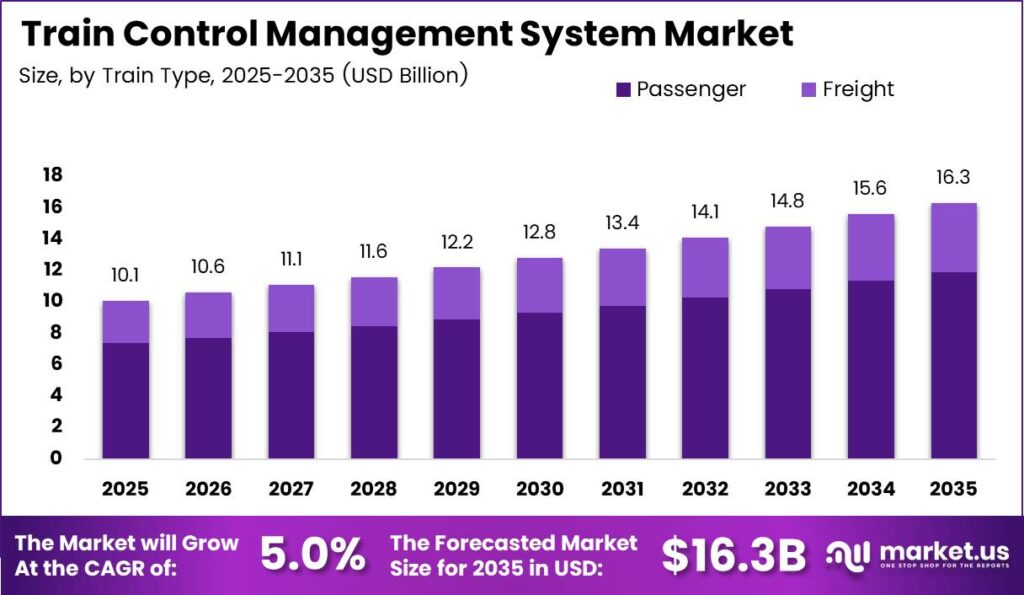
Global Train Control Management System Market size is expected to be worth around USD 16.3 Billion by 2035 from USD 10.1 Billion in 2025, growing at a CAGR of 5.0% during the forecast period 2026 to 2035.
Train control management systems encompass the hardware, software, and communication platforms that regulate train movement, enforce separation rules, and optimize network throughput. The market spans onboard equipment, trackside infrastructure, and integrated control solutions serving passenger rail, metro networks, and freight corridors globally. This reflects a capital-intensive sector where safety regulation and network capacity drive procurement decisions equally.
As per our research, global railway passenger volumes increased approximately 4.5% in 2025, signaling sustained ridership pressure on existing network capacity. Operators managing higher passenger loads require more precise train separation and scheduling tools. This dynamic accelerates investment timelines for CBTC and ETCS deployments across urban and intercity networks.
Key Takeaways
- The global Train Control Management System Market is valued at USD 10.1 Billion in 2025 and is forecast to reach USD 16.3 Billion by 2035.
- The market expands at a CAGR of 5.0% during the forecast period 2026 to 2035.
- By Train Type, the Passenger segment dominates with a 72.34% share in 2025.
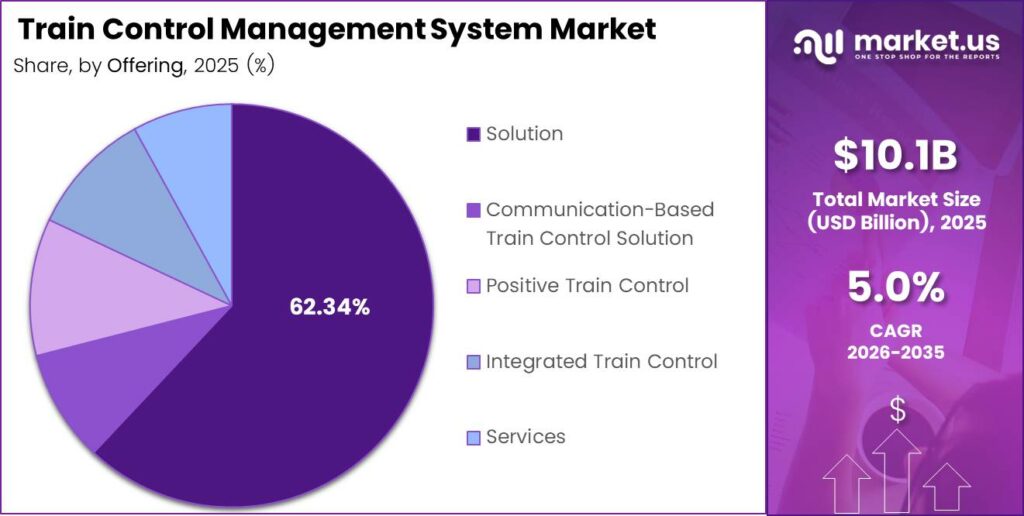
- By Offering, the Solution segment leads with a 62.34% share in 2025.
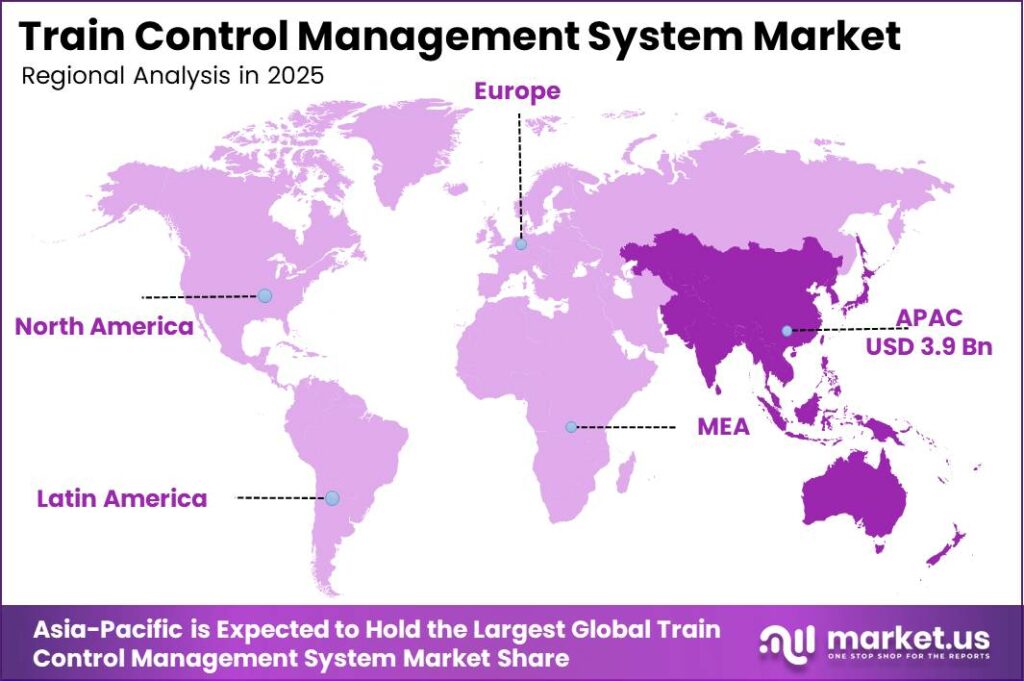
- Asia-Pacific is the dominant region, holding a 38.78% market share valued at USD 3.9 Billion in 2025, and is the fastest-growing region.
According to IEA data, rail carries 8% of global passengers and 7% of global freight while consuming only 2% of transport energy. This efficiency ratio positions rail infrastructure investment as a direct policy instrument for decarbonizing transport. Governments committed to emissions reduction treat train control upgrades as a lever for increasing rail modal share without proportional energy cost.
In August 2025, Mitsubishi Electric began supplying traction systems for 60 DDNG trains totaling 300 cars, with cumulative supply expected to reach 266 trains and 1,006 cars by 2031. This contract scale reflects the long-cycle, multi-year revenue structure that defines supplier positioning in this market. Vendors securing rolling stock integration roles gain recurring service revenue that outlasts initial equipment deliveries.
Train Type Analysis
In 2025, Passenger held a dominant market position in the By Train Type segment of the Train Control Management System Market, with a 72.34% share. Passenger rail networks operate at higher train frequencies and tighter headways than freight corridors, creating direct demand for precision signalling and automated train protection. Operators expanding metro and intercity capacity cannot do so without concurrent investment in train control infrastructure.
The Freight sub-segment holds the remaining share in the By Train Type segment. As per our research, global rail-freight activity increased approximately 2% in 2025, while EU rail-freight performance declined 1.8%, from 375.1 billion tonne-kilometres in 2024 to 368.2 billion tonne-kilometres in 2025. This divergence signals that freight control investment is concentrated in markets with active corridor expansion, particularly North America and Asia, rather than across the board.
Data from Bureau of Transportation Statistics shows the United States had 136,429 railroad route-miles in 2022, including 91,285 miles owned and operated by six Class I freight railroads. This concentration of freight infrastructure in a small number of operators creates procurement leverage and standardization opportunities for train control suppliers. Vendors who align products with Class I specifications gain disproportionate access to large-scale upgrade contracts.
CSX removed more than 7,000 miles of legacy pole lines as part of its network modernization program. This infrastructure clearance directly precedes digital communication system deployment across freight corridors. Suppliers positioned to replace legacy signalling with interoperable digital control platforms are the primary beneficiaries of this transition across North American Class I networks.
Offering Analysis
In 2025, Solution held a dominant market position in the By Offering segment of the Train Control Management System Market, with a 62.34% share. Integrated software and hardware solutions command higher contract values than standalone services because they encompass system design, installation, certification, and ongoing software support. Buyers procuring full solutions rather than individual components create longer supplier relationships and higher switching costs. In July 2025, Alstom received contracts totaling 303 million euros for 26 automated metro trains and the modernization of Lyon Metro Line D, illustrating the scale of integrated solution contracts in this segment.
The Services sub-segment holds the remaining share within the By Offering segment. Eurostat figures show EU passengers made 8.7 billion rail trips, representing 444.5 billion passenger-kilometres, in 2024. High and sustained ridership volumes demand continuous system maintenance and software assurance, supporting durable aftermarket revenue for suppliers with established service networks. In August 2025, Alstom received a Singapore CBTC contract worth a couple of hundred million euros covering three existing stations and the extension to Terminal 5, demonstrating how service-linked solution contracts extend supplier tenure well beyond initial installation.
Key Market Segments
By Train Type
- Passenger
- Freight
By Offering
- Solution
- Communication-Based Train Control Solution
- Positive Train Control
- Integrated Train Control
- Services
Regional Analysis
Asia-Pacific Dominates the Train Control Management System Market with a Market Share of 38.78%, Valued at USD 3.9 Billion
Asia-Pacific holds the largest market share and is the fastest-growing region. China Railways recorded passenger traffic growth of 3.7% in 2025, reflecting continued ridership expansion across high-speed and urban rail networks. This volume growth sustains capital investment in train control infrastructure as network operators prioritize capacity and safety compliance simultaneously. In June 2024, Alstom received a 96.2 million euro Bengaluru Metro GoA4 CBTC contract covering 80.39 kilometres, 50 stations, three depots and 53 six-car trains, illustrating the scale of metro automation investment across South and East Asian urban corridors.
Europe represents a structurally significant region driven by mandatory ERTMS deployment timelines. European rail-freight activity declined approximately 2.4% in 2025, yet passenger network investment remains active as ETCS Baseline rollouts continue under EU regulatory deadlines. In February 2025, Hitachi Rail signed a SelTrac CBTC contract covering San Francisco Muni’s approximately 71-mile, 33-station network and 10 years of support, signaling that North American urban networks are also committing to long-cycle digital signalling upgrades. In June 2025, Siemens Mobility signed a BLS ETCS Level 2 framework agreement worth more than 110 million euros with a contract period exceeding 10 years, reflecting the multi-decade revenue horizon that European regulatory mandates create for compliant suppliers.
Key Regions and Countries
North America
- US
- Canada
Europe
- Germany
- France
- The UK
- Spain
- Italy
- Rest of Europe
Asia Pacific
- China
- Japan
- South Korea
- India
- Australia
- Rest of APAC
Latin America
- Brazil
- Mexico
- Rest of Latin America
Middle East and Africa
- GCC
- South Africa
- Rest of MEA
Market Dynamics
Market Opportunity Analysis - Secondary networks, freight corridors, and emerging metro markets offer underexplored entry points for train control suppliers
The Freight sub-segment holds a minority share within the Train Control Management System Market but represents an underexplored opportunity in markets actively expanding dedicated freight corridors. North America concentrates freight rail ownership among six Class I operators, creating a small number of high-value procurement decisions per cycle. Suppliers who align certification and product standards with Class I specifications access contracts that smaller regional competitors cannot compete for.
Secondary and regional rail networks across Asia, Africa, and Latin America remain largely unprotected by digital train control systems. These networks carry growing volumes on infrastructure originally designed for lower-density operations. As traffic increases, operators face safety and throughput constraints that only onboard protection and communication-based control can resolve without full track reconstruction.
Private and industrial rail networks, including mining corridors in Australia and the Americas, operate outside national regulatory frameworks and make procurement decisions on operational economics rather than statutory deadlines. This creates a faster sales cycle than public rail tenders. Suppliers offering modular, cost-scalable protection systems gain access to a procurement channel that is structurally decoupled from public budget cycles and certification timelines.
Urban metro operators in the Middle East and Latin America are expanding network capacity through new line construction rather than frequency upgrades on existing infrastructure. New lines require full train control system specification from the design stage, giving suppliers a cleaner integration path than brownfield retrofits. This greenfield procurement dynamic shortens delivery timelines and reduces the certification complexity that constrains retrofit projects in mature markets.
Technology and Innovation Landscape - CBTC, ETCS Baseline 4, FRMCS migration, and GoA4 automation define the competitive technology frontier
Communication-Based Train Control is the dominant technology investment across urban metro markets globally. Alstom had been selected for 190 CBTC metro lines, with more than 90 lines operating, while Siemens Trainguard MT operates across 96 metro lines. CBTC deployments replace fixed-block signalling with continuous train-to-wayside communication, enabling headway reductions that increase network capacity without additional track infrastructure.
ETCS Baseline 4 introduces new interfaces for FRMCS radio and automated train operation, creating a technology migration cycle that extends beyond hardware replacement into software architecture redesign. Suppliers with existing Baseline 2 and 3 certified portfolios must manage multi-generation compatibility while developing Baseline 4 products. This parallel engineering load rewards vendors with modular software platforms that can reuse safety-certified components across specification generations.
GoA4 full automation represents the highest-value technology tier in urban rail, enabling driverless operation across closed metro networks. Hitachi Rail signed an approximately 481.6 million euro Turin Metro Line 2 contract covering GoA4 CBTC across a 28-kilometre, 31-station configuration. GoA4 contracts command premium pricing because they integrate train control with platform screen doors, passenger information systems, and centralized operations management into a single accountability structure.
FRMCS migration from GSM-R is creating a parallel technology investment cycle alongside ETCS Baseline deployment across European networks. Alstom has equipped 23,000 kilometres of track with ETCS technology and installed more than 3,000 interlockings across more than 35 countries. Suppliers with this scale of installed base face both a retrofit revenue opportunity and a technical obligation to deliver FRMCS-compatible upgrades before GSM-R network shutdowns affect operational continuity on deployed systems.
Drivers
Statutory compulsion is converting safety policy into active procurement orders across Europe and Asia. The EU adopted Regulation (EU) 2024/1679 on 13 June 2024, requiring ERTMS deployment across the TEN-T network with completion milestones beginning in 2030. India approved Kavach Version 4.0 on 16 July 2024, supported by a 2025 to 2026 budget allocation of ₹1,673.19 crore.
By the end of 2024, ETCS covered only about 10% of the TEN-T network and approximately 19% of the relevant fleet. This gap between mandate and deployment creates a long forward order book. Suppliers with certified hardware and scalable engineering capacity hold a structural advantage over those dependent on isolated equipment sales in fragmented tender environments.
| Driver | (~) % Impact on CAGR Forecast | Geographic Relevance | Impact Timeline |
|---|---|---|---|
| Statutory Train-Protection Mandates | +0.9% | Europe, India, East Asia | Short term (≤ 2 years) |
| Urban Metro Capacity Expansion | +0.55% | Asia-Pacific, Middle East, Latin America | Medium term (2–4 years) |
| High-Speed Corridor Buildout | +0.4% | China, India, Europe, Gulf states | Medium term (2–4 years) |
| Legacy Interlocking Replacement | +0.3% | Europe, Japan, North America | Medium term (2–4 years) |
| Freight Corridor Throughput Upgrades | +0.25% | North America, China, India, Australia | Short term (≤ 2 years) |
| Rolling-Stock Modernization Cycles | +0.2% | Europe, Asia-Pacific, North America | Medium term (2–4 years) |
Restraints
Retrofit economics present an immediate purchasing barrier across all major markets. European Commission analysis published in 2025 found that the indicative cost of retrofitting one vehicle rose from approximately €450,000 in 2018 to €900,000 in 2022. A fixed-price overrun of only 5% equals roughly €45,000 per vehicle, compelling operators to defer marginal fleets and forcing suppliers to price larger contingencies into bids.
Indian Railways benchmarks Kavach trackside and station equipment at approximately ₹50 lakh per kilometre and locomotive equipment at approximately ₹80 lakh per locomotive. This implies roughly ₹8 crore of onboard equipment for a 10-locomotive package before integration costs. Consequently, capital deployment slows in budget-constrained networks, compressing project margins for suppliers who absorb engineering variance rather than pass it to operators.
| Restraint | (~) % Impact on CAGR Forecast | Geographic Relevance | Impact Timeline |
|---|---|---|---|
| High Retrofit Economics | -0.65% | Europe, India, North America | Short term (≤ 2 years) |
| Fragmented Public Funding | -0.45% | Europe, Latin America, Africa | Short term (≤ 2 years) |
| Safety-Certification Gateways | -0.35% | Global | Medium term (2–4 years) |
| Brownfield Access Constraints | -0.25% | Europe, Japan, major metropolitan networks | Short term (≤ 2 years) |
| Low-Density Route Economics | -0.2% | North America, Australia, rural emerging markets | Long term (≥ 4 years) |
| Trade and Localization Barriers | -0.15% | India, China, Middle East, Southeast Asia | Medium term (2–4 years) |
Challenges
Mixed-baseline interoperability creates the most persistent structural burden for suppliers across European and cross-border networks. Current European specifications permit ETCS Baseline 2, Baseline 3 maintenance release 1, Baseline 3 release 2, and Baseline 4, with differing GSM-R, FRMCS and automated-operation interfaces. A supplier portfolio spanning these 4 specification states and 5 vehicle families can produce as many as 20 core configuration combinations before national operating rules are applied.
This regression testing and authorization workload consumes scarce systems-engineering capacity without generating incremental revenue. Suppliers that invest in modular architectures and automated testing platforms convert this compliance burden into a structural barrier against smaller competitors. Those without reusable safety evidence face margin erosion on every software release cycle.
| Challenge | (~) % CAGR Friction Drag | Geographic Relevance | Mitigation Horizon |
|---|---|---|---|
| Mixed-Baseline Interoperability Burden | -0.5% | Europe and cross-border corridors | Medium term (2–4 years) |
| Safety-Critical Cyber Exposure | -0.35% | Global digitally connected networks | Long term (≥ 4 years) |
| Rail Systems Talent Scarcity | -0.3% | Europe, North America, Australia, Middle East | Medium term (2–4 years) |
| Electronics Obsolescence Management | -0.2% | Global | Long term (≥ 4 years) |
| Track-Train Rollout Misalignment | -0.15% | Europe, India, multinational corridors | Medium term (2–4 years) |
| Environmental Validation Complexity | -0.15% | India, Middle East, Africa, northern climates | Medium term (2–4 years) |
Opportunities
Outcome-based lifecycle services represent the largest untapped commercial opportunity across global installed fleets. Evidence from railway maintenance programs indicates data-driven condition monitoring can reduce maintenance expenditure by approximately 10 to 15%, while a 2026 review projects asset-availability improvements of 10 to 25% and reductions of 20 to 35% in unplanned interventions. Suppliers capturing approximately 20% of verified maintenance savings could generate recurring revenue equal to roughly 2 to 3% of the monitored maintenance baseline.
Shifting an estimated 10 to 20% of contract value toward analytics, software, and availability guarantees could expand blended gross margin by approximately 3 to 6 percentage points. This model reduces dependence on one-time equipment deliveries and creates compounding revenue tied to fleet performance rather than procurement cycles. Early movers who establish outcome pricing frameworks before competitors will set contract norms that raise the entry cost for later challengers.
| Opportunity | (~) % Potential CAGR Upside | Geographic Relevance | Execution Window |
|---|---|---|---|
| Outcome-Based Lifecycle Services | +0.55% | Global installed fleets | Medium term (2–4 years) |
| FRMCS Migration Packages | +0.4% | Europe and standards-following export markets | Medium term (2–4 years) |
| Autonomous Operations Enablement | +0.35% | Urban metros, mining and closed networks | Long term (≥ 4 years) |
| Secondary-Network Protection Systems | +0.25% | Asia, Africa, Latin America | Long term (≥ 4 years) |
| Private and Industrial Rail | +0.2% | Australia, Americas, Africa, Middle East | Medium term (2–4 years) |
| Energy-Optimized Traffic Management | +0.15% | Europe, East Asia, urban rail systems | Medium term (2–4 years) |
Key Company Insights
Hitachi Ltd. generated 1,171.3 billion yen in its Mobility segment in FY2024, representing approximately 12% of total company revenue. In July 2026, Hitachi Rail received a Toronto Line 2 CBTC contract designed to increase capacity by up to 40%, from 23,400 to 33,000 passengers per hour. This scale of capacity uplift positions Hitachi as the preferred partner for metro operators facing passenger volume pressure beyond incremental upgrades.
Siemens AG generated 12.4 billion euros in Mobility revenue and employed approximately 43,400 people in FY2025. Siemens Trainguard MT operates across 96 metro lines and 4,351 trains, transporting more than 30 million passengers daily. In January 2025, Siemens Mobility secured four HS2 infrastructure and service contracts worth approximately 560 million pounds, demonstrating the firm’s ability to win high-value, long-duration contracts on flagship national rail programs where technical depth and certification experience are decisive.
Key Players
- Hitachi Ltd.
- Siemens AG
- Mitsubishi Electric Corporation
- Toshiba Corporation
- Oranjewoud NV
- EKE-Electronics
- Alstom
- Strukton Rail
- Bombardier Inc.
- ABB
- MEN Mikro Elektronik GmbH
- DEUTA-WERKE GmbH
- Thales Group
- Knorr-Bremse AG
- Other Key Players
Recent Developments
- April 27, 2026 – Siemens Mobility and L.K. Comstock received a nearly USD 390 million contract covering 65 track kilometres, 23 stations and a 25-year maintenance term for the New York City Fulton Line digitalization.
- June 18, 2026 – An Alstom-led consortium signed four Egyptian railway-modernization contracts worth approximately 690 million euros, including an Alstom share of approximately 300 million euros.
- July 15, 2026 – Hitachi Rail received a Toronto Line 2 CBTC contract designed to increase capacity by up to 40%, from 23,400 to 33,000 passengers per hour.
- March 4, 2026 – Hitachi Rail signed an approximately 481.6 million euro Turin Metro Line 2 rolling-stock and GoA4 CBTC contract covering a final 28-kilometre, 31-station configuration.
- May 5, 2026 – Alstom signed a 295 million euro contract to install CBTC and modernize Lausanne’s m2 metro fleet.
- July 16, 2026 – Fortescue awarded Knorr-Bremse a signalling-modernization contract in the upper double-digit-million-euro range for rail infrastructure in Australia.
- March 26, 2026 – Siemens Mobility and Sonda received an ETCS Level 1 project covering more than 300 kilometres and 11 passenger stations in Mexico.
- February 6, 2026 – Siemens Mobility and Stadler signed an approximately 3 billion euro framework contract for 226 four-car automated trains, with options for 100 additional trains, for the Copenhagen S-Bane.
- July 30, 2026 – A Siemens-led consortium received approximately 308 million euros of Romanian signalling contracts covering approximately 560 kilometres, 66 stations, 122 level crossings and more than 2,000 signals.
- March 24, 2026 – Alstom received an approximately 380 million euro Houston Skyway contract covering 16 vehicles and 15 years of operations and maintenance.
Report Scope
| Report Features | Description |
|---|---|
| Market Value (2025) | USD 10.1 Billion |
| Forecast Revenue (2035) | USD 16.3 Billion |
| CAGR (2026-2035) | 5.0% |
| Base Year for Estimation | 2025 |
| Historic Period | 2020-2024 |
| Forecast Period | 2026-2035 |
| Report Coverage | Revenue Forecast, Market Dynamics, Market Opportunity Analysis, Technology and Innovation Landscape, Competitive Landscape, Recent Developments |
| Segments Covered | By Train Type (Passenger, Freight), By Offering (Solution: Communication-Based Train Control Solution, Positive Train Control, Integrated Train Control; Services) |
| Regional Analysis | North America (US and Canada), Europe (Germany, France, The UK, Spain, Italy, and Rest of Europe), Asia Pacific (China, Japan, South Korea, India, Australia, and Rest of APAC), Latin America (Brazil, Mexico, and Rest of Latin America), Middle East and Africa (GCC, South Africa, and Rest of MEA) |
| Competitive Landscape | Hitachi Ltd., Siemens AG, Mitsubishi Electric Corporation, Toshiba Corporation, Oranjewoud NV, EKE-Electronics, Alstom, Strukton Rail, Bombardier Inc., ABB, MEN Mikro Elektronik GmbH, DEUTA-WERKE GmbH, Thales Group, Knorr-Bremse AG, Other Key Players |
| Customization Scope | Customization for segments, region/country-level will be provided. Additional customization can be done based on requirements. |
| Purchase Options | We have three licenses to opt for: Single User License, Multi-User License (Up to 5 Users), Corporate Use License (Unlimited User and Printable PDF) |





































