


Global Traffic Simulation Systems Market Size, Share, Growth Analysis By Component (Software, Hardware), By Simulation Type (Microscopic, Mesoscopic, Macroscopic), By Application (Urban Mobility Planning, Autonomous Vehicle Testing, Freight Logistics, Event Management, Emergency Planning), By End User (Government Agencies, Engineering Consultancies, Private Mobility Operators, Academic & Research Institutions), By Region and Companies - Industry Segment Outlook, Market Assessment, Competition Scenario, Statistics, Trends and Forecast 2025-2034
- Published date: Dec 2025
- Report ID: 169492
- Number of Pages: 350
- Format:
-
keyboard_arrow_up
Quick Navigation
Report Overview
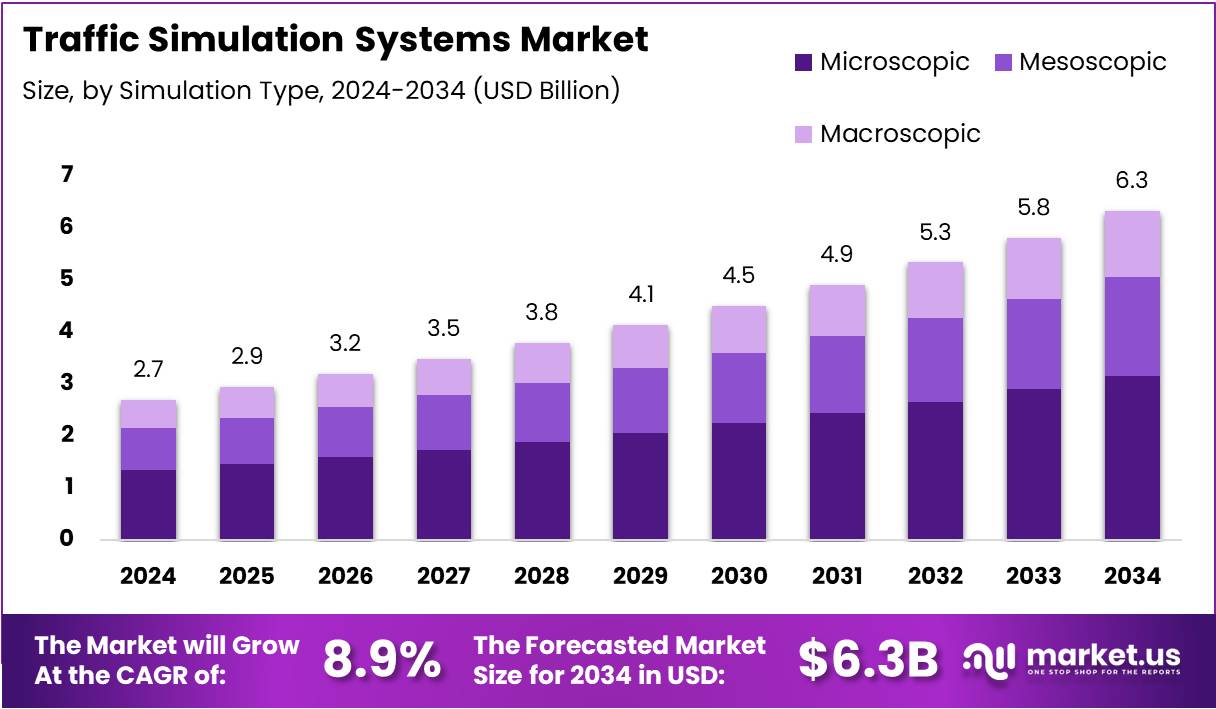
The Global Traffic Simulation Systems Market size is expected to be worth around USD 6.3 Billion by 2034, from USD 2.7 Billion in 2024, growing at a CAGR of 8.9% during the forecast period from 2025 to 2034.
Traffic Simulation Systems are advanced software platforms designed to model, analyze, and optimize vehicle and pedestrian flows in urban and regional networks. They help governments, planners, and private operators test scenarios virtually, reduce congestion, and improve road safety. Growing urbanization and smart city initiatives are accelerating the adoption of these solutions.
Government investment and regulatory support play a critical role in market growth. Policies promoting sustainable mobility, public transit integration, and traffic impact assessments encourage the use of simulation systems. These frameworks require accurate modeling tools to guide infrastructure planning and traffic management strategies efficiently.
Technological advancements are driving innovation in the market. Real-time simulation, cloud computing, and GPU-accelerated platforms allow for large-scale modeling of vehicles and pedestrians. These improvements help stakeholders analyze complex scenarios, optimize traffic flow, and make data-driven decisions for urban planning and emergency management.
Urban freight operations are increasingly influenced by simulation insights. Studies indicate that replacing 10% of conventional delivery vans with cargo-cycles can significantly reduce travel distances and traffic delays. This highlights the role of simulation systems in promoting sustainable logistics and improving last-mile delivery efficiency.
Accuracy in traffic data is crucial for reliable simulations. Using inaccurate maps can reduce traffic volume by 42%, while omitting bus routes increases private-car trips by 47%. Furthermore, not-iterated routes prevent 6.6% of vehicles from following their original paths, emphasizing the importance of precise data for realistic modeling.
Optimized real-time simulation models leveraging GPU instancing and efficient batching can maintain 60 FPS with up to 1,500 vehicles. Such capabilities allow urban planners and mobility operators to evaluate large networks dynamically, providing actionable insights for traffic management, infrastructure investment, and long-term urban mobility planning.
Key Takeaways
- The Global Traffic Simulation Systems Market is projected to reach USD 6.3 Billion by 2034 from USD 2.7 Billion in 2024, growing at a CAGR of 8.9%.
- Software dominates the market with a 74.6% share in the component segment.
- Microscopic simulation leads with a 49.9% share by simulation type.
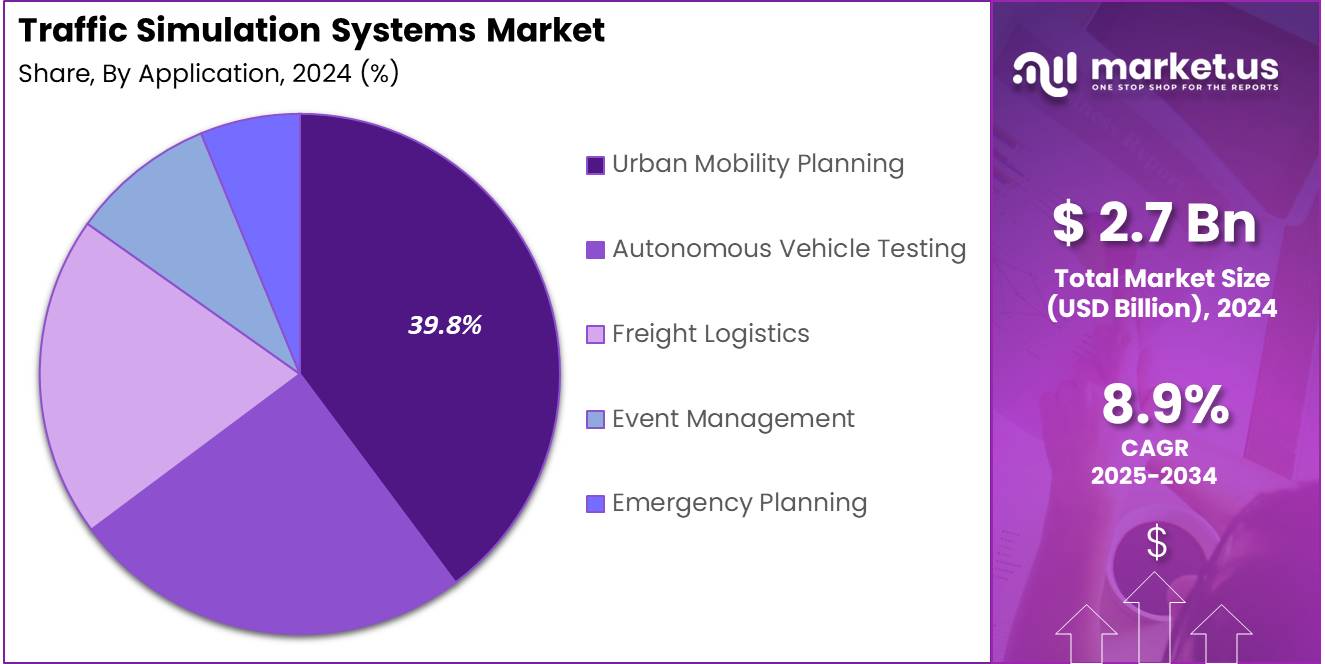
- Urban Mobility Planning holds the largest application share at 39.8%.
- Government Agencies represent the largest end-user segment with a 44.1% share.
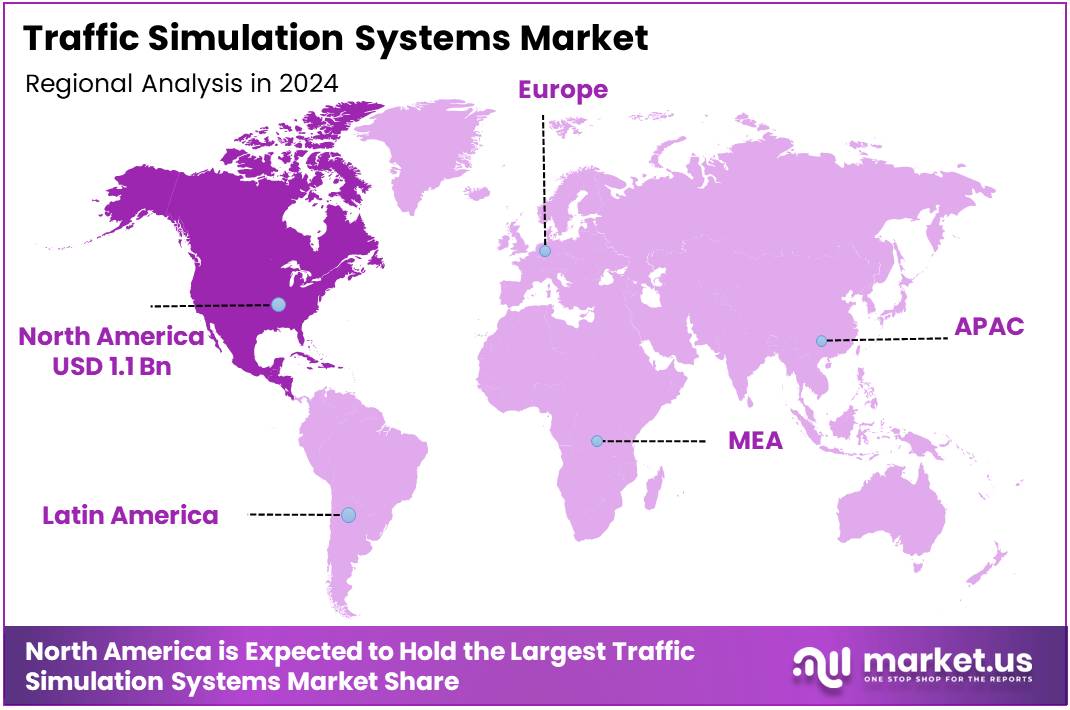
- North America leads the regional market with 43.8% market share, valued at USD 1.1 Billion.
Component Analysis
Software dominates with 74.6% due to its advanced analytics capabilities and scalability.
In 2024, Software held a dominant market position in the By Component Analysis segment of Traffic Simulation Systems Market, with a 74.6% share. This substantial dominance stems from growing demand for sophisticated modeling tools that accurately predict traffic patterns and optimize transportation networks. Software solutions offer unparalleled flexibility, enabling users to simulate complex scenarios and integrate real-time data feeds.
Cloud-based deployment models enhance accessibility, allowing organizations to scale simulation capabilities without significant infrastructure investments. Machine learning integration has strengthened software’s position as the preferred choice for traffic analysis.
Hardware represents the complementary segment, providing essential physical infrastructure for data collection and system operation. Although holding smaller market share, hardware remains critical for supporting sensor networks, processing units, and display systems. Organizations invest in hardware to establish robust data acquisition frameworks that feed accurate information into software platforms. IoT devices and edge computing hardware enhance real-time simulation capabilities, ensuring physical components work seamlessly with software solutions.
Simulation Type Analysis
Microscopic dominates with 49.9% due to its detailed vehicle-level modeling capabilities.
In 2024, Microscopic held a dominant market position in the By Simulation Type Analysis segment of Traffic Simulation Systems Market, with a 49.9% share. This approach excels in modeling individual vehicle behaviors, driver interactions, and lane-changing dynamics with exceptional precision. Transportation planners prefer microscopic simulation for urban intersection analysis, roundabout design, and traffic signal optimization. The granular detail enables stakeholders to evaluate safety measures and test innovative traffic control strategies before implementation.
Mesoscopic simulation bridges microscopic and macroscopic approaches, offering balanced computational efficiency and modeling detail. This methodology tracks vehicle platoons rather than individual vehicles, making it suitable for large-scale network analysis. Transportation agencies utilize mesoscopic models for regional corridor studies and multi-modal transportation planning, benefiting from reduced computational requirements while maintaining reasonable accuracy.
Macroscopic simulation focuses on aggregate traffic flow characteristics, treating vehicles as continuous fluid streams. This approach proves valuable for high-level strategic planning, long-term forecasting, and metropolitan-scale transportation studies. Planners leverage macroscopic models to evaluate policy impacts and infrastructure investment priorities. Despite lower granularity, it remains essential for understanding system-wide dynamics across extensive transportation networks.
Application Analysis
Urban Mobility Planning dominates with 39.8% due to increasing urbanization and smart city initiatives.
In 2024, Urban Mobility Planning held a dominant market position in the By Application Analysis segment of Traffic Simulation Systems Market, with a 39.8% share. Rapid urbanization intensifies the need for efficient transportation systems that minimize congestion and reduce environmental impact. Municipal authorities leverage simulation tools to design sustainable transit networks and optimize public transportation routes. These platforms enable planners to test multiple scenarios and predict policy change impacts before committing resources.
Autonomous Vehicle Testing represents a rapidly growing segment driven by the automotive industry’s shift toward self-driving technologies. Simulation systems provide safe environments for testing autonomous vehicle algorithms and sensor fusion capabilities across diverse traffic conditions. Manufacturers utilize these platforms to accelerate development cycles, reduce physical testing costs, and validate safety performance under scenarios impractical to replicate in real-world settings.
Freight Logistics applications focus on optimizing cargo transportation efficiency, warehouse operations, and last-mile delivery networks. Companies employ simulation tools to model supply chain dynamics and evaluate routing strategies while minimizing transportation costs. These systems help logistics providers anticipate bottlenecks, optimize fleet utilization, and assess e-commerce growth impact on urban delivery patterns.
Event Management applications address challenges of coordinating traffic during large-scale gatherings, concerts, and sporting events. Event organizers utilize simulation platforms to design effective crowd dispersal strategies and optimize parking arrangements. These tools enable stakeholders to anticipate congestion hotspots, evaluate alternative traffic flow patterns, and develop contingency plans ensuring public safety during temporary high-density scenarios.
Emergency Planning applications focus on developing response strategies for natural disasters and critical incidents requiring rapid evacuation or emergency service deployment. Government agencies employ simulation systems to model evacuation routes and test emergency response protocols. These platforms help authorities identify vulnerable network segments, evaluate alternative routing options, and train personnel on effective incident management procedures.
End User Analysis
Government Agencies dominates with 44.1% due to public infrastructure responsibilities and regulatory mandates.
In 2024, Government Agencies held a dominant market position in the By End User Analysis segment of Traffic Simulation Systems Market, with a 44.1% share. Public sector organizations bear primary responsibility for transportation infrastructure planning and traffic management across jurisdictions. These agencies invest heavily in simulation technology to support evidence-based policymaking and justify infrastructure expenditures. Government entities utilize these systems to engage stakeholders and ensure transportation investments align with sustainability objectives.
Engineering Consultancies constitute a significant segment, providing specialized expertise to clients across public and private sectors. These firms deploy advanced simulation tools to conduct traffic impact assessments and design transportation infrastructure. Consultancies leverage simulation capabilities to differentiate service offerings, enhance project deliverables, and provide comprehensive analysis that supports successful project outcomes while maintaining competitive marketplace advantages.
Private Mobility Operators including ride-sharing companies and transit agencies increasingly adopt simulation systems to optimize fleet operations and route planning. These organizations utilize traffic models to forecast demand patterns and evaluate service expansion opportunities. Simulation enables private operators to enhance customer experience, reduce operational costs, and develop data-driven strategies strengthening competitive positioning in evolving urban mobility ecosystems.
Academic & Research Institutions employ traffic simulation systems for educational purposes and theoretical research in transportation science. Universities utilize these platforms to train future transportation professionals and conduct fundamental research on traffic flow theory. Academic users contribute to advancing simulation methodologies, validating new modeling approaches, and fostering collaboration between industry practitioners and researchers to drive continuous improvement.
Key Market Segments
By Component
- Software
- Hardware
By Simulation Type
- Microscopic
- Mesoscopic
- Macroscopic
By Application
- Urban Mobility Planning
- Autonomous Vehicle Testing
- Freight Logistics
- Event Management
- Emergency Planning
By End User
- Government Agencies
- Engineering Consultancies
- Private Mobility Operators
- Academic & Research Institutions
Drivers
Rising Urbanization and Smart Infrastructure Development Drive Traffic Simulation Systems Market Growth
The traffic simulation systems market is experiencing significant expansion driven by rapid urbanization worldwide. As more people migrate to cities, urban areas face unprecedented traffic congestion challenges. Major metropolitan regions are struggling with overcrowded roads, longer commute times, and increased pollution levels. This situation creates urgent demand for advanced traffic simulation tools that help city planners design better road networks and optimize traffic flow patterns before implementing costly infrastructure changes.
Government initiatives play a crucial role in market acceleration. Authorities are investing heavily in Intelligent Transportation Systems to modernize aging infrastructure and improve urban mobility. These investments focus on implementing smart traffic solutions that reduce congestion and enhance road safety. Traffic simulation software enables governments to test various scenarios digitally, saving both time and resources in the planning phase.
The shift toward data-driven decision-making further propels market growth. Transportation authorities now recognize the value of using real-time traffic data and predictive analytics for effective management. Modern simulation systems analyze vast amounts of traffic information to forecast congestion patterns and suggest optimal solutions. These tools help officials make informed choices about signal timing, lane configurations, and traffic routing strategies, ultimately improving overall transportation efficiency.
Restraints
Workforce and Infrastructure Challenges Restrain Traffic Simulation Systems Market Growth
The traffic simulation systems market faces significant constraints that impact its widespread adoption and effectiveness. One primary challenge involves the limited availability of skilled professionals capable of managing and interpreting complex simulation data. These systems generate vast amounts of information requiring specialized knowledge in traffic engineering, data analytics, and software operations. Organizations struggle to find qualified personnel who can accurately analyze simulation outputs and translate them into actionable insights for urban planning and traffic management decisions.
The shortage of trained experts creates bottlenecks in project implementation and reduces the overall return on investment for organizations investing in these advanced technologies. Many smaller municipalities and developing regions particularly face difficulties in recruiting and retaining such specialized talent, limiting market penetration in these areas.
Another major restraint involves integration difficulties with existing legacy infrastructure. Many cities operate on older traffic management systems that were not designed to work with modern simulation platforms. Connecting new simulation software with decades-old hardware and databases presents technical complications, requiring substantial time and financial resources. Compatibility issues between different technology generations often lead to incomplete data transfer and reduced system effectiveness.
Growth Factors
Integration of AI-Based Predictive Analytics for Real-Time Traffic Management Drives Market Growth
The traffic simulation systems market is experiencing significant growth opportunities driven by technological advancements and urbanization trends. AI-based predictive analytics is transforming how cities manage traffic flow in real-time. These intelligent systems can analyze vast amounts of data from sensors, cameras, and GPS devices to predict congestion patterns before they occur. This allows traffic authorities to make proactive decisions, reducing delays and improving overall road efficiency. The ability to simulate different scenarios and test solutions virtually saves cities both time and money.
Smart city initiatives worldwide are creating substantial demand for advanced traffic simulation tools. Governments are investing heavily in digital infrastructure to make urban areas more livable and efficient. Traffic simulation systems help city planners design better road networks, optimize signal timing, and plan for future growth. As more cities commit to becoming “smart,” the need for sophisticated simulation software continues to rise.
Cloud-based traffic simulation platforms represent another major growth opportunity. These scalable solutions allow multiple stakeholders to access and collaborate on urban planning projects from anywhere. Cloud technology reduces the need for expensive hardware investments and enables smaller cities to afford advanced simulation capabilities. This democratization of technology is expanding the market reach significantly.
Emerging Trends
Adoption of Digital Twin Technology Reshapes Traffic Simulation Capabilities
The traffic simulation systems market is experiencing significant transformation driven by emerging technologies. Digital twin technology is gaining strong momentum as cities and transportation authorities seek more accurate traffic modeling. This approach creates virtual replicas of real-world traffic networks, allowing planners to test various scenarios before implementing actual changes. The technology helps reduce costs and minimize risks associated with infrastructure modifications.
Multi-modal traffic simulation is becoming essential for modern urban planning. Cities now handle diverse transportation modes including cars, buses, bicycles, and pedestrians simultaneously. Simulation systems that integrate all these modes provide comprehensive insights into traffic flow patterns. This capability supports better decision-making for developing sustainable urban mobility solutions.
Vehicle-to-Infrastructure (V2I) communication integration represents another major trend. Simulation models now incorporate V2I data to predict how connected vehicles interact with traffic signals and road infrastructure. This advancement improves accuracy in forecasting traffic conditions under smart city environments. Transportation agencies use these enhanced simulations to prepare for autonomous vehicle deployment and intelligent transportation systems.
Regional Analysis
North America Dominates the Traffic Simulation Systems Market with a Market Share of 43.8%, Valued at USD 1.1 Billion
North America leads the Traffic Simulation Systems Market, holding a dominant 43.8% market share with a valuation of USD 1.1 Billion. The region benefits from well-established infrastructure, early adoption of intelligent transportation systems, and substantial government initiatives to enhance traffic management. Growing urban congestion and increasing demand for data-driven solutions further support market growth, making North America the largest contributor globally.
Europe Traffic Simulation Systems Market Trends
Europe demonstrates consistent growth in traffic simulation systems, fueled by rising urban traffic congestion and proactive smart city programs. Governments are increasingly implementing data-driven solutions to optimize traffic flow and reduce road accidents. Advanced technological adoption, such as autonomous vehicle testing and integrated transport management, also contributes to Europe’s expanding market.
Asia Pacific Traffic Simulation Systems Market Trends
Asia Pacific is experiencing rapid market expansion due to accelerating urbanization, increasing population density, and a surge in vehicle ownership. Investments in intelligent transportation systems and smart city infrastructure are driving demand for sophisticated simulation solutions. Countries in the region are focusing on improving urban mobility planning, freight logistics, and emergency traffic management, boosting market opportunities.
Middle East and Africa Traffic Simulation Systems Market Trends
The Middle East and Africa market is gradually expanding, driven by infrastructure modernization and rising urban traffic challenges. Governments are emphasizing smart city initiatives and technology-driven traffic solutions to improve road safety and commuter efficiency. Increasing awareness of traffic congestion issues and strategic investments in intelligent transportation systems are supporting steady market adoption.
Latin America Traffic Simulation Systems Market Trends
Latin America is witnessing moderate growth in the traffic simulation systems market, supported by urban infrastructure development and government interest in modern traffic management. Increasing traffic congestion in major cities and growing focus on safety and efficiency are creating opportunities for data-driven simulation tools. Investment in smart transportation initiatives is gradually boosting market penetration across the region.
Key Regions and Countries
North America
- US
- Canada
Europe
- Germany
- France
- The UK
- Spain
- Italy
- Rest of Europe
Asia Pacific
- China
- Japan
- South Korea
- India
- Australia
- Rest of APAC
Latin America
- Brazil
- Mexico
- Rest of Latin America
Middle East & Africa
- GCC
- South Africa
- Rest of MEA
Key Traffic Simulation Systems Company Insights
In 2024, Anylogic continues to be a front-runner in the Traffic Simulation Systems Market due to its versatile software solutions, which cater to urban mobility planning and large-scale transportation projects. Its multi-method modeling approach offers high accuracy, supporting both microscopic and macroscopic simulations, making it a preferred choice for governments and consultancies.
MC Trans maintains a strong presence by delivering robust traffic modeling tools that focus on real-time analysis and predictive traffic behavior. Their solutions are widely adopted for infrastructure planning, allowing stakeholders to optimize traffic flows efficiently while minimizing congestion in urban areas.
Siemens AG leverages its technological expertise to provide integrated traffic management systems that combine simulation with intelligent transport system (ITS) applications. Their offerings emphasize automation, safety, and energy-efficient traffic solutions, which are increasingly critical for smart city initiatives globally.
Adacel stands out for its specialized simulation platforms designed for air traffic and ground traffic coordination. Their software enhances operational efficiency and safety in complex environments, serving both transportation authorities and private operators who require precise, scenario-based modeling capabilities.
Top Key Players in the Market
- Anylogic
- MC Trans
- Siemens AG
- Adacel
- Nexus Telecom
- Fujitsu
- Ufa Inc
- Caliper
- Skysoft-Atm
- Micro Nav
Recent Developments
- In April 2025, Chaos launched Chaos Anima 6, the first traffic simulation specifically designed for architectural visualization. This tool enables realistic traffic and pedestrian flow animations in architectural presentations.
- In June 2024, OPAL-RT announced the acquisition of 4D-Virtualiz (4D-V), welcoming their team and innovative software. This strengthens OPAL-RT’s real-time simulation capabilities across automotive and aerospace sectors.
- In July 2024, PTV Planung Transport Verkehr GmbH launched PTV Vissim Automotive, an upgraded traffic simulation platform. The enhanced version offers advanced features for autonomous vehicle testing and connected vehicle scenarios.
- In April 2024, the 7bridges acquisition expanded IFS’s logistics and transportation optimization capabilities. This integration brought advanced AI simulation and analytics for sophisticated supply chain planning solutions.
Report Scope
Report Features Description Market Value (2024) USD 2.7 Billion Forecast Revenue (2034) USD 6.3 Billion CAGR (2025-2034) 8.9% Base Year for Estimation 2024 Historic Period 2020-2023 Forecast Period 2025-2034 Report Coverage Revenue Forecast, Market Dynamics, Competitive Landscape, Recent Developments Segments Covered By Component (Software, Hardware), By Simulation Type (Microscopic, Mesoscopic, Macroscopic), By Application (Urban Mobility Planning, Autonomous Vehicle Testing, Freight Logistics, Event Management, Emergency Planning), By End User (Government Agencies, Engineering Consultancies, Private Mobility Operators, Academic & Research Institutions) Regional Analysis North America (US and Canada), Europe (Germany, France, The UK, Spain, Italy, and Rest of Europe), Asia Pacific (China, Japan, South Korea, India, Australia, and Rest of APAC), Latin America (Brazil, Mexico, and Rest of Latin America), Middle East & Africa (GCC, South Africa, and Rest of MEA) Competitive Landscape Anylogic, MC Trans, Siemens AG, Adacel, Nexus Telecom, Fujitsu, Ufa Inc, Caliper, Skysoft-Atm, Micro Nav Customization Scope Customization for segments, region/country-level will be provided. Moreover, additional customization can be done based on the requirements. Purchase Options We have three licenses to opt for: Single User License, Multi-User License (Up to 5 Users), Corporate Use License (Unlimited User and Printable PDF)  Traffic Simulation Systems MarketPublished date: Dec 2025add_shopping_cartBuy Now get_appDownload Sample
 -
-
- Anylogic
- MC Trans
- Siemens AG
- Adacel
- Nexus Telecom
- Fujitsu
- Ufa Inc
- Caliper
- Skysoft-Atm
- Micro Nav
Our Clients

- 169492
- Dec 2025






