


Global Trade Compliance Software Market By Deployment Mode (Cloud-based, On-premises), By Organization Size (Large Enterprises, Small and Medium-sized Enterprises (SMEs)), By Application (Restricted Party Screening (RPS), Export & Import Classification, Others), By End-User Industry (Manufacturing, Retail & E-commerce, Automotive, Others),By Regional Analysis, Global Trends and Opportunity, Future Outlook By 2025-2035
- Published date: Feb. 2026
- Report ID: 177673
- Number of Pages: 256
- Format:
-
keyboard_arrow_up
Quick Navigation
- Report Overview
- Top Market Takeaways
- Business Impact and Efficiency
- Driver Impact Analysis
- Restraints Impact analysis
- By Deployment Mode
- By Organization Size
- By Application
- By End User Industry
- Investor Type Impact Matrix
- Technology Impact Analysis
- Investment Opportunities
- Emerging Trends
- Growth Factors
- Key Market Segments
- Regional Analysis
- Competitive Analysis
- Future Outlook
- Recent Developments
- Report Scope
Report Overview
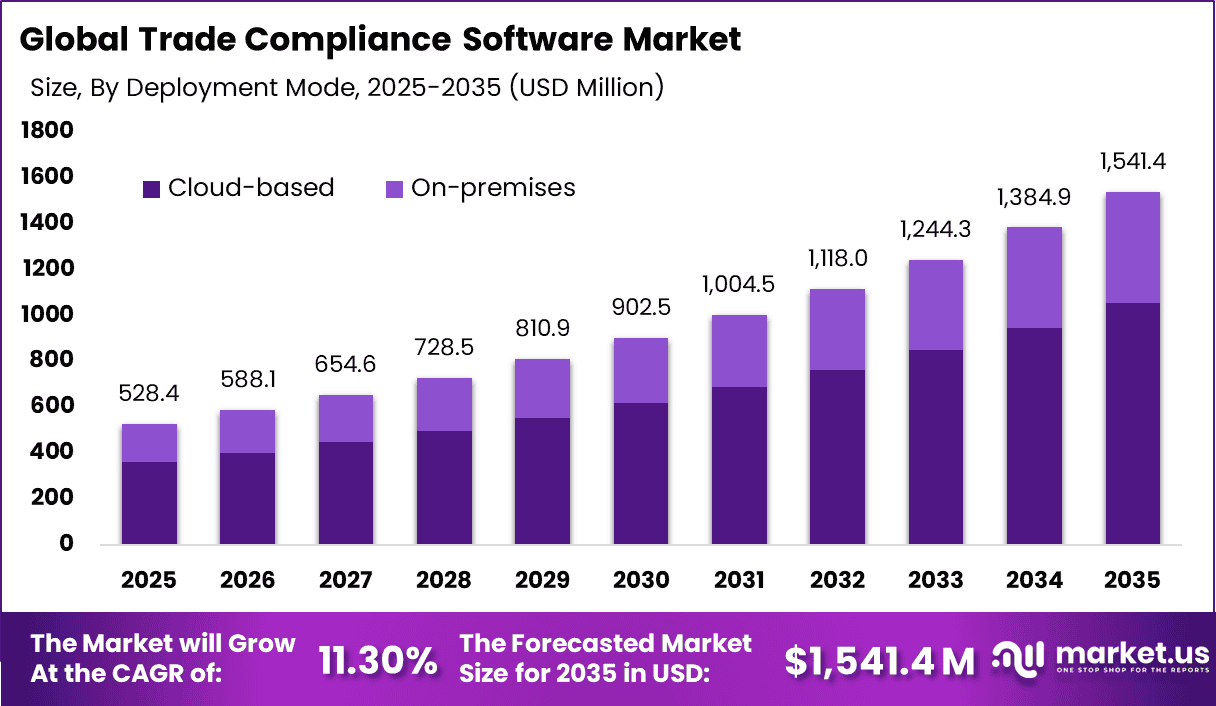
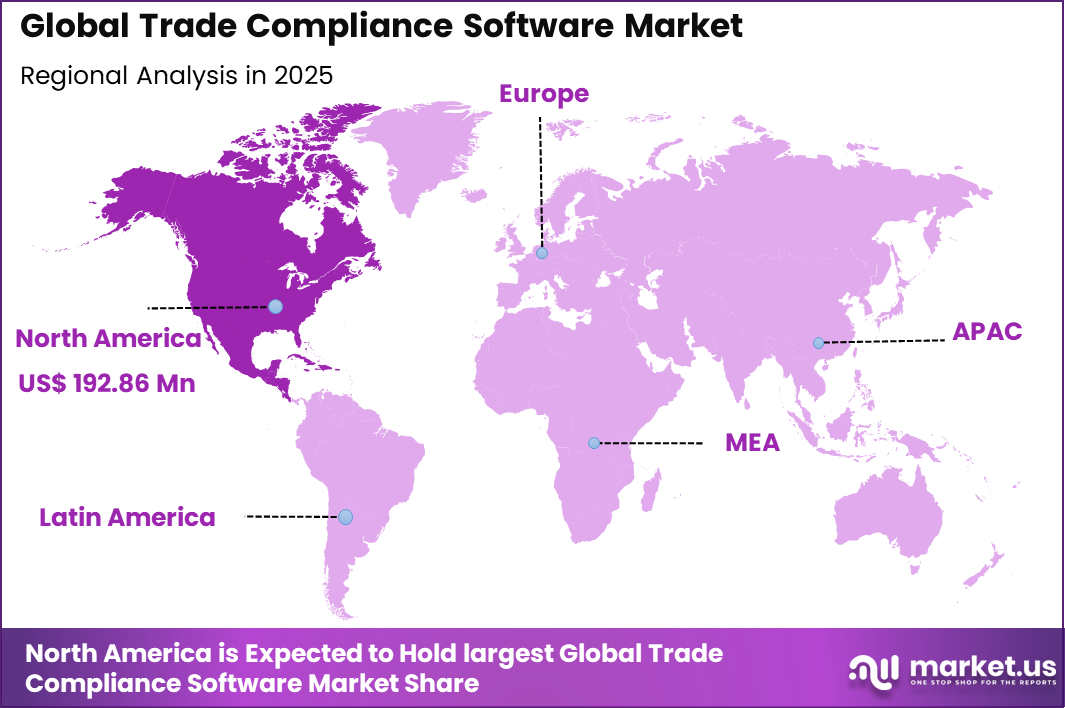
The Global Trade Compliance Software Market generated USD 528.4 million in 2025 and is predicted to register growth from USD 588.1 million in 2026 to about USD 1,541.4 million by 2035, recording a CAGR of 11.30% throughout the forecast span. In 2025, North America held a dominan market position, capturing more than a 36.5% share, holding USD 192.86 Million revenue.
The Trade Compliance Software Market refers to digital platforms designed to help organizations comply with international trade regulations, export controls, customs requirements, and sanctions laws. These systems automate classification, documentation, screening, and reporting processes required for cross-border transactions. As global supply chains become more complex, regulatory oversight continues to intensify, making automated compliance tools essential rather than optional.
Trade compliance software integrates with enterprise resource planning systems, logistics platforms, and customs databases to ensure that goods, parties, and transactions meet applicable trade laws. The software reduces manual errors, mitigates penalties, and improves operational transparency. With increasing geopolitical tensions and evolving trade restrictions, organizations are prioritizing structured compliance frameworks supported by digital tools.
A primary driver of the Trade Compliance Software market is the increasing complexity of international trade regulations. Governments frequently update tariff structures, sanctions policies, and export control frameworks. Enterprises must ensure accurate classification of goods and documentation to avoid penalties. Automated compliance tools help manage these dynamic regulatory requirements effectively.
Demand for trade compliance software is strongest among multinational enterprises and organisations with complex supply chains that span multiple jurisdictions. These businesses face significant challenges in reconciling regulatory requirements, documentation standards, and classification rules across regions. Centralised compliance systems help reduce manual effort, support consistent application of trade policies, and improve coordination between internal functions such as procurement, logistics, and legal teams.
Top Market Takeaways
- By deployment mode, cloud-based platforms account for 68.4% of the market, providing scalable screening, tariff calculations, and real-time regulatory updates across global supply chains.
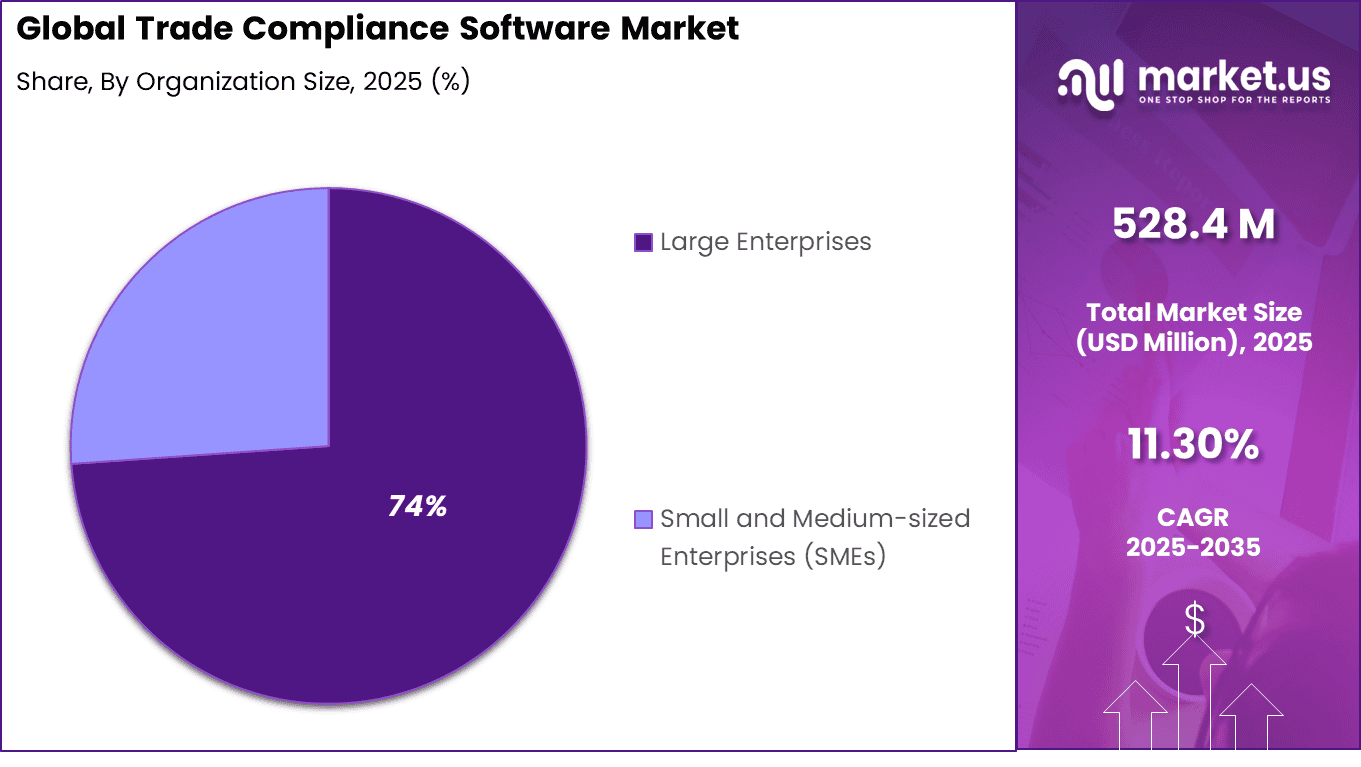
- By organization size, large enterprises represent 73.9%, automating complex export/import controls, denied party lists, and sanctions monitoring for multinational operations.
- By application, restricted party screening (RPS) captures 35.7%, flagging entities on watchlists like OFAC, EU, or BIS to prevent prohibited transactions.
- By end-user industry, manufacturing holds 38.5% share, managing product classifications (ECCN/HTS), export licensing, and dual-use compliance in volatile geopolitics.
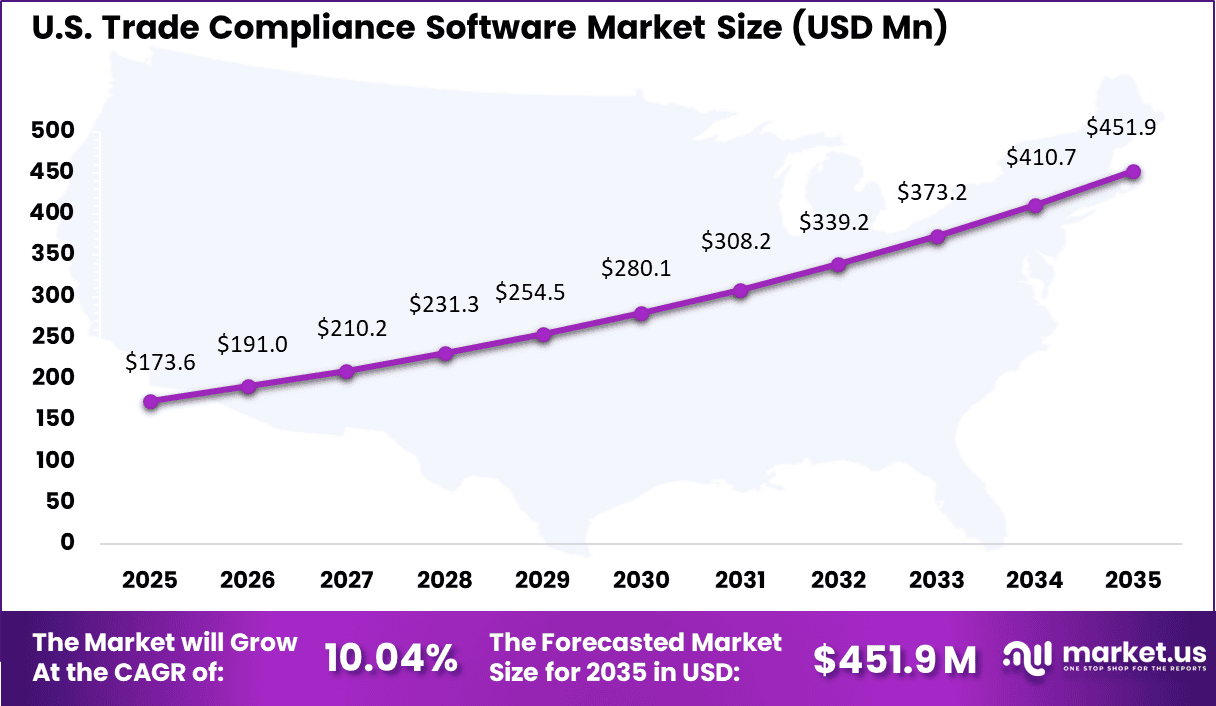
- By region, North America leads with 36.5% of the global market, where the U.S. is valued at USD 173.6 million with a projected CAGR of 10.04%, driven by EAR/ITAR enforcement and reshoring trends.
Business Impact and Efficiency
- Organizations deploying integrated digital systems report a 30% increase in operational efficiency, alongside a 25% reduction in process-related costs, compared to traditional manual workflows.
- Adoption of digital supply chain and compliance platforms contributes to a 20% reduction in compliance-related incidents, strengthening regulatory adherence and audit readiness.
- Around 39% of fast-growing companies, defined as those targeting more than 15% annual growth, regard trade compliance as a strategic competitive advantage, compared to 22% of slower-growing firms.
- Approximately 86% of high-growth organizations consider compliance technology a critical component of their long-term business strategy, highlighting its role in supporting scalable and risk-aware expansion.
Driver Impact Analysis
Key Driver Impact on CAGR Forecast (~%) Geographic Relevance Impact Timeline Increasing complexity of global trade regulations and sanctions +3.1% North America, Europe Short to medium term Rising cross-border trade volumes and e-commerce expansion +2.4% Asia Pacific, North America Medium term Growing enforcement of export controls and customs compliance +2.1% North America, Europe Medium term Adoption of automated screening and classification tools +1.9% Global Medium term Demand for real-time regulatory updates and audit readiness +1.8% Global Medium to long term Restraints Impact analysis
Key Restraint Impact on CAGR Forecast (~%) Geographic Relevance Impact Timeline High implementation and integration costs -2.2% Emerging Markets Short to medium term Complexity of integrating with ERP and supply chain systems -2.0% Global Medium term Limited awareness among small exporters and SMEs -1.7% Asia Pacific, Latin America Medium term Frequent changes in trade policies creating uncertainty -1.5% Global Medium term Dependence on accurate master data and product classification -1.3% Global Medium to long term By Deployment Mode
Cloud-based deployment accounting for 68.4% reflects strong demand for scalable and centrally managed compliance systems. Cloud delivery enables organizations to access real-time regulatory updates without relying on local software maintenance. This ensures that compliance rules remain aligned with frequently changing international trade laws.
Cloud architecture also supports seamless integration with global subsidiaries and third-party logistics partners. Large multinational corporations benefit from unified oversight across different geographic operations. Automatic updates and centralized data management reduce operational complexity and compliance gaps.
Another contributing factor is cost efficiency. Cloud-based subscription models reduce upfront capital expenditure and allow flexible scaling based on transaction volumes. This aligns with the needs of organizations handling fluctuating trade activities.
By Organization Size
Large enterprises representing 73.9% demonstrate stronger adoption due to high transaction volumes and complex supply chains. Multinational companies face diverse regulatory requirements across regions, which increases the need for automated screening and documentation processes.
These enterprises manage multiple subsidiaries, distribution centers, and supplier networks. Trade compliance software provides centralized monitoring and standardized procedures across business units. This improves governance and ensures consistent regulatory adherence.
Additionally, large enterprises often operate in industries subject to strict export controls. The financial and reputational impact of non-compliance can be significant, reinforcing investment in advanced compliance management systems.
By Application
Restricted Party Screening accounting for 35.7% highlights its critical role in trade compliance operations. RPS tools automatically check customers, suppliers, and partners against global sanctions lists and denied party databases. This process is essential to prevent unauthorized transactions.
Manual screening processes are time-consuming and prone to human error. Automated RPS systems provide real-time alerts and audit trails, ensuring regulatory adherence. As sanctions lists are frequently updated, automated screening enhances operational reliability.
Furthermore, enforcement agencies impose strict penalties for violations involving restricted entities. This regulatory pressure drives continuous demand for advanced screening modules integrated within trade compliance platforms.
By End User Industry
Manufacturing representing 38.5% reflects the sector’s exposure to cross-border supply chains and export regulations. Manufacturers frequently ship components and finished goods across multiple countries, increasing compliance complexity.
Export classification, tariff management, and customs documentation are central to manufacturing operations. Trade compliance software helps streamline these processes while minimizing shipment delays and penalties.
In addition, manufacturers often deal with dual-use technologies and controlled materials. Accurate documentation and licensing management are critical to maintaining regulatory compliance and avoiding disruptions.
Investor Type Impact Matrix
Key Restraint Impact on CAGR Forecast (~%) Geographic Relevance Impact Timeline High implementation and integration costs −2.2% Emerging Markets Short to medium term Complexity of integrating with ERP and supply chain systems −2.0% Global Medium term Limited awareness among small exporters and SMEs −1.7% Asia Pacific, Latin America Medium term Frequent changes in trade policies creating uncertainty −1.5% Global Medium term Dependence on accurate master data and product classification −1.3% Global Medium to long term Technology Impact Analysis
Technology Enabler Impact on CAGR Forecast (~%) Primary Function Geographic Relevance Adoption Timeline Automated restricted party screening systems +3.3% Sanctions and embargo compliance Global Short to medium term AI-driven tariff classification and HS code mapping +2.7% Accurate duty calculation North America, Europe Medium term Cloud-based compliance management platforms +2.4% Scalability and regulatory updates Global Medium term Integration with ERP and supply chain management systems +2.0% End-to-end visibility Global Medium to long term Real-time regulatory change monitoring tools +1.6% Proactive compliance management Global Long term Investment Opportunities
Investment opportunities in the Trade Compliance Software Market include development of advanced analytics and risk scoring capabilities that support more nuanced compliance decision making. Tools that provide predictive insights into regulatory shifts, tariff impact, and shipment risk will attract interest from global firms seeking strategic advantages. Enhancing automation in classification and documentation workflows can further reduce manual workload.
There are also opportunities in modular and interoperable platforms that integrate seamlessly with enterprise systems such as ERP, warehouse management, and customs declaration tools. Providers that support flexible deployment options, including hybrid and cloud based models, can address diverse customer needs. Services that assist in implementation, training, and regulatory research can strengthen long-term adoption.
Emerging Trends
In the Trade Compliance Software market, a prominent trend is the increasing use of automated screening and rule-based engines to align global trade activities with ever-changing regulatory requirements. Organisations are moving away from manual compliance checks toward systems that can automatically verify shipments, partners, and documentation against export controls, sanctions lists, and tariff classifications.
This trend reflects the need to reduce human error and respond rapidly to regulatory updates that occur across jurisdictions. Another emerging pattern is the integration of compliance workflows directly into procurement and logistics systems, so that trade rules are enforced early in the supply chain rather than being applied as a downstream review.
Growth Factors
A key growth driver in this market is the expanding complexity of international trade regulations, which places increasing pressure on enterprises to ensure adherence at all stages of cross-border operations. Organizations that deal with multiple countries must manage diverse compliance requirements and rapidly adapt to policy changes, making manual oversight difficult and risky. Trade compliance software helps centralise these rules and automate compliance checks, supporting smoother and more transparent operations.
Another significant driver is the need to mitigate financial and reputational risk associated with regulatory violations, which can result from incorrect classification, missed license requirements, or sanctioned party engagements. By providing structured compliance controls and audit trails, these systems help organisations uphold ethical trade practices and cultivate trust with partners and stakeholders.
Key Market Segments
By Deployment Mode
- Cloud-based
- On-premises
By Organization Size
- Large Enterprises
- Small and Medium-sized Enterprises (SMEs)
By Application
- Restricted Party Screening (RPS)
- Export & Import Classification
- Customs Management & Filing
- Sanctions & Embargo Management
- Others
By End-User Industry
- Manufacturing
- Retail & E-commerce
- Automotive
- Aerospace & Defense
- Pharmaceuticals & Healthcare
- Others
Regional Analysis
North America holding 36.5% reflects strong regulatory enforcement and mature trade management systems. Organizations in the region operate under well-established export control frameworks and sanctions programs. This regulatory structure increases demand for structured compliance solutions.
The region also benefits from advanced digital infrastructure and widespread adoption of enterprise software systems. Integration of compliance tools within broader supply chain platforms supports sustained market growth.
The United States contributing USD 173.6 Mn with a CAGR of 10.04% as per the provided inputs indicates stable expansion. Growth is driven by ongoing updates to export control regulations and sanctions programs. Companies operating internationally must continuously monitor evolving compliance requirements.
Increased scrutiny from enforcement agencies reinforces proactive compliance investment. As supply chains diversify and trade policies shift, U.S. based organizations are prioritizing automated compliance tools to maintain operational continuity and regulatory adherence.
Key Regions and Countries
- North America
- US
- Canada
- Europe
- Germany
- France
- The UK
- Spain
- Italy
- Russia
- Netherlands
- Rest of Europe
- Asia Pacific
- China
- Japan
- South Korea
- India
- Australia
- Singapore
- Thailand
- Vietnam
- Rest of APAC
- Latin America
- Brazil
- Mexico
- Rest of Latin America
- Middle East & Africa
- South Africa
- Saudi Arabia
- UAE
- Rest of MEA
Competitive Analysis
The competitive landscape of the Trade Compliance Software Market is led by global enterprise software providers such as SAP SE and Oracle Corporation, along with regulatory intelligence firms like Thomson Reuters Corporation. These companies offer integrated compliance modules within broader ERP and risk management platforms. Their solutions support automated classification, denied party screening, and global trade documentation. Strong global presence and continuous product upgrades enhance their leadership.
Mid sized and specialized vendors including Descartes Systems Group, Inc., E2open, LLC, Integration Point, LLC, Amber Road, Inc., and AEB SE focus on end to end trade management. Their platforms provide tariff management, export controls, and customs filing automation. These providers emphasize regulatory updates and localized compliance capabilities. Flexible deployment models and integration with logistics systems improve adoption among multinational enterprises.
Niche compliance and advisory focused players such as OCR Services, Inc., QuestaWeb, Inc., Customs Solutions, Ltd., Vigilant Global Trade Services, BluJay Solutions, Ltd., Precision Software, and Exiger, LLC deliver targeted solutions. Their offerings address supply chain risk screening, audit support, and specialized trade consulting. These firms compete through domain expertise and regulatory depth. The market also includes regional providers that cater to country specific regulations.
Top Key Players in the Market
- SAP SE
- Oracle Corporation
- Thomson Reuters Corporation
- Descartes Systems Group, Inc.
- E2open, LLC
- Integration Point, LLC
- Amber Road, Inc.
- AEB SE
- OCR Services, Inc.
- QuestaWeb, Inc.
- Customs Solutions, Ltd.
- Vigilant Global Trade Services
- BluJay Solutions, Ltd.
- Precision Software
- Exiger, LLC
- Others
Future Outlook
The future outlook for the Trade Compliance Software Market is positive as companies increasingly focus on meeting international trade rules and avoiding fines. Demand for trade compliance software is expected to grow because these solutions help automate checks, manage documentation, and ensure adherence to changing regulations.
Adoption of real-time monitoring, data analytics, and integration with supply chain systems will support more accurate compliance and faster decision making. Growth can be attributed to rising global trade volumes, stricter regulatory environments, and the need to reduce risks and costs. Overall, the market is expected to expand as organizations prioritize efficient and compliant trade operations.
Recent Developments
- July 2025, Oracle: Oracle highlighted new capabilities in Oracle Transportation and Global Trade Management Cloud 25C, including updates tied to Trade Incentive Programs and other GTM enhancements communicated through Oracle’s customer community. This is relevant because incentive program controls and entry matching workflows directly influence duty optimization and compliance accuracy in high-volume trade operations.
- June 2025, Descartes: Descartes disclosed the acquisition of PackageRoute. While PackageRoute is positioned around final-mile carrier solutions, the broader implication for trade compliance platforms is that logistics execution and compliance data flows are being brought closer together, which supports stronger shipment level documentation and traceability.
Report Scope
Report Features Description Market Value (2025) USD 528.4 Million Forecast Revenue (2035) USD 1,541.4 Million CAGR(2025-2035) 11.30% Base Year for Estimation 2024 Historic Period 2020-2024 Forecast Period 2025-2035 Report Coverage Revenue forecast, AI impact on Market trends, Share Insights, Company ranking, competitive landscape, Recent Developments, Market Dynamics and Emerging Trends Segments Covered By Deployment Mode (Cloud-based, On-premises), By Organization Size (Large Enterprises, Small and Medium-sized Enterprises (SMEs)), By Application (Restricted Party Screening (RPS), Export & Import Classification, Others), By End-User Industry (Manufacturing, Retail & E-commerce, Automotive, Others) Regional Analysis North America – US, Canada; Europe – Germany, France, The UK, Spain, Italy, Russia, Netherlands, Rest of Europe; Asia Pacific – China, Japan, South Korea, India, New Zealand, Singapore, Thailand, Vietnam, Rest of Latin America; Latin America – Brazil, Mexico, Rest of Latin America; Middle East & Africa – South Africa, Saudi Arabia, UAE, Rest of MEA Competitive Landscape SAP SE, Oracle Corporation, Thomson Reuters Corporation, Descartes Systems Group, Inc., E2open, LLC, Integration Point, LLC, Amber Road, Inc., AEB SE, OCR Services, Inc., QuestaWeb, Inc., Customs Solutions, Ltd., Vigilant Global Trade Services, BluJay Solutions, Ltd., Precision Software, Exiger, LLC, Others Customization Scope Customization for segments, region/country-level will be provided. Moreover, additional customization can be done based on the requirements. Purchase Options We have three license to opt for: Single User License, Multi-User License (Up to 5 Users), Corporate Use License (Unlimited User and Printable PDF)  Trade Compliance Software MarketPublished date: Feb. 2026add_shopping_cartBuy Now get_appDownload Sample
 -
-
- SAP SE
- Oracle Corporation
- Thomson Reuters Corporation
- Descartes Systems Group, Inc.
- E2open, LLC
- Integration Point, LLC
- Amber Road, Inc.
- AEB SE
- OCR Services, Inc.
- QuestaWeb, Inc.
- Customs Solutions, Ltd.
- Vigilant Global Trade Services
- BluJay Solutions, Ltd.
- Precision Software
- Exiger, LLC
- Others
Our Clients

- 177673
- Feb. 2026









