


Global Swine Artificial Insemination Market By Components (Services and Equipments (Insemination Catheters, Semen and Extenders, Collection and Processing Equipment, Storage and Handling and Others)), By End Users (Swine Farms, Breeding Centers, Veterinary Clinics and Hospitals, Research Institutes and Universities and Others), Region and Companies – Industry Segment Outlook, Market Assessment, Competition Scenario, Trends and Forecast 2026-2035
- Published date: March 2026
- Report ID: 180347
- Number of Pages: 294
- Format:
-
keyboard_arrow_up
Quick Navigation
Report Overview
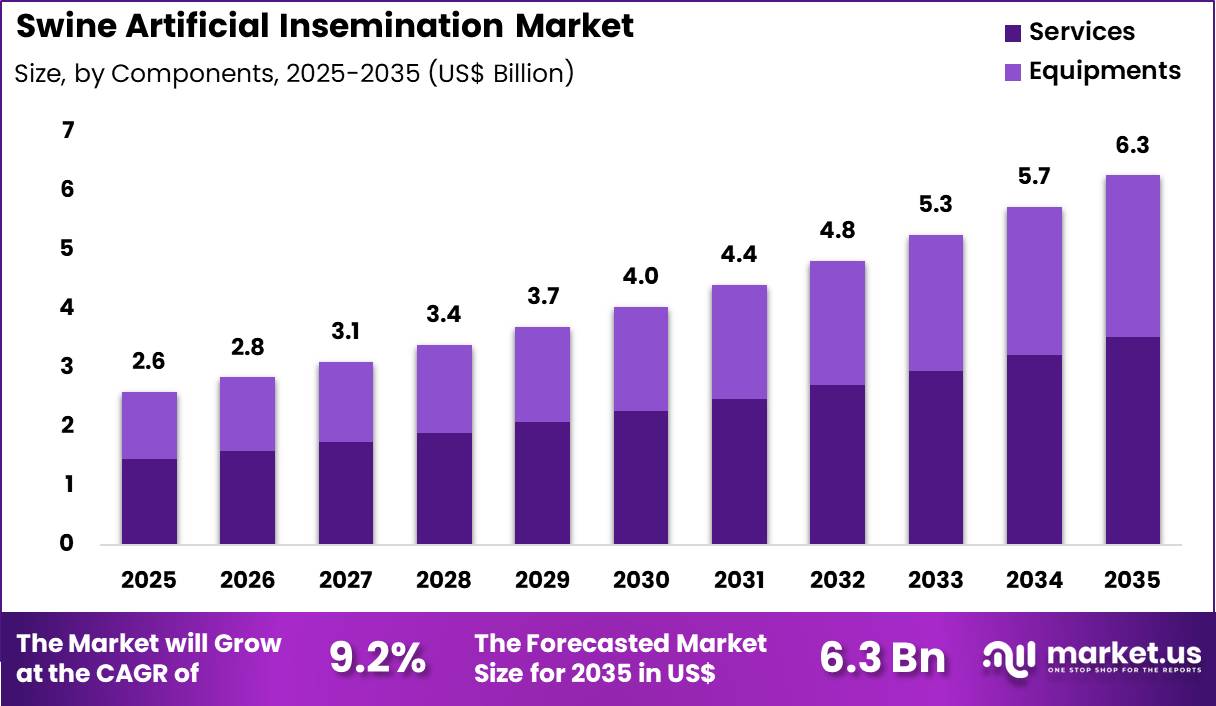
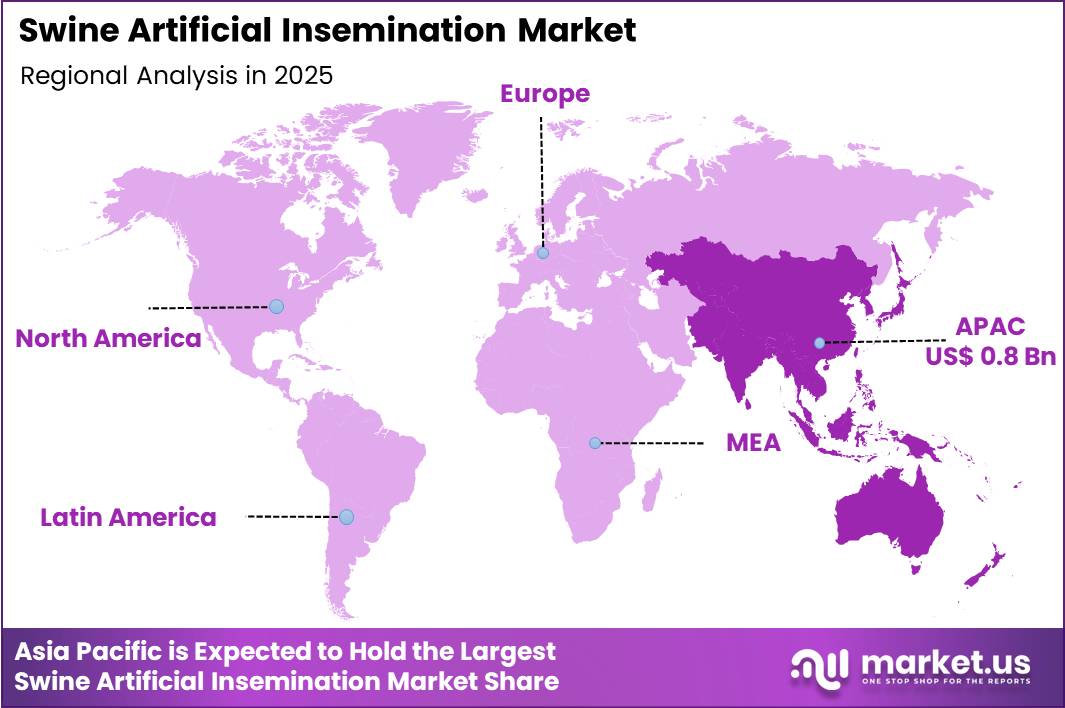
The Global Swine Artificial Insemination Market size is expected to be worth around US$ 6.3 Billion by 2035 from US$ 2.6 Billion in 2025, growing at a CAGR of 9.2% during the forecast period 2026-2035. In 2025, Asia Pacific led the market, achieving over 32.2% share with a revenue of US$ 0.8 Billion.
Increasing global demand for pork and the push for genetic improvement accelerate the swine artificial insemination market as producers adopt this technology to enhance herd performance, biosecurity, and reproductive efficiency.
Large-scale swine operations increasingly implement boar semen collection and distribution programs, enabling the use of superior genetics from elite sires to improve lean growth rate, feed conversion, and carcass quality across commercial sow herds.
These practices support timed artificial insemination protocols synchronized with estrus detection, optimizing conception rates and litter size uniformity in intensive farrow-to-finish systems. Producers apply deep intrauterine insemination techniques to reduce semen volume per dose, lowering costs while maintaining high fertility in hyper-prolific sows.
Artificial insemination also facilitates disease control by minimizing direct boar contact, preventing transmission of pathogens such as PRRS virus and Actinobacillus pleuropneumoniae in high-health status herds. Farm managers utilize frozen semen storage and thawing systems for strategic breeding, preserving valuable genetic lines and enabling crossbreeding programs that target specific market traits.
Manufacturers pursue opportunities to develop extended shelf-life semen extenders and automated insemination devices, expanding applications in small-to-medium farms transitioning from natural mating to controlled reproduction. Developers advance sex-sorted semen technologies that produce female-biased litters, broadening utility in gilt production and reducing surplus male piglets in welfare-focused operations.
These innovations support precision breeding platforms that integrate genomic selection with artificial insemination, accelerating genetic progress for disease resistance and meat quality. Opportunities emerge in portable, user-friendly insemination tools and real-time estrus detection sensors that improve timing accuracy and labor efficiency.
Companies invest in sustainable packaging and cold-chain logistics that maintain semen viability during transport to remote facilities. Recent trends emphasize biosecure, low-volume insemination methods and data-driven reproductive management, positioning the market for growth in efficient, health-focused swine production systems.
Key Takeaways
- In 2025, the market generated a revenue of US$ 2.6 Billion, with a CAGR of 9.2%, and is expected to reach US$ 6.3 Billion by the year 2035.
- The components segment is divided into services and equipments, with services taking the lead with a market share of 56.2%.
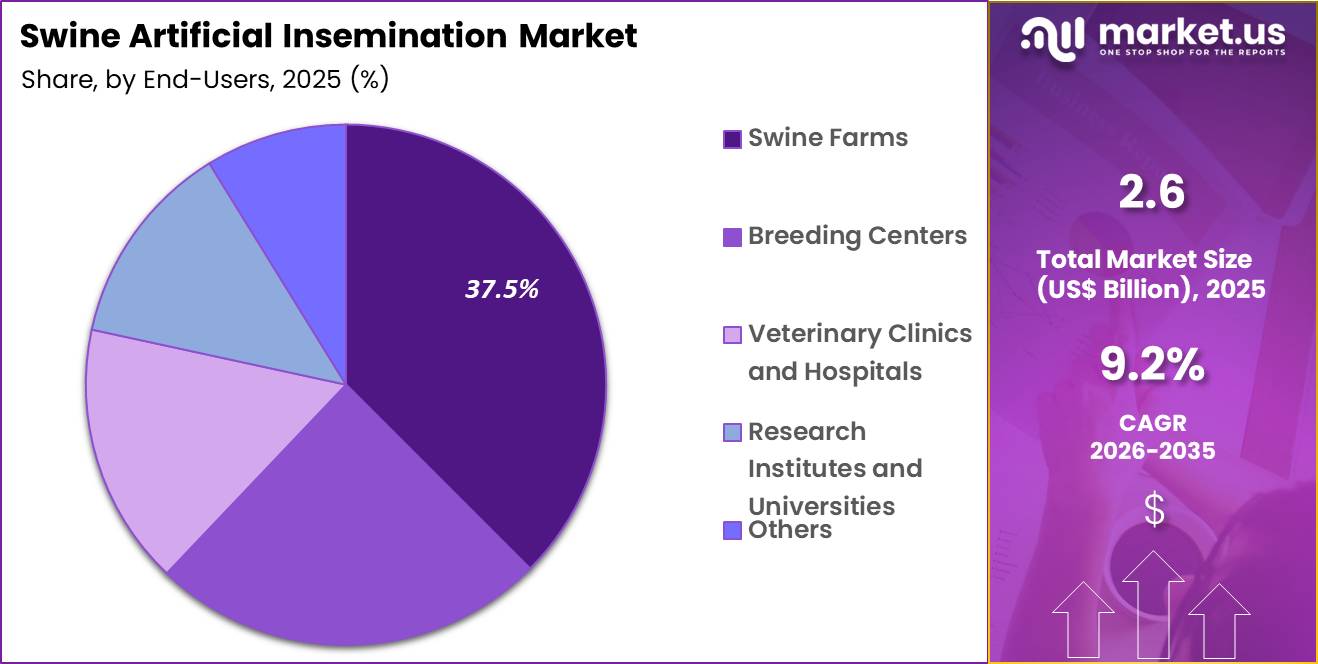
- Considering end users, the market is divided into swine farms, breeding centers, veterinary clinics and hospitals, research institutes and universities and others. Among these, swine farms held a significant share of 37.5%.
- Asia Pacific led the market by securing a market share of 32.2%.
Components Analysis
Services accounted for 56.2% of growth within components and dominate the swine artificial insemination market due to the increasing reliance on professional reproductive management programs across commercial pig farms. Farm operators increasingly seek expert semen collection, storage, processing, and insemination support to improve conception success rates.
Service providers offer specialized genetic selection and timing optimization that enhances breeding efficiency and litter size outcomes. Segment growth is expected to accelerate as large-scale swine producers adopt advanced breeding services to improve herd productivity and profitability.
Growing awareness regarding disease-free breeding practices supports service adoption across intensive farming operations. Reproductive management services assist in reducing breeding errors and improving pregnancy outcomes.
Integration of technical expertise with precision breeding tools strengthens farm-level productivity. Demand is anticipated to increase as farmers prioritize genetic improvement and efficient reproductive cycles. Commercial swine farms increasingly depend on outsourced insemination services to enhance operational consistency. Service-based models support faster adoption of standardized breeding protocols across global pork production systems.
End-User Analysis
Swine farms accounted for 37.5% of growth within end-users and dominate the swine artificial insemination market due to their direct involvement in large-scale pork production and herd expansion programs. Farmers increasingly adopt artificial insemination practices to improve genetic quality and reproductive efficiency within breeding populations.
Modern farms implement structured breeding schedules that enhance fertility outcomes and reduce dependency on natural mating. Segment growth is projected to strengthen as producers aim to improve litter uniformity and reduce breeding-related disease transmission risks.
Artificial insemination supports controlled genetic selection that improves meat yield and growth performance. Increasing global demand for pork products drives investment in advanced reproductive technologies at farm level. Swine farms adopt insemination programs to enhance productivity and optimize herd replacement rates.
Adoption is likely to increase as farms focus on improving breeding consistency and long-term production sustainability. Technological advancements in semen storage and handling further support on-site insemination practices across commercial swine operations.
Key Market Segments
By Components
- Services
- Equipments
- Insemination Catheters
- Semen and Extenders
- Collection and Processing Equipment
- Storage and Handling
- Others
By End Users
- Swine Farms
- Breeding Centers
- Veterinary Clinics and Hospitals
- Research Institutes and Universities
- Others
Drivers
Increasing swine herd size and breeding inventory is driving the market.
The expansion of commercial swine herds worldwide has substantially increased the utilization of artificial insemination techniques to achieve genetic improvement and higher litter sizes. Larger operations are prioritizing AI to maximize reproductive efficiency and reduce reliance on natural mating.
Producers are adopting AI to introduce superior genetics from elite boars without maintaining large boar populations on-site. The correlation between herd expansion and the need for controlled breeding programs further amplifies demand for insemination equipment and semen.
Government agricultural statistics reflect consistent growth in hog inventories, supporting broader AI adoption. Swine artificial insemination enables precise timing and higher conception rates compared to natural service. National livestock reports document the shift toward commercial-scale production requiring advanced reproductive technologies.
Key suppliers are developing improved extenders and catheters to support higher volumes. This driver encourages investment in semen processing and storage infrastructure. United States inventory of all hogs and pigs on December 1, 2024, was 75.8 million head, up 1 percent from December 1, 2023, with breeding inventory at 6.00 million head.
Restraints
New biosecurity regulations affecting semen transportation are restraining the market.
Recent regulatory changes in major producing regions have imposed stricter biosecurity requirements on the movement and importation of swine semen, complicating supply chains for artificial insemination. Producers and AI centers must comply with enhanced testing and documentation protocols, increasing operational complexity and costs.
International trade of semen doses faces longer approval timelines due to disease prevention measures. The correlation between regulatory stringency and delayed semen availability constrains timely breeding programs. Government veterinary authorities have tightened rules to prevent disease spread across borders.
Swine artificial insemination centers must invest in additional testing facilities to meet new standards. National biosecurity guidelines now require more rigorous certification for exported semen. Key stakeholders report logistical delays impacting breeding schedules.
This restraint limits flexibility in global semen distribution networks. New regulations on biosecurity in the European Union affecting the transportation of swine semen were introduced in November 2024.
Opportunities
Growth in commercial pig farming in Asia is creating growth opportunities.
The expansion of large-scale commercial pig operations in Asia presents significant potential for swine artificial insemination technologies to support genetic upgrading and productivity gains. Governmental policies promoting modern livestock farming encourage the adoption of AI in major pork-producing countries.
Increasing pork consumption in urban areas amplifies the need for efficient breeding methods in commercial herds. Partnerships with local producers facilitate introduction of imported semen and equipment. The large scale of pig farming in the region magnifies prospects for AI utilization in herd improvement programs.
Educational initiatives for farmers promote the benefits of artificial insemination for litter size and growth rates. This opportunity enables suppliers to establish regional distribution and technical support networks. Leading companies are adapting products for local breeds and production systems. Overall, Asian commercial farming growth aligns with efforts to meet rising protein demand sustainably
Impact of Macroeconomic / Geopolitical Factors
Macroeconomic conditions influence the swine artificial insemination market through feed costs, farm profitability, and investment in breeding efficiency. Inflation increases expenses for semen storage systems, laboratory consumables, and transport logistics, which raises operational costs for breeding centers.
Higher interest rates limit financing options for modern reproductive facilities and genetic improvement programs. Geopolitical tensions disrupt supplies of veterinary supplies, hormones, and cold chain equipment, creating sourcing challenges.
Current US tariffs on imported breeding tools and temperature control systems increase procurement costs and compress supplier margins. These pressures can slow technology adoption among smaller pork producers.
At the same time, producers invest in local genetic programs and improve breeding performance to maintain herd productivity. Growing focus on disease control and production efficiency continues to support stable long term market growth.
Latest Trends
Development of AI-driven fertility monitoring tools is a recent trend in the market.
In 2025, the integration of artificial intelligence tools for sow fertility monitoring has advanced timing accuracy and conception rates in commercial swine operations. These systems analyze behavioral and physiological data to predict optimal insemination windows. Producers have adopted sensor-based platforms for real-time estrus detection in group housing.
Clinical evaluations in 2025 confirmed higher farrowing rates with AI-supported breeding decisions. Verility Inc. launched Fertile-Eyez AI technology in April 2025 for improving sow conception with fewer inseminations. This development addresses challenges in large-scale herd management. The trend emphasizes data-driven breeding to reduce semen usage and labor costs.
Regulatory support for digital tools in livestock reproduction has accelerated adoption. Industry efforts optimize algorithms for diverse housing systems. These innovations aim to enhance reproductive efficiency while supporting sustainable pork production.
Regional Analysis
North America is leading the Swine Artificial Insemination Market
North America accounted for 32.2% of the Swine Artificial Insemination market in 2025, while Asia Pacific demonstrated strong expansion driven by industrial pork production and genetic improvement programs. Regional pork integrators have increased investments in reproductive technologies to enhance litter size and improve herd health outcomes.
China and Vietnam continue to modernize commercial pig farms with controlled breeding protocols following African Swine Fever recovery strategies. The Ministry of Agriculture and Rural Affairs of China reported in 2023 that the country’s pig inventory reached over 452 million heads, encouraging producers to adopt structured breeding methods for efficient herd management.
Large scale producers now utilize AI to maintain biosecurity while improving reproductive consistency. Rising feed costs have also pushed farmers to focus on productivity gains per sow. Expanding veterinary infrastructure across Southeast Asia supports improved semen handling and insemination practices. These developments continue to accelerate the adoption of controlled breeding solutions in commercial pork operations.
The Asia Pacific region is expected to experience the highest CAGR during the forecast period
Producers across North America will expand the use of advanced breeding technologies during the forecast period to improve genetic performance and maintain disease free herds. Commercial farms in the US and Canada are integrating data based estrus detection tools with reproductive planning systems to increase conception rates.
The US Department of Agriculture reported in 2024 that the country maintained over 74 million hogs and pigs in inventory, creating consistent demand for structured breeding programs. Farm operators now train staff to implement precision insemination schedules that reduce mating variability.
Technology suppliers also offer semen preservation systems that extend storage life and improve fertility outcomes. Integrated pork companies continue to invest in nucleus breeding centers to support herd uniformity. Growing demand for high quality pork products strengthens the focus on controlled reproductive practices. These ongoing improvements are expected to reinforce technology adoption across commercial swine farms.
Key Regions and Countries
North America
- US
- Canada
Europe
- Germany
- France
- The UK
- Spain
- Italy
- Russia
- Netherland
- Rest of Europe
Asia Pacific
- China
- Japan
- South Korea
- India
- Australia
- New Zealand
- Singapore
- Thailand
- Vietnam
- Rest of APAC
Latin America
- Brazil
- Mexico
- Rest of Latin America
Middle East & Africa
- South Africa
- Saudi Arabia
- UAE
- Rest of MEA
Key Players Analysis
Leading companies in the swine artificial insemination market drive growth by enhancing semen processing technologies, expanding genetic selection programs, and strengthening technical support services for commercial pig farms. They collaborate with large scale pork producers to improve reproductive efficiency and invest in disease resistant breeding lines that support consistent herd performance.
Firms also integrate digital fertility tracking tools with advisory solutions to help producers optimize conception rates and litter outcomes. For instance, Pig Improvement Company (PIC), founded in 1962 in Oxfordshire, England, operates as the pig genetics division of Genus plc and delivers advanced breeding stock and semen solutions across more than 30 countries.
The company builds its global presence through science led genetic improvement programs that support higher productivity in pork production systems. Through continued investment in genomic research and producer engagement platforms, PIC enables customers to improve breeding outcomes and long term farm profitability.
Top Key Players
- Genus Plc
- IMV Technologies
- Agtech, Inc.
- Neogen Corporation.
- GenePro, Inc.
- MINITÜB GMBH
- Swine Genetics International
- Semen Cardona S.L.
Recent Developments
- In the August of 2025, ICAR-KVK Wokha organized a three-day artificial insemination training program for 25 pig farmers across Nagaland. The sessions addressed reproductive practices, feed management, disease control, and small-scale enterprise development, supporting improved genetic outcomes and productivity in regional swine farming systems.
- In April 2025, Verility Inc. introduced its Fertile-Eyez AI platform to enhance sow conception efficiency. The technology is designed to reduce the number of insemination attempts, lower labor and semen usage, and maintain conception rates of up to 91%, enabling more precise breeding practices in commercial pig production.
Report Scope
Report Features Description Market Value (2025) US$ 2.6 Billion Forecast Revenue (2035) US$ 6.3 Billion CAGR (2026-2035) 9.2% Base Year for Estimation 2025 Historic Period 2020-2024 Forecast Period 2026-2035 Report Coverage Revenue Forecast, Market Dynamics, COVID-19 Impact, Competitive Landscape, Recent Developments Segments Covered By Components (Services and Equipments (Insemination Catheters, Semen and Extenders, Collection and Processing Equipment, Storage and Handling and Others)), By End Users (Swine Farms, Breeding Centers, Veterinary Clinics and Hospitals, Research Institutes and Universities and Others) Regional Analysis North America – US, Canada; Europe – Germany, France, The UK, Spain, Italy, Russia, Netherlands, Rest of Europe; Asia Pacific – China, Japan, South Korea, India, Australia, New Zealand, Singapore, Thailand, Vietnam, Rest of APAC; Latin America – Brazil, Mexico, Rest of Latin America; Middle East & Africa – South Africa, Saudi Arabia, UAE, Rest of MEA Competitive Landscape Genus Plc, IMV Technologies, Agtech, Inc., Neogen Corporation., GenePro, Inc., MINITÜB GMBH, Swine Genetics International, Semen. Customization Scope Customization for segments, region/country-level will be provided. Moreover, additional customization can be done based on the requirements. Purchase Options We have three licenses to opt for: Single User License, Multi-User License (Up to 5 Users), Corporate Use License (Unlimited User and Printable PDF)  Swine Artificial Insemination MarketPublished date: March 2026add_shopping_cartBuy Now get_appDownload Sample
 -
-
- Genus Plc
- IMV Technologies
- Agtech, Inc.
- Neogen Corporation.
- GenePro, Inc.
- MINITÜB GMBH
- Swine Genetics International
- Semen Cardona S.L.
Our Clients

- 180347
- March 2026






