Market Overview
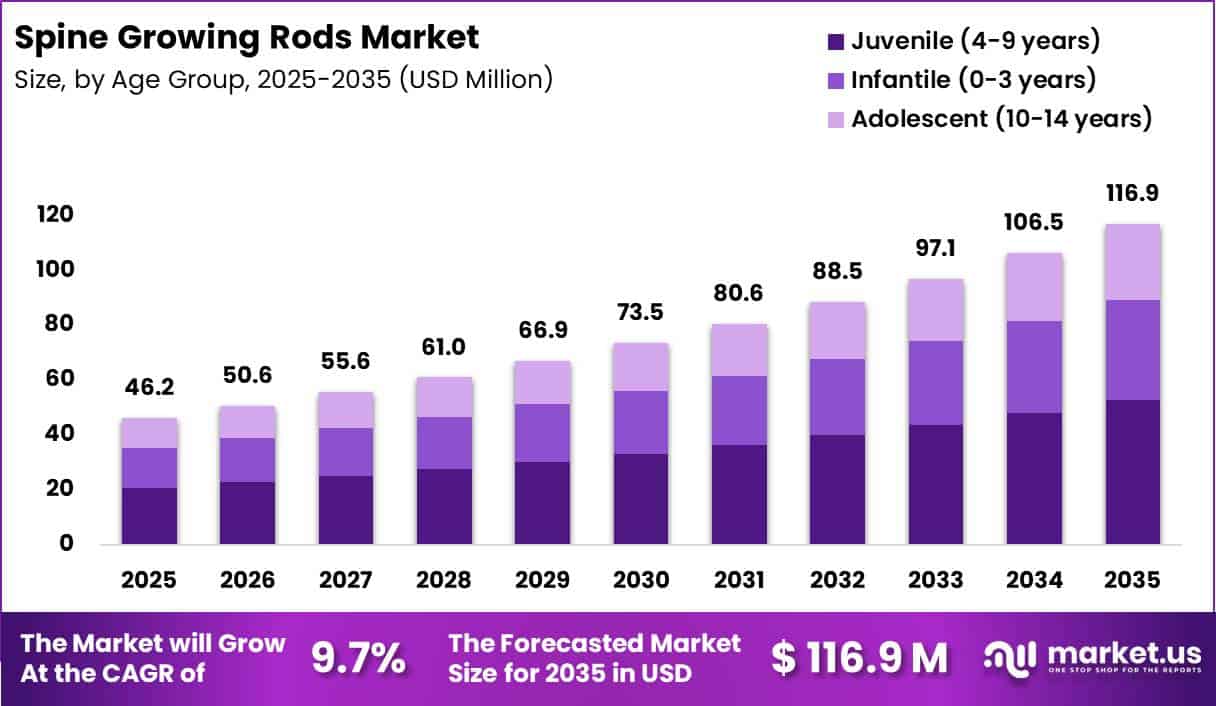
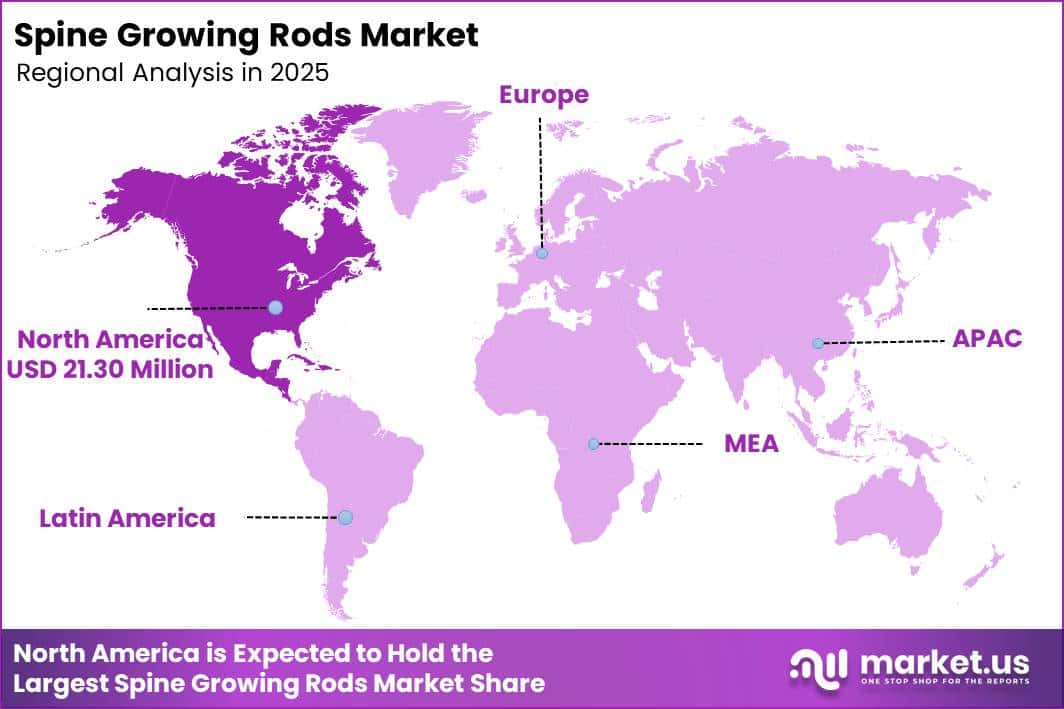
Global Spine Growing Rods Market size is expected to be worth around US$ 116.9 Million by 2035 from US$ 46.20 Million in 2025, growing at a CAGR of 9.7% during the forecast period from 2026 to 2035. In 2025, North America led the market, achieving over 46.15% share with a revenue of US$ 21.30 Million.
The global Spine Growing Rods Market is supported by the increasing clinical focus on treating early-onset scoliosis (EOS), a spinal deformity diagnosed before the age of 10 that can impair thoracic development and lung growth if left untreated. Healthcare systems are emphasizing early intervention to preserve spinal growth while minimizing long-term disability, creating sustained demand for growth-friendly spinal implants and advanced pediatric orthopedic procedures.
According to the U.S. National Library of Medicine (NCBI), early-onset scoliosis accounts for approximately 10% of all pediatric scoliosis cases, representing a complex patient population requiring specialized management. Progressive EOS can lead to thoracic insufficiency syndrome and restrictive lung disease, making timely diagnosis and treatment essential for maintaining respiratory development.
Growing rod systems have become an important treatment option because they help control spinal curvature while allowing continued spinal growth. Clinical evidence published through PubMed reported that, in a multicenter study of children with neurofibromatosis-associated EOS, growing rods achieved an average 51% correction of spinal curvature while supporting approximately 39 mm of spinal growth during follow-up.
Technological innovation is also reshaping pediatric spinal care. Research from the Pediatric Spine Study Group found that the adoption of magnetically controlled growing rods (MCGRs) increased dramatically, representing 83% of new growth-friendly implants during the final years of a decade-long analysis, reducing the need for repeated surgical lengthening procedures compared with traditional systems.
Regulatory support continues to encourage innovation in scoliosis treatment. In May 2023, the U.S. Food and Drug Administration (FDA) approved the REFLECT Scoliosis Correction System, expanding available treatment options for skeletally immature patients with idiopathic scoliosis and reinforcing continued investment in pediatric spinal technologies.
Key Takeaways
- Market Size : Spine Growing Rods Market size is expected to be worth around US$ 116.9 Million by 2035 from US$ 46.20 Million in 2025.
- Market Share : The market is growing at a CAGR of 9.7% during the forecast period from 2026 to 2035.
- Product Type Analysis : The Magnetically Controlled Growing Rods (MCGRs) segment dominated the Spine Growing Rods Market with a 62.5% share in 2025.
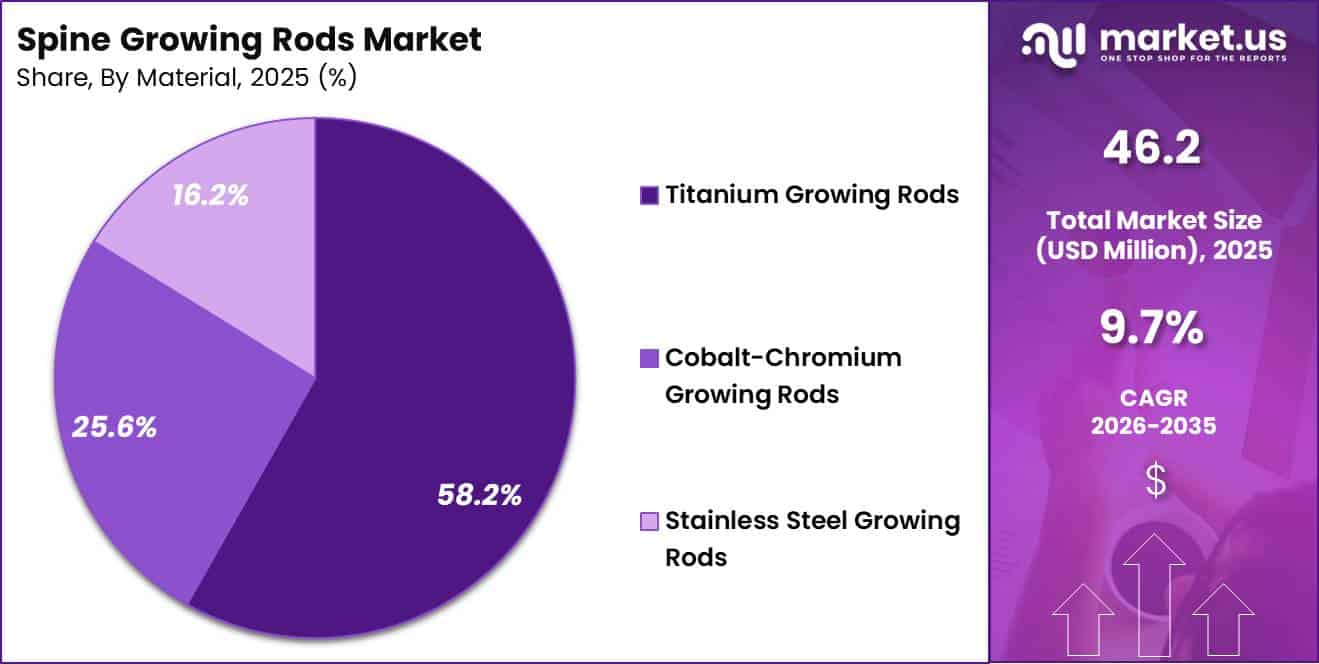
- Material Analysis : The Titanium Growing Rods segment accounted for the largest 58.2% market share in 2025.
- Age Group Analysis : The Juvenile (4–9 years) segment dominated the Spine Growing Rods Market with a 45.1% share in 2025.
- Application Analysis : The Early-Onset Scoliosis (EOS) segment held the leading 48.6% market share in 2025.
- End User Analysis : The Hospitals segment dominated the Spine Growing Rods Market with a 56.4% share in 2025.
- Regional Analysis : In 2025, North America led the market, achieving over 46.15% share with a revenue of US$ 21.30 Million.
Product Type Analysis
The Magnetically Controlled Growing Rods (MCGRs) segment dominated the Spine Growing Rods Market with a 62.5% share in 2025. The segment leads because it reduces the need for repeated surgical lengthening procedures, allowing surgeons to adjust the rods externally using a magnetic remote controller during outpatient visits. This approach lowers the number of surgeries, minimizes hospital stays, and reduces the physical and emotional burden on children and their families.
MCGRs also provide effective deformity correction while maintaining spinal growth, making them the preferred choice for treating early-onset scoliosis in many specialized pediatric spine centers. Continuous improvements in implant design and surgical techniques are further supporting adoption despite ongoing monitoring for device-related complications.
Traditional Growing Rods continue to hold a significant market share because they remain a well-established and clinically proven treatment option, particularly in healthcare facilities where magnetic systems are less accessible.
Although they require periodic surgical lengthening, they offer reliable long-term correction and remain widely used worldwide. Spring-Loaded Growing Rods represent an emerging segment, gaining attention for their ability to provide continuous distraction without repeated manual adjustments.
Ongoing clinical research and technological advancements are expected to improve their performance and increase their adoption over the coming years, particularly in advanced pediatric orthopedic centers.
Material Analysis
The Titanium Growing Rods segment accounted for the largest 58.2% market share in 2025. Titanium remains the preferred material because of its excellent biocompatibility, high strength-to-weight ratio, corrosion resistance, and compatibility with MRI imaging.
The material also supports long-term implantation while reducing the risk of adverse tissue reactions, making it highly suitable for pediatric patients who require implants over several years. Its durability and flexibility help maintain spinal stability while allowing controlled spinal growth, contributing to its widespread use in modern growing rod systems.
Cobalt-Chromium Growing Rods are increasingly used in patients requiring greater mechanical strength and stiffness, particularly in severe spinal deformities where stronger corrective forces are needed. These rods provide improved resistance to bending and fatigue under high mechanical loads.
Stainless Steel Growing Rods continue to serve a smaller portion of the market due to their affordability and acceptable mechanical performance. However, their comparatively higher weight and lower corrosion resistance have resulted in gradual preference shifting toward titanium-based systems in advanced healthcare facilities.
Age Group Analysis
The Juvenile (4–9 years) segment dominated the Spine Growing Rods Market with a 45.1% share in 2025. Children in this age group are commonly diagnosed with progressive early-onset scoliosis while still experiencing substantial spinal and thoracic growth.
Growing rod treatment during these years helps control curve progression, maintain spinal growth, and support normal lung development before definitive spinal fusion becomes necessary. Early surgical intervention in juvenile patients also improves long-term clinical outcomes and reduces the risk of severe deformity progression. These factors continue to make this age group the largest recipient of growth-friendly spinal implants.
The Infantile (0–3 years) segment represents an important but smaller market because treatment decisions are highly individualized, often beginning with casting or bracing before surgery is considered. Adolescent (10–14 years) patients also contribute significantly to market demand, particularly when scoliosis progresses despite conservative treatment or when children present with delayed diagnosis.
Growing rod systems continue to provide effective spinal correction while preserving remaining growth potential before final spinal fusion.
Application Analysis
The Early-Onset Scoliosis (EOS) segment held the leading 48.6% market share in 2025. EOS remains the primary indication for growing rod implantation because the condition develops before the age of 10 and can severely affect spinal alignment, chest development, and lung function if left untreated.
Growing rod systems are specifically designed to manage progressive spinal curvature while allowing continued spinal growth, making them the standard surgical treatment for many severe EOS cases. Increasing awareness, earlier diagnosis, and advances in growth-friendly surgical technologies continue to support the dominance of this segment.
Congenital Scoliosis also represents a notable segment, driven by vertebral malformations present at birth that often require early surgical management. Neuromuscular Scoliosis contributes steady demand due to spinal deformities associated with neurological disorders such as cerebral palsy and muscular dystrophy.
Syndromic Scoliosis includes patients with inherited disorders affecting spinal development, while the Others segment comprises less common pediatric spinal deformities requiring individualized treatment approaches.
End User Analysis
The Hospitals segment dominated the Spine Growing Rods Market with a 56.4% share in 2025. Hospitals remain the leading end users because growing rod implantation is a complex surgical procedure requiring advanced operating rooms, specialized pediatric orthopedic surgeons, multidisciplinary care teams, and comprehensive post-operative monitoring.
Large hospitals also provide imaging, rehabilitation, and long-term follow-up services needed throughout the patient’s growth period. Their access to advanced spinal technologies and experienced surgical teams continues to support the highest procedure volumes.
Specialty Orthopedic Centers are steadily expanding their role by providing dedicated pediatric spine services, experienced deformity surgeons, and personalized follow-up programs for children requiring repeated monitoring.
Ambulatory Surgical Centers (ASCs) currently account for a smaller share because most growing rod procedures involve complex pediatric cases requiring inpatient care. However, advances in minimally invasive techniques and improvements in perioperative management may gradually increase the role of ASCs for selected spinal procedures in the future.
Market Segmentations
By Product Type
- Traditional Growing Rods
- Magnetically Controlled Growing Rods
- Spring-Loaded Growing Rods
By Material
- Titanium Growing Rods
- Cobalt-Chromium Growing Rods
- Stainless Steel Growing Rods
By Age Group
- Infantile (0-3 years)
- Juvenile (4-9 years)
- Adolescent (10-14 years)
By Application
- Early-Onset Scoliosis
- Congenital Scoliosis
- Neuromuscular Scoliosis
- Syndromic Scoliosis
- Others
By End User
- Hospitals
- Specialty Orthopedic Centers
- Ambulatory Surgical Centers
Driver
Shift to magnetically controlled and spring-driven growth-friendly rod technologies
Technology transitions within spine growing rods from traditional mechanically lengthened constructs to magnetically controlled systems and continuous‑distraction spring implants are structurally altering unit economics, replacement cycles, and value capture per patient episode.
Magnetically controlled rods, such as those in the MAGnetic Expansion Control (MAGEC) system, allow external rod lengthening in clinic settings every three to six months without anesthesia, incisions, or hospital admission, effectively converting repeated operative lengthenings into ambulatory procedures.
Historically, children with traditional growing rods could require 2–3 surgical lengthenings per year until spinal maturity, implying more than 10 operations over a 4–5‑year treatment horizon; magnetically controlled rods and spring‑based systems aim to cut that number sharply, shifting cost from repeated OR usage toward higher‑value initial implants and in‑office adjustments.
The Spring Distraction System recently approved by the FDA uses a spring‑driven mechanism that continuously applies gentle force, supporting spinal growth without the need for repeated surgical revisions, which further reinforces the move away from episodic surgeries toward continuous biomechanical correction.
From a commercial standpoint, these innovations justify premium pricing per implant often 1.5–2.0x conventional rod price points while preserving overall episode‑of‑care savings for payers and hospitals through reduced anesthesia exposure and shorter inpatient stays.
Over a 2026–2030 horizon, technology replacement cycles as centers upgrade installed bases, coupled with surgeon preference consolidation around magnetically controlled and spring systems, can realistically add nearly 2 % points to the growth trajectory by elevating average selling prices and lengthening the revenue tail per child.
Strategically, vendors capturing this technology shift transition from selling commodity hardware to offering integrated growth‑friendly platforms , which resembles an outcome‑oriented service model and creates stickier relationships with high‑volume pediatric spine programs.
| Driver | (~) % Impact on CAGR Forecast | Geographic Relevance | Impact Timeline |
|---|---|---|---|
| Rising pediatric scoliosis burden and surgical eligibility expansion | +2.0% | North America core, EU, APAC corridors | Medium term (2–4 years) |
| Shift to magnetically controlled and spring-driven growth-friendly rod technologies | +1.8% | North America core, EU, selective APAC | Long term (≥ 4 years) |
| Breakthrough/FDA clearances and fast-track pathways for EOS implants | +1.5% | North America core, EU spill-over | Medium term (2–4 years) |
| Hospital focus on reducing repeat surgeries and total cost of care | +1.3% | North America core, EU, developed APAC | Short–Medium term (≤ 4 years) |
| Expansion of specialized pediatric spine centers and multidisciplinary programs | +1.0% | North America core, EU, China/India metros | Long term (≥ 4 years) |
| Increased awareness and earlier diagnosis of early-onset scoliosis | +0.8% | Global, with emphasis on urban APAC and Latin America | Short–Medium term (≤ 4 years) |
Challenge
Specialist Shortage Limiting Early-Onset Scoliosis Treatment Growth
Early-onset scoliosis with thoracic insufficiency risk remains a relatively rare but high-complexity condition, with congenital scoliosis incidence around 3 per 100,000 persons and only about 5–6% of such patients undergoing surgery within five years, resulting in a small but technically demanding surgical volume concentrated in tertiary centers.
Adolescent idiopathic scoliosis incidence of roughly 0.5% per year and prevalence in the 0.5–5% range generate broader deformity workload, yet only a fraction of these patients qualify for growth-friendly constructs, creating a narrow pipeline of surgeons and multidisciplinary teams with repeated, high-acuity growing rod experience.
As a result, many regions operate with only a handful of pediatric deformity surgeons capable of managing EOS growing rod programs, leading to center volumes of 200–300 pediatric spinal deformity cases annually but with EOS and complex growth-friendly implants representing perhaps 10–15% of that load, limiting experiential learning curves and slowing diffusion of best practices.
Talent bottlenecks manifest quantitatively in extended referral radii (often 200–500 km), patient migration to national reference centers, and capacity ceilings where adding even 20–30 extra EOS cases per year demands hiring additional highly trained staff, which can take 4–6 years of fellowship and post-fellowship experience to fully mature.
For manufacturers, this constrains the addressable install base and slows the ramp-up of new systems, effectively trimming around 0.8–1.0 % points from feasible CAGR as growth must align with the pace of specialist training, multidisciplinary team formation and infrastructure scaling.
Strategically, companies are compelled to support surgeon education, digital planning tools and remote proctoring, yet the inherently long training curve renders this a long-term mitigation challenge with persistent friction beyond 2029–2030.
| Challenge | (~) % CAGR Friction Drag | Geographic Relevance | Mitigation Horizon |
|---|---|---|---|
| High complication burden | -1.6% | North America, Western Europe, East Asia | Medium term (2–4 years) |
| OR resource intensity | -1.1% | OECD pediatric centers, urban Asia | Medium term (2–4 years) |
| Specialized talent bottleneck | -0.9% | Global tertiary spine hubs | Long term (≥ 4 years) |
| Regulatory and data demands | -0.8% | US, EU, UK, Japan | Medium term (2–4 years) |
| Technology transition pressure | -1.0% | North America, EU, selective APAC | Long term (≥ 4 years) |
| Supply chain precision needs | -0.7% | Global implant manufacturing clusters | Short term (≤ 2 years) |
Restraints
Heightened regulatory and safety scrutiny on growth-friendly systems
A second restraint stems from intensified regulatory and safety oversight directed at growth-friendly rod systems, especially magnetically controlled constructs, following adverse event clusters, safety communications, and device-specific recalls in the U.S. and Europe over the last decade.
Public FDA communications tied to mechanical failures, end-cap separation, and local tissue reactions in certain magnetically controlled rod families have introduced an additional layer of mandated post-market surveillance, more stringent mechanical and biocompatibility testing, and detailed manufacturer reporting obligations, effectively adding 12–24 months to the lifecycle from concept to widespread clinical adoption for new designs.
Each new device iteration now faces higher premarket evidence expectations, including multi-year follow-up cohorts and fatigue testing up to several million cycles, which raises R&D and regulatory costs per product by an estimated 20–30% and pushes break-even volumes higher, discouraging smaller innovators from entering the market.
On the provider side, risk committees responding to safety alerts can temporarily freeze implantation of affected systems or cap case volumes to 50–70% of prior run-rates until additional data are available, creating 1–2 year demand troughs in specific geographies and shifting procedures back to traditional techniques that blunt value messaging around fewer surgeries and better growth preservation.
This prudential drag, combined with periodic negative media coverage around pediatric implant safety, is modeled to trim roughly 1.7 % points from medium-term CAGR potential by delaying replacement cycles, slowing upgrades to advanced rod platforms, and forcing companies to reallocate capital from commercialization to compliance-heavy testing and documentation.
| Restraint | (~) % Impact on CAGR Forecast | Geographic Relevance | Impact Timeline |
|---|---|---|---|
| High complication and revision burden | -2.3% | North America core, EU, selective APAC | Medium term (2-4 years) |
| Heightened regulatory and safety scrutiny on growth-friendly systems | -1.7% | U.S., EU, U.K. | Medium term (2-4 years) |
| Peri-operative cost inflation and constrained pediatric OR capacity | -1.5% | North America, Western Europe | Short to medium term (≤ 4 years) |
| Limited specialist surgeon base and learning-curve risk | -1.3% | Emerging APAC, LATAM, Middle East | Long term (≥ 4 years) |
| Reimbursement friction and value-assessment pushback | -1.4% | U.S. commercial, EU payers | Medium to long term (≥ 3 years) |
| Supply chain fragility for advanced rod systems and implants | -0.8% | Global, with APAC-centric manufacturing corridors | Short term (≤ 2 years) |
Opportunity
Emerging Market Access Expanding Spine Growing Rod Adoption
Spine growing rod adoption in low- and middle-income countries remains low relative to estimated EOS and pediatric deformity burden, driven by scarcity of specialized centers, high upfront implant cost, and infrastructure limitations that impede repeated lengthening procedures and advanced imaging, even though severe, progressive curves and thoracic insufficiency carry high mortality and morbidity.
Emerging markets in APAC, Latin America, and parts of the Middle East and Africa collectively represent millions of children where progressive deformities are either untreated or managed with late-stage fusion, constraining the baseline global market despite a significant uncaptured TAM; for example, converting even 5–10% of currently unmanaged severe cases into growth-friendly pathways would translate into thousands of additional procedures per year by the early 2030s.
A strategic opportunity lies in designing tiered access models with lower-cost rod constructs, standardized training packages, and regional centers-of-excellence that pool expertise, supported by staggered payment schemes or international donor and government co-funding, thereby reducing device and care pathway cost per patient by 30–40% while still preserving acceptable margins through volume scaling and simplified product portfolios.
These models could include “good-better-best” implant tiers matched to infrastructure readiness, along with tele-mentoring for surgeons, enabling manufacturers to expand their SOM into underpenetrated geographies without compromising safety; because baseline forecasts typically assume only gradual EM adoption, aggressive execution on tiered access could lift global CAGR by about 2.0 % points, with revenue mix shifting toward high-volume, lower ASP markets over a 10-year horizon.
| Opportunity | (~) % Potential CAGR Upside | Geographic Relevance | Execution Window |
|---|---|---|---|
| AI-personalized EOS care platforms | +2.5% | North America core, EU, APAC tier-1 | Medium term (2–4 years) |
| Remote-adjustable hybrid rods & home monitoring bundles | +2.2% | North America, EU, East Asia | Short–medium term (≤ 4 years) |
| Value-based pediatric spine bundles with payers | +1.9% | US, EU5, advanced LATAM | Medium term (2–4 years) |
| Tiered access models for underpenetrated EMs | +2.0% | APAC emerging, MEA, LATAM | Long term (≥ 4 years) |
| Data-driven post-market registries & IP monetization | +1.6% | Global centers of excellence | Medium–long term (2–5 years) |
| Adjacent thoracic growth & smart implant ecosystem | +2.8% | North America, EU, Japan | Long term (≥ 4 years) |
Regional Analysis
In 2025, North America dominated the Spine Growing Rods Market, accounting for over 46.15% of global revenue, equivalent to approximately US$ 21.30 million. The region’s leadership is supported by advanced pediatric orthopedic centers, widespread availability of specialized spine surgeons, and early adoption of growth-friendly spinal technologies for treating early-onset scoliosis (EOS).
The United States continues to be the largest contributor owing to favorable reimbursement systems, strong regulatory support from the U.S. Food and Drug Administration (FDA), and the presence of leading children’s hospitals that routinely perform growing rod procedures.
In addition, organizations such as the American Academy of Orthopaedic Surgeons (AAOS) recommend growing rod treatment for young children with progressive scoliosis to preserve spinal and lung development, further strengthening clinical adoption.
Europe represents the second-largest regional market, driven by well-established public healthcare systems, increasing awareness of early scoliosis diagnosis, and expanding use of magnetically controlled growing rods (MCGRs).
Countries including Germany, France, the United Kingdom, and Italy continue to invest in pediatric orthopedic care, while European clinical guidelines emphasize growth-preserving surgical techniques for children with severe spinal deformities. Ongoing multicenter research and collaborations across European spine societies further support innovation and treatment standardization.
The Asia-Pacific region is expected to witness the fastest growth during the forecast period due to its large pediatric population, improving healthcare infrastructure, rising healthcare expenditure, and expanding access to specialized spinal surgery in countries such as China, Japan, India, and South Korea.
Meanwhile, Latin America and the Middle East & Africa are gradually expanding their market presence through investments in pediatric healthcare services, improved orthopedic training programs, and increasing adoption of advanced spinal implants as access to specialized scoliosis treatment continues to improve.
Key Regions and Countries
North America
- The US
- Canada
Europe
- Germany
- France
- The U.K.
- Italy
- Spain
- Russia & CIS
- Rest of Europe
Asia Pacific
- China
- India
- Japan
- South Korea
- ASEAN
- Australia & New Zealand
- Rest of Asia Pacific
Middle East & Africa
- GCC
- South Africa
- Rest of Middle East & Africa
Latin America
- Brazil
- Mexico
- Rest of Latin America
Key Player Analysis
The Spine Growing Rods Market is moderately competitive, with leading medical device companies focusing on innovation, pediatric spine care, and surgeon-friendly technologies. Medtronic plc maintains a strong position through its broad spinal implant portfolio, navigation technologies, and continuous investment in spine surgery solutions.
Johnson & Johnson (DePuy Synthes) offers an extensive range of spinal implants, deformity correction systems, and enabling technologies that strengthen its presence in pediatric and adult spine procedures. Zimmer Biomet Holdings Inc. continues to expand its spine business by providing advanced fixation systems and biologic solutions for complex spinal disorders.
Stryker Corporation enhances its market position through minimally invasive spine technologies and innovative interventional spine products designed to improve surgical outcomes.
NuVasive Inc., now part of Globus Medical Inc., has strengthened its capabilities in spine surgery by combining expertise in procedural innovation, navigation, and comprehensive implant technologies. Orthofix Medical Inc. focuses on reconstructive spinal solutions, biologics, and bone growth therapies that support complex spinal procedures.
Alphatec Holdings Inc. continues to invest in advanced spinal fixation systems and procedural technologies to improve clinical efficiency. B. Braun Melsungen AG, through its Aesculap division, offers a broad portfolio of spinal implants and surgical instruments, supporting hospitals with high-quality orthopedic and neurosurgical solutions.
Together, these companies continue to drive product innovation, strategic collaborations, and global expansion, supporting the long-term growth of the Spine Growing Rods Market.
Top Key Players
- Medtronic plc
- Johnson & Johnson (DePuy Synthes)
- Zimmer Biomet Holdings Inc.
- Stryker Corporation
- NuVasive Inc.
- Globus Medical Inc.
- Orthofix Medical Inc.
- Alphatec Holdings Inc.
- B. Braun Melsungen AG
- SpineGuard S.A.
- SeaSpine Holdings Corporation
- Paradigm Spine GmbH
- RTI Surgical Holdings Inc.
- Wright Medical Group N.V.
- Precision Spine Inc.
- Others
Recent Developments
- In July 2026 – Johnson & Johnson (DePuy Synthes) acquired Expanding Innovations, Inc. in the U.S. to strengthen its spine portfolio with expandable interbody cage technology.
- In June 2026 – Medtronic plc launched the GAiTEWAY™ software platform, expanding its AI-enabled AiBLE™ ecosystem for spine surgery across North America.
- In April 2026 – Medtronic plc completed the first clinical cases using the Stealth AXiS™ Surgical System, demonstrating its integrated navigation and imaging platform for spine and cranial procedures.
Report Scope
| Report Features | Description |
|---|---|
| Market Value (2025) | US$ 46.20 Million |
| Forecast Revenue (2035) | US$ 116.9 Million |
| CAGR (2026-2035) | 9.7% |
| Base Year for Estimation | 2025 |
| Historic Period | 2020-2024 |
| Forecast Period | 2026-2035 |
| Report Coverage | Revenue Forecast, Market Dynamics, Competitive Landscape, Recent Developments |
| Segments Covered | By Product Type (Traditional Growing Rods, Magnetically Controlled Growing Rods, Spring-Loaded Growing Rods), By Material (Titanium Growing Rods, Cobalt-Chromium Growing Rods, Stainless Steel Growing Rods), By Age Group (Infantile (0-3 years), Juvenile (4-9 years), Adolescent (10-14 years)), By Application (Early-Onset Scoliosis, Congenital Scoliosis, Neuromuscular Scoliosis, Syndromic Scoliosis, Others), By End User (Hospitals, Specialty Orthopedic Centers, Ambulatory Surgical Centers) |
| Regional Analysis | North America – The US, Canada; Europe – Germany, France, U.K., Italy, Spain, Russia & CIS, Rest of Europe; Asia Pacific – China, India, Japan, South Korea, ASEAN, Australia & New Zealand, Rest of Asia Pacific; Middle East & Africa – GCC, South Africa, Rest of Middle East & Africa; Latin America – Brazil, Mexico, Rest of Latin America |
| Competitive Landscape | Medtronic plc, Johnson & Johnson (DePuy Synthes), Zimmer Biomet Holdings Inc., Stryker Corporation, NuVasive Inc., Globus Medical Inc., Orthofix Medical Inc., Alphatec Holdings Inc., B. Braun Melsungen AG, SpineGuard S.A., SeaSpine Holdings Corporation, Paradigm Spine GmbH, RTI Surgical Holdings Inc., Wright Medical Group N.V., Precision Spine Inc., Others |
| Customization Scope | Customization for segments, region/country-level will be provided. Moreover, additional customization can be done based on the requirements. |
| Purchase Options | We have three licenses to opt for: Single User License, Multi-User License (Up to 5 Users), Corporate Use License (Unlimited User and Printable PDF) |