


Global Smart Harvest Market Size, Share Analysis Report By Component (Hardware, Software, Services), By Technology (Robotic Automation Systems, Machine Vision and Imaging, Autonomous Navigation, Cloud and Edge Data Analytics), By Crop Type (Fruits, Vegetables, Nuts, Others), By Farm Environment (Greenhouses, Open Fields) , By Region and Companies - Industry Segment Outlook, Market Assessment, Competition Scenario, Trends and Forecast 2026-2035
- Published date: Mar 2026
- Report ID: 181030
- Number of Pages: 266
- Format:
-
keyboard_arrow_up
Quick Navigation
Report Overview
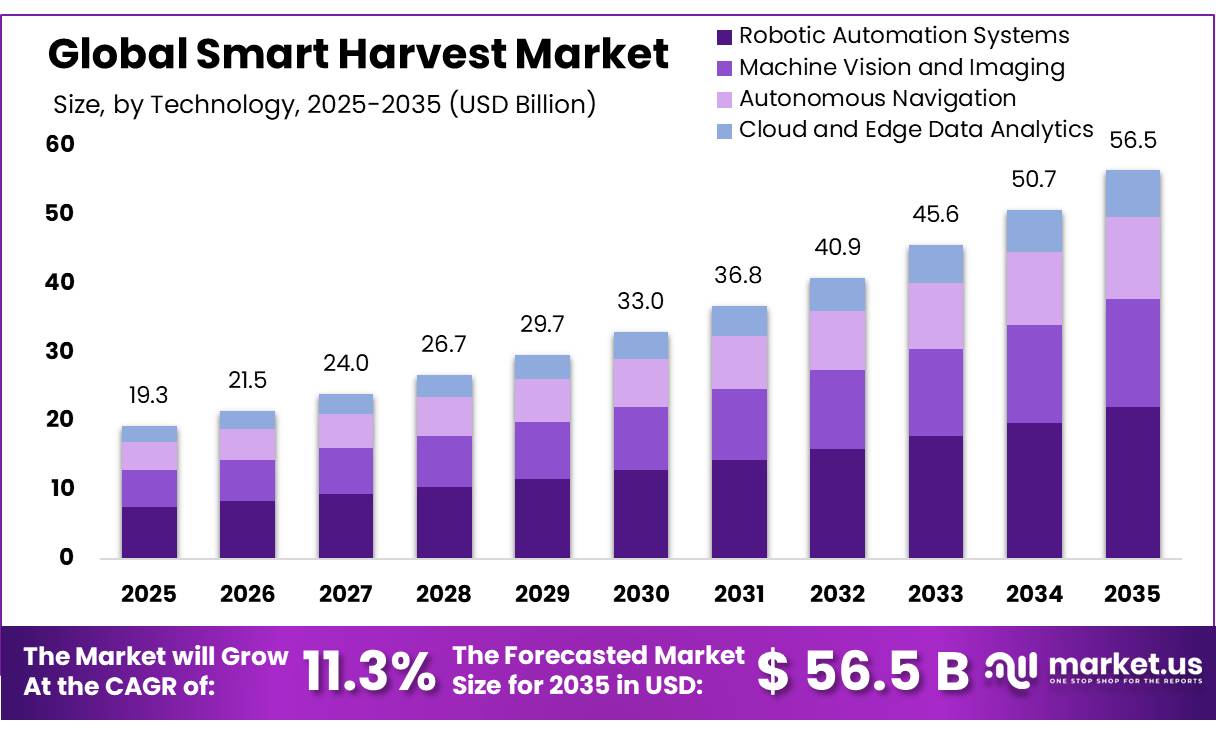
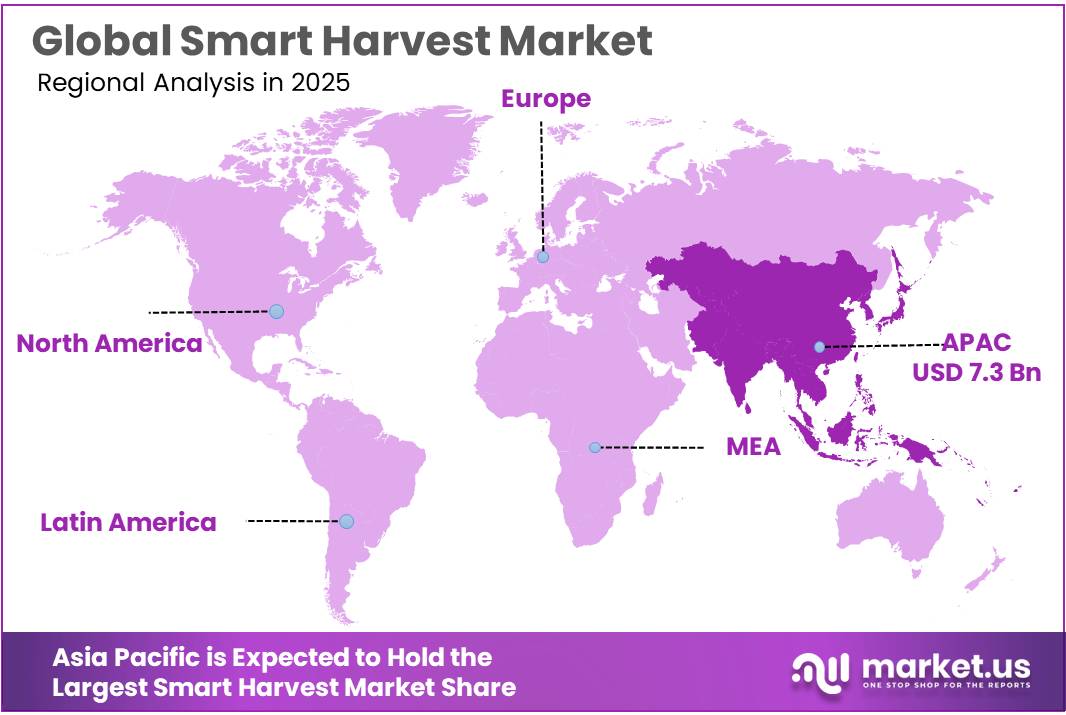
The Global Smart Harvest Market size is expected to be worth around USD 56.5 Billion by 2035, from USD 19.3 Billion in 2025, growing at a CAGR of 11.3% during the forecast period from 2026 to 2035. In 2025, Asia Pacific held a dominant market position, capturing more than a 38.2% share, holding USD 7.3 billion revenue.
Smart Harvest can be positioned as the technology-led modernization of crop harvesting and immediate post-harvest handling, combining sensors, AI, robotics, drones, machine vision, yield estimation, farm software, and connected equipment to improve picking accuracy, reduce crop loss, and raise labor productivity. Its industrial relevance is strengthening because the structural pressures on agriculture are intensifying.
- The United Nations projects the global population to reach around 9.7 billion by 2050, while FAO states that agriculture already accounts for about 70% of global freshwater withdrawals. At the same time, FAO reports that 13.2% of food is lost in the supply chain after harvest on farms and before retail, and food lost before retail is valued at roughly USD 400 billion globally.
In parallel, the production base remains highly fragmented: FAO estimates there are about 570 million farms worldwide, more than 90% of which are family farms, and these farms produce over 80% of the world’s food in value terms. This combination of rising food demand, tight water availability, post-harvest inefficiency, and fragmented production makes Smart Harvest solutions increasingly important for both commercial agribusinesses and smallholder-linked value chains.
The current industrial scenario is shaped by operational pressure across harvesting windows, labor productivity, and loss control. FAO states that 13.2% of food is lost in the supply chain from post-harvest up to, but not including, retail, showing why harvest timing, sorting, and on-farm handling technologies are becoming commercially relevant. FAO also notes that households, food service, and retail generated 1.05 billion tonnes of food waste in 2022, equal to 132 kg per capita, which strengthens the case for upstream intelligence that can improve quality consistency before produce enters downstream channels.
The main demand drivers are resource pressure and the need for higher output from existing land and water systems. The World Bank notes that agriculture uses about 70% of global freshwater withdrawals, and it also highlights that feeding around 9 billion people by 2050 may require a 50% increase in agricultural production and a 15% rise in water withdrawals if efficiency does not improve. This makes smart harvest systems attractive because they do not only target labor substitution; they also support better maturity detection, selective picking, lower field losses, and improved harvest planning in water-stressed environments.
Technology validation is also improving. USDA reported in its FY2024 Annual Performance Report that a dual-arm robotic apple harvesting system improved efficiency by up to 34%, pointing to growing commercial viability in specialty crops. In addition, USDA NIFA highlighted a 12-armed apple robot with 100% canopy apple-detection accuracy and about 70% picking success, while a targeted shake-and-catch system achieved a 90% fruit-picking rate with roughly 10% fruit damage. These metrics suggest that the industry is moving from concept-stage automation toward practical deployment in labor-intensive fruit and horticulture segments.
Key Takeaways
- Smart Harvest Market size is expected to be worth around USD 56.5 Billion by 2035, from USD 19.3 Billion in 2025, growing at a CAGR of 11.3%.
- Hardware held a dominant market position, capturing more than a 52.8% share of the Smart Harvest market.
- Robotic Automation Systems held a dominant market position, capturing more than a 39.6% share.
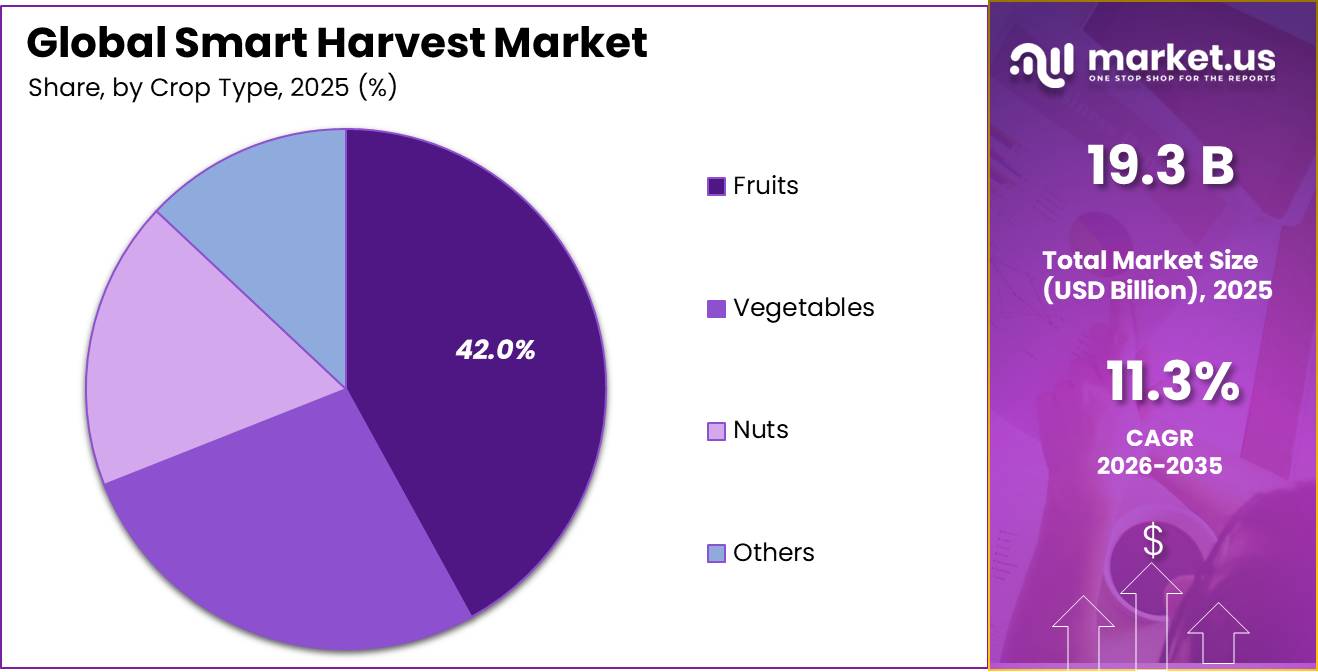
- Fruits held a dominant market position, capturing more than a 42.5% share of the Smart Harvest market.
- Open Fields held a dominant market position, capturing more than a 69.7% share of the Smart Harvest market.
- Asia Pacific emerged as the dominating region in the Smart Harvest market, accounting for about 38.2% share with a market value of nearly USD 7.3 Bn.
By Component Analysis
Hardware dominates with 52.8% share driven by rising adoption of smart farm equipment
In 2024, Hardware held a dominant market position, capturing more than a 52.8% share of the Smart Harvest market. This strong position is mainly linked to the growing use of physical agricultural technologies such as sensors, cameras, robotic harvesters, GPS-enabled machinery, drones, and automated sorting systems used directly in the harvesting process. Farmers and agribusiness operators are increasingly investing in these hardware components because they play a direct role in improving harvesting efficiency, crop detection accuracy, and field productivity.
By Technology Analysis
Robotic Automation Systems lead with 39.6% share as farms shift toward automated harvesting
In 2024, Robotic Automation Systems held a dominant market position, capturing more than a 39.6% share of the Smart Harvest market. The strong presence of this segment is largely driven by the growing need to automate labor-intensive harvesting tasks. Agricultural producers are increasingly adopting robotic technologies that can identify ripe crops, pick them carefully, and sort them during the harvesting process. These robotic systems are particularly useful in fruit and vegetable farming where harvesting requires precision and careful handling to maintain product quality.
By Crop Type Analysis
Fruits dominate with 42.5% share as precision harvesting becomes essential for delicate produce
In 2024, Fruits held a dominant market position, capturing more than a 42.5% share of the Smart Harvest market. This strong share is mainly linked to the delicate nature of fruit crops, which require careful handling during harvesting. Unlike many other crops, fruits such as apples, berries, grapes, and citrus are highly sensitive to bruising and damage. Because of this, growers are increasingly turning to smart harvesting technologies that can identify ripe fruits and pick them gently using advanced sensors, cameras, and automated harvesting equipment.
By Farm Environment Analysis
Open Fields lead with 69.7% share due to large-scale crop cultivation and wider technology adoption
In 2024, Open Fields held a dominant market position, capturing more than a 69.7% share of the Smart Harvest market. This strong share is mainly due to the vast amount of global agricultural land used for field-based farming. Crops such as grains, vegetables, fruits, and oilseeds are commonly grown in open field environments, making them the primary area where smart harvesting technologies are applied. Farmers operating large farms are increasingly adopting advanced harvesting tools such as GPS-guided harvesters, field sensors, drones, and automated machinery to improve harvesting efficiency and manage large cultivation areas more effectively.
Key Market Segments
By Component
- Hardware
- Software
- Services
By Technology
- Robotic Automation Systems
- Machine Vision and Imaging
- Autonomous Navigation
- Cloud and Edge Data Analytics
By Crop Type
- Fruits
- Vegetables
- Nuts
- Others
By Farm Environment
- Greenhouses
- Open Fields
Emerging Trends
Rising Adoption of Agricultural Robotics and Automation in Harvesting
One of the most noticeable trends shaping the Smart Harvest market today is the rapid adoption of robotics and automation in agricultural harvesting activities. Farmers across many regions are increasingly using robots, sensors, and automated equipment to manage harvesting tasks more efficiently. According to the Food and Agriculture Organization (FAO), digital automation technologies and robotics are becoming important tools for modern farming because they help improve the precision of agricultural operations and reduce the need for intensive manual labor.
The shift toward robotics is also linked to the growing need to increase agricultural productivity. Global food demand continues to rise as the population expands. FAO estimates suggest that global food demand could increase by about 60% by 2050, which means agricultural systems must produce significantly more food while dealing with limited land and environmental challenges. In response, many farms are adopting digital tools, artificial intelligence systems, and automated harvesting machines to improve productivity and reduce crop losses.
Another important development is the rise of digital agriculture platforms that integrate farm data with harvesting technologies. These platforms combine satellite imagery, sensor networks, and farm management software to provide real-time insights into crop conditions. With this information, farmers can plan harvesting schedules more accurately and improve decision-making. According to FAO innovation discussions, farmers in many regions are already adopting digital tools such as artificial intelligence, blockchain, and precision farming technologies to transform how food is produced and harvested.
Drivers
Rising Food Loss and Post-Harvest Inefficiency Driving Smart Harvest Adoption
- According to the Food and Agriculture Organization (FAO) and the United Nations Environment Programme (UNEP), about 13.2% of food produced globally is lost between harvest and retail stages because of poor harvesting practices, inadequate infrastructure, and inefficient supply chains. This loss occurs mainly during harvesting, on-farm handling, transportation, and storage before products reach markets.
The scale of food loss highlights a serious challenge for global agriculture. FAO estimates show that roughly 13.3% of global food production is lost after harvest and before retail, which equals more than 1.31 billion tonnes of food annually. Such large losses create economic pressure on farmers and reduce the availability of food supplies worldwide. When crops are harvested too early, too late, or handled incorrectly, their quality declines, leading to waste before they even reach consumers. Smart harvesting technologies are designed to address this problem by improving crop detection, harvest timing, and precision picking.
Food losses are especially severe in perishable products such as fruits and vegetables. Studies indicate that around 25% to 50% of fruits and vegetables can be lost after harvest due to improper harvesting methods, handling damage, and limited storage capacity. These crops are highly sensitive and require careful harvesting and handling processes to maintain freshness and market quality. Smart harvest systems equipped with sensors, machine vision, and automated picking equipment help reduce such losses by ensuring crops are harvested at the correct maturity stage and handled carefully during collection.
The issue of food loss also directly impacts global food security. According to FAO projections, the global population is expected to reach nearly 9.7 billion by 2050, which will require agriculture to produce about 50% more food compared to 2012 levels to meet future demand. However, expanding farmland is becoming increasingly difficult due to limited natural resources and environmental concerns. As a result, improving efficiency in existing agricultural systems has become essential.
Restraints
High Technology Cost and Limited Access for Small Farmers
The global farming structure itself highlights this challenge. According to the Food and Agriculture Organization (FAO), there are more than 570 million farms worldwide, and a very large portion of them operate on small land areas. In fact, about 84% of the world’s farms are smaller than 2 hectares, meaning they are smallholder farms with limited financial capacity to invest in advanced agricultural equipment. These farms collectively operate only about 12% of the world’s agricultural land, yet they play a crucial role in food production and rural livelihoods. Because most of these farmers operate on tight budgets, purchasing smart harvesting machines or digital farming technologies is often financially difficult.
Another challenge comes from the overall structure of global agriculture. Small farms are extremely common and important to food supply. Research shows that farms smaller than 2 hectares produce roughly 35% of the world’s food, despite having limited land and financial resources. This means a significant portion of global food production still comes from farmers who may not have the financial capability to adopt advanced technologies such as automated harvesters or AI-based crop monitoring systems. As long as these farmers face financial barriers, the large-scale adoption of smart harvesting solutions will remain limited in many regions.
Governments and international organizations are aware of this challenge and are working to support farmers through modernization programs. Several countries have introduced agricultural mechanization schemes, digital farming initiatives, and rural credit programs aimed at improving farmers’ access to new technologies. For example, international organizations such as the FAO and the United Nations Development Programme (UNDP) have launched projects that promote precision agriculture and digital farming tools for smallholder farmers, focusing on improving productivity while reducing operational costs. These programs often provide training, financial assistance, and technical support to help farmers gradually adopt new technologies.
Opportunity
Growing Global Food Demand Creating Opportunities for Smart Harvest Technologies
One of the strongest growth opportunities for the Smart Harvest market comes from the rapidly increasing global demand for food. As the world population continues to grow, agricultural systems are under pressure to produce more food using limited land and natural resources. According to the Food and Agriculture Organization (FAO), the global population is expected to reach around 9.7 billion people by 2050, which will significantly increase the demand for food products worldwide.
With this population growth, agriculture will need to expand its productivity. FAO projections indicate that global agriculture must produce about 50% more food by 2050 compared to 2012 levels in order to meet rising food demand. In some long-term projections, experts even suggest that food production may need to increase by around 60–70% to support the growing population and changing dietary patterns.
Governments around the world are also encouraging the adoption of digital agriculture and smart farming technologies. For example, India launched the Digital Agriculture Mission, which aims to build a digital public infrastructure for agriculture using systems such as AgriStack and the Krishi Decision Support System. These initiatives focus on collecting farm data, improving crop monitoring, and supporting farmers with technology-based decision tools.
Regional Insights
Asia Pacific dominates the Smart Harvest market with 38.2% share, valued at about USD 7.3 Bn
Asia Pacific emerged as the dominating region in the Smart Harvest market, accounting for about 38.2% share with a market value of nearly USD 7.3 Bn. The region’s strong position is mainly supported by its vast agricultural base, large farming population, and increasing adoption of modern agricultural technologies. Countries such as China, India, Japan, South Korea, and Australia play a significant role in driving the regional market as they invest in agricultural automation, precision farming, and digital technologies to improve productivity and reduce crop losses.
Agriculture remains a critical sector across Asia Pacific economies. According to FAO statistics, the region produces a significant portion of the world’s crops and livestock, contributing heavily to global food supply chains. Global crop production reached about 9.9 billion tonnes in 2023, with Asian countries contributing a large share due to their extensive cultivation areas and large farming populations.
Key Regions and Countries Insights
- North America
- US
- Canada
- Europe
- Germany
- France
- The UK
- Spain
- Italy
- Rest of Europe
- Asia Pacific
- China
- Japan
- South Korea
- India
- Australia
- Rest of APAC
- Latin America
- Brazil
- Mexico
- Rest of Latin America
- Middle East & Africa
- GCC
- South Africa
- Rest of MEA
Key Players Analysis
Deere & Company is a major player in smart harvesting technologies through its advanced precision agriculture equipment and connected machinery systems. In 2024, the company reported about USD 61.3 billion in total net sales and revenues, with a large portion coming from agriculture and turf equipment. Deere continues to invest heavily in digital agriculture, allocating nearly USD 2.2 billion annually to research and development. Its connected machinery platform links over 500,000 machines globally, helping farmers collect field data and improve harvesting efficiency through automation, GPS guidance, and smart sensors.
Robert Bosch GmbH plays an important role in agricultural automation through sensor technologies, AI systems, and IoT solutions used in smart farming. In 2024, Bosch reported global revenues of around EUR 91.6 billion, with its mobility and industrial technology divisions supporting agricultural automation equipment. The company invests roughly EUR 7 billion annually in research and development, focusing on digital and connected technologies. Bosch sensors and automation systems are used across thousands of smart agricultural machines, helping farmers improve harvesting precision and reduce crop losses through advanced monitoring and automation.
Kubota Corporation is a leading agricultural equipment manufacturer known for tractors, harvesters, and smart farming solutions. In 2024, Kubota reported total revenues of roughly JPY 3.1 trillion (around USD 20 billion). The company operates across more than 120 countries and focuses strongly on agricultural mechanization and digital farming technologies. Kubota invests about JPY 70–80 billion annually in research and development, supporting innovations in autonomous tractors, smart harvesting equipment, and precision farming systems designed to improve productivity and reduce labor dependency in modern agriculture.
Top Key Players Outlook
- Deere & Company
- Trimble Inc.
- Robert Bosch GmbH
- CNH Industrial N.V.
- Kubota Corporation
- Yanmar Holdings Co., Ltd.
- Panasonic Holdings Corporation
- SZ DJI Technology Co., Ltd.
- Agrobot
- Harvest CROO Robotics LLC.
- Dogtooth Technologies Limited
- Tevel Aerobotics Technologies Ltd
- Naio Technologies Inc.
- Small Robot Company
- Octinion
Recent Industry Developments
In 2024, the Bosch Group generated around €90.3 billion in global sales revenue and invested approximately €7.8 billion in research and development, showing its strong focus on innovation and advanced technologies.
In 2024, Trimble reported total revenue of about USD 3.68 billion, reflecting its strong presence in technology solutions across agriculture, construction, and geospatial industries.
Report Scope
Report Features Description Market Value (2025) USD 19.3 Bn Forecast Revenue (2035) USD 56.5 Bn CAGR (2026-2035) 11.3% Base Year for Estimation 2025 Historic Period 2020-2024 Forecast Period 2026-2035 Report Coverage Revenue Forecast, Market Dynamics, Competitive Landscape, Recent Developments Segments Covered By Component (Hardware, Software, Services), By Technology (Robotic Automation Systems, Machine Vision and Imaging, Autonomous Navigation, Cloud and Edge Data Analytics), By Crop Type (Fruits, Vegetables, Nuts, Others), By Farm Environment (Greenhouses, Open Fields) Regional Analysis North America – US, Canada; Europe – Germany, France, The UK, Spain, Italy, Rest of Europe; Asia Pacific – China, Japan, South Korea, India, Australia, Singapore, Rest of APAC; Latin America – Brazil, Mexico, Rest of Latin America; Middle East & Africa – GCC, South Africa, Rest of MEA Competitive Landscape Deere & Company, Trimble Inc., Robert Bosch GmbH, CNH Industrial N.V., Kubota Corporation, Yanmar Holdings Co., Ltd., Panasonic Holdings Corporation, SZ DJI Technology Co., Ltd., Agrobot, Harvest CROO Robotics LLC., Dogtooth Technologies Limited, Tevel Aerobotics Technologies Ltd, Naio Technologies Inc., Small Robot Company, Octinion Customization Scope Customization for segments, region/country-level will be provided. Moreover, additional customization can be done based on the requirements. Purchase Options We have three licenses to opt for: Single User License, Multi-User License (Up to 5 Users), Corporate Use License (Unlimited User and Printable PDF) 
-
-
- Deere & Company
- Trimble Inc.
- Robert Bosch GmbH
- CNH Industrial N.V.
- Kubota Corporation
- Yanmar Holdings Co., Ltd.
- Panasonic Holdings Corporation
- SZ DJI Technology Co., Ltd.
- Agrobot
- Harvest CROO Robotics LLC.
- Dogtooth Technologies Limited
- Tevel Aerobotics Technologies Ltd
- Naio Technologies Inc.
- Small Robot Company
- Octinion
Our Clients

- 181030
- Mar 2026






