Serial To Cellular Gateway Market By Product Type (2G, 3G, 4G or LTE, 5G), By Communication Protocol (RS232, RS485, RS422, Others), By Distribution Channel (Direct Sales, Distributors, Online), By Application (Industrial Automation, Transportation, Energy and Utilities, Retail, Healthcare, Other Applications), By Regional Analysis, Global Trends and Opportunity, Future Outlook By 2026-2035
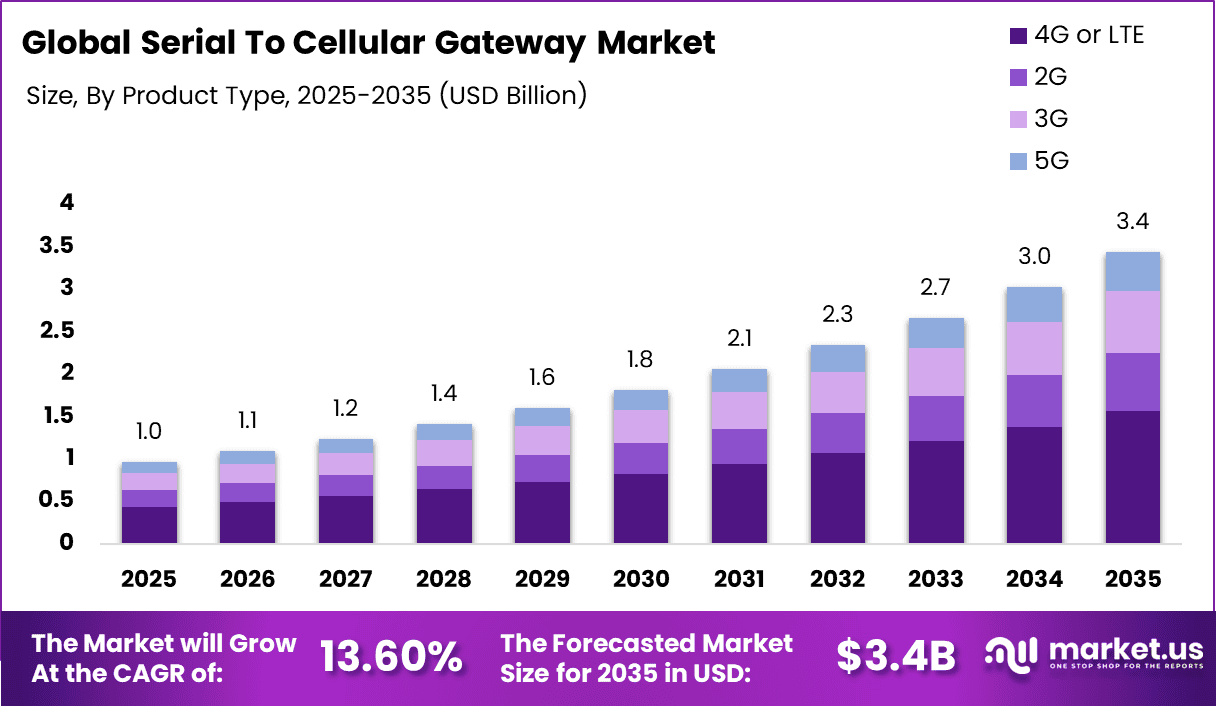
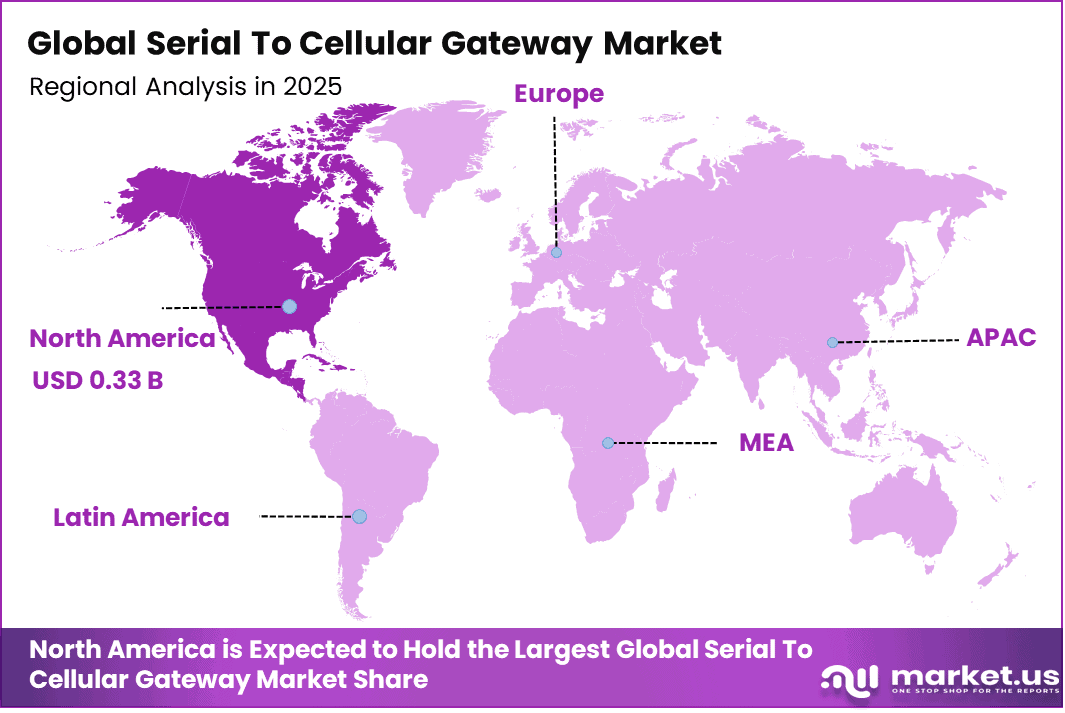
The Global Serial To Cellular Gateway Market generated USD 1 billion in 2025 and is predicted to register growth from USD 1.1 billion in 2026 to about USD 3.4 billion by 2035, recording a CAGR of 13.60% throughout the forecast span. In 2025, North America held a dominan market position, capturing more than a 34.8% share, holding USD 0.33 Billion revenue.
Top Market Takeaways
4G or LTE gateways command 45.6% market share, providing reliable high-speed connectivity for legacy RS232/RS485 devices in areas lacking wired infrastructure.
Communication protocols capture 47.1%, enabling Modbus, DNP3, and serial-to-IP conversion for seamless PLC/SCADA integration over cellular networks.
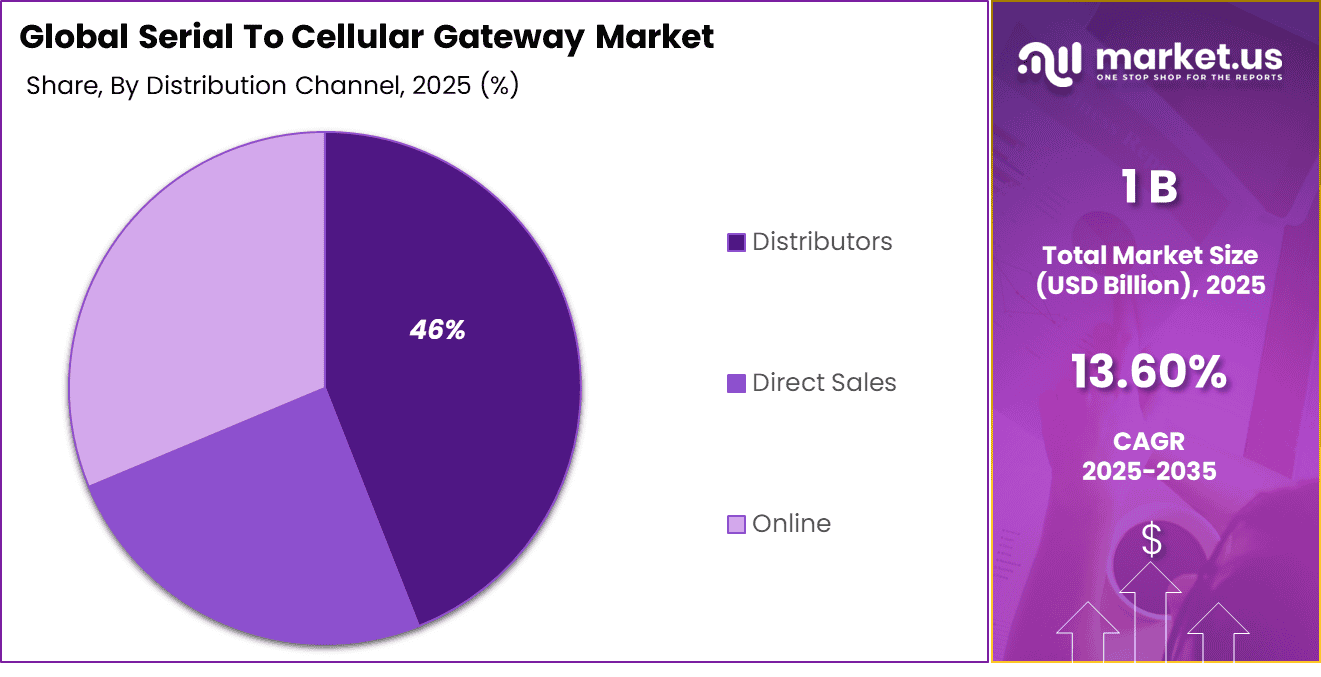
Distributors hold 46.4%, facilitating rapid deployment across manufacturing sites with volume pricing and local technical support.
Industrial automation applications claim 33.8%, powering remote sensor polling, equipment telemetry, and distributed control systems without Ethernet dependency.
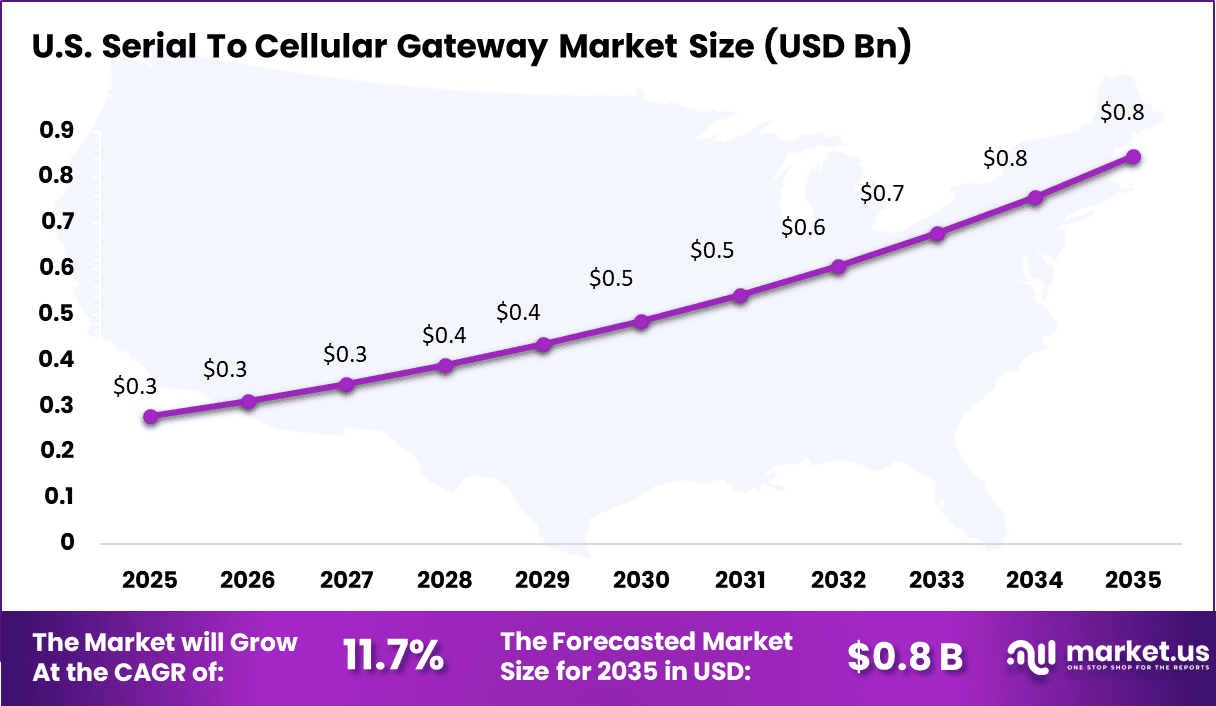
North America drives 34.8% global value, with U.S. market at USD 0.28 billion and 11.7% CAGR, fueled by smart factory initiatives and energy sector digitalization.
Serial To Cellular Gateway market refers to communication devices that connect serial based equipment to cellular networks so data can be transmitted remotely without relying on wired infrastructure.
These gateways are commonly used to link legacy machines, industrial controllers, meters, kiosks, security systems, and field devices with modern mobile communication networks. The market is gaining importance as many industries still operate serial equipment but need remote monitoring, data transfer, and control across distributed locations.
One of the main factors driving this market is the growing need to connect older serial devices with modern wireless networks without replacing the full installed system. Many businesses prefer this approach because it helps extend the life of existing equipment and lowers upgrade costs.
Another important factor is the wider use of remote asset monitoring in industries such as utilities, manufacturing, transport, and infrastructure, where cellular connectivity supports easier data collection and faster operational response.
Demand for serial to cellular gateways is increasing among industrial users, utilities, transport operators, security system integrators, and infrastructure managers that need reliable communication for devices located in remote or hard to wire areas.
These buyers want practical solutions that can support continuous data transmission, reduce manual site visits, and improve visibility across field operations. Demand is also rising because many organizations want simple migration paths from legacy communication systems to more flexible wireless networks.
Drivers Impact Analysis
Key Driver
Impact on CAGR Forecast (~%)
Geographic Relevance
Impact Timeline
Strategic Effect
Increasing adoption of IoT and industrial connectivity solutions
+2.9%
North America, Europe, Asia Pacific
Short to Mid Term (2025–2031)
Enables seamless device connectivity
Growing need to connect legacy serial devices to modern cellular networks
+2.6%
Global
Mid Term (2026–2032)
Extends lifecycle of existing equipment
Expansion of remote monitoring and industrial automation
+2.4%
Global
Mid Term (2026–2032)
Improves operational visibility
Rising deployment in utilities, transportation, and energy sectors
+2.2%
North America, Asia Pacific, Europe
Mid to Long Term (2026–2035)
Supports critical infrastructure connectivity
Increasing focus on real time data transmission and analytics
+2.0%
Global
Mid to Long Term (2026–2035)
Enhances decision making
Restraints Impact Analysis
Key Restraint
Impact on CAGR Forecast (~%)
Geographic Relevance
Impact Timeline
Strategic Effect
High cost of deployment and integration
-2.2%
Global
Mid Term (2026–2032)
Limits adoption among SMEs
Connectivity challenges in remote or low coverage areas
-2.0%
Emerging regions
Short to Mid Term (2025–2030)
Affects reliability
Security concerns in cellular communication networks
-1.8%
Global
Mid to Long Term (2026–2035)
Raises risk of data breaches
Complexity in configuring legacy serial systems
-1.6%
Global
Mid Term (2026–2032)
Increases deployment time
Lack of standardization across communication protocols
-1.5%
Global
Mid to Long Term (2026–2035)
Creates interoperability issues
By Product Type Analysis
4G or LTE accounted for 45.6% of the Serial to Cellular Gateway Market. This segment leads because 4G networks provide reliable and widespread connectivity for industrial devices that require continuous data transmission. These gateways enable seamless communication between legacy serial equipment and modern cellular networks.
The segment is also supported by the ongoing need for stable connectivity in remote and distributed environments. Many industries continue to rely on 4G infrastructure for machine to machine communication, which strengthens demand for LTE based gateway solutions.
By Communication Protocol Analysis
Communication protocol accounted for 47.1% of the market. This segment leads because compatibility with multiple industrial protocols is essential for connecting legacy systems to modern communication networks. Gateways must support different protocols to ensure smooth data exchange across devices and platforms.
The segment is driven by the diversity of industrial systems and equipment. Organizations require flexible solutions that can integrate with existing infrastructure, which increases the importance of protocol support in gateway deployment.
By Distribution Channel Analysis
Distributors represented 46% of the market. This segment dominates because distributors play a key role in reaching industrial customers and providing access to a wide range of connectivity solutions. They help bridge the gap between manufacturers and end users.
The segment is supported by the need for technical support and localized service. Distributors often provide installation guidance, product availability, and after sales support, which makes them an important channel for gateway solutions.
By Application Analysis
Industrial automation accounted for 33.8% of the market. This segment leads because industries use cellular gateways to connect machines, sensors, and control systems for real time monitoring and automation. These solutions enable efficient data transfer and support remote management of industrial operations.
The segment is driven by increasing adoption of automation and connected devices in manufacturing and process industries. Organizations rely on gateway solutions to improve operational efficiency, reduce downtime, and enable smarter industrial workflows.
Investor Type Impact Analysis
Investor Type
Growth Sensitivity
Risk Exposure
Geographic Focus
Investment Outlook
Venture Capital Firms
High
Medium
US, Europe
Growth in industrial IoT solutions
Private Equity Firms
High
Medium
North America, Europe
Expansion in connectivity platforms
Strategic Technology Investors
High
Medium
US, China, Japan
Strengthens IoT ecosystem
Corporate Venture Arms
Medium to High
Medium
Global
Supports industrial partnerships
Government and Infrastructure Funds
Medium
Low
Asia Pacific, Europe
Supports smart infrastructure initiatives
Technology Enablement Analysis
Technology Enabler
Impact on CAGR Forecast (~%)
Geographic Relevance
Impact Timeline
Implementation Significance
Cellular technologies including LTE and 5G connectivity
+3.0%
Global
Short to Mid Term (2025–2031)
Enables reliable wireless communication
IoT platforms for device management and monitoring
+2.7%
Global
Mid Term (2026–2032)
Improves device control
Edge computing for real time data processing
+2.4%
Global
Mid to Long Term (2026–2035)
Reduces latency
Integration with cloud based analytics platforms
+2.2%
Global
Mid Term (2026–2032)
Enhances data insights
Secure communication protocols and encryption technologies
+2.0%
Global
Mid to Long Term (2026–2035)
Improves data security
Emerging Trends
A key trend in the Serial to Cellular Gateway market is the increasing use of connectivity solutions that bridge legacy equipment with modern cellular networks. Many industries continue to operate devices that rely on serial communication, and gateways are being adopted to enable these systems to transmit data over cellular infrastructure.
These solutions are becoming more advanced, supporting remote monitoring and configuration through centralized platforms. This trend reflects a gradual shift where older industrial systems are integrated into connected environments without requiring complete replacement.
Growth Factors
The growing need to connect existing infrastructure with modern communication networks is supporting the expansion of serial to cellular gateway solutions. Industries such as utilities, transportation, and manufacturing rely on long standing equipment that remains operational but lacks built in connectivity.
Gateways allow organizations to extend the life of these systems while enabling data transmission and remote access. At the same time, increasing interest in remote monitoring and operational visibility encourages the adoption of solutions that support efficient and reliable connectivity across distributed environments.
Key Market Segments
By Product Type
2G
3G
4G or LTE
5G
By Communication Protocol
RS232
RS485
RS422
Others
By Distribution Channel
Direct Sales
Distributors
Online
By Application
Industrial Automation
Transportation
Energy and Utilities
Retail
Healthcare
Other Applications
Regional Analysis
North America accounted for 34.8% of the Serial to Cellular Gateway Market, reflecting strong adoption of industrial connectivity solutions across manufacturing, utilities, and transportation sectors. Organizations across the region increasingly deploy gateways to connect legacy serial devices with modern cellular networks, enabling remote monitoring and data transmission. The growing need to extend the life of existing equipment while supporting digital connectivity continues to drive demand for serial to cellular gateway solutions across North America.
The U.S. generated about USD 0.28 Billion within the regional market and is projected to expand at a CAGR of 11.7%. Enterprises across the country continue to invest in solutions that enable seamless communication between older industrial systems and cellular infrastructure.
These gateways help support remote operations, improve data visibility, and reduce the need for manual intervention. As industries move toward connected operations and remote asset management, demand for serial to cellular gateway solutions continues to grow steadily across the US market.
Key Regions and Countries
North America
US
Canada
Europe
Germany
France
The UK
Spain
Italy
Russia
Netherlands
Rest of Europe
Asia Pacific
China
Japan
South Korea
India
Australia
Singapore
Thailand
Vietnam
Rest of APAC
Latin America
Brazil
Mexico
Rest of Latin America
Middle East & Africa
South Africa
Saudi Arabia
UAE
Rest of MEA
Competitive Analysis
The competitive landscape of the Serial to Cellular Gateway market includes industrial networking, IoT connectivity, and communication hardware providers. Advantech Co. Ltd., Sterlite Technologies Limited, HFCL Limited, Digi International Inc., Moxa Inc., Axiomtek Co. Ltd., Lantronix Inc., Teltonika Networks UAB, ICP DAS Co. Ltd., Antaira Technologies LLC, and Proxicast LLC hold strong positions because they offer reliable gateway devices for connecting legacy serial equipment with modern cellular networks. These companies compete through product durability, network compatibility, remote monitoring support, and ease of deployment in industrial environments.
Other players such as Guangzhou Robustel Co. Ltd., Celona Inc., Aviz Networks Inc., USR IOT Technology Limited, Lavelle Networks Private Limited, Xiamen Four-Faith Communication Technology Co. Ltd., Shenzhen Wlink Technology Co. Ltd., NetBox Labs Inc., Neysa Networks Private Limited, Highway 9 Networks Inc., and NetAlly LLC add competition through specialized connectivity solutions and flexible industrial communication systems.
The market is shaped by data transmission reliability, security, device management, and the growing need to connect remote assets across utilities, transport, manufacturing, and smart infrastructure applications.
Xiamen Four-Faith Communication Technology Co. Ltd.
Shenzhen Wlink Technology Co. Ltd.
NetBox Labs Inc.
Neysa Networks Private Limited
Proxicast LLC
Highway 9 Networks Inc.
Antaira Technologies LLC
Others
Future Outlook
The future outlook for the Serial to Cellular Gateway Market looks positive as industries continue to connect legacy serial equipment to modern cellular networks for remote monitoring, control, and data transfer. Current industrial products already support serial communication over LTE and help connect hard to reach devices in utilities, transport, manufacturing, and field operations, which shows clear practical demand for this type of solution. As more businesses upgrade old systems without fully replacing them, demand for serial to cellular gateways is expected to grow steadily in the coming years.
Recent Developments
February, 2026 – Advantech launches 5G gateways for factory floors with multi-protocol support. It adds edge computing for real-time alerts in oil rigs. Targets automation pros with rugged IP67 models for harsh sites.
January, 2026 – Sterlite rolls out fiber-cellular hybrids for rural grids. Focuses on India power nets with low-power LTE modes. Partners local telcos for quick 5G upgrades on legacy sensors.
Report Scope
Report Features
Description
Market Value (2025)
USD 1 Billion
Forecast Revenue (2035)
USD 3.4 Billion
CAGR(2025-2035)
13.60%
Base Year for Estimation
2024
Historic Period
2020-2024
Forecast Period
2026-2035
Report Coverage
Revenue forecast, AI impact on Market trends, Share Insights, Company ranking, competitive landscape, Recent Developments, Market Dynamics and Emerging Trends
Segments Covered
By Product Type (2G, 3G, 4G or LTE, 5G), By Communication Protocol (RS232, RS485, RS422, Others), By Distribution Channel (Direct Sales, Distributors, Online), By Application (Industrial Automation, Transportation, Energy and Utilities, Retail, Healthcare, Other Applications)
Regional Analysis
North America – US, Canada; Europe – Germany, France, The UK, Spain, Italy, Russia, Netherlands, Rest of Europe; Asia Pacific – China, Japan, South Korea, India, New Zealand, Singapore, Thailand, Vietnam, Rest of Latin America; Latin America – Brazil, Mexico, Rest of Latin America; Middle East & Africa – South Africa, Saudi Arabia, UAE, Rest of MEA