


Report Overview
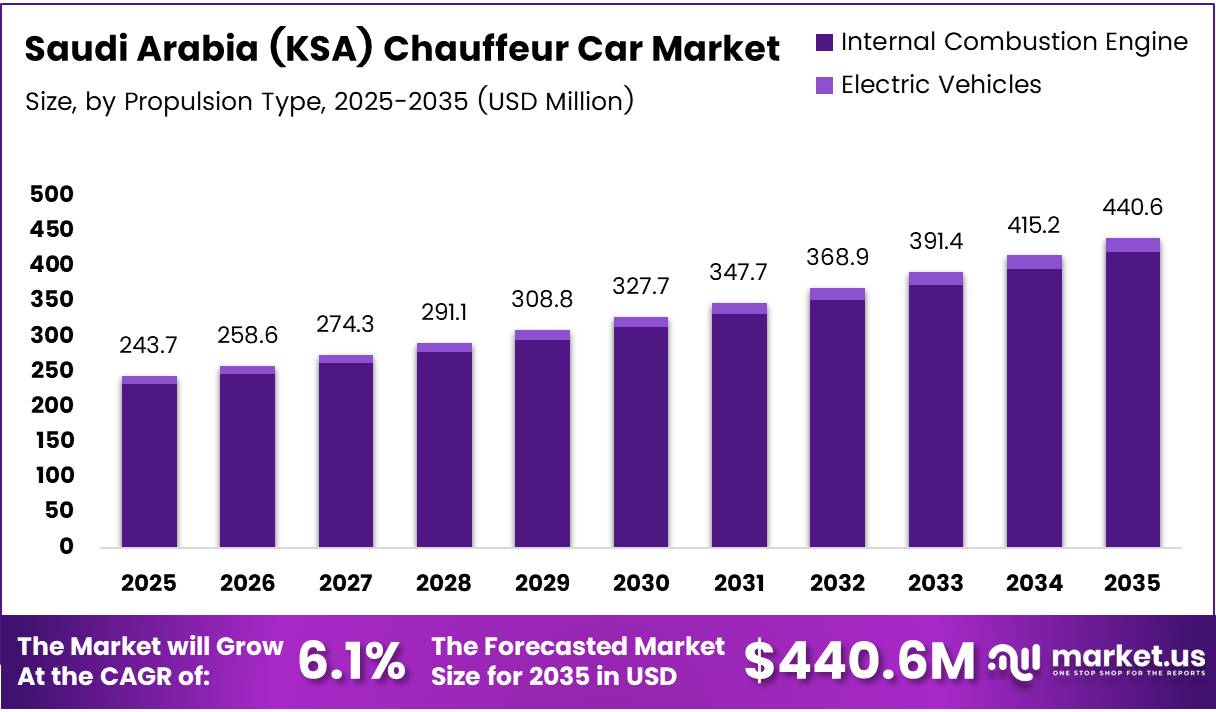
In 2025, Saudi Arabia (KSA) Chauffeur Car Market was valued at US$243.7 million, and between 2025 and 2035, this market is estimated to register a CAGR of 6.1%, reaching about US$440.6 million by 2035.
The chauffeur car market in Saudi Arabia is expanding rapidly, supported by Vision 2030, rising tourism, and increasing demand for premium mobility solutions. Growth is closely tied to major urban centers such as Riyadh, Jeddah, and Dammam, where corporate activity, international travel, and high-net-worth populations drive consistent demand for chauffeur-driven services. These services are widely used for business travel, airport transfers, and high-profile events, reflecting a strong preference for comfort, reliability, and professional image.
- The market is further strengthened by the aviation sector’s performance, with Saudi airports handling approximately 140.9 million passengers in 2025, including 76 million international and 65 million domestic travelers, alongside nearly 980,400 flights, marking a 9.6% increase in passenger traffic and 8.3% growth in flight movements.
This surge directly supports demand for seamless ground transportation, particularly at hubs such as King Khalid International Airport and King Abdulaziz International Airport. Premium vehicle usage remains central, with models like the Mercedes-Benz S-Class and Range Rover commonly deployed. Additionally, initiatives such as Emirates Chauffeur-Drive Services, offering coverage within a 100-kilometer radius in Riyadh, highlight the integration of air and ground travel, reinforcing the market’s evolution toward high-quality, end-to-end mobility solutions.
- In November 2024, Emirates, recognized as the world’s largest international airline, launched Chauffeur-Drive Services (CDS) in Riyadh, enhancing the end-to-end travel experience for premium passengers traveling through King Khalid International Airport. First and Business Class travelers benefit from a seamless, door-to-door journey that mirrors the airline’s onboard standards, with complimentary service available within a 100-kilometer radius for passengers on its three daily flights.
Key Takeaways
- Saudi Arabia (KSA) chauffeur car market was valued at US$243.7 million in 2025.
- Saudi Arabia (KSA) chauffeur car market is projected to grow at a CAGR of 6.1% and is estimated to reach US$440.6 million by 2035.
- On the basis of service type, event transportation dominated the market, constituting 29.2% of the total market share.
- Based on the vehicle type, sedans led the chauffeur car market, comprising 41.2% of the total market.
- Among the propulsion types, internal combustion engine chauffeur cars held a major share of the market, accounting for around 95.5% of the revenue.
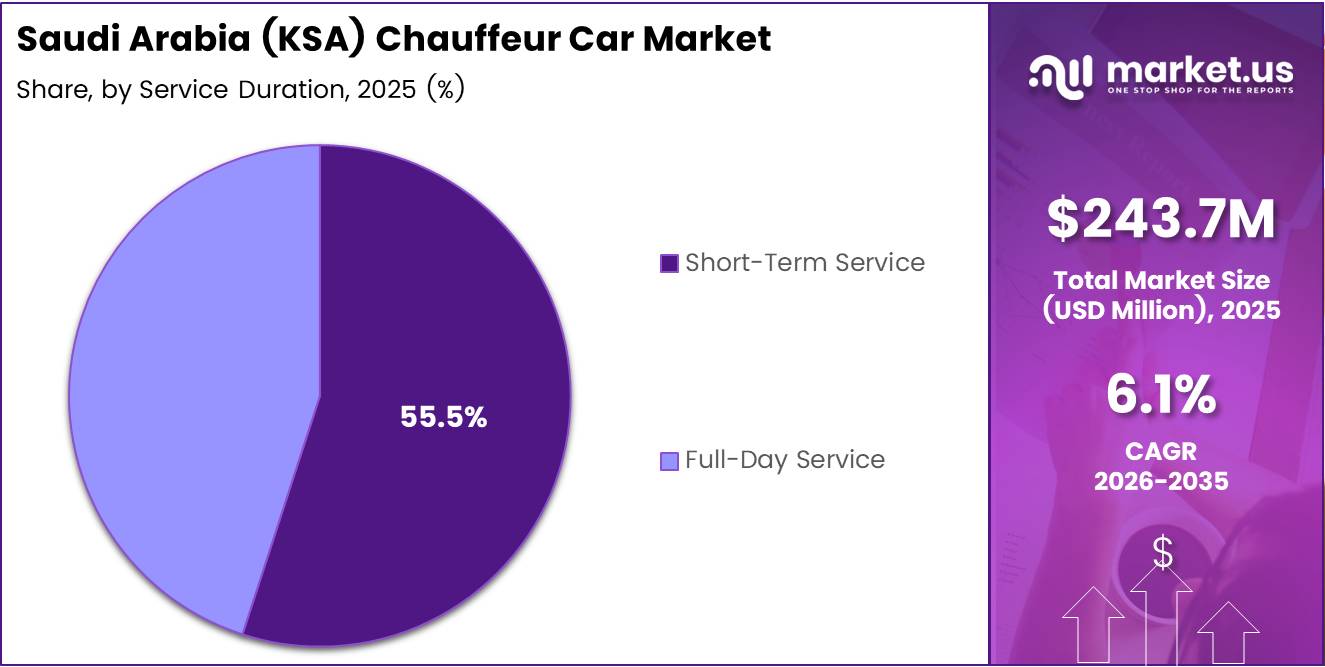
- Based on the service duration, short-term services withheld larger share in the market, with 55.5%.
Service Type Analysis
Event Transportation Services Are a Prominent Segment in the Market.
Event Transportation emerges as the leading service segment, accounting for 29.2% of the Saudi Arabia chauffeur car market, reflecting the Kingdom’s accelerating focus on large-scale events and global engagement initiatives. The growing calendar of international exhibitions, entertainment festivals, corporate gatherings, and high-profile social functions has significantly elevated demand for reliable, premium transportation solutions.
Cities such as Riyadh and Jeddah serve as primary hubs for such activities, where chauffeur-driven services are preferred for their ability to deliver punctuality, comfort, and a strong professional image. Clients typically include corporate delegations, VIP guests, and event organizers requiring coordinated fleet movement. The segment benefits from increasing government investment in entertainment and tourism, positioning chauffeur services as a critical enabler of seamless event logistics and premium attendee experiences.
Vehicle Type Analysis
Sedans Dominated the Chauffeur Car Market.
The sedan segment dominates the Saudi Arabia chauffeur car market, accounting for 41.2% of total demand, driven by its strong alignment with corporate and executive travel requirements. Sedans are widely preferred for airport transfers, business meetings, and daily urban mobility due to their balance of comfort, cost-efficiency, and professional appearance. In key cities such as Riyadh and Jeddah, chauffeur-driven sedans are extensively utilized by corporate clients, diplomats, and international visitors seeking reliable and discreet transportation.
Premium models such as the Mercedes-Benz S-Class further reinforce this segment’s dominance by catering to high-end clientele who prioritize luxury and brand image. The segment continues to benefit from consistent demand across both short-term and full-day service requirements.
Propulsion Type Analysis
Internal Combustion Engine Chauffeur Cars Held Major Share of the Market.
Internal combustion engine (ICE) vehicles dominate the Saudi Arabia chauffeur car market, accounting for 95.5% of total fleet composition, reflecting their widespread availability, established infrastructure, and operational reliability. Chauffeur service providers across major cities such as Riyadh and Jeddah continue to rely on petrol-based sedans and SUVs due to their longer driving range, quick refueling capabilities, and suitability for intercity travel.
High-end ICE models such as the premium SUVs remain preferred choices for corporate and VIP clients. While electric vehicles are gradually entering the market, limitations related to charging infrastructure and higher upfront costs currently constrain their adoption, reinforcing the continued dominance of ICE vehicles.
- Under Vision 2030, the Kingdom has set a target for 30% of all vehicles in Riyadh to be electric by 2030, supported by substantial investments exceeding USD 50 billion in EV manufacturing, infrastructure, and supporting technologies.
The global shift toward electric fleets is also reshaping chauffeur markets worldwide. Learn more in our [Global Chauffeur Car Market – EV Segment Analysis].
Service Duration Analysis
Chauffeur Cars Are Mostly Utilized for Short-Term Services.
Short-term service represents the dominant segment in the Saudi Arabia chauffeur car market, accounting for 55.5% of total demand, driven by the high frequency of point-to-point travel requirements across urban centers. This segment is widely utilized for airport transfers, business meetings, and intra-city mobility, particularly in key cities.
The growing volume of air passengers and corporate activity has reinforced the need for flexible, on-demand transportation solutions that offer convenience and time efficiency. Clients, including business travelers and international visitors, prefer short-term bookings for their cost-effectiveness and ease of access. The segment also benefits from digital booking platforms, which enable quick reservations and real-time service management, further strengthening its widespread adoption.
Key Market Segments
By Service Type
- Airport Transfer
- City Tours & Leisure Travel
- Business & Corporate Travel
- Event Transportation
- Others
By Vehicle Type
- Sedan
- SUV
- Others
By Propulsion Type
- Internal Combustion Engine
- Electric Vehicles
By Service Duration
- Short-Term Service
- Full-Day Service
Drivers
Government Initiatives for Promoting Tourism Industry Drives the Demand for Chauffeur Cars
Government-led initiatives to strengthen tourism have become a major driver of the Saudi Arabia chauffeur car market, significantly expanding demand for premium mobility solutions. The sector has undergone structural transformation through legislative reforms and large-scale tourism projects, supported by the National Tourism Strategy, the e-visa system, a new tourism law, and workforce development programs aimed at building local human capital.
- Between 2019 and 2024, around 56 tourism-related greenfield projects worth USD 1.9 billion were attracted, with foreign inflows led by China and strong domestic participation from the Public Investment Fund and the Tourism Development Fund, accelerating hospitality expansion.
The Kingdom’s diversified attractions, including the Red Sea coastline, deserts, and historical Nabatean sites, alongside giga-projects such as NEOM, Red Sea Project, AMAALA, Diriyah, and AlUla, are reshaping visitor inflows and generating long-term tourism value exceeding USD 40 billion.
- Tourism is a core pillar of Vision 2030, targeting 150 million visits, 1.6 million jobs, and 10% GDP contribution by 2030, supported by institutions such as the Ministry of Tourism, Saudi Tourism Authority, and Tourism Development Fund.
This expansion directly strengthens requirements for efficient, reliable, and premium chauffeur-driven transport services across the Kingdom.
- As tourism GDP rises from 3.5% in 2019 to around 5% by 2025, with a target of 10% and SAR 600 billion contribution, mobility demand across urban and intercity routes is increasing.
Restraints
Geographic Concentration of Demand in Key Urban Centers Limiting Chauffeur Cars Adoption
The Saudi Arabia chauffeur-driven car market is constrained by the pronounced geographic concentration of demand within a limited number of urban centers. Premium mobility requirements are largely concentrated in Riyadh, Jeddah, and Dammam, where corporate headquarters, luxury tourism activity, government offices, and high-density business operations are primarily located. This uneven distribution results in localized demand clusters rather than a broad-based national market.
Riyadh functions as the main executive transport hub, supported by rapid urbanization, the development of the King Abdullah Financial District, and the growing presence of multinational corporations. Demand is driven by executives, diplomats, and business travelers requiring airport transfers, intra-city mobility, and event-based transportation.
In Jeddah, demand is shaped by its dual role as a commercial port and gateway to Makkah and Madinah, with services catering to international visitors, corporate clients, and religious tourism flows through King Abdulaziz International Airport. The Eastern Province, including Dammam, Khobar, and Dhahran, contributes demand from the energy and industrial sectors, where professionals rely on reliable chauffeur services for intercity and intra-city travel.
This geographic concentration creates operational limitations, as fleet deployment, driver availability, and logistics remain heavily centered on major urban hubs, restricting scalability and service efficiency in smaller and emerging locations.
- Apart from this, in March 2026, widespread operational issues disrupted the Kingdom’s aviation network, affecting hundreds of passengers. A total of 604 flight delays and 63 cancellations were recorded across five major hubs: King Abdulaziz International Airport, King Khalid International Airport, King Fahd International Airport, Prince Mohammad Bin Abdulaziz Airport, and Al-Jouf Domestic Airport, causing congestion and travel delays.
Opportunity
Expansion of Hospitality Sector Expanding Market Reach
The rapid expansion of the hospitality sector in Saudi Arabia is creating a strong growth avenue for the chauffeur-driven car market, particularly within premium and structured mobility services. The increasing availability of hospitality infrastructure is directly driving demand for reliable, high-quality ground transportation, where chauffeur services are becoming an essential component of the overall guest experience.
- As of 2025, the Kingdom’s hotel inventory reached approximately 171,650 rooms, with supply projected to rise by 18% by 2027. The pipeline includes around 358,000 planned rooms, with nearly 94,000 keys under construction or advanced planning.
Saudi Arabia, positioned as one of the fastest-growing global tourism destinations, offers a diverse landscape of natural and cultural assets, including coastal regions, mountain terrains, and eight UNESCO World Heritage sites. Large-scale developments such as integrated resorts, new cities, and airport expansions are further strengthening investor confidence, supported by government incentives aimed at boosting tourism infrastructure.
- Riyadh is projected to see a 19% rise in quality room supply, reaching about 30,330 keys by 2027. Makkah and Madinah lead with projects adding over 252,000 rooms, including 70,000, 47,000, 42,000, and 41,000 keys, with 64% in four- and five-star segments.
Luxury tourism growth is further strengthening demand for chauffeur services, as high-end hospitality increasingly integrates personalized, door-to-door mobility. Chauffeur-driven transport is becoming an extension of premium hospitality, ensuring comfort, professionalism, and seamless connectivity across dispersed tourism destinations, reinforcing its role in the evolving tourism value chain.
Emerging Trends
Increasing Demand from Mega Events
The Saudi Arabia chauffeur car market is increasingly shaped by the Kingdom’s emergence as a major destination for global and regional events, which is generating sustained demand for premium, chauffeur-driven mobility services. Large-scale sports tournaments, cultural festivals, and high-profile business conferences create concentrated periods of travel activity where expectations around punctuality, safety, and comfort are significantly heightened. The chauffeur services are positioned as a preferred solution, offering personalized and professional transportation that bridges the gap between conventional public transport, ride-hailing platforms, and the elevated requirements of international visitors.
- Future mega events including the Esports World Cup 2026, AFC Asian Cup 2027, Asian Winter Games 2029, Expo 2030, FIFA World Cup 2034, and Asian Games 2034 are expected to further strengthen long-term demand for structured, high-end chauffeur services across the Kingdom.
- Additionally, Hajj brings 1,673,230 pilgrims, including 1,506,576 international and 166,654 domestic, highlighting large-scale religious mobility needs.
Saudi Arabia is undergoing a structural shift toward becoming a global events hub under Vision 2030, supported by strong government backing and continuous infrastructure development. This transformation is elevating event management into a key economic driver. Major entertainment and cultural platforms such as Riyadh Season 2025-26, Jeddah Season, Islamic Solidarity Games, and AlUla Moments have collectively attracted high visitor volumes, with Riyadh Season alone recording approximately 20 million visitors since 2019 across 11 zones.
| Premier Exhibition Spaces | Space |
|---|---|
| Riyadh Exhibition & Convention Center, Malham (RECC) | 48,000 m² – up to 78,000 m² |
| Riyadh Front Exhibition and Conference Center (RFECC) | 38,500 m² – up to 70,500 m² |
| Riyadh International Exhibition & Convention Center (RICEC) | 14,644 m² – up to 24,644 m² |
| Jeddah Super Dome | 34,000 sqm (the largest superdome in the world) |
| Dhahran Expo | 25,600 sqm |
Geopolitical Impact Analysis
Geopolitical Volatility and Its Ripple Effects on Saudi Arabia’s Chauffeur-Driven Mobility Ecosystem
Geopolitical tensions in the Middle East are exerting a notable impact on the Saudi Arabia chauffeur-driven car market by introducing operational uncertainty and influencing travel behavior across key customer segments. While the Kingdom maintains relative stability, its proximity to conflict-prone areas continues to affect the movement of executives, diplomats, tourists, and religious travelers, who increasingly incorporate safety considerations into travel planning. This often results in delayed, modified, or cancelled itineraries, directly affecting demand patterns for premium chauffeur services in core hubs such as Riyadh, Jeddah, and the Eastern Province.
Operational disruptions are also observed through airspace restrictions, rerouting of flights, and temporary airport closures during periods of heightened tension. These factors affect passenger inflows at major gateways, including premium airport transfer services such as those linked with Emirates Chauffeur-Drive Services in Riyadh, leading to cancellations and scheduling inefficiencies. Such volatility reduces short-term demand visibility and complicates fleet utilization, driver allocation, and service reliability.
The geopolitical instability has contributed to fluctuations in global oil prices, which have exceeded US$100 per barrel during conflict periods such as the US-Iran tensions. These price movements increase production and logistics costs, particularly for imported luxury vehicles that form the backbone of chauffeur fleets. Higher costs of raw materials, energy, and transportation place additional pressure on vehicle manufacturers and service operators.
Rising insurance premiums, security-related expenditures, and contingency planning requirements further elevate operating costs. Although the Saudi market remains resilient, these conditions necessitate stronger risk management frameworks, flexible scheduling models, and adaptive fleet strategies to maintain service continuity and support long-term market stability.
Key Company Insights
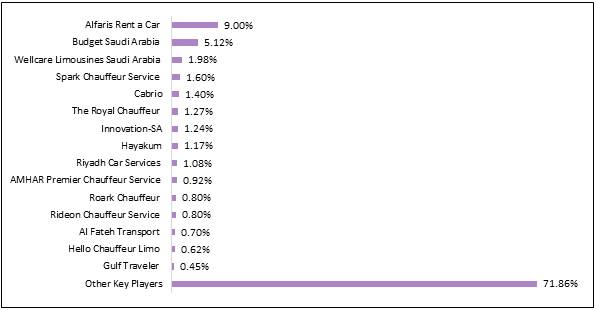
Players in the Saudi Arabia chauffeur car market focus on strengthening service differentiation through premium customer experience, fleet quality enhancement, and digital booking integration. Operators prioritize maintaining a diverse fleet of executive sedans and luxury SUVs to cater to corporate clients, VIP travelers, and high-net-worth individuals, while ensuring consistent vehicle maintenance and cleanliness standards. Investment in trained chauffeurs, often multilingual and professionally certified, is a key focus to improve service reliability and customer satisfaction.
Many providers expand partnerships with hotels, airlines, and event organizers to secure steady demand streams, particularly for airport transfers and event transportation. The adoption of mobile applications, real-time tracking, and cashless payment systems enhances convenience and operational efficiency. Additionally, companies are increasingly focusing on corporate contracts and subscription-based mobility solutions to ensure recurring revenue and strengthen client retention.
Key Players
- Alfaris Rent a Car
- Budget Saudi Arabia
- Wellcare Limousines Saudi Arabia
- Spark Chauffeur Service
- Cabrio
- The Royal Chauffeur
- Innovation-SA
- Hayakum
- Riyadh Car Service
- AMHAR Premier Chauffeur Service
- Roark Chauffeur
- Rideon Chauffeur Service
- Al Fateh Transport
- Hello Chauffeur Limo
- Gulf Traveler
- Other Key Players
Report Scope
| Report Features | Description |
|---|---|
| Market Value (2025) | US$243.7 Mn |
| Forecast Revenue (2035) | US$440.6 Mn |
| CAGR (2025-2035) | 6.1% |
| Base Year for Estimation | 2025 |
| Historic Period | 2021-2024 |
| Forecast Period | 2025-2035 |
| Report Coverage | Revenue Forecast, Market Dynamics, Competitive Landscape, Recent Developments |
| Segments Covered | By Service Type (Airport Transfer, City Tours & Leisure Travel, Business & Corporate Travel, Event Transportation, and Others), By Vehicle Type (Sedan, SUV, and Others), By Propulsion Type (Internal Combustion Engine and Electric Vehicles), By Service Duration (Short-Term Service and Full-Day Service) |
| Competitive Landscape | Alfaris Rent a Car, Budget Saudi Arabia, Wellcare Limousines Saudi Arabia, Spark Chauffeur Service, Cabrio, The Royal Chauffeur, Innovation-SA, Hayakum, Riyadh Car Service, AMHAR Premier Chauffeur Service, Roark Chauffeur, Rideon Chauffeur Service, Al Fateh Transport, Hello Chauffeur Limo, Gulf Traveler, and Other Players. |
| Customization Scope | Customization for segments, region/country-level will be provided. Moreover, additional customization can be done based on the requirements. |
| Purchase Options | We have three licenses to opt for: Single User License, Multi-User License (Up to 5 Users), Corporate Use License (Unlimited Users and Printable PDF) |





































