Global Remote Firmware Management Market Size, Share and Analysis By Type (Device Firmware, Bootloader Firmware, Embedded System Firmware, Network Firmware, Security & Update Management Firmware), By Software (Operating System, Middleware, Other Softwares), By Application (Healthcare, Consumer Electronics, Communications, Automotive, Industrial, Other Applications), By Regional Analysis, Global Trends and Opportunity, Future Outlook By 2025-2035
- Published date: March 2026
- Report ID: 181649
- Number of Pages: 356
- Format:
-
keyboard_arrow_up
Quick Navigation
Report Overview
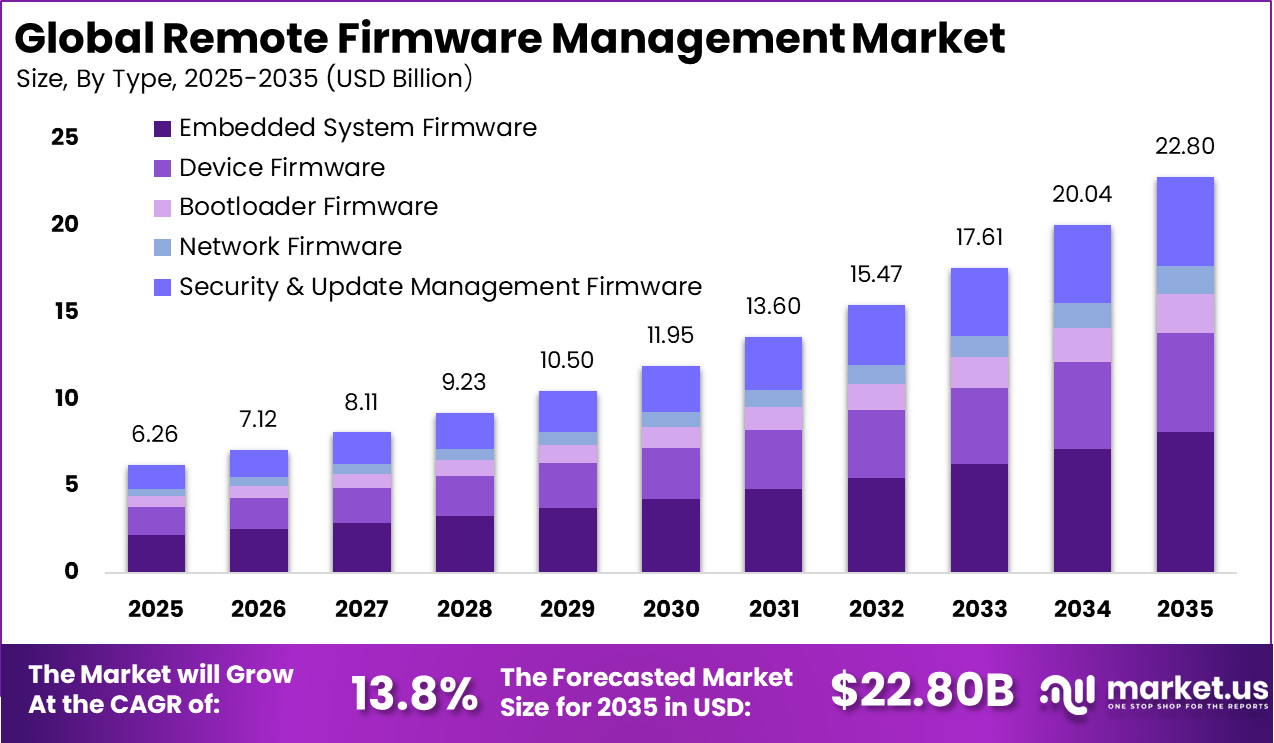
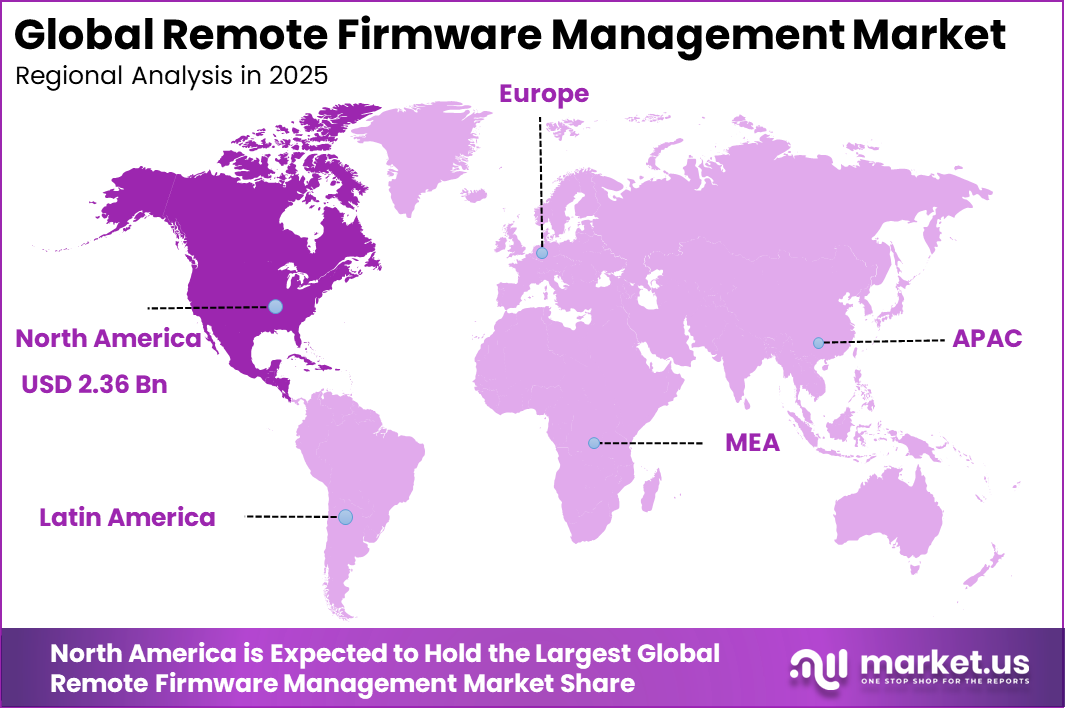
The Global Remote Firmware Management Market size is expected to be worth around USD 22.80 billion by 2035, from USD 6.26 billion in 2025, growing at a CAGR of 13.8% during the forecast period from 2025 to 2035. North America held a dominant market position, capturing more than a 13.8% share, holding USD 2.36 billion in revenue.
The Remote Firmware Management Market refers to solutions that enable organizations to update, monitor, and control firmware across connected devices without physical access. These systems are widely used in IoT devices, industrial equipment, automotive systems, medical devices, and enterprise hardware. Firmware acts as the core software layer that controls hardware functions, and its continuous updating has become essential for performance, security, and lifecycle management.
The growing number of connected devices has significantly expanded the need for centralized and remote firmware control. The market has evolved as organizations move from manual device maintenance to over-the-air update frameworks. Industry cybersecurity standards highlight that modern connected devices must support secure remote updates as a baseline requirement. For example, global IoT security frameworks emphasize that devices should be capable of receiving authenticated firmware updates to fix vulnerabilities and improve functionality.
One of the primary drivers is the rapid growth in connected devices and IoT ecosystems. Industrial, consumer, and enterprise devices now operate in distributed environments, making physical updates impractical. As a result, organizations are increasingly dependent on remote firmware updates to maintain operational continuity. This shift is supported by the expansion of IoT deployments across sectors such as manufacturing, healthcare, and smart infrastructure.
Demand is being driven by the need for real-time visibility and control over large device fleets. Enterprises managing thousands or millions of endpoints require centralized platforms that can track firmware versions, detect outdated systems, and ensure compliance. Remote firmware management provides a scalable approach to handle these requirements efficiently across global operations.
For instance, in January 2026, IBM Corporation enhanced its Maximo platform with new remote firmware capabilities for industrial IoT devices, enabling secure over-the-air updates across global manufacturing networks. This development helps manufacturers cut downtime by 30% while ensuring compliance, showing how established players continue dominating firmware management innovation.
Key Takeaway
- In 2025, Embedded System Firmware led the Global Remote Firmware Management Market, accounting for 35.6% of total share.
- In 2025, the Middleware segment emerged as the dominant component, capturing 40.7% of the market.
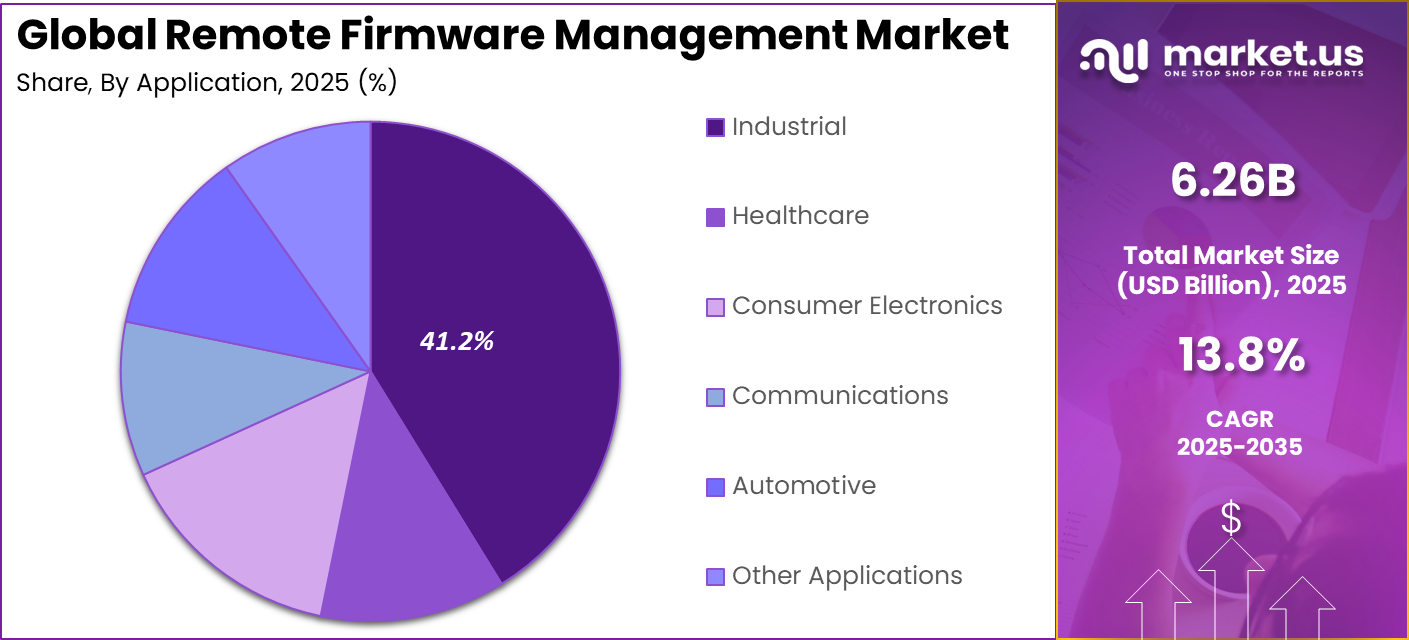
- In 2025, the Industrial sector represented the largest application segment with a 41.2% share.
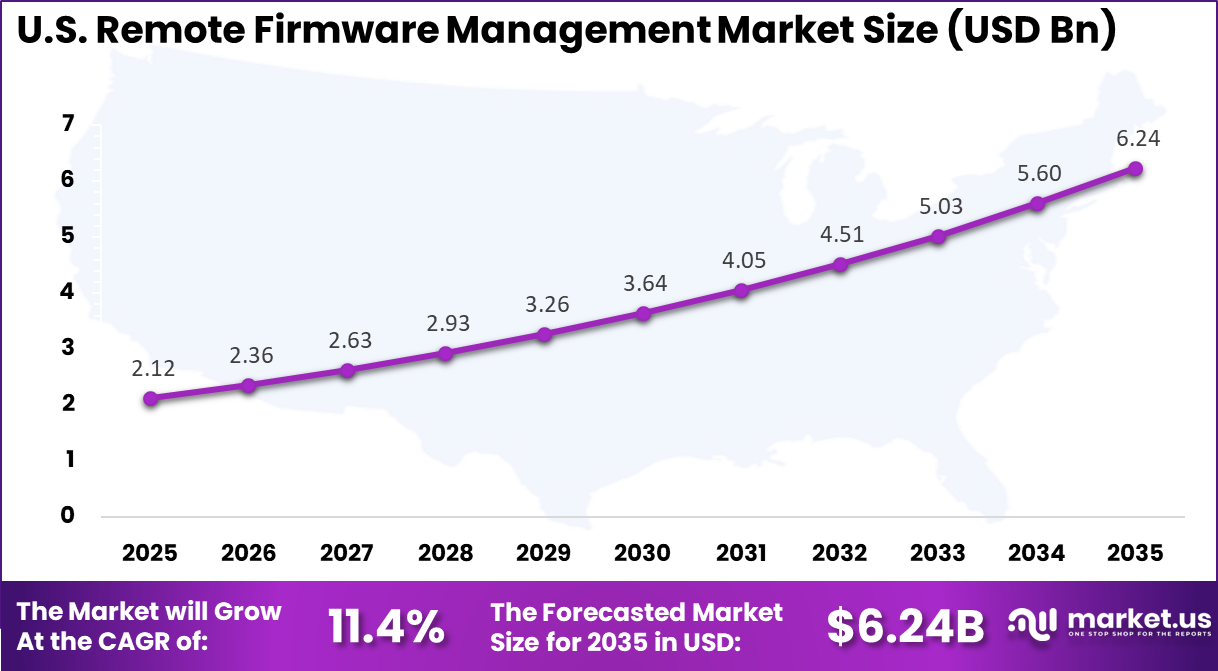
- In 2025, the U.S. Remote Firmware Management Market reached USD 2.12 billion and recorded a growth rate of 11.4%.
- In 2025, North America maintained regional leadership, securing more than 37.8% of the Global Remote Firmware Management Market.
KPIs Statistics
The adoption of remote firmware update capabilities has led to measurable cost efficiencies across operations. Maintenance expenses have been reduced by approximately 23%, while fuel efficiency improvements of around 17% have been observed in large-scale fleet deployments. These gains are primarily attributed to reduced manual servicing requirements and improved system optimization.
In constrained embedded environments, the use of optimized binary packing methods such as Base64 instead of Intel Hex has significantly enhanced update performance. Average download times have been reduced from 103.8 seconds to 36.9 seconds, indicating a substantial improvement in data transmission efficiency and overall system responsiveness.
By Type
Embedded system firmware accounts for 35.6% of the market, reflecting the widespread use of embedded devices across industrial equipment, consumer electronics, and connected infrastructure. These devices require regular firmware updates to maintain functionality, improve performance, and address security vulnerabilities. Remote firmware management platforms allow organizations to deploy updates efficiently across large device networks.
The importance of embedded firmware is also driven by its role in controlling hardware level operations. Ensuring that firmware remains secure and up to date is essential for preventing system failures and cyber risks. As embedded systems continue to expand across industries, remote firmware management solutions remain critical for maintaining device reliability.
For Instance, in March 2026, Siemens AG announced enhancements to its embedded control tech, streamlining remote firmware pushes for industrial gear. Engineers now handle boot and runtime fixes over networks more easily, cutting manual work. This keeps devices humming in real-world setups where every minute counts.
By Software
Middleware represents 40.7% of the market, highlighting its role in enabling communication between firmware management platforms and connected devices. Middleware solutions facilitate data exchange, update deployment, and system integration across diverse device ecosystems. These platforms act as a bridge between hardware components and management systems, ensuring smooth firmware operations.
The adoption of middleware is also supported by its ability to manage heterogeneous device environments with different operating systems and communication protocols. It allows centralized control over firmware updates while maintaining compatibility across devices. As device ecosystems become more complex, middleware continues to play a key role in remote firmware management.
For instance, in January 2026, Microsoft Corporation launched new middleware tools in its Azure stack for better firmware coordination across cloud layers. It links apps and devices seamlessly, so updates roll out without snags in mixed environments. Teams find it a game-changer for layered software that needs to stay in sync.
By Application
Industrial applications account for 41.2% of the market, reflecting the growing use of connected machinery and automation systems in manufacturing and industrial operations. Industrial equipment relies on firmware to control processes, monitor performance, and ensure operational efficiency. Remote firmware management platforms enable manufacturers to update and maintain these systems without interrupting production.
Industrial environments also require high levels of reliability and security, as firmware vulnerabilities can lead to operational disruptions. Remote update capabilities allow organizations to quickly address issues and deploy security patches across multiple devices. As industrial automation continues to expand, remote firmware management remains essential for maintaining system stability.
For Instance, in February 2026, PTC Inc. introduced industrial remote update features in ThingWorx. It targets factory machines for quick firmware rolls over networks. Plants gain from less downtime and steady performance, matching the automation surge. Hands-on reliability like this drives the industrial edge.
By Region
North America holds 37.8% of the market share due to strong adoption of connected devices and industrial automation technologies. Organizations in the region invest in remote management platforms to maintain device performance and security across distributed networks. The presence of advanced technology infrastructure supports widespread adoption.
For instance, in February 2026, Oracle IoT Cloud from Austin, Texas, launched enterprise-grade remote firmware provisioning with end-to-end encryption, targeting compliance-heavy sectors like energy and utilities. The platform’s zero-trust architecture gained rapid adoption among Fortune 500 firms. Oracle’s security focus strengthens North America’s enterprise firmware dominance.
Within North America, the United States contributes USD 2.12 billion with a growth rate of 11.4%. The country’s large industrial base and increasing deployment of connected systems have strengthened demand for remote firmware management solutions. Continued investment in automation and device management technologies is expected to support steady market growth.
For instance, in February 2026, IBM strengthened U.S. leadership in remote firmware management by launching enhanced Watson IoT firmware update capabilities. The platform now supports zero-downtime updates across millions of industrial devices, helping manufacturers maintain continuous operations while addressing cybersecurity vulnerabilities.
Emerging Trends
A major emerging trend is the rapid shift toward over-the-air update frameworks across industries. OTA technology enables firmware updates to be delivered wirelessly through internet or cellular networks, eliminating the need for physical access to devices. This approach is now widely adopted in smartphones, connected vehicles, and IoT ecosystems, where updates can add features, fix bugs, and patch vulnerabilities remotely.
Another important trend is the integration of advanced security and integrity mechanisms within firmware update systems. Research shows that firmware vulnerabilities are increasingly being targeted, which has led to the adoption of secure boot, encryption, authentication protocols, and real-time integrity checks. Modern firmware platforms are also incorporating AI, machine learning, and blockchain-based validation techniques to improve threat detection and ensure secure update delivery.
Zero-touch provisioning is another key trend, enabling devices to update automatically without manual intervention. With nearly 55% adoption in new installations, this approach simplifies large scale deployments. It reduces human errors, improves security, and allows organizations to manage growing device fleets efficiently with minimal operational effort.
Growth Factors
The rapid increase in IoT devices is a major growth driver, as billions of connected systems require continuous firmware updates. Remote management ensures efficient patching and performance optimization. Data shows around 70% growth in demand linked to this expansion, highlighting the need for scalable and automated firmware solutions.
Security concerns are also accelerating adoption, as firmware vulnerabilities are becoming prime targets for cyber threats. Around 80% of organizations prioritize remote updates to address these risks quickly. This focus on security transforms firmware management into a critical function for maintaining device integrity and long term operational stability.
Key Market Segments
By Type
- Device Firmware
- Bootloader Firmware
- Embedded System Firmware
- Network Firmware
- Security & Update Management Firmware
By Software
- Operating System
- Middleware
- Other Softwares
By Application
- Industrial
- Healthcare
- Consumer Electronics
- Communications
- Automotive
- Other Applications
Key Regions and Countries
North America
- US
- Canada
Europe
- Germany
- France
- The UK
- Spain
- Italy
- Russia
- Netherlands
- Rest of Europe
Asia Pacific
- China
- Japan
- South Korea
- India
- Australia
- Singapore
- Thailand
- Vietnam
- Rest of APAC
Latin America
- Brazil
- Mexico
- Rest of Latin America
Middle East & Africa
- South Africa
- Saudi Arabia
- UAE
- Rest of MEA
Driver Analysis
Need for Scalable Device Management
A major driver of the remote firmware management market is the need for scalable device management across industries. Organizations managing large fleets of devices require centralized systems that can update and monitor devices efficiently. Remote firmware management platforms enable simultaneous updates across thousands of devices, significantly improving operational scalability.
Another driver is the increasing demand for continuous product improvement. Manufacturers use firmware updates to introduce new features, improve performance, and extend the lifecycle of devices without requiring hardware replacement. This capability enhances customer satisfaction and reduces long-term costs.
For instance, in February 2026, IBM rolled out updates to its Watson IoT platform, focusing on secure remote patching for connected devices amid growing cyber threats. This move helps manufacturers keep firmware tight against breaches without downtime, easing the push for better IoT defenses in factories and smart setups. Teams now handle risks faster, matching the surge in online gadgets.
Restraint Analysis
Connectivity Dependence and Infrastructure Requirements
One restraint affecting the remote firmware management market is the dependence on network connectivity. Remote updates require stable internet connections, and devices operating in low-connectivity environments may face challenges in receiving timely updates.
Another restraint involves the infrastructure and system complexity required for secure firmware deployment. Organizations must implement authentication, encryption, and validation mechanisms to ensure that firmware updates are not compromised, which can increase implementation complexity and cost.
For instance, in November 2025, Siemens tackled update headaches in its MindSphere platform by simplifying deployment across mixed industrial hardware. The fix cuts compatibility issues in factories with old and new gear, but rollout still demands careful testing. It shows the ongoing struggle to streamline remote pushes in diverse setups.
Opportunity Analysis
Expansion of Industrial IoT and Smart Devices
A significant opportunity in the remote firmware management market lies in the growth of industrial IoT and smart device ecosystems. Industries such as manufacturing, energy, and logistics deploy connected devices across large geographic areas. Remote firmware management enables efficient maintenance and continuous optimization of these systems without physical intervention.
Another opportunity involves predictive maintenance and lifecycle management. By integrating firmware management with analytics platforms, organizations can monitor device performance and deploy updates proactively to prevent failures. This approach improves system uptime and operational efficiency.
For instance, in March 2026, Amazon Web Services (AWS) boosted its IoT Core with smarter OTA automation, scheduling updates based on device status and bandwidth. This lets operators manage fleets hands-free, opening paths for cloud-driven upkeep in logistics and beyond. It taps into the shift toward self-managing updates for massive device groups.
Challenge Analysis
Security Risks and Update Failures
One of the key challenges in the remote firmware management market is ensuring secure update delivery. Firmware updates can become potential attack vectors if not properly secured. Unauthorized or corrupted updates may compromise device functionality or expose systems to cyber threats.
Another challenge involves managing update failures and system downtime. If a firmware update is interrupted or improperly installed, it can lead to device malfunction. Organizations must implement rollback mechanisms and testing processes to ensure reliable update deployment across large device networks.
For instance, in January 2026, HPE faced scrutiny after a firmware flaw in edge servers sparked remote exploit worries, prompting a rushed patch campaign. Scanning scattered networks proved tough, exposing gaps in visibility for deep vulnerabilities. It underscores the fight to lock down firmware without breaking operations.
Key Players Analysis
The Remote Firmware Management Market is driven by global technology and cloud providers that enable secure device updates and lifecycle management across distributed environments. Microsoft Corporation, IBM Corporation, Oracle Corporation, and Amazon Web Services provide cloud based platforms that support remote firmware updates, device monitoring, and secure deployment pipelines. These solutions are widely used in IoT ecosystems, enterprise IT infrastructure, and industrial systems.
Industrial automation and embedded system providers also play a critical role in this market. Siemens AG, PTC Inc., Advantech Co., Ltd., and Wind River Systems, Inc. deliver platforms that support firmware updates in manufacturing, automotive, and smart infrastructure environments. Their solutions ensure device reliability, operational efficiency, and compliance with industry standards.
Semiconductor and infrastructure technology companies further strengthen the competitive landscape. Arm Holdings plc, Cisco Systems Inc., and Hewlett Packard Enterprise provide hardware architectures and networking solutions that support secure firmware distribution and device connectivity. Additional players such as IO GmbH contribute specialized solutions for industrial firmware management and automation.
Top Key Players in the Market
- IBM Corporation
- Microsoft Corporation
- Siemens AG
- PTC Inc.
- IO GmbH
- Oracle Corporation
- Hewlett Packard Enterprise
- Advantech Co., Ltd.
- Wind River Systems, Inc.
- Arm Holdings plc
- Cisco Systems Inc.
- Amazon Web Services (AWS)
- Other Key Players
Recent Developments
- In February 2026, Oracle Corporation embedded remote firmware tools within its OCI IoT service, launching support for custom Linux distributions used in telco edge equipment. Telecom operators report 40% faster rollout cycles compared to legacy systems, positioning Oracle strongly in mission-critical deployments.
- In January 2026, Siemens AG expanded its MindSphere platform with AI-driven firmware optimization tools through a deepened NVIDIA partnership announced at CES. This allows factories to deploy adaptive firmware updates that learn from production patterns, reducing energy waste by up to 25% in real-world deployments.
Report Scope
Report Features Description Market Value (2025) USD 6.2 Bn Forecast Revenue (2035) USD 22.8 Bn CAGR (2026-2035) 13.8% Base Year for Estimation 2025 Historic Period 2020-2024 Forecast Period 2026-2035 Report Coverage Revenue forecast, AI impact on Market trends, Share Insights, Company ranking, competitive landscape, Recent Developments, Market Dynamics and Emerging Trends Segments Covered By Type (Device Firmware, Bootloader Firmware, Embedded System Firmware, Network Firmware, Security & Update Management Firmware), By Software (Operating System, Middleware, Other Software), By Application (Healthcare, Consumer Electronics, Communications, Automotive, Industrial, Other Applications) Regional Analysis North America – US, Canada; Europe – Germany, France, The UK, Spain, Italy, Russia, Netherlands, Rest of Europe; Asia Pacific – China, Japan, South Korea, India, New Zealand, Singapore, Thailand, Vietnam, Rest of Latin America; Latin America – Brazil, Mexico, Rest of Latin America; Middle East & Africa – South Africa, Saudi Arabia, UAE, Rest of MEA Competitive Landscape IBM Corporation, Microsoft Corporation, Siemens AG, PTC Inc., Bosch.IO GmbH, Oracle Corporation, Hewlett Packard Enterprise, Advantech Co., Ltd., Wind River Systems, Inc., Arm Holdings plc, Cisco Systems Inc., Amazon Web Services (AWS), Other Key Players Customization Scope Customization for segments, region/country-level will be provided. Moreover, additional customization can be done based on the requirements. Purchase Options We have three license to opt for: Single User License, Multi-User License (Up to 5 Users), Corporate Use License (Unlimited User and Printable PDF)  Remote Firmware Management MarketPublished date: March 2026add_shopping_cartBuy Now get_appDownload Sample
 -
-
- IBM Corporation
- Microsoft Corporation
- Siemens AG
- PTC Inc.
- IO GmbH
- Oracle Corporation
- Hewlett Packard Enterprise
- Advantech Co., Ltd.
- Wind River Systems, Inc.
- Arm Holdings plc
- Cisco Systems Inc.
- Amazon Web Services (AWS)
- Other Key Players
Our Clients

- 181649
- March 2026