Report Overview
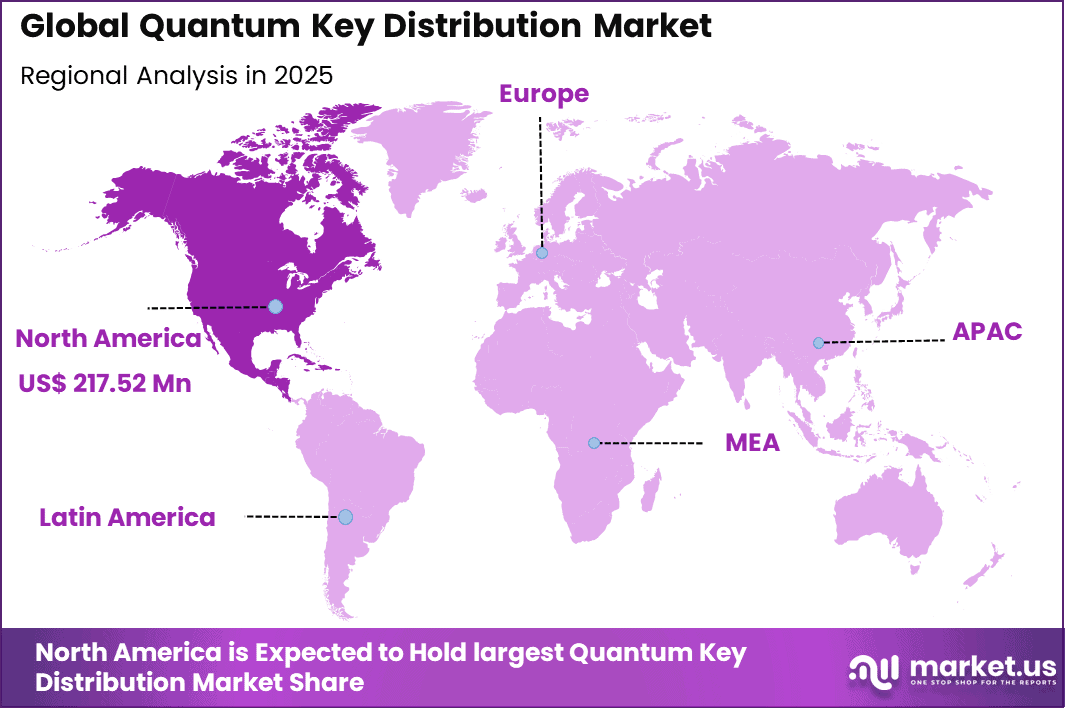
The Global Quantum Key Distribution Market generated USD 550.7 million in 2025 and is predicted to register growth from USD 755.6 million in 2026 to about USD 13,015.4 million by 2035, recording a CAGR of 37.2% throughout the forecast span. In 2025, North America held a dominant market position, capturing more than a 39.5% share, with USD 217.52 million in revenue.
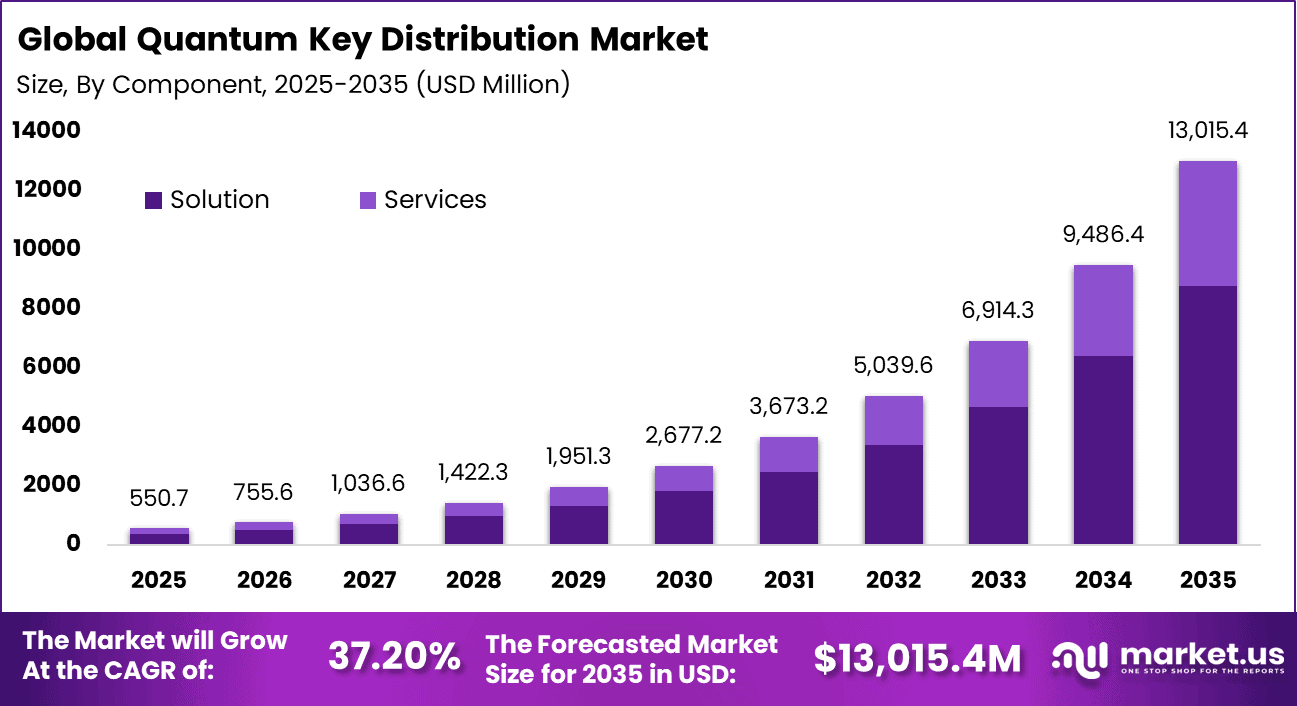
The quantum key distribution market refers to technologies and services that use the principles of quantum physics to create and share secure cryptographic keys for communications. Quantum key distribution (QKD) enables two parties to generate a shared secret key in a way that any attempt to intercept or measure the key alters its state and can be detected.
This property provides a higher level of security compared with traditional encryption key exchange methods. QKD is applied in sectors that require strong protection for sensitive data and communications, such as government networks, financial institutions, defence systems, and critical infrastructure.
The main driving factors for the quantum key distribution market are the growing need for secure communication and rising threats to data integrity. As digital systems handle larger volumes of confidential information, concerns about cyber attacks and advanced threats have increased. Conventional encryption methods may become vulnerable to powerful future computers, including quantum computers. Organisations that manage highly sensitive data seek security systems that can protect against both current and emerging threats.
Top Market Takeaways
- By component, solutions dominated the quantum key distribution market with a 67.5% share, providing integrated systems for generating and distributing unbreakable encryption keys.
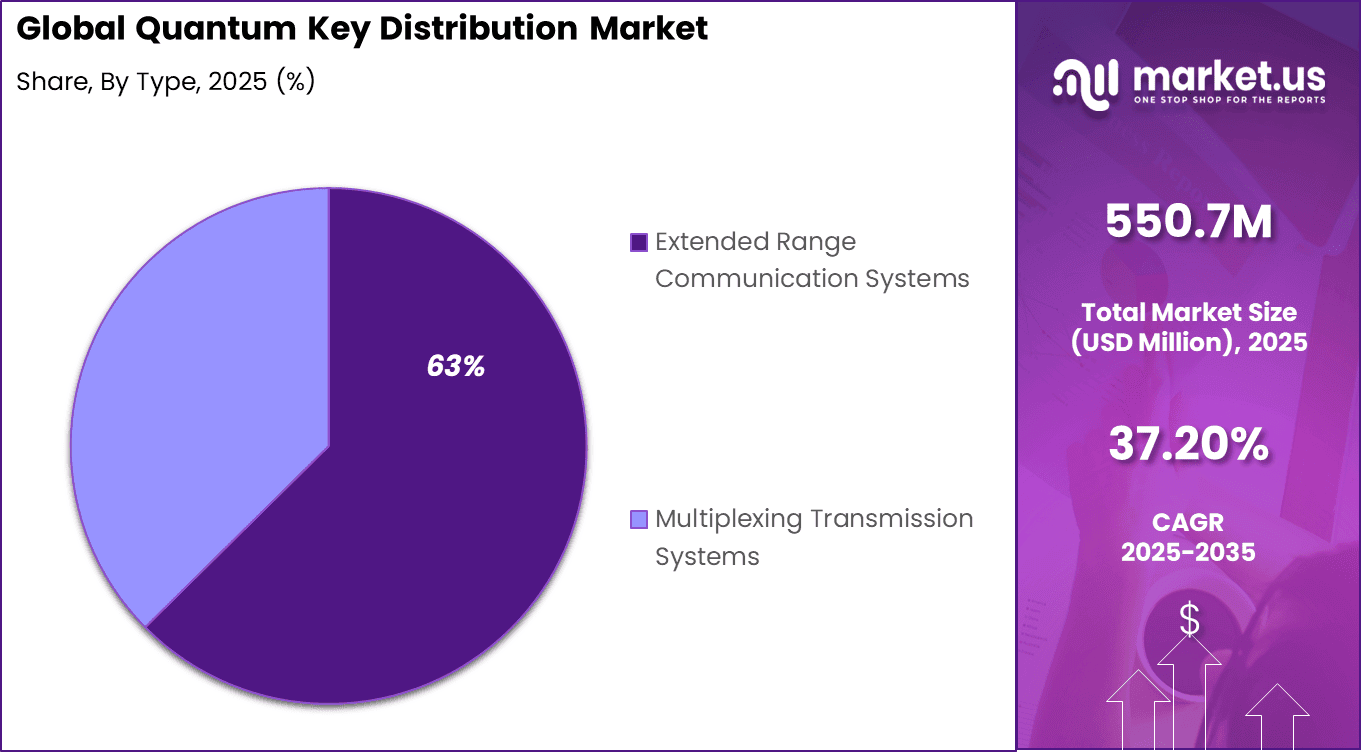
- By type, extended range communication systems captured 62.6%, enabling secure data links over fiber optics and free-space for government and enterprise use.
- By application, secure communication led at 43.2%, safeguarding sensitive transmissions against quantum computing threats.
- By end-use, BFSI held 34.7%, adopting QKD to protect financial transactions and customer data from future decryption risks.
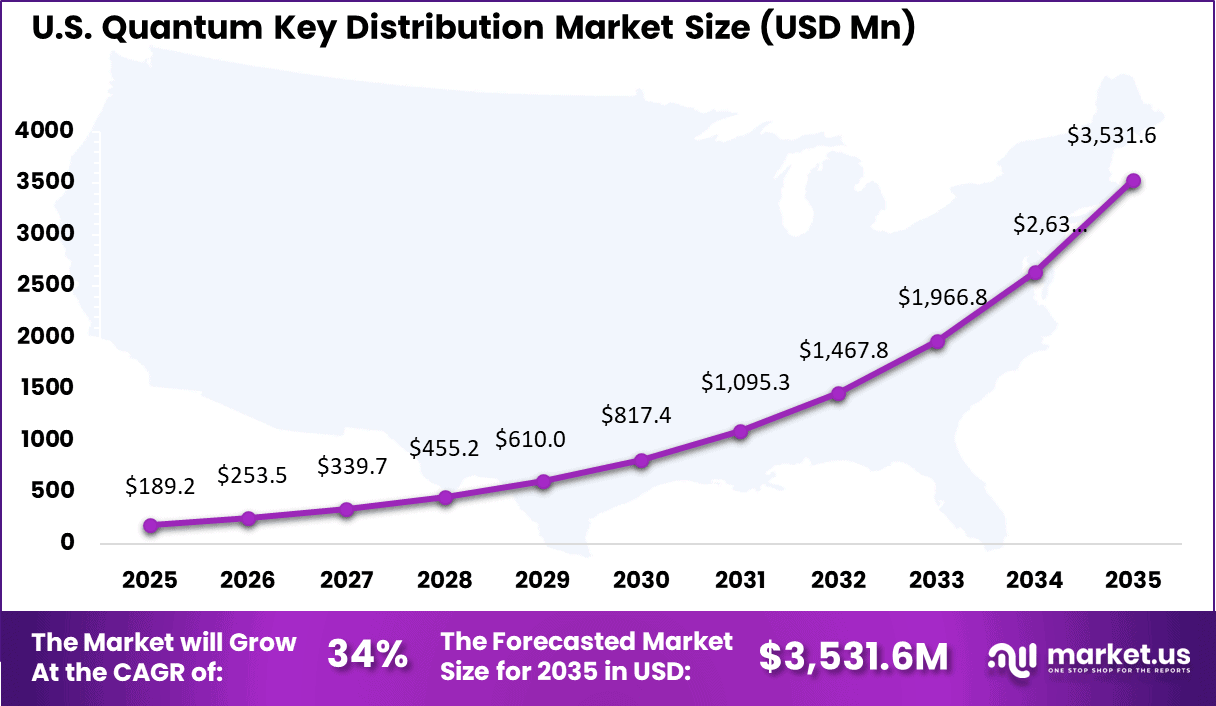
- North America accounted for 39.5% of the global market, with the U.S. valued at USD 189.20 million and growing at a CAGR of 34.0%.
Component Analysis
Solutions account for 67.5% of the Quantum Key Distribution market, showing that buyers primarily invest in complete QKD systems rather than individual hardware elements. These solutions combine quantum key generation, key management software, monitoring tools, and integration layers with existing network security infrastructure.
From an operational perspective, integrated QKD solutions reduce implementation complexity and deployment risk. Vendors deliver tested and validated systems that meet security and compliance requirements. The strong share of this segment reflects market demand for end-to-end quantum security solutions that can be adopted without deep in-house quantum expertise.
Type Analysis
Extended range communication systems hold 63% of the market, indicating strong focus on long-distance quantum-secure communication. These systems enable secure key exchange over extended fiber or free-space networks, which is essential for enterprise and inter-city communication. Extended range capability expands the practical usability of QKD beyond short laboratory environments.
From a deployment standpoint, extended range systems support broader network coverage and real-world use cases. They allow secure communication between data centers, financial institutions, and government facilities. The strong presence of this segment reflects the need to scale quantum security across wide-area networks.
Application Analysis
Secure communication represents 43.2% of application demand, making it the leading use case for QKD. Organizations use QKD to protect sensitive data transmission against advanced cyber threats. Quantum-based key exchange ensures that any interception attempt is detectable, providing a higher level of security than classical methods.
Secure communication applications are critical in sectors where data confidentiality is essential. QKD strengthens encryption frameworks and future-proofs security against quantum attacks. The strong share of this segment reflects growing concern over long-term data protection and emerging quantum computing risks.
End-Use Analysis
The BFSI sector accounts for 34.7% of end-use adoption, making it the largest industry segment in the market. Financial institutions handle highly sensitive data such as transaction records, customer information, and interbank communications. QKD helps protect these data flows from interception and cyber espionage.
BFSI organizations also face strict regulatory and compliance requirements. Quantum-secure communication supports risk mitigation and trust. The strong presence of this segment reflects the financial sector’s proactive approach to adopting advanced security technologies.
Key Market Segments
By Component
- Solution
- Services
By Type
- Extended Range Communication Systems
- Multiplexing Transmission Systems
By Application
- Secure Communication
- Network Security
- Database Encryption
- Others
By End-use
- Government and Defense
- BFSI
- Healthcare
- IT and Telecom
- Automotive
- Others
Regional Analysis
North America accounted for a 39.5% share, supported by a strong focus on next-generation cybersecurity and protection of critical communication infrastructure. Quantum key distribution solutions have been adopted to enable ultra-secure encryption for government, defense, financial services, and research networks.
Demand has been driven by rising concerns over future quantum computing threats to classical encryption methods. The region’s advanced research capabilities and early investments in quantum technologies have reinforced steady market development.
The U.S. market reached USD 189.2 Mn and is projected to grow at a 34.0% CAGR, reflecting rapid acceleration of quantum security initiatives. Adoption has been driven by federal investment in quantum research and increasing demand from defense, intelligence, and financial institutions. Quantum key distribution has helped U.S. organizations enhance encryption resilience and prepare for post-quantum security environments
Key Regions and Countries
- North America
- US
- Canada
- Europe
- Germany
- France
- The UK
- Spain
- Italy
- Russia
- Netherlands
- Rest of Europe
- Asia Pacific
- China
- Japan
- South Korea
- India
- Australia
- Singapore
- Thailand
- Vietnam
- Rest of APAC
- Latin America
- Brazil
- Mexico
- Rest of Latin America
- Middle East & Africa
- South Africa
- Saudi Arabia
- UAE
- Rest of MEA
Key Reasons for Adoption
- Cybersecurity threats are increasing against sensitive communication networks
- Traditional encryption methods face risks from advanced computing capabilities
- Governments and enterprises require long-term security for critical data
- Secure communication is essential for national security and defense systems
- Awareness is growing around future-proof cryptographic technologies
Benefits
- Communication security is strengthened through physics-based encryption
- Data interception attempts are detected immediately
- Long-term confidentiality is supported for highly sensitive information
- Trust levels are improved in secure data transmission
- Risk of encryption compromise is significantly reduced
Usage
- Used in government networks for secure data communication
- Applied in defense systems for protected information exchange
- Deployed in financial institutions for secure transaction communication
- Utilized in research networks handling sensitive data
- Integrated into critical infrastructure communication systems
Emerging Trends
| Key Trend | Description |
|---|---|
| Satellite-based QKD networks | Deployment of satellite constellations to extend quantum-secure key exchange to global and cross-border links. |
| Integration with 5G and IoT | QKD is embedded into 5G backhaul and critical IoT networks to secure ultra-low-latency, high-bandwidth traffic. |
| Chip-scale QKD devices | Miniaturized photonic chips reduce size, cost, and power needs for metro and access networks. |
| Hybrid classical-quantum security | Combination of QKD with post-quantum cryptography and existing VPNs for layered protection. |
| National quantum backbone projects | Government-led quantum communication backbones link ministries, defense, finance, and utilities. |
Growth Factors
| Key Factors | Description |
|---|---|
| Rising quantum-computing threat | Concern that future quantum computers will break current public-key encryption drives demand for quantum-safe keys. |
| Escalating cyberattacks on critical infrastructure | Utilities, telecom, and defense seek ultra-secure channels for long-lived sensitive data. |
| Government funding and mandates | National security and data-sovereignty programs explicitly promote or require QKD deployments. |
| Expansion of high-value data traffic | Growth in financial, healthcare, and cloud workloads increases the need for long-term confidentiality. |
| Advances in quantum optics and networking | Improvements in fiber distance, repeater concepts, and satellite links make QKD more commercially viable. |
Market Dynamics
Driver Analysis - Rising Urgency for Quantum-Safe Data Security
A key driver of the quantum key distribution market is growing concern over future cyber threats that could break current encryption methods. Traditional security systems are built around mathematical problems that could become vulnerable when powerful quantum computers emerge. This has led organisations in finance, defence, and critical infrastructure to explore quantum key distribution as a way to share encryption keys that cannot be intercepted without detection, because the laws of quantum physics reveal any eavesdropping.
Governments and research institutions are supporting investments in quantum communication networks to protect sensitive data and national assets. This support is seen in projects that aim to integrate quantum encryption into existing communication systems, as well as satellite-based experiments that extend secure key exchange beyond local fibre networks. Such strategic focus on advanced security solutions is expanding interest and early adoption of quantum key distribution technology.
Restraint Analysis - High Technical Costs and Infrastructure Requirements
One restraint for the quantum key distribution market is the substantial cost and specialised infrastructure needed to implement the systems. QKD requires dedicated equipment, such as quantum transmitters and receivers, and often trusted relays for long-distance networks. These components must operate with high precision to preserve quantum states used for secure key sharing, and they are typically more expensive than conventional encryption hardware.
In addition to equipment costs, organisations must adapt or build communication infrastructure that can accommodate quantum links, which can create barriers for widespread deployment. Running QKD over existing fibre or satellite networks also requires careful integration and ongoing maintenance, which adds to total cost of ownership and can slow investments by enterprises that are weighing near-term expenses against long-term security benefits.
Opportunity Analysis - Expansion Through Telecom and Secure Networks
An important opportunity in the quantum key distribution market lies in its potential integration into telecom and secure network architectures. As telecom operators and large enterprises seek quantum-safe encryption, QKD can be offered as a premium security layer to protect data moving across critical infrastructure. This trend is particularly relevant in data-intensive sectors where secure communications are essential, such as cloud services and inter-bank networks.
There is also an opportunity for growth through space-based QKD initiatives that connect quantum secure links over longer distances. Satellite-enabled quantum key distribution could open new markets where terrestrial networks are limited, and national programmes focused on secure global communication infrastructure may further stimulate deployment. These developments help position QKD as part of future secure communication strategies.
Challenge Analysis - Practical Limits and Transmission Constraints
Despite its promise, a major challenge for the quantum key distribution market is the practical limitation of transmission distance and signal performance. Quantum signals are fragile and can degrade over long distances in optical fibre, reducing the rate at which secure keys can be generated. This challenge requires advanced techniques or repeaters to maintain signal quality, which complicates large-scale implementation.
Another challenge comes from the precision required in preparing and measuring quantum states. Even small imperfections can make it hard to distinguish genuine signals from noise, which affects both security and performance. This puts pressure on vendors and users to refine hardware and protocols, and it means that QKD systems often demand specialised expertise to deploy and operate effectively in real-world networks.
Competitive Analysis
The competitive landscape of the quantum key distribution market is shaped by a mix of specialized quantum security firms and large technology companies investing in next-generation cryptography. ID Quantique and Kloch focus on developing QKD hardware and software that enable secure key exchange using quantum principles.
At the same time, established technology and defense-oriented players such as NEC Corporation, Toshiba Corporation, and Telsy add competitive pressure by leveraging strong R&D capabilities, telecom partnerships, and experience in critical infrastructure security.
Competitive differentiation increasingly depends on performance reliability, interoperability with classical encryption systems, deployment cost, and compliance with national security standards. The Others segment includes emerging startups and research-driven vendors offering experimental or niche QKD solutions, which increases innovation and supports gradual market expansion.
Top Key Players in the Market
- ID Quantique
- InfiniQuant
- KETS Quantum Security Ltd
- Kloch Inc.
- LuxQuanta Technologies S.L.
- MagiQ Technologies Inc.
- NEC Corporation
- QuantumCTek Co., Ltd.
- QuintessenceLabs Pty Ltd
- Telsy S.p.A.
- Toshiba Corporation
- Others
Future Outlook
Growth in the Quantum Key Distribution market is expected to increase as concerns around data security and future quantum threats grow. QKD enables secure key exchange using quantum principles, which helps protect sensitive communications from interception.
Governments, defense agencies, and critical infrastructure operators are showing rising interest in this technology. Over time, improvements in transmission distance, system stability, and integration with existing networks are likely to support broader adoption.
Recent Developments
- In December 2025, ID Quantique (IDQ), via its parent IonQ, completed the first quantum‑resistant network deployment in Switzerland using the Solteris solution, integrating QKD‑style key distribution with Cisco NX‑OS and NIST‑certified quantum‑random‑number‑generator‑based post‑quantum cryptography.
- In July 2025, NEC together with Toshiba and NICT demonstrated the world’s first multiplexed QKD and key generation within a system designed for NTT’s IOWN all‑photonics network, advancing QKD integration into next‑generation optical infrastructure.
Report Scope
| Report Features | Description |
|---|---|
| Market Value (2025) | USD 550.7 Million |
| Forecast Revenue (2035) | USD 13,015.4 Million |
| CAGR(2025-2035) | 37.2% |
| Base Year for Estimation | 2024 |
| Historic Period | 2020-2024 |
| Forecast Period | 2025-2035 |
| Report Coverage | Revenue forecast, AI impact on Market trends, Share Insights, Company ranking, competitive landscape, Recent Developments, Market Dynamics and Emerging Trends |
| Segments Covered | By Component (Solution, Services), By Type (Extended Range Communication Systems, Multiplexing Transmission Systems), By Application (Secure Communication, Network Security, Database Encryption, Others), By End-use (Government and Defense, BFSI, Healthcare, IT and Telecom, Automotive, Others) |
| Regional Analysis | North America – US, Canada; Europe – Germany, France, The UK, Spain, Italy, Russia, Netherlands, Rest of Europe; Asia Pacific – China, Japan, South Korea, India, New Zealand, Singapore, Thailand, Vietnam, Rest of Latin America; Latin America – Brazil, Mexico, Rest of Latin America; Middle East & Africa – South Africa, Saudi Arabia, UAE, Rest of MEA |
| Competitive Landscape | ID Quantique, InfiniQuant, KETS Quantum Security Ltd, Kloch Inc., LuxQuanta Technologies S.L., MagiQ Technologies Inc., NEC Corporation, QuantumCTek Co., Ltd., QuintessenceLabs Pty Ltd, Telsy S.p.A., Toshiba Corporation, Others |
| Customization Scope | Customization for segments, region/country-level will be provided. Moreover, additional customization can be done based on the requirements. |
| Purchase Options | We have three licenses to opt for: Single User License, Multi-User License (Up to 5 Users), Corporate Use License (Unlimited Users and Printable PDF) |