


Global Off-Highway Equipment Lubricants Market Size, Share and Report Analysis By Type (Heavy-Duty Engine Oils, Transmission Fluids, Hydraulic Fluids, Greases, Gear oils, Others), By Equipment (Tractor, Excavator, Forklift, Harvesters, Others), By End-User (Construction, Mining, Agriculture, Forestry, Material Handling, Others) , By Region and Companies - Industry Segment Outlook, Market Assessment, Competition Scenario, Trends and Forecast 2025-2035
- Published date: Mar 2026
- Report ID: 179957
- Number of Pages: 332
- Format:
-
keyboard_arrow_up
Quick Navigation
Report Overview
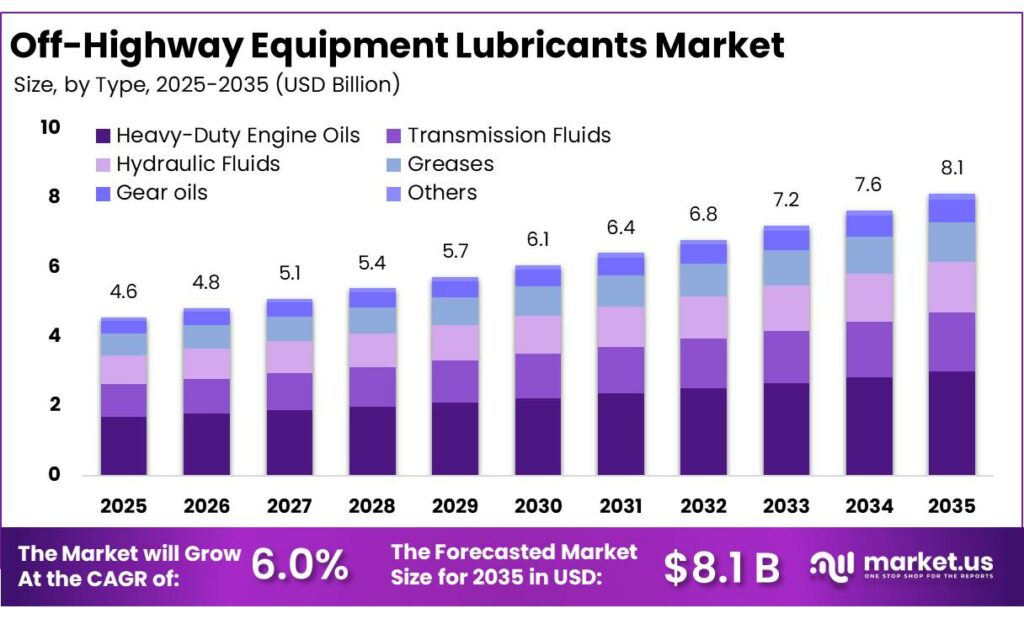
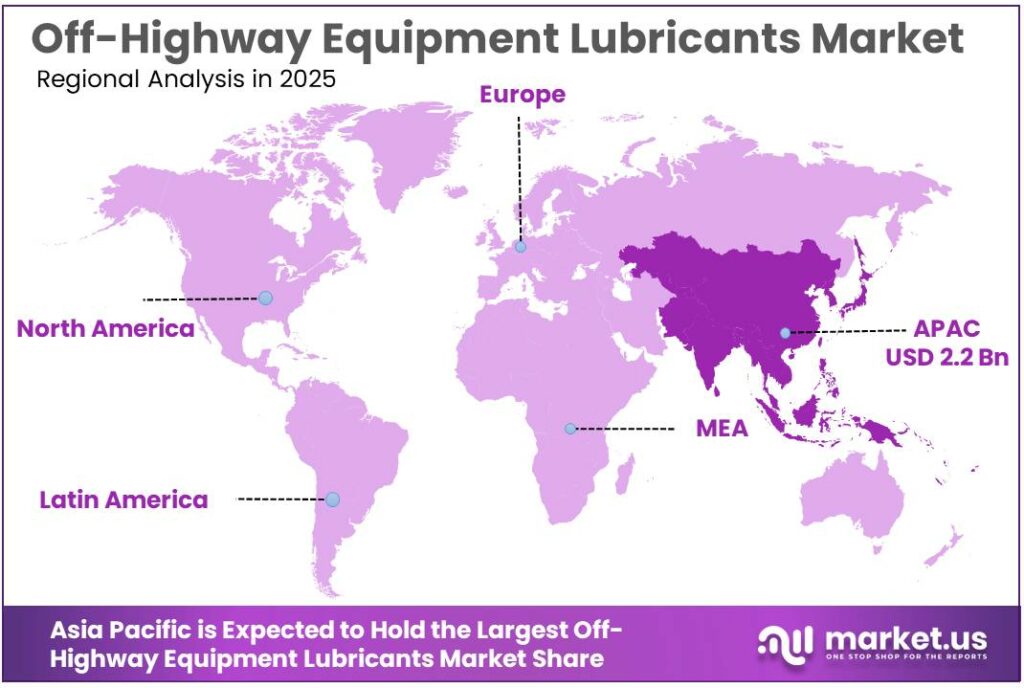
The Global Off-Highway Equipment Lubricants Market is expected to be worth around USD 8.1 Billion by 2035, up from USD 4.6 Billion in 2025, at a CAGR of 6.0% from 2026 to 2035. The Asia Pacific segment maintained 48.9%, supporting a Off-Highway Equipment Lubricants value of USD 2.2 Bn.
Off-highway equipment lubricants form a critical support market for heavy machinery used in construction, mining, agriculture, forestry and material-handling. These lubricants protect engines, transmissions, axles and hydraulic systems that typically operate under high loads, shock, dust and wide temperature swings. Because most off-highway equipment is still powered by internal combustion engines, and around 95% of global transport energy is supplied by liquid fuels from petroleum, demand for high-performance lubricants remains structurally linked to fossil fuel use in heavy-duty sectors.
From an industrial perspective, the market is tightly coupled with long-term infrastructure and agricultural trends. The G20-backed Global Infrastructure Outlook estimates that the world needs around USD 97 trillion of infrastructure investment by 2040, with Asia alone accounting for USD 52 trillion of that requirement, to keep pace with population growth and urbanization. The transport sector accounts for roughly 60% of total global oil demand, with road vehicles alone consuming about 80% of transport energy, underscoring the centrality of fuel- and lubricant-intensive mobility to the global energy system.
- Government infrastructure initiatives further support long-term lubricant consumption in off-highway fleets. In the United States, the Infrastructure Investment and Jobs Act authorizes about USD 1.2 trillion in transportation and infrastructure spending, with USD 550 billion earmarked as new investments, driving multi-year activity in road, bridge, rail and utility construction where heavy equipment is lubricant-intensive.
Regulation is another powerful driver. The European Union’s Stage V standards for non-road mobile machinery (NRMM), formalized under Regulation (EU) 2016/1628, are described by the International Council on Clean Transportation as “the world’s toughest emission standards” for construction, industrial and off-road equipment.
In the United States, EPA Tier 4 rules for non-road diesel engines require about 90% reductions in particulate matter and NOₓ versus earlier tiers, forcing engine designs that run hotter and cleaner and therefore demand low-ash, oxidation-stable lubricants to protect after-treatment systems.
Key Takeaways
- Off-Highway Equipment Lubricants Market is expected to be worth around USD 8.1 Billion by 2035, up from USD 4.6 Billion in 2025, at a CAGR of 6.0%.
- Heavy-Duty Engine Oils held a dominant market position, capturing more than a 37.4% share.
- Tractor held a dominant market position, capturing more than a 34.1% share.
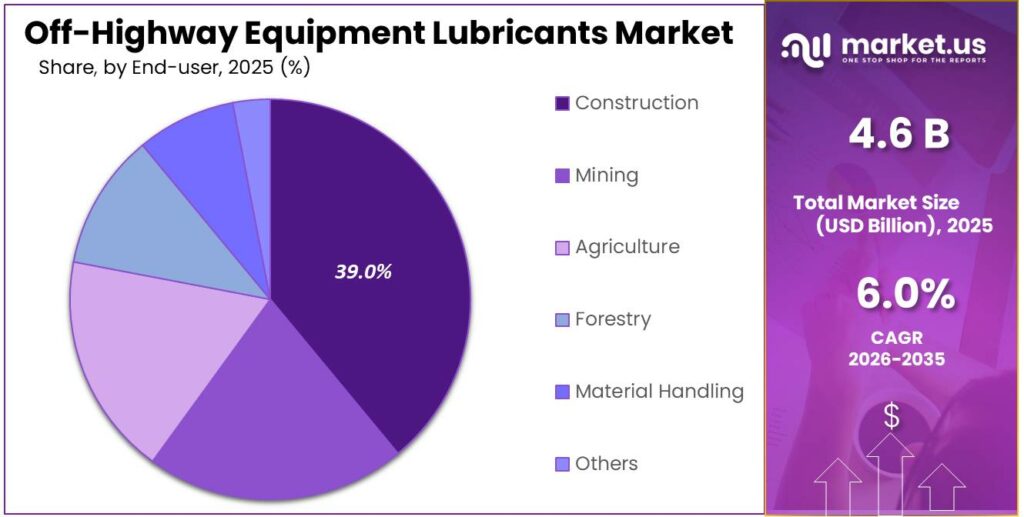
- Construction held a dominant market position, capturing more than a 39.3% share.
- Asia Pacific dominates the Off-Highway Equipment Lubricants Market, accounting for 48.9% of global revenue, equivalent to USD 2.2 billion.
By Type Analysis
Heavy-Duty Engine Oils lead the market with a strong 37.4% share
In 2024, Heavy-Duty Engine Oils held a dominant market position, capturing more than a 37.4% share, reflecting their essential role in protecting high-load and high-temperature engines used in construction, mining, and agricultural machinery. This category remained the core lubricant type across off-highway fleets because equipment operators continue to push for longer drain intervals, reduced downtime, and stronger protection against soot, oxidation, and thermal stress.
Throughout 2024, demand was supported by rising engine upgrades in non-road mobile machinery and stricter emission norms that require cleaner, low-ash formulations to safeguard after-treatment systems. As a result, OEM-approved heavy-duty oils saw steady consumption across both advanced and developing markets.
By Equipment Analysis
Tractor segment leads the market with a strong 34.1% share
In 2024, Tractor held a dominant market position, capturing more than a 34.1% share, driven by the steady rise in mechanized farming and the growing use of high-horsepower tractors across large agricultural fields. Farmers increasingly relied on modern tractors for ploughing, harvesting, soil preparation, and haulage, which created consistent demand for reliable lubricants that could handle heavy loads and long operating hours.
Throughout 2024, the segment benefited from upgrades in engine technology, greater adoption of multi-function tractors, and the need for performance-oriented engine oils, transmission fluids, and hydraulic lubricants tailored for agricultural conditions.
By End-User Analysis
Construction segment leads the market with a solid 39.3% share
In 2024, Construction held a dominant market position, capturing more than a 39.3% share, supported by the rapid expansion of infrastructure projects, road-building programs, urban development, and large-scale industrial construction across global regions. Heavy machinery such as excavators, loaders, bulldozers, graders, and compactors operated in harsh environments, making high-performance lubricants essential for engine protection, hydraulic system stability, and reduction of component wear.
In 2024, the increasing shift toward high-capacity equipment and continuous on-site operations created strong demand for durable lubricants that improve fuel efficiency and minimize breakdowns, helping the construction segment maintain its leadership.
Key Market Segments
By Type
- Heavy-Duty Engine Oils
- Transmission Fluids
- Hydraulic Fluids
- Greases
- Gear oils
- Others
By Equipment
- Tractor
- Excavator
- Forklift
- Harvesters
- Others
By End-User
- Construction
- Mining
- Agriculture
- Forestry
- Material Handling
- Others
Emerging Trends
Shift toward climate-smart and biodegradable lubricants in food-linked machinery
One of the clearest recent trends in the Off-Highway Equipment Lubricants space is a move toward climate-smart, low-emission and biodegradable formulations, especially for machinery that sits close to the world’s food system.
- The Food and Agriculture Organization (FAO) reports that global agrifood systems emitted 16.5 billion tonnes of CO₂-equivalent in 2023, accounting for 32% of total human-made greenhouse gases. Farm-gate emissions from crops and livestock alone reached 8.1 billion tonnes, about 49% of agrifood emissions and up 17% since 2001.
Research summarised by FAO and other partners also shows that agriculture’s share of total greenhouse gas emissions has hovered around 20% of global CO₂-equivalent output in recent years, even as productivity rose. At the same time, analytical work cited by FAO indicates that direct agricultural emissions have edged down from 11.4 Gt CO₂-equivalent in 1992 to 10.9 Gt in 2020, thanks to efficiency gains and better practices.
The OECD-FAO Agricultural Outlook 2025–2034 makes this link explicit. In one scenario, the report suggests that eliminating undernourishment and cutting direct agricultural emissions by 7% below current levels by 2034 would require roughly a 15% increase in agricultural productivity, along with broad adoption of emission-reduction technologies. Technologies in that basket go beyond seeds and fertilizers.
Drivers
Soaring food demand and farm mechanization are powering lubricant growth
One of the biggest real-world drivers for Off-Highway Equipment Lubricants is the simple fact that the world needs much more food, grown much more efficiently. The Food and Agriculture Organization (FAO) estimates that by 2050 the world will have to produce around 60% more food to feed a population of about 9.3 billion people, after food output has already increased by almost 300% over the last 50 years.
In a separate long-term projection, FAO expects global food production to rise by roughly 60% between 2005/07 and 2050 in its baseline scenario. At the same time, recent UN-linked analysis puts the 2050 population figure close to 9.7 billion, up from about 8.2 billion people in 2024.
To respond to this pressure, governments are actively pushing farm mechanization, which directly lifts demand for off-highway lubricants. India, for example, runs a national Sub-Mission on Agricultural Mechanisation that helps farmers buy tractors and equipment via targeted subsidies. Official scheme documents show support of 35% subsidy for small and marginal farmers on 8–20 PTO HP tractors, with others receiving 25% assistance on eligible machines.
State-level programs build on this. In 2025, the Telangana government in India launched a new Agricultural Mechanisation Scheme with an allocation of ₹100 crore, offering 50% subsidy for women farmers and 40% for other farmers on tractors, harvesters and sprayers, aiming to benefit about 130,000 farmers across the state.
Restraints
Electrification and energy transition slow traditional lubricant demand
For agriculture specifically, researchers have identified that electrification of tractors and related machinery offers clear environmental advantages but faces adoption barriers including higher upfront investment and infrastructure gaps.
Studies on agricultural electric vehicles (AEVs) show that while they could reduce greenhouse gas emissions by up to 74% compared to diesel tractors, the high initial cost and limited charging infrastructure are slowing widespread adoption. These barriers are not just technological but also financial and structural, meaning farmers and fleet owners may delay replacing existing diesel equipment until electric options are more affordable and supported.
Another dimension of the energy transition is the rising expectation for stricter emissions regulations for non-road mobile machinery. Standards similar to on-road vehicle norms are being discussed globally, forcing OEMs to explore both cleaner diesel alternatives and electrified powertrains. While this improves air quality and operational efficiency, it also signals a future where lubricants tailored for ICEs may gradually lose some of their share.
The pace of this transition is uneven, and off-highway electrification will not happen overnight. Heavy machinery used in mining, large-scale construction, and high-output agriculture still predominantly runs on diesel engines due to their unmatched power and endurance.
Opportunity
Sustainable farm mechanization is opening a powerful lubricant growth lane
A major long-term growth opportunity for Off-Highway Equipment Lubricants sits in one place: the global push for sustainable agricultural mechanization. Leading food and policy bodies are crystal clear that agriculture must produce much more with fewer hands and tighter natural limits. The FAO notes that, by 2050, the world will need to produce about 50–60% more food to feed a population approaching 9.7 billion people, compared with baseline levels around 2012–2013.
The OECD-FAO Agricultural Outlook projects that global agricultural and fish production will grow by about 14% by 2034, driven mainly by productivity gains in middle-income economies and an expected 17% rise in meat, dairy and egg output. That extra output means larger animal herds, more harvested hectares and more intensive use of off-highway equipment.
FAO is not just modelling this future; it is actively promoting sustainable mechanization as a central tool to raise productivity while protecting soils and water. Its mechanization strategy stresses that farm machines, when used wisely, help conserve soil structure and improve water-use efficiency, especially under climate stress.
- In 2023, the Global Conference on Sustainable Agricultural Mechanization held at FAO headquarters in Rome drew over 8,500 online registrations and more than 300 in-person delegates, under the theme “Innovation, Efficiency and Resilience”.
Regional Insights
Asia Pacific Leads the Market with 48.9% Share Valued at USD 2.2 Billion
Asia Pacific dominates the Off-Highway Equipment Lubricants Market, accounting for 48.9% of global revenue, equivalent to USD 2.2 billion, supported by the region’s massive construction pipeline, strong agricultural base, and expanding mining operations. This dominance is closely linked to Asia’s role as the world’s industrial and agricultural powerhouse.
According to the Asian Development Bank, developing Asia requires USD 1.7 trillion in annual infrastructure investment through 2030, covering transport, energy, and urban development—driving high utilization of excavators, loaders, graders, and other heavy machinery that depend on premium lubricants for long-duty cycles.
Additionally, FAO data confirms that Asia produces over 50% of global agricultural output and consumes more than 90% of the world’s rice, reflecting extraordinary tractor and harvester usage across China, India, Indonesia, and Vietnam. Such intense mechanization increases demand for engine oils, hydraulic fluids, and gear oils used across varied terrain and climatic conditions.
Mining is another strong contributor, with countries like Australia, China, and India collectively responsible for a large share of global coal, iron ore, and mineral production—activities that require high-performance lubricants to maintain machinery under extreme heat, dust, and load stress. Growing urban populations—projected to reach 3.3 billion in Asia by 2050, as per United Nations estimates—further push infrastructure expansion, lifting demand for heavy-duty construction equipment and their supporting lubricants.
Taken together, these structural drivers solidify Asia Pacific not just as the largest regional market at 48.9%, but also as the most strategically important hub for future growth in off-highway equipment lubricants, driven by rapid industrial activity, rising mechanization, and consistent investment across agriculture, mining, and infrastructure.
Key Regions and Countries Insights
- North America
- US
- Canada
- Europe
- Germany
- France
- The UK
- Spain
- Italy
- Rest of Europe
- Asia Pacific
- China
- Japan
- South Korea
- India
- Australia
- Rest of APAC
- Latin America
- Brazil
- Mexico
- Rest of Latin America
- Middle East & Africa
- GCC
- South Africa
- Rest of MEA
Key Players Analysis
Shell is one of the world’s largest lubricant suppliers, delivering more than 5 billion litres of lubricants yearly across industrial and off-highway sectors. Operating in 70+ countries, the company maintains strong supply chains for hydraulic fluids, engine oils, and gear lubricants for construction and agricultural machinery. Shell’s annual revenue surpasses USD 350 billion, supporting continued investment in synthetic and low-emission lubricant technologies. Its extensive distribution footprint and OEM partnerships allow it to serve heavy-equipment fleets across Asia, Europe, and the Americas.
BP, through its Castrol brand, delivers a wide portfolio of lubricants for off-road machinery. The company operates in 65+ countries and posts annual revenues above USD 200 billion. Castrol supplies heavy-duty engine oils, hydraulic fluids, and driveline lubricants designed for construction and farm equipment. BP’s global network includes 7 major refineries and multiple blending plants supplying high-performance fluids. With energy-transition investments exceeding USD 8 billion annually, BP continues improving lubricant formulations for efficiency and environmental performance.
FUCHS is the world’s largest independent lubricant manufacturer, operating in over 45 countries with 35+ production sites worldwide. The company generates annual revenues above EUR 3.5 billion and produces a large range of hydraulic oils, engine oils, and greases tailored for construction, agricultural, and mining machinery. FUCHS manufactures more than 10,000 lubricant formulations, enabling high customization for extreme operating environments. Its strong specialty-product portfolio strengthens its role in high-performance off-highway lubrication.
Top Key Players Outlook
- Exxon Mobil Corporation
- Royal Dutch Shell plc
- Chevron Corporation
- BP plc
- FUCHS Lubricants Co.
- Valvoline Inc.
- Idemitsu Kosan Co. Ltd.
- Sinopec Limited
- Lukoil Lubricants Company
- Phillips 66 Lubricants
- Castrol Limited
- Caltex Australia Group
Recent Industry Developments
In 2025, Exxon Mobil is investing significantly in lubricant supply infrastructure to meet growing regional needs. The company is building a lubricant manufacturing plant in Raigad, India, worth INR 900 crore, which will have the capability to produce 159,000 kiloliters of finished lubricants per year once operations begin at the end of 2025.
In 2024, Valvoline Inc. reported net revenues of USD 1,619.0 million, growing about 12% year-on-year, with system-wide store sales of USD 3,100 million and over 2,010 service locations, showing expanding reach into both retail and fleet maintenance channels.
Report Scope
Report Features Description Market Value (2025) USD 4.6 Bn Forecast Revenue (2035) USD 8.1 Bn CAGR (2026-2035) 6.0% Base Year for Estimation 2025 Historic Period 2020-2024 Forecast Period 2026-2035 Report Coverage Revenue Forecast, Market Dynamics, Competitive Landscape, Recent Developments Segments Covered By Type (Heavy-Duty Engine Oils, Transmission Fluids, Hydraulic Fluids, Greases, Gear oils, Others), By Equipment (Tractor, Excavator, Forklift, Harvesters, Others), By End-User (Construction, Mining, Agriculture, Forestry, Material Handling, Others) Regional Analysis North America – US, Canada; Europe – Germany, France, The UK, Spain, Italy, Rest of Europe; Asia Pacific – China, Japan, South Korea, India, Australia, Singapore, Rest of APAC; Latin America – Brazil, Mexico, Rest of Latin America; Middle East & Africa – GCC, South Africa, Rest of MEA Competitive Landscape Exxon Mobil Corporation, Royal Dutch Shell plc, Chevron Corporation, BP plc, FUCHS Lubricants Co., Valvoline Inc., Idemitsu Kosan Co. Ltd., Sinopec Limited, Lukoil Lubricants Company, Phillips 66 Lubricants, Castrol Limited, Caltex Australia Group Customization Scope Customization for segments, region/country-level will be provided. Moreover, additional customization can be done based on the requirements. Purchase Options We have three licenses to opt for: Single User License, Multi-User License (Up to 5 Users), Corporate Use License (Unlimited User and Printable PDF)  Off-Highway Equipment Lubricants MarketPublished date: Mar 2026add_shopping_cartBuy Now get_appDownload Sample
 -
-
- Exxon Mobil Corporation
- Royal Dutch Shell plc
- Chevron Corporation
- BP plc
- FUCHS Lubricants Co.
- Valvoline Inc.
- Idemitsu Kosan Co. Ltd.
- Sinopec Limited
- Lukoil Lubricants Company
- Phillips 66 Lubricants
- Castrol Limited
- Caltex Australia Group
Our Clients

- 179957
- Mar 2026






