Global Neural Network Market Size, Share and Analysis Report By Component (Hardware, Software, Services), By Type of Neural Network (Feedforward Neural Networks, Convolutional Neural Networks, Recurrent Neural Networks, Long Short-Term Memory Networks and Others) By Learning Type (Supervised Learning, Unsupervised Learning, Reinforcement Learning) By Deployment Mode (On-Premises, Cloud-Based), By Application (Image Recognition & Computer Vision, Natural Language Processing, Speech Recognition & Voice Interfaces, Predictive Analytics & Forecasting, Robotics & Autonomous Systems, and Others), By End User / Industry Vertical (IT & Telecommunications, BFSI, Healthcare & Life Sciences, Automotive & Transportation, Manufacturing & Industrial, Retail & E-commerce), By Regional Analysis, Global Trends and Opportunity, Future Outlook By 2025-2035
- Published date: Feb. 2026
- Report ID: 176537
- Number of Pages: 336
- Format:
-
keyboard_arrow_up
Quick Navigation
- Report Overview
- Top Market Takeaways
- Drivers Impact Analysis
- Restraint Impact Analysis
- Investor Type Impact Matrix
- Technology Enablement Analysis
- By Component
- By Neural Network Type
- By Learning Type
- By Deployment Mode
- By Application
- By End User
- Regional Perspective
- Emerging Trend Analysis
- Driver Analysis
- Restraint Analysis
- Opportunity Analysis
- Challenge Analysis
- Competitive Analysis
- Recent Developments
- Key Market Segments
- Report Scope
Report Overview
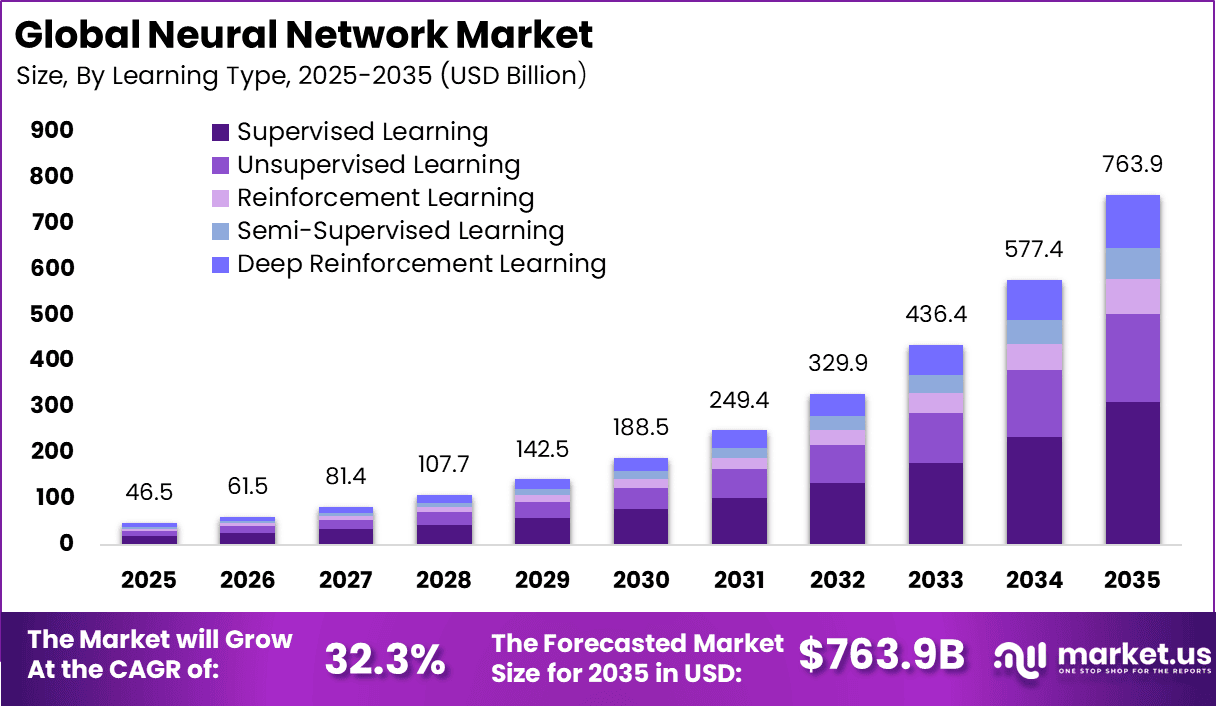
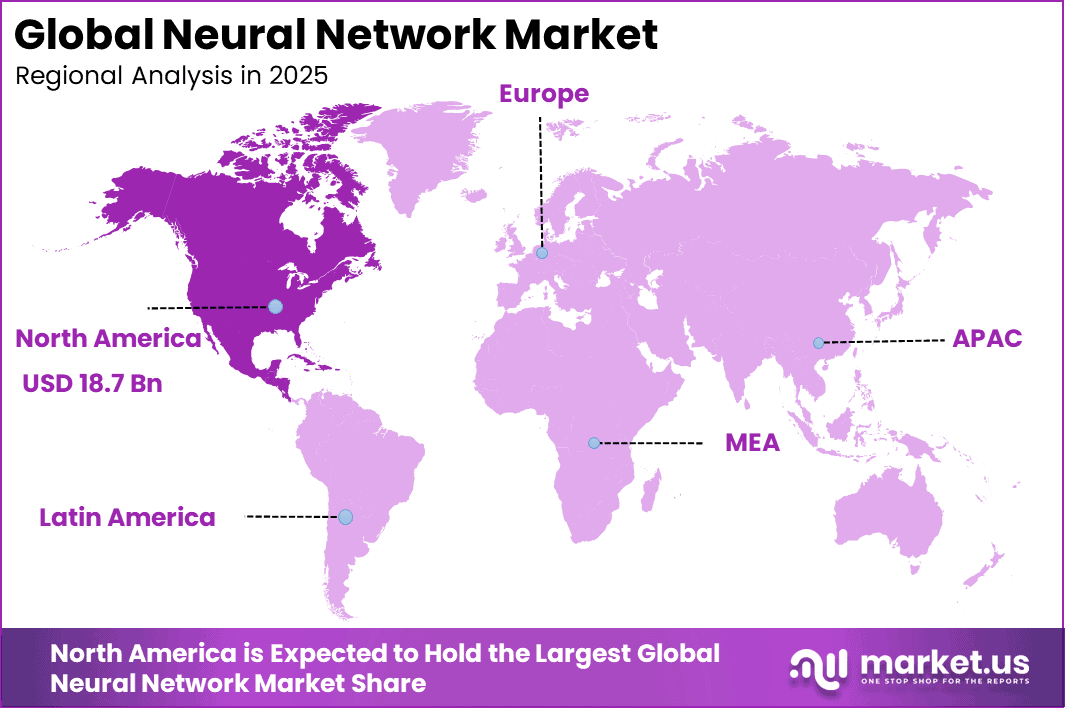
The Global Neural Network Market represents a significant long-term investment opportunity, with market size increasing from USD 46.5 billion in 2025 and projected to reach approximately USD 763.9 billion by 2035, growing at a CAGR of 32.3% during the forecast period. North America accounted for more than 40.3% of the global market and generated USD 18.7 billion in revenue, supported by strong adoption of neural network technologies across enterprise software, cloud platforms, and data-driven applications.
The neural network market covers computational models inspired by the human brain that enable machines to recognize patterns, learn from data, and make predictions. These models are widely used in areas such as image recognition, speech processing, recommendation systems, and predictive analytics. Adoption has increased as organizations seek to automate complex tasks and extract insights from large and unstructured datasets.
A primary driver of the neural network market is the rapid increase in data generated from digital platforms, sensors, and connected devices. Neural networks are well suited to process large volumes of structured and unstructured data and to identify complex relationships that traditional models cannot capture. This capability supports applications in areas such as fraud detection, medical imaging, and demand forecasting.
As data volumes continue to expand, reliance on neural network based models increases. Demand for neural network technologies is driven by enterprises adopting artificial intelligence across core business functions. Financial services use them for risk assessment and fraud prevention. Healthcare organizations apply them in diagnostics and patient monitoring. This cross-industry applicability supports sustained demand.
Top Market Takeaways
- By component, the hardware segment held the largest share at 38.9%, driven by demand for high performance processors and accelerators.
- By neural network type, convolutional neural networks (CNNs) accounted for approximately 35.5%, reflecting their widespread use in vision and pattern recognition tasks.
- By learning type, supervised learning led with 40.9%, supported by strong availability of labeled datasets and enterprise adoption.
- By deployment mode, the cloud based segment captured nearly 44.5%, driven by scalability and ease of model training and deployment.
- By application, image recognition and computer vision held about 30.5%, highlighting strong use across security, retail, healthcare, and automation.
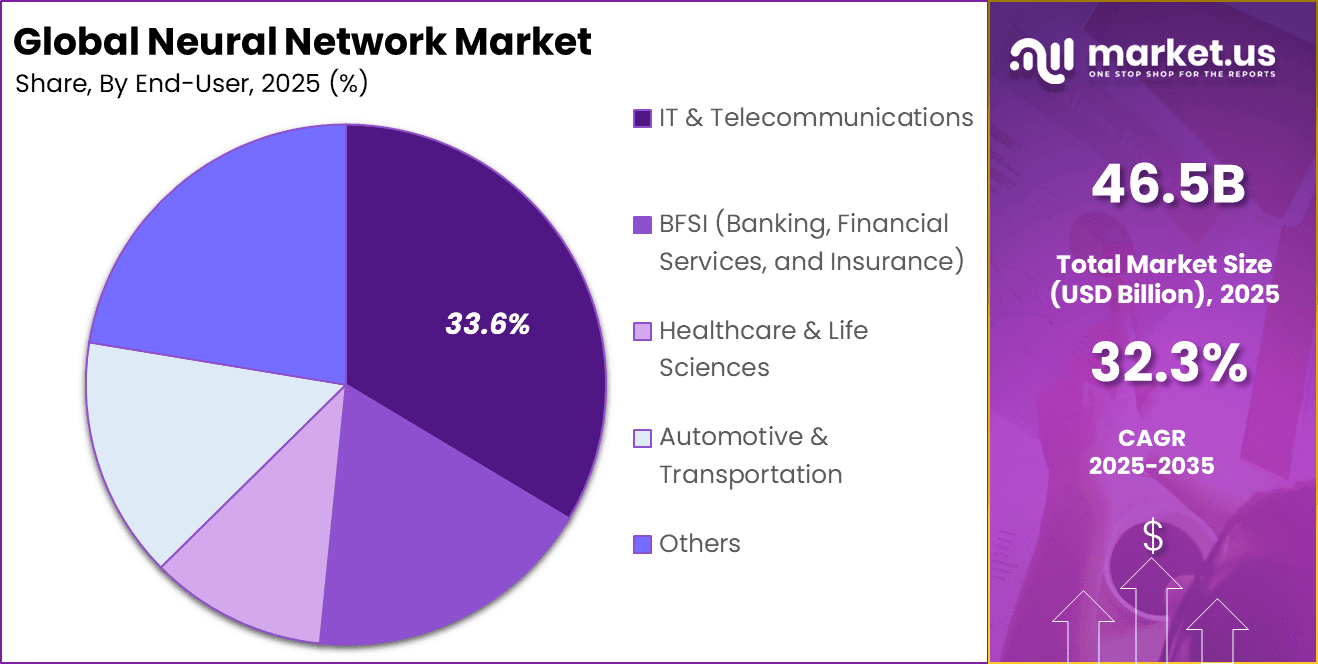
- By end user, the IT and telecommunications sector represented nearly 33.6%, supported by network optimization, automation, and analytics use cases.
- North America dominated the global neural network market with approximately 40.3% share, driven by advanced digital infrastructure and early technology adoption.
Drivers Impact Analysis
Key Driver Impact on CAGR Forecast (~) % Geographic Relevance Impact Timeline Rapid adoption of AI across enterprise and consumer applications +9.1% Global Short to medium term Growth of generative AI, deep learning, and foundation models +8.4% North America, Europe Short term Rising demand for automation in healthcare, finance, and manufacturing +6.7% North America, Asia Pacific Medium term Expansion of cloud AI platforms and AI-as-a-service models +4.9% Global Medium term Increasing availability of large datasets and compute power +3.2% Global Medium to long term Restraint Impact Analysis
Key Restraint Impact on CAGR Forecast (~) % Geographic Relevance Impact Timeline High computational and energy costs of training large models -5.8% Global Short to medium term Shortage of skilled AI and machine learning professionals -4.6% Asia Pacific, Latin America Medium term Data privacy, security, and regulatory constraints -3.9% Europe, North America Medium term Model explainability and trust issues in critical applications -3.1% Global Medium term Dependence on advanced semiconductor supply chains -2.6% Global Medium to long term Investor Type Impact Matrix
Investor Type Growth Sensitivity Risk Exposure Geographic Focus Investment Outlook AI software and platform providers Very High Medium Global Strong recurring and usage-based revenue Cloud and hyperscale infrastructure investors Very High Medium North America, Europe Core enablers of AI scale Semiconductor and AI accelerator investors High Medium Asia Pacific, North America High demand tied to model growth Private equity firms Medium Medium North America, Europe Platform expansion and consolidation Venture capital investors Very High High North America Early-stage innovation and model breakthroughs Technology Enablement Analysis
Technology Enabler Impact on CAGR Forecast (~) % Primary Function Geographic Relevance Adoption Timeline Deep learning architectures and transformer models +9.4% High-accuracy AI inference Global Short term AI accelerators and GPU-based computing +8.1% Faster model training Global Short to medium term Distributed and parallel training frameworks +6.5% Scalability of large models North America, Europe Medium term Cloud-native AI development platforms +5.2% Lower deployment barriers Global Medium term Edge neural networks for real-time inference +3.7% Low-latency decision making Asia Pacific, North America Medium to long term By Component
Hardware represents the largest component segment, holding 38.9% of overall adoption in the Neural Network Market. This dominance is driven by the need for high performance computing resources to train and run complex neural network models. Specialized processors, accelerators, and memory systems are essential to support intensive data processing workloads.
The continued reliance on hardware is also linked to improvements in processing efficiency and energy optimization. Organizations invest in advanced hardware to reduce training time and improve model accuracy. This sustains strong demand for hardware within the market.
By Neural Network Type
Convolutional neural networks account for approximately 35.5% of neural network adoption. This leadership is primarily due to their effectiveness in processing visual and spatial data. CNN architectures are widely used in tasks that require pattern detection and feature extraction.
Their dominance is reinforced by strong performance in real world applications. Image and video analysis benefit from the layered structure of convolutional models. As visual data volumes increase, CNNs remain a preferred architecture.
By Learning Type
Supervised learning holds the largest share at 40.9% within the learning type segment. This reflects its structured training approach using labeled datasets, which delivers high accuracy and predictable outcomes. Organizations favor supervised learning for applications where reliability is critical.
The widespread availability of labeled data further supports adoption. Supervised models are easier to validate and maintain compared to other approaches. This contributes to their continued leadership in the market.
By Deployment Mode
Cloud based deployment represents nearly 44.5% of overall adoption. Cloud platforms provide scalable computing resources and centralized model management. These capabilities are essential for training large neural networks and handling variable workloads.
The preference for cloud deployment is also influenced by cost efficiency and faster implementation. Organizations can access advanced infrastructure without managing physical systems. This reinforces cloud based models as the dominant deployment mode.
By Application
Image recognition and computer vision applications account for nearly 30.5% of total market demand. This dominance is driven by increasing use of visual analytics across industries. Neural networks enable accurate interpretation of images and video streams.
Adoption is supported by advancements in sensor technology and data availability. Visual data plays a central role in automation and monitoring. These factors sustain strong demand for computer vision applications.
By End User
The IT and telecommunication sector represents nearly 33.6% of end user demand. This sector relies heavily on neural networks for network optimization, traffic analysis, and service quality monitoring. High data volumes make intelligent processing essential.
Neural networks support predictive maintenance and real time decision making in communication networks. Digital infrastructure expansion further increases adoption. This maintains the sector’s leading position among end users.
Regional Perspective
North America dominates the Neural Network Market by holding about 40.3% of total adoption. The region benefits from advanced digital infrastructure, strong research capabilities, and high enterprise technology investment. Neural networks are widely integrated into business and consumer applications.
Supportive innovation environments and skilled talent availability further strengthen regional leadership. Organizations across sectors prioritize intelligent automation. These conditions sustain North America’s dominant position in the market.
Emerging Trend Analysis
A key emerging trend in the Neural Network market is the increasing deployment of hybrid models that combine classical neural network architectures with symbolic reasoning and logic based systems. These hybrid frameworks aim to improve interpretability while retaining predictive performance, allowing neural networks to address complex decision making with greater transparency.
Research and development efforts are increasingly focused on blending deep learning with structured reasoning to support tasks that require both pattern recognition and logical inference. Another emerging trend is the growing use of lightweight neural network models optimised for edge devices and low power environments.
As demand increases for smart functions in consumer electronics, industrial sensors, and autonomous systems, neural networks are being compressed and adapted for efficient operation outside large data centre environments. Techniques such as model pruning, knowledge distillation, and quantization are widely applied to balance performance with efficiency.
Driver Analysis
A primary driver of the Neural Network market is the proliferation of data and computing resources that support model training and deployment. Organisations across industries are generating large volumes of structured and unstructured data that can be leveraged to train high performance neural networks for tasks such as image recognition, language understanding, and predictive analytics.
The availability of accelerated computing platforms, including GPUs and specialised AI chips, has enabled more complex models to be developed and deployed at scale. Another strong driver is the expansion of AI enabled applications across diverse sectors such as healthcare, automotive, finance, and consumer technology.
Neural networks provide capabilities for advanced pattern detection and prediction that people increasingly rely on for diagnostics, autonomous driving features, fraud detection, and personalised services. The broad applicability of neural network methods makes them an essential component of contemporary AI strategies.
Restraint Analysis
A major restraint in the Neural Network market is the increasing concern about model explainability and interpretability. Complex neural architectures, especially deep learning models, are often viewed as opaque, making it difficult for stakeholders to understand how specific predictions are made. This lack of transparency can constrain adoption in regulated industries where explainability is required for compliance and accountability.
Another restraint arises from the high computational cost associated with training and tuning large neural network models. Training state of the art networks can require significant energy and specialised infrastructure, creating barriers for smaller organisations that lack large IT budgets or access to advanced computing resources. These resource demands can slow experimentation and limit innovation outside well resourced institutions.
Opportunity Analysis
An important opportunity in the Neural Network market lies in the development of federated learning approaches that allow distributed model training without centralising sensitive data. Federated learning supports collaborative model improvement while respecting data privacy and regulatory constraints, making it attractive for sectors such as healthcare and finance where data sharing is restricted.
Wider adoption of federated neural networks can enable innovation while maintaining confidentiality. Another opportunity is the integration of neural networks with domain specific solutions that address specialised challenges, such as drug discovery, industrial defect detection, or climate modelling.
Customised neural network frameworks that embed domain knowledge can deliver differentiated value, improving efficiency and decision quality in niche applications. This trend supports growth in vertical markets where tailored AI solutions are increasingly sought.
Challenge Analysis
A significant challenge in the Neural Network market is ensuring ethical use and avoiding unintended societal impacts. Neural networks trained on biased data can produce discriminatory or unfair outcomes, which raises concerns in settings such as hiring systems, credit evaluation, or criminal justice. Addressing bias, fairness, and accountability remains a core challenge for developers and users alike.
Another challenge involves maintaining model robustness and reliability in real world environments. Neural networks can be sensitive to input perturbations or distribution shifts, which can degrade performance when deployed outside controlled conditions. Ensuring stability and consistent behaviour across varied inputs requires rigorous validation and ongoing monitoring of neural models.
Competitive Analysis
Large cloud and enterprise technology providers such as Microsoft Corporation, IBM Corporation, and Amazon Web Services lead the neural network market through scalable infrastructure and managed AI services. Their platforms support model development, training, and deployment across industries. Strong integration with data, security, and compliance tools supports enterprise adoption. Oracle Corporation and SAP SE extend neural networks into business workflows.
Semiconductor and hardware-focused players such as NVIDIA Corporation, Intel Corporation, and Qualcomm Technologies provide the compute backbone for neural networks. Hewlett Packard Enterprise and Fujitsu Limited support on-premises and hybrid AI deployments. Emerging chip innovators such as Graphcore, Cerebras Systems, and Xilinx address training efficiency and performance bottlenecks.
AI research-driven and regional technology leaders such as OpenAI and DeepMind shape neural network innovation through large-scale models and breakthroughs. Baidu, Inc., Tencent AI Lab, and Huawei Technologies strengthen regional ecosystems. Salesforce, Inc. embeds neural networks into customer platforms. This competitive landscape supports rapid innovation, wider adoption, and continuous performance improvement across global AI markets.
Top Key Players in the Market
- Microsoft Corporation
- IBM Corporation
- Amazon Web Services (AWS)
- Intel Corporation
- NVIDIA Corporation
- Oracle Corporation
- Qualcomm Technologies
- Baidu, Inc.
- Tencent AI Lab
- Huawei Technologies
- Salesforce, Inc.
- SAP SE
- HPE (Hewlett Packard Enterprise)
- Fujitsu Limited
- Graphcore
- Cerebras Systems
- Xilinx (AMD)
- OpenAI
- DeepMind (Alphabet subsidiary)
- Others
Recent Developments
- In July 2025, SenseTime introduced the enhanced SenseNova V6.5 multimodal large model system at the WAIC 2025 Large Model Forum. The update marked a shift in AI usage from a productivity support tool to a direct productivity driver, with notable improvements in reasoning performance and operational efficiency.
- In March 2025, Microsoft partnered with Inait to develop AI models inspired by mammalian brain reasoning. The collaboration focuses on creating advanced reasoning systems that can be applied across industries such as finance and robotics.
- In January 2025, NVIDIA launched the GeForce RTX 50 Series GPUs featuring DLSS 4 with Multi Frame Generation. This technology enables AI driven generation of up to three additional frames for each traditionally rendered frame, delivering performance improvements of up to 8x compared to conventional rendering.
Key Market Segments
By Component
- Hardware
- GPUs
- TPUs
- FPGAs
- ASICs
- Software
- Neural Network Frameworks
- AI Platforms & Middleware
- Services
- Training & Consulting
- Integration & Deployment
- Managed Services
By Type
- Feedforward Neural Networks (FNN)
- Convolutional Neural Networks (CNN)
- Recurrent Neural Networks (RNN)
- Long Short-Term Memory Networks (LSTM)
- Generative Adversarial Networks (GANs)
- Others
By Learning Type
- Supervised Learning
- Unsupervised Learning
- Reinforcement Learning
- Semi-Supervised Learning
- Deep Reinforcement Learning
By Deployment Mode
- On-Premises
- Cloud-Based
- Public Cloud
- Private Cloud
- Hybrid Cloud
By Application
- Image Recognition & Computer Vision
- Natural Language Processing (NLP)
- Speech Recognition & Voice Interfaces
- Predictive Analytics & Forecasting
- Robotics & Autonomous Systems
- Healthcare Diagnostics & Genomics
- Financial Risk Analysis & Fraud Detection
- Industrial Process Automation
- Others
By End User / Industry Vertical
- IT & Telecommunications
- BFSI (Banking, Financial Services, and Insurance)
- Healthcare & Life Sciences
- Automotive & Transportation
- Others
Regional Analysis and Coverage
- North America
- US
- Canada
- Europe
- Germany
- France
- The UK
- Spain
- Italy
- Russia
- Netherlands
- Rest of Europe
- Asia Pacific
- China
- Japan
- South Korea
- India
- Australia
- Singapore
- Thailand
- Vietnam
- Rest of Latin America
- Latin America
- Brazil
- Mexico
- Rest of Latin America
- Middle East & Africa
- South Africa
- Saudi Arabia
- UAE
- Rest of MEA
Report Scope
Report Features Description Market Value (2025) USD 46.5 Bn Forecast Revenue (2035) USD 763.9 Bn CAGR(2026-2035) 12.6% Base Year for Estimation 2025 Historic Period 2020-2024 Forecast Period 2026-2035 Report Coverage Revenue forecast, AI impact on Market trends, Share Insights, Company ranking, competitive landscape, Recent Developments, Market Dynamics and Emerging Trends Segments Covered By Component (Hardware, Software, Services), By Type of Neural Network (Feedforward Neural Networks, Convolutional Neural Networks, Recurrent Neural Networks, Long Short-Term Memory Networks and Others) By Learning Type (Supervised Learning, Unsupervised Learning, Reinforcement Learning) By Deployment Mode (On-Premises, Cloud-Based), By Application (Image Recognition & Computer Vision, Natural Language Processing, Speech Recognition & Voice Interfaces, Predictive Analytics & Forecasting, Robotics & Autonomous Systems, and Others), By End User / Industry Vertical (IT & Telecommunications, BFSI, Healthcare & Life Sciences, Automotive & Transportation, Manufacturing & Industrial, Retail & E-commerce) Regional Analysis North America – US, Canada; Europe – Germany, France, The UK, Spain, Italy, Russia, Netherlands, Rest of Europe; Asia Pacific – China, Japan, South Korea, India, New Zealand, Singapore, Thailand, Vietnam, Rest of Latin America; Latin America – Brazil, Mexico, Rest of Latin America; Middle East & Africa – South Africa, Saudi Arabia, UAE, Rest of MEA Competitive Landscape Microsoft Corporation, IBM Corporation, Amazon Web Services (AWS), Intel Corporation, NVIDIA Corporation, Oracle Corporation, Qualcomm Technologies, Baidu, Inc., Tencent AI Lab, Huawei Technologies, Salesforce, Inc., SAP SE, HPE (Hewlett Packard Enterprise), Fujitsu Limited, Graphcore, Cerebras Systems, Xilinx (AMD), OpenAI, DeepMind (Alphabet subsidiary), Others Customization Scope Customization for segments, region/country-level will be provided. Moreover, additional customization can be done based on the requirements. Purchase Options We have three license to opt for: Single User License, Multi-User License (Up to 5 Users), Corporate Use License (Unlimited User and Printable PDF) 
-
-
- Microsoft Corporation
- IBM Corporation
- Amazon Web Services (AWS)
- Intel Corporation
- NVIDIA Corporation
- Oracle Corporation
- Qualcomm Technologies
- Baidu, Inc.
- Tencent AI Lab
- Huawei Technologies
- Salesforce, Inc.
- SAP SE
- HPE (Hewlett Packard Enterprise)
- Fujitsu Limited
- Graphcore
- Cerebras Systems
- Xilinx (AMD)
- OpenAI
- DeepMind (Alphabet subsidiary)
- Others
Our Clients

- 176537
- Feb. 2026