


Global Network Cabinet Monitoring Market Size, Share and Analysis By Component (Hardware, Software, Services), By Monitoring Type (Temperature Monitoring, Humidity Monitoring, Power Monitoring, Security Monitoring, Others), By Application (Data Centers, Enterprises, Telecom, Industrial, Government, Others), By Regional Analysis, Global Trends and Opportunity, Future Outlook By 2025-2035
- Published date: March 2026
- Report ID: 181492
- Number of Pages: 213
- Format:
-
keyboard_arrow_up
Quick Navigation
Report Overview
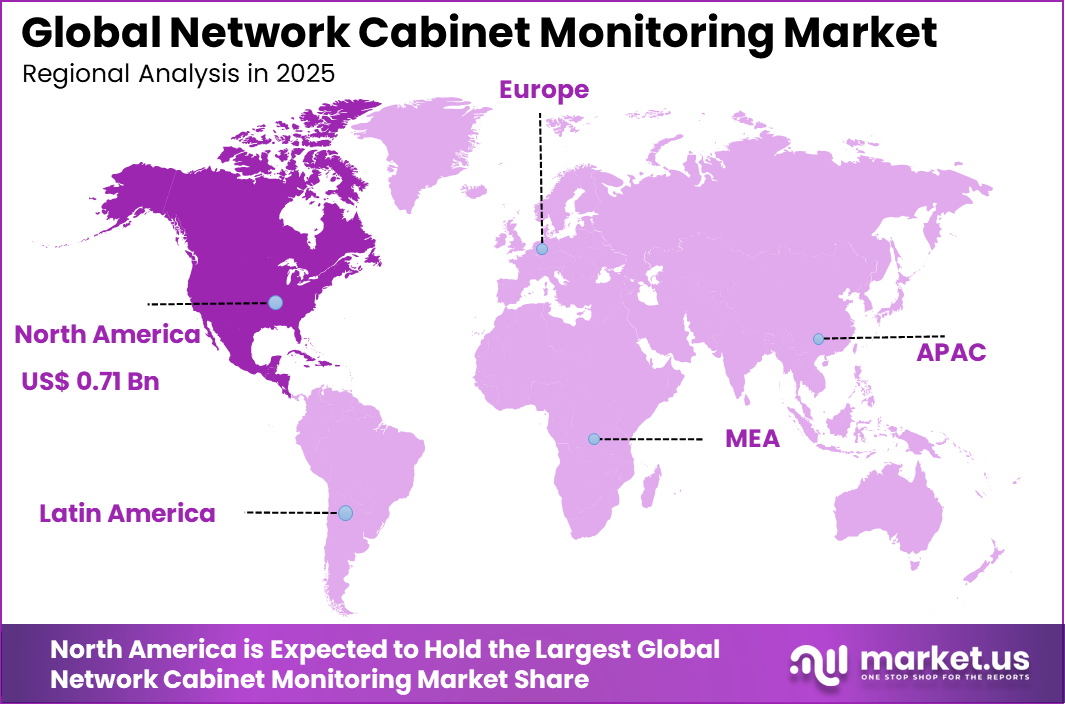
The Global Network Cabinet Monitoring Market size is expected to be worth around USD 5.54 billion by 2035, from USD 1.97 billion in 2025, growing at a CAGR of 10.9% during the forecast period from 2025 to 2035. North America held a dominant market position, capturing more than a 36.4% share, holding USD 0.71 billion in revenue.
Network Cabinet Monitoring refers to the process of tracking environmental and operational conditions inside network cabinets that house IT and communication equipment. Sensors and monitoring tools measure temperature, humidity, airflow, and power status. This helps IT teams detect problems early, prevent overheating, and maintain stable performance of servers, switches, and other critical network devices.
The market gains momentum due to the sharp rise in data traffic across enterprise networks. Organizations now rely on constant monitoring to avoid system failures and performance issues. Unplanned outages cost businesses thousands per minute, making preventive oversight essential. Over 40% of equipment failures occur from overheating in dense cabinets, which increases the need for reliable environmental monitoring solutions.
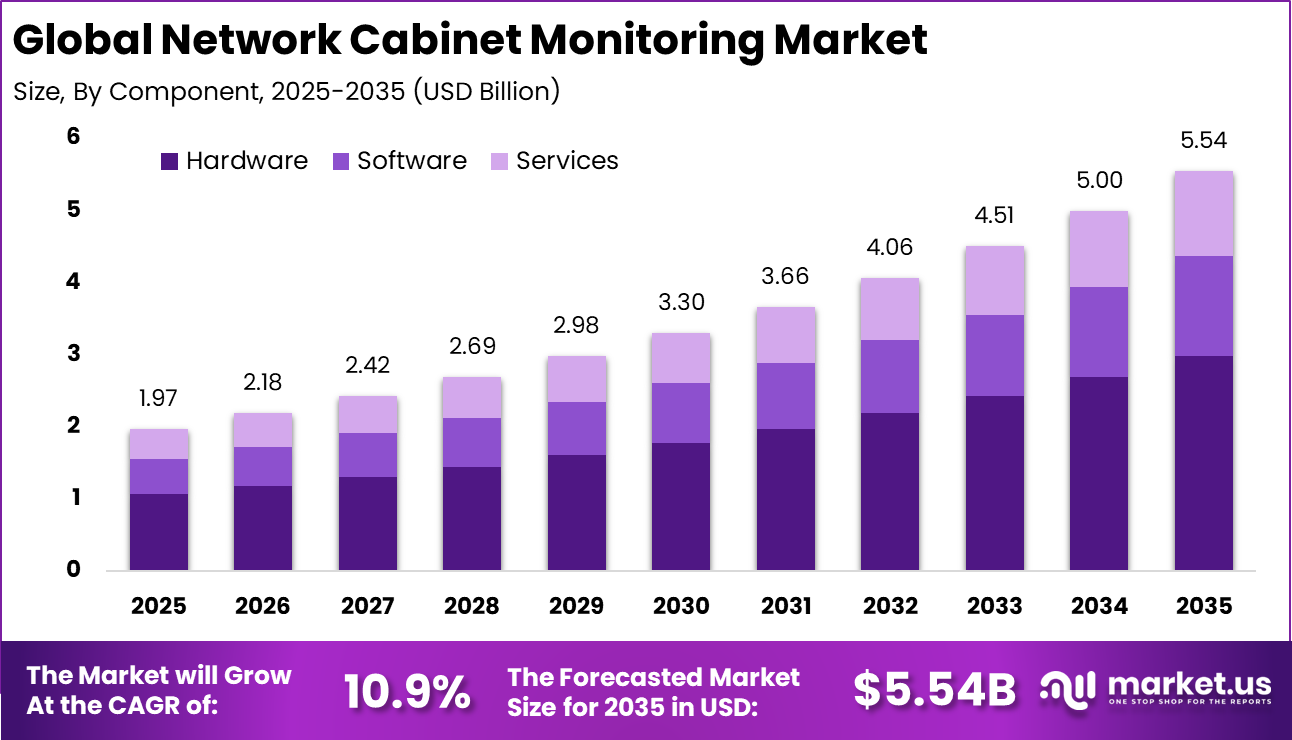
The market for Network Cabinet Monitoring is driven by the rising need to protect critical IT equipment from overheating, power issues, and unexpected failures. Businesses rely on stable network performance, so constant monitoring inside cabinets has become important. Growing data center activity, remote infrastructure management, and the need for faster fault detection are also supporting demand for these monitoring solutions.
Demand is increasing as businesses depend heavily on uninterrupted digital operations. Distributed IT infrastructure and remote work environments have expanded the number of network cabinets in use. Monitoring these systems remotely helps teams respond quickly to problems. Around 70% of IT managers report that real time alerts reduce response time significantly, encouraging broader adoption across data intensive industries.
For instance, in June 2025, Emerson Electric Co. (via Vertiv legacy tech) unveiled DeltaV-based cabinet surveillance with vibration detection. Early adopters in manufacturing saw 15% fewer equipment failures. Emerson’s reliable monitoring tech continues to anchor U.S. industrial dominance in harsh-environment network cabinets.
Key Takeaway
- In 2025, the Hardware segment led the Global Network Cabinet Monitoring Market, accounting for 53.8% of total share.
- In 2025, Power Monitoring emerged as the dominant solution type, capturing 37.5% of the market.
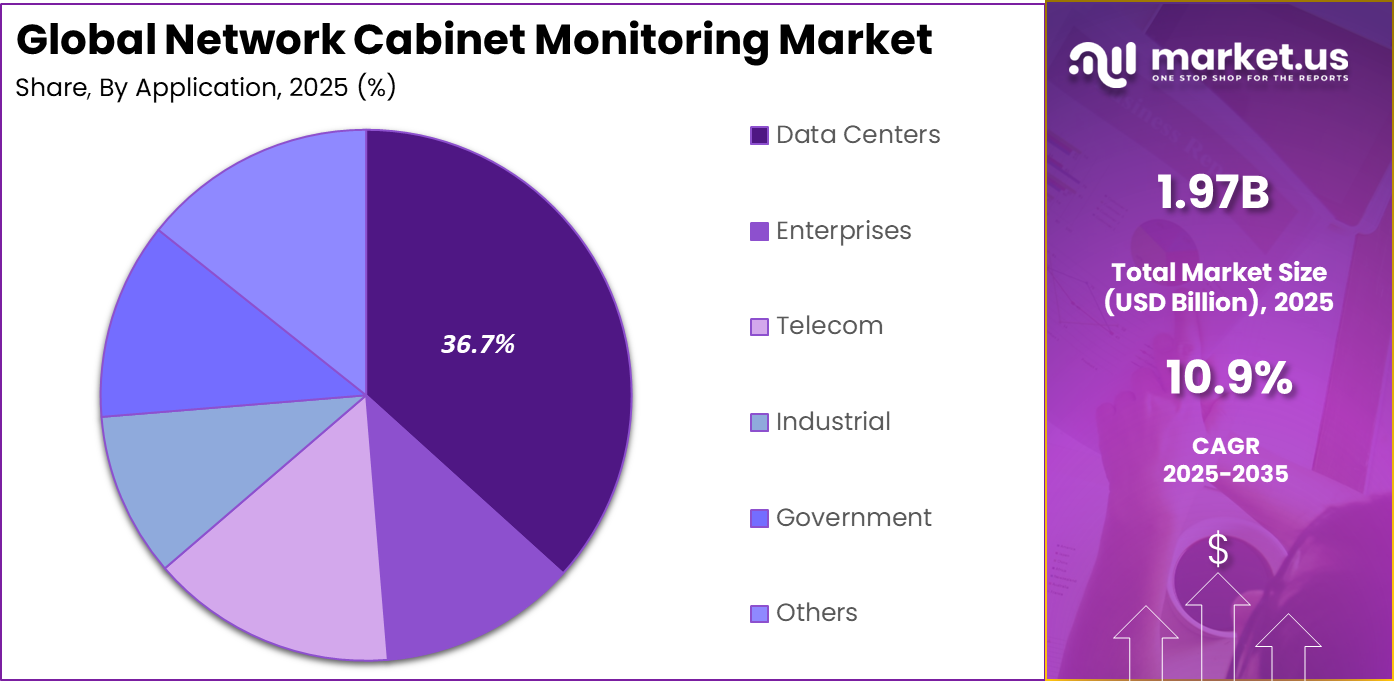
- In 2025, Data Centers represented the leading application segment with a 36.7% share.
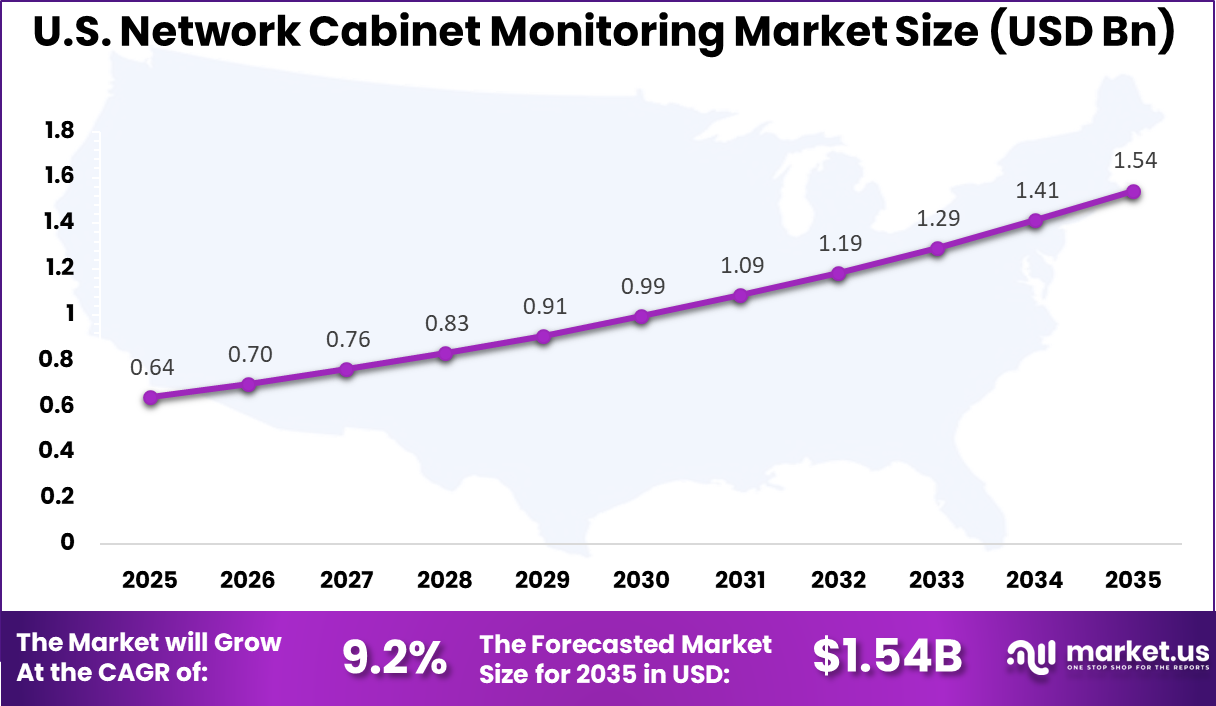
- In 2025, the U.S. Network Cabinet Monitoring Market reached USD 0.64 billion and recorded a growth rate of 9.2%.
- In 2025, North America maintained regional leadership, securing more than 36.4% of the Global Network Cabinet Monitoring Market.
Role of Generative AI
Generative AI helps IT teams understand the huge amount of data produced by cabinet sensors. It reviews logs, temperature signals, and power activity to detect unusual patterns such as overheating or voltage drops. Early trials show the technology can reduce downtime by nearly 40% by identifying potential faults before they affect operations.
AI driven tools also allow engineers to interact with monitoring systems through simple chat platforms. Teams can ask questions and receive quick insights without checking complex dashboards. This practical use of AI has improved troubleshooting efficiency, with many organizations reporting around 35% faster issue resolution during network incidents.
U.S. Market Size
The market for Network Cabinet Monitoring within the U.S. is growing tremendously and is currently valued at USD 0.64 billion, the market has a projected CAGR of 9.2%. The market is growing due to the rising expansion of data centers, cloud infrastructure, and edge computing facilities across the country.
Organizations depend heavily on uninterrupted digital services, making reliable equipment monitoring essential. Companies are investing in smarter cabinet monitoring tools to prevent overheating, reduce downtime, and maintain stable performance of servers, networking hardware, and communication systems.
For instance, in March 2026, Vertiv Group Corp., based in Columbus, Ohio, launched advanced AI-driven network cabinet monitoring systems that provide real-time environmental control and predictive maintenance for data centers. This innovation helps prevent downtime and optimize energy use, solidifying U.S. leadership in reliable network infrastructure management.
In 2025, North America held a dominant market position in the Global Network Cabinet Monitoring Market, capturing more than a 36.4% share, holding USD 0.71 billion in revenue. This dominance is due to the strong presence of large data centers, advanced telecom infrastructure, and early adoption of intelligent monitoring technologies.
Enterprises in the region prioritize network reliability and preventive maintenance. High investments in cloud computing, enterprise IT modernization, and digital services also strengthen demand for cabinet monitoring solutions across multiple industries.
For instance, in January 2026, Emerson Electric Co., headquartered in Ferguson, Missouri, unveiled next-gen cabinet monitoring with remote diagnostics and automation capabilities tailored for telecom infrastructure. This positions North America at the forefront of scalable, high-performance network monitoring solutions worldwide.
Component Analysis
In 2025, The Hardware segment held a dominant market position, capturing a 53.8% share of the Global Network Cabinet Monitoring Market. This dominance is due to the essential role hardware devices play in monitoring network cabinets. Sensors that track temperature, humidity, airflow, and door activity provide direct visibility into cabinet conditions. These physical devices collect accurate environmental data that helps IT teams detect issues early and maintain stable operating environments for networking equipment.
Hardware monitoring tools are widely used because they support continuous supervision of equipment placed in dense cabinets. Many facilities rely on these devices to identify overheating, airflow blockages, or unusual cabinet activity. Early detection helps technicians act quickly and maintain reliable performance across the network infrastructure.
For Instance, in March 2026, Vertiv Group Corp. rolled out new controller modules designed for edge cabinets with better vibration resistance. The update targets high-density areas where reliability matters most. Teams can now adjust settings faster, cutting response times during peaks. This development drives hardware growth by addressing gaps in harsh conditions.
Monitoring Type Analysis
In 2025, the Power Monitoring segment held a dominant market position, capturing a 37.5% share of the Global Network Cabinet Monitoring Market. This dominance is due to the growing need to maintain stable electrical conditions inside network cabinets. Networking equipment depends on a reliable power supply, and monitoring systems help track voltage levels, current usage, and energy distribution. These insights help operators identify irregularities before they affect network performance.
Power monitoring solutions also help organizations manage energy consumption and protect sensitive equipment. By observing power behavior in real time, IT teams can prevent overload conditions and respond quickly to potential risks. This improves operational stability and supports the continuous functioning of critical network systems.
For instance, in January 2026, Eaton Corporation introduced a power tracker add-on that flags load shifts in seconds across multiple cabinets. It helps balance energy draw and avoid spikes that slow operations. Managers like how it links to alerts for quick fixes. This innovation fuels power monitoring’s rise by tackling efficiency head-on.
Application Analysis
In 2025, The Data Centers segment held a dominant market position, capturing a 36.7% share of the Global Network Cabinet Monitoring Market. This dominance is due to the large number of network cabinets installed inside modern data centers. These facilities operate with high density computing equipment that generates heat and requires controlled environmental conditions. Monitoring systems help operators maintain safe cabinet temperatures and manage airflow effectively.
Data center teams depend on cabinet monitoring to maintain reliable operations. Continuous tracking of cabinet conditions helps technicians detect potential risks early and maintain a stable infrastructure. This approach supports uninterrupted service delivery and ensures that digital platforms and cloud services run smoothly.
For Instance, in January 2026, Emerson Electric Co. debuted a cabinet oversight kit for hyperscale sites, emphasizing airflow and power ties. It speeds up issue spotting in massive layouts. Operators gain clearer views without extra staff. Data center demand surges with these efficient tools. This keeps the application dominant as digital loads keep climbing.
Emerging Trends
Edge AI processing is becoming common in network cabinet monitoring systems. Instead of sending all sensor data to the cloud, analysis happens close to the cabinet itself. This approach reduces response delays and works well in areas with unstable connectivity. Around 60% of modern installations already include edge processing for faster alerts.
Wireless sensor networks are gradually replacing traditional wired monitoring setups. These solutions simplify installation because they reduce the need for heavy cabling inside cabinets. The approach also supports flexible expansion as new devices are added. Adoption increased by about 45% last year as organizations looked for easier deployment methods.
Growth Factors
The growing number of data centers worldwide is creating strong demand for cabinet monitoring systems. More computing infrastructure means more cabinets that require temperature, airflow, and power supervision. Nearly 55% of new data center facilities now include advanced monitoring tools during initial setup to reduce equipment risks.
Security concerns around physical infrastructure are also driving the adoption of intelligent monitoring. Operators increasingly use AI-supported systems to detect unusual activity in power usage or cabinet conditions. Around 70% of infrastructure managers now add anomaly detection layers to strengthen protection beyond traditional environmental monitoring.
Key Market Segments
By Component
- Hardware
- Software
- Services
By Monitoring Type
- Temperature Monitoring
- Humidity Monitoring
- Power Monitoring
- Security Monitoring
- Others
By Application
- Data Centers
- Enterprises
- Telecom
- Industrial
- Government
- Others
Key Regions and Countries
North America
- US
- Canada
Europe
- Germany
- France
- The UK
- Spain
- Italy
- Russia
- Netherlands
- Rest of Europe
Asia Pacific
- China
- Japan
- South Korea
- India
- Australia
- Singapore
- Thailand
- Vietnam
- Rest of APAC
Latin America
- Brazil
- Mexico
- Rest of Latin America
Middle East & Africa
- South Africa
- Saudi Arabia
- UAE
- Rest of MEA
Drivers
Growing need for real-time cabinet visibility
Organizations depend heavily on stable network infrastructure to support digital services and business operations. Network cabinets contain critical devices such as switches, routers, and servers that require constant supervision. Real time visibility helps IT teams track environmental conditions, power usage, and cabinet access so that issues can be detected early before they affect performance.
Continuous monitoring also improves operational efficiency for technical teams. Instead of reacting to failures after they occur, administrators receive alerts when abnormal temperature, humidity, or power conditions appear. This allows faster response and better maintenance planning, helping organizations maintain reliable connectivity across data centers and distributed IT environments.
For instance, in January 2026, Schneider Electric rolled out upgraded NetShelter enclosures with built-in sensors for instant temperature and power tracking. This move helps data center teams catch small issues early, avoiding big outages. Operators now get mobile alerts to keep everything humming without constant checks.
Restraint
Integration complexity
Integrating cabinet monitoring systems into existing network infrastructure can be challenging for many organizations. Older facilities often operate with different hardware standards and management platforms that may not easily support modern monitoring sensors and software. This creates additional work for IT teams during installation and system configuration.
Technical compatibility between monitoring devices, communication protocols, and management platforms also requires careful coordination. In some cases, organizations need specialized expertise to connect monitoring systems with existing network management tools. These integration requirements can slow deployment and increase operational effort for infrastructure teams.
For instance, in November 2025, Eaton Corporation shared details on a tricky rollout where its monitoring add-on clashed with legacy wiring in older sites. Teams spent weeks tweaking protocols to sync data flows, slowing the full setup. In the end, they simplified cabling paths, but it showed how mixed gear still trips up quick installs.
Opportunities
Expansion of Edge Computing Infrastructure
The rise of edge computing is opening new opportunities for network cabinet monitoring solutions. Businesses are deploying smaller data processing facilities closer to users to support applications that require faster response times. These distributed locations often operate without full time technical staff, increasing the need for remote monitoring capabilities.
Cabinet monitoring technologies help operators supervise environmental and power conditions across many remote locations from a central platform. Sensors and monitoring tools allow teams to detect equipment risks quickly and respond before service disruption occurs. As edge computing environments continue expanding, demand for reliable monitoring systems is expected to increase.
For instance, in March 2026, ABB Ltd. introduced compact monitors designed for edge sites like remote factories, linking cabinets to local processing hubs. This fits the push for on-site data handling, cutting lag in alerts for far-flung operations. Early users in manufacturing saw faster responses to edge failures.
Challenges
Keeping pace with evolving security and compliance needs
Security concerns around physical infrastructure are becoming more important for organizations that manage network environments. Cabinets containing networking equipment must be protected from unauthorized access or tampering. Monitoring systems help track door activity, access attempts, and environmental changes that could indicate potential risks.
Regulatory and operational standards also require organizations to maintain proper control over infrastructure environments. IT teams must ensure that monitoring tools support audit requirements and provide accurate records of cabinet conditions and access events. Keeping monitoring systems updated with evolving security expectations remains a continuing challenge for infrastructure operators.
For instance, in September 2025, APC by Schneider Electric patched a firmware gap in their cabinet units after new regs demanded tighter access logs. Updates rolled out firm-wide, but some sites lagged due to downtime fears. They added auto-checks to spot compliance drifts going forward.
Key Players Analysis
The Network Cabinet Monitoring Market is driven by global power management and infrastructure solution providers that deliver monitoring systems for data centers and telecom environments. Schneider Electric, Vertiv Group Corp., and Eaton Corporation provide advanced cabinet monitoring solutions that track temperature, humidity, power usage, and physical access. These systems help organizations maintain optimal operating conditions and prevent equipment failures.
Industrial automation and enclosure system providers also play a key role in this market. Rittal GmbH & Co. KG, ABB Ltd., and Emerson Electric Co. offer integrated monitoring and control systems for network cabinets and server racks. Their solutions focus on improving operational reliability, energy efficiency, and equipment protection. These companies support large scale infrastructure deployments across industrial automation and IT sectors.
Connectivity and power distribution solution providers further strengthen the competitive landscape. APC, Panduit Corp., Tripp Lite, and Legrand SA deliver rack level monitoring, cable management, and intelligent power distribution units. These solutions enable real time visibility into cabinet performance and support proactive maintenance strategies.
Top Key Players in the Market
- Schneider Electric
- Vertiv Group Corp.
- Eaton Corporation
- Rittal GmbH & Co. KG
- ABB Ltd.
- Emerson Electric Co.
- APC by Schneider Electric
- Panduit Corp.
- Tripp Lite
- Legrand SA
- Others
Recent Developments
- In January 2026, Schneider Electric launched the latest EcoStruxure IT Rack Monitoring solution with enhanced AI analytics for predictive maintenance. This upgrade helps data center managers spot cooling failures before they happen, cutting downtime by 30% in real-world tests. It’s a smart move to keep North America ahead in reliable network infrastructure.
- In March 2026, Eaton Corporation introduced the Network-M4 card, building on their M3 with zero-trust cybersecurity baked in. It prevents cyberattacks on UPS-connected cabinets while monitoring power quality. Eaton’s focus on secure, connected infrastructure solidifies its dominant position in North American mission-critical monitoring.
Report Scope
Report Features Description Market Value (2025) USD 1.9 Bn Forecast Revenue (2035) USD 5.5 Bn CAGR (2025-2035) 10.9% Base Year for Estimation 2025 Historic Period 2020-2024 Forecast Period 2025-2035 Report Coverage Revenue forecast, AI impact on Market trends, Share Insights, Company ranking, competitive landscape, Recent Developments, Market Dynamics and Emerging Trends Segments Covered By Component (Hardware, Software, Services), By Monitoring Type (Temperature Monitoring, Humidity Monitoring, Power Monitoring, Security Monitoring, Others), By Application (Data Centers, Enterprises, Telecom, Industrial, Government, Others) Regional Analysis North America – US, Canada; Europe – Germany, France, The UK, Spain, Italy, Russia, Netherlands, Rest of Europe; Asia Pacific – China, Japan, South Korea, India, New Zealand, Singapore, Thailand, Vietnam, Rest of Latin America; Latin America – Brazil, Mexico, Rest of Latin America; Middle East & Africa – South Africa, Saudi Arabia, UAE, Rest of MEA Competitive Landscape Schneider Electric, Vertiv Group Corp., Eaton Corporation, Rittal GmbH & Co. KG, ABB Ltd., Emerson Electric Co., APC by Schneider Electric, Panduit Corp., Tripp Lite, Legrand SA, Others Customization Scope Customization for segments, region/country-level will be provided. Moreover, additional customization can be done based on the requirements. Purchase Options We have three license to opt for: Single User License, Multi-User License (Up to 5 Users), Corporate Use License (Unlimited User and Printable PDF)  Network Cabinet Monitoring MarketPublished date: March 2026add_shopping_cartBuy Now get_appDownload Sample
 -
-
- Schneider Electric
- Vertiv Group Corp.
- Eaton Corporation
- Rittal GmbH & Co. KG
- ABB Ltd.
- Emerson Electric Co.
- APC by Schneider Electric
- Panduit Corp.
- Tripp Lite
- Legrand SA
- Others
Our Clients

- 181492
- March 2026









