


Global Moss Agate Market Size, Share Analysis Report By Grade (Low-Grade, Mid-Grade, and High-Grade), By Application (Jewelry And Fashion Accessories, Decorative/Interior Design, Lapidary, Collectibles, and Others), By Region and Companies - Industry Segment Outlook, Market Assessment, Competition Scenario, Trends and Forecast 2026-2035
- Published date: Mar 2026
- Report ID: 181407
- Number of Pages: 384
- Format:
-
keyboard_arrow_up
Quick Navigation
Report Overview
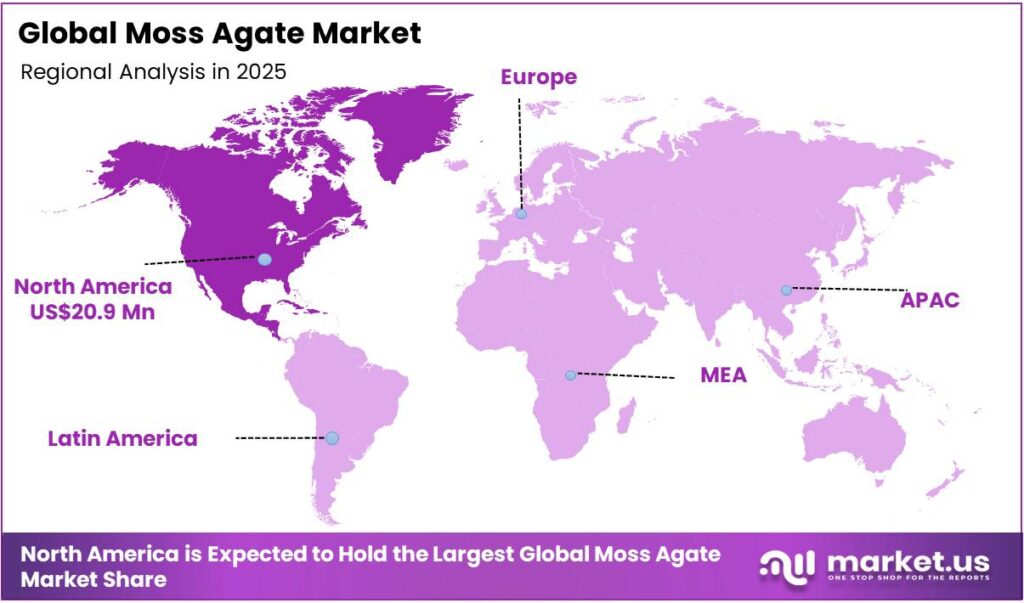
The Global Moss Agate Market size is expected to be worth around USD 107.4 Million by 2035, from USD 57.2 Million in 2025, growing at a CAGR of 6.5% during the forecast period from 2026 to 2035. In 2025, North America held a dominant market position, capturing more than a 41.6% share, holding USD 9.7 Million revenue.
Moss agate is a semi-precious gemstone known for its translucent to milky-white body and green, branch-like inclusions that resemble moss or foliage. It does not contain any organic plant matter, and its unique patterns are formed by mineral impurities such as manganese and iron oxides. The moss agate market is shaped by growing consumer demand for semi-precious stones, particularly in jewelry and fashion accessories.
- According to India’s Ministry of Commerce and Industry, India alone exports US$36 billion in gems and jewelry across the globe annually, and ranks 5th among the top exporters. Additionally, India’s 1 million gem and jewelry units employ approximately 4.3 million individuals.
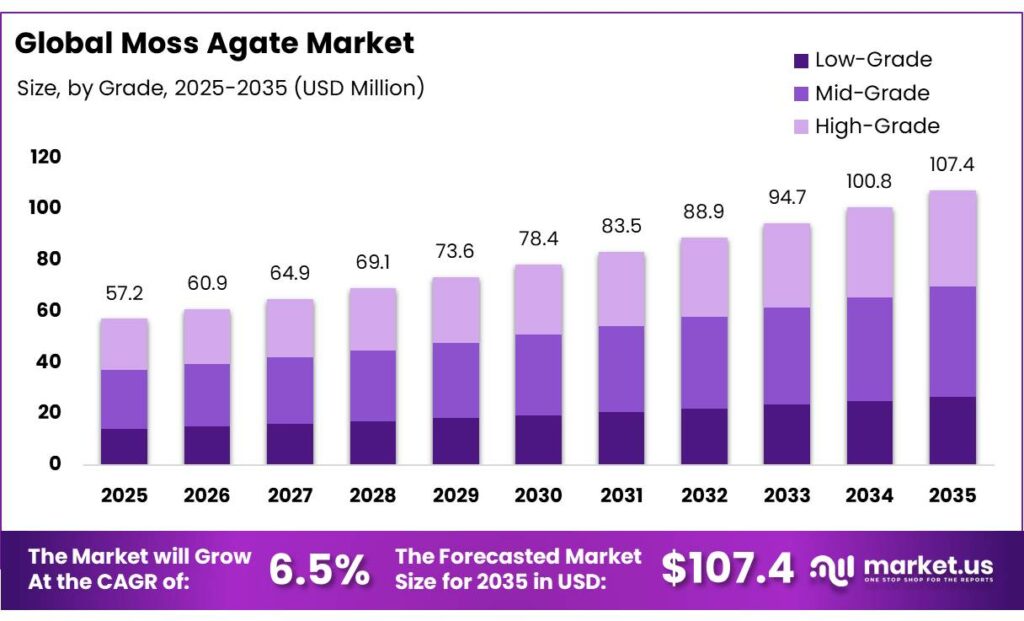
North America stands as the largest market, driven by a preference for unique, natural gemstones that offer both aesthetic appeal and sustainable sourcing. Moss agate is favored for its distinct, earthy patterns and versatility in handcrafted jewelry, as well as home decor items. Mid-grade Moss agate is particularly popular, offering a balance of affordability and visual appeal. While high-grade variants are valued for their striking patterns, their higher cost limits widespread use, and low-grade agates are less sought after due to their lack of clarity.
- According to the United States Geological Survey (USGS), the United States alone produced around 63 million natural gemstones, including agate, beryl, coral, diamond, garnet, jade, jasper, opal, pearl, quartz, sapphire, shell, topaz, tourmaline, turquoise, and many other gem materials.
Moreover, the rise of e-commerce platforms has further expanded market reach, enabling broader access to these products. However, challenges such as moss agate’s relatively low hardness and fragility in everyday use limit its application in decorative design, lapidary, or collectibles. Manufacturers focus on sustainability, craftsmanship, and product differentiation to stay competitive.
Key Takeaways:
- The global moss agate market was valued at US$57.2 million in 2025.
- The global moss agate market is projected to grow at a CAGR of 6.5% and is estimated to reach US$107.4 million by 2035.
- Based on the grades of moss agate, mid-grade moss agate sheets dominated the market, with a market share of around 40.1%.
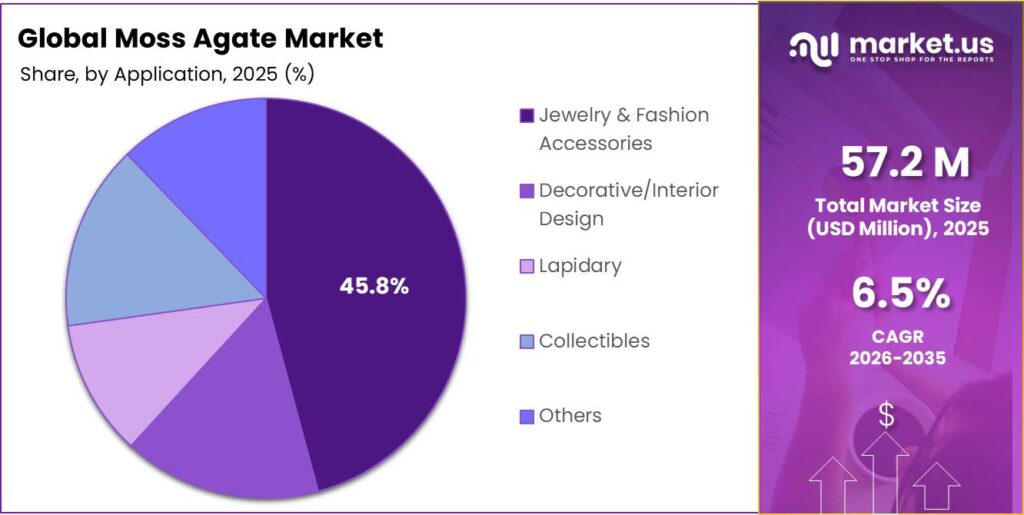
- Among the applications of moss agate, jewelry & fashion accessories held a major share in the market, 45.8% of the market share.
- In 2025, North America was the most dominant region in the moss agate market, accounting for around 36.5% of the total global consumption.
Grade Analysis
Mid-Grade Moss Agate Held the Largest Share in the Market.
The moss agate market is segmented based on grades into low-grade, mid-grade, and high-grade. The mid-grade moss agate dominated the market, comprising around 40.1% of the market share. Mid-grade Moss agate strikes a balance between aesthetic appeal and cost-effectiveness, making it more widely used than low-grade or high-grade variants. Its patterns are visually interesting and relatively uniform, offering a desirable natural look without the high expense associated with top-tier specimens. High-grade moss agate, though more visually striking, is often priced higher, limiting its accessibility to a broader range of consumers.
Conversely, low-grade moss agate may lack the clarity or intricate designs that higher-grade stones offer, which can make it less attractive for use in jewelry or home decor. Mid-grade agate provides a good compromise, offering appealing designs at a more accessible price point, making it the preferred choice for mass-market consumers and artisans alike. This blend of affordability and visual quality positions it as the most commonly used grade in various products.
Application Analysis
Moss Agate is Mostly Utilized for Jewelry & Fashion Accessories.
Based on the applications of moss agate, the market is divided into jewelry & fashion accessories, decorative/interior design, lapidary, collectibles, and others. The jewelry & fashion accessories dominated the moss agate market, with a market share of 45.8%, due to its visually appealing, unique patterns and semi-precious nature, which makes it ideal for wearable art. Jewelry allows the natural beauty of the stone to be showcased, with pieces such as necklaces, rings, and earrings providing high visibility and personal connection.
Additionally, the relatively manageable size and shape of moss agate make it well-suited for crafting into jewelry components. In contrast, other applications, such as decorative/interior design or lapidary, require larger, more uniform stones, which are less common with moss agate. Furthermore, the stone’s physical properties, such as its relatively moderate hardness, make it more durable for everyday wear than for uses in heavier-duty applications such as collectibles or sculptures, where durability and size are more critical. The stone’s aesthetic value and practical attributes align more naturally with jewelry and accessories.
Key Market Segments:
By Grade
- Low-Grade
- Mid-Grade
- High-Grade
By Application
- Jewelry & Fashion Accessories
- Decorative/Interior Design
- Lapidary
- Collectibles
- Others
Drivers
High Growth in the Jewelry Market Drives the Moss Agate Market.
The rise in the global jewelry market has been a significant driver for the Moss agate sector, fueled by increasing consumer interest in natural and semi-precious stones. Moss agate is widely sought after for its unique appearance and is categorized within the broader group of chalcedony, which has witnessed steady demand in jewelry production. Additionally, the expanding trend of sustainability in consumer goods has further heightened the appeal of semi-precious stones such as moss agate, often considered eco-friendly alternatives.
Data from the U.S. Geological Survey (USGS) indicates that while total gemstone imports for consumption fluctuated, decreasing 19% in 2024, the United States remains a dominant consumer of non-diamond gemstones such as agate. Similarly, in India, government-backed Special Economic Zones (SEZs) contribute 30% of total gem and jewelry exports, with studded jewelry, often featuring semi-precious stones such as moss agate, making up the largest share at 47%.
Additionally, the European Union’s recent push for ethical sourcing in jewelry has further amplified interest in stones such as moss agate, which are often marketed as sustainably sourced. The connection between jewelry’s growth and moss agate can be seen in broader gemstone demand patterns and shifts in consumer preferences for authenticity and craftsmanship.
Restraints
Physical and Wearability Challenges Might Hamper the Demand for Moss Agate.
Moss agate marketability is significantly constrained by intrinsic physical vulnerabilities and wearability limitations inherent to its mineral structure. As a microcrystalline quartz variety, it possesses a Mohs hardness of 6.5-7, positioning it below common environmental abrasives such as silicon dioxide (sand/dust), which ranks at 7. This parity leads to surface scratching and loss of polish over extended use.
Moss agate, such as other varieties of chalcedony, is prone to fracturing due to its relatively low hardness compared to other gemstones. This can complicate its use in jewelry pieces subject to frequent wear, such as rings or bracelets. Additionally, moss agate’s porous nature makes it susceptible to absorbing oils and dirt, leading to surface degradation over time, particularly in pieces worn daily. This issue necessitates more careful maintenance, potentially reducing its appeal among consumers who prioritize durability.
Furthermore, its relatively high moisture absorption rate may contribute to its fragility under certain environmental conditions, further challenging its widespread use in jewelry. Due to these factors, the gemstone is categorized as semi-durable. While popular in jewelry, institutional guidance from the Gemological Institute of America (GIA) advises against ultrasonic or steam cleaning for many agates. This maintenance overhead serves as a market barrier for consumers seeking low-maintenance daily-wear items.
Opportunity
Rise of E-Commerce Marketplaces Creates Opportunities in the Moss Agate Market.
The integration of moss agate into global e-commerce platforms has fundamentally altered its supply chain, transitioning from localized artisanal trade to high-velocity digital marketplaces. This shift is driven by the demand for unique-specimen transparency, where digital catalogs allow consumers to verify specific dendritic patterns before purchase.
According to the U.S. Census Bureau, e-commerce retail sales in the United States saw a steady increase, rising by 5.2% in the third quarter of 2025 from the third quarter of 2024. This digital shift has facilitated easier access to niche products, such as moss agate jewelry, reaching a broader global consumer base.
According to the United Nations Conference on Trade and Development (UNCTAD), e-commerce facilitates the inclusion of small- and medium-sized enterprises (SMEs) in global value chains. In the gemstone sector, this is evidenced by the rise of direct-to-consumer (DTC) listings on cross-border platforms, which bypass traditional multi-tiered wholesale layers.
Furthermore, the U.S. Department of Commerce highlights that e-commerce sales of gemstones and jewelry have become more diverse, driven by consumer preference for convenience and the ability to shop directly from global suppliers.
Trends
Demand in Home Decor and Gift Items.
The demand for moss agate in home decor and gift items has been growing, driven by increasing consumer interest in natural materials and holistic design elements. Moss agate, prized for its unique, earthy patterns, has become a popular choice for decorative objects. Key non-jewelry items include agate coasters, paperweights, obelisks, spheres, and towers. For instance, India’s export records from June 2025 include shipments of over 1,200 sets of agate coasters to the United States and approximately 950 kg of polished decorative articles.
The home decor products made from natural stones, including moss agate, are sought after by consumers looking for sustainable and aesthetically pleasing pieces. Additionally, gift items using semi-precious stones such as moss agate have gained popularity in the global market, especially in the context of personalized and artisanal gifts. This trend aligns with growing consumer preferences for items that combine beauty, sustainability, and uniqueness in home and gift offerings.
Geopolitical Impact Analysis
Geopolitical Tensions Are Impacting the Moss Agate Chemical Shipments.
Geopolitical tensions impact the moss agate market primarily through disruptions in supply chain logistics and regulatory shifts in major gemstone processing hubs. As a niche semi-precious stone, moss agate relies on specialized export-oriented clusters, particularly in India, Brazil, and the United States, where cross-border trade policies are increasingly sensitive to broader diplomatic relations. For instance, in India, the largest processor of moss agate, the Ministry of Commerce and Industry monitors gemstone exports under the Foreign Trade Policy (FTP).
Geopolitical shifts have led to sudden changes in Import-Export (IE) Codes or licensing requirements, impacting the annual shipments of agate products destined for the U.S. and Europe. Additionally, the European Union’s response to geopolitical crises, such as sanctions and trade barriers, has led to logistical hurdles in the transport of gemstones across borders, especially to markets in North America and Europe.
Moreover, as per a 2022 U.S. International Trade Administration report, geopolitical instability has also led to shifts in consumer priorities, with an increased focus on locally sourced and ethically produced goods. This may reduce demand for moss agate sourced from regions affected by conflict. While the stone’s aesthetic appeal remains strong, geopolitical factors have made sourcing and trade more challenging, creating a less predictable market environment for moss agate and other semi-precious stones.
Regional Analysis
North America Held the Largest Share of the Global Moss Agate Market.
In 2025, North America dominated the global moss agate market, holding about 36.5% of the total global consumption. The region represents a primary consumption hub for moss agate, particularly within the artisanal and designer jewelry segments. Market prominence is defined by high import volumes of non-diamond gemstones and a concentrated base of domestic hobbyists and commercial mining. According to the U.S. Geological Survey (USGS), the United States remains a globally significant consumer of semi-precious gemstones. In 2024, the total value of non-diamond gemstones imported for consumption was approximately US$2.0 billion.
The significant moss agate deposits are localized in the Western United States, specifically in Montana (Yellowstone River), Wyoming, and Oregon. Furthermore, while the U.S. is a net importer, specialized Montana moss agate is a high-value export item for international collectors, noted for its high-contrast iron and manganese inclusions. As North American consumers increasingly favor authenticity and natural materials, moss agate has found a stable market for decorative objects, gift items, and accessories. The region’s increasing inclination toward eco-conscious consumption further cements its role as the largest market for Moss agate.
Key Regions and Countries
- North America
- The US
- Canada
- Europe
- Germany
- France
- The UK
- Spain
- Italy
- Russia & CIS
- Rest of Europe
- APAC
- China
- Japan
- South Korea
- India
- ASEAN
- Rest of APAC
- Latin America
- Brazil
- Mexico
- Rest of Latin America
- Middle East & Africa
- GCC
- South Africa
- Rest of MEA
Key Players Analysis
Manufacturers of moss agate emphasize product differentiation by offering unique, high-quality stones with distinct patterns, catering to consumers seeking exclusivity. Additionally, various manufacturers are increasingly prioritizing sustainability by sourcing moss agate from ethically mined or eco-friendly operations, appealing to environmentally conscious buyers.
Another key strategy involves expanding distribution channels, particularly through e-commerce platforms, making it easier for global consumers to access moss agate products. Moreover, manufacturers often invest in collaboration with artisans and jewelry designers to create bespoke, handcrafted pieces, which have gained popularity in niche markets. Similarly, they focus on building brand recognition through transparent sourcing practices and storytelling around the authenticity and craftsmanship of their products, fostering customer loyalty.
The Major Players in The Industry
- Stuller, Inc.
- Rio Grande Jewelry Supply
- Pala International
- Giometal Co., Ltd.
- Miracle Marble Art
- Stoneplus Enterprises Pvt Ltd
- Royal Agate
- L. Manufacturing and Trading Company
- Anshul Impex
- Moonlight Gems
- Other Key Players
Key Developments
- In January 2026, Stuller collaborated with the American Gem Trade Association (AGTA) to enhance the identification of AGTA-sourced colored gemstones on Stuller.com. Grounded in shared values, this partnership promotes education, ethical business practices, and integrity within the colored gemstone industry.
- In January 2023, the American Gem Trade Association (AGTA) and Rio Grande Jewelry Supply initiated a collaborative effort to mutually promote their respective businesses and activities.
Report Scope
Report Features Description Market Value (2025) US$57.2 Mn Forecast Revenue (2035) US$107.4 Mn CAGR (2025-2035) 6.5% Base Year for Estimation 2025 Historic Period 2021-2024 Forecast Period 2025-2035 Report Coverage Revenue Forecast, Market Dynamics, Competitive Landscape, Recent Developments Segments Covered By Grade (Low-Grade, Mid-Grade, and High-Grade), By Application (Jewelry & Fashion Accessories, Decorative/Interior Design, Lapidary, Collectibles, and Others) Regional Analysis North America – The US & Canada; Europe – Germany, France, The UK, Spain, Italy, Russia & CIS, Rest of Europe; APAC– China, Japan, South Korea, India, ASEAN & Rest of APAC; Latin America– Brazil, Mexico & Rest of Latin America; Middle East & Africa– GCC, South Africa, & Rest of MEA Competitive Landscape Stuller, Inc., Rio Grande Jewelry Supply, Pala International, Giometal Co., Ltd., Miracle Marble Art, Stoneplus Enterprises Pvt Ltd, Royal Agate, W.L. Manufacturing and Trading Company, Anshul Impex, Moonlight Gems, and Other Players. Customization Scope Customization for segments, region/country-level will be provided. Moreover, additional customization can be done based on the requirements. Purchase Options We have three licenses to opt for: Single User License, Multi-User License (Up to 5 Users), Corporate Use License (Unlimited Users and Printable PDF) 
-
-
- Stuller, Inc.
- Rio Grande Jewelry Supply
- Pala International
- Giometal Co., Ltd.
- Miracle Marble Art
- Stoneplus Enterprises Pvt Ltd
- Royal Agate
- L. Manufacturing and Trading Company
- Anshul Impex
- Moonlight Gems
- Other Key Players
Our Clients

- 181407
- Mar 2026






