Report Overview
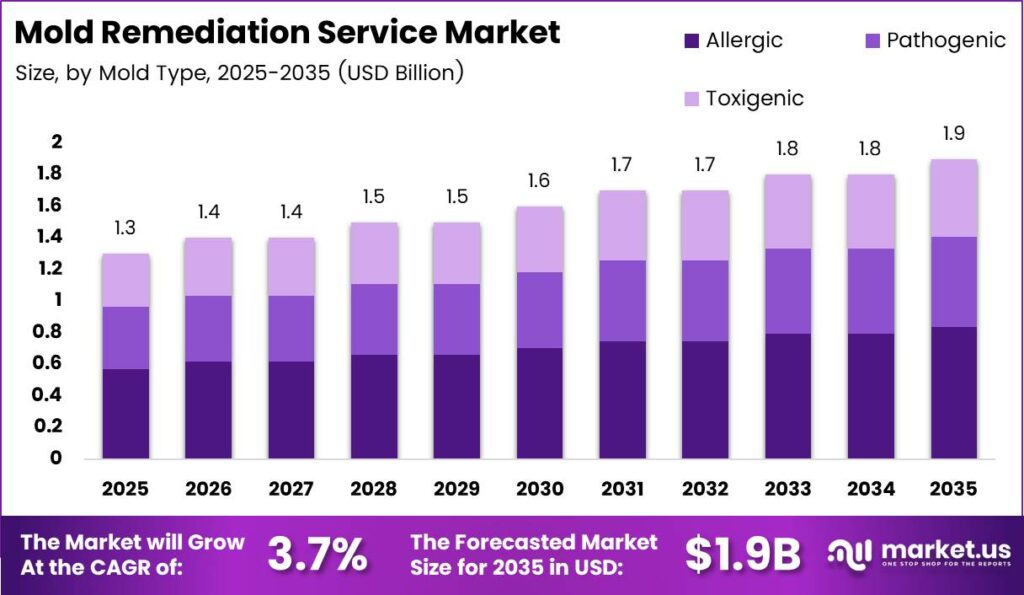
Global Mold Remediation Service Market size is expected to be worth around USD 1.9 Billion by 2035 from USD 1.3 Billion in 2025, growing at a CAGR of 3.7% during the forecast period 2026 to 2035.
The mold remediation service market covers professional inspection, containment, removal, surface treatment, and post-remediation verification across residential, commercial, and industrial properties. Service providers address contamination on substrates including drywall, wood, carpet, tile, and HVAC components. The market spans standalone remediation contractors, franchise networks, and integrated restoration firms that bundle mold services with water damage and fire recovery work.
Key Takeaways
- The Global Mold Remediation Service Market is valued at USD 1.3 Billion in 2025 and is forecast to reach USD 1.9 Billion by 2035.
- The market is projected to grow at a CAGR of 3.7% from 2026 to 2035.
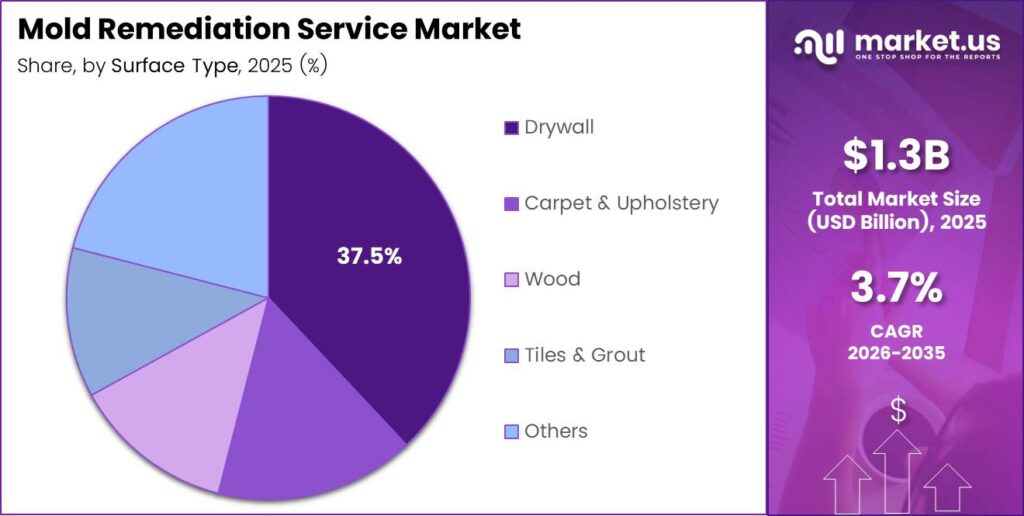
- By Surface Type, Drywall dominates with a market share of 37.55%.
- By Mold Type, Allergic mold holds the leading position with a share of 43.78%.
- By End User, Residential accounts for the largest share at 64.67%.
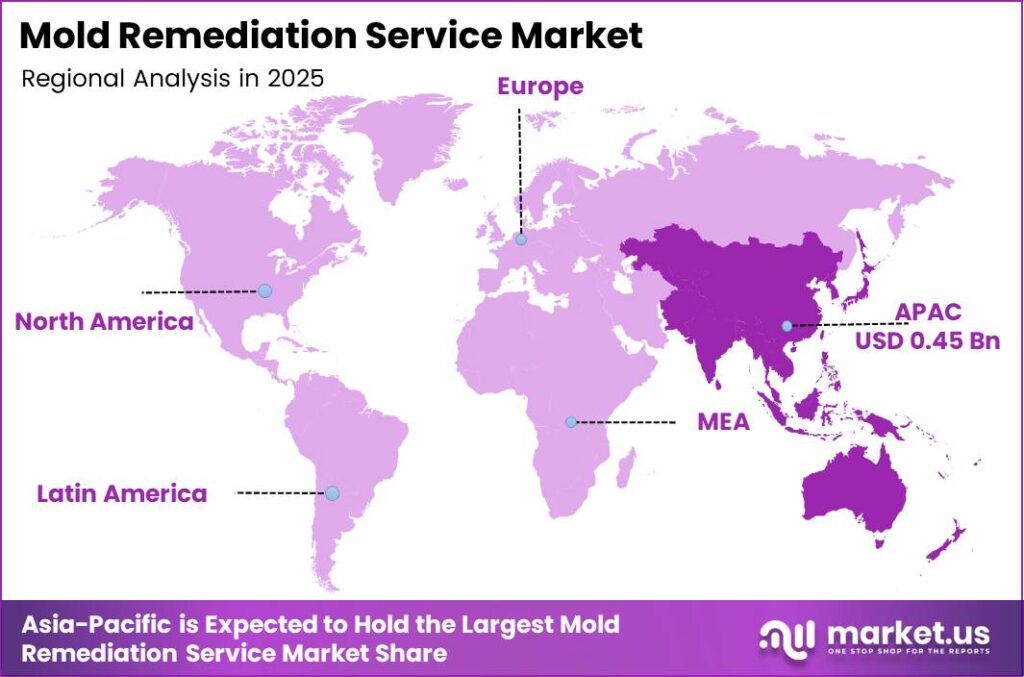
- Asia-Pacific leads all regions with a market share of 34.78%, valued at USD 0.45 Billion.
- Middle East and Africa is the fastest-growing region during the forecast period.
Government-backed housing regulations and building safety standards are converting previously discretionary mold work into mandatory, time-bound service engagements. England’s social housing sector now enforces remediation deadlines under the Awaab’s Law provisions of the Social Housing (Regulation) Act 2023, creating structured pipeline for compliant contractors. This legal shift moves mold remediation from reactive call-out work toward scheduled, accountable service contracts with landlords and housing associations.
Data from Eurostat shows 15.5% of the EU population lived in dwellings with leaking roofs, damp walls, or rot in window frames or floors in 2023. This housing-condition exposure directly widens the addressable base for professional remediation across Europe. As per our research, the Solvane Group completed its $50 Million acquisition of the Evolve Restoration platform in May 2026, signaling that investor capital is actively consolidating fragmented remediation operators into scalable national platforms.
According to World Bank data, 1.81 Billion people globally live in flood-prone areas, a structural exposure that sustains long-cycle remediation demand wherever post-flood drying fails to meet professional thresholds. This figure measures flood exposure rather than verified remediation demand, but it frames the risk pool available to service providers who expand geographically into flood-affected urban markets. Contractors positioned near flood corridors carry a durable structural advantage over those concentrated in low-risk zones.
Surface Type Analysis
Drywall dominates with 37.55% due to widespread residential and commercial use.
In 2025, Drywall held a dominant market position in the By Surface Type segment of the Mold Remediation Service Market, with a 37.55% share. Paul Davis Restoration quoted localized cleanup of under 100 square feet at $500 to $5,000 in 2026, while remediation spanning 100 to 400 square feet reached $5,500 to $12,000. Drywall absorbs moisture rapidly and conceals growth behind wall cavities, requiring full-panel removal rather than surface cleaning. This scope intensity means drywall jobs carry higher per-engagement revenue than hard-surface alternatives, reinforcing the segment’s commercial dominance.
Carpet and Upholstery represents the fastest-growing sub-segment within surface type remediation. Porous textile substrates retain spores deep within fiber layers, making surface biocide treatment insufficient for professional clearance. This technical barrier forces clients toward full material removal and replacement rather than cleaning, raising average job value. Contractors who invest in textile-specific containment protocols and disposal workflows gain a pricing premium unavailable in commodity surface-cleaning segments.
Wood surfaces present a structurally distinct remediation challenge because mold penetrates grain layers and requires sanding, encapsulation, or structural replacement depending on depth of colonization. For widespread contamination involving structural drying or HVAC systems, Paul Davis’s 2026 guide quoted whole-home project costs of $10,000 to $30,000 or more. Wood remediation in older building stock frequently exposes underlying moisture pathways, extending scope and timeline beyond initial assessment. This complexity positions specialist wood-remediation contractors favorably against generalist operators when bidding on aged residential and heritage properties.
Tiles and Grout form a lower-risk surface category where mold colonizes porous grout lines rather than the tile body itself, typically allowing chemical treatment without demolition. In April 2026, Liberty Restoration Group acquired ServiceMaster of Columbia in Missouri, expanding its multi-state restoration platform. This consolidation pattern signals that franchise networks are aggregating surface-type capabilities under unified brands to offer clients single-vendor coverage across all substrate categories rather than specialty-only engagements.
Mold Type Analysis
Allergic mold dominates with 43.78% due to high residential exposure and health claims.
In 2025, Allergic mold held a dominant market position in the By Mold Type segment of the Mold Remediation Service Market, with a 43.78% share. Paul Davis’s 2026 pricing guide listed mold removal and cleaning at $10 to $20 per square foot for standard work, rising to $30 per square foot where difficult access, significant demolition, or specialized containment was involved. Allergic mold species such as Cladosporium and Alternaria trigger documented respiratory responses, making remediation a health-necessity purchase rather than a discretionary one. This demand quality reduces price sensitivity and supports premium-tier service positioning for contractors who lead with health-outcome framing.
Pathogenic mold is the fastest-growing sub-segment within mold type remediation. Species including Aspergillus carry direct infection risk for immunocompromised occupants, compelling faster institutional response in healthcare facilities, aged-care properties, and social housing. Visual inspection and moisture assessment is priced at $250 to $300, with air or surface sampling at $150 to $400 per sample and clearance testing at $300 to $900 or more. These assessment fees create a defined pre-remediation revenue line, giving contractors margin on diagnostics before physical removal begins. Contractors certified in pathogenic species identification hold a procurement advantage in institutional bidding.
Toxigenic mold, including Stachybotrys chartarum, requires the most rigorous containment protocols and personal protective equipment among all mold categories. Remediation of toxigenic species frequently involves full structural demolition of affected assemblies and specialized waste disposal under hazardous-material handling requirements. These regulatory and procedural demands raise crew certification costs and limit the pool of qualified contractors. Service providers who invest in toxigenic certification gain access to a lower-competition, higher-margin segment where procurement decisions prioritize compliance credentials over price.
End User Analysis
Residential dominates with 64.67% due to high private dwelling contamination rates.
In 2025, Residential held a dominant market position in the By End User segment of the Mold Remediation Service Market, with a 64.67% share. According to World Bank data, 600 Million urban residents face significant annual flood hazard, a structural exposure that generates recurring post-flood remediation demand across owner-occupied and rental housing stock. Residential properties account for the largest share of occupied building stock globally, and private dwellings often lack the preventive maintenance programs that reduce contamination severity in managed commercial properties. This reactive service pattern creates durable, repeat-purchase volume for residential specialists.
Industrial end users represent the fastest-growing segment within the mold remediation market. Food processing facilities, pharmaceutical manufacturing plants, and cold-storage warehouses operate under regulatory contamination-control obligations that make professional remediation non-discretionary. In March 2025, Knox Lane acquired a majority stake in HighGround Restoration Group, a residential mitigation and restoration platform operating across 13 states. Industrial contamination events carry production-loss liability that dwarfs remediation cost, giving contractors leverage to sell comprehensive containment and verification contracts rather than isolated cleanup assignments. This liability dynamic supports contract value well above the residential average.
Commercial end users span office buildings, retail properties, hospitality facilities, and managed multi-tenant assets, where property managers carry documented duty-of-care obligations toward occupants. HVAC contamination in commercial buildings can distribute mold spores across entire floor plates, escalating project scope rapidly and requiring coordinated access management. Contractors who develop formal commercial service agreements and rapid-response dispatch capacity convert routine HVAC maintenance relationships into preferential remediation vendor status, reducing competition from generalist operators at each call-out.
Key Market Segments
By Surface Type
- Drywall
- Carpet and Upholstery
- Wood
- Tiles and Grout
- Others
By Mold Type
- Allergic
- Pathogenic
- Toxigenic
By End User
- Residential
- Industrial
- Commercial
Regional Analysis
Asia-Pacific Dominates the Mold Remediation Service Market with a Market Share of 34.78%, Valued at USD 0.45 Billion
Asia-Pacific holds 34.78% of the global mold remediation service market, valued at USD 0.45 Billion in 2025. High humidity climates across Southeast Asia, South Asia, and coastal East Asia create persistent mold conditions in both residential and commercial building stock. Rapid urbanization and dense multi-unit housing construction have concentrated moisture-related building failures within high-population corridors, producing a deep and recurring remediation pipeline for contractors operating in the region’s major metropolitan markets.
Middle East and Africa is the fastest-growing region in the mold remediation service market during the forecast period. Gulf Cooperation Council construction activity has expanded the commercial and hospitality building base substantially, and HVAC-dependent environments in arid climates create condensation-related mold risk that drives professional remediation demand within newer building stock. In November 2025, First Onsite Property Restoration acquired RBT Restoration By Trades in Kelowna, British Columbia, expanding its British Columbia network to 5 branches. This acquisition pattern reflects broader industry logic that geographic network density translates directly into faster dispatch capacity and stronger contract retention in competitive regional markets.
North America represents a structurally mature remediation market with established franchise networks, insurance-driven procurement, and well-codified contractor certification requirements. Europe carries significant latent demand anchored by its aging housing stock and statutory remediation obligations in social housing. Latin America and remaining Asia-Pacific territories represent early-stage markets where professional remediation services are gradually displacing owner-managed responses to contamination events.
Key Regions and Countries
North America
- US
- Canada
Europe
- Germany
- France
- The UK
- Spain
- Italy
- Rest of Europe
Asia Pacific
- China
- Japan
- South Korea
- India
- Australia
- Rest of APAC
Latin America
- Brazil
- Mexico
- Rest of Latin America
Middle East and Africa
- GCC
- South Africa
- Rest of MEA
Market Dynamics
Market Opportunity Analysis - Underserved end user segments and high-risk geographies offer defensible entry points for specialist operators
Industrial end users represent the most underexploited segment within the current mold remediation market despite holding the fastest growth trajectory. Food processing, pharmaceutical, and cold-storage facilities face mandatory contamination-control obligations, yet professional remediation vendor penetration in this segment remains concentrated among a small number of multi-hazard specialists. Contractors who build industrial certification credentials and invest in contained-environment mobilization protocols gain access to procurement processes that exclude the residential-focused generalists who dominate the market by volume.
Middle East and Africa carries the highest regional growth rate in the forecast period but remains underpenetrated by professional remediation networks relative to its expanding commercial and hospitality building base. HVAC-intensive construction in Gulf markets creates endemic condensation-related contamination that property managers currently address through maintenance contracts rather than specialist remediation engagements. Contractors who establish regional presence and certify crews under international remediation standards before this segment matures will capture early contract volume at limited competitive pressure.
Pathogenic mold remediation in healthcare and aged-care facilities is structurally underserved because most active remediation contractors lack the infection-control protocols and documentation required for hospital procurement. This credentialing barrier limits the addressable contractor pool and sustains above-market pricing for qualified operators. New entrants who build pathogenic specialization from inception rather than retrofitting it onto residential service frameworks will compete in a procurement tier where price is secondary to compliance evidence and project track record.
Toxigenic mold remediation represents the highest-margin, lowest-competition sub-segment within mold type, yet most franchise networks avoid it due to crew certification costs and liability exposure. This creates persistent white space for independent operators and mid-sized regional firms willing to invest in hazardous-material handling credentials. By contrast, the residential drywall segment that currently drives the largest share of market volume is served by the highest density of competing contractors, compressing margins and limiting differentiation to speed and brand trust.
Technology and Innovation Landscape - Ionization, diagnostics, and remediation technology are reshaping service quality and competitive differentiation
Needlepoint bipolar ionization is emerging as a post-remediation air-quality tool with documented performance data from controlled field tests. GPS Air reported 387 airborne mold spores per cubic meter in an ionization-equipped dormitory room in August 2025, compared with 9,557 spores per cubic meter in an adjacent untreated room. The treated room registered 2.9% of outdoor mold concentration versus 73.4% in the untreated room, against an outdoor reference of 13,014 spores per cubic meter. Contractors who integrate ionization systems into post-remediation verification protocols can demonstrate measurable air-quality outcomes rather than relying solely on visual clearance, which strengthens client confidence and supports premium service pricing.
September 2025 measurements by GPS Air recorded indoor airborne mold concentrations of 1,394 spores per cubic meter in one dormitory and 1,520 in a second, against an outdoor reference of 132,028 spores per cubic meter. Indoor concentrations reached 1.1% and 1.2% of outdoor levels respectively, with samples analyzed by third-party laboratories using optical microscopy. These remain manufacturer-reported, site-specific results rather than industry benchmarks, but they demonstrate the documentation methodology that institutional buyers increasingly require before accepting project completion. Contractors who adopt third-party analytical verification as a standard workflow step build an audit trail that differentiates their service from operators who rely on visual inspection alone.
Project timeline management technology is becoming a competitive differentiator as clients demand scheduling transparency and completion certainty. Paul Davis’s 2026 operational guide indicates small remediation projects complete in 1 to 3 days, mid-sized jobs in 3 to 5 days, and larger multi-room or structurally complex projects in 1 to 2 weeks when structural drying and reconstruction are required. Digital project management platforms that automate crew scheduling, equipment tracking, and client communication convert these planning ranges into binding commitments, reducing scope disputes and repeat-visit costs. Contractors who implement job-management software reduce per-project administrative overhead and improve utilization rates across their crew base.
Thermal imaging and moisture-mapping technology is advancing the accuracy of initial contamination assessment, reducing the frequency of scope revisions that erode contractor margin on fixed-price contracts. Real-time moisture data collected during assessment allows project managers to define containment zones with greater precision before demolition begins, reducing material waste and labor hours. Combined with remote monitoring sensors installed after remediation, these tools create a continuous building-condition data stream that feeds post-remediation subscription service offerings. Contractors who invest in diagnostic hardware build a proprietary data advantage over competitors whose assessments rely on visual inspection and manual moisture readings alone.
Drivers
Storm-driven water intrusion converts porous building materials into active mold environments when saturation persists beyond practical drying windows. NOAA recorded 27 major weather and climate disasters during 2024, including 5 tropical cyclones, documenting the successive structural impacts of Hurricanes Helene and Milton. EPA recommends drying wet materials within 24 to 48 hours, making rapid mobilization commercially critical and supporting integrated workflows that combine water extraction, containment, removal, and restoration rather than isolated surface cleaning. Emergency dispatch capacity and regional equipment availability therefore determine service conversion and mix more directly than disaster counts alone.
England’s social housing sector now enforces mold remediation deadlines under the Awaab’s Law provisions of the Social Housing (Regulation) Act 2023, shifting remediation from reactive call-out work toward scheduled, time-bound service contracts. Recurring plumbing failures and building envelope degradation in aging occupied stock sustain medium-term remediation pipelines across global markets independent of acute weather events. Commercial HVAC contamination in humid-climate buildings creates recurring maintenance-adjacent demand that professional contractors can convert into preferred-vendor agreements. Large-area professional cleanup requirements across North American and international institutional properties reinforce the case for credentialed, scale-capable operators over unregulated local competitors.
| Driver | (~) % Impact on CAGR Forecast | Geographic Relevance | Impact Timeline |
|---|---|---|---|
| Storm-related water intrusion | +0.40% | Global; strongest in flood-exposed regions | Short term (≤ 2 years) |
| Enforceable rental-housing remediation deadlines | +0.25% | England social housing | Short term (≤ 2 years) |
| Recurring plumbing and envelope failures | +0.20% | Global occupied-building stock | Medium term (2–4 years) |
| Commercial HVAC contamination remediation | +0.15% | Global; humid-climate commercial buildings | Short term (≤ 2 years) |
| Large-area professional cleanup requirements | +0.10% | North America; international institutional properties | Short term (≤ 2 years) |
Restraints
Mold exclusions in standard homeowners policies interrupt the conversion of identified contamination into funded remediation jobs. The NAIC confirms that most homeowners policies provide limited or no mold coverage, with additional endorsements available but not guaranteed. Standard policies also exclude flood damage, requiring a separate coverage decision before remediation reimbursement is possible. Contractors face unrecovered survey and estimating effort, weaker schedule visibility, and a structural need to establish payment responsibility before mobilizing crews, all of which reduce effective pipeline conversion rates.
Unfunded owner payment capacity and small-area do-it-yourself substitution suppress professional engagement across the lower end of the residential market. Property-access authorization refusals in rental and multi-owner properties delay or block scheduling, while unavailable occupant relocation arrangements restrict access to occupied residential and care facilities. These friction points are concentrated in the financially constrained and densely occupied residential segments that represent the market’s largest volume base. Contractors who develop flexible phased-payment structures and scheduling protocols for occupied properties reduce pipeline attrition without requiring insurance reform.
| Restraint | (~) % Impact on CAGR Forecast | Geographic Relevance | Impact Timeline |
|---|---|---|---|
| Mold exclusions and restricted insurance coverage | -0.30% | United States; policy-dependent elsewhere | Short term (≤ 2 years) |
| Unfunded owner payment capacity | -0.20% | Global; financially constrained households | Short term (≤ 2 years) |
| Small-area do-it-yourself substitution | -0.15% | Global residential properties | Short term (≤ 2 years) |
| Property-access authorization refusals | -0.10% | Rental and multi-owner properties | Short term (≤ 2 years) |
| Unavailable occupant relocation arrangements | -0.05% | Occupied residential and care properties | Short term (≤ 2 years) |
Challenges
Remediation capacity depends on retaining trained technicians who execute containment, protective-equipment procedures, and supervised removal to professional standards. The U.S. Bureau of Labor Statistics reports 52,700 hazardous-materials removal jobs in 2025 and approximately 4,300 annual openings, mostly to replace workers leaving occupations or the labor force. This replacement rate equals roughly 8.2% of the reported employment base annually. Contractors who invest in structured onboarding, supervisor development, and cross-training convert a systemic workforce constraint into an internal competitive advantage over operators who rely on unstructured hiring.
Concealed contamination behind multilayer building assemblies creates persistent scope uncertainty that disrupts project pricing and scheduling. Coexisting hazards such as asbestos or lead paint in older buildings require sequenced abatement before mold remediation can proceed, extending project timelines and cost exposure. Clearance evidence interpretation varies across fragmented assessment practices, creating disputes between contractors and clients over project completion. Occupied-site containment logistics in healthcare, education, and operating business environments add mobilization complexity that generalist operators frequently underprice at bid stage.
| Challenge | (~) % CAGR Friction Drag | Geographic Relevance | Mitigation Horizon |
|---|---|---|---|
| Skilled Crew Replacement Pressure | -0.25% | North America; comparable skilled-service markets | Medium term (2–4 years) |
| Concealed Contamination Scope Uncertainty | -0.15% | Global; multilayer building assemblies | Short term (≤ 2 years) |
| Coexisting Hazard Sequencing Complexity | -0.10% | Older buildings across developed markets | Medium term (2–4 years) |
| Clearance Evidence Interpretation Variability | -0.10% | Global; fragmented assessment practices | Medium term (2–4 years) |
| Occupied Site Containment Logistics | -0.05% | Healthcare, education, and operating businesses | Short term (≤ 2 years) |
Opportunities
Post-remediation moisture-assurance subscriptions convert completed one-time cleanups into separately priced monitoring, inspection, and response contracts. EPA recommends indoor relative humidity below 60%, ideally 30 to 50%, alongside scheduled inspections and maintenance, providing operational benchmarks for subscription service design. Attaching monitoring contracts to 15% of completed jobs at annual revenue equal to 10% of the original job value generates recurring revenue equal to 1.5% of that cohort’s originating revenue. Route consolidation and remote triage could achieve 10 to 15% lower inspection cost per property and a 2 to 3 percentage-point improvement in the attached service line’s gross margin.
Independent-contractor acquisition platforms offer consolidators the ability to convert fragmented local operators into networked franchise assets with shared dispatch, marketing, and compliance infrastructure. Reusable-content salvage service extensions add revenue per job by recovering materials that would otherwise be disposed of, improving client satisfaction and margin per engagement simultaneously. Marine accommodation remediation and heritage-property conservation partnerships represent longer-horizon niches where specialist credentials command premium pricing unavailable in commodity residential work. The full opportunity portfolio carries a conservative additive ceiling of +0.80 percentage points, implying conditional CAGR of 4.5% against the supplied 3.7% baseline.
| Opportunity | (~) % Potential CAGR Upside | Geographic Relevance | Execution Window |
|---|---|---|---|
| Post-remediation moisture-assurance subscriptions | +0.25% | Global; professionally managed property portfolios | Medium term (2–4 years) |
| Independent-contractor acquisition platforms | +0.20% | Fragmented North American and European markets | Medium term (2–4 years) |
| Reusable-content salvage service extensions | +0.15% | Commercial and institutional properties | Medium term (2–4 years) |
| Marine accommodation remediation specialization | +0.10% | Coastal shipping and leisure-vessel hubs | Long term (≥ 4 years) |
| Heritage-property conservation partnerships | +0.10% | Europe, Asia, and historic urban centers | Long term (≥ 4 years) |
Key Company Insights
AdvantaClean operated as a franchise-based mold remediation and indoor air quality brand prior to its acquisition by HomeFront Brands in May 2026. The brand’s integration into a 700-plus territory portfolio gives it access to shared marketing infrastructure, cross-referral volume from adjacent service categories, and centralized training resources. This franchise consolidation positions AdvantaClean for accelerated territory expansion under institutional ownership, though brand differentiation becomes harder to maintain as portfolio standardization increases across HomeFront’s service lines.
SERVPRO holds one of the strongest brand recognition positions in North American restoration, supported by a national franchise network and a formal partnership with the First Responders Children’s Foundation announced in May 2025. In April 2025, SERVPRO Team Shaw acquired 3 Dallas–Fort Worth locations and added Finish Line MEP, expanding its footprint to 30 locations across 4 Southwestern markets. This geographic density creates dispatch-speed advantages that smaller regional operators cannot match. However, franchise model overhead and national brand standards constrain the pricing and service-design flexibility that independent specialists use to compete in niche or institutional segments.
Key Players
- AdvantaClean
- AllClean USA
- ASAP Restoration, LLC
- SERVPRO
- ServiceMaster Restore
- Neighborly Company
- Bust Mold Inc.
- PuroClean
- BELFOR
- Other Key Players
Recent Developments
- May 8, 2026: HomeFront Brands announced its acquisition of AdvantaClean, adding a sixth brand to its portfolio and expanding its combined network to more than 700 territories across the United States and Canada.
- October 2026: ServiceMaster Restoration Alliance of Tacoma acquired ServiceMaster Total Cleaning Service of Redmond, Washington. The acquired operation will trade as ServiceMaster Restore of Kirkland, providing mold remediation, water damage restoration, fire and smoke restoration, specialty cleaning, and disaster recovery from a permanent Eastside base.
- September 2026: EIS Holdings acquired Environmental Construction, LLC, a Tampa-based contractor providing mold remediation, asbestos and lead-based paint abatement, commercial demolition, and concrete cutting. The acquisition expanded EIS’s Florida platform and its capacity to perform environmental remediation work for commercial, industrial, and government clients.
- August 2026: Liberty Restoration Group completed its acquisition of ServiceMaster Restoration Services by KRS, adding offices in Peoria and Bloomington, Illinois, and Milwaukee, Wisconsin. Together with its earlier Columbia acquisition, this transaction expanded Liberty’s restoration network to 8 markets across 5 Midwestern states.
- December 2025: Guardian Restoration Partners announced its acquisition of Empact Construction Services, operating as GoDry Chicago. GoDry retained its brand and co-owners, while Guardian committed operational support and investment in personnel and systems to expand its Chicago-area restoration and water-mitigation business.
- October 2025: Sullivan Brothers Family of Companies acquired Cotton Holdings from Sun Capital Partners. Cotton retained its existing brands and leadership, with the new ownership providing long-term capital to support growth and broader disaster-response capabilities.
Geopolitical Impact Analysis
Global trade friction and climate-linked infrastructure stress are raising input costs across the mold remediation supply chain. According to WTO data, average applied tariff rates on construction and restoration equipment categories increased materially through 2025 as US-China trade tensions extended to machinery and chemical product classifications. UNCTAD reports that container freight rate volatility added an estimated 15 to 20% to landed import costs on specialized remediation equipment during 2024 and 2025. Contractors dependent on imported HEPA filtration systems, negative air machines, and industrial dehumidifiers absorbed margin pressure that smaller operators could not fully pass through to clients.
Regional conflict and energy price volatility in Europe and the Middle East have sustained elevated costs for chemical biocide inputs and plastic containment materials derived from petrochemical feedstocks. The IEA reported that European natural gas prices remained more than 3 times their pre-2021 benchmark levels through early 2025, maintaining cost pressure on manufacturing inputs for remediation consumables. According to World Bank projections, commodity price instability is expected to persist through 2026, sustaining input cost uncertainty for contractors who price fixed-scope remediation contracts months in advance. Operators with domestic supply relationships and bulk purchasing agreements hold a structural cost advantage over those exposed to spot-market import pricing.
Report Scope
| Report Features | Description |
|---|---|
| Market Value (2025) | USD 1.3 Billion |
| Forecast Revenue (2035) | USD 1.9 Billion |
| CAGR (2026-2035) | 3.7% |
| Base Year for Estimation | 2025 |
| Historic Period | 2020-2024 |
| Forecast Period | 2026-2035 |
| Report Coverage | Revenue Forecast, Market Dynamics, Market Opportunity Analysis, Technology and Innovation Landscape, Competitive Landscape, Recent Developments |
| Segments Covered | By Surface Type (Drywall, Carpet and Upholstery, Wood, Tiles and Grout, Others), By Mold Type (Allergic, Pathogenic, Toxigenic), By End User (Residential, Industrial, Commercial) |
| Regional Analysis | North America (US and Canada), Europe (Germany, France, The UK, Spain, Italy, and Rest of Europe), Asia Pacific (China, Japan, South Korea, India, Australia, and Rest of APAC), Latin America (Brazil, Mexico, and Rest of Latin America), Middle East and Africa (GCC, South Africa, and Rest of MEA) |
| Competitive Landscape | AdvantaClean, AllClean USA, ASAP Restoration LLC, SERVPRO, ServiceMaster Restore, Neighborly Company, Bust Mold Inc., PuroClean, BELFOR, Other Key Players |
| Customization Scope | Customization for segments, region / country-level will be provided. Additional customization can be done based on requirements. |
| Purchase Options | We have three licenses to opt for: Single User License | Multi-User License (Up to 5 Users) | Corporate Use License (Unlimited User and Printable PDF) |