Report Overview
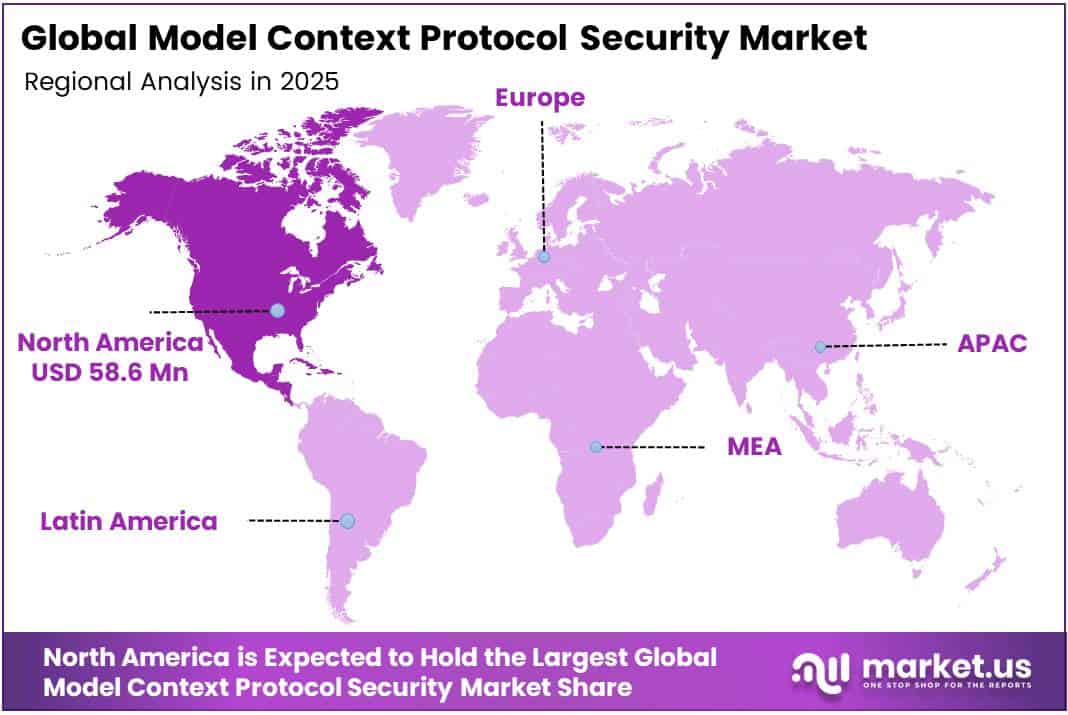
In 2025, the Global Model Context Protocol Security Market was valued at USD 139.6 million. The market is projected to grow at a CAGR of 30.2% during 2026–2035, reaching approximately USD 1,952.1 million by 2035. North America dominated the global market in 2025, accounting for more than 42.0% of the total market share and generating approximately USD 58.6 million in revenue.
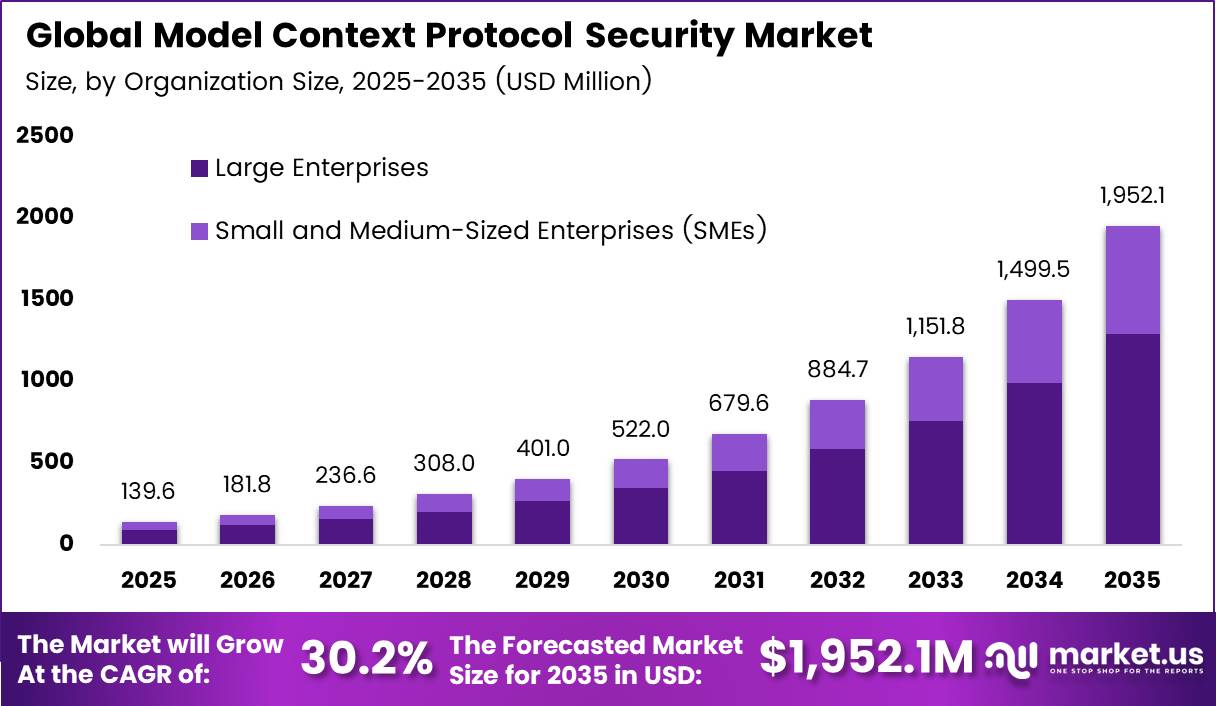
These figures represent a forecast, not a verified industry total. The OECD reported that 20.2% of firms used AI in 2025, up from 14.2% in 2024. This expansion supports the demand outlook by creating more connections between AI applications, company data, and business tools.
North America offers a strong potential customer base. The U.S. Census Bureau reported AI use among 39.7% of Information businesses and 33.9% of Finance and Insurance businesses in the survey period ending May 3, 2026. These sectors’ sensitive data and complex workflows, alongside Canada’s enterprise base, support potential demand but do not independently establish the region’s MCP security market share or revenue.
Key Takeaways
- The Model Context Protocol Security Market estimate totals USD 139.6 million in 2025 and forecasts USD 1,952.1 million by 2035. The supplied CAGR reaches 30.2% during 2026-2035.
- Solutions leads the Component segment with a 68.0% share.
- Cloud-Based leads the Deployment Mode segment with a 57.0% share.
- Large Enterprises leads the Organization Size segment with a 66.0% share.
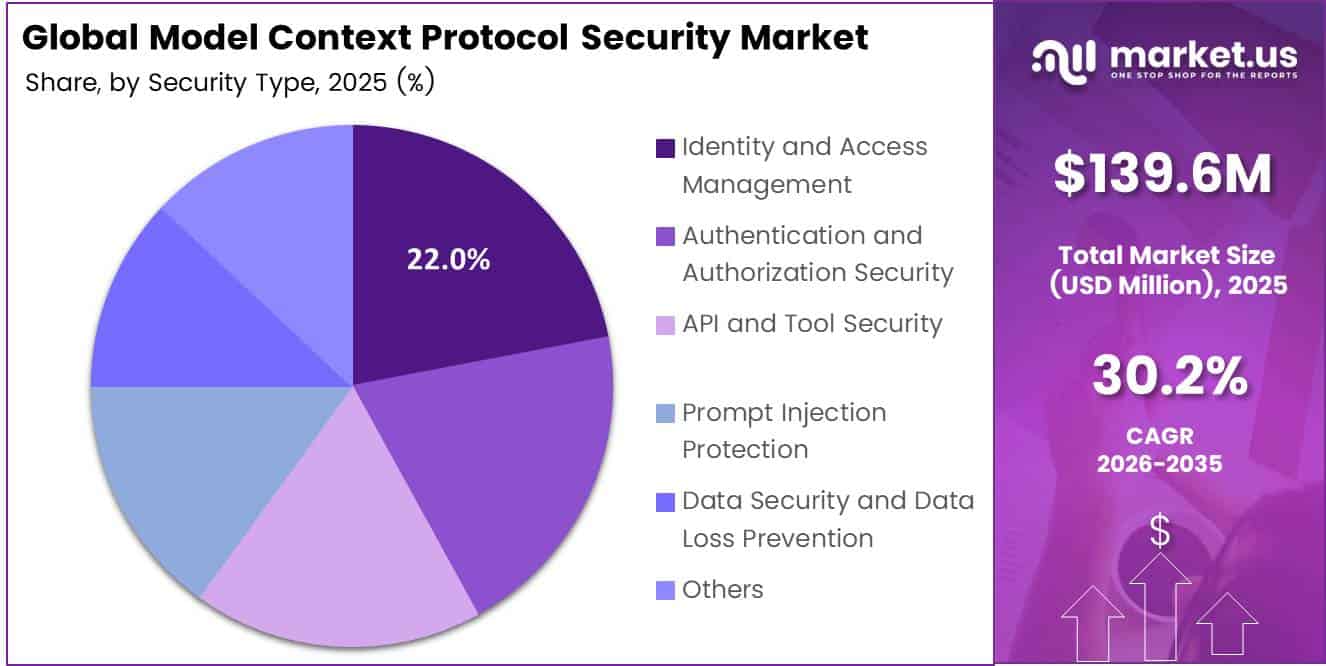
- Identity and Access Management leads the Security Type segment with a 22.0% share.
- Information Technology and Telecommunications leads the End-Use Industry segment with a 25.0% share.
- North America leads with a 42.0% share and USD 58.6 million in revenue.
By Component
Solutions dominate with 68.0% due to built-in MCP gateway and policy controls.
Solutions lead because companies want ready-to-use tools that sit between AI agents and the MCP servers they call. Big platform vendors set the pace. Microsoft’s revenue reached $281.7 billion in fiscal 2025, up 15%, and its security tools come packaged inside its cloud stack.
Microsoft Cloud revenue climbed 23% to $168.9 billion. That shows buyers keep spending on platform products they can switch on fast. Services are growing fastest because most firms lack the in-house skill to lock down MCP setups.
Eurostat found that only 35.50% of EU firms have written ICT security rules, and just 34.64% run ICT security tests. These gaps push buyers toward audits, testing, and managed security services.
By Deployment Mode
Cloud-Based dominates with 57.0% due to remote MCP servers hosted on hyperscalers.
Cloud-based tools lead because most AI models and MCP servers now run on large public clouds. So security teams place their controls right next to that traffic. Azure passed $75 billion in yearly revenue for the first time, up 34%.
Demand keeps rising. Azure and other cloud services grew 40% in the first quarter of fiscal 2026. Hybrid is the fastest-growing mode. Many teams run MCP servers on their own laptops and data centres while they call cloud models at the same time.
NSA guidance warns that weak MCP setups can let attacker inputs reach execution systems, so firms want one set of controls that covers both sides. Microsoft’s server products and cloud services revenue rose 30% in that quarter, which shows strong demand for mixed setups.
By Organization Size
Large Enterprises dominate with 66.0% due to many agents and strict audit duties.
Large enterprises lead because they connect hundreds of AI agents to sensitive internal tools. They also face the toughest audit rules. Eurostat shows that 75.62% of large EU firms run ICT risk checks, compared with 29.35% of small firms.
Large firms also back up data at a rate of 94.95%, against 77.09% for small firms. That deeper security habit turns quickly into spending on MCP protection.
SMEs are growing fastest because cheap AI assistants now link to email, files, and payment apps through ready-made MCP connectors. In an OECD survey, 61% of SMEs say they use AI. Smaller teams rarely have security staff, so they want simple, low-cost MCP security packages.
By Security Type
Identity and Access Management dominates with 22.0% due to every agent needing scoped credentials.
Identity and access management leads because each AI agent and MCP server needs its own identity and tightly limited access rights. Firms already trust identity tools. Eurostat found that 83.69% of EU firms use strong password checks, but only 39.84% combine two or more login methods.
The risk is real. In September 2026, CISA added the first MCP flaw to its Known Exploited Vulnerabilities list: a LiteLLM login bypass rated 8.8. Federal agencies had 14 days to fix it. Prompt injection protection is growing fastest.
By End-Use Industry
Information Technology and Telecommunications dominate with 25.0% due to earliest MCP adoption by developers.
IT and telecom firms lead because their developers built and rolled out MCP servers before anyone else. They plug coding agents into code stores, ticket systems, and cloud consoles. Microsoft’s quarterly cloud revenue reached $51.5 billion, up 26%, which shows how fast tech buyers are scaling AI workloads.
Its commercial order backlog jumped 110% to $625 billion, a sign of more AI agent work ahead for this sector. BFSI is the fastest-growing industry because banks connect AI agents to payment and account systems where one bad tool call can move money.
The FBI logged 24,768 business email compromise complaints in 2025, with losses near $3.05 billion. Investment fraud losses reached about $8.65 billion. Strict regulators push lenders and insurers to lock down every agent link.
Key Market Segments
By Component
- Solutions
- Services
By Deployment Mode
- Cloud-Based
- On-Premises
- Hybrid
By Organization Size
- Large Enterprises
- Small and Medium-Sized Enterprises (SMEs)
By Security Type
- Identity and Access Management
- Authentication and Authorization Security
- API and Tool Security
- Prompt Injection Protection
- Data Security and Data Loss Prevention
- Others
By End-Use Industry
- Information Technology and Telecommunications
- Banking, Financial Services, and Insurance (BFSI)
- Healthcare and Life Sciences
- Retail and E-Commerce
- Manufacturing
- Energy and Utilities
- Media and Entertainment
- Education
- Other
Geopolitical Impact Analysis
MCP security primarily involves software and services, not manufactured goods. Trade barriers affect it indirectly through servers, networking equipment, and cloud infrastructure. The WTO’s U.S. tariff profile lists a simple average applied most-favoured-nation tariff of 3.3% for 2025. This baseline does not capture every additional tariff or product exemption.
Shipping disruptions can delay the equipment that hosts MCP gateways and monitoring systems. UNCTAD reported that rerouting ships between Shanghai and Rotterdam added about 12 sailing days during the Red Sea crisis. That historical benchmark shows the potential impact on infrastructure delivery, not a verified current delay for every shipment.
Commodity changes can partly offset infrastructure costs. The World Bank reported an 11% copper price decline between April 2 and April 8, 2025, alongside a Brent crude decline of slightly more than USD 12 per barrel. Copper supports electrical and networking infrastructure, while fuel affects freight costs.
Trade volatility complicates capacity planning. The WTO reported that U.S. import volumes rose 14% quarter-on-quarter in the first quarter of 2025, then fell 16% in the second quarter after seasonal adjustment. Such frontloading can shift hardware availability and delivery schedules.
Regional Analysis
North America dominates the Model Context Protocol Security Market, holding a 42.0% share and generating USD 58.6 million in revenue. The supplied estimates establish this position; public sources provide context rather than independent confirmation.
Large enterprises offer a clear demand base. The U.S. Census Bureau reported that 37% of businesses with at least 250 employees used AI, while 32% of businesses with 100 to 249 employees reported use in the collection period ending May 3, 2026.
Asia Pacific combines a broad digital customer base with uneven access to online services. ITU estimated internet use at 66% across its Asia-Pacific region in 2024. That regional measure does not establish separate MCP security markets for China, Japan, South Korea, India, or Australia. It does show the scale of the connected environment in which AI integrations can grow.
Europe offers a growing enterprise customer base, but the input supplies no regional revenue or share. Eurostat reported that 20.0% of EU enterprises with at least 10 employees used AI in 2025, up 6.5 percentage points from the previous year. This measure supports demand potential across Germany, France, Spain, Italy, and other EU markets, but it does not describe the UK.
Key Regions and Countries
North America
- US
- Canada
Europe
- Germany
- France
- The UK
- Spain
- Italy
- Rest of Europe
Asia Pacific
- China
- Japan
- South Korea
- India
- Australia
- Rest of APAC
Latin America
- Brazil
- Mexico
- Rest of Latin America
Middle East and Africa
- GCC
- South Africa
- Rest of MEA
Market Dynamics
Drivers
| Driver | (~) % Impact on CAGR Forecast | Geographic Relevance | Impact Timeline |
|---|---|---|---|
| Cross-platform MCP adoption | +1.6% | Global; North America-led | Short term (2 years or less) |
| Remote-server authorization requirements | +1.0% | Global cloud deployments | Short term (2 years or less) |
| Enterprise server inventory controls | +0.8% | North America; Europe; Asia-Pacific | Short term (2 years or less) |
| Sensitive-action approval enforcement | +0.6% | Global enterprise applications | Short term (2 years or less) |
| Centralized connection observability | +0.5% | Global multi-cloud enterprises | Medium term (2 to 4 years) |
Cross-platform MCP adoption
Protocol standardization is turning isolated AI integrations into repeatable security-control purchasing requirements. According to Anthropic, MCP launched on November 25, 2024, with three developer components.
OpenAI’s API documentation also establishes remote-server integration and default approval controls, extending commercialization beyond desktop implementations. More reusable connections support recurring policy-enforcement subscriptions rather than one-off consulting, underpinning an analyst-estimated contribution of +1.6 percentage points, not an institutionally reported adoption statistic.
The table estimates are conditional percentage-point sensitivities around the supplied 30.2% baseline CAGR, not measured causal effects or automatic additions to an inclusive forecast. Combined driver and opportunity upside totals +8.0 percentage points, while restraint and challenge downside totals -6.0 percentage points, yielding separate stress scenarios of 38.2% and 24.2%.
Restraints
| Restraint | (~) % Impact on CAGR Forecast | Geographic Relevance | Impact Timeline |
|---|---|---|---|
| Bundled controls displacing standalone purchases | -1.3% | Global; platform-centric enterprises | Short term (2 years or less) |
| Untrusted-server procurement exclusions | -0.7% | Global security-sensitive enterprises | Short term (2 years or less) |
| Missing server-side token validation | -0.6% | Global legacy deployments | Short term (2 years or less) |
| Mandatory geography-based access restrictions | -0.4% | Cross-border enterprise deployments | Short term (2 years or less) |
| Customer self-build substitution | -0.3% | North America; Europe; technology hubs | Medium term (2 to 4 years) |
Bundled controls displacing standalone purchases
The immediate barrier is substitution at the purchasing decision, rather than an absence of MCP deployment: according to Cloudflare’s Agents SDK documentation, authentication flows, tool discovery, and connection management are built into its remote-client implementation; according to OpenAI’s API documentation, remote MCP integrations request approval before data sharing by default.
The analyst’s conditional bottleneck assumes that bundled functionality eliminates 10–15% of otherwise qualified, basic-control-only standalone purchase opportunities; that assumption supports a bounded -1.3-percentage-point sensitivity against the supplied 30.2% baseline, rather than a direct proportional conversion from opportunity loss to market growth.
Challenges
| Challenge | (~) % CAGR Friction Drag | Geographic Relevance | Mitigation Horizon |
|---|---|---|---|
| Indirect prompt injection resilience | -1.1% | Global agentic workflows | Long term (4 years or more) |
| Protocol version compatibility maintenance | -0.6% | Global heterogeneous client ecosystems | Medium term (2 to 4 years) |
| Security inspection latency budgets | -0.4% | Global interactive applications | Medium term (2 to 4 years) |
| Context-dependent policy precision | -0.3% | Global multilingual enterprises | Medium term (2 to 4 years) |
| Session isolation engineering complexity | -0.3% | Global multi-tenant services | Medium term (2 to 4 years) |
Indirect prompt injection resilience
The structural vulnerability is that legitimate tool output can contain adversarial instructions, so authenticated access does not by itself establish the safety of content subsequently interpreted by an agent: according to OpenAI’s MCP integration guidance, malicious instructions embedded in accessible content can redirect model behavior and cause private-data disclosure.
Against those source-established risks, an analyst operating scenario assumes 15–25% more adversarial regression cases and 5–10% additional security-engineering effort per major release; neither range is an institutional measurement. The associated -1.1-percentage-point friction estimate represents slower scaling of reliable protection, not the procurement cancellations assigned to restraints.
Opportunities
| Opportunity | (~) % Potential CAGR Upside | Geographic Relevance | Execution Window |
|---|---|---|---|
| Independent MCP assurance subscriptions | +1.2% | Global regulated buyers and suppliers | Medium term (2 to 4 years) |
| Disconnected sovereign deployment packages | +0.8% | Europe; Asia-Pacific; Middle East | Medium term (2 to 4 years) |
| Industrial read-only connector security | +0.6% | Manufacturing hubs worldwide | Long term (4 years or more) |
| Embedded distributor revenue sharing | +0.5% | Global software distribution channels | Medium term (2 to 4 years) |
| Specialist connector portfolio consolidation | +0.4% | North America; Europe; Asia-Pacific | Medium term (2 to 4 years) |
Independent MCP assurance subscriptions
The white space is commercially reusable, independently verified assurance evidence for MCP servers—not the already active sale of runtime security controls: according to OpenAI’s integration guidance, custom MCP servers are third-party services that OpenAI does not develop or verify; according to NIST’s Generative AI Profile, provenance tracking and documentation support risk management.
An analyst commercialization scenario assumes that reusable evidence templates and automated retesting reduce delivery hours per repeat assessment by 20–30%; with labor representing 40% of assessment revenue and pricing held constant, the arithmetic implies an 8–12-percentage-point gross-margin improvement before tooling and independent-review costs.
Those explicitly modeled assumptions support a bounded +1.2-percentage-point potential CAGR sensitivity, contingent on buyer recognition and credible independence, while shifting unit economics from bespoke audit labor toward recurring assurance subscriptions.
Key Players Analysis
Tier 1 identifies large platform suppliers, not verified MCP market leaders. Microsoft reported FY2025 revenue of USD 281.7 billion, including USD 168.9 billion from Microsoft Cloud. It spent USD 32.488 billion on research and development. These figures show funding capacity, but Microsoft does not identify MCP security revenue in those disclosures.
Amazon’s 2024 annual report places AWS revenue at about USD 108 billion. Amazon reported cash capital expenditure of USD 77.7 billion, mainly for technology infrastructure and fulfilment capacity. The company does not assign that entire investment to AWS or MCP security.
Palo Alto Networks reported FY2025 revenue of USD 9.2 billion, Next-Generation Security annual recurring revenue of USD 5.6 billion, and research and development expense of USD 1.9841 billion. ARR measures recurring contract value, not annual recognised revenue.
Tier 2 covers more focused identity and security suppliers. Okta reported revenue of USD 742 million and research and development expense of USD 160 million in the third quarter of FY2026. Proofpoint’s acquisition target Hornetsecurity reported nearly USD 200 million in ARR and 20% year-over-year growth, showing the scale of the adjacent managed-security business.
The supplied list also includes Cisco, Cloudflare, IBM, Docker, Google, Anthropic, Lasso Security, Invariant Labs, Akto Security, and MintMCP. This report does not assign them numeric MCP shares without product-level disclosures. A defensible hierarchy requires comparable revenue definitions, deployment evidence, and customer counts.
Top Key Players in the Market
- Microsoft Corporation
- Palo Alto Networks, Inc.
- Cisco Systems, Inc.
- Cloudflare, Inc.
- Okta, Inc.
- Proofpoint, Inc.
- International Business Machines Corporation
- Docker, Inc.
- Amazon Web Services, Inc.
- Google LLC
- Anthropic PBC
- Lasso Security Ltd.
- Invariant Labs GmbH
- Akto Security, Inc.
- MintMCP, Inc.
Recent Developments
- In July 2025, Palo Alto Networks signed an agreement to acquire CyberArk at an announced equity value of approximately USD 25 billion. The agreement specified USD 45 in cash and 2.2005 Palo Alto Networks shares for each CyberArk share.
- In December 2025, Proofpoint completed its Hornetsecurity acquisition. The official release stated total consideration of USD 1.8 billion. The transaction expanded managed Microsoft 365 security, data protection, and compliance capabilities, which form an adjacent security market rather than measured MCP revenue.
Report Scope
| Report Features | Description |
|---|---|
| Market Value (2025) | USD 139.6 Million |
| Forecast Revenue (2035) | USD 1,952.1 Million |
| CAGR (2026-2035) | 30.2% |
| Base Year for Estimation | 2025 |
| Historic Period | 2020-2024 |
| Forecast Period | 2026-2035 |
| Report Coverage | Revenue Forecast, Market Dynamics, Competitive Landscape, Recent Developments |
| Segments Covered | By Component (Solutions, Services); By Deployment Mode (Cloud-Based, On-Premises, Hybrid); By Organization Size (Large Enterprises, Small and Medium-Sized Enterprises (SMEs)); By Security Type (Identity and Access Management, Authentication and Authorization Security, API and Tool Security, Prompt Injection Protection, Data Security and Data Loss Prevention, Others); By End-Use Industry (Information Technology and Telecommunications, Banking, Financial Services, and Insurance (BFSI), Healthcare and Life Sciences, Retail and E-Commerce, Manufacturing, Energy and Utilities, Media and Entertainment, Education, Other) |
| Regional Analysis | North America – US, Canada; Europe – Germany, France, The UK, Spain, Italy, Rest of Europe; Asia Pacific – China, Japan, South Korea, India, Australia, Singapore, Rest of APAC; Latin America – Brazil, Mexico, Rest of Latin America; Middle East & Africa – GCC, South Africa, Rest of MEA |
| Competitive Landscape | Microsoft Corporation, Palo Alto Networks, Inc., Cisco Systems, Inc., Cloudflare, Inc., Okta, Inc., Proofpoint, Inc., International Business Machines Corporation, Docker, Inc., Amazon Web Services, Inc., Google LLC, Anthropic PBC, Lasso Security Ltd., Invariant Labs GmbH, Akto Security, Inc., MintMCP, Inc. |
| Customization Scope | Customization for segments, region/country-level will be provided. Moreover, additional customization can be done based on the requirements. |
| Purchase Options | We have three licenses to opt for: Single User License, Multi-User License (Up to 5 Users), Corporate Use License (Unlimited Users and Printable PDF) |