


Market Overview
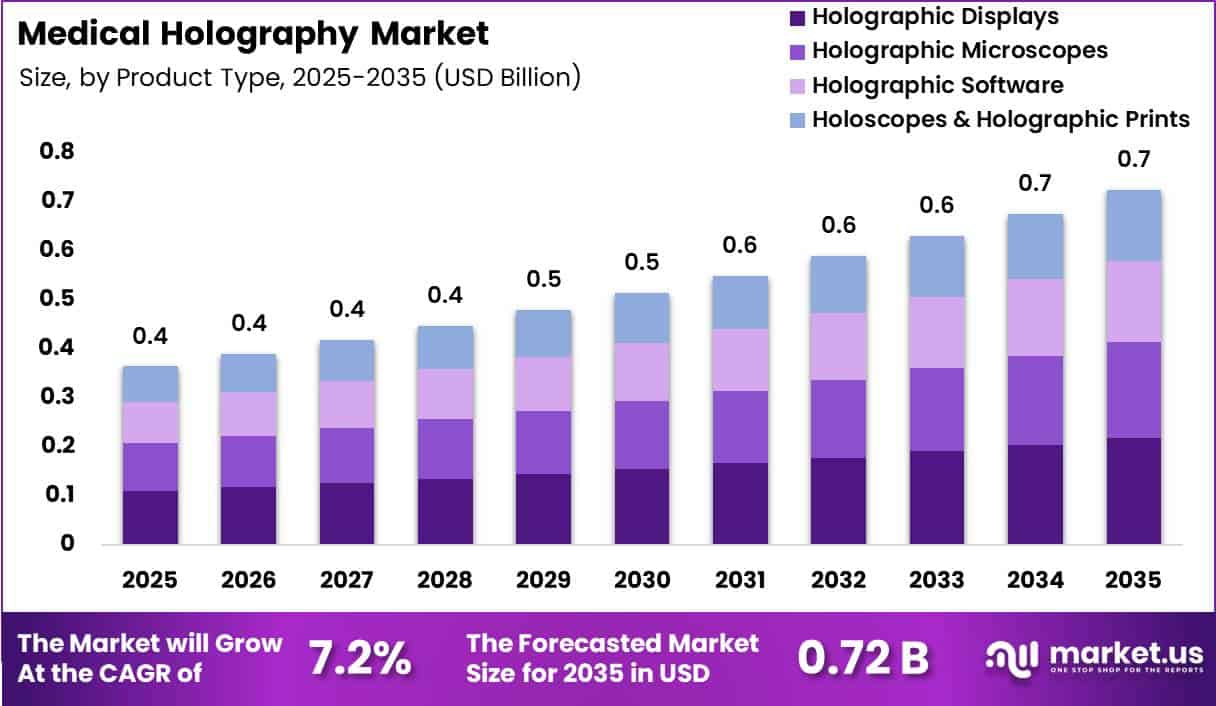
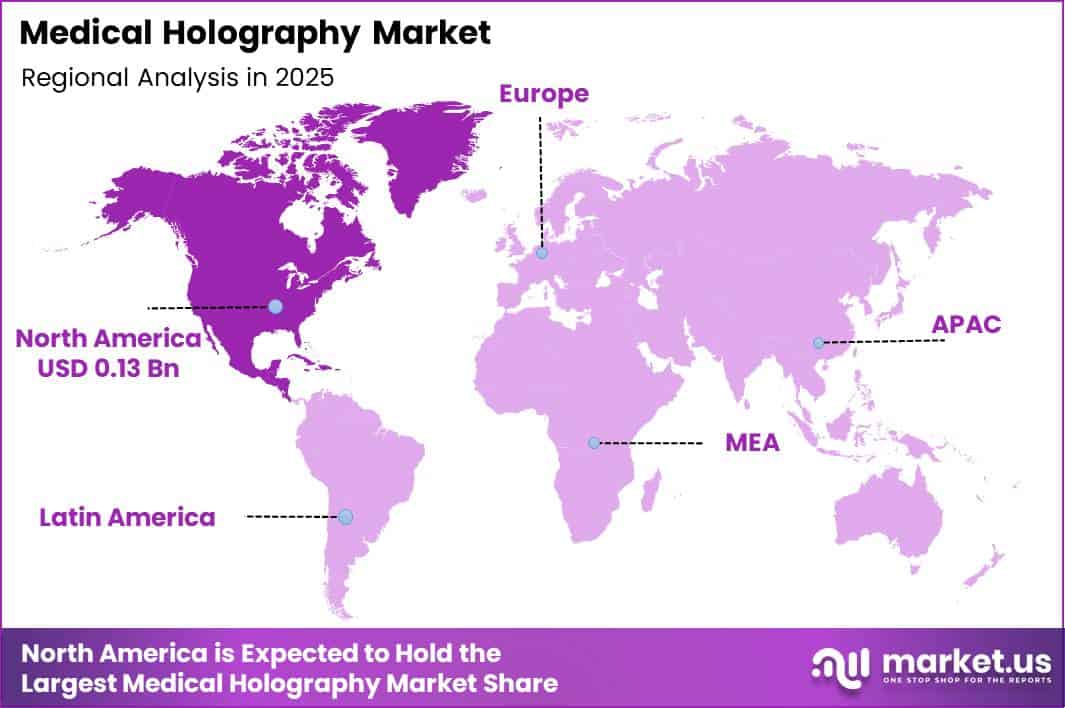
The Global Medical Holography Market size is expected to be worth around US$ 0.72 Billion by 2035 from US$ 0.36 Billion in 2025, growing at a CAGR of 7.2% during the forecast period from 2026 to 2035. In 2025, North America led the market, achieving over 37% share with a revenue of US$ 0.13 billion.
Medical holography is an emerging healthcare imaging technology that enables the creation of interactive three-dimensional (3D) visual representations of anatomical structures, diagnostic images, and biological data.
By converting information from imaging modalities such as computed tomography (CT), magnetic resonance imaging (MRI), and ultrasound into 3D holographic models, the technology supports improved visualisation, surgical planning, medical education, and patient communication.
The growing adoption of advanced imaging solutions is accelerating interest in holographic applications across healthcare. According to the National Institutes of Health-indexed research literature, medical holography has demonstrated applications in areas including radiology, orthopaedics, cardiology, pathology, and surgical training by providing enhanced anatomical visualisation compared with conventional 2D images.
Medical holography is increasingly being explored for precision-driven procedures, where surgeons can review patient-specific 3D models before and during complex interventions. Research has highlighted the use of holographic visualisation for understanding vascular structures, bone anatomy, cranial regions, and other complex biological systems.
Additionally, holographic platforms are gaining attention in medical education, allowing students and healthcare professionals to study realistic 3D anatomical models rather than relying only on traditional illustrations.
The technology also aligns with the healthcare sector’s shift toward digital transformation, artificial intelligence-assisted imaging, and minimally invasive procedures. Recent research on medical augmented reality and holographic visualisation identified more than 170 publications evaluating applications of immersive visualisation technologies in medicine, reflecting increasing scientific interest in this field.
Key Takeaways
- Market Size: The Global Medical Holography Market size was US$ 0.36 billion in 2025. The market is estimated to grow to US$ 0.72 billion by 2035.
- Market Share: The Compound Annual Growth Rate (CAGR) of the market from 2026 to 2035 will be 7.2%.
- Product Type: Holographic Displays has the largest market share, accounting for 30.20% of total product type revenue.
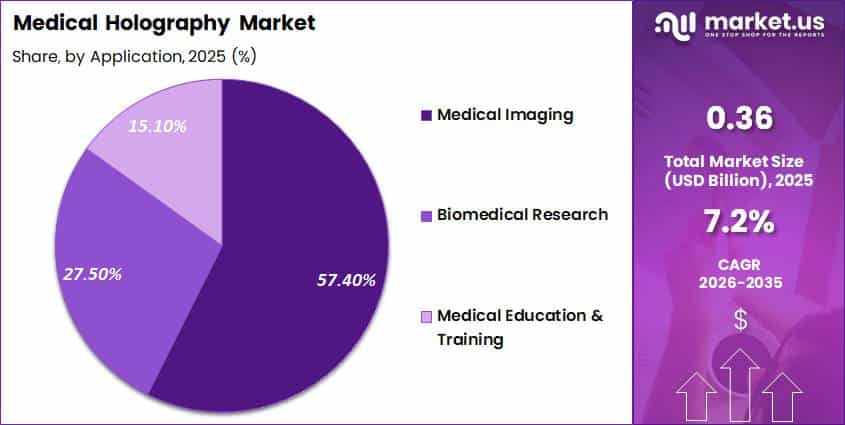
- Application: Medical Imaging leads the segment, accounting for 57.40% of total application revenue.
- End User: Hospitals & Surgical Centres lead the segment, accounting for 38.20% of total end-user revenue.
- Regional: North America is the dominant regional market, accounting for 37% of global revenue.
Product Type Analysis
The product type segment of the Medical Holography Market is primarily driven by the increasing adoption of advanced visualization technologies for diagnosis, surgical planning, research, and medical training.
Holographic Displays dominate the market, accounting for a 30.2% share in 2025, supported by their growing use in presenting patient-specific 3D anatomical models, real-time imaging data, and interactive visualisation during clinical procedures. These displays enable healthcare professionals to analyse complex structures with improved depth perception compared with traditional two-dimensional imaging methods.
Holographic Microscopes hold a 27.0% market share in 2025 and are widely utilised in biomedical research, pathology, and cellular analysis due to their ability to provide high-resolution three-dimensional visualisation of biological samples. Holographic Software accounts for a 23.0% share, supported by demand for image processing platforms, 3D reconstruction tools, and integration with medical imaging systems such as MRI and CT.
Holoscopes & Holographic Prints represent a 19.8% share in 2025 and are the fastest-growing segment, driven by increasing applications in medical education, surgical demonstrations, and patient communication. The ability to create physical or interactive holographic representations of organs and tissues is improving understanding of complex medical conditions and supporting personalised healthcare approaches.
Application Analysis
The application segment of the Medical Holography Market is expanding due to the increasing need for precise visualisation solutions across diagnosis, treatment planning, and healthcare education.
Medical Imaging dominates the market with a 57.4% share in 2025, driven by the growing integration of holographic technologies with advanced imaging modalities, including MRI, CT scans, and ultrasound. Holographic visualisation allows clinicians to transform conventional imaging data into interactive 3D models, supporting improved interpretation of complex anatomical structures and enhanced surgical preparation.
Biomedical Research accounts for a 27.5% share in 2025, supported by the rising use of holographic microscopy and three-dimensional visualisation techniques in cellular studies, drug discovery, tissue engineering, and disease research. Researchers are increasingly adopting holographic solutions to analyse biological processes with greater accuracy and spatial understanding.
Medical Education & Training holds a 15.1% share in 2025 and represents the fastest-growing application segment, as healthcare institutions are adopting immersive learning technologies to improve anatomy education and surgical skill development.
Holographic models provide students and medical professionals with realistic, interactive representations of human organs, reducing dependence on conventional cadaver-based training and static illustrations while enhancing learning outcomes.
End-User Analysis
The end-user segment of the Medical Holography Market is influenced by rising demand for advanced visualisation platforms across clinical care, research, and healthcare education environments.
Hospitals & Surgical Centres lead the market with a 38.2% share in 2025, driven by increasing adoption of holographic solutions for surgical planning, minimally invasive procedures, pre-operative visualisation, and improved communication among multidisciplinary medical teams. These facilities are utilising holographic technologies to enhance precision in complex surgeries involving cardiovascular, orthopaedic, neurological, and oncological conditions.
Research Laboratories & Institutes represent a significant segment, supported by growing investments in biomedical research, regenerative medicine, molecular studies, and advanced imaging techniques. Holographic microscopy and 3D visualisation tools enable researchers to examine biological structures and processes with improved spatial accuracy.
Academic Medical Centres are increasingly adopting medical holography for training and simulation purposes, allowing students, surgeons, and healthcare professionals to interact with realistic digital anatomical models. These centres are integrating holographic platforms into modern medical education programs to improve practical learning experiences.
Pharmaceutical & Biotech Companies are also expanding their use of holographic technologies for drug development, cellular research, and visualisation of biological interactions. The adoption of three-dimensional imaging approaches supports research efficiency and enhances understanding of complex disease mechanisms.
Key Market Segments
By Product Type
- Holographic Displays
- Holographic Microscopes
- Holographic Software
- Holoscopes & Holographic Prints
By Application
- Medical Imaging
- Biomedical Research
- Medical Education & Training
By End User
- Hospitals & Surgical Centres
- Research Laboratories & Institutes
- Academic Medical Centres
- Pharmaceutical & Biotech Companies
Driver
Surgical planning and navigation use-case deepening in medical holography
Medical holography is increasingly gaining commercial traction in use cases where it directly improves surgical precision, planning efficiency, and intraoperative decision-making, rather than serving primarily as a visualisation or training enhancement tool.
Regulatory signals support this shift: FDA recognised augmented reality and imaging guidance systems are most concentrated in high acuity domains such as radiology, neurology, spine surgery, and orthopaedics. This pattern suggests that procedural navigation, not educational or general visualisation use, is the primary near-term revenue driver for holographic platforms.
Clinical literature from NIH-indexed sources highlights growing evidence that mixed reality and holographic overlays can improve anatomical comprehension and assist minimally invasive cardiac and orthopaedic procedures. Across multiple studies, 3D patient-specific planning tools are associated with improved spatial understanding of complex anatomy and more confident preoperative decision-making.
The economic impact is most pronounced in high-value surgical specialities such as spine, cranial, orthopaedic, and structural heart procedures, where hospitals are more willing to pay for tools that reduce planning iterations, lower intraoperative uncertainty, and shorten the learning curve for complex cases. This creates a pathway for premium software and hardware reimbursement aligned with procedure intensity rather than device volume alone.
Overall, the shift toward procedure-integrated holography strengthens unit economics and supports an estimated 2.0 % point uplift to CAGR in advanced surgical markets, particularly across the U.S., Western Europe, Japan, and South Korea, where image-guided surgery ecosystems are already mature.
| Driver | (~) % Impact on CAGR Forecast | Geographic Relevance | Impact Timeline |
|---|---|---|---|
| FDA-cleared AR/VR-holography pipeline expansion | +2.3% | North America core, EU fast-follow, APAC tertiary centers | Short term |
| Surgical planning and navigation use-case deepening | +2.0% | North America core, Western Europe, Japan, South Korea | Short term |
| Medical training and anatomy education digitisation | +1.6% | North America, EU, India urban institutes, GCC academic hubs | Medium term |
| 2026 device-quality and compliance normalisation | +1.4% | North America core, EU exporters, APAC manufacturing corridors | Medium term |
| Imaging-software interoperability and digital workflow pull | +1.8% | North America, EU, APAC private hospital chains | Short term |
| Compute/display cost compression enabling broader ROI | +1.5% | APAC corridors, North America, EU secondary hospitals | Medium term |
Challenge
Reimbursement proof gap in medical holography adoption
Medical holography adoption is constrained less by clinician acceptance and more by the absence of a clear reimbursement pathway that translates visualisation benefits into billable economic value. Under current CMS structures, payment continues to flow through existing physician and hospital service codes, with no dedicated reimbursement category for holography or mixed reality navigation tools.
In inpatient settings, adoption may depend on NTAP-style justification, requiring evidence of novelty, cost inadequacy of existing approaches, and demonstrable clinical improvement.
As a result, vendors must generate substantial health economic evidence before procurement committees approve enterprise-wide deployment. This typically includes 9 to 18 months of data collection and multiple validated endpoints such as reduced preoperative planning time, shorter procedure duration, or fewer imaging re-reads.
Without this evidence package, adoption often remains confined to 1 to 3 departmental pilot programs. This creates a commercialisation bottleneck with longer 6- to 12-month sales cycles, reliance on capital budget justification, and fragmented hospital-by-hospital ROI negotiations instead of standardised reimbursement-driven scaling.
Overall, the reimbursement proof gap introduces an estimated 1.8% point drag on CAGR in 2026 to 2028, slowing diffusion until clearer coding, payment pathways, and health economic benchmarks for holography-enabled surgical workflows are established.
| Challenge | (~) % CAGR Friction Drag | Geographic Relevance | Mitigation Horizon |
|---|---|---|---|
| Reimbursement Proof Gap | -1.8% | North America core, EU hospital systems | Medium term (2-4 years) |
| Clinical Validation Fragmentation | -1.5% | U.S. academic centres, EU regulatory hubs, Japan tertiary care | Medium term (2-4 years) |
| Workflow Integration Burden | -1.3% | North America core, EU, GCC flagship hospitals, APAC urban systems | Short term (≤ 2 years) |
| AI/Software Compliance Load | -1.6% | U.S. FDA market, EU MDR environments, UK regulated pathways | Medium term (2-4 years) |
| Optical Component Volatility | -1.4% | APAC manufacturing corridors, U.S. import channels, EU device assemblers | Medium term (2-4 years) |
| Specialist Talent Bottleneck | -1.1% | U.S. and EU teaching hospitals, Japan, South Korea, India metros | Long-term (≥ 4 years) |
Restraints
Fragmented data, interoperability and safety constraints in medical holography
Medical holography depends on high-quality, multi-source clinical data such as radiology images, surgical videos, pathology, and electronic health records to generate accurate 3D visualisations. However, healthcare data systems remain fragmented globally, with limited interoperability between electronic medical records, imaging archives, and hospital networks.
Integration often requires custom engineering per hospital site, costing approximately USD 0.3 to 0.8 million and adding 6 to 12 months to deployment timelines, particularly where real-time intraoperative data access is required. This slows scalability and increases implementation complexity.
At the same time, cybersecurity and privacy requirements are increasing development burdens. Hospitals and regulators now demand encryption, access controls, and audit trails, which can consume 15 to 25 % of annual research and development effort due to continuous compliance and updates.
FDA-style safety and human factors expectations also require vendors to validate usability and error prevention in clinical workflows, adding additional testing and documentation cycles before full deployment.
Overall, these interoperability, security, and safety constraints reduce the near term addressable customer base by approximately 20 to 30 % and extend deployment timelines to 24 to 36 months, resulting in an estimated 0.9 % point drag on CAGR through the mid term adoption phase.
| Restraint | (~) % Impact on CAGR Forecast | Geographic Relevance | Impact Timeline |
|---|---|---|---|
| High compute and system TCO | -2.1% | North America core, EU, advanced APAC | Medium term (2–4 years) |
| Complex multi-agency device regulation | -1.6% | U.S., EU, UK, Japan | Medium–Long term (2–6 years) |
| Limited reimbursement & budget pressure | -1.4% | U.S., EU public systems, select APAC | Short–Medium term (≤4 years) |
| Scarce specialist skills and workflow fit | -1.1% | Global tertiary centers | Medium term (2–4 years) |
| Fragmented data, interoperability & safety | -0.9% | Global, esp. U.S./EU urban hubs | Medium–Long term (3–6 years) |
Opportunity
Holographic chronic care education platforms
This opportunity focuses on subscription-based holographic education platforms for chronic disease management, including diabetes, cardiometabolic kidney conditions, musculoskeletal disorders, and behavioural health.
Unlike baseline medical holography applications centred on imaging and surgical visualisation, this represents a shift toward longitudinal, reimbursable patient engagement and behaviour change services. These platforms would deliver interactive, life-size holographic education in clinics, pharmacies, and community health centres, supporting value-based care frameworks such as CMS ACCESS and related digital health reimbursement pilots.
The target population includes hundreds of millions of chronic disease patients globally by 2035. Under emerging value-based payment models, vendors could charge approximately 150 to 250 dollars per patient annually, supported by high content scalability and low marginal delivery costs, enabling gross margins in the 55 to 65 % range. Content developed once can be deployed across thousands of sites, improving economics versus traditional in-person education.
Assuming 3 to 5 % penetration of eligible CMS chronic care populations in North America and 1 to 2 % in select EU and APAC urban markets, this segment could generate a 4 to 6 billion dollar addressable opportunity by 2030.
It also has the potential to add approximately 1.5 % points to CAGR by converting education into a reimbursable recurring service rather than a one-time clinical interaction. Realisation depends on integration with continuous monitoring systems, payer-aligned outcome metrics such as A1C reduction and reduced hospitalisation rates, and validated curricula that demonstrate measurable improvements in chronic disease outcomes.
| Opportunity | (~) % Potential CAGR Upside | Geographic Relevance | Execution Window |
|---|---|---|---|
| Holographic chronic-care education platforms | +1.5% | North America core, EU, APAC urban | Short term (≤ 2 years) |
| Procedural 3D rehearsal & remote proctoring | +1.8% | North America, EU, GCC, East Asia | Medium term (2–4 years) |
| Holographic telepresence in tertiary care | +1.2% | North America core, EU, APAC emerging | Medium term (2–4 years) |
| Population-scale training for emerging markets | +0.9% | APAC, LATAM, Africa | Long-term (≥ 4 years) |
| Integrated holography–digital twin for precision medicine | +1.4% | North America, EU, Japan, South Korea | Long-term (≥ 4 years) |
| Holographic cognitive & mental-health interventions | +0.8% | North America, EU, APAC urban | Medium term (2–4 years) |
Regional Analysis
In 2025, North America led the market, achieving over 37.00% share with a revenue of US$ 0.13 billion. North America represents a leading region in the Medical Holography Market, supported by strong healthcare infrastructure, rapid adoption of advanced imaging technologies, and significant investments in medical innovation. The region’s growth is driven by increasing utilisation of 3D visualisation solutions in surgical planning, medical education, and biomedical research.
The presence of leading academic medical centres, research institutions, and technology developers has accelerated the integration of holographic platforms into clinical workflows. Additionally, growing demand for minimally invasive procedures and precision-based healthcare solutions is encouraging hospitals and surgical centres to adopt advanced visualisation technologies.
Europe is witnessing steady expansion due to increasing digital transformation across healthcare systems, rising adoption of artificial intelligence-assisted imaging, and government initiatives supporting innovative medical technologies. Countries with advanced healthcare systems are implementing holographic solutions for surgical simulation, anatomical education, and complex disease research.
The Asia-Pacific region is expected to experience significant growth, driven by improving healthcare infrastructure, increasing investments in medical technology, and expanding research activities in countries such as Japan, South Korea, and China. Growing demand for advanced medical training tools and enhanced diagnostic capabilities is supporting regional adoption.
Latin America and the Middle East & Africa are emerging markets for medical holography, supported by gradual healthcare modernisation, increasing awareness of advanced imaging technologies, and investments in specialised healthcare facilities. However, adoption remains influenced by technology costs, infrastructure availability, and access to skilled professionals.
Overall, global demand is being shaped by the transition toward personalised medicine, digital healthcare, and advanced visualisation-based clinical solutions.
Key Regions and Countries
North America
- The US
- Canada
Europe
- Germany
- France
- The U.K.
- Italy
- Spain
- Russia & CIS
- Rest of Europe
Asia Pacific
- China
- India
- Japan
- South Korea
- ASEAN
- Australia & New Zealand
- Rest of Asia Pacific
Middle East & Africa
- GCC
- South Africa
- Rest of Middle East & Africa
Latin America
- Brazil
- Mexico
- Rest of Latin America
Key Player Analysis
Suppliers in the global medical holography market are strengthening their competitive positions through the development of real-time three-dimensional holographic visualisation platforms. These systems enable surgeons to interact with patient-specific anatomical models generated from CT, MRI, and ultrasound data during pre-operative planning and intraoperative navigation.
Holographic microscopy is also being advanced to provide label-free quantitative phase imaging for live-cell and tissue visualisation in biomedical research and pathology.
Key strategic priorities include augmented reality surgical guidance, where holographic anatomical overlays are integrated with direct surgical-field visualisation, and immersive medical education platforms that support procedural training without cadaveric or patient exposure.
Holographic software platforms are further being developed with gesture and voice controls, allowing clinicians to manipulate three-dimensional anatomical models without conventional two-dimensional screens.
Investment is also being directed toward clinical validation, regulatory approvals, and institutional partnerships with hospitals and academic medical centres. The integration of artificial intelligence for automated anatomical segmentation and surgical planning is expected to reduce technical barriers and expand adoption across surgical specialities. These developments are anticipated to support broader market penetration through 2035.
Top Key Players
- EchoPixel Inc.
- RealView Imaging Ltd.
- Microsoft Corporation (HoloLens)
- Augmedics
- Eon Reality Inc.
- zSpace Inc.
- Mach7 Technologies Pte. Ltd.
- Holoxica Ltd.
- Lyncee Tec SA
- Phase Holographic Imaging AB (PHI)
- Nanolive SA
- Ovizio Imaging Systems NV/SA
- Holografika Kft.
- Medivis
- Zebra Imaging Inc.
- Other Key Players
Recent Developments
- In January 2026, Microsoft Corporation (HoloLens) expanded its HoloLens mixed reality surgical guidance platform integration with major hospital electronic health record and medical imaging systems, targeting intraoperative holographic anatomical overlay adoption across North American academic medical center surgical programs.
- In February 2026, Augmedics secured expanded FDA clearance for its xvision holographic spine surgery navigation platform, enabling broader institutional adoption across North American hospital orthopaedic and neurosurgery department procurement programs targeting improved pedicle screw placement accuracy.
- In March 2026, EchoPixel Inc. launched its True 3D holographic medical imaging platform across European radiology department institutional buyers, targeting pre-operative surgical planning workflow integration for cardiovascular, oncology, and orthopaedic surgical specialities.
- In May 2026, Phase Holographic Imaging AB expanded its holographic microscopy platform distribution across pharmaceutical and biotech company research institutional buyers, targeting live cell imaging and drug discovery application adoption across European and North American laboratory networks.
Report Scope
| Report Features | Description |
|---|---|
| Market Value (2025) | US$ 0.36 Billion |
| Forecast Revenue (2035) | US$ 0.72 Billion |
| CAGR (2026-2035) | 7.2% |
| Base Year for Estimation | 2025 |
| Historic Period | 2020-2024 |
| Forecast Period | 2026-2035 |
| Report Coverage | Revenue Forecast, Market Dynamics, Competitive Landscape, Recent Developments |
| Segments Covered | By Product Type (Holographic Displays, Holographic Microscopes, Holographic Software, Holoscopes & Holographic Prints), By Application (Medical Imaging, Biomedical Research, Medical Education & Training), By End User (Hospitals & Surgical Centres, Research Laboratories & Institutes, Academic Medical Centres, Pharmaceutical & Biotech Companies) |
| Regional Analysis | North America – The US, Canada; Europe – Germany, France, U.K., Italy, Spain, Russia & CIS, Rest of Europe; Asia Pacific – China, India, Japan, South Korea, ASEAN, Australia & New Zealand, Rest of Asia Pacific; Middle East & Africa – GCC, South Africa, Rest of Middle East & Africa; Latin America – Brazil, Mexico, Rest of Latin America |
| Competitive Landscape | EchoPixel Inc., RealView Imaging Ltd., Microsoft Corporation (HoloLens), Augmedics, Eon Reality Inc., zSpace Inc., Mach7 Technologies Pte. Ltd., Holoxica Ltd., Lyncee Tec SA, Phase Holographic Imaging AB (PHI), Nanolive SA, Ovizio Imaging Systems NV/SA, Holografika Kft., Medivis, Zebra Imaging Inc., Other Key Players |
| Customization Scope | Customization for segments, region/country-level will be provided. Moreover, additional customization can be done based on the requirements. |
| Purchase Options | We have three licenses to opt for: Single User License, Multi-User License (Up to 5 Users), Corporate Use License (Unlimited User and Printable PDF) |





































