


Global Mechanical Locks Market Size, Share, Growth Analysis By Product (Padlocks, Deadlocks, Cylindrical Locks, Others), By Material (Steel, Brass, Aluminum, Others), By End-User (Residential, Commercial, Industrial), By Distribution Channel (Offline, Online), By Region and Companies - Industry Segment Outlook, Market Assessment, Competition Scenario, Statistics, Trends and Forecast 2026-2035
- Published date: Feb 2026
- Report ID: 178963
- Number of Pages: 363
- Format:
-
keyboard_arrow_up
Quick Navigation
Report Overview
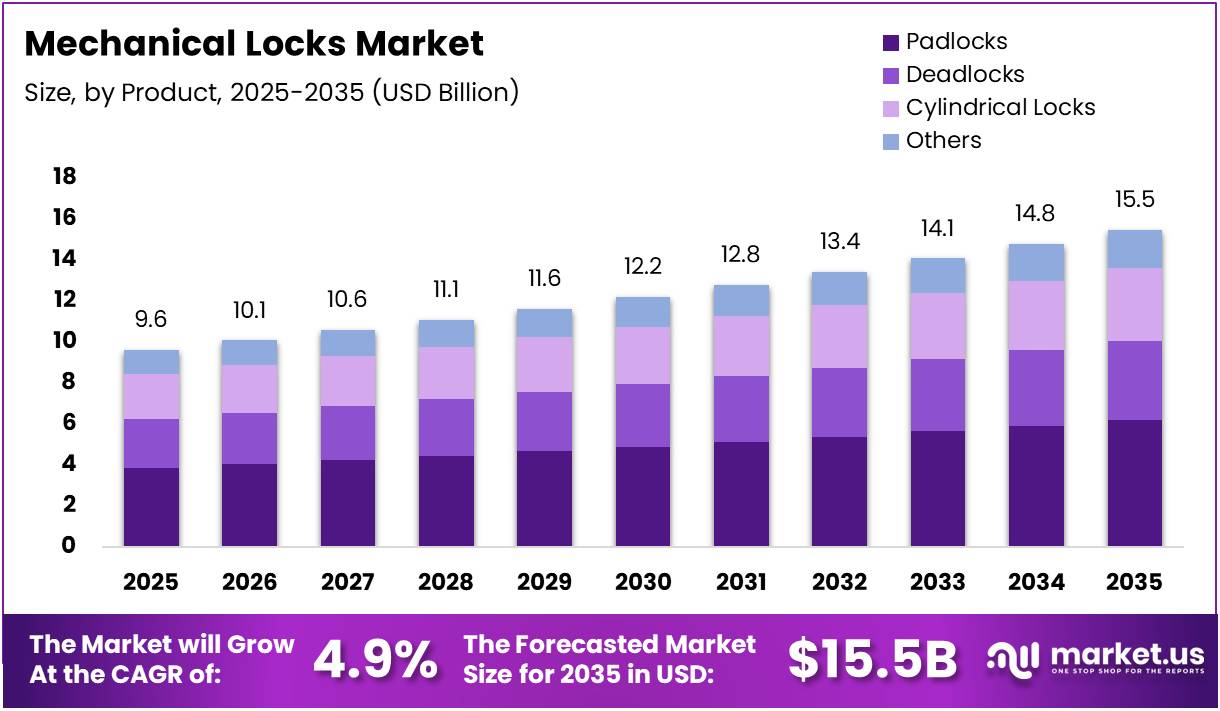
The Global Mechanical Locks Market size is expected to be worth around USD 15.5 Billion by 2035 from USD 9.6 Billion in 2025, growing at a CAGR of 4.9% during the forecast period 2026 to 2035.
Mechanical locks are physical security devices that use keys, bolts, or cylinders to prevent unauthorized access to doors, cabinets, gates, and equipment. They include a broad range of products such as padlocks, deadlocks, cylindrical locks, and mortise locks. Moreover, these products are trusted globally for their simplicity, durability, and independence from electrical power sources.
The market is driven by rising demand for high-security locking solutions in residential and commercial buildings. Rapid construction activity in emerging economies continues to boost mechanical lock installation at scale. Additionally, property developers and builders consistently favor mechanical locks for their low maintenance requirements and long operational life compared to electronic alternatives.
Growth opportunities are emerging through hybrid mechanical-digital solutions that combine physical security with smart access technology. Furthermore, untapped rural and semi-urban markets across Asia Pacific, Africa, and Latin America offer significant expansion potential. Rising use of mechanical locks in industrial equipment and commercial storage also contributes to the market’s long-term growth trajectory.
Government investments in affordable housing, public infrastructure, and commercial real estate are supporting steady demand for mechanical locking systems. Several national building codes and safety regulations require certified locking hardware in residential and public structures. Therefore, compliance mandates are generating consistent procurement of high-quality mechanical locks across global construction markets.
Eco-friendly manufacturing trends and hybrid product development are further shaping the market’s evolution. Manufacturers are exploring recycled materials, sustainable processes, and IoT-compatible mechanical designs to meet modern buyer expectations. Consequently, the mechanical locks market is transitioning from a purely traditional segment into one that balances heritage product reliability with contemporary innovation.
According to Keytrak, 76% of respondents use traditional locks, while only 8% use smart or keyless entry systems, and 30% use a combination of both. This confirms that mechanical locks remain the dominant security choice for the majority of property managers and homeowners globally.
According to Dormakaba, the lifespan of a mechanical lock in daily use can mechanically be around 15 to 20 years. This long service life significantly reduces total cost of ownership, making mechanical locks an economically sound investment. Consequently, facility managers and property owners continue to prioritize mechanical locks in their long-term security and maintenance planning.
Key Takeaways
- The Global Mechanical Locks Market was valued at USD 9.6 Billion in 2025 and is projected to reach USD 15.5 Billion by 2035.
- The market is expected to grow at a CAGR of 4.9% during the forecast period 2026 to 2035.
- By Product, Padlocks held the dominant segment share of 34.82% in 2025.
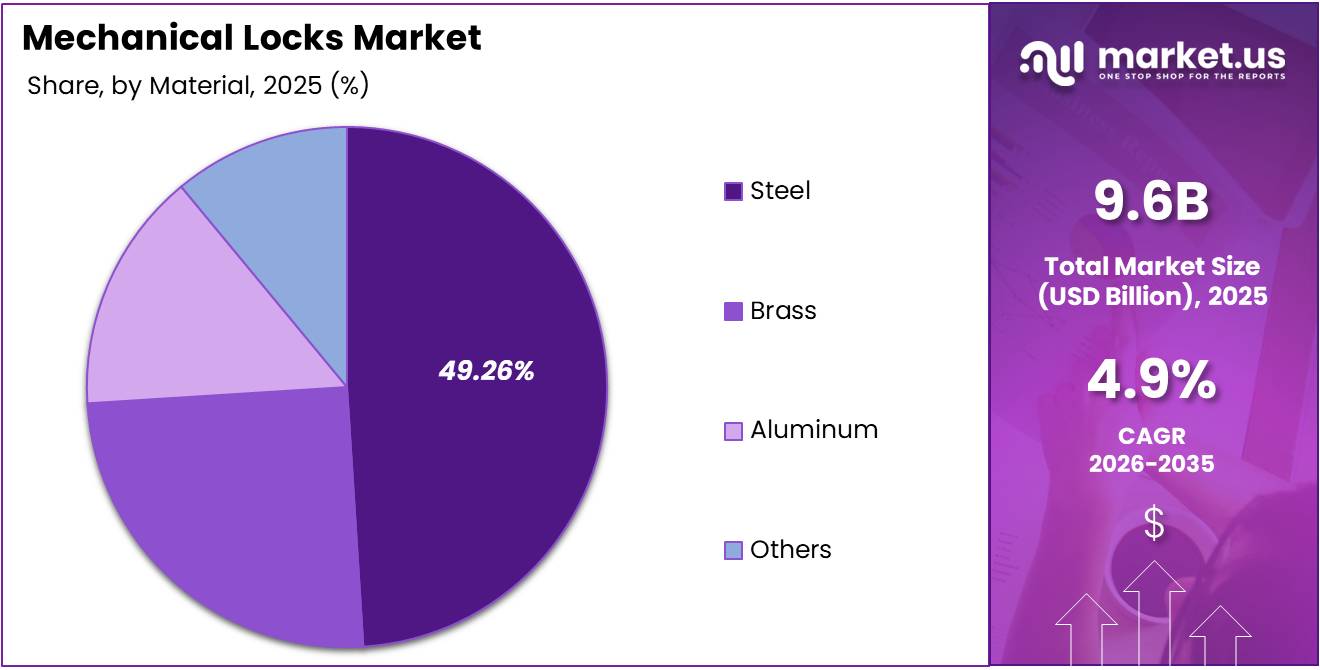
- By Material, Steel led the market with a share of 49.26% in 2025.
- By End-User, the Residential segment accounted for the largest share of 41.23% in 2025.
- By Distribution Channel, Offline channels dominated with a 78.35% share in 2025.
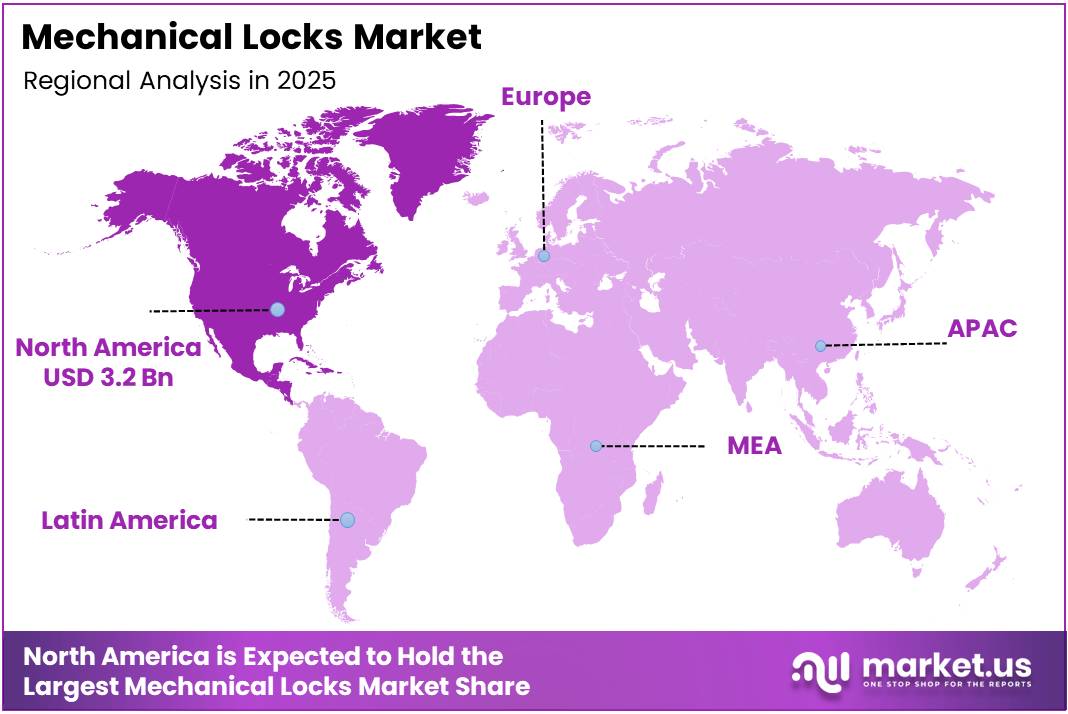
- North America led the global market with a 35.10% share, valued at USD 3.2 Billion in 2025.
By Product Analysis
Padlocks dominate with 34.82% due to their portability and versatile use across residential, commercial, and industrial applications.
In 2025, Padlocks held a dominant market position in the By Product segment of the Mechanical Locks Market, with a 34.82% share. Their portability and versatility make them ideal for securing gates, lockers, sheds, and storage units. Moreover, consistent demand across multiple end-user categories continues to reinforce padlocks as the leading product segment globally.
Deadlocks are primarily installed on entry doors of homes and commercial buildings, providing strong resistance to forced entry. Their simple yet highly effective bolt mechanism makes them a trusted choice for perimeter security. Additionally, building codes in several countries recommend deadlock installation on exterior doors, supporting steady and recurring demand across construction projects.
Cylindrical Locks are widely used in residential and light commercial settings due to their ease of installation and competitive pricing. These locks are integrated into standard door knob and lever-handle assemblies. Furthermore, their availability across multiple security grades supports adoption in new construction, commercial fit-outs, and renovation projects of varying budget levels.
Others category includes cam locks, mortise locks, and lever locks serving specialized applications in furniture, cabinets, and industrial equipment. These products address niche security requirements across multiple industries. Consequently, this segment continues to expand as manufacturers develop purpose-built locking solutions for commercial and industrial end-users with specific functional needs.
By Material Analysis
Steel dominates with 49.26% due to its superior strength, corrosion resistance, and widespread availability in lock manufacturing.
In 2025, Steel held a dominant market position in the By Material segment of the Mechanical Locks Market, with a 49.26% share. Steel locks are favored for their exceptional durability, long service life, and resistance to physical attack. Moreover, their cost-effectiveness and widespread availability make steel the most used material in global mechanical lock manufacturing.
Brass is a widely used material in lock manufacturing due to its natural corrosion resistance and ease of machining. Brass locks are commonly found in interior door hardware, decorative fittings, and classic keyway designs. Additionally, the material’s antimicrobial properties make brass locks a preferred option in healthcare, hospitality, and food service environments.
Aluminum locks are valued for their lightweight construction and natural resistance to rust, making them well-suited for outdoor and coastal environments. They are commonly specified for sliding doors, windows, and lightweight storage units. Furthermore, growing demand for lighter security hardware in residential and commercial construction is driving increased adoption of aluminum-based locking products.
Others category includes zinc alloy and composite materials used in specialized locking applications requiring unique aesthetic or functional properties. These materials offer advantages such as enhanced finish quality and targeted corrosion protection. Consequently, manufacturers are actively exploring alternative material options to meet evolving design preferences and sustainability demands across the market.
By End-User Analysis
Residential dominates with 41.23% due to rising homeownership rates and growing consumer focus on household security.
In 2025, Residential held a dominant market position in the By End-User segment of the Mechanical Locks Market, with a 41.23% share. Growing homeownership rates and increasing security awareness among households are key demand drivers. Moreover, ongoing construction of new residential properties across emerging and developed markets is consistently expanding the installed base of mechanical locks.
The Commercial segment covers offices, retail stores, hotels, and public institutions that require reliable and rekey-friendly access control solutions. Mechanical locks in commercial settings are favored for their durability, ease of maintenance, and low total cost of ownership. Additionally, regulatory requirements for certified security hardware in public buildings support consistent procurement across the commercial sector.
The Industrial segment encompasses manufacturing plants, warehouses, logistics facilities, and utility infrastructure requiring heavy-duty locking solutions. Industrial mechanical locks must withstand extreme operating conditions including temperature variation, dust, and vibration. Consequently, demand for robust, high-grade mechanical locks in this segment is growing alongside ongoing expansion of global manufacturing and supply chain infrastructure.
By Distribution Channel Analysis
Offline dominates with 78.35% as customers prefer to physically inspect and purchase mechanical locks through trusted retail and hardware outlets.
In 2025, Offline held a dominant market position in the By Distribution Channel segment of the Mechanical Locks Market, with a 78.35% share. Customers prefer purchasing mechanical locks through hardware stores, specialty retailers, and distributors where they can physically evaluate products before buying. Moreover, professional installation services available at offline outlets further reinforce the dominance of traditional retail channels.
The Online distribution channel is gaining steady traction as e-commerce platforms expand product availability to remote and semi-urban markets. Consumers are increasingly turning to online channels for competitive pricing, product comparison, and home delivery convenience. Additionally, growing digital literacy and improving logistics infrastructure across emerging markets are accelerating the gradual shift toward online mechanical lock sales.
Key Market Segments
By Product
- Padlocks
- Deadlocks
- Cylindrical Locks
- Others
By Material
- Steel
- Brass
- Aluminum
- Others
By End-User
- Residential
- Commercial
- Industrial
By Distribution Channel
- Offline
- Online
Drivers
Increasing Demand for High-Security and Durable Locking Solutions Drives Mechanical Locks Market Growth
The mechanical locks market is primarily driven by rising demand for reliable security solutions in residential and commercial properties. Growing concerns about burglary, unauthorized access, and asset protection are encouraging property owners to invest in proven locking systems. Moreover, increasing urbanization and new construction activity are consistently expanding the installed base of mechanical locks worldwide.
Infrastructure development programs and large-scale construction projects across emerging economies are generating sustained demand for mechanical locking hardware. Governments and developers in Asia Pacific, the Middle East, and Latin America are investing heavily in housing, transportation, and commercial real estate. Consequently, these regions are becoming high-volume markets for both standard and premium mechanical lock products.
The preference for durable and low-maintenance locking systems is another important driver supporting market expansion. Unlike electronic alternatives, mechanical locks require minimal upkeep and operate without a power supply. Therefore, property managers and facility operators in regions with unreliable electricity infrastructure continue to prioritize mechanical locks for their consistent, cost-effective, and dependable security performance.
Restraints
Competition from Smart Lock Technologies and Limited Awareness Restrain Mechanical Locks Market Growth
A primary restraint in the mechanical locks market is intensifying competition from digital and smart lock technologies. Smart locks offer keyless entry, remote access management, and integration with home automation platforms. However, while smart lock adoption is growing among tech-savvy consumers, their higher cost and connectivity dependency still limit their ability to fully displace mechanical alternatives at scale.
Mechanical lock manufacturers are facing increasing pricing pressure as smart lock production costs gradually decline. As consumer awareness of electronic security options improves, demand for traditional locks faces headwinds in developed markets. Consequently, mechanical lock producers must focus on product innovation, design differentiation, and value-added features to remain competitive against rapidly evolving digital alternatives.
Limited awareness about the benefits of high-quality mechanical locks remains a restraining factor, particularly in emerging regions. Many consumers in rural and semi-urban markets continue to purchase low-cost, uncertified locking products that underperform in security. Therefore, industry stakeholders need to invest in consumer education, quality certification programs, and distribution partnerships to drive adoption of premium mechanical lock solutions in underserved markets.
Growth Factors
Hybrid Solutions and Untapped Market Expansion Create Strong Growth Opportunities for Mechanical Locks
One of the most significant growth opportunities in the mechanical locks market is the development of hybrid mechanical-digital locking solutions. These products combine the proven reliability of mechanical mechanisms with the convenience of digital access features. Moreover, growing consumer interest in versatile security systems is encouraging manufacturers to invest in hybrid product innovation and development pipelines.
Expansion into untapped rural and semi-urban markets represents another key avenue for market growth. Many households and small businesses in developing regions still rely on low-quality security hardware. Additionally, improving distribution networks, rising disposable incomes, and greater retail penetration in these areas are creating favorable conditions for established mechanical lock brands to capture new customer segments.
Rising use of mechanical locks in commercial and industrial equipment is further supporting market expansion. Machinery enclosures, storage systems, utility panels, and control cabinets require dependable locking mechanisms to prevent unauthorized access. Consequently, industrial growth across manufacturing, logistics, energy, and infrastructure sectors is generating sustained demand for purpose-built mechanical locking solutions in non-residential applications.
Emerging Trends
IoT Integration and Sustainable Manufacturing Are Shaping the Future of the Mechanical Locks Market
A major emerging trend in the mechanical locks market is the integration of mechanical components with IoT-enabled security platforms. Manufacturers are designing locks that pair traditional physical mechanisms with digital monitoring and real-time alert capabilities. Moreover, this convergence allows users to benefit from the dependability of mechanical locks combined with connected security management through smart home ecosystems.
The growing popularity of vintage and classic lock designs is another trend driven by consumer demand for aesthetic appeal. Architects and interior designers are increasingly specifying decorative mechanical locks for heritage buildings, boutique hotels, and luxury residential projects. Additionally, this trend is encouraging manufacturers to revive traditional craftsmanship and period-style hardware while maintaining contemporary security performance standards.
Demand for eco-friendly and sustainable lock manufacturing materials is gaining traction as environmental consciousness increases globally. Producers are exploring recycled metals, low-emission production processes, and sustainable packaging to reduce environmental impact. Consequently, sustainability credentials are becoming a competitive differentiator for mechanical lock brands targeting green-certified construction projects and environmentally conscious commercial and residential buyers.
Regional Analysis
North America Dominates the Mechanical Locks Market with a Market Share of 35.10%, Valued at USD 3.2 Billion
North America holds the leading position in the global mechanical locks market, accounting for 35.10% of total revenue, valued at USD 3.2 Billion in 2025. The region’s dominance is driven by high residential and commercial construction activity, stringent building safety regulations, and strong consumer preference for reliable security hardware. Moreover, the presence of well-established manufacturers and extensive distribution networks further reinforces North America’s market leadership.
Europe Mechanical Locks Market Trends
Europe is a mature and stable market for mechanical locks, supported by well-established construction, renovation, and heritage building maintenance industries. Countries such as Germany, the UK, France, and Italy maintain high standards for security hardware in residential and commercial properties. Additionally, stringent regulatory frameworks around building safety continue to sustain consistent demand for certified mechanical locking solutions across the region.
Asia Pacific Mechanical Locks Market Trends
Asia Pacific is one of the fastest-growing regions in the mechanical locks market, driven by rapid urbanization and large-scale housing development in China, India, and Southeast Asia. Rising disposable incomes and expanding construction pipelines are increasing demand for quality security hardware across the region. Consequently, Asia Pacific presents significant long-term growth opportunities for both global and regional mechanical lock manufacturers.
Latin America Mechanical Locks Market Trends
Latin America represents an emerging growth opportunity in the global mechanical locks market, with Brazil and Mexico leading regional demand. Growing residential construction activity and rising urban security concerns are supporting market expansion in this region. Furthermore, improving retail distribution channels and increasing consumer awareness about physical security products are encouraging broader adoption of mechanical locks across Latin American markets.
Middle East and Africa Mechanical Locks Market Trends
The Middle East and Africa region is experiencing steady growth in the mechanical locks market, supported by large-scale infrastructure and hospitality sector development. Ambitious construction programs in GCC countries are generating strong demand for commercial-grade locking hardware. Additionally, rising urbanization and improving living standards across Sub-Saharan Africa are gradually expanding the consumer base for quality mechanical security products.
Key Regions and Countries
North America
- US
- Canada
Europe
- Germany
- France
- The UK
- Spain
- Italy
- Rest of Europe
Asia Pacific
- China
- Japan
- South Korea
- India
- Australia
- Rest of APAC
Latin America
- Brazil
- Mexico
- Rest of Latin America
Middle East & Africa
- GCC
- South Africa
- Rest of MEA
Key Company Insights
Assa Abloy AB is a global leader in access solutions, offering a comprehensive portfolio of mechanical and electronic locking products across residential, commercial, and institutional markets. The company operates in over 70 countries and maintains a strong focus on product innovation and strategic acquisitions. Its broad distribution network and brand strength position it as a dominant force in the global mechanical locks industry.
Allegion plc specializes in security products and solutions with a strong presence in North America, Europe, and Asia Pacific. The company offers a wide range of mechanical locks, door controls, and access hardware across multiple well-known brands. Moreover, Allegion focuses on delivering integrated security solutions for residential, commercial, and institutional customers, supported by an extensive service infrastructure and global distribution capability.
Dormakaba Holding AG is a leading provider of access and security solutions, combining mechanical and digital locking technologies to serve diverse global market needs. The company serves customers in over 130 countries through an extensive product portfolio and service network. Additionally, Dormakaba’s focus on hybrid security innovation and sustainable manufacturing practices aligns well with evolving customer expectations and market trends.
Spectrum Brands Holdings, Inc. is a well-established player in the residential and commercial security hardware segment, offering mechanical locks, deadbolts, and door hardware through retail and professional channels. The company’s strong foothold in North American retail markets and continued focus on product development support ongoing growth in mechanical lock sales. Furthermore, its accessible pricing strategy broadens its reach across diverse consumer segments.
Key Players
- Assa Abloy AB
- Allegion plc
- Dormakaba Holding AG
- Spectrum Brands Holdings, Inc.
- CISA S.p.A.
- Godrej & Boyce Manufacturing Company Limited
- ABUS August Bremicker Söhne KG
- Mul-T-Lock Ltd.
- Master Lock
- Winkhaus GmbH & Co. KG
- Gretsch-Unitas group
- Häfele SE & Co. KG
- C.Ed. Schulte GmbH Zylinderschlossfabrik
- Others
Recent Developments
- January 2026 – SALTO WECOSYSTEM announced a strategic investment in ATZ to drive innovation across its product development pipeline and enhance overall supply chain resilience. This investment underscores the growing convergence of mechanical and digital security technologies in the global access solutions market.
- December 2025 – Assa Abloy completed the acquisition of Sargent and Greenleaf, a manufacturer of high-security mechanical and electronic locking solutions and safe hardware, with its corporate office based in Kentucky. This acquisition strengthens Assa Abloy’s position in the premium mechanical lock segment across North America.
- November 2025 – Camlock Systems announced a strategic partnership with Painco Ibérica to strengthen its access solutions distribution and market presence across Spain and Portugal. This collaboration expands Camlock’s reach into the Iberian Peninsula and enhances service capabilities for regional commercial and industrial customers.
Report Scope
Report Features Description Market Value (2025) USD 9.6 Billion Forecast Revenue (2035) USD 15.5 Billion CAGR (2026-2035) 4.9% Base Year for Estimation 2025 Historic Period 2020-2024 Forecast Period 2026-2035 Report Coverage Revenue Forecast, Market Dynamics, Competitive Landscape, Recent Developments Segments Covered By Product (Padlocks, Deadlocks, Cylindrical Locks, Others), By Material (Steel, Brass, Aluminum, Others), By End-User (Residential, Commercial, Industrial), By Distribution Channel (Offline, Online) Regional Analysis North America (US and Canada), Europe (Germany, France, The UK, Spain, Italy, and Rest of Europe), Asia Pacific (China, Japan, South Korea, India, Australia, and Rest of APAC), Latin America (Brazil, Mexico, and Rest of Latin America), Middle East & Africa (GCC, South Africa, and Rest of MEA) Competitive Landscape Assa Abloy AB, Allegion plc, Dormakaba Holding AG, Spectrum Brands Holdings, Inc., CISA S.p.A., Godrej & Boyce Manufacturing Company Limited, ABUS August Bremicker Söhne KG, Mul-T-Lock Ltd., Master Lock, Winkhaus GmbH & Co. KG, Gretsch-Unitas group, Häfele SE & Co. KG, C.Ed. Schulte GmbH Zylinderschlossfabrik, Others Customization Scope Customization for segments, region/country-level will be provided. Moreover, additional customization can be done based on the requirements. Purchase Options We have three licenses to opt for: Single User License, Multi-User License (Up to 5 Users), Corporate Use License (Unlimited User and Printable PDF) 
-
-
- Assa Abloy AB
- Allegion plc
- Dormakaba Holding AG
- Spectrum Brands Holdings, Inc.
- CISA S.p.A.
- Godrej & Boyce Manufacturing Company Limited
- ABUS August Bremicker Söhne KG
- Mul-T-Lock Ltd.
- Master Lock
- Winkhaus GmbH & Co. KG
- Gretsch-Unitas group
- Häfele SE & Co. KG
- C.Ed. Schulte GmbH Zylinderschlossfabrik
- Others
Our Clients

- 178963
- Feb 2026






