


Global Managed VPN Market Size, Share and Analysis By Type (Remote Access VPNs, Site-to-Site VPNs), By End User (Service Providers, Enterprises), By Regional Analysis, Global Trends and Opportunity, Future Outlook By 2025-2035
- Published date: March 2026
- Report ID: 182202
- Number of Pages: 295
- Format:
-
keyboard_arrow_up
Quick Navigation
- Report Overview
- Key Takeaway
- Key Managed VPN Market Statistics
- Report Scope
- By Type: Remote Access VPNs
- By End User: Enterprises
- By Region: North America
- Growth Factors
- Emerging Trends
- Key Market Segments
- Driver Analysis
- Restraint Analysis
- Opportunity Analysis
- Challenge Analysis
- Key Players Analysis
- Recent Developments
Report Overview
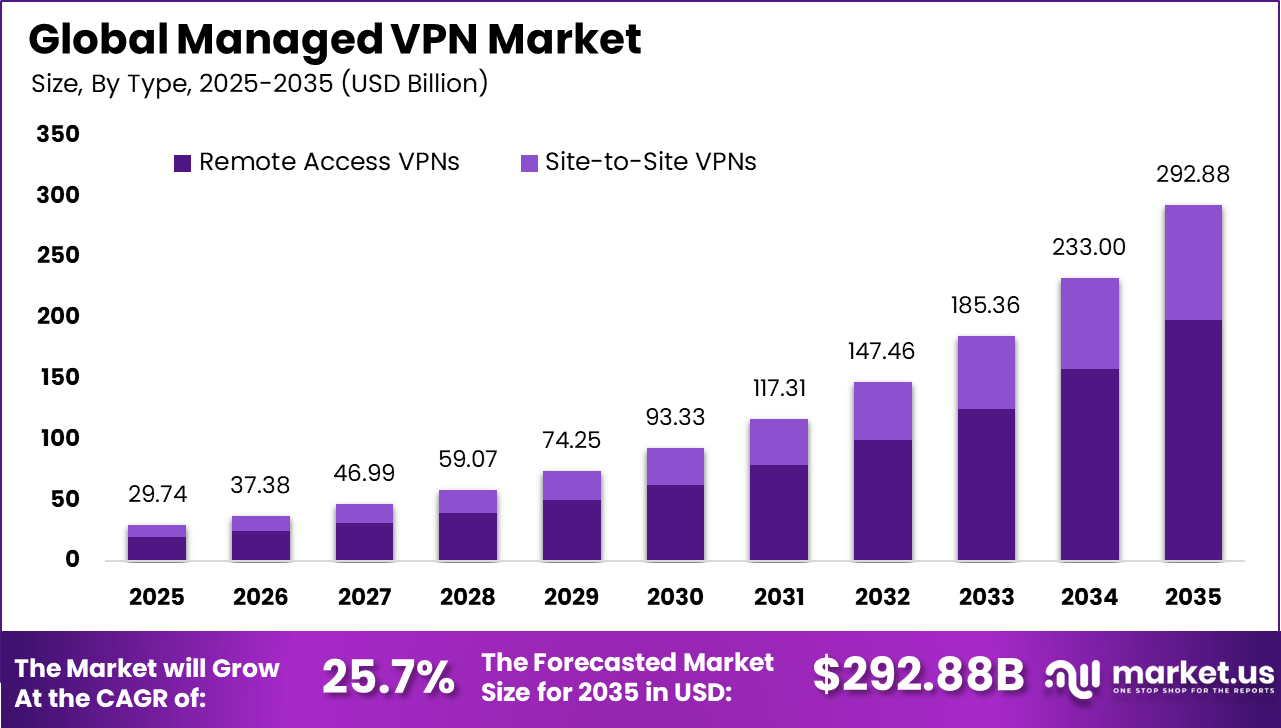
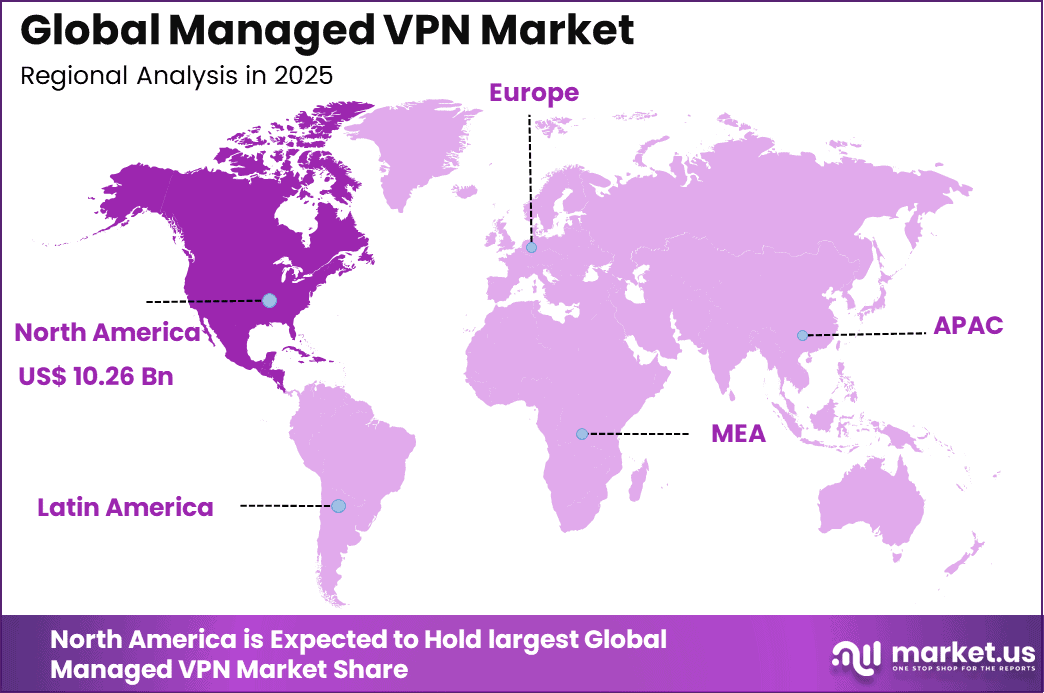
The Global Managed VPN Market size is expected to be worth around USD 292.88 billion by 2035, from USD 29.74 billion in 2025, growing at a CAGR of 25.7% during the forecast period from 2025 to 2035. North America held a dominant market position, capturing more than a 34.5% share, holding USD 10.26 billion in revenue.
The managed VPN market refers to outsourced virtual private network services that enable organizations to securely connect remote users, branch offices, and distributed systems through encrypted communication channels. Managed VPN providers design, deploy, monitor, and maintain VPN infrastructure, allowing businesses to ensure secure data transmission without managing the underlying network complexity internally. These services are widely used across enterprises to support secure remote access, site-to-site connectivity, and protected communication over public networks.
The demand for managed VPN solutions has increased significantly as organizations adopt cloud services, remote work models, and distributed IT environments. Businesses require secure and reliable connectivity to protect sensitive data from cyber threats while maintaining seamless access to applications and systems. Managed VPN services provide centralized management, scalability, and continuous monitoring, making them essential for modern enterprise networking.
For instance, in February 2026, Perimeter 81 focused on scaling its managed network and SASE‑style offering, including VPN‑like secure remote access, for cloud‑native companies and MSPs. The company sharpened its multi‑tenant dashboards and access‑policy workflows, aiming to make it easier for managed‑service providers to deliver managed‑VPN‑style services to distributed teams.
Key Takeaway
- In 2025, Remote Access VPNs led the Global Managed VPN Market, accounting for 67.8% of total share.
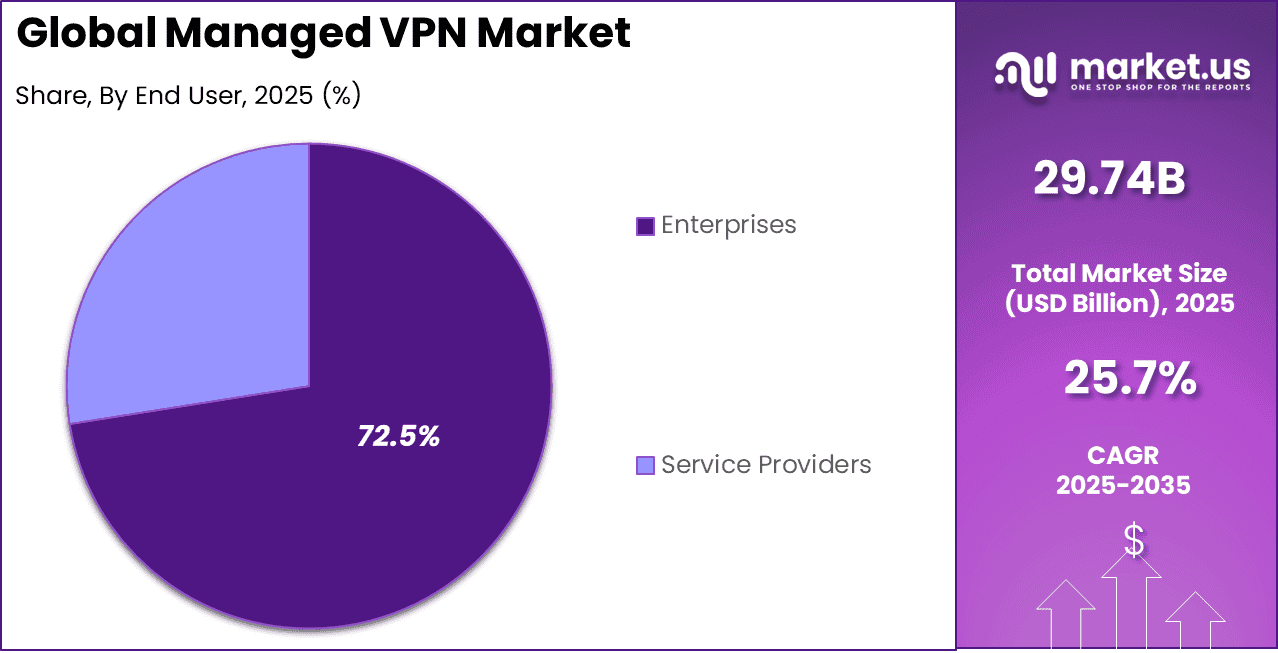
- In 2025, Enterprises represented the primary customer segment, capturing 72.5% of overall demand.
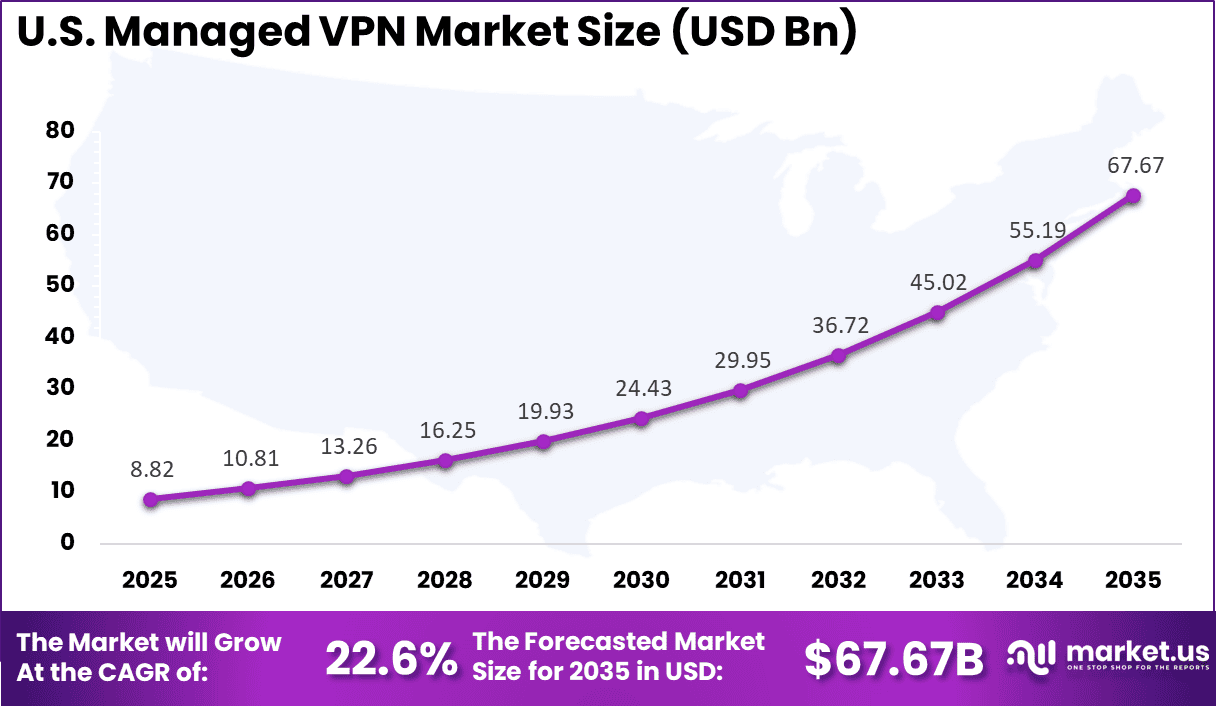
- In 2025, the U.S. Managed VPN Market reached USD 8.82 billion and recorded a strong growth rate of 22.6%.
- In 2025, North America maintained regional leadership, securing more than 34.5% of the Global Managed VPN Market.
Key Managed VPN Market Statistics
- Approximately 22.9% of global internet users utilize VPN services, while usage in the United States reaches nearly 42%.
- More than 68% of remote workers in the United States rely on VPNs for secure enterprise access, and corporate VPN adoption increased by 44% between 2021 and 2024.
- Key drivers of VPN adoption include enhanced security at 51%, fast and reliable connectivity at 49%, and the demand for affordable and user friendly solutions.
- Over 52% of U.S. organizations are integrating VPNs into identity based and zero trust access management frameworks.
- VPN usage is more prevalent among younger users, with 39% of global users aged 16 to 24 actively using VPN services.
- Regionally, Indonesia leads VPN adoption with a 55% usage rate, followed by India at 43%.
- When selecting VPN services, 51% of users prioritize strong encryption protocols, while 49% value fast and reliable connections.
- Around 40% of users consider affordable pricing an essential factor, 32% prefer a wide range of server locations, and 28% prioritize a user friendly interface.
Report Scope
Report Features Description Market Value (2025) USD 29.7 Bn Forecast Revenue (2035) USD 292.8 Bn CAGR (2026-2035) 25.7% Base Year for Estimation 2025 Historic Period 2020-2024 Forecast Period 2026-2035 Report Coverage Revenue forecast, AI impact on Market trends, Share Insights, Company ranking, competitive landscape, Recent Developments, Market Dynamics and Emerging Trends Segments Covered By Type (Remote Access VPNs, Site-to-Site VPNs), By End User (Service Providers, Enterprises) Regional Analysis North America – US, Canada; Europe – Germany, France, The UK, Spain, Italy, Russia, Netherlands, Rest of Europe; Asia Pacific – China, Japan, South Korea, India, New Zealand, Singapore, Thailand, Vietnam, Rest of Latin America; Latin America – Brazil, Mexico, Rest of Latin America; Middle East & Africa – South Africa, Saudi Arabia, UAE, Rest of MEA Competitive Landscape Barracuda Networks, Cisco, Citrix, ExpressVPN, Fortinet, MikroTik, NordVPN, OpenVPN, Palo Alto Networks, Perimeter 81, Others Customization Scope Customization for segments, region/country-level will be provided. Moreover, additional customization can be done based on the requirements. Purchase Options We have three license to opt for: Single User License, Multi-User License (Up to 5 Users), Corporate Use License (Unlimited User and Printable PDF) By Type: Remote Access VPNs
Remote access VPNs account for 67.8% of the market, reflecting the growing need for secure connectivity for remote employees and mobile users. These solutions allow users to access corporate networks from external locations while maintaining encrypted communication channels. Organizations rely on remote access VPNs to support workforce mobility and ensure secure access to enterprise resources.
The adoption of remote access VPNs is also driven by the rise of hybrid work models and distributed teams. Employees require secure and reliable access to internal systems regardless of location. Managed VPN providers offer centralized control, monitoring, and maintenance, enabling organizations to maintain secure connectivity without managing complex infrastructure internally.
For Instance, in March 2026, Barracuda Networks rolled out fresh updates to its remote access VPN client. They fixed crashes during tunnel compression and smoothed out reconnects with SAML logins, making it way more reliable for users jumping on from anywhere. Folks on the ground say it feels snappier now, especially with DNS leak protection kicking in strongly.
By End User: Enterprises
Enterprises account for 72.5% of market adoption due to the scale and complexity of their network environments. These organizations manage large numbers of users, devices, and applications that require secure and consistent connectivity. Managed VPN services help enterprises maintain network security while simplifying operational management.
Large and medium sized enterprises also rely on managed VPN solutions to reduce infrastructure costs and improve network performance. Service providers handle network monitoring, maintenance, and security updates, allowing enterprises to focus on core business operations. As digital transformation continues, enterprise adoption of managed VPN services remains strong.
For instance, in January 2026, Palo Alto Networks tackled a high-severity DoS bug in GlobalProtect for enterprise firewalls. It let outsiders hammer the portal into maintenance mode, but patches rolled out fast for PAN-OS setups. Enterprise IT crews love how it bolsters their big-scale remote access, dodging downtime during peak hours seamlessly.
By Region: North America
North America holds 34.5% of the market share due to strong adoption of advanced network security solutions and widespread use of remote work technologies. Organizations in the region invest in managed VPN services to protect data transmission across distributed networks. The presence of mature IT infrastructure further supports regional market growth.
For instance, in January 2026, Cisco reinforced North America’s Managed VPN supremacy through its Secure Access Service Edge (SASE) platform update, integrating Meraki and Umbrella technologies. The platform now supports 5G-optimized VPN tunnels for hybrid workforces, powering 85% of Fortune 500 companies’ secure connectivity needs across the U.S. and Canada.
Within North America, the United States contributes USD 8.82 billion with a growth rate of 22.6%. The country’s large enterprise base and increasing demand for secure remote connectivity have accelerated adoption of managed VPN services. Continued investment in cybersecurity and network infrastructure is expected to sustain market expansion.
For instance, in February 2026, Barracuda Networks strengthened U.S. dominance in the Managed VPN market by launching its enhanced CloudGen WAN platform, offering zero-trust security for distributed enterprises. The solution provides seamless remote access with AI-driven threat detection, serving over 200,000 organizations across North America. This innovation solidifies their leadership in secure connectivity solutions.
Growth Factors
One of the primary growth factors driving the managed VPN market is the rapid expansion of remote and hybrid work environments. Employees increasingly access corporate systems from various locations, creating the need for secure remote connectivity. Managed VPN services ensure encrypted communication and protect sensitive information across public networks.
Another growth factor is the increasing adoption of cloud computing and digital transformation initiatives. As organizations migrate workloads to cloud environments, secure connectivity between users and cloud applications becomes critical. Managed VPN solutions provide reliable access to cloud resources while maintaining strong security controls.
Emerging Trends
One emerging trend in the managed VPN market is the integration of VPN services with broader security frameworks such as secure access service edge architectures. This integration combines network security, access control, and traffic management into a unified platform, enhancing overall security and performance.
Another trend is the adoption of advanced encryption protocols and zero-trust security models. Modern managed VPN solutions incorporate identity-based authentication and continuous verification to strengthen security and reduce the risk of unauthorized access.
Key Market Segments
By Type
- Remote Access VPNs
- Site-to-Site VPNs
By End User
- Service Providers
- Enterprises
- BFSI
- Healthcare
- IT & ITES
- Energy & Power
- Media & Entertainment
- Transportation & Logistics
- Manufacturing
- Others
Key Regions and Countries
North America
- US
- Canada
Europe
- Germany
- France
- The UK
- Spain
- Italy
- Russia
- Netherlands
- Rest of Europe
Asia Pacific
- China
- Japan
- South Korea
- India
- Australia
- Singapore
- Thailand
- Vietnam
- Rest of APAC
Latin America
- Brazil
- Mexico
- Rest of Latin America
Middle East & Africa
- South Africa
- Saudi Arabia
- UAE
- Rest of MEA
Driver Analysis
Increasing Need for Secure Remote Connectivity
A key driver of the managed VPN market is the growing need for secure remote connectivity across enterprises. Organizations must ensure that employees, partners, and customers can access systems securely from different locations. Managed VPN services provide encrypted connections that protect data from interception and unauthorized access.
Another driver is the rising number of cyber threats targeting network communications. Data transmitted over public networks is vulnerable to attacks such as interception and unauthorized access. Managed VPN solutions enhance network security by encrypting data and implementing secure authentication mechanisms.
Restraint Analysis
Performance Limitations and Latency
One restraint affecting the managed VPN market is the potential impact on network performance. VPN encryption and routing processes can introduce latency, particularly when users access distant servers or high-volume data applications. This may affect user experience in bandwidth-intensive operations.
Another restraint involves the complexity of managing large-scale VPN deployments. Organizations with extensive networks and numerous users may face challenges in maintaining consistent performance and ensuring efficient traffic routing across VPN connections.
Opportunity Analysis
Expansion of Secure Networking Services
A significant opportunity in the managed VPN market lies in the expansion of secure networking services. Organizations increasingly seek integrated solutions that combine VPN connectivity with threat detection, access control, and network monitoring. Managed service providers can offer comprehensive security solutions that address multiple aspects of enterprise networking.
Another opportunity involves the growing adoption of VPN services in emerging markets. As businesses in developing regions expand digital operations and internet connectivity improves, demand for secure communication solutions is expected to increase.
Challenge Analysis
Evolving Security Requirements
One of the key challenges in the managed VPN market is keeping pace with evolving cybersecurity threats. Attackers continuously develop new techniques to exploit network vulnerabilities, requiring VPN providers to update security protocols and monitoring systems regularly.
Another challenge involves balancing security with user experience. Organizations must ensure that VPN solutions provide strong encryption and protection while maintaining fast and reliable connectivity. Achieving this balance is critical for widespread adoption.
Key Players Analysis
The Managed VPN Market is driven by cybersecurity and networking providers that deliver secure remote access and encrypted communication solutions for enterprises and individuals. Cisco, Fortinet, and Palo Alto Networks provide enterprise grade VPN solutions integrated with advanced security features such as threat detection and access control. These platforms are widely adopted by organizations to secure remote work environments and protect sensitive data.
Cloud networking and virtualization providers also contribute significantly to managed VPN adoption. Citrix, Barracuda Networks, and Perimeter 81 offer secure access solutions that combine VPN capabilities with zero trust network access frameworks. These platforms enable centralized management of remote connections and user authentication. Their solutions support enterprises seeking scalable and cloud based secure access infrastructure.
Consumer focused VPN providers and open source platforms further expand the competitive landscape. ExpressVPN, NordVPN, and OpenVPN provide secure browsing and privacy focused connectivity solutions for individual users and small businesses. Additional vendors such as MikroTik contribute networking hardware and VPN configuration capabilities. The market remains competitive, with differentiation driven by encryption standards, network performance, and integration with broader cybersecurity frameworks.
Top Key Players in the Market
- Barracuda Networks
- Cisco
- Citrix
- ExpressVPN
- Fortinet
- MikroTik
- NordVPN
- OpenVPN
- Palo Alto Networks
- Perimeter 81
- Others
Recent Developments
- In January 2026, NordVPN, already a major consumer‑VPN brand, continued to expand its enterprise‑focused offerings, including NordLayer‑style SASE‑style access tied to managed‑VPN‑style remote connectivity. The strategy targets small and mid‑size businesses that want vendor‑managed secure access without standing up a complex in‑house VPN infrastructure.
- In February 2026, OpenVPN broadened its role as an underlying access technology by deepening integration with cloud‑native and SASE‑style platforms, enabling providers and enterprises to use OpenVPN Access Server as a managed‑VPN backend. Partners are increasingly wrapping managed services around OpenVPN‑based tunnels, especially in distributed‑office and hybrid‑cloud scenarios.

-
-
- Barracuda Networks
- Cisco
- Citrix
- ExpressVPN
- Fortinet
- MikroTik
- NordVPN
- OpenVPN
- Palo Alto Networks
- Perimeter 81
- Others
Our Clients

- 182202
- March 2026









