Global Logistics Visibility Software Market Size, Share and Analysis By Functionality (Real-time Tracking, Route Optimization, Inventory Management, Analytics and Reporting, Others), By Deployment (Cloud-based, On-premises), By Pricing Model (Subscription-based, Usage-based, Perpetual Licensing), By Enterprise Size (Small and Mid-Sized Enterprises (SMEs), Large Enterprises), By End-User Industry (Retail, Manufacturing, Food & Beverages, Automotive, Healthcare, Transportation & Logistics, Others), By Regional Analysis, Global Trends and Opportunity, Future Outlook By 2025-2035
- Published date: March 2026
- Report ID: 180979
- Number of Pages: 240
- Format:
-
keyboard_arrow_up
Quick Navigation
- Report Overview
- Key Takeaway
- Market Growth and Adoption
- Role of Generative AI
- Functionality Analysis
- Deployment Analysis
- Pricing Model Analysis
- Enterprise Size Analysis
- End-User Industry Analysis
- Region Insights
- Growth Factors
- Emerging Trends
- Key Market Segments
- Drivers
- Restraint
- Opportunities
- Challenges
- Key Players Analysis
- Recent Developments
- Report Scope
Report Overview
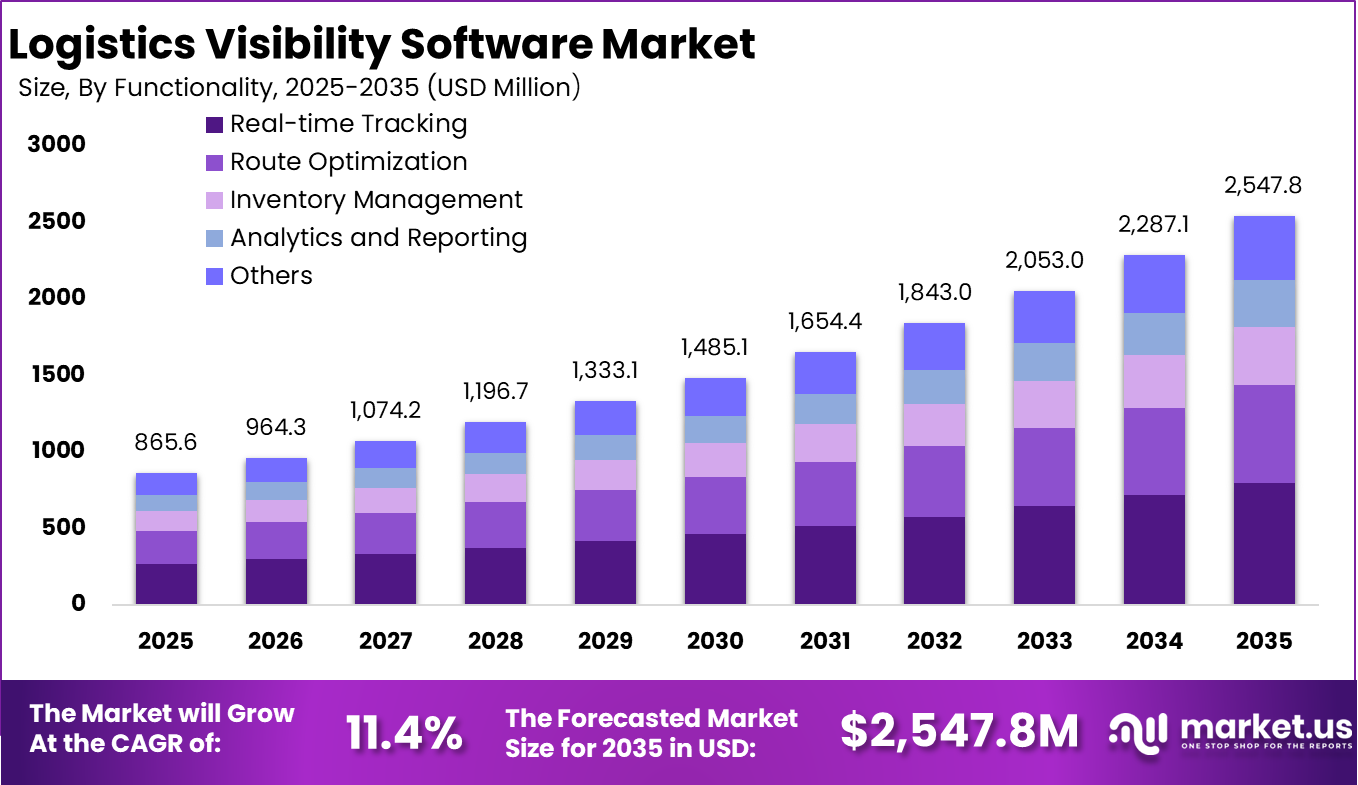
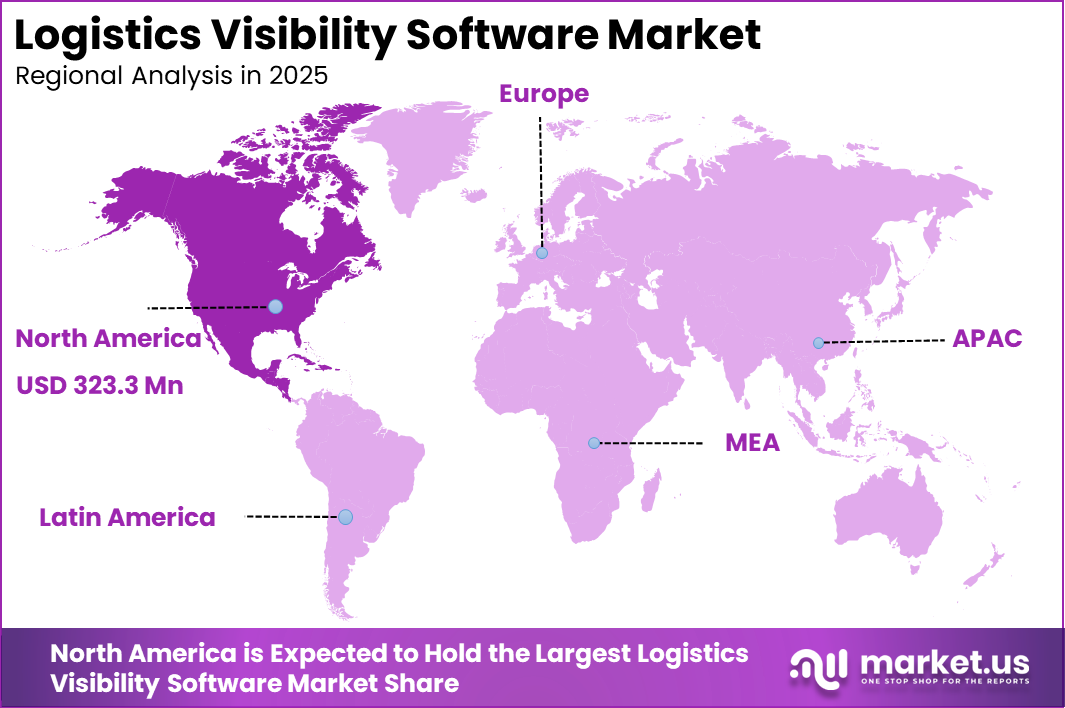
The Global Logistics Visibility Software Market size is expected to be worth around USD 2,547.8 million by 2035, from USD 865.6 million in 2025, growing at a CAGR of 11.4% during the forecast period from 2025 to 2035. North America held a dominant market position, capturing more than a 37.35% share, holding USD 323.3 million in revenue.
The Logistics Visibility Software Market refers to digital platforms that help shippers, carriers, freight forwarders, and supply chain teams track the movement, condition, and status of goods across transport networks in real time. These platforms bring together shipment data, milestone events, inventory signals, and exception alerts into one operational view.
The market has become more important as supply chains have grown more fragmented, cross border operations have become more data intensive, and customers now expect faster and more transparent delivery updates. European transport policy itself now treats digital freight information and shared logistics data as important tools for better visibility, real time cargo management, and more efficient use of transport infrastructure.
Rising global trade and complex supply chains are pushing companies to adopt logistics visibility software. Disruptions such as port congestion cause delays longer than two weeks for about 51% of firms. Growing e-commerce activity and demand for precise delivery times increase pressure. Extreme weather incidents now impact 22% of supply chains each year, strengthening the need for reliable tracking tools.
Demand for logistics visibility software grows as companies struggle with frequent shipping disruptions. Global logistics delays average between 10% and 25% due to customs checks and port backlogs. Supplier failures have risen by 39% in recent years, pushing firms to detect problems early. During peak seasons, shipment delays increase by over 30%, strengthening demand for smarter monitoring tools.
For instance, in January 2026, Blue Yonder unveiled AI-driven innovations in its Logistics Ops Agent, optimizing over 23 million warehouse tasks in 2025 alone. Retailers are leveraging the platform’s 3D load-building and route optimization to tackle shrinking margins and boost end-to-end supply chain velocity amid rising complexity.
Key Takeaway
- In 2025, the Real-time Tracking segment held a dominant market position, capturing a 31.48% share of the Global Logistics Visibility Software Market.
- In 2025, the Cloud-based segment held a dominant market position, capturing a 75.4% share of the Global Logistics Visibility Software Market.
- In 2025, the Subscription-based segment held a dominant market position, capturing a 43.72% share of the Global Logistics Visibility Software Market.
- In 2025, the Large Enterprises segment held a dominant market position, capturing a 68.94% share of the Global Logistics Visibility Software Market.
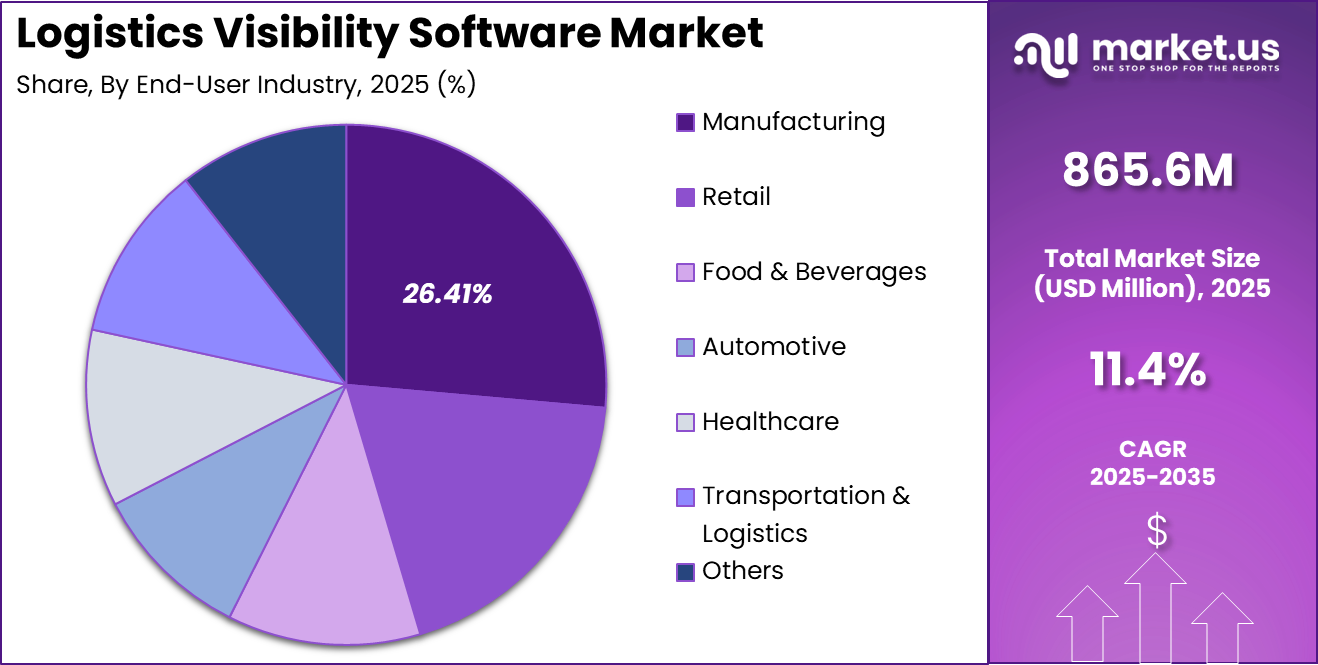
- In 2025, the Manufacturing segment held a dominant market position, capturing a 26.41% share of the Global Logistics Visibility Software Market.
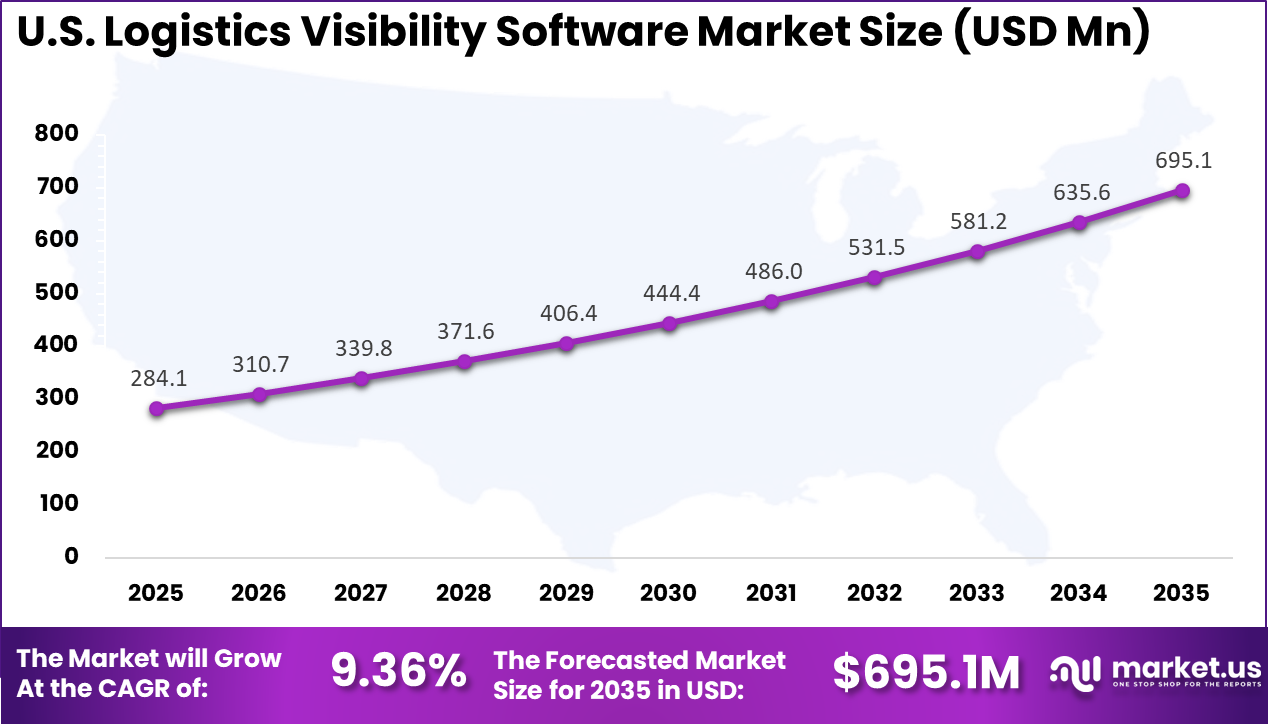
- The U.S. Logistics Visibility Software Market was valued at USD 284.1 Million in 2025, with a robust CAGR of 9.36%.
- In 2025, North America held a dominant market position in the Global Logistics Visibility Software Market, capturing more than a 37.35% share.
Market Growth and Adoption
- Around 50% of shippers and 59% of logistics service providers have implemented freight tracking capabilities.
- Approximately 70% of organizations identify supply chain visibility as a top priority, yet 62% report limited operational insight.
- In 2024, 76% of shippers experienced supply chain disruptions, and 22% faced more than 20 disruptive events.
- Companies adopting visibility platforms report up to 20% improvement in operational efficiency.
- AI driven systems reduce transportation expenses by nearly 20% and overall logistics costs by 10% to 15%.
- Enhanced visibility improves warehouse efficiency by up to 30%.
- AI based forecasting tools lower demand prediction errors by approximately 40%.
- Advanced platforms automate up to 75% of manual tracking and reporting tasks.
- The most utilized features include real time tracking, predictive estimated arrival times, and automated exception management.
- About 67% of organizations rely on digital dashboards for end to end supply chain visibility.
- Tracking coverage currently reaches 60% for in transit shipments, 85% for delivered goods, 40% for warehouse inventory, and 75% for processing activities.
Role of Generative AI
Generative AI helps logistics teams analyze large data streams coming from trucks, ports, and warehouses. It quickly creates reports and answers operational questions. Nearly 44% of logistics teams already rely on these tools to speed up decisions and improve supply chain visibility.
Generative AI also builds predictive scenarios using weather, traffic, and operational data. These insights help teams identify potential delays before they occur. Companies save significant time previously spent on manual checks, while studies indicate 25-30% improvement in on-time deliveries with AI-driven visibility systems.
Functionality Analysis
In 2025, Real time tracking represents 31.48% of the market functionality segment, reflecting the increasing need for continuous monitoring of shipments and logistics operations. Logistics visibility platforms integrate data from transportation systems, GPS devices, and sensor networks to provide accurate updates on shipment location and status. This capability allows supply chain managers to monitor delivery progress and identify potential delays before they disrupt operations.
The use of real time tracking tools also improves operational responsiveness. Companies can adjust transportation routes, coordinate with logistics partners, and manage inventory levels more effectively. As global supply chains become more interconnected, real time tracking functionality remains essential for maintaining supply chain reliability.
For Instance, in January 2026, Project44 rolled out fresh updates to its visibility platform, sharpening real-time tracking with better carrier tools and predictive alerts. Shippers now get live shipment views that help spot delays early and adjust routes on the spot. This keeps goods moving smoothly even when things go sideways, making it a go-to for teams chasing reliability.
Deployment Analysis
In 2025, the Cloud based deployment accounts for 75.4% of the market, highlighting strong enterprise preference for scalable and centralized logistics management systems. Cloud infrastructure enables organizations to monitor supply chain activities across multiple locations through unified dashboards. This approach improves data accessibility for logistics managers, suppliers, and transportation providers.
Cloud deployment also supports advanced analytics and system integration with enterprise resource planning and transportation management platforms. Organizations benefit from reduced infrastructure costs and faster implementation timelines. As supply chain operations continue to digitalize, cloud based logistics visibility platforms maintain dominant adoption.
For instance, in March 2026, Blue Yonder pushed a cloud upgrade that scales visibility tools without downtime, perfect for growing fleets. Teams access dashboards from any device, sharing updates across offices and warehouses effortlessly. The ease of rolling out fixes keeps cloud setups ahead in fast-paced logistics.
Pricing Model Analysis
In 2025, The subscription based pricing represents 43.72% of the market, reflecting the demand for flexible and predictable technology investments. Businesses prefer subscription models because they reduce upfront capital expenditure while providing access to continuously updated software platforms. This approach allows companies to scale logistics visibility capabilities according to operational requirements.
The subscription model also ensures regular platform improvements and system updates without complex upgrade procedures. Organizations benefit from ongoing access to enhanced analytics and monitoring capabilities. As digital supply chain tools become more essential to logistics management, subscription based pricing remains widely adopted.
For Instance, in December 2025, Manhattan Associates introduced flexible subscription tiers that match usage patterns for visibility software. Companies start small and add features as needs grow, avoiding big upfront hits. This pay-as-you-go vibe makes it simple for budgets to breathe while testing real value.
Enterprise Size Analysis
In 2025, The Large enterprises account for 68.94% of market adoption due to the complexity of their global supply chain networks. These organizations manage extensive logistics operations that involve multiple suppliers, transportation partners, and distribution centers. Logistics visibility software helps consolidate operational data and improve coordination across these networks.
Large companies also rely on advanced analytics tools to optimize transportation planning and reduce supply chain risks. Centralized visibility enables managers to evaluate performance metrics and identify inefficiencies within logistics operations. As supply chains expand internationally, large enterprises continue to lead adoption of visibility platforms.
For Instance, in October 2025, Infor unveiled tools tailored for large-scale logistics, integrating visibility into core systems. Enterprises manage complex flows from procurement to delivery with unified insights. It empowers them to cut waste at scale, setting new bars for efficiency in heavy operations.
End-User Industry Analysis
In 2025, The manufacturing represents 26.41% of market adoption due to its reliance on efficient supply chain coordination. Manufacturers depend on accurate visibility into raw material shipments, production inputs, and product distribution to maintain consistent production schedules. Logistics visibility software provides insights that help manufacturers monitor supplier deliveries and transportation timelines.
Manufacturers also use these platforms to manage inventory levels and reduce production delays caused by supply chain disruptions. Data insights allow companies to improve logistics planning and strengthen supplier collaboration. As manufacturing supply chains become increasingly global, demand for logistics visibility systems continues to grow.
For Instance, in March 2026, Shippeo added manufacturing-focused features that sync supplier feeds with factory floors. Plants get alerts on incoming parts, avoiding assembly halts from late arrivals. This tight loop keeps production humming, especially for just-in-time setups common in the sector.
Region Insights
North America holds 37.35% of the market share due to strong adoption of digital supply chain technologies and advanced logistics infrastructure. Organizations in the region actively invest in software platforms that enhance transportation monitoring and supply chain coordination. The presence of large logistics providers and technology companies further supports regional market development.
For instance, in October 2025, Atlanta’s Manhattan Associates rolled out enhanced cloud-based visibility software with edge AI capabilities. This update provides end-to-end shipment tracking for U.S. retailers, cutting inventory costs significantly and maintaining North America’s lead in retail logistics optimization technology.
Within North America, the United States contributes USD 284.1 million with a growth rate of 9.36%. The country’s extensive freight transportation network and large manufacturing sector have strengthened demand for logistics visibility software. Continued investment in digital logistics technologies is expected to sustain market growth across the region.
For instance, in February 2026, Project44 from Chicago achieved its first positive operating free cash flow quarter, showcasing financial strength. The company launched Movement, an AI-powered decision intelligence platform enhancing supply chain visibility across North America. This innovation solidifies U.S. leadership in logistics technology, serving global brands with real-time insights and automation.
Growth Factors
One of the key growth factors driving the logistics visibility software market is the expansion of global e-commerce and digital trade. Online retail operations require efficient logistics coordination to ensure timely deliveries and accurate shipment tracking. Logistics visibility platforms enable companies to monitor shipments across various transportation modes and improve last-mile delivery performance.
Another growth factor is the growing demand for supply chain transparency. Businesses increasingly seek real-time insights into transportation processes to improve inventory planning and reduce operational uncertainties. Visibility software helps organizations analyze transportation data, identify delays, and optimize supply chain workflows.
Emerging Trends
One emerging trend in the logistics visibility software market is the integration of artificial intelligence and predictive analytics. AI-powered systems analyze transportation data, historical shipment patterns, and external factors such as weather or traffic conditions to forecast potential disruptions. This predictive capability allows companies to proactively adjust logistics strategies and avoid delays.
Another trend is the adoption of Internet of Things technologies within logistics networks. Sensors attached to shipments and transportation equipment generate real-time data related to location, temperature, and handling conditions. Logistics visibility platforms collect and analyze this information to ensure product safety and improve monitoring across supply chains.
Key Market Segments
By Functionality
- Real-time Tracking
- Route Optimization
- Inventory Management
- Analytics and Reporting
- Others
By Deployment
- Cloud-based
- On-premises
By Pricing Model
- Subscription-based
- Usage-based
- Perpetual Licensing
By Enterprise Size
- Small and Mid-Sized Enterprises (SMEs)
- Large Enterprises
By End-User Industry
- Manufacturing
- Retail
- Food & Beverages
- Automotive
- Healthcare
- Transportation & Logistics
- Others
Key Regions and Countries
North America
- US
- Canada
Europe
- Germany
- France
- The UK
- Spain
- Italy
- Russia
- Netherlands
- Rest of Europe
Asia Pacific
- China
- Japan
- South Korea
- India
- Australia
- Singapore
- Thailand
- Vietnam
- Rest of APAC
Latin America
- Brazil
- Mexico
- Rest of Latin America
Middle East & Africa
- South Africa
- Saudi Arabia
- UAE
- Rest of MEA
Drivers
Growing Need for Real Time Supply Chain Visibility
Global supply chains have become more complex as goods move through multiple transportation modes, warehouses, and distribution hubs. Businesses now require better monitoring tools to understand where shipments are at every stage. Logistics visibility software provides clear tracking information that helps companies reduce uncertainty and maintain stable supply operations.
Frequent disruptions such as port congestion, customs delays, and labor shortages also increase the need for real time monitoring. Logistics teams want early alerts when shipments slow down or change routes. Visibility platforms help managers respond quickly, adjust delivery plans, and maintain smooth coordination between carriers, suppliers, and distribution centers.
For instance, in February 2026, Project44 rolled out fresh updates to its visibility platform, focusing on real-time collaboration tools for carriers and shippers. Teams can now share live shipment data across lanes, spot issues early, and adjust routes instantly. This move helps businesses keep goods moving smoothly amid daily disruptions, building stronger trust with partners.
Restraint
Data Integration Complexity
One major challenge for logistics visibility platforms is the difficulty of connecting data from different systems. Supply chains involve several stakeholders, including carriers, warehouse operators, and port authorities. Each participant often uses different software or tracking technologies, which makes smooth data integration difficult.
Companies sometimes struggle to combine information from transport management systems, warehouse platforms, and external carrier networks. Inconsistent data formats and limited system compatibility slow down implementation. These technical barriers can delay adoption and require additional time and resources before companies fully benefit from visibility tools.
For instance, in January 2026, Blue Yonder tackled integration headaches by simplifying connections between old warehouse systems and new tracking apps. Users report less time spent on manual fixes, though linking diverse carrier feeds still takes effort. It eases some pain but highlights ongoing struggles with mismatched tech stacks.
Opportunities
Expansion of E-Commerce Logistics
The rapid expansion of e-commerce continues to create strong demand for improved logistics tracking solutions. Online retail requires accurate delivery updates and dependable shipment monitoring from warehouse dispatch to final delivery. Visibility software helps businesses meet these expectations by providing real time shipment insights.
Retailers and logistics providers increasingly depend on digital tracking systems to manage large volumes of small shipments. These tools allow businesses to monitor parcel movement, coordinate last mile deliveries, and provide customers with reliable delivery information. As online shopping continues to grow, the need for advanced logistics visibility solutions is expanding steadily.
For instance, in March 2026, Shippeo expanded its e-commerce tracking to cover last-mile deliveries in growing online grocery markets. Retailers now send live ETAs to shoppers, boosting satisfaction amid rising order volumes. This positions them well as digital sales push logistics into busier urban routes.
Challenges
Managing Large Volumes of Supply Chain Data
Modern logistics operations generate massive amounts of operational data from tracking devices, sensors, and transportation systems. Handling this information efficiently becomes a challenge for many organizations. Without proper analysis tools, companies struggle to identify important insights within complex shipment data.
Logistics teams need systems that can organize and interpret large data streams quickly. When data management processes are weak, delays in identifying shipment disruptions can occur. Therefore, Companies face ongoing pressure to strengthen their data processing capabilities and maintain reliable logistics visibility.
For instance, in July 2025, e2open enhanced its dashboard to prioritize critical data amid floods from suppliers worldwide. It helps teams avoid getting lost in details, but scaling for peak events remains tough. The update underscores the ongoing battle to stay ahead of data growth.
Key Players Analysis
The Logistics Visibility Software Market is led by supply chain technology providers that offer real time shipment tracking, predictive analytics, and integrated logistics management platforms. project44, Blue Yonder, Descartes Systems Group, and Manhattan Associates provide advanced visibility platforms that allow organizations to monitor freight movements and optimize transportation networks. These solutions enable real time tracking across road, rail, ocean, and air transportation systems.
Large enterprise software providers also contribute significantly to logistics visibility capabilities. IBM Corporation, Infor, and e2open deliver supply chain orchestration platforms supported by AI driven analytics and predictive demand modeling. These systems integrate transportation data, warehouse operations, and supplier networks to provide a unified view of logistics performance.
Emerging logistics technology companies are expanding innovation in real time freight monitoring and delivery optimization. FourKites, Shippeo, FarEye, Blume Global, Overhaul, Trimble, along with platforms such as LogiNext, GoComet, FreightVerify, and Trucker Tools Smart Capacity, focus on predictive shipment tracking and automated logistics coordination. These providers support digital supply chain transformation through cloud based monitoring tools and AI driven route optimization.
Top Key Players in the Market
- Project44
- Blue Yonder
- Descartes Systems Group, Inc.
- Manhattan Associates, Inc.
- Infor
- IBM Corporation
- e2open
- GEP
- LogiNext
- GoComet
- Shippeo Platform
- FourKites
- Overhaul
- FarEye
- Blume Visibility
- FreightVerify
- Trimble Visibility
- Trucker Tools Smart Capacity
- Others
Recent Developments
- In February 2026, Infor from New York introduced Nexus Cold Chain Visibility, achieving 99.9% accuracy for U.S. pharma/food shippers. IoT-integrated with ERP systems, it prevents $2M+ annual spoilage losses, demonstrating technical superiority that reinforces North American leadership in regulated industry monitoring solutions.
- In December 2025, Descartes Systems Group enhanced its Global Logistics Visibility with blockchain trade compliance, automating 95% of U.S. customs documentation. Canadian innovation serving American importers achieves 99% shipment accuracy across 190+ countries, maintaining North America’s edge through secure, compliant international visibility solutions.
Report Scope
Report Features Description Market Value (2025) USD 865.6 Mn Forecast Revenue (2035) USD 2,547.8 Mn CAGR (2025-2035) 11.4% Base Year for Estimation 2025 Historic Period 2020-2024 Forecast Period 2025-2035 Report Coverage Revenue forecast, AI impact on Market trends, Share Insights, Company ranking, competitive landscape, Recent Developments, Market Dynamics and Emerging Trends Segments Covered By Functionality (Real-time Tracking, Route Optimization, Inventory Management, Analytics and Reporting, Others), By Deployment (Cloud-based, On-premises), By Pricing Model (Subscription-based, Usage-based, Perpetual Licensing), By Enterprise Size (Small and Mid-Sized Enterprises (SMEs), Large Enterprises), By End-User Industry (Retail, Manufacturing, Food & Beverages, Automotive, Healthcare, Transportation & Logistics, Others) Regional Analysis North America – US, Canada; Europe – Germany, France, The UK, Spain, Italy, Russia, Netherlands, Rest of Europe; Asia Pacific – China, Japan, South Korea, India, New Zealand, Singapore, Thailand, Vietnam, Rest of Latin America; Latin America – Brazil, Mexico, Rest of Latin America; Middle East & Africa – South Africa, Saudi Arabia, UAE, Rest of MEA Competitive Landscape Project44, Blue Yonder, Descartes Systems Group, Inc., Manhattan Associates, Inc., Infor, IBM Corporation, e2open, GEP, LogiNext, GoComet, Shippeo Platform, FourKites, Overhaul, FarEye, Blume Visibility, FreightVerify, Trimble Visibility, Trucker Tools Smart Capacity, Others Customization Scope Customization for segments, region/country-level will be provided. Moreover, additional customization can be done based on the requirements. Purchase Options We have three license to opt for: Single User License, Multi-User License (Up to 5 Users), Corporate Use License (Unlimited User and Printable PDF)  Logistics Visibility Software MarketPublished date: March 2026add_shopping_cartBuy Now get_appDownload Sample
 -
-
- Project44
- Blue Yonder
- Descartes Systems Group, Inc.
- Manhattan Associates, Inc.
- Infor
- IBM Corporation
- e2open
- GEP
- LogiNext
- GoComet
- Shippeo Platform
- FourKites
- Overhaul
- FarEye
- Blume Visibility
- FreightVerify
- Trimble Visibility
- Trucker Tools Smart Capacity
- Others
Our Clients

- 180979
- March 2026