


Global Live Entertainment Market Size, Share, Growth Analysis By Type (Concerts, Live Music, Music Festivals, Acoustic or Intimate Recitals, DJ Sets & Electronic Music Events, Others), By Performing Arts (Theatre, Musicals, Opera & Ballet, Improv & Stand-Up Comedy, Others), By Sports Events (Stadium Matches, Extreme Sports Competitions, Wrestling & Mixed Martial Arts, Others), By Social and Cultural Events (Food & Cultural Festivals, Parades & Carnivals, Traditional or Folk Performances, Others), By Digital Live Entertainment (Live Game Streaming, Live Podcasts & Interactive Shows, Virtual Concerts & VR Events, Others), By Region and Companies - Industry Segment Outlook, Market Assessment, Competition Scenario, Statistics, Trends and Forecast 2026-2035
- Published date: Feb 2026
- Report ID: 178029
- Number of Pages: 245
- Format:
-
keyboard_arrow_up
Quick Navigation
- Report Overview
- Key Takeaways
- By Type Analysis
- By Performing Arts Analysis
- By Sports Events Analysis
- By Social and Cultural Events Analysis
- By Digital Live Entertainment Analysis
- Key Market Segments
- Drivers
- Restraints
- Growth Factors
- Emerging Trends
- Regional Analysis
- Key Regions and Countries
- Key Company Insights
- Recent Developments
- Report Scope
Report Overview
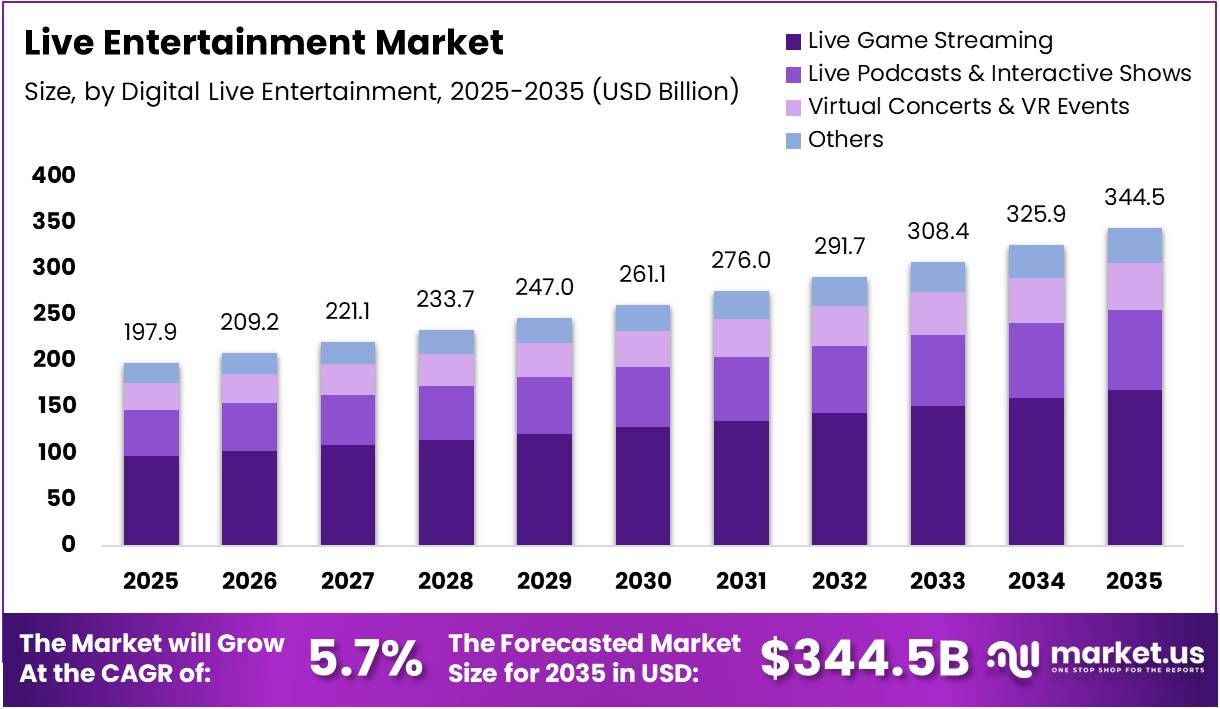
The Global Live Entertainment Market size is expected to be worth around USD 344.5 Billion by 2035 from USD 197.9 Billion in 2025, growing at a CAGR of 5.7% during the forecast period 2026 to 2035.
The Live Entertainment Market encompasses live performances, concerts, sports events, theatrical productions, cultural festivals, and digital streaming experiences. This sector delivers real-time entertainment experiences to audiences through various formats and venues. Moreover, it represents a significant economic driver connecting performers, venues, promoters, and audiences globally.
Live entertainment has evolved beyond traditional performances to include hybrid digital-physical experiences. Consequently, the industry now integrates advanced technologies such as virtual reality, augmented reality, and live streaming platforms. Additionally, this transformation enables broader audience reach while maintaining the authenticity of in-person experiences that consumers increasingly value.
The market experiences robust growth driven by rising consumer preference for experiential entertainment over material goods. Furthermore, expanding international touring events and large-scale music festivals attract diverse audiences worldwide. Therefore, corporate sponsorship and brand engagement initiatives significantly contribute to market expansion through strategic partnerships and activation campaigns.
Government support through cultural funding and infrastructure development positively impacts market growth. Additionally, regulatory frameworks governing event safety, licensing, and crowd management ensure sustainable industry operations. However, compliance requirements also present operational challenges that stakeholders must navigate effectively to maintain growth momentum.
According to MusicRadar, 39% ranked live music as their top entertainment choice, ahead of movies and sports. Moreover, 93% of respondents said they attend live shows because they crave real, in-person experiences over virtual ones. This demonstrates the enduring appeal of live entertainment despite digital alternatives.
According to International Journal of Engineering Management and Science, 70.3% of respondents attend live music events at least a few times per year. Consequently, this consistent participation rate indicates strong audience loyalty and recurring revenue potential. Therefore, the market maintains steady demand across diverse demographic segments and geographic regions.
Key Takeaways
- Global Live Entertainment Market valued at USD 197.9 Billion in 2025, projected to reach USD 344.5 Billion by 2035
- Market expected to grow at a CAGR of 5.7% during the forecast period 2026-2035
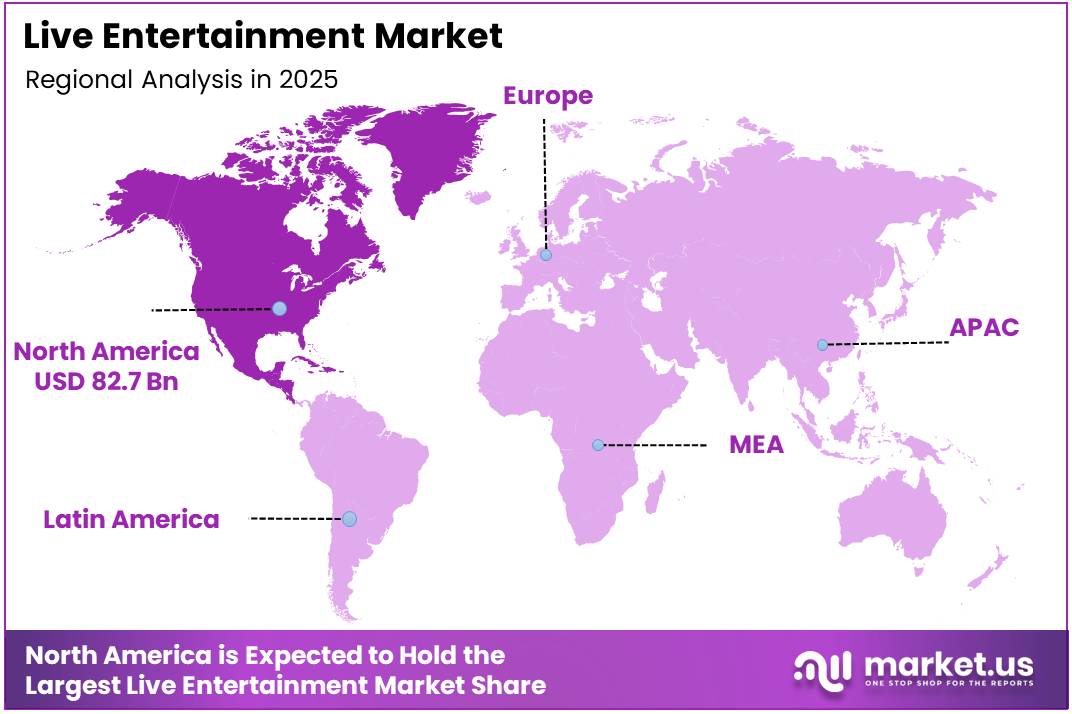
- North America dominates with 41.80% market share, valued at USD 82.7 Billion
- Concerts segment leads By Type category with 31.5% market share in 2025
- Theatre dominates Performing Arts segment capturing 34.7% share
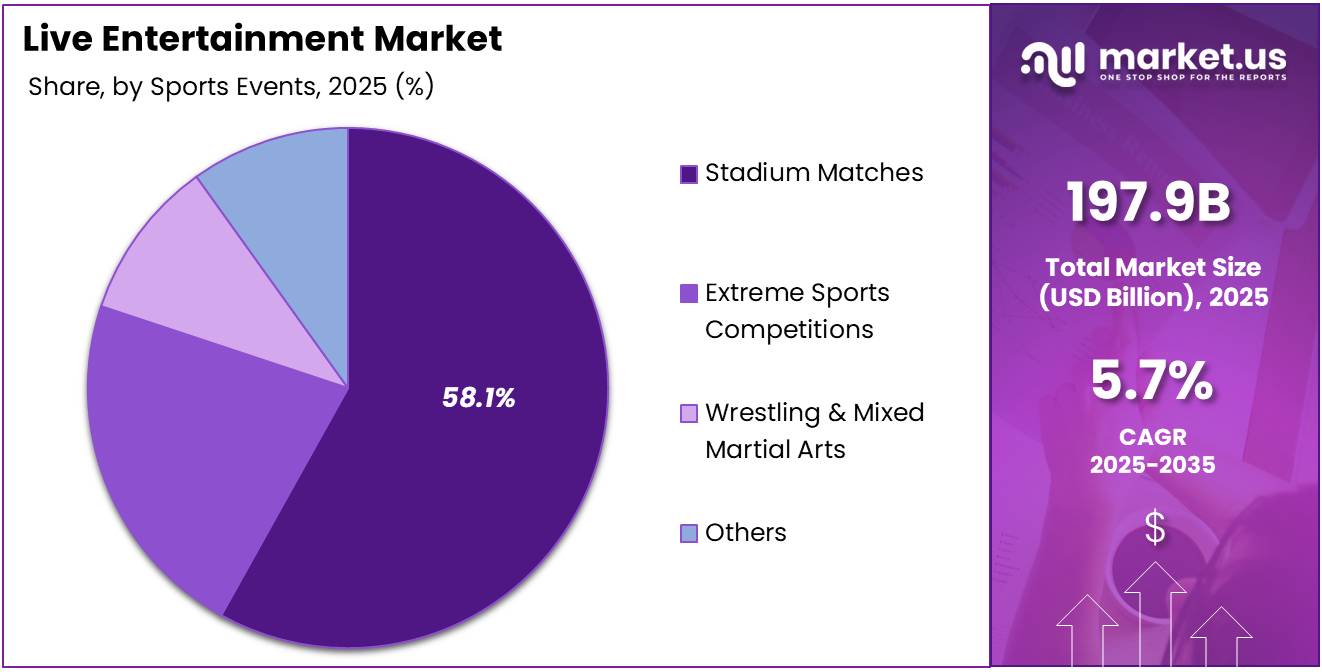
- Stadium Matches hold 58.1% share in Sports Events segment
- Food & Cultural Festivals account for 41.9% of Social and Cultural Events segment
- Live Game Streaming leads Digital Live Entertainment with 49.2% market share
By Type Analysis
Concerts dominate with 31.5% due to massive global audience appeal and recurring revenue from touring artists.
In 2025, Concerts held a dominant market position in the By Type segment of Live Entertainment Market, with a 31.5% share. Concerts attract massive audiences through headline performances by popular artists and bands. Moreover, international touring schedules and multi-city tours generate substantial ticket sales. Therefore, this segment benefits from loyal fan bases and strong merchandising opportunities.
Live Music encompasses diverse venue performances from intimate clubs to large arenas. Additionally, this category includes tribute shows, cover bands, and emerging artist performances. Consequently, live music creates accessibility for audiences seeking varied entertainment experiences. Furthermore, local and regional performances contribute to community engagement and cultural development.
Music Festivals represent multi-day events featuring numerous artists across various genres. Moreover, festivals attract international attendees and generate significant economic impact through tourism. Additionally, brand partnerships and sponsorships enhance festival experiences. Therefore, this segment continues expanding with new formats and destination-based events gaining popularity.
Acoustic or Intimate Recitals cater to niche audiences preferring smaller, personal performance settings. Furthermore, these events emphasize artistic quality and direct artist-audience connection. Additionally, premium pricing models support sustainability for specialized venues. Consequently, this segment maintains steady growth among discerning entertainment consumers.
DJ Sets & Electronic Music Events showcase electronic dance music through club performances and large-scale festivals. Moreover, this category attracts younger demographics and international DJ talent. Additionally, nightlife venues and dedicated electronic music festivals drive consistent demand. Therefore, technological integration enhances production quality and audience engagement.
Others include karaoke nights, open mic events, battle of the bands, and community music gatherings. Moreover, these grassroots entertainment formats support emerging talent and local music scenes. Additionally, informal venues and smaller-scale events foster audience participation. Consequently, this category provides accessible entry points for both performers and attendees.
By Performing Arts Analysis
Theatre dominates with 34.7% due to established Broadway and West End productions attracting global audiences.
In 2025, Theatre held a dominant market position in the By Performing Arts segment of Live Entertainment Market, with a 34.7% share. Theatre productions combine storytelling, acting, and stagecraft to deliver compelling live experiences. Moreover, long-running shows and touring productions generate consistent revenue streams. Therefore, major theatrical districts worldwide maintain strong audience attendance and cultural significance.
Musicals integrate music, dance, and dramatic narrative to create immersive entertainment experiences. Additionally, blockbuster musical productions achieve global recognition and extended performance runs. Consequently, musicals attract diverse audiences across age groups and demographics. Furthermore, film adaptations and original productions continue expanding the musical theatre landscape.
Opera & Ballet represent classical performing arts with centuries-old traditions and devoted audiences. Moreover, these art forms receive cultural funding and institutional support globally. Additionally, modern interpretations and contemporary productions attract new audiences. Therefore, opera houses and ballet companies maintain artistic relevance while preserving traditional repertoires.
Improv & Stand-Up Comedy deliver spontaneous entertainment through comedic performances and audience interaction. Furthermore, comedy clubs and touring comedians generate substantial ticket sales and streaming content. Additionally, comedy festivals and special events attract large audiences seeking humor-based entertainment. Consequently, this segment benefits from social media promotion and celebrity comedian appeal.
Others encompass mime shows, spoken word poetry, experimental theatre, and performance art installations. Moreover, these alternative performing arts formats attract avant-garde audiences and cultural enthusiasts. Additionally, fringe festivals and independent venues support innovative artistic expressions. Therefore, this category contributes to artistic diversity and creative experimentation.
By Sports Events Analysis
Stadium Matches dominate with 58.1% due to massive fan followings for major league sports and championship events.
In 2025, Stadium Matches held a dominant market position in the By Sports Events segment of Live Entertainment Market, with a 58.1% share. Stadium matches encompass professional football, cricket, baseball, and other major sports attracting tens of thousands of spectators. Moreover, championship games and playoff events generate premium ticket pricing and extensive media coverage. Therefore, this segment represents the largest revenue contributor within sports entertainment.
Extreme Sports Competitions feature high-adrenaline activities including surfing, skateboarding, and motocross events. Additionally, these competitions attract younger demographics and action sports enthusiasts. Consequently, extreme sports events incorporate entertainment elements beyond athletic competition. Furthermore, brand sponsorships and athlete endorsements drive commercial success and audience engagement.
Wrestling & Mixed Martial Arts deliver combat sports entertainment through organized competitions and theatrical performances. Moreover, major promotions host large-scale events in arenas and stadiums worldwide. Additionally, pay-per-view models and streaming platforms expand audience reach. Therefore, this segment maintains strong fan loyalty and recurring event attendance.
Others include amateur sports tournaments, charity matches, exhibition games, and school sports championships. Moreover, community-level sporting events foster local engagement and grassroots participation. Additionally, these events support youth development and recreational sports programs. Consequently, this category strengthens community bonds while promoting athletic activities.
By Social and Cultural Events Analysis
Food & Cultural Festivals dominate with 41.9% due to celebrating diverse cuisines, traditions, and community heritage.
In 2025, Food & Cultural Festivals held a dominant market position in the By Social and Cultural Events segment of Live Entertainment Market, with a 41.9% share. These festivals combine culinary experiences with cultural performances and artisan exhibitions. Moreover, they attract families and tourists seeking authentic cultural immersion. Therefore, food and cultural festivals generate significant local economic impact and tourism revenue.
Parades & Carnivals deliver large-scale public celebrations featuring processions, floats, and street performances. Additionally, these events often commemorate historical occasions or seasonal celebrations. Consequently, parades attract massive crowds and foster community participation. Furthermore, televised broadcasts extend audience reach beyond physical attendance.
Traditional or Folk Performances preserve cultural heritage through dance, music, and storytelling from specific regions or communities. Moreover, these performances educate audiences about cultural traditions and historical narratives. Additionally, government and institutional support sustains traditional art forms. Therefore, folk performances maintain cultural relevance while adapting to contemporary presentation formats.
Others include art exhibitions, craft fairs, religious ceremonies, and community gatherings with entertainment components. Moreover, these social events strengthen cultural identity and intergenerational knowledge transfer. Additionally, local festivals and seasonal celebrations enhance community cohesion. Consequently, this category supports cultural preservation while providing accessible entertainment options.
By Digital Live Entertainment Analysis
Live Game Streaming dominates with 49.2% due to explosive growth in esports and interactive gaming content.
In 2025, Live Game Streaming held a dominant market position in the By Digital Live Entertainment segment of Live Entertainment Market, with a 49.2% share. Live game streaming platforms enable gamers to broadcast gameplay to global audiences in real-time. Moreover, professional esports tournaments attract millions of viewers and substantial prize pools. Therefore, this segment represents the fastest-growing digital entertainment category.
Live Podcasts & Interactive Shows offer real-time audio and video content with direct audience participation through chat and Q&A features. Additionally, podcast tours bring digital content creators to live venue settings. Consequently, hybrid formats combine traditional broadcasting with live audience experiences. Furthermore, monetization through subscriptions and donations supports content creator sustainability.
Virtual Concerts & VR Events leverage immersive technologies to deliver live music experiences through virtual reality platforms. Moreover, artists perform in digital environments accessible to global audiences simultaneously. Additionally, VR concerts eliminate geographical barriers and venue capacity limitations. Therefore, this emerging segment attracts tech-savvy audiences and offers new revenue streams for performers.
Others include live Q&A sessions, interactive webinars, livestreamed workshops, and digital meet-and-greet events. Moreover, these formats enable direct creator-audience interactions across geographical boundaries. Additionally, emerging platforms continuously introduce innovative digital entertainment experiences. Consequently, this category expands possibilities for personalized and niche digital content delivery.
Key Market Segments
By Type
- Concerts
- Live Music
- Music Festivals
- Acoustic or Intimate Recitals
- DJ Sets & Electronic Music Events
- Others
By Performing Arts
- Theatre
- Musicals
- Opera & Ballet
- Improv & Stand-Up Comedy
- Others
By Sports Events
- Stadium Matches
- Extreme Sports Competitions
- Wrestling & Mixed Martial Arts
- Others
By Social and Cultural Events
- Food & Cultural Festivals
- Parades & Carnivals
- Traditional or Folk Performances
- Others
By Digital Live Entertainment
- Live Game Streaming
- Live Podcasts & Interactive Shows
- Virtual Concerts & VR Events
- Others
Drivers
Rising Consumer Spending on Experiential Entertainment Over Material Goods Drives Market Growth
Modern consumers increasingly prioritize experiences over physical possessions, driving strong demand for live entertainment events. Moreover, social media sharing amplifies the value of attending memorable live performances and festivals. Consequently, ticket sales and event attendance continue growing despite premium pricing strategies. Therefore, experiential spending represents a fundamental shift in consumer behavior.
Large-scale music festivals and international touring events expand market reach through diverse programming and multi-genre offerings. Additionally, established artists and emerging performers attract loyal audiences across geographic markets. Furthermore, festival tourism generates substantial economic benefits for host cities and regions. Consequently, promoters invest heavily in production quality and artist lineups.
Corporate investment in live events creates strategic brand engagement opportunities through sponsorship activation and experiential marketing campaigns. Moreover, companies leverage live entertainment platforms to connect with target demographics authentically. Additionally, brand partnerships enhance event production quality and attendee experiences. Therefore, corporate sponsorship revenue streams support market expansion and innovation.
Restraints
High Initial Investment Costs and Regulatory Compliance Requirements Limit Market Entry
Event organizers face substantial upfront costs for venue rentals, artist bookings, production equipment, and marketing campaigns. Moreover, regulatory compliance requires extensive safety measures, insurance coverage, and licensing procedures. Consequently, smaller promoters and independent organizers encounter significant financial barriers. Therefore, high capital requirements concentrate market power among established industry players.
Regulatory restrictions governing crowd management, noise levels, and operational hours create complex compliance environments for event organizers. Additionally, licensing processes vary across jurisdictions, increasing administrative burdens. Furthermore, safety inspections and permit approvals extend planning timelines and increase costs. Consequently, regulatory complexity deters new market entrants and limits event frequency.
Outdoor events depend heavily on favorable weather conditions, creating unpredictable operational risks and potential revenue losses. Moreover, extreme weather events force cancellations or postponements, impacting profitability and audience satisfaction. Additionally, climate change increases weather-related disruptions and planning uncertainties. Therefore, weather dependence remains a persistent challenge for outdoor entertainment venues.
Growth Factors
Technological Integration and Market Expansion Create Significant Growth Opportunities
Immersive technologies including augmented reality, virtual reality, and holographic stage production transform live entertainment experiences. Moreover, these innovations enhance visual spectacle and audience engagement through interactive elements. Consequently, technology adoption differentiates premium events and justifies higher ticket prices. Therefore, technological advancement drives competitive advantage and market growth.
Hybrid event models combining in-person attendance with global live streaming access expand audience reach exponentially. Additionally, streaming options generate additional revenue streams while maintaining live venue capacity. Furthermore, hybrid formats accommodate diverse consumer preferences and geographical limitations. Consequently, dual-format events maximize market penetration and profitability.
Tier-II and Tier-III cities represent untapped markets with growing middle-class populations and increasing entertainment spending. Moreover, expanding venue infrastructure and improved connectivity enable event accessibility in smaller markets. Additionally, regional artists and localized content resonate with emerging audience segments. Therefore, geographic expansion into underserved cities accelerates overall market growth.
Emerging Trends
Premium Experiences and Digital Innovation Reshape Live Entertainment Landscape
Consumer demand for premium VIP packages and exclusive backstage experiences drives high-margin revenue opportunities for event organizers. Moreover, limited-access experiences create exclusivity and enhance perceived value among affluent audiences. Consequently, premium offerings differentiate events and strengthen brand positioning. Therefore, luxury entertainment packages represent a rapidly growing market segment.
Genre-specific niche festivals and cultural showcase events attract dedicated audiences seeking specialized content and authentic experiences. Additionally, themed festivals build strong community connections and recurring attendance patterns. Furthermore, niche programming reduces direct competition with mainstream events. Consequently, specialized festivals maintain higher customer loyalty and sustainable business models.
Cashless payment ecosystems and RFID-based smart ticketing systems streamline event operations and enhance attendee convenience. Moreover, digital payment integration reduces transaction times and improves security measures. Additionally, RFID technology enables personalized experiences and valuable consumer data collection. Therefore, digital infrastructure adoption accelerates operational efficiency and audience satisfaction.
Regional Analysis
North America Dominates the Live Entertainment Market with a Market Share of 41.80%, Valued at USD 82.7 Billion
North America leads the global market due to established entertainment infrastructure, major venue networks, and strong consumer spending power. Moreover, the region hosts numerous international touring artists and large-scale festivals. The market share of 41.80% and value of USD 82.7 Billion reflect robust demand across concerts, sports events, and theatrical productions. Therefore, North America maintains competitive advantage through innovation and market maturity.
Europe Live Entertainment Market Trends
Europe maintains strong cultural traditions supporting opera, ballet, theatre, and music festivals across diverse markets. Additionally, government subsidies and institutional funding sustain performing arts venues and organizations. Furthermore, summer festival seasons attract international tourism and generate substantial economic impact. Consequently, European markets balance traditional programming with contemporary entertainment formats.
Asia Pacific Live Entertainment Market Trends
Asia Pacific experiences rapid growth driven by expanding middle class, increasing disposable income, and urbanization trends. Moreover, K-pop concerts, esports tournaments, and cultural festivals attract massive audiences. Additionally, infrastructure development supports larger venues and international event hosting. Therefore, the region represents significant growth potential for global entertainment companies.
Middle East & Africa Live Entertainment Market Trends
Middle East & Africa develops entertainment sectors through government initiatives supporting tourism and cultural diversification. Additionally, major cities host international concerts and sporting events in world-class venues. Furthermore, cultural festivals celebrate regional heritage while attracting global audiences. Consequently, investment in entertainment infrastructure accelerates market development.
Latin America Live Entertainment Market Trends
Latin America demonstrates strong cultural affinity for live music, dance performances, and sporting events. Moreover, carnival celebrations and music festivals represent significant economic and cultural events. Additionally, growing urban populations and improved economic conditions support entertainment spending. Therefore, Latin America offers expanding opportunities for domestic and international entertainment providers.
Key Regions and Countries
North America
- US
- Canada
Europe
- Germany
- France
- The UK
- Spain
- Italy
- Rest of Europe
Asia Pacific
- China
- Japan
- South Korea
- India
- Australia
- Rest of APAC
Latin America
- Brazil
- Mexico
- Rest of Latin America
Middle East & Africa
- GCC
- South Africa
- Rest of MEA
Key Company Insights
Live Nation Entertainment operates as the world’s leading live entertainment company, managing ticketing, promotion, and venue operations globally. The company owns Ticketmaster and produces thousands of events annually across diverse entertainment categories. Moreover, Live Nation’s integrated business model combines artist management, sponsorship sales, and digital streaming capabilities. Consequently, the company maintains dominant market position through vertical integration and extensive venue network partnerships.
AEG (Anschutz Entertainment Group) ranks among the largest sports and entertainment presenters worldwide, operating premier venues and promoting major tours. Additionally, AEG owns and operates arenas, stadiums, theatres, and clubs across multiple continents. Furthermore, the company produces music festivals including Coachella and promotes tours for top-tier artists. Therefore, AEG’s diversified portfolio spans sports franchises, live entertainment, and venue management.
HYBE Corporation represents a leading entertainment lifestyle platform company integrating music production, artist management, and live entertainment experiences. Moreover, HYBE manages globally successful K-pop groups and expands into various entertainment segments. Additionally, the company invests in technology platforms and merchandise businesses complementing live performances. Consequently, HYBE’s comprehensive approach to artist development and fan engagement drives competitive differentiation.
MSG Entertainment owns and operates iconic entertainment venues including Madison Square Garden and Radio City Music Hall in New York. Furthermore, MSG produces and presents diverse entertainment content ranging from concerts to sporting events and special productions. Additionally, the company leverages premium venue locations and historical brand recognition to attract major events. Therefore, MSG Entertainment maintains strategic positioning in the North American entertainment landscape.
Key players
- Live Nation Entertainment
- AEG (Anschutz Entertainment Group)
- HYBE Corporation
- MSG Entertainment
- CTS Eventim AG & Co. KGaA
- Disney
- Shubert Organization
- Yoshimoto Kogyo
- TBS Holdings, Inc.
- Feld Entertainment
Recent Developments
- February 2026 – QCI and IWP announced a strategic partnership to expand live entertainment access across tribal gaming and entertainment venues. This collaboration aims to bring diverse entertainment programming to underserved markets while supporting economic development in tribal communities.
- January 2026 – Live Nation Entertainment, DF Entertainment, and Dale Play Live entered into a long-term partnership with Club Atlético River Plate at Más Monumental Stadium. The agreement enables hosting of major concerts and entertainment events at one of South America’s premier sporting venues with capacity exceeding 80,000 attendees.
- August 2025 – Ticketek Entertainment Group acquired Eventfinda to fuel regional expansion across Asia Pacific markets. This acquisition strengthens Ticketek’s digital ticketing capabilities and extends market presence in New Zealand and Australian entertainment markets.
- June 2025 – Dice was acquired by live entertainment and tech platform Fever to enhance ticketing technology and event discovery capabilities. The merger combines Dice’s ticketing innovation with Fever’s experiential entertainment marketplace, creating integrated solutions for event organizers and consumers.
- May 2025 – Live Nation acquired leading Dominican Republic promoter SD Concerts to support growing fan demand and touring across Latin America. This strategic acquisition expands Live Nation’s presence in Caribbean markets and strengthens regional touring infrastructure.
- January 2025 – ATG Entertainment acquired SOM Produce, a preeminent theatre producer, operator, and distributor in Spain. The acquisition positions ATG to expand theatrical productions and venue operations throughout Spanish-speaking markets while diversifying content offerings.
Report Scope
Report Features Description Market Value (2025) USD 197.9 Billion Forecast Revenue (2035) USD 344.5 Billion CAGR (2026-2035) 5.7% Base Year for Estimation 2025 Historic Period 2020-2024 Forecast Period 2026-2035 Report Coverage Revenue Forecast, Market Dynamics, Competitive Landscape, Recent Developments Segments Covered By Type (Concerts, Live Music, Music Festivals, Acoustic or Intimate Recitals, DJ Sets & Electronic Music Events, Others), By Performing Arts (Theatre, Musicals, Opera & Ballet, Improv & Stand-Up Comedy, Others), By Sports Events (Stadium Matches, Extreme Sports Competitions, Wrestling & Mixed Martial Arts, Others), By Social and Cultural Events (Food & Cultural Festivals, Parades & Carnivals, Traditional or Folk Performances, Others), By Digital Live Entertainment (Live Game Streaming, Live Podcasts & Interactive Shows, Virtual Concerts & VR Events, Others) Regional Analysis North America (US and Canada), Europe (Germany, France, The UK, Spain, Italy, and Rest of Europe), Asia Pacific (China, Japan, South Korea, India, Australia, and Rest of APAC), Latin America (Brazil, Mexico, and Rest of Latin America), Middle East & Africa (GCC, South Africa, and Rest of MEA) Competitive Landscape Live Nation Entertainment, AEG (Anschutz Entertainment Group), HYBE Corporation, MSG Entertainment, CTS Eventim AG & Co. KGaA, Disney, Shubert Organization, Yoshimoto Kogyo, TBS Holdings Inc., Feld Entertainment Customization Scope Customization for segments, region/country-level will be provided. Moreover, additional customization can be done based on the requirements. Purchase Options We have three licenses to opt for: Single User License, Multi-User License (Up to 5 Users), Corporate Use License (Unlimited User and Printable PDF) 
-
-
- Live Nation Entertainment
- AEG (Anschutz Entertainment Group)
- HYBE Corporation
- MSG Entertainment
- CTS Eventim AG & Co. KGaA
- Disney
- Shubert Organization
- Yoshimoto Kogyo
- TBS Holdings, Inc.
- Feld Entertainment
Our Clients

- 178029
- Feb 2026






