


Global Liquid Sodium Silicate Market Size, Share Analysis Report By Molar Ratio (1.6 to 2.8 (Alkaline), 2.8 to 3.3 (Neutral)), By Application (Detergents, Catalysts, Pulp and Paper, Elastomers, Others), By End-use (Construction, Paper and Pulp, Petrochemical, Chemicals, Others) , By Region and Companies - Industry Segment Outlook, Market Assessment, Competition Scenario, Trends and Forecast 2025-2034
- Published date: Sep 2025
- Report ID: 159766
- Number of Pages: 372
- Format:
-
keyboard_arrow_up
Quick Navigation
Report Overview
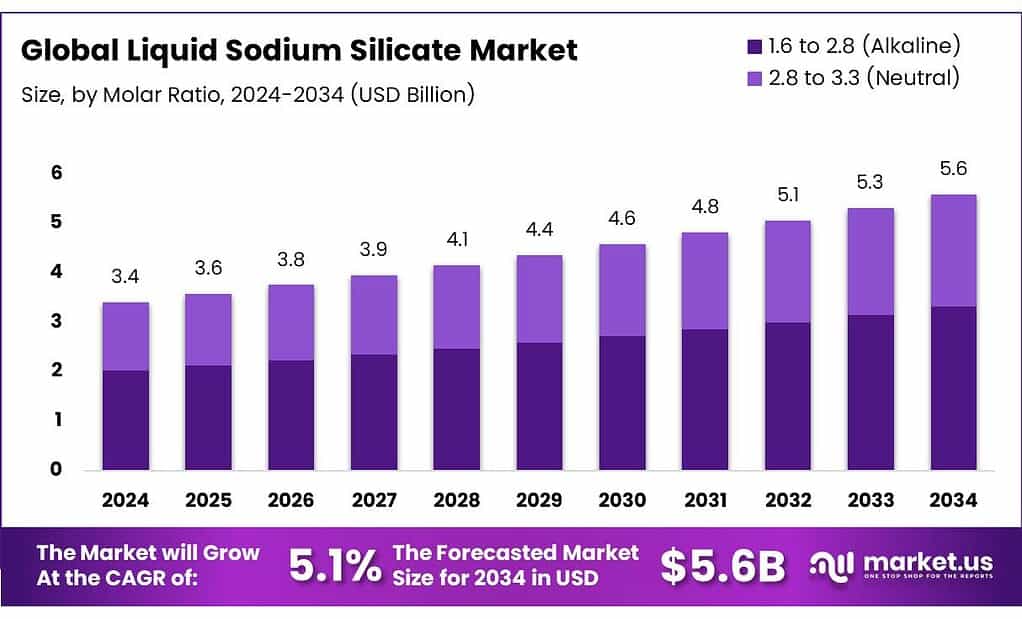
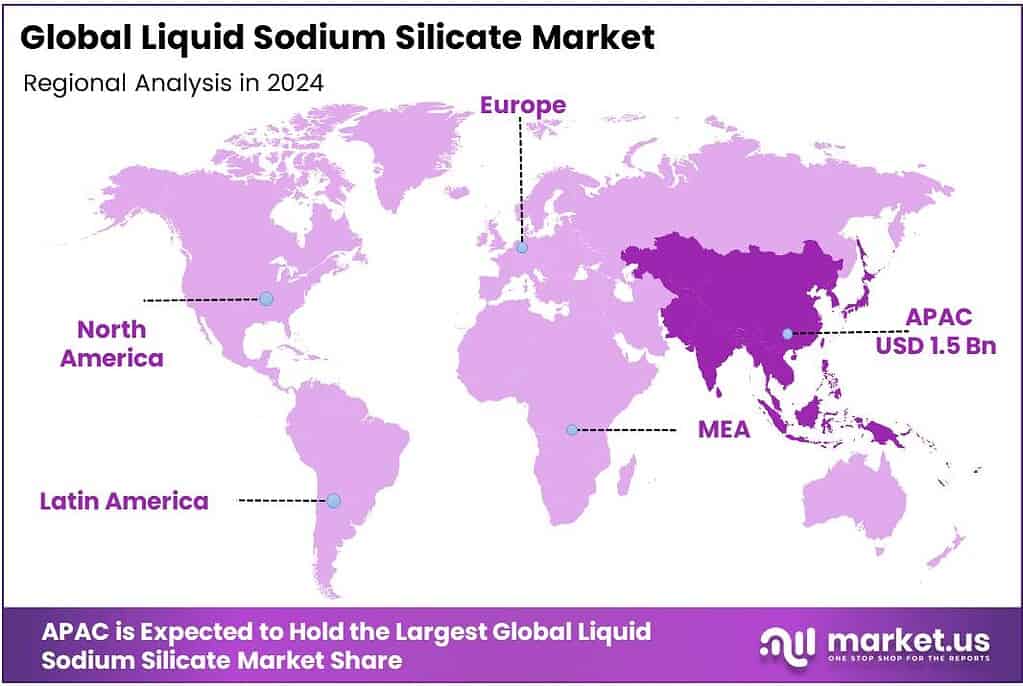
The Global Liquid Sodium Silicate Market size is expected to be worth around USD 5.6 Billion by 2034, from USD 3.4 Billion in 2024, growing at a CAGR of 5.1% during the forecast period from 2025 to 2034. In 2024 Asia-Pacific (APAC) held a dominant market position, capturing more than a 44.8% share, holding USD 1.5 Billion in revenue.
Liquid sodium silicate, commonly referred to as waterglass, is an inorganic compound produced by dissolving silica (SiO₂) in an alkaline solution, typically sodium hydroxide (NaOH). This chemical is widely utilized in numerous industrial applications such as detergents, cement, water treatment, paper manufacturing, and as a bonding agent in refractory materials. The versatility of liquid sodium silicate, particularly its high thermal stability and excellent adhesive properties, has made it an essential component in many sectors, contributing to its consistent demand.
Industrial momentum for liquid sodium silicate is closely tied to upstream soda ash and silica availability and to downstream demand in detergents, pulp & paper, and construction. While global sodium-carbonate (soda ash) statistics are tracked by the U.S. Geological Survey, confirming supply fundamentals for silicate producers, sector pull is clearer on the demand side: the European Commission documented detergent consumption in the EU-25 at roughly 6 million tonnes per year, a large, steady base that depends on builders such as silicates in many formulations. In parallel, the FAO’s annual pulp-and-paper capacity surveys show continued sizable global paper and board capacity, supporting adhesive demand where liquid silicate is widely used for corrugating and paper bonding.
Policy has also nudged the detergent system toward lower-phosphorus “builder” packages in which soluble silicates often feature. U.S. phosphorus controls—including widespread state-level bans culminating in the July 2010 automatic dishwasher detergent change—were estimated by the U.S. EPA to remove about 52,000 pounds of phosphorus from wastewater discharges, reinforcing long-run substitution away from phosphate builders.
Construction is another growth vector. India’s public infrastructure push continues: the Union Budget 2025–26 allocated ₹2,87,333 crore to the Ministry of Road Transport and Highways, supporting cement and concrete activity in which sodium silicate is used as a chemical binder and in specialty grouts and sealants.
At the same time, the IEA reports the cement sector must cut direct CO₂ intensity by ~4% annually through 2030 to align with net-zero pathways, a transition that is accelerating interest in alternative binders and admixtures—including silicate-based systems and geopolymers—that can enhance durability and, in some cases, lower clinker factors. These policy and technology trends expand application space for liquid sodium silicate in construction chemicals.
Key Takeaways
- Liquid Sodium Silicate Market size is expected to be worth around USD 5.6 Billion by 2034, from USD 3.4 Billion in 2024, growing at a CAGR of 5.1%.
- 1.6 to 2.8 molar ratio (alkaline) segment held a dominant market position, capturing more than a 59.3% share of the global liquid sodium silicate market.
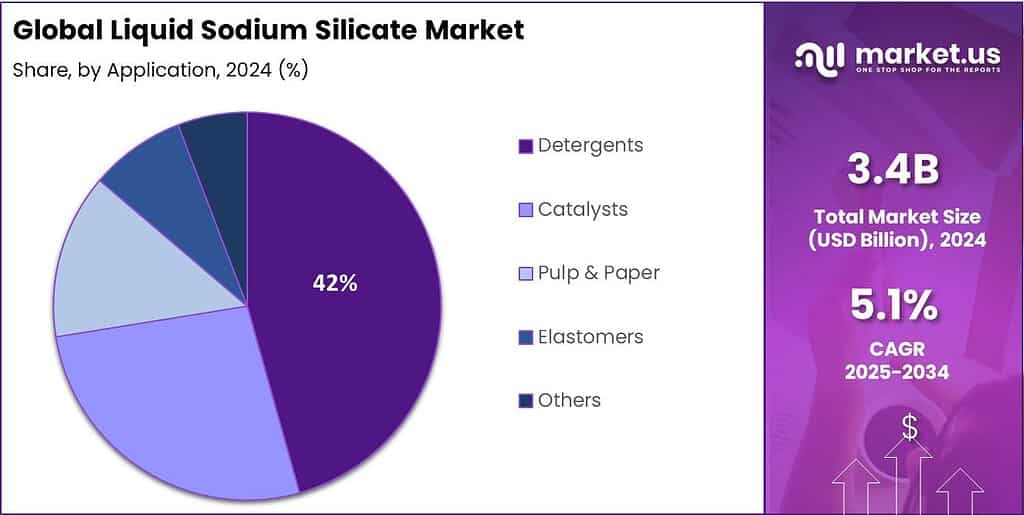
- detergents held a dominant market position, capturing more than a 42.4% share of the global liquid sodium silicate market.
- construction held a dominant market position, capturing more than a 34.1% share of the global liquid sodium silicate market.
- Asia Pacific region held the dominant market position in the global liquid sodium silicate market, capturing more than 44.80% of the total share, valued at approximately USD 1.5 billion.
By Molar Ratio Analysis
1.6 to 2.8 Molar Ratio (Alkaline) Dominates Liquid Sodium Silicate Market with 59.3% Share
In 2024, the 1.6 to 2.8 molar ratio (alkaline) segment held a dominant market position, capturing more than a 59.3% share of the global liquid sodium silicate market. This molar ratio is highly preferred due to its effective balance between alkalinity and silica content, making it suitable for a wide range of industrial applications. The alkaline liquid sodium silicate with a molar ratio between 1.6 and 2.8 is primarily used in detergents, water treatment, and cement production due to its superior bonding, cleaning, and coagulating properties.
The growth of this segment can be attributed to the rising demand in the detergent and construction sectors. The detergent industry, which requires effective cleaning agents, is expanding rapidly, especially in regions like Asia Pacific, where rising disposable incomes are driving the demand for cleaning products. Additionally, the construction sector’s increased focus on sustainable materials has boosted the need for high-performance liquid sodium silicate in cement and concrete production. This molar ratio, with its versatility, supports durability, strength, and improved resistance to environmental factors, which are essential for modern construction.
By Application Analysis
Detergents Lead Liquid Sodium Silicate Market with 42.4% Share
In 2024, detergents held a dominant market position, capturing more than a 42.4% share of the global liquid sodium silicate market. This significant share is driven by the increasing demand for liquid sodium silicate in household and industrial detergents. Its role as a key ingredient in both laundry and dishwashing products is critical, providing effective cleaning properties and enhancing the performance of detergents. The ability of liquid sodium silicate to soften water, break down stains, and prevent the build-up of soap scum makes it a preferred choice for manufacturers in the detergent industry.
This growth can be attributed to the increasing global consumption of household cleaning products, which is fueled by rising urbanization, higher living standards, and growing consumer awareness of hygiene. Additionally, the growing preference for eco-friendly and high-performance cleaning products will further support the market for liquid sodium silicate in detergent formulations. As sustainability trends continue, liquid sodium silicate’s ability to enhance detergent efficacy while being cost-effective will further solidify its market position in the years to come.
By End-use Analysis
Construction Dominates Liquid Sodium Silicate Market with 34.1% Share
In 2024, construction held a dominant market position, capturing more than a 34.1% share of the global liquid sodium silicate market. This is due to the increasing use of liquid sodium silicate in cement production, where it acts as a bonding agent, improving the strength, durability, and water resistance of concrete. Liquid sodium silicate’s role in construction materials is vital, especially for creating high-quality concrete used in infrastructure, roads, and buildings. The growth of the construction industry, particularly in emerging economies, continues to drive demand for this versatile compound.
The rise in infrastructure development, especially in urban areas and industrial zones, coupled with the growing adoption of sustainable and efficient construction materials, is expected to fuel this growth. Liquid sodium silicate’s ability to improve the performance of construction materials in harsh environmental conditions makes it an indispensable part of modern construction practices. As global investment in infrastructure and construction projects continues, the demand for liquid sodium silicate within this sector is likely to remain robust.
Key Market Segments
By Molar Ratio
- 1.6 to 2.8 (Alkaline)
- 2.8 to 3.3 (Neutral)
By Application
- Detergents
- Catalysts
- Pulp & Paper
- Elastomers
- Others
By End-use
- Construction
- Paper & Pulp
- Petrochemical
- Chemicals
- Others
Emerging Trends
Adoption of Sodium Silicate in Circular Economy Packaging
One of the strongest recent trends shaping the liquid sodium silicate industry is its increasing integration into the circular economy, particularly in food-related packaging. The shift toward recyclable and biodegradable packaging materials is no longer just a corporate initiative but a global necessity. According to the Food and Agriculture Organization (FAO), packaging waste accounts for a large share of the nearly 390 million tonnes of plastics produced globally each year, much of which is linked to food distribution and consumption. As governments, retailers, and consumers demand alternatives to single-use plastics, sodium silicate is gaining traction as a recyclable adhesive and coating that helps strengthen paper and board packaging without compromising food safety.
The global expansion of paper packaging offers clear evidence of this trend. FAO forestry production statistics report that paper and paperboard output reached 417 million tonnes in 2022. A significant portion of this is consumed by the packaging industry, where corrugated boxes and cartons dominate food logistics and retail shelves. Sodium silicate, with its water-based chemistry and absence of volatile organic compounds (VOCs), is increasingly used to bond corrugated layers or act as a barrier coating. Its ability to enhance recyclability and reduce environmental burden makes it a preferred material in a world where packaging recovery and reuse are critical.
Government initiatives are amplifying this momentum. The European Union’s Green Deal and Circular Economy Action Plan aim to make all packaging reusable or recyclable by 2030. Similarly, India’s 2022 ban on several categories of single-use plastics under the Plastic Waste Management Rules has created strong incentives for food processors and beverage companies to switch to paper-based packaging. These regulatory signals open the door for sodium silicate to expand beyond its traditional industrial roles into mainstream packaging solutions that meet strict compliance and sustainability standards.
Drivers
Food- & Beverage-Grade Water Safety Requirements
Liquid sodium silicate demand is increasingly pulled by the simple fact that modern food and beverage plants must prove their process water is safe, stable and non-corrosive at every step—from ingredient water to CIP rinse lines. Codex Alimentarius (the FAO/WHO food standards program) now provides dedicated “Guidelines for the Safe Use and Reuse of Water in Food Production and Processing,” pushing food businesses to apply risk-based water controls that keep equipment clean, minimize microbiological risks and protect piping from corrosion.
The scale of that pull is large because food and agriculture is itself enormous and still growing. FAO reports that global agriculture value added reached about USD 4.0 trillion in 2023, up 2.6% year on year—evidence of sustained production throughput that relies on hygienic water across slaughter, dairy, beverage, starch, sugar, and packaging lines. As output rises, so does the need for low-foaming, alkali-stable water chemistries that prevent iron and manganese deposition, keep heat exchangers efficient, and protect canning or bottling circuits—roles for which liquid sodium silicate is widely used.
In the United States, technical filings illustrate how silicates are actually used in food-adjacent potable systems. An FDA docket example cites ~100 ppm sodium silicate (≈23 mg Si/L) as a corrosion inhibitor in potable water—levels consistent with keeping metals in solution, limiting scale, and protecting downstream stainless and mild-steel assets. Because many food plants distribute potable water internally before final filtration at points of use, this type of inhibitor dosing provides a cost-effective, non-phosphate way to extend asset life and reduce unplanned downtime—an operational win that compounds at high line speeds.
Restraints
Environmental and Effluent Disposal Challenges
One of the most pressing restraining factors for the use of liquid sodium silicate lies in the way it interacts with the environment, especially when it enters wastewater streams. While sodium silicate itself is not considered acutely toxic, its high alkalinity can change the pH of effluents, raising compliance concerns for food and beverage plants, detergent manufacturers, and paper mills. The U.S. Environmental Protection Agency (EPA) highlights that effluents with high alkalinity can upset biological wastewater treatment processes, leading to stricter monitoring and costly neutralization requirements for industrial users.
According to the Food and Agriculture Organization (FAO), global food processing is a major water user, with the food industry in Europe alone consuming over 4.2 billion cubic meters of water annually across operations such as beverage production, dairy, and sugar refining. When large-scale processors rely on sodium silicate in cleaning or water treatment, the resulting high-pH discharge increases the load on treatment plants. Many municipalities now enforce strict discharge pH ranges, typically between 6.0 and 9.0, and exceedances can trigger fines or even temporary shutdowns.
This regulatory backdrop has prompted government initiatives that indirectly restrain sodium silicate use. For example, the European Union’s Water Framework Directive mandates member states to achieve “good chemical status” for water bodies, leading to tighter controls on alkaline effluents. Similarly, in the United States, the EPA’s National Pollutant Discharge Elimination System (NPDES) sets strict effluent guidelines for food processing plants, requiring neutralization systems when alkaline chemicals such as silicates are present in wastewater. These compliance systems add costs, often discouraging smaller food processors from adopting or expanding silicate use.
Opportunity
Expanding Role in Sustainable Food Packaging
A key growth opportunity for liquid sodium silicate lies in its application as an eco-friendly adhesive and coating material in food packaging. With global concerns about plastic waste and non-biodegradable materials, regulators and food companies are increasingly turning toward recyclable paper- and board-based solutions. Liquid sodium silicate, known for its strong bonding capacity, heat resistance, and recyclability, is emerging as a critical enabler of this shift. The Food and Agriculture Organization (FAO) highlights that the world produces over 390 million tonnes of plastics annually, with food packaging being one of the largest contributors to single-use plastic waste.
Government initiatives further reinforce this opportunity. The European Union’s Single-Use Plastics Directive (SUPD) calls for a reduction in non-biodegradable packaging, pushing industries toward fiber-based alternatives. Similarly, India’s Plastic Waste Management Rules 2022 banned certain categories of single-use plastics, spurring investment in paper-based packaging for snacks, beverages, and processed foods. These regulatory pressures are creating a surge in demand for adhesives like liquid sodium silicate, which bond well with paper substrates while maintaining compliance with food safety standards.
- According to the FAO’s forestry statistics, global paper and paperboard production reached 417 million tonnes in 2022. Much of this output is consumed in packaging, and as the e-commerce sector expands, the demand for strong, recyclable adhesives in corrugated board has grown sharply.
Unlike synthetic resin adhesives, liquid sodium silicate offers the benefit of being water-based, low in volatile organic compounds (VOCs), and fully compatible with the recycling loop. Food companies, under pressure to align with packaging sustainability goals, are increasingly testing silicate adhesives for cartons, labels, and multilayer paper packaging.
Regional Insights
Asia Pacific Dominates Liquid Sodium Silicate Market with 44.80% Share
In 2024, the Asia Pacific region held the dominant market position in the global liquid sodium silicate market, capturing more than 44.80% of the total share, valued at approximately USD 1.5 billion. This dominance is primarily driven by the region’s robust industrial base, including large-scale detergent manufacturing, construction, and water treatment sectors. China, India, and Japan are the key contributors to this market share, supported by high demand across multiple industries such as cement, textiles, and chemicals.
The region’s rapid urbanization and industrial growth have significantly increased the consumption of liquid sodium silicate. For instance, China remains the largest producer and consumer of liquid sodium silicate, with its vast construction and manufacturing industries fueling continued demand. Additionally, the rise in infrastructure development and industrialization in India and Southeast Asia is further driving the demand for high-quality building materials, including cement and concrete enhanced by liquid sodium silicate.
Key Regions and Countries Insights
- North America
- US
- Canada
- Europe
- Germany
- France
- The UK
- Spain
- Italy
- Rest of Europe
- Asia Pacific
- China
- Japan
- South Korea
- India
- Australia
- Rest of APAC
- Latin America
- Brazil
- Mexico
- Rest of Latin America
- Middle East & Africa
- GCC
- South Africa
- Rest of MEA
Key Players Analysis
Evonik Industries AG is a global leader in specialty chemicals, offering a wide range of products and solutions, including sodium silicates. The company focuses on innovation and sustainability, providing high-performance materials for various industries such as automotive, electronics, and water treatment. Evonik’s commitment to research and development ensures the delivery of advanced and eco-friendly products to meet the evolving needs of its customers.
Solvay S.A. is a global leader in materials and chemicals, offering a wide range of products, including sodium silicates. The company focuses on innovation and sustainability, providing solutions for various industries such as automotive, electronics, and water treatment. Solvay’s commitment to research and development ensures the delivery of high-quality and eco-friendly products to meet the evolving needs of its customers.
BASF SE is the world’s largest producer of chemicals, offering a wide range of products, including sodium silicates. The company focuses on innovation and sustainability, providing solutions for various industries such as automotive, electronics, and water treatment. BASF’s commitment to research and development ensures the delivery of high-quality and eco-friendly products to meet the evolving needs of its customers.
Top Key Players Outlook
- Solvay S.A
- PQ Corporation
- Evonik Industries AG
- QEMETICA
- BASF SE
- PPG Industries, Inc
- W.R. Grace & Company
- Tokuyama Corporation
- Sinchem Silica Gel Co, Ltd.
- Nippon Chemical Industrial Co., Ltd.
Recent Industry Developments
In 2024 PPG Industries, saw a 6% increase in its market share, generating approximately $1.2 billion in revenue from sodium silicate products. PPG’s growth can be attributed to its continued investment in eco-friendly technologies and innovation in water-based coatings.
In 2024, BASF achieved a 5% increase in market share, with sodium silicate revenues reaching approximately $1.3 billion.
Report Scope
Report Features Description Market Value (2024) USD 3.4 Bn Forecast Revenue (2034) USD 5.6 Bn CAGR (2025-2034) 5.1% Base Year for Estimation 2024 Historic Period 2020-2023 Forecast Period 2025-2034 Report Coverage Revenue Forecast, Market Dynamics, Competitive Landscape, Recent Developments Segments Covered By Molar Ratio (1.6 to 2.8 (Alkaline), 2.8 to 3.3 (Neutral)), By Application (Detergents, Catalysts, Pulp and Paper, Elastomers, Others), By End-use (Construction, Paper and Pulp, Petrochemical, Chemicals, Others) Regional Analysis North America – US, Canada; Europe – Germany, France, The UK, Spain, Italy, Rest of Europe; Asia Pacific – China, Japan, South Korea, India, Australia, Singapore, Rest of APAC; Latin America – Brazil, Mexico, Rest of Latin America; Middle East & Africa – GCC, South Africa, Rest of MEA Competitive Landscape Solvay S.A, PQ Corporation, Evonik Industries AG, QEMETICA, BASF SE, PPG Industries, Inc, W.R. Grace & Company, Tokuyama Corporation, Sinchem Silica Gel Co, Ltd., Nippon Chemical Industrial Co., Ltd. Customization Scope Customization for segments, region/country-level will be provided. Moreover, additional customization can be done based on the requirements. Purchase Options We have three licenses to opt for: Single User License, Multi-User License (Up to 5 Users), Corporate Use License (Unlimited User and Printable PDF)  Liquid Sodium Silicate MarketPublished date: Sep 2025add_shopping_cartBuy Now get_appDownload Sample
 -
-
- Solvay S.A
- PQ Corporation
- Evonik Industries AG
- QEMETICA
- BASF SE
- PPG Industries, Inc
- W.R. Grace & Company
- Tokuyama Corporation
- Sinchem Silica Gel Co, Ltd.
- Nippon Chemical Industrial Co., Ltd.
Our Clients

- 159766
- Sep 2025






