


Report Overview
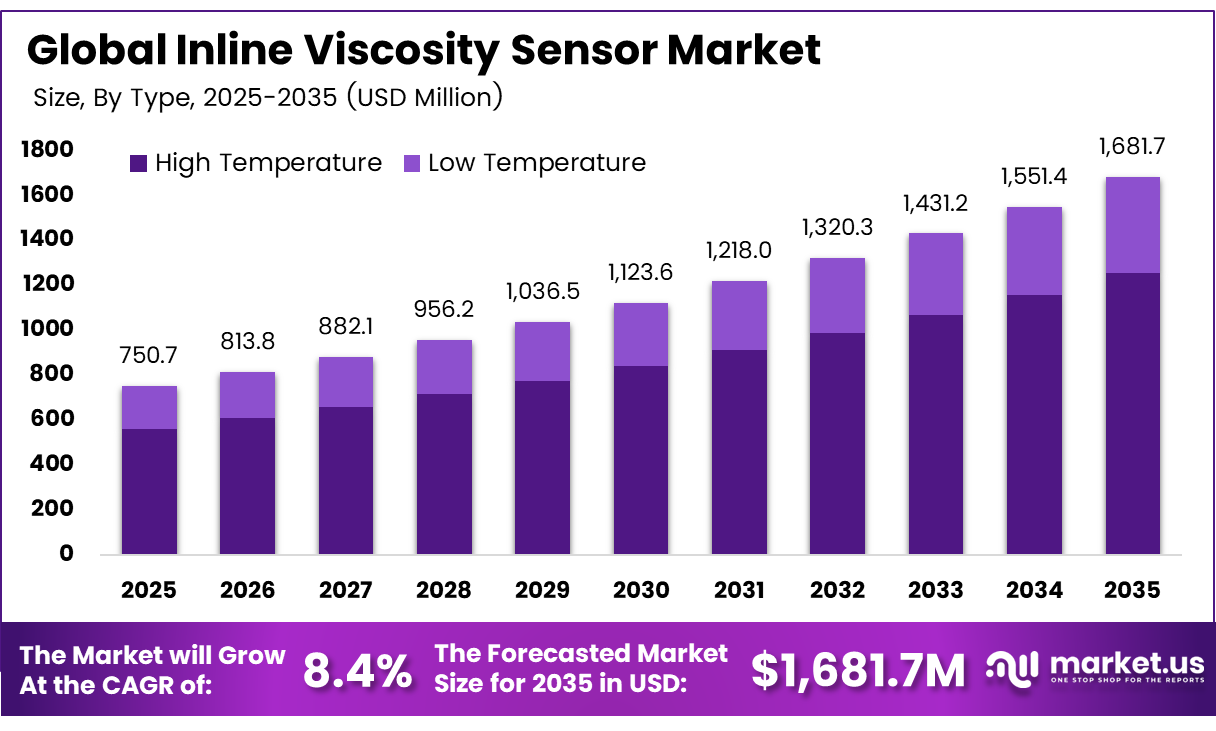
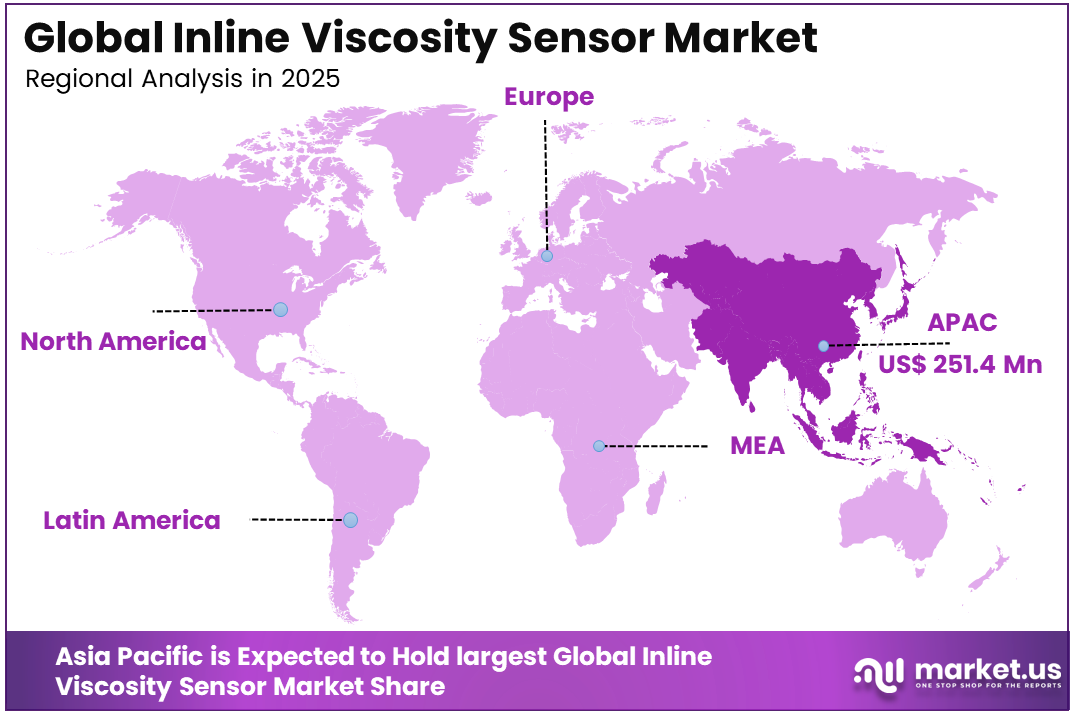
The Global Inline Viscosity Sensor Market size is expected to be worth around USD 1,681.7 million by 2035, from USD 750.7 million in 2025, growing at a CAGR of 8.4% during the forecast period from 2025 to 2035. Asia Pacific held a dominant market position, capturing more than a 33.5% share, holding USD 251.48 million in revenue.
An inline viscosity sensor refers to a device installed directly in a process line to measure the viscosity of fluids in real time. It helps monitor flow behavior without taking samples, allowing continuous control of production conditions. These sensors support consistent product quality and improve efficiency across industrial operations.
Top driving factors include rapid automation of processing lines and a stronger focus on consistent product output across industries. The need to track viscosity in real time has increased across oil and gas, chemicals, coatings, and food plants, as more than half of modern factories now integrate smart sensors into quality control systems.
The market for inline viscosity sensors is driven by the need for continuous process monitoring and consistent product quality across industries. Manufacturers prefer real-time measurement to reduce manual testing and improve efficiency. Growing adoption of automated production systems, stricter quality requirements, and the need to control fluid behavior in complex processes are further supporting steady demand.
Demand is rising as producers shift from sample-based checks to continuous monitoring systems. This transition can reduce inspection time by around 30 to 40% and lower scrap in high-volume operations. Strict hygiene and safety standards in the food, beverage, and pharmaceutical sectors continue to support the adoption of inline measurement solutions.
For instance, in April 2026, Rheonics highlighted its SRV inline viscometer and density meter as a single‑probe solution for printing, petrochemicals, and food applications. The compact, all‑metal devices provide stable, repeatable viscosity under harsh conditions, giving plant engineers a single‑click way to hold viscosity, density, and temperature within narrow bands during production.
Key Takeaway
- In 2025, the High Temperature segment held a dominant market position, capturing a 74.7% share of the Global Inline Viscosity Sensor Market.
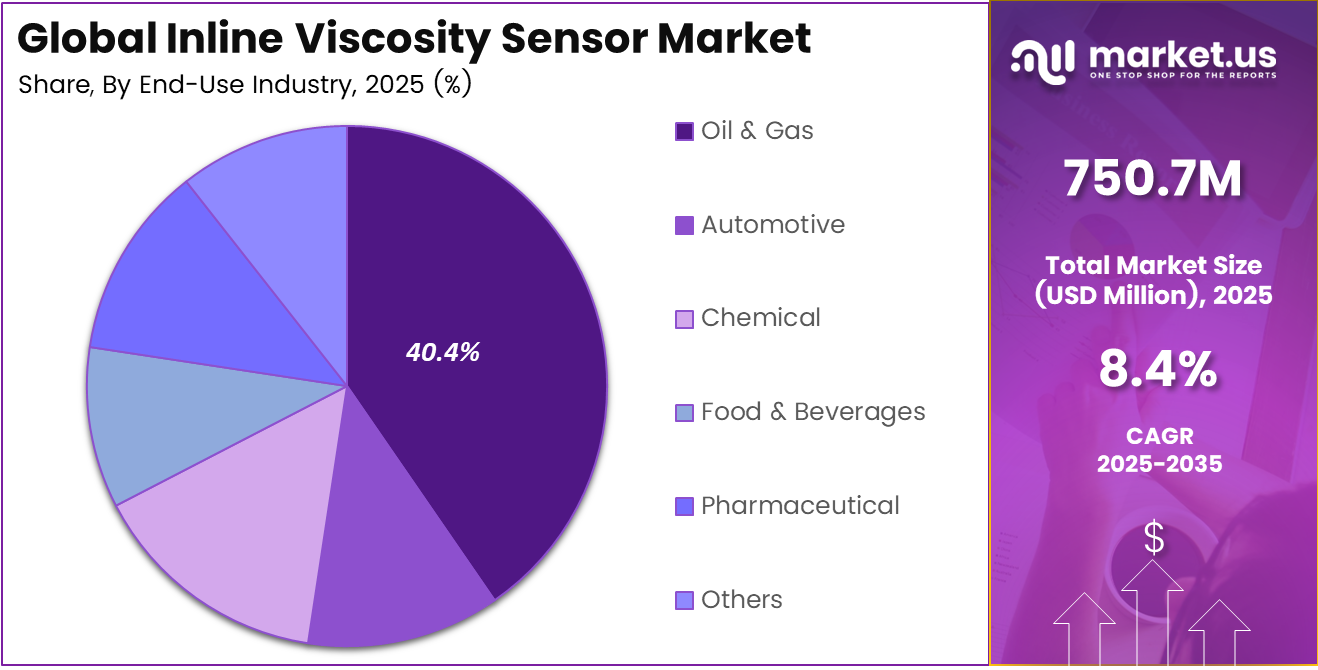
- In 2025, the Oil & Gas segment held a dominant market position, capturing a 40.4% share of the Global Inline Viscosity Sensor Market.
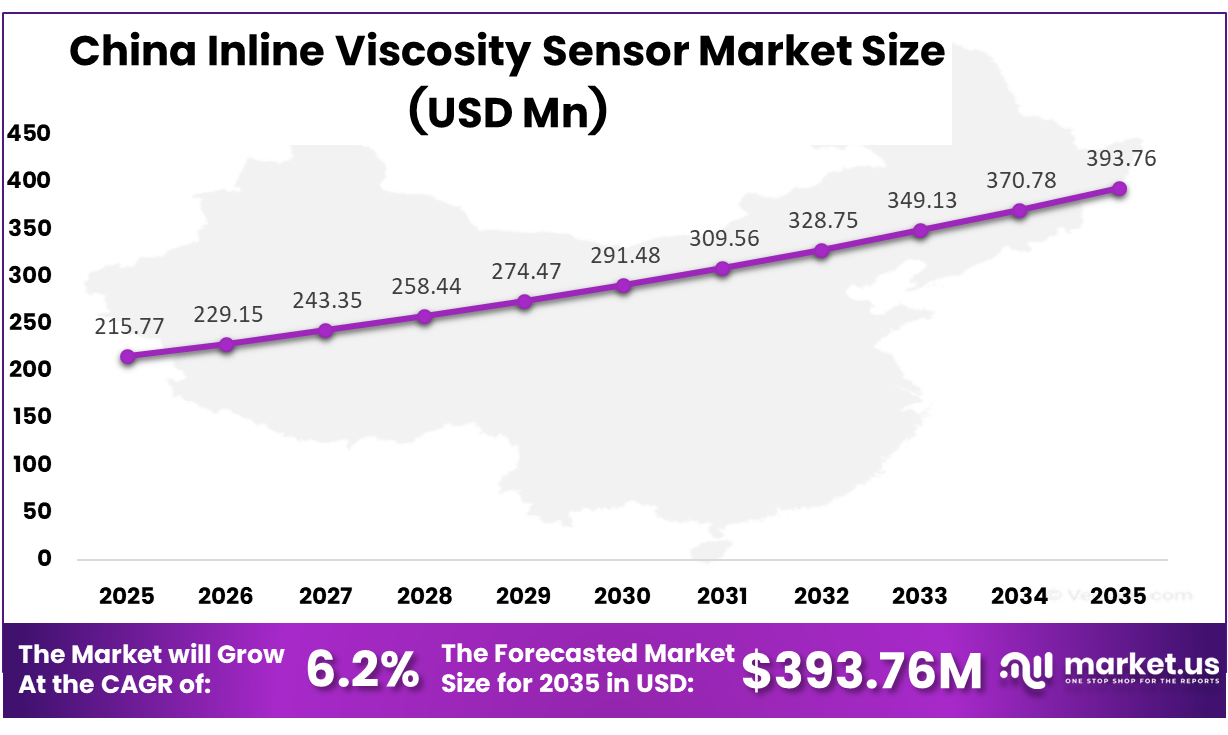
- The China Inline Viscosity Sensor Market was valued at USD 215.77 Million in 2025, with a robust CAGR of 6.2%.
- In 2025, the Asia Pacific held a dominant market position in the Global Inline Viscosity Sensor Market, capturing more than a 33.5% share.
Role of Generative AI
Generative AI is increasingly layered over data from inline viscosity sensors, helping convert continuous streams into clear operational insights. Manufacturers applying these models report double-digit improvements in productivity and reduced unplanned downtime, as systems learn to detect early process variations before they affect product quality in real-time environments.
At the plant level, generative AI supports the simulation of viscosity behaviour under different process conditions. Instead of lengthy physical trials, operators can predict formulation responses to temperature or shear changes. More than 60% of early adopters now use advanced AI in areas like quality control and process optimisation, with sensors acting as key data sources.
Investment and Business Benefits
Investment opportunities are expanding in advanced sensing technologies and compact inline devices designed for easy retrofit into existing systems. Growth is also seen in multifunctional probes that measure viscosity alongside temperature or density. In addition, software solutions that analyze real-time data and support predictive maintenance are attracting increasing industrial interest.
Business benefits are reflected in improved yield, stable product quality, and better traceability during audits. Inline viscosity measurement enables detailed batch-level monitoring, helping reduce reliance on laboratory testing. In continuous processes, it can shorten release time by cutting lab tests per batch by 20 to 50% while maintaining strict quality control standards.
Regional Analysis
In 2025, the Asia Pacific held a dominant market position in the Global Inline Viscosity Sensor Market, capturing more than 33.5% share and generating USD 251.48 million in revenue. This dominance is due to the strong presence of large manufacturing bases across China, Japan, South Korea, and India. Inline viscosity sensors are widely used in oil and gas, chemicals, food processing, coatings, and pharmaceutical production to improve real-time quality control. Asia Pacific also benefits from rising factory automation, expanding process industries, and growing investment in smart manufacturing systems that support continuous monitoring and stable product output.
For instance, in February 2025, Anton Paar’s inline density and viscosity sensor gained FDA 510(k) clearance, reinforcing its position as a preferred supplier for hygienic, pharmaceutical-grade inline viscosity measurement, including in Chinese drug-manufacturing lines that are rapidly scaling continuous production and demanding real-time rheology control for monoclonal antibody and biologics processing.
China Inline Viscosity Sensor Market Size
The market for the Inline Viscosity Sensor within China is growing tremendously and is currently valued at USD 215.77 million; the market has a projected CAGR of 6.2%. The market is growing due to China’s rapid industrial automation, strong chemical and refining base, and rising focus on process quality. Manufacturers are adopting inline viscosity sensors to monitor fluids in real time, reduce manual testing, and improve batch consistency. Growth is also supported by smart factory programs, stricter quality control in food and pharmaceutical production, and higher demand for efficient process monitoring across high-volume industrial plants.
For instance, in February 2026, Emerson expanded its inline viscosity sensor footprint in China by bundling its Emerson Electric inline viscosity probes with Plantweb digital ecosystem and DeltaV DCS in new contracts for chemical and food processing plants, strengthening its dominance through automation-led, real‑time quality control and IIoT integration across major Chinese process manufacturing hubs.
Key Regions and Countries
North America
- US
- Canada
Europe
- Germany
- France
- The UK
- Spain
- Italy
- Russia
- Netherlands
- Rest of Europe
Asia Pacific
- China
- Japan
- South Korea
- India
- Australia
- Singapore
- Thailand
- Vietnam
- Rest of APAC
Latin America
- Brazil
- Mexico
- Rest of Latin America
Middle East & Africa
- South Africa
- Saudi Arabia
- UAE
- Rest of MEA
Type Analysis
In 2025, the High Temperature segment held a dominant market position, capturing a 74.4% share of the Global Inline Viscosity Sensor Market. This dominance stems from the ability of high-temperature sensors to operate reliably under extreme industrial conditions. They are widely used in continuous processes where fluids are exposed to heat and pressure. Industries prefer these sensors as they help maintain consistent viscosity levels and reduce process interruptions during production.
High-temperature designs are also valued for durability and long operational life in demanding environments. Their stable performance supports better process control and minimizes frequent maintenance. As manufacturing shifts toward continuous operations, these sensors remain important for ensuring smooth flow behavior and maintaining product consistency across batches.
For instance, in January 2025, Cambridge Viscosity introduced a pharmaceutical-grade inline viscometer optimized for sterile clean-in-place environments, delivering faster response times. This development specifically targets high-temperature applications in pharmaceutical manufacturing, where maintaining sterile conditions at elevated temperatures is critical for compliance and product integrity.
End-Use Industry Analysis
In 2025, the Oil & Gas segment held a dominant market position, capturing a 40.4% share of the Global Inline Viscosity Sensor Market. This dominance is due to the strong need for accurate viscosity control in oil and gas operations. Processes such as drilling, refining, and transport require constant monitoring to maintain fluid performance. Inline sensors support these needs by providing real-time data, which helps operators maintain stability and improve process reliability.
Oil and gas facilities also rely on these sensors to reduce delays linked to manual testing and improve overall efficiency. Continuous monitoring helps detect variations early and supports better decision-making. As operations become more complex, the role of inline viscosity measurement continues to strengthen in this industry.
For instance, in June 2025, ABB launched the AquaMaster 4 electromagnetic flowmeter featuring built-in viscosity estimation capability through signal damping analysis. This technology serves municipal wastewater treatment operations, helping operators optimize polymer usage in sludge dewatering processes while maintaining process efficiency standards critical for environmental compliance in oil and gas adjacent applications.
Key Market Segments
By Type
- Low Temperature
- High Temperature
By End-Use Industry
- Oil & Gas
- Automotive
- Chemical
- Food & Beverages
- Pharmaceutical
- Others
Emerging Trends
A major trend is the shift toward smart viscosity sensors equipped with onboard processing and communication capabilities. These systems directly connect to SCADA, DCS, and cloud platforms, reducing integration effort. Multi-parameter sensors that combine viscosity with temperature or density are also gaining traction due to simplified installation and improved measurement context.
Another trend is the rise of compact and non-intrusive sensor designs. Miniaturisation is becoming a key requirement in new deployments, especially where space and sample volume are limited. Digital functionality is now a priority feature, while MEMS-based devices are expanding faster due to strong compatibility with lab-on-chip and advanced process systems.
Growth Factors
Growth is strongly influenced by Industry 4.0 and automation initiatives across manufacturing sectors. More than 65% of manufacturers are adopting smart sensors as part of digital transformation efforts. Inline viscosity sensors are increasingly integrated into these systems to enable closed-loop control, improve process stability, and support efficient material usage.
Regulatory pressure and rising quality expectations are also shaping market expansion. Industries such as food, pharmaceuticals, and specialty chemicals require strict process validation and traceability. Real-time viscosity monitoring helps meet compliance standards while reducing scrap and rework, ensuring consistent product quality under demanding operational and safety frameworks.
Market Dynamics
Drivers - Shift Toward Real-Time Quality
The shift toward real-time quality control is encouraging industries to adopt inline viscosity sensors. Continuous monitoring helps operators understand fluid behavior during production and maintain stable process conditions. This approach supports consistent output and reduces reliance on periodic sampling methods that may miss rapid process variations.
Manufacturers are focusing on improving product consistency across batches by using live data from sensors. Inline viscosity measurement allows quick adjustments during mixing, coating, or blending stages. This helps maintain uniformity in final products and supports better control over complex production lines where fluid properties directly affect performance.
For instance, in September 2025, Emerson introduced an inline viscosity solution integrated with its process controllers to help food and beverage plants move from batch lab checks to continuous in-line quality control. The system streams real-time viscosity and temperature data into existing control strategies so operators can hold product texture within tight limits and react quickly to raw material variation.
Restraint - High Installation Complexity
High installation complexity remains a key limitation, especially for plants operating with legacy infrastructure. Integrating inline viscosity sensors often requires process modifications, careful placement, and compatibility with existing control systems. These factors can delay implementation and increase the need for skilled technical support during deployment.
In addition, maintenance and calibration requirements can create challenges for operators unfamiliar with continuous monitoring systems. Incorrect setup or positioning may affect performance, leading to hesitation among smaller facilities. This slows adoption in industries where operational simplicity and minimal disruption remain important priorities.
For instance, in March 2024, Endress+Hauser promoted project stories showing how adding inline viscosity measurement in existing dairy plants can be challenging because of tight pipe racks, hygienic requirements, and limited shutdown windows. Engineers must coordinate process design, welding, cleaning validation, and automation work. These demands sometimes slow adoption as operators weigh installation effort against the benefits of continuous viscosity data.
Opportunities - IIoT-Enabled Smart Sensors
The rise of IIoT-enabled smart sensors is creating strong growth opportunities in this market. Inline viscosity devices are increasingly designed with connectivity features that allow seamless data transfer to digital platforms, supporting better monitoring and process control across automated industrial environments.
These smart systems also enable advanced analytics, helping plants interpret viscosity trends and optimize production processes. Integration with cloud platforms and predictive tools allows manufacturers to improve efficiency, reduce waste, and enhance operational planning, making smart viscosity sensing an important part of connected factory ecosystems.
For instance, in January 2026, Siemens expanded its industrial edge and AI ecosystem to make it easier for plants to collect and analyze data from smart field devices, including inline viscosity sensors connected over standard protocols. By linking viscosity trends with other process tags at the edge, users can build local analytics that support predictive quality control and maintenance without large central projects.
Challenges - Measurement Accuracy
Maintaining measurement accuracy across different operating conditions remains a major challenge. Variations in temperature, pressure, and fluid composition can affect viscosity readings, making it difficult to ensure consistent performance across diverse industrial applications and environments.
Another concern is ensuring the long-term stability of sensor performance without frequent recalibration. Industries require reliable data for critical decision-making, and any deviation can impact product quality. Addressing these concerns requires proper sensor selection, correct installation, and ongoing monitoring to maintain confidence in measurement systems.
For instance, in March 2025, Anton Paar introduced a new viscometer for precise measurement of low viscosity and shear-sensitive samples, underlining how important test conditions are for accuracy. The design emphasizes controlled temperature, defined shear, and careful handling to reduce turbulence. This reflects a broader issue in inline sensing, where changing flow regimes and temperatures can make it difficult to match lab reference values.
Key Players Analysis
One of the leading players, in April 2024, Endress+Hauser expanded its smart sensor portfolio with enhanced inline viscometry options bundled into turnkey skids for chemical and biotech users. The company is using its global service network to position viscosity as a critical real‑time quality parameter alongside flow, level, and temperature in continuous plants.
Top Key Players in the Market
- Emerson Electric Co.
- Endress+Hauser Group Services AG
- Siemens AG
- Anton Paar GmbH
- Brookfield Engineering Laboratories, Inc.
- Rheonics GmbH
- VAF Instruments B.V.
- Marimex Industries Corp.
- Hydramotion Ltd.
- Cambridge Viscosity, Inc.
- Sofraser S.A.
- Orb Instruments, Inc.
- Norcross Corporation
- KROHNE Group
- Lemis Baltic
- Ametek Inc.
- Parker Hannifin Corporation
- Sensotech GmbH
- FLEXIM Instruments UK Ltd.
- Petrotest Instruments GmbH & Co. KG
- Others
Recent Developments
- In November 2025, Brookfield, now under AMETEK, continued to invest in inline viscometry as part of its broader viscosity and rheology portfolio. Its strategy centers on pairing trusted lab instruments with rugged inline probes so manufacturers can correlate plant data with QC results and close the loop on quality control in real time.
- In September 2024, Siemens deepened integration between inline viscosity sensors and its PCS 7 and SIMATIC automation platforms. By embedding viscosity tags into advanced process‑control strategies, Siemens is helping customers in oil, gas, and polymers trim energy use and stabilize product quality, supporting a market shift toward fully digital, sensor‑rich production lines.
Report Scope
| Report Features | Description |
|---|---|
| Market Value (2025) | USD 750.7 Million |
| Forecast Revenue (2035) | USD 1,681.7 Million |
| CAGR (2026-2035) | 8.4% |
| Base Year for Estimation | 2025 |
| Historic Period | 2020-2024 |
| Forecast Period | 2026-2035 |
| Report Coverage | Revenue Forecast, Market Dynamics, Competitive Landscape, Recent Developments |
| Segments Covered | By Type (Low Temperature, High Temperature), By End-Use Industry (Oil & Gas, Automotive, Chemical, Food & Beverages, Pharmaceutical, Others) |
| Regional Analysis | North America (US and Canada), Europe (Germany, France, The UK, Spain, Italy, and Rest of Europe), Asia Pacific (China, Japan, South Korea, India, Australia, and Rest of APAC), Latin America (Brazil, Mexico, and Rest of Latin America), Middle East & Africa (GCC, South Africa, and Rest of MEA) |
| Competitive Landscape | Emerson Electric Co., Endress+Hauser Group Services AG, Siemens AG, Anton Paar GmbH, Brookfield Engineering Laboratories, Inc., Rheonics GmbH, VAF Instruments B.V., Marimex Industries Corp., Hydramotion Ltd., Cambridge Viscosity, Inc., Sofraser S.A., Orb Instruments, Inc., Norcross Corporation, KROHNE Group, Lemis Baltic, Ametek Inc., Parker Hannifin Corporation, Sensotech GmbH, FLEXIM Instruments UK Ltd., Petrotest Instruments GmbH & Co. KG, Others |
| Customization Scope | Customization at the segment and region/country levels will be provided. Moreover, customization can be tailored to the requirements. |
| Purchase Options | We have three licenses to opt for: Single User License, Multi-User License (Up to 5 Users), Corporate Use License (Unlimited Users and Printable PDF) |





































