


Global Hydraulic Cylinder Market Size, Share, Growth Analysis By Function (Double Acting Hydraulic Cylinder, Single Acting Hydraulic Cylinder), By Product Type (Welded Cylinder, Tie Rod Cylinder, Others), By Application (Mobile Equipment, Industrial Equipment), By End-Use Industry (Construction, Agriculture, Aerospace & Defence, Forestry, Marine, Others), By Region and Companies - Industry Segment Outlook, Market Assessment, Competition Scenario, Statistics, Trends and Forecast 2026-2035
- Published date: Feb 2026
- Report ID: 180639
- Number of Pages: 323
- Format:
-
keyboard_arrow_up
Quick Navigation
Report Overview
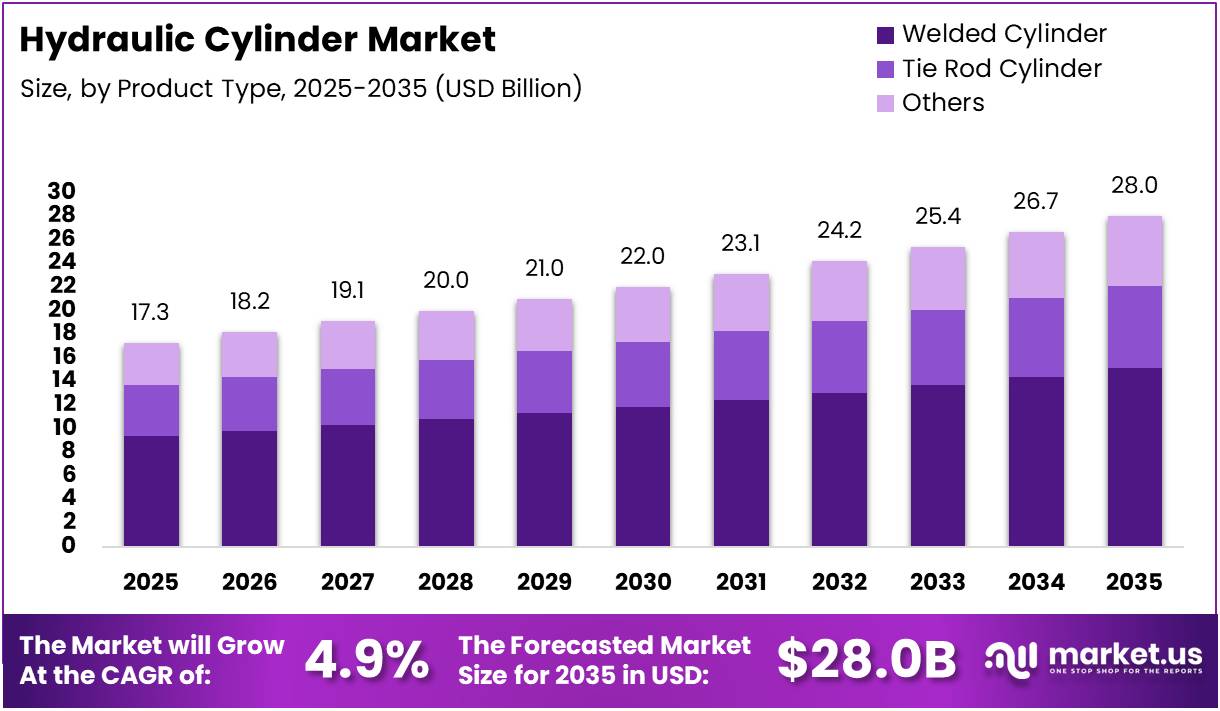
The Global Hydraulic Cylinder Market size is expected to be worth around USD 28.0 Billion by 2035 from USD 17.3 Billion in 2025, growing at a CAGR of 4.9% during the forecast period 2026 to 2035.
Hydraulic cylinders are mechanical actuators that use pressurized hydraulic fluid to produce linear force and motion. They are widely used in heavy equipment, industrial machinery, and mobile applications. These devices convert hydraulic energy into mechanical work, enabling precise control over lifting, pushing, and pulling operations in demanding environments.
The market covers a wide range of cylinder types, including welded, tie rod, and telescopic designs. These products serve end-use industries such as construction, agriculture, aerospace, marine, and forestry. Moreover, the growing need for heavy-duty mechanical systems continues to expand the overall scope of hydraulic cylinder applications globally.
The market is experiencing steady growth driven by rising investments in construction infrastructure, agricultural mechanization, and industrial automation. Additionally, the expansion of renewable energy projects and large-scale mechanical systems is creating new demand. Governments worldwide are increasing infrastructure spending, which directly supports the adoption of hydraulic-powered equipment across multiple sectors.
Regulatory frameworks focused on emissions reduction and sustainability are also influencing product development in the hydraulic cylinder market. Consequently, manufacturers are investing in eco-friendly hydraulic fluids and energy-efficient designs. Government mandates on equipment performance and environmental standards are pushing the industry toward more advanced and compliant hydraulic solutions.
Recent research highlights the efficiency advantages of modern hydraulic systems. According to Frontiers in Mechanical Engineering, motor-controlled hydraulic cylinders achieve 60% to 64% total energy savings compared to traditional valve-controlled cylinders in crane operations. Additionally, according to MacGregor, refurbishing hydraulic cylinders saves approximately 80% of CO2 emissions compared to manufacturing new units.
Sustainability efforts are further supported by remanufacturing practices. According to Okon Recycling, remanufacturing hydraulic cylinders reduces waste by up to 80% and carbon emissions by approximately 60%, while maintaining performance equal to new components. Moreover, according to ResearchGate, structural optimization of hydraulic cylinders can reduce component weight by 15% to 30%, improving efficiency and load capacity.
Key Takeaways
- The global Hydraulic Cylinder Market was valued at USD 17.3 Billion in 2025 and is projected to reach USD 28.0 Billion by 2035.
- The market is expected to grow at a CAGR of 4.9% during the forecast period 2026 to 2035.
- By Function, Double Acting Hydraulic Cylinder dominates with a 71.2% market share in 2025.
- By Product Type, Welded Cylinder leads the segment with a 54.6% share.
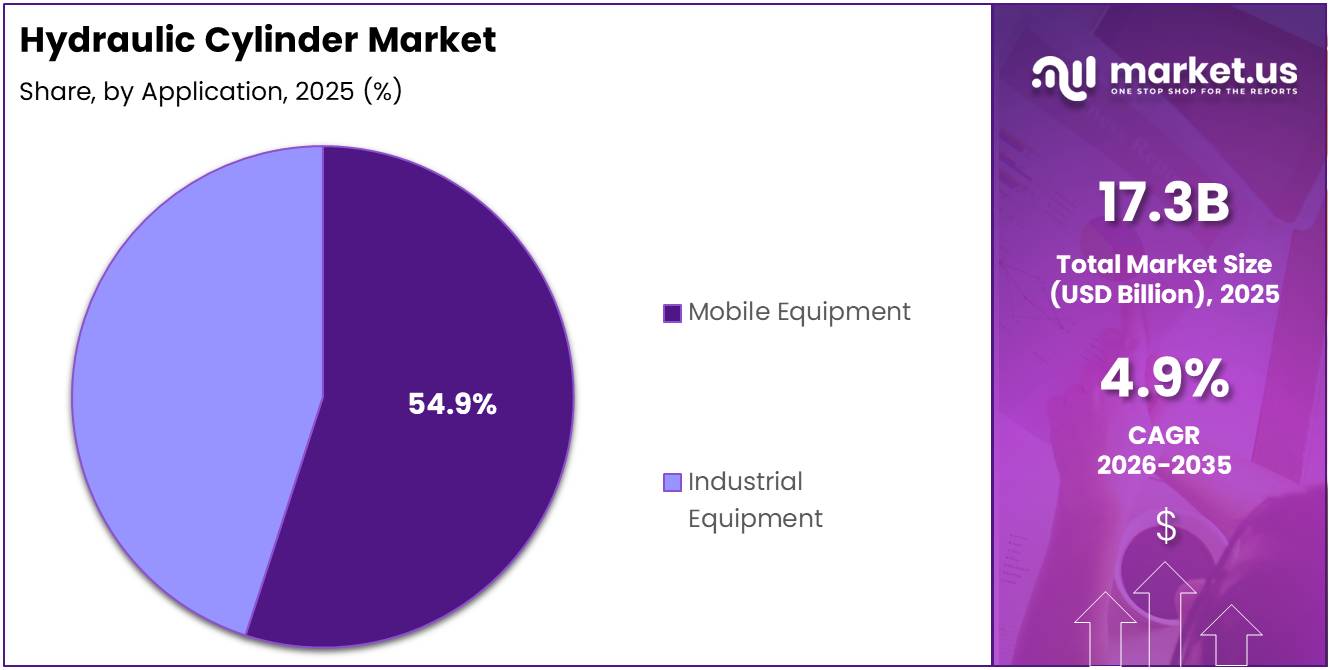
- By Application, Mobile Equipment holds the dominant position with a 54.9% share.
- By End-Use Industry, Construction leads with a 35.6% market share.
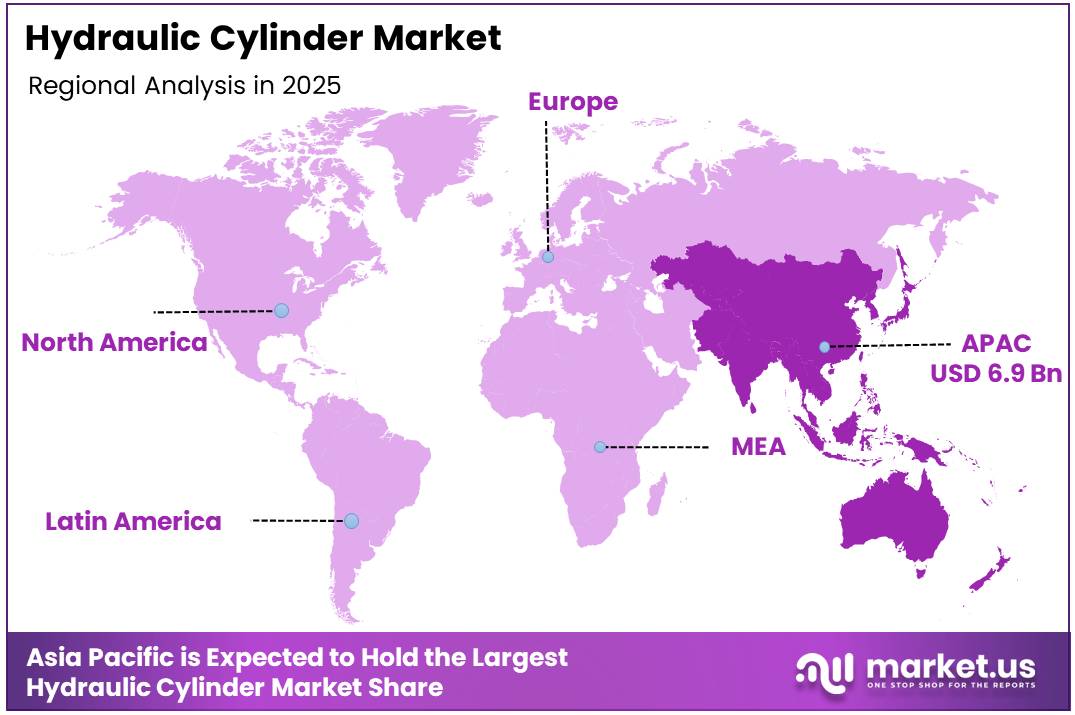
- Asia Pacific is the leading region with a 40.1% market share, valued at USD 6.9 Billion in 2025.
By Function Analysis
Double Acting Hydraulic Cylinder dominates with 71.2% due to its ability to apply hydraulic force in both directions, enabling precise and controlled motion.
In 2025, Double Acting Hydraulic Cylinder held a dominant market position in the By Function segment of the Hydraulic Cylinder Market, with a 71.2% share. These cylinders use hydraulic pressure on both sides of the piston, enabling precise control over both extension and retraction. Consequently, they are preferred in construction and industrial machinery requiring consistent two-directional force.
Single Acting Hydraulic Cylinder holds the remaining share in the By Function segment. These cylinders apply hydraulic force in only one direction, relying on an external force such as gravity or a spring for the return stroke. Therefore, they are commonly used in lighter applications where simplicity and cost efficiency are the primary requirements.
By Product Type Analysis
Welded Cylinder dominates with 54.6% due to its compact and robust construction, making it ideal for heavy-duty mobile and industrial equipment.
In 2025, Welded Cylinder held a dominant market position in the By Product Type segment of the Hydraulic Cylinder Market, with a 54.6% share. Welded cylinders offer a compact and robust design without external tie rods, making them highly suitable for mobile and heavy-duty industrial equipment. Moreover, their durability and resistance to extreme pressures drive widespread adoption.
Tie Rod Cylinder holds a significant share in the By Product Type segment. These cylinders use external high-strength tie rods to withstand application pressure, making them easy to repair and reconfigure. Additionally, their modular design makes them cost-effective and widely used in industrial manufacturing and automation equipment requiring consistent performance over long cycles.
Others in the By Product Type segment include telescopic and specialty hydraulic cylinders designed for niche applications. These products cater to specific industry needs where standard welded or tie rod configurations are not suitable. However, their adoption remains limited to specialized sectors such as aerospace, marine, and custom material handling systems.
Application Analysis
Mobile Equipment dominates with 54.9% due to high demand from construction machinery, agricultural equipment, and material handling applications.
In 2025, Mobile Equipment held a dominant market position in the By Application segment of the Hydraulic Cylinder Market, with a 54.9% share. Mobile equipment such as excavators, cranes, and agricultural machinery relies heavily on hydraulic cylinders for lifting, tilting, and steering. Consequently, rising infrastructure investment and agricultural mechanization are key growth drivers for this sub-segment.
Industrial Equipment accounts for the remaining share in the By Application segment. This includes manufacturing machinery, presses, and material handling systems that use hydraulic cylinders for controlled linear motion. Moreover, the expansion of factory automation and the push for higher production efficiency continue to support steady demand in this application area.
End-Use Industry Analysis
Construction dominates with 35.6% due to extensive use of hydraulic cylinders in excavators, cranes, bulldozers, and other earthmoving equipment.
In 2025, Construction held a dominant market position in the By End-Use Industry segment of the Hydraulic Cylinder Market, with a 35.6% share. Hydraulic cylinders are essential in construction equipment such as excavators, bulldozers, and cranes. Therefore, rising global infrastructure spending and urbanization are directly fueling demand in this leading end-use category.
Agriculture is a key end-use segment, with hydraulic cylinders widely used in tractors, harvesters, and irrigation systems. Increasing mechanization in developing economies is boosting adoption in this sector. Additionally, the need to improve farm productivity and reduce manual labor is driving manufacturers to develop more robust hydraulic solutions for agricultural applications.
Aerospace and Defence represents a specialized but growing segment for hydraulic cylinders. These industries require high-precision, lightweight cylinders that can perform under extreme conditions. Consequently, ongoing defence modernization programs and commercial aviation expansion are creating consistent demand for advanced hydraulic actuation systems in this technically demanding sector.
Forestry is an important end-use segment where hydraulic cylinders are used in logging equipment, tree harvesters, and timber-handling machinery. The increasing demand for sustainable forestry practices is encouraging upgrades to more efficient hydraulic systems. Moreover, the expansion of commercial forestry operations in emerging markets continues to support demand growth.
Marine applications involve hydraulic cylinders used in steering systems, deck machinery, and offshore equipment. These cylinders must withstand harsh saltwater environments and high-pressure conditions. Therefore, the growth of maritime trade, naval expansion, and offshore oil and gas operations continues to create steady demand for corrosion-resistant hydraulic cylinder solutions.
Others in the By End-Use Industry segment cover sectors such as mining, energy, and material handling. These sectors use hydraulic cylinders for a variety of specialized functions requiring high force output and durability. However, their individual market shares remain smaller compared to construction and agriculture, though collectively they contribute meaningful volume to the overall market.
Key Market Segments
By Function
- Double Acting Hydraulic Cylinder
- Single Acting Hydraulic Cylinder
By Product Type
- Welded Cylinder
- Tie Rod Cylinder
- Others
By Application
- Mobile Equipment
- Industrial Equipment
By End-Use Industry
- Construction
- Agriculture
- Aerospace & Defence
- Forestry
- Marine
- Others
Drivers
Rising Global Demand for Construction and Agricultural Equipment Drives Hydraulic Cylinder Market Growth
The hydraulic cylinder market is experiencing strong growth driven by rising global demand for heavy construction and earthmoving equipment. Large-scale infrastructure projects across emerging and developed economies require high-power hydraulic actuation. Consequently, increased public and private investment in road, bridge, and urban development projects is creating sustained demand for hydraulic cylinders.
Agricultural mechanization is another key driver for the hydraulic cylinder market. Increasing adoption of hydraulic systems in tractors, harvesters, and irrigation equipment is improving farm productivity and reducing manual labor. Moreover, government programs promoting mechanized farming in developing countries are accelerating the integration of hydraulic technologies in the agricultural machinery sector.
The expansion of industrial automation and material handling equipment is further supporting market growth. Hydraulic cylinders are widely integrated into automated production lines, robotic systems, and warehouse machinery. Therefore, the increasing focus on operational efficiency and precision in manufacturing industries continues to drive demand for reliable hydraulic motion control solutions globally.
Restraints
Shift Toward Electric Actuators and Environmental Regulations Restrain the Hydraulic Cylinder Market
A key restraint for the hydraulic cylinder market is the increasing adoption of electric linear actuators as alternatives. These actuators offer cleaner operation, easier integration with digital control systems, and lower maintenance requirements. Consequently, industries focused on electrification and sustainability are gradually replacing hydraulic systems with electric alternatives, particularly in light-duty industrial applications.
Environmental and regulatory concerns related to hydraulic fluid leakage and contamination also pose challenges for the market. Hydraulic fluids can be hazardous to soil and water ecosystems if not managed properly. Moreover, stricter environmental regulations in several regions are increasing compliance costs for manufacturers and end-users of hydraulic cylinder systems.
Additionally, the high maintenance requirements and potential for hydraulic fluid spills create operational risks for equipment operators. These concerns are prompting a shift toward biodegradable hydraulic fluids and improved sealing technologies. However, transitioning to these solutions requires additional investment, which can slow adoption in cost-sensitive markets and industries.
Growth Factors
Renewable Energy Deployment and Smart Hydraulic Systems Accelerate Market Growth
The deployment of hydraulic cylinders in renewable energy infrastructure presents a significant growth opportunity. Wind turbine pitch control, solar panel tracking systems, and hydroelectric equipment increasingly rely on hydraulic actuation. Therefore, the global expansion of renewable energy capacity is creating new and consistent demand for hydraulic cylinders in large-scale mechanical systems.
Increasing demand for custom-engineered hydraulic cylinders is another major growth factor. Specialized industries such as offshore oil and gas, aerospace, and heavy mining require cylinders tailored to unique pressure, load, and environmental specifications. Consequently, manufacturers offering engineering design services and bespoke solutions are gaining competitive advantage and expanding their customer base.
Rising investments in smart and sensor-integrated hydraulic systems are accelerating market growth. These systems incorporate real-time monitoring capabilities to track pressure, temperature, and performance parameters. Moreover, predictive maintenance enabled by integrated sensors reduces downtime and operating costs, making sensor-equipped hydraulic cylinders increasingly attractive to industrial and mobile equipment operators.
Emerging Trends
IoT Integration and Energy-Efficient Designs Reshape the Hydraulic Cylinder Market Landscape
The integration of IoT-enabled monitoring technologies in hydraulic cylinder systems is a prominent emerging trend. Connected sensors embedded in cylinders allow real-time data collection on performance, wear, and fluid conditions. Consequently, operators can shift from reactive to proactive maintenance strategies, reducing unexpected equipment failures and improving overall system reliability in industrial operations.
The development of lightweight and high-strength materials for hydraulic cylinders is gaining significant momentum. Advanced materials such as high-grade alloy steels, composite coatings, and aluminum alloys are being adopted to reduce cylinder weight without sacrificing durability. Therefore, these innovations are improving fuel efficiency in mobile equipment and enabling the design of more compact hydraulic systems.
Increasing focus on energy-efficient hydraulic designs is reshaping how manufacturers develop and market hydraulic cylinders. Modern designs incorporate variable flow systems, regenerative hydraulic circuits, and optimized valve configurations to minimize energy loss. Additionally, growing pressure from environmental regulations and operational cost targets is accelerating the industry-wide shift toward more energy-conscious hydraulic engineering solutions.
Regional Analysis
Asia Pacific Dominates the Hydraulic Cylinder Market with a Market Share of 40.1%, Valued at USD 6.9 Billion
Asia Pacific dominates the Hydraulic Cylinder Market with a market share of 40.1%, valued at approximately USD 6.9 Billion in 2025. The region’s dominance is driven by rapid infrastructure expansion in China, India, and Southeast Asia. Moreover, high agricultural mechanization rates and strong growth in industrial manufacturing continue to fuel hydraulic cylinder demand across the region.
North America Hydraulic Cylinder Market Trends
North America holds a significant share of the global hydraulic cylinder market, supported by high demand from the construction and mining sectors. The United States leads regional demand, driven by ongoing infrastructure programs and strong agricultural machinery adoption. Additionally, the presence of leading hydraulic cylinder manufacturers and a mature industrial base supports consistent market performance in this region.
Europe Hydraulic Cylinder Market Trends
Europe represents a well-established market for hydraulic cylinders, with strong demand from the automotive, manufacturing, and agricultural machinery sectors. Germany, France, and the UK are key contributors to regional growth. Moreover, strict environmental regulations in the European Union are driving investment in advanced, energy-efficient hydraulic systems and eco-friendly hydraulic fluid technologies across the region.
Middle East and Africa Hydraulic Cylinder Market Trends
The Middle East and Africa region is witnessing gradual growth in the hydraulic cylinder market. Expanding oil and gas infrastructure, construction projects, and mining activities are driving demand. Consequently, government investment in economic diversification and large-scale industrial development across GCC countries is creating new opportunities for hydraulic cylinder manufacturers targeting this region.
Latin America Hydraulic Cylinder Market Trends
Latin America presents emerging growth potential for the hydraulic cylinder market, supported by agricultural expansion, mining activities, and infrastructure development. Brazil and Mexico lead regional demand, driven by their large agricultural sectors and growing construction industries. However, economic volatility and infrastructure funding gaps in some countries may limit the pace of market expansion in this region.
Key Regions and Countries
North America
- US
- Canada
Europe
- Germany
- France
- The UK
- Spain
- Italy
- Rest of Europe
Asia Pacific
- China
- Japan
- South Korea
- India
- Australia
- Rest of APAC
Latin America
- Brazil
- Mexico
- Rest of Latin America
Middle East & Africa
- GCC
- South Africa
- Rest of MEA
Key Company Insights
Aggressive, Inc. is a recognized manufacturer of hydraulic cylinders and actuators serving heavy-duty industrial and mobile equipment markets. The company focuses on delivering custom-engineered hydraulic solutions for construction, agriculture, and material handling applications. Its product portfolio emphasizes durability and performance. Moreover, its recent acquisition of United Hydraulics Corp. intellectual properties strengthens its technical capabilities and market reach.
Best Metal Products is a specialized manufacturer providing hydraulic cylinders and precision metal components for a range of industrial sectors. The company is known for its quality manufacturing standards and engineering expertise. Its cylinders serve diverse end-use markets including construction and material handling. Additionally, the company continues to expand its product offering to meet evolving customer specifications and industry demands.
Bosch Rexroth is a global leader in drive and control technologies, including hydraulic cylinders for industrial and mobile applications. The company offers a broad portfolio of hydraulic actuators designed for precision and reliability. Consequently, it serves construction, manufacturing, and aerospace industries. Its global presence and engineering innovation position it as a leading force in the hydraulic cylinder market.
Caterpillar is one of the world’s leading manufacturers of construction and mining equipment, with hydraulic cylinders forming a critical component across its product range. The company designs and integrates high-performance hydraulic systems into its heavy machinery. Therefore, Caterpillar’s extensive global distribution network and strong engineering capabilities make it a dominant player in the hydraulic cylinder and equipment market.
Key Players
- Aggressive, Inc.
- Best Metal Products
- Bosch Rexroth
- Caterpillar
- Eaton Corporation
- ENERPAC
- Hydrosila
- HYDAC
- JARP Industries Inc.
- Liebherr
- Ligon Industries, LLC
- Montanhydraulik GmbH
- Norrhydro Oy
- Pacoma GmbH
- Parker Hannifin Corp
- Other Key Players
Recent Developments
- December 2025 – One Equity Partners announced its agreement to acquire Montanhydraulik GmbH, a European specialist in hydraulic cylinder manufacturing. This acquisition strengthens One Equity Partners’ industrial portfolio and expands its presence in the global hydraulic actuation and fluid power sector.
- November 2025 – Pelican Energy Partners announced the acquisition of Hanna Cylinders, a global provider of heavy-duty hydraulic and pneumatic cylinders. This strategic move enhances Pelican’s capabilities in industrial fluid power solutions for energy, construction, and heavy equipment markets.
- November 2025 – Aggressive, Inc. announced the acquisition of United Hydraulics Corp. intellectual properties, significantly expanding its engineering capabilities and hydraulic cylinder product range. This move reinforces Aggressive’s position as a comprehensive hydraulic solution provider across North American industrial markets.
Report Scope
Report Features Description Market Value (2025) USD 17.3 Billion Forecast Revenue (2035) USD 28.0 Billion CAGR (2026-2035) 4.9% Base Year for Estimation 2025 Historic Period 2020-2024 Forecast Period 2026-2035 Report Coverage Revenue Forecast, Market Dynamics, Competitive Landscape, Recent Developments Segments Covered By Function (Double Acting Hydraulic Cylinder, Single Acting Hydraulic Cylinder), By Product Type (Welded Cylinder, Tie Rod Cylinder, Others), By Application (Mobile Equipment, Industrial Equipment), By End-Use Industry (Construction, Agriculture, Aerospace & Defence, Forestry, Marine, Others) Regional Analysis North America (US and Canada), Europe (Germany, France, The UK, Spain, Italy, and Rest of Europe), Asia Pacific (China, Japan, South Korea, India, Australia, and Rest of APAC), Latin America (Brazil, Mexico, and Rest of Latin America), Middle East & Africa (GCC, South Africa, and Rest of MEA) Competitive Landscape Aggressive, Inc., Best Metal Products, Bosch Rexroth, Caterpillar, Eaton Corporation, ENERPAC, Hydrosila, HYDAC, JARP Industries Inc., Liebherr, Ligon Industries, LLC, Montanhydraulik GmbH, Norrhydro Oy, Pacoma GmbH, Parker Hannifin Corp, Other Key Players Customization Scope Customization for segments, region/country-level will be provided. Moreover, additional customization can be done based on the requirements. Purchase Options We have three licenses to opt for: Single User License, Multi-User License (Up to 5 Users), Corporate Use License (Unlimited User and Printable PDF) 
-
-
- Aggressive, Inc.
- Best Metal Products
- Bosch Rexroth
- Caterpillar
- Eaton Corporation
- ENERPAC
- Hydrosila
- HYDAC
- JARP Industries Inc.
- Liebherr
- Ligon Industries, LLC
- Montanhydraulik GmbH
- Norrhydro Oy
- Pacoma GmbH
- Parker Hannifin Corp
- Other Key Players
Our Clients

- 180639
- Feb 2026






