


Report Overview
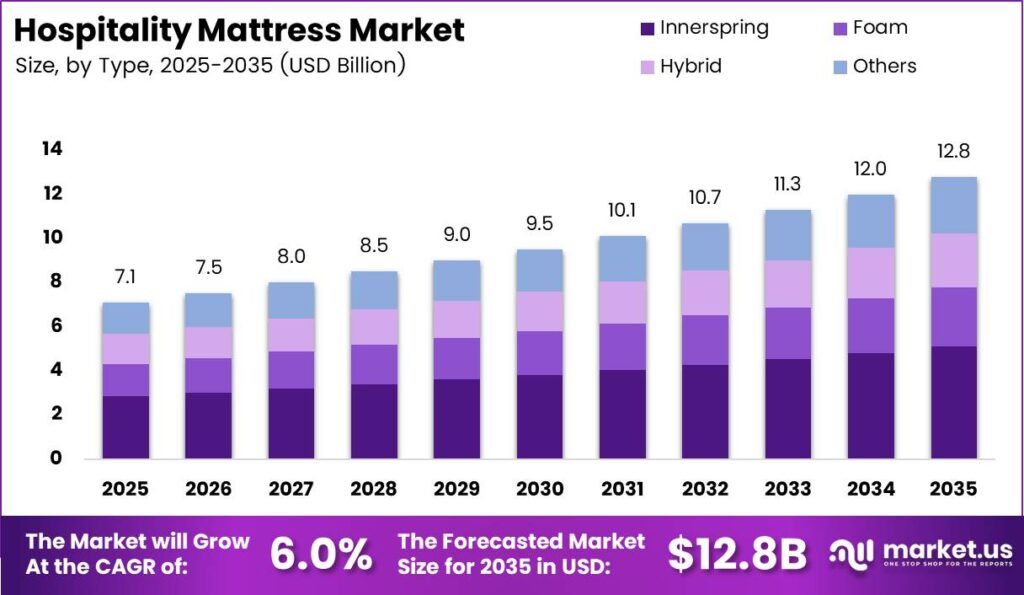
Global Hospitality Mattress Market size is expected to be worth around USD 12.8 Billion by 2035 from USD 7.1 Billion in 2025, growing at a CAGR of 6.0% during the forecast period 2026 to 2035. This expansion reflects sustained hotel construction activity, rising occupancy-driven replacement cycles, and accelerating operator investment in premium sleep experiences across all lodging tiers.
The hospitality mattress market covers mattresses manufactured and procured specifically for commercial lodging properties, including hotels, resorts, hostels, and extended-stay facilities. Products range from entry-level innerspring units for budget properties to customized hybrid and foam constructions for luxury brands. Procurement typically flows through direct supplier contracts, group purchasing organizations, and brand-mandated specification programs.
Key Takeaways
- The global Hospitality Mattress Market is valued at USD 7.1 Billion in 2025 and is forecast to reach USD 12.8 Billion by 2035.
- The market grows at a CAGR of 6.0% during the forecast period 2026 to 2035.
- By Type, Innerspring dominates with a 34.67% share in 2025.
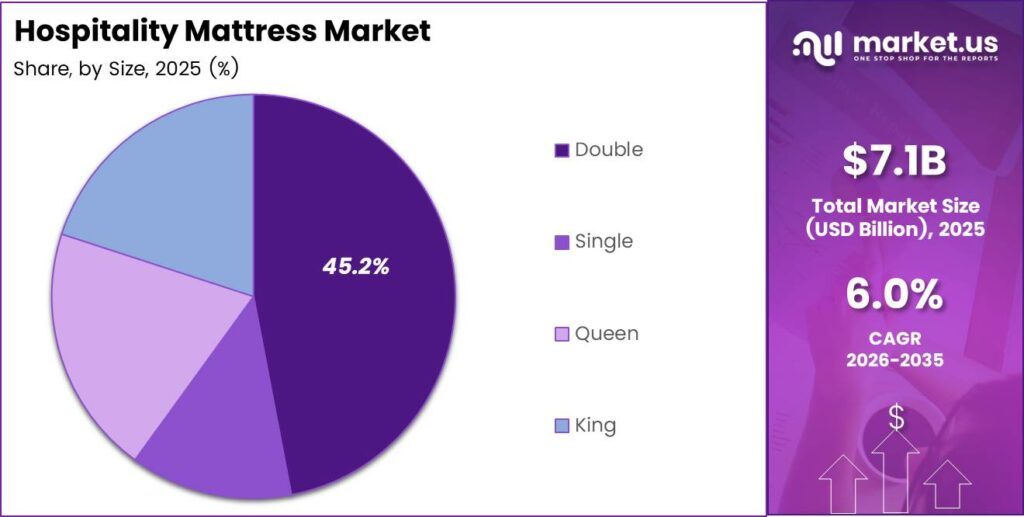
- By Size, Double dominates with a 45.23% share in 2025 and is also the fastest-growing size segment.
- By End Use, Hotels & Resorts leads with a 58.67% share in 2025.
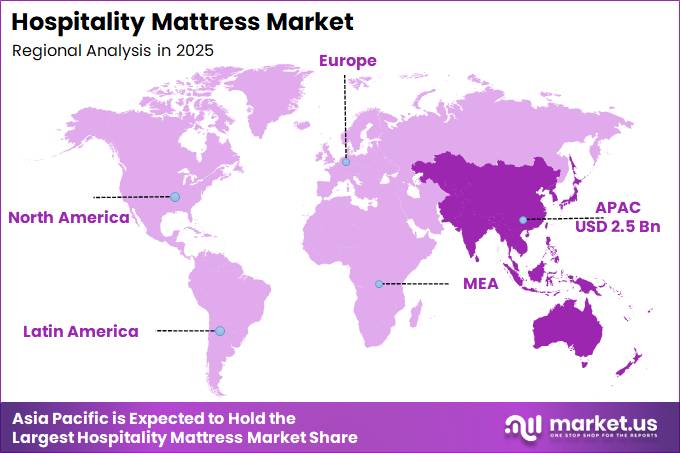
- Asia-Pacific dominates the regional landscape with a 36.32% market share, valued at USD 2.5 Billion, and is also the fastest-growing region.
According to UN Tourism, international tourist arrivals worldwide reached 1.52 billion in 2025, approximately 60 million more than in 2024. This volume of active travelers directly pressures hotel occupancy rates and accelerates mattress wear cycles. Properties in high-demand corridors face compressed replacement intervals, which converts occupancy growth into measurable procurement demand.
Data from WTTC shows Travel & Tourism contributed USD 11.6 Trillion to global GDP in 2025, equivalent to 9.8% of the global economy. This sectoral weight signals that hospitality infrastructure investment remains a structural priority for governments and private operators alike. Mattress suppliers positioned within capital-expenditure planning cycles stand to capture recurring volume from both new builds and refurbishment programs. In July 2025, Serta Simmons Bedding expanded its portfolio with the Serta iSeries NXG collection, reflecting active product investment aligned with rising operator demand for differentiated sleep solutions.
Type Analysis
Innerspring dominates with 34.67% due to cost efficiency and wide operator familiarity.
In 2025, Innerspring held a dominant market position in the By Type segment of the Hospitality Mattress Market, with a 34.67% share. Hotels select innerspring units for their predictable performance, established supply chains, and lower per-unit procurement cost. This segment captures the majority of mid-scale and economy property orders, making it the default specification tier for high-volume contract purchasing programs.
Foam is the fastest-growing type segment, reflecting operator interest in pressure-relief performance and reduced motion transfer for shared-room configurations. Budget and mid-scale properties increasingly specify foam units as a cost-effective path to improved guest sleep scores. As per our research, rising online review culture has made mattress comfort a measurable driver of repeat booking behavior, accelerating foam adoption across lodging tiers.
Hybrid mattresses address operators seeking premium positioning without the full cost of specialty foam constructions. These units combine innerspring support with foam or latex comfort layers, enabling upscale and upper-midscale brands to differentiate their sleep offering. Eurostat reported nearly 3.1 Billion nights spent in EU tourist accommodation in 2025, up 2.2% from 2024, which supports sustained replacement and upgrade demand across European hotel portfolios. Others, including latex and specialty constructions, hold the remaining share collectively.
Size Analysis
Double dominates with 45.23% due to standard room configuration across most lodging tiers.
In 2025, Double held a dominant market position in the By Size segment of the Hospitality Mattress Market, with a 45.23% share. Double is also the fastest-growing size segment, driven by its compatibility with standard guestroom footprints across budget, midscale, and upscale properties. Sealy specifies the standard US full/double mattress at 54 × 75 inches, a dimension that aligns with the most widely built hotel room configurations globally. This size standardization reduces specification complexity and lowers procurement costs for multi-property operators.
Single mattresses serve dormitory-style rooms, hostels, and budget properties where space efficiency governs room design. Operators in high-density urban markets and campus-adjacent lodging rely on single-size procurement to maximize room yield. This segment benefits from the fastest hostel expansion activity, particularly across Southeast Asia and Europe, where low-cost accommodation formats continue to scale.
Queen and King sizes serve upper-midscale, upscale, and luxury properties where room dimensions accommodate larger sleeping surfaces. These segments carry higher per-unit values and support branded sleep programs that differentiate premium tiers. In September 2026, Ikano Industry expanded into the commercial lodging sector in North America with the launch of its customizable IKONA Hospitality mattress collection, which targets exactly this premium customization space across multiple size configurations. Queen and King collectively hold the remaining size share alongside Single.
End Use Analysis
Hotels & Resorts dominates with 58.67% due to scale of installed room stock and structured procurement cycles.
In 2025, Hotels & Resorts held a dominant market position in the By End Use segment of the Hospitality Mattress Market, with a 58.67% share. This segment generates the largest absolute procurement volume through brand-mandated replacement schedules, new property openings, and refurbishment programs. Large hotel groups operate centralized purchasing functions that create predictable, high-volume order flows for mattress suppliers with approved vendor status.
Hostels represent the fastest-growing end-use segment, supported by the global expansion of budget travel and branded hostel chains entering previously independent markets. Operators in this category prioritize durability and low per-unit cost over comfort tier. As the hostel format professionalizes across Asia-Pacific and Europe, procurement moves from ad hoc purchasing toward structured contracts, creating new volume opportunities for suppliers willing to serve lower price points at scale.
Others, including serviced apartments, extended-stay facilities, and boutique lodging formats, hold the remaining end-use share. These operators often require non-standard sizes and construction specifications that fall outside mainstream hotel programs. This segment rewards suppliers with flexible manufacturing capabilities and short minimum order quantities.
Key Market Segments
By Type
- Innerspring
- Foam
- Hybrid
- Others
By Size
- Double
- Single
- Queen
- King
By End Use
- Hotels & Resorts
- Hostels
- Others
Regional Analysis
Asia-Pacific Dominates the Hospitality Mattress Market with a Market Share of 36.32%, Valued at USD 2.5 Billion
Asia-Pacific holds the largest regional share at 36.32%, valued at USD 2.5 Billion in 2025, and ranks as the fastest-growing region in the global Hospitality Mattress Market. The region’s growth stems from rapid hotel construction across China, India, and Southeast Asia, combined with rising middle-class travel volumes. Suppliers with regional manufacturing presence capture cost and lead-time advantages that importers cannot easily match in this corridor.
Europe represents a structurally active replacement market, driven by a mature hotel stock and government-supported tourism infrastructure. By July 2025, edyn’s Silentnight mattress rollout had reached properties in at least 6 European cities, including Manchester, Edinburgh, Paris, Dublin, Munich, and London, demonstrating that branded sleep upgrade programs are executing at scale across key European lodging hubs. This signals that European operators are prioritizing sleep quality investment as a competitive differentiator rather than deferring non-urgent capital expenditure.
North America benefits from structured franchise systems that enforce brand sleep standards across large property portfolios, creating consistent replacement demand. Gulf markets drive incremental volume through luxury resort and business hotel construction tied to international tourism and events infrastructure investment. Latin America and the Middle East and Africa collectively hold the remaining regional share, with growth concentrated in urban hotel development corridors where international brands are expanding their footprint.
Key Regions and Countries
North America
- US
- Canada
Europe
- Germany
- France
- The UK
- Spain
- Italy
- Rest of Europe
Asia Pacific
- China
- Japan
- South Korea
- India
- Australia
- Rest of APAC
Latin America
- Brazil
- Mexico
- Rest of Latin America
Middle East and Africa
- GCC
- South Africa
- Rest of MEA
Market Dynamics
Market Opportunity Analysis - Underserved lodging formats and high-growth regions offer targeted entry points for suppliers and investors
The hostel segment presents the most accessible near-term entry point for suppliers willing to serve budget-focused procurement at volume. Hostels are the fastest-growing end-use segment yet remain underserved by mainstream contract programs designed around hotel-scale order quantities. Suppliers offering lower minimum order sizes, durable entry-tier constructions, and flexible payment terms can displace informal purchasing arrangements that currently dominate this category.
Asia-Pacific holds a 36.32% regional share and leads on growth, yet manufacturing supply chains in the region remain fragmented across a large number of smaller producers. This fragmentation creates an opening for mid-scale international suppliers to establish preferred-vendor relationships with regional hotel chains that currently source inconsistently. Consolidating regional supply relationships would reduce specification variability and enable volume-based pricing advantages unavailable to single-property operators.
The Others end-use category, covering serviced apartments, extended-stay facilities, and boutique lodging, holds the remaining end-use share and sits outside standard brand procurement programs. This segment purchases infrequently through ad hoc channels, which suppresses unit prices and limits supplier visibility. Vendors capable of aggregating demand across multiple boutique operators through group purchasing platforms can convert fragmented spend into structured contracts with higher margin potential.
Queen and King size segments serve upper-midscale and luxury properties that carry the highest per-unit mattress values in the market. However, these segments remain underrepresented in modular and topper-based product innovation relative to their revenue contribution. Suppliers that introduce replaceable comfort layer technology, as demonstrated by Ikano’s IKONA Hospitality launch, into Queen and King configurations target a high-value refresh cycle that commands premium pricing and reduces full-replacement frequency.
Technology and Innovation Landscape - Sustainable materials, modular construction, and service-model innovation redefine supplier differentiation in hospitality bedding
Sustainable foam formulation has moved from a brand claim to a certified material standard in premium hospitality supply. Greiner reported that the NEVEON foam used in MATR mattresses supplied to Boutique Hotel Stadthalle in Vienna contained 30% sustainably certified renewable raw materials, accounted for through a REDcert²-certified mass-balance approach. This certification pathway allows suppliers to document sustainability performance within existing chemical and manufacturing processes without redesigning full product lines.
Modular mattress architecture addresses a core operator pain point by separating wear components from durable structural elements. The Ikona Hospitality mattress collection, announced in September 2026, uses a removable zip-on/zip-off topper system that configures the same underlying platform at either 12 inches or 14 inches in height. Hotels can replace the topper without replacing the whole mattress, which reduces material costs per refresh cycle and shortens the procurement decision from a full replacement to a component swap.
Sensor-enabled sleep services represent a longer-horizon innovation pathway for luxury and technology-forward lodging operators. Embedding biometric monitoring within mattress platforms allows properties to offer personalized sleep data as a paid amenity, creating a recurring service revenue stream alongside the physical product sale. This model shifts the supplier relationship from a transactional vendor to an ongoing technology partner, which raises switching costs and generates data that can support warranty and comfort management programs.
Customization platforms at the product specification level are also advancing commercial differentiation. The IKONA Hospitality lineup at launch comprised 3 models, Solara, Térrava, and Borealis, available through a hotel-focused program offering customization of construction, comfort, dimensions, profile, fabrics, and performance features. This level of configuration depth targets multi-brand hotel groups that require distinct sleep profiles for different property tiers without managing separate supplier relationships for each brand.
Drivers
Newly opened hotel rooms generate immediate first-fit mattress orders, making operating-room additions the strongest active volume driver in this market. Marriott reported approximately 109,000 net room additions and 6.8% net room growth in 2024, followed by approximately 73,600 net additions and more than 4.3% growth in 2025. Each 100 newly operating rooms requires approximately 100 to 140 mattresses depending on room configuration, which shifts suppliers toward opening-date-linked contracts and standardized installation programs.
| Driver | (~) % Impact on CAGR Forecast | Geographic Relevance | Impact Timeline |
|---|---|---|---|
| Operating hotel room additions | +0.65% | Global; Asia-Pacific and Middle East emphasis | Short term (≤ 2 years) |
| Occupancy-led mattress wear acceleration | +0.35% | Global; high-occupancy urban and resort markets | Short term (≤ 2 years) |
| Existing-room premium sleep upgrades | +0.25% | North America, Europe, Gulf markets | Medium term (2–4 years) |
| Franchise conversion bedding standardization | +0.20% | Europe, North America, Asia-Pacific | Short term (≤ 2 years) |
| Independent-hotel procurement aggregation | +0.15% | India, Southeast Asia, fragmented European markets | Medium term (2–4 years) |
Restraints
Restricted borrowing capacity and competition for available capital stop discretionary mattress purchases even when hotels remain operational. The Federal Reserve’s July 2025 lending survey reported tighter standards and weaker demand for commercial real estate lending, with standards still tight relative to historical ranges despite some easing since 2024. In an illustrative replacement model, extending a purchasing cycle from 8 to 10 years reduces annualized replacement throughput from 12.5% to 10.0% of installed stock, a 20% decline within the affected cohort.
This capital constraint limits the estimated baseline deduction to 0.40 percentage points, while suppliers face postponed orders and weaker factory utilization. As a result, manufacturers face greater pressure to offer phased delivery structures and extended payment terms to maintain order flow. Properties holding debt from high-rate financing periods represent the most acute procurement risk for suppliers relying on predictable replacement cycles.
| Restraint | (~) % Impact on CAGR Forecast | Geographic Relevance | Impact Timeline |
|---|---|---|---|
| Restricted hotel-owner capital availability | −0.40% | Global; leveraged owners and smaller operators | Short term (≤ 2 years) |
| Noncompliant mattress sales prohibitions | −0.20% | United States; other regulated destinations | Short term (≤ 2 years) |
| Import-duty-driven purchase cancellations | −0.15% | Import-dependent hospitality markets | Short term (≤ 2 years) |
| Distressed-property procurement freezes | −0.10% | Markets with insolvent or receivership-held hotels | Short term (≤ 2 years) |
| Extended incumbent supply-contract lock-ins | −0.05% | Global; centrally contracted hotel portfolios | Medium term (2–4 years) |
Challenges
Mattresses’ high transport volume relative to unit value creates continuing exposure to vessel rerouting, container availability, and delivery variability. UN Trade and Development reported that Suez Canal tonnage fell approximately 70% by mid-2024, Cape of Good Hope arrivals increased 89%, and rerouting raised container-ship demand approximately 12%. The Shanghai Containerized Freight Index more than doubled from late-2023 levels by mid-2024, compressing margins for import-dependent suppliers.
As a cost sensitivity measure, a manufacturer with freight equal to 8% of delivered cost would experience a 4% delivered-cost increase if freight expense rose 50%, assuming other costs remained unchanged. Carrying an additional 2 to 4 weeks of inventory would also absorb working capital. The estimated 0.25 percentage-point friction allocation reflects uneven exposure and mitigation through regional assembly and alternate routing strategies.
| Challenge | (~) % CAGR Friction Drag | Geographic Relevance | Mitigation Horizon |
|---|---|---|---|
| Bulky freight network volatility | −0.25% | Global; ocean-dependent procurement corridors | Short term (≤ 2 years) |
| Foam formulation consistency management | −0.10% | Global manufacturing and sourcing networks | Medium term (2–4 years) |
| Hotel specification portfolio complexity | −0.10% | Global; multibrand hotel portfolios | Medium term (2–4 years) |
| Installation labor scheduling constraints | −0.10% | North America, Europe, remote resorts | Short term (≤ 2 years) |
| Comfort warranty dispute management | −0.15% | Global; premium and high-service properties | Medium term (2–4 years) |
Opportunities
Closed-loop modular mattress services represent a prospective white space combining replaceable wear components, scheduled servicing, take-back, and material recovery. California’s approval of the mattress stewardship organization’s 2024 annual report on September 29, 2025, and Oregon’s first-year program report for 2025 demonstrate an operating recovery infrastructure. This creates a commercial foundation for suppliers to build subscription-style service contracts with hotel operators rather than competing on replacement unit price alone.
In an illustrative engineering case, assigning 30% of initial manufacturing cost to a replaceable comfort assembly lowers material expenditure at first eligible refresh by up to 70% relative to complete replacement. A commercially conservative execution target is a 15 to 25% reduction in lifecycle cost per occupied-room-year and a 2 to 4 percentage-point supplier gross-margin improvement. The estimated +0.35 percentage-point upside is conditional on adoption, with a fully executed scenario implying 7.05% CAGR against the supplied 6.0% baseline.
| Opportunity | (~) % Potential CAGR Upside | Geographic Relevance | Execution Window |
|---|---|---|---|
| Closed-loop modular mattress services | +0.35% | Europe, North America; dense hotel clusters | Medium term (2–4 years) |
| Hotel-branded consumer mattress licensing | +0.25% | North America, Europe, affluent Asian markets | Medium term (2–4 years) |
| Marine and expedition lodging supply | +0.20% | Cruise hubs and expedition-tourism corridors | Medium term (2–4 years) |
| Paid sensor-enabled sleep services | +0.15% | Technology-enabled luxury hospitality markets | Long term (≥ 4 years) |
| Regional contract-manufacturer consolidation | +0.10% | Fragmented Asian and European supply markets | Medium term (2–4 years) |
Key Company Insights
Serta Simmons Bedding holds a strong position in the hospitality mattress channel through its Beautyrest Hospitality product line, which serves branded hotel programs at scale. In May 2026, Preferred Hotels & Resorts established a strategic Alliance Partner relationship with Serta Simmons Bedding to launch the Preferred Pillow Top by Beautyrest Hospitality, an exclusive line for luxury member properties. This partnership deepens Serta’s penetration into the premium hospitality tier and raises switching costs for affiliated properties.
Tempur Sealy International, now operating as Somnigroup International, reported approximately USD 1.7 Billion in annual net sales per Sleep Number’s 2024 Form 10-K, reflecting the consolidated scale of the leading bedding group. On January 21, 2026, Serta Simmons Bedding announced its new Serta Perfect Sleeper collection featuring a 4-in-1 linked-coil Q4 Support System with suggested entry pricing starting at USD 699. Tempur Sealy’s vertically integrated supply chain and multi-brand architecture give it procurement leverage that independent regional suppliers cannot replicate across large hotel portfolios.
Key Players
- Serta Simmons Bedding
- Tempur Sealy International
- Sleep Number Corporation
- King Koil
- Kingsdown, Inc.
- Corsicana Mattress Company
- Pikolin
- Breckle
- Hilding Anders
- Restonic Mattress Corporation
- AH Beard
- Other Key Players
Recent Developments
- January 2025 – Serta Simmons Bedding launched the all-new Beautyrest and Beautyrest World Class collections, featuring upgraded coil densities and advanced cooling technologies.
- February 5, 2025 – Tempur Sealy completed its approximately USD 5 Billion acquisition of Mattress Firm, funded with approximately USD 2.7 Billion in cash consideration and 34.2 Million common shares.
- February 18, 2025 – Tempur Sealy International officially changed its corporate name to Somnigroup International Inc., shifting to a decentralized operating model for its major business units.
- May 2025 – Mattress Warehouse officially completed the acquisition of 176 physical retail locations, comprising 73 former Mattress Firm stores and 103 Sleep Outfitters locations, from Tempur Sealy International as part of a required antitrust divestiture.
- January 21, 2026 – Serta Simmons Bedding announced Beautyrest Black Hybrid XCS models, with Series Three suggested pricing starting at USD 3,999 and Series Five starting at USD 5,699.
- March 12, 2026 – Sleep Number announced five new beds across its ComfortMode, ComfortNext and Climate collections, with purchasing availability beginning March 23, 2026.
- August 2026 – Springfit Mattresses showcased its latest premium hospitality mattress innovations and advanced B2B sleep technology at the India International Hospitality Expo (IHE 2026) in Greater Noida.
Report Scope
| Report Features | Description |
|---|---|
| Market Value (2025) | USD 7.1 Billion |
| Forecast Revenue (2035) | USD 12.8 Billion |
| CAGR (2026-2035) | 6.0% |
| Base Year for Estimation | 2025 |
| Historic Period | 2020-2024 |
| Forecast Period | 2026-2035 |
| Report Coverage | Revenue Forecast, Market Dynamics, Market Opportunity Analysis, Technology and Innovation Landscape, Competitive Landscape, Recent Developments |
| Segments Covered | By Type (Innerspring, Foam, Hybrid, Others), By Size (Double, Single, Queen, King), By End Use (Hotels & Resorts, Hostels, Others) |
| Regional Analysis | North America (US and Canada), Europe (Germany, France, The UK, Spain, Italy, and Rest of Europe), Asia Pacific (China, Japan, South Korea, India, Australia, and Rest of APAC), Latin America (Brazil, Mexico, and Rest of Latin America), Middle East and Africa (GCC, South Africa, and Rest of MEA) |
| Competitive Landscape | Serta Simmons Bedding, Tempur Sealy International, Sleep Number Corporation, King Koil, Kingsdown, Inc., Corsicana Mattress Company, Pikolin, Breckle, Hilding Anders, Restonic Mattress Corporation, AH Beard, Other Key Players |
| Customization Scope | Customization for segments, region/country-level will be provided. Additional customization can be done based on requirements. |
| Purchase Options | We have three licenses to opt for: Single User License, Multi-User License (Up to 5 Users), Corporate Use License (Unlimited User and Printable PDF) |





































