


Report Overview
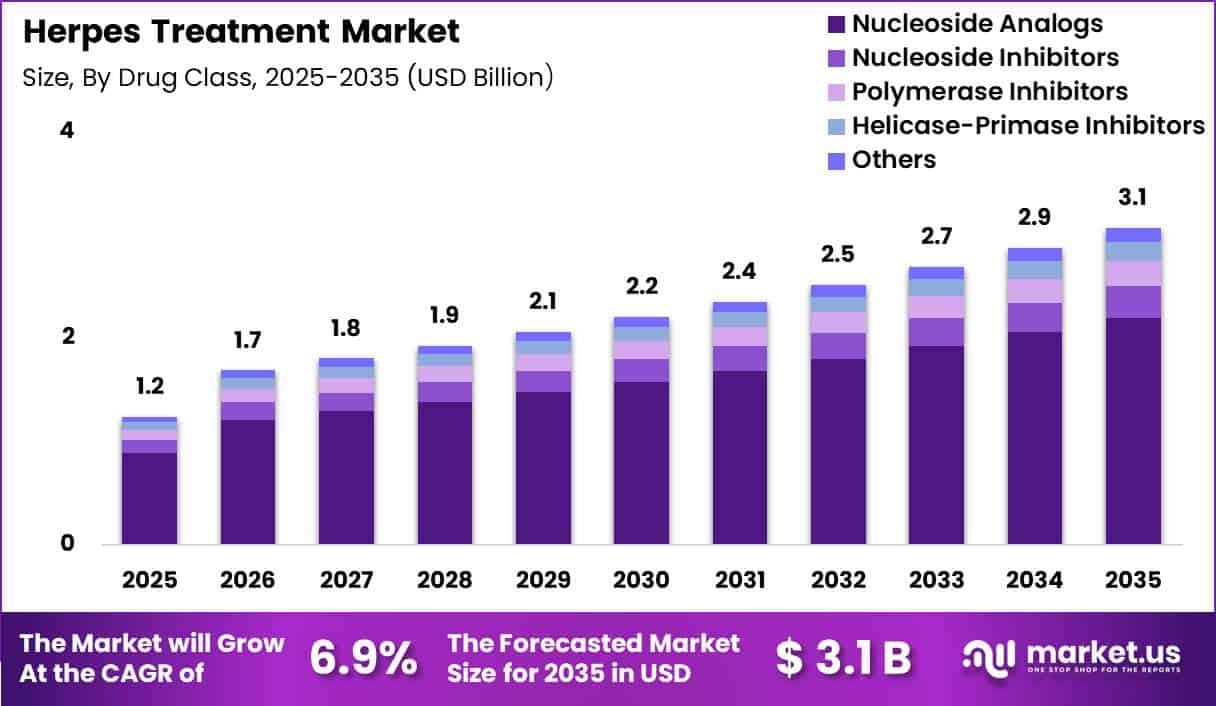
Global Herpes Treatment Market size is expected to be worth around US$ 3.1 Billion by 2035 from US$ 1.2 Billion in 2025, growing at a CAGR of 6.9% during the forecast period from 2026 to 2035. In 2025, North America led the market, achieving over 41.63% share with a revenue of US$ 0.52 Billion.
The herpes treatment market is shaped by the clinical burden of herpes simplex virus (HSV) infections and the continued reliance on antiviral therapies for long-term management. Herpes infections, primarily caused by Herpes Simplex Virus Type 1 and Herpes Simplex Virus Type 2, remain highly prevalent globally, creating sustained demand for therapeutic interventions.
According to the World Health Organization, an estimated 3.7 billion people under the age of 50 (approximately 67% of the global population) are infected with HSV-1, while about 491 million people aged 15–49 years (13%) are living with HSV-2 infection. These figures indicate a substantial patient pool requiring symptomatic management and recurrence prevention, thereby supporting consistent market demand.
From a treatment perspective, antiviral medications remain the standard of care. Drugs such as Acyclovir, Valacyclovir, and Famciclovir are widely prescribed. These agents function by inhibiting viral DNA replication, reducing lesion healing time, and decreasing viral shedding. Clinical guidance from the Centers for Disease Control and Prevention indicates that suppressive antiviral therapy can reduce recurrence frequency by 70%–80% in patients with frequent outbreaks, while also lowering transmission risk.
Healthcare infrastructure expansion and improved access to medications are key growth enablers. Distribution channels including hospital pharmacies, retail pharmacies, and digital platforms have enhanced treatment accessibility. The rise of online pharmacies and telemedicine services has further facilitated prescription continuity, particularly in urban and semi-urban populations.
Key Takeaways
- Market Size: Global Herpes Treatment Market size is expected to be worth around US$ 3.1 Billion by 2035 from US$ 1.2 Billion in 2025.
- Market Share: The market growing at a CAGR of 6.9% during the forecast period from 2026 to 2035.
- Drug Class Analysis: Nucleoside analogs account for approximately 71.6% of the total market share in 2025.
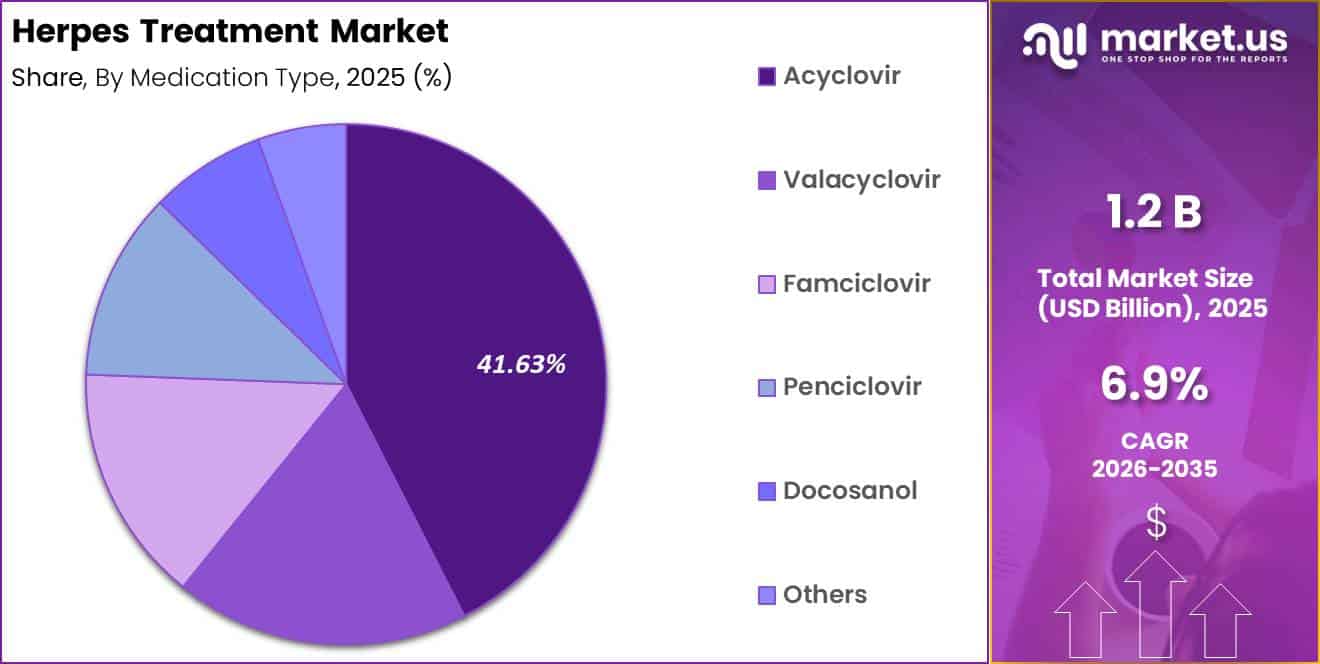
- Medication Type Analysis: Acyclovir is projected to dominate the herpes treatment market, capturing approximately 42.5% of the market share in 2025.
- Dosage Form Analysis: Tablets and capsules dominate the herpes treatment market, accounting for approximately 58.4% of the total market share in 2025.
- Distrubution Channel Analysis: The retail pharmacies hold the largest share of the herpes treatment market, accounting for approximately 45.6% in 2025.
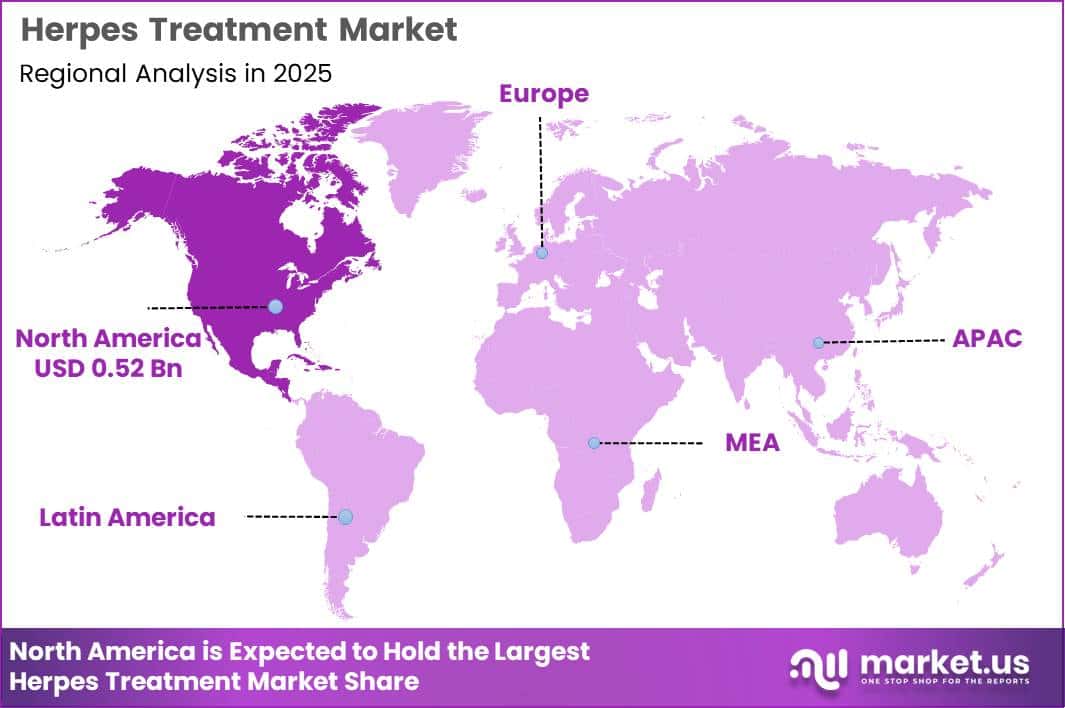
- Regional Analysis: In 2025, North America led the market, achieving over 41.63% share with a revenue of US$ 0.52 Billion.
Drug Class Analysis
The herpes treatment market, when segmented by drug class, is predominantly led by nucleoside analogs, which account for approximately 71.6% of the total market share in 2025. This dominance can be attributed to their established clinical efficacy, favorable safety profile, and widespread adoption as first-line antiviral therapies.
These agents function by inhibiting viral DNA synthesis, thereby limiting replication and reducing symptom severity. Strong physician preference and extensive generic availability have further reinforced their market penetration.
Nucleoside inhibitors represent an adjacent segment, contributing moderately to overall revenues due to their targeted antiviral mechanisms and expanding therapeutic applications.
Polymerase inhibitors are witnessing gradual adoption, particularly in resistant herpes strains, supported by ongoing research and development initiatives. Meanwhile, helicase-primase inhibitors are emerging as a promising class, driven by their novel mechanism of action and potential effectiveness against drug-resistant infections.
The “others” category includes experimental therapies and combination regimens, which are currently in limited use but expected to gain traction over the forecast period. Overall, innovation in antiviral drug classes is anticipated to support sustained market growth.
Medication Type Analysis
Based on medication type, acyclovir is projected to dominate the herpes treatment market, capturing approximately 42.5% of the market share in 2025. Its long-standing clinical use, cost-effectiveness, and broad-spectrum antiviral activity have positioned it as the preferred treatment option globally. High prescription rates and availability in multiple formulations further support its leading position.
Valacyclovir follows as a significant segment, benefiting from improved bioavailability and simplified dosing regimens compared to acyclovir. This has led to increased patient compliance and growing adoption in developed healthcare markets. Famciclovir also holds a notable share, particularly in cases requiring alternative therapies due to resistance or tolerance issues.
Penciclovir is primarily utilized in topical formulations, contributing to niche demand, especially for recurrent herpes labialis. Docosanol, an over-the-counter option, is gaining traction due to its accessibility and use in early-stage symptom management.
The “others” segment includes newer antivirals and combination therapies, which are gradually entering the market. Continuous product innovation and patient-centric treatment approaches are expected to diversify this segment further.
Dosage Form Analysis
In terms of dosage form, tablets and capsules dominate the herpes treatment market, accounting for approximately 58.4% of the total market share in 2025. This dominance is primarily driven by ease of administration, patient convenience, and widespread prescription for both acute and suppressive therapy. Oral formulations are preferred in outpatient settings and for long-term management, supporting consistent demand.
Creams and ointments represent a significant segment, particularly for topical treatment of herpes simplex infections. Their localized application and over-the-counter availability make them a popular choice for mild and recurrent cases. However, their effectiveness is often limited compared to systemic therapies, which restricts broader adoption.
Injectables and intravenous solutions are primarily utilized in severe or complicated herpes infections, including immunocompromised patients and hospitalized cases. Although these segments hold a smaller market share, their importance remains critical in acute care settings.
Advancements in drug delivery technologies and formulation improvements are expected to enhance the efficacy and convenience of various dosage forms, thereby supporting overall market expansion.
Distrubution Channel Analysis
The distribution channel segmentation indicates that retail pharmacies hold the largest share of the herpes treatment market, accounting for approximately 45.6% in 2025. This dominance is supported by high patient footfall, accessibility, and the availability of both prescription and over-the-counter antiviral medications. Retail pharmacies serve as the primary point of purchase for chronic and recurrent herpes treatments.
Hospital pharmacies constitute a significant segment, driven by demand for injectable and intravenous therapies administered in inpatient settings. Their role is particularly crucial in managing severe infections and immunocompromised patients, where specialized care is required.
Online pharmacies are experiencing rapid growth, supported by increasing digital adoption, convenience, and discreet purchasing options for patients. This channel is gaining prominence, particularly in urban and tech-enabled populations.
Clinics also contribute to the market, mainly through direct dispensing during consultations and outpatient treatments. The integration of digital health platforms and telemedicine services is expected to further enhance distribution efficiency across channels, supporting sustained market development.
Key Market Segments
By Drug Class
- Nucleoside Analogs
- Nucleoside Inhibitors
- Polymerase Inhibitors
- Helicase-Primase Inhibitors
- Others
By Medication Type
- Acyclovir
- Valacyclovir
- Famciclovir
- Penciclovir
- Docosanol
- Others
By Dosage Form
- Tablets and Capsules
- Creams and Ointments
- Injectables
- Intravenous Solutions
By Distribution Channel
- Hospital Pharmacies
- Retail Pharmacies
- Online Pharmacies
- Clinics
Driving Factors
High Global Disease Burden and Recurrence Rates
The growth of the herpes treatment market is primarily driven by the substantial global disease burden and recurrent nature of infections. According to the World Health Organization, approximately 3.8 billion people under age 50 (64%) are infected with HSV-1, while around 520 million individuals (13%) aged 15–49 live with HSV-2 infections globally. These figures indicate that herpes remains one of the most prevalent viral infections worldwide.
Furthermore, about 205 million individuals experienced symptomatic genital herpes episodes in 2020, reflecting continuous demand for therapeutic interventions. The recurrent nature of the disease, characterized by periodic outbreaks triggered by stress or illness, necessitates long-term antiviral therapy such as acyclovir and valacyclovir.
Additionally, HSV-2 infection has been associated with an increased risk of HIV acquisition, reinforcing the clinical importance of treatment. The combination of high prevalence, chronic infection lifecycle, and recurring symptoms is expected to sustain consistent demand for herpes therapeutics across global healthcare systems.
Trending Factors
Increasing Adoption of Suppressive Antiviral Therapy
A key trend observed in the herpes treatment market is the growing adoption of long-term suppressive antiviral therapy to manage recurrent outbreaks and reduce transmission risks. Clinical guidance from the World Health Organization indicates that daily low-dose antiviral regimens can significantly decrease recurrence frequency and transmission probability. This shift reflects a transition from episodic treatment toward preventive care models.
Additionally, healthcare authorities such as the Centers for Disease Control and Prevention highlight that herpes infections are lifelong and often asymptomatic, leading to underdiagnosis and increased emphasis on continuous management strategies. The increasing awareness of asymptomatic transmission is further driving routine antiviral usage.
Moreover, the integration of patient-centered care approaches, including improved adherence to oral antivirals and combination therapies for symptom relief, is strengthening treatment outcomes.
This trend is supported by rising public health initiatives focused on sexually transmitted infections (STIs), which emphasize early diagnosis and sustained treatment. Consequently, the market is witnessing a gradual shift toward preventive and maintenance therapies rather than solely outbreak-based interventions.
Restraining Factors
Lack of Curative Treatment and Asymptomatic Cases
A significant restraint in the herpes treatment market is the absence of a definitive cure, which limits the overall effectiveness of available therapies. According to the World Health Organization, herpes simplex virus infections are treatable but not curable, as the virus remains dormant in nerve cells and can reactivate periodically. This biological characteristic restricts treatment outcomes to symptom control rather than eradication.
Additionally, a large proportion of infections remain asymptomatic or unrecognized, reducing diagnosis rates and delaying treatment initiation. The Centers for Disease Control and Prevention also reports that many infected individuals are unaware of their condition due to mild or absent symptoms, contributing to underreporting and limited treatment uptake.
This creates a gap between actual disease prevalence and treated population. Furthermore, stigma associated with sexually transmitted infections can discourage individuals from seeking medical care. These factors collectively hinder market expansion by limiting patient penetration, despite the high underlying prevalence of the disease.
Opportunity
Vaccine Development and Public Health Initiatives
The herpes treatment market presents significant opportunities driven by ongoing research in vaccine development and expanding public health initiatives. The World Health Organization has emphasized the need for new preventive strategies, including vaccines and topical microbicides, to control herpes transmission.
With over 520 million people affected by HSV-2 globally, even partial vaccine efficacy could create substantial demand and reduce disease burden. Additionally, increasing investments in sexually transmitted infection (STI) control programs are improving awareness, diagnosis, and access to antiviral treatments. The linkage between HSV-2 infection and increased HIV risk further strengthens the case for integrated treatment and prevention programs.
Governments and healthcare agencies are focusing on early screening and education, particularly among high-risk populations, which is expected to expand the treated patient pool.
Moreover, advancements in antiviral drug formulations and delivery mechanisms, including long-acting therapies, are expected to enhance patient compliance. These developments collectively indicate a cautiously optimistic outlook for innovation-driven growth in the herpes treatment market.
Regional Analysis
North America dominated the global herpes treatment market in 2025, accounting for over 41.63% of the total market share and generating approximately US$ 0.52 billion in revenue. This leadership position can be attributed to the high prevalence of herpes simplex virus (HSV) infections, well-established healthcare infrastructure, and strong access to advanced antiviral therapies.
Additionally, increased awareness regarding sexually transmitted infections (STIs), supported by public health initiatives and screening programs, has contributed to early diagnosis and consistent treatment adoption across the region.
The presence of leading pharmaceutical companies and continuous investment in research and development have further strengthened market growth in North America. The availability of branded and generic antiviral medications, along with favorable reimbursement frameworks, has improved treatment accessibility. Moreover, digital health platforms and telemedicine services have enhanced patient engagement and adherence to long-term therapy.
In comparison, Europe represents a significant market, driven by robust healthcare systems and rising awareness, while the Asia-Pacific region is expected to witness the fastest growth due to increasing population, improving healthcare access, and expanding diagnostic capabilities.
Emerging markets in Latin America and the Middle East & Africa are gradually gaining traction, supported by improving healthcare infrastructure and growing focus on infectious disease management.
Key Regions and Countries
North America
- The US
- Canada
Europe
- Germany
- France
- The U.K.
- Italy
- Spain
- Russia & CIS
- Rest of Europe
Asia Pacific
- China
- India
- Japan
- South Korea
- ASEAN
- Australia & New Zealand
- Rest of Asia Pacific
Middle East & Africa
- GCC
- South Africa
- Rest of Middle East & Africa
Latin America
- Brazil
- Mexico
- Rest of Latin America
Key Players Analysis
The competitive landscape of the Herpes Treatment Market is characterized by the presence of established pharmaceutical companies with strong antiviral portfolios and ongoing research capabilities. Key players such as GlaxoSmithKline, Novartis AG, F. Hoffmann-La Roche Ltd, and Merck & Co., Inc. dominate the market through well-established brands and extensive global distribution networks.
The market has been largely driven by antiviral drugs such as acyclovir, valacyclovir, and famciclovir, with leading companies focusing on lifecycle management strategies and formulation improvements to maintain revenue streams. GlaxoSmithKline, for instance, has maintained a strong position with its branded antiviral therapies, supported by robust marketing and physician outreach programs.
Strategic initiatives such as mergers, acquisitions, and partnerships have been increasingly adopted to strengthen product pipelines and expand geographic reach. In addition, companies like AiCuris Anti-infective Cures AG are investing in novel antiviral agents targeting drug-resistant herpes strains, indicating a shift toward innovation-driven competition.
Furthermore, the entry of generic manufacturers has intensified price competition, particularly in emerging markets, thereby influencing overall market dynamics. Research efforts are increasingly focused on vaccine development and long-acting therapeutics, which are expected to reshape the competitive environment over the forecast period.
Market Key Players
- GlaxoSmithKline plc
- Novartis AG
- Pfizer Inc.
- Merck & Co., Inc.
- Johnson & Johnson
- Abbott Laboratories
- Bayer AG
- Teva Pharmaceutical Industries Ltd.
- Mylan N.V.
- Sandoz International GmbH
- Apotex Inc.
- Sun Pharmaceutical Industries Ltd.
- Cipla Inc.
- Aurobindo Pharma Limited
- Dr. Reddy’s Laboratories Ltd.
- Others
Recent Developments
- Novartis AG (March 2026): Investments were increased in virology and immunology research platforms, with a focus on next-generation antiviral therapies. This aligns with broader efforts to enhance presence in infectious disease segments, including HSV-related treatments.
- Pfizer Inc. (May 2026): The company actively participated in large-scale biotech acquisitions contributing to an industry deal value of over USD 84 billion in Q1 2026, aimed at strengthening antiviral and vaccine pipelines.
- Johnson & Johnson (February 2026): Continued expansion of infectious disease research programs was observed, with emphasis on antiviral drug innovation and immune-based therapies targeting chronic viral infections.
- Abbott Laboratories (August 2025): Diagnostic Expansion: New advancements were made in viral diagnostic solutions, improving early detection of herpes simplex virus, which supports treatment adoption and disease management efficiency.
Report Scope
| Report Features | Description |
|---|---|
| Market Value (2025) | US$ 1.2 Billion |
| Forecast Revenue (2035) | US$ 3.1 Billion |
| CAGR (2026-2035) | 6.9% |
| Base Year for Estimation | 2025 |
| Historic Period | 2020-2024 |
| Forecast Period | 2026-2035 |
| Report Coverage | Revenue Forecast, Market Dynamics, Competitive Landscape, Recent Developments |
| Segments Covered | By Drug Class (Nucleoside Analogs, Nucleoside Inhibitors, Polymerase Inhibitors, Helicase-Primase Inhibitors, Others) By Medication Type (Acyclovir, Valacyclovir, Famciclovir, Penciclovir, Docosanol, Others) By Dosage Form (Tablets and Capsules, Creams and Ointments, Injectables, Intravenous Solutions) By Distribution Channel (Hospital Pharmacies, Retail Pharmacies, Online Pharmacies, Clinics) |
| Regional Analysis | North America – The US, Canada; Europe – Germany, France, U.K., Italy, Spain, Russia & CIS, Rest of Europe; Asia Pacific – China, India, Japan, South Korea, ASEAN, Australia & New Zealand, Rest of Asia Pacific; Middle East & Africa – GCC, South Africa, Rest of Middle East & Africa; Latin America – Brazil, Mexico, Rest of Latin America |
| Competitive Landscape | GlaxoSmithKline plc, Novartis AG, Pfizer Inc., Merck & Co., Inc., Johnson & Johnson, Abbott Laboratories, Bayer AG, Teva Pharmaceutical Industries Ltd., Mylan N.V., Sandoz International GmbH, Apotex Inc., Sun Pharmaceutical Industries Ltd., Cipla Inc., Aurobindo Pharma Limited, Dr. Reddy’s Laboratories Ltd., Others, |
| Customization Scope | Customization for segments, region/country-level will be provided. Moreover, additional customization can be done based on the requirements. |
| Purchase Options | We have three licenses to opt for: Single User License, Multi-User License (Up to 5 Users), Corporate Use License (Unlimited User and Printable PDF) |





































