


Market Overview
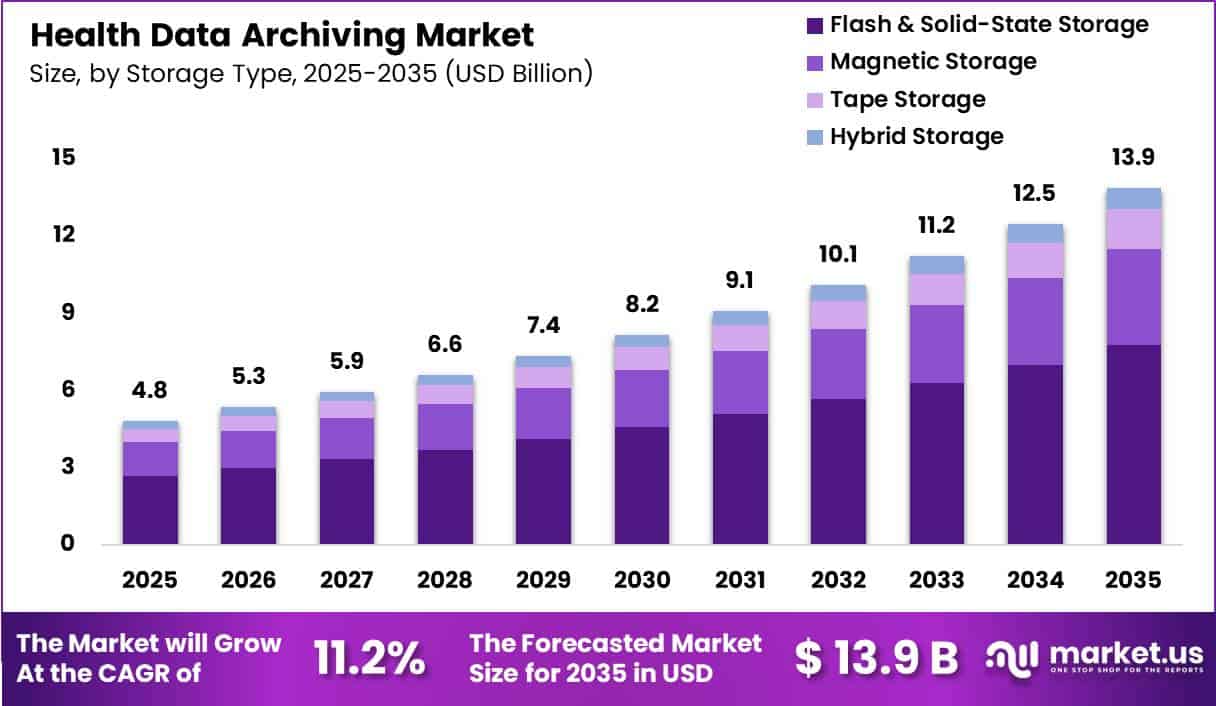
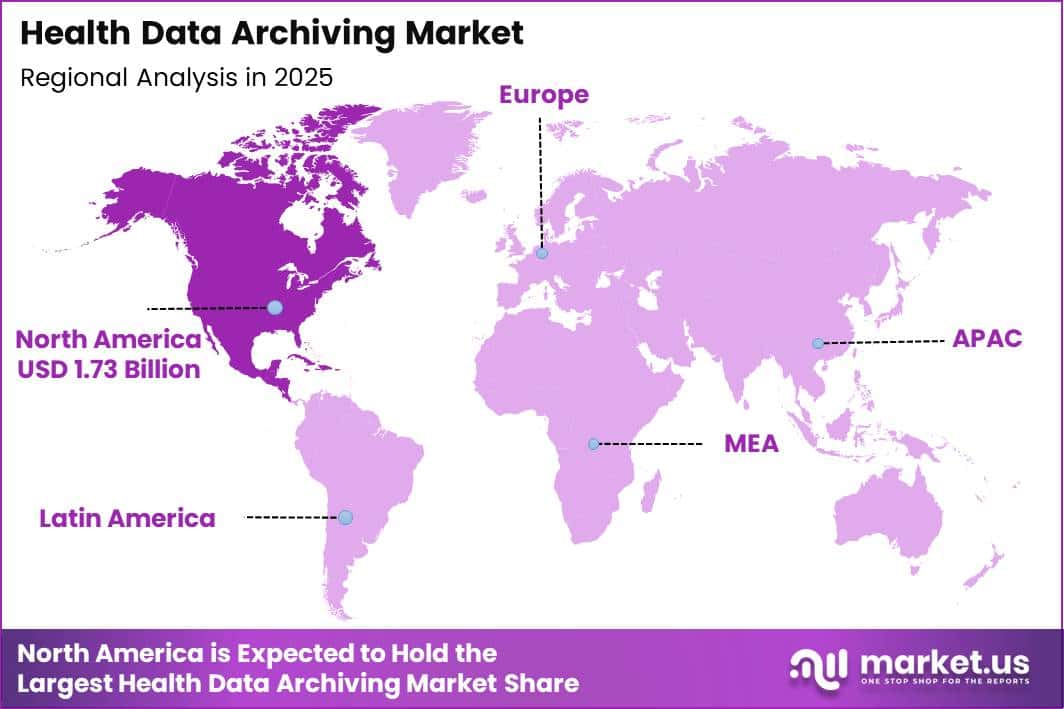
Global Health Data Archiving Market size is expected to be worth around US$ 13.89 Billion by 2035 from US$ 4.81 Billion in 2025, growing at a CAGR of 11.18% during the forecast period from 2026 to 2035. In 2025, North America led the market, achieving over 36.00% share with a revenue of US$ 1.73 Billion.
The Health Data Archiving Market is gaining momentum as healthcare organizations continue to digitize patient records and manage rapidly expanding volumes of clinical information. The widespread adoption of electronic health records (EHRs), medical imaging systems, laboratory information systems, and connected healthcare technologies has significantly increased the need for secure, scalable, and compliant data archiving solutions.
Governments and healthcare agencies are also strengthening interoperability initiatives to ensure patient information can be securely exchanged across healthcare networks while preserving long-term accessibility.
In the United States, the 2024 National Electronic Health Records Survey (NEHRS) reported that 95.0% of office-based physicians had adopted an electronic health record system, while 83.6% were using certified EHR technology. This widespread digital adoption is creating substantial volumes of healthcare data that require efficient storage, retrieval, and lifecycle management.
Healthcare providers are increasingly investing in cloud infrastructure, AI-enabled data management, and standardized interoperability frameworks such as FHIR (Fast Healthcare Interoperability Resources) and the United States Core Data for Interoperability (USCDI).
These standards improve secure data exchange between hospitals, laboratories, imaging centers, and public health agencies, making long-term health data archiving more efficient and reliable. Federal agencies including the CDC and the Assistant Secretary for Technology Policy (ASTP) continue to expand nationwide interoperability programs to modernize healthcare information systems.
The CDC’s Public Health Data Strategy is accelerating modernization of health information infrastructure through unified data platforms, improved analytics, and faster data integration across multiple public health sources. These initiatives strengthen data quality, cybersecurity, disaster recovery, and regulatory compliance, all of which are essential for sustainable health data archiving.
As healthcare systems generate increasingly complex datasets from genomics, imaging, remote monitoring, and AI-driven clinical applications, organizations are prioritizing scalable archiving platforms that support secure long-term retention, rapid retrieval, and improved patient care.
Key Takeaways
- Market Size : Health Data Archiving Market size is expected to be worth around US$ 13.89 Billion by 2035 from US$ 4.81 Billion in 2025.
- Market Share : The market is growing at a CAGR of 11.18% during the forecast period from 2026 to 2035.
- Storage Type Analysis : In 2025, Flash & Solid-State Storage dominated the Health Data Archiving Market, accounting for 56.0% of the total market share.
- Storage System Analysis : In 2025, Direct-Attached Storage (DAS) held the largest share of the Health Data Archiving Market, capturing 34.0% of the market.
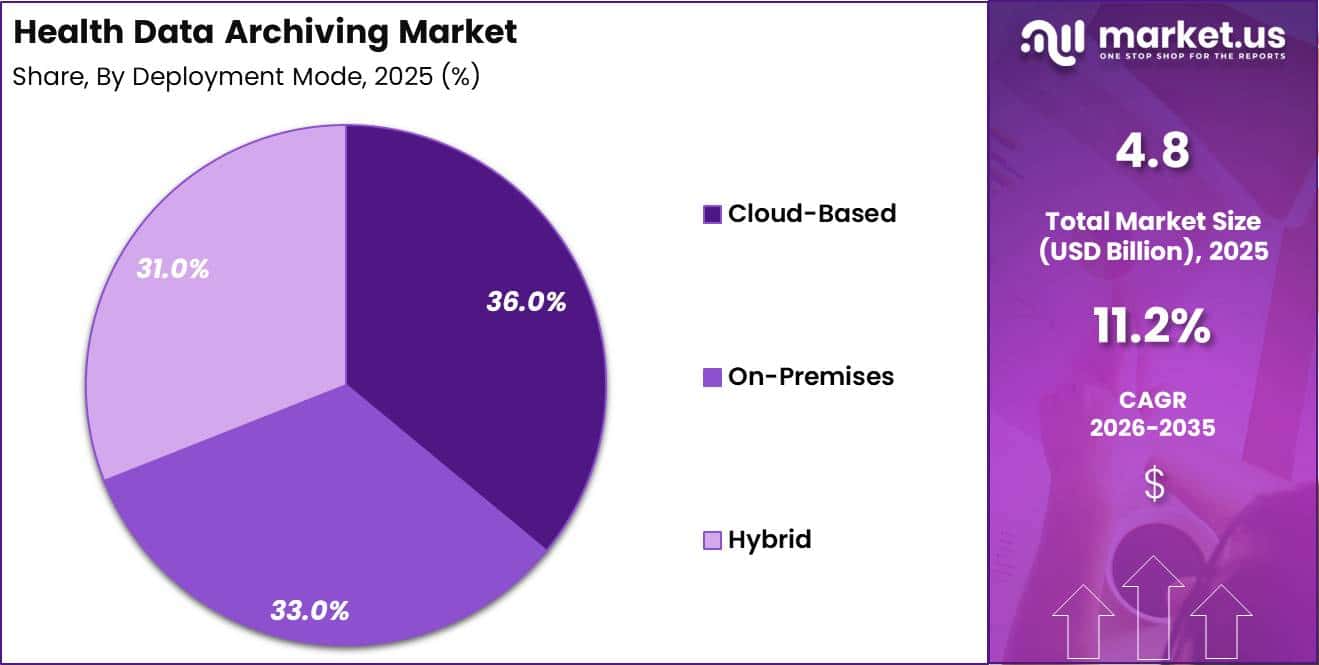
- Deployment Mode Analysis : In 2025, Cloud-Based deployment accounted for 36.0% of the Health Data Archiving Market, making it the leading deployment model.
- Architecture Analysis : In 2025, Object Storage led the Health Data Archiving Market with 38.0% of the total market share.
- Data Type Analysis : In 2025, Clinical Data (EHR/EMR & Physician Notes) accounted for 33.4% of the Health Data Archiving Market, making it the largest data type segment.
- End User Analysis : In 2025, Hospitals & Clinics dominated the Health Data Archiving Market, capturing 27.0% of the market share.
- Regional Analysis : In 2025, North America led the market, achieving over 36.00% share with a revenue of US$ 1.73 Billion.
Storage Type Analysis
In 2025, Flash & Solid-State Storage dominated the Health Data Archiving Market, accounting for 56.0% of the total market share. Its leadership is driven by the growing demand for high-speed access to electronic health records (EHRs), diagnostic images, genomic datasets, and other critical clinical information.
Flash-based storage delivers low latency, high reliability, and energy efficiency, making it well suited for hospitals and healthcare networks that require rapid retrieval of archived patient data. The increasing adoption of AI-assisted diagnostics and enterprise imaging platforms has further accelerated the deployment of flash storage in healthcare environments.
Magnetic Storage continues to be widely used for cost-effective long-term retention of patient records and administrative data, particularly in organizations handling large volumes of historical information. Tape Storage remains relevant for regulatory compliance, disaster recovery, and offline archival because of its low operating cost, long media lifespan, and protection against cyber threats such as ransomware.
Meanwhile, Hybrid Storage is gaining popularity as healthcare providers combine flash storage for active clinical data with magnetic or tape systems for long-term archives. This balanced approach improves performance while optimizing storage costs and supporting data lifecycle management across healthcare enterprises.
Healthcare imaging platforms and vendor-neutral archives increasingly support these multi-tier storage strategies to enhance scalability and long-term data preservation.
Storage System Analysis
In 2025, Direct-Attached Storage (DAS) held the largest share of the Health Data Archiving Market, capturing 34.0% of the market. DAS remains a preferred choice for hospitals and diagnostic centers because it offers fast data access, simplified deployment, and lower implementation costs for local storage environments.
It is commonly used in Picture Archiving and Communication Systems (PACS), where high-speed retrieval of medical images is essential for clinical workflows. Network-Attached Storage (NAS) is witnessing steady adoption due to its ability to centralize storage resources, support file sharing across multiple departments, and simplify data management in medium and large healthcare facilities.
NAS is particularly valuable for organizations managing increasing volumes of electronic medical records and collaborative clinical applications. Storage Area Network (SAN) also represents an important segment, especially among large hospitals and integrated healthcare systems that require high-performance, scalable, and highly available storage infrastructure.
SAN enables efficient management of large imaging repositories, enterprise databases, and mission-critical healthcare applications. As healthcare organizations continue to modernize their IT environments, many are integrating DAS, NAS, and SAN architectures to balance performance, scalability, and cost while ensuring secure long-term preservation of patient information.
Deployment Mode Analysis
In 2025, Cloud-Based deployment accounted for 36.0% of the Health Data Archiving Market, making it the leading deployment model. Healthcare providers are increasingly adopting cloud platforms because they offer flexible scalability, lower infrastructure costs, remote accessibility, and efficient disaster recovery.
Cloud archiving also supports automated data lifecycle management, encrypted storage, and regulatory compliance, enabling organizations to securely preserve growing volumes of clinical and imaging data. On-Premises deployment continues to maintain a significant presence among healthcare institutions that require complete control over sensitive patient information, particularly where strict regulatory or organizational policies limit cloud adoption.
These systems remain common in hospitals with established IT infrastructure and specialized data security requirements. Hybrid deployment is experiencing rapid growth as healthcare organizations combine on-premises systems with cloud services to achieve greater flexibility and resilience.
Hybrid environments allow frequently accessed clinical information to remain on local infrastructure while long-term archives are securely transferred to cloud storage. This strategy improves operational efficiency, reduces storage costs, and enhances business continuity.
Many healthcare organizations are adopting hybrid architectures to support digital transformation while maintaining compliance with data protection and patient privacy requirements.
Architecture Analysis
In 2025, Object Storage led the Health Data Archiving Market with 38.0% of the total market share. The segment’s dominance is attributed to its exceptional scalability, metadata-driven organization, and ability to manage vast quantities of unstructured healthcare data, including medical images, pathology files, videos, and genomics datasets.
Object storage enables healthcare providers to efficiently archive and retrieve information while supporting vendor-neutral archive (VNA) platforms and cloud-native environments. File Storage remains widely adopted because it offers familiar folder-based access, making it suitable for routine document management, electronic health records, and departmental data sharing.
It continues to serve hospitals that require straightforward storage for everyday clinical workflows. Block Storage also plays an important role by providing high-performance storage for transactional applications, hospital information systems, and databases requiring fast input/output operations.
As healthcare data volumes continue to grow, organizations increasingly combine object, file, and block storage architectures to optimize performance, scalability, and cost efficiency.
This integrated approach supports enterprise imaging, regulatory compliance, and long-term preservation of diverse healthcare data assets while improving interoperability across digital health platforms.
Data Type Analysis
In 2025, Clinical Data (EHR/EMR & Physician Notes) accounted for 33.4% of the Health Data Archiving Market, making it the largest data type segment. The widespread use of electronic health records, physician documentation, discharge summaries, and patient histories has significantly increased the need for secure long-term storage and rapid retrieval.
Regulatory requirements and continuity of patient care continue to drive investment in archiving these critical clinical records. Medical Imaging Data represents another major segment due to the increasing volume of radiology, cardiology, pathology, and diagnostic imaging files generated by modern healthcare facilities.
Laboratory Data continues to expand with growing demand for digital pathology, diagnostic testing, and integrated laboratory information systems. Financial & Administrative Data also contributes substantially, as healthcare organizations archive billing records, insurance claims, and operational documents to support compliance and audits.
Genomic & Research Data is emerging as a fast-growing segment because precision medicine, genomics research, and AI-based healthcare analytics generate extremely large datasets that require scalable, secure, and long-term storage solutions. Together, these diverse data types are driving continuous innovation in healthcare data archiving platforms.
End User Analysis
In 2025, Hospitals & Clinics dominated the Health Data Archiving Market, capturing 27.0% of the market share. The segment leads due to the continuous generation of electronic health records, diagnostic images, laboratory reports, physician documentation, and administrative information.
Hospitals increasingly invest in enterprise archiving platforms to improve interoperability, regulatory compliance, cybersecurity, and long-term patient record management. Diagnostic Imaging Centers represent a significant segment because they generate high volumes of radiology images that require secure storage and efficient retrieval through vendor-neutral archive (VNA) systems.
Academic & Research Institutes are expanding their use of archiving solutions to preserve research datasets, clinical trial information, and genomic data for long-term analysis. Pharmaceutical & Biotechnology Companies rely on advanced data archiving to manage clinical research, drug development records, and regulatory documentation while maintaining data integrity.
Healthcare Payers also contribute to market growth by archiving claims data, policy information, and member records for compliance and operational efficiency. Other end users, including public health organizations and specialty care providers, continue adopting scalable archiving platforms as digital healthcare transformation accelerates worldwide.
Market Segmentations
By Storage Type
- Flash & Solid-State Storage
- Magnetic Storage
- Tape Storage
- Hybrid Storage
By Storage System
- Direct-Attached Storage (DAS)
- Network-Attached Storage (NAS)
- Storage Area Network (SAN)
By Deployment Mode
- Cloud-Based
- On-Premises
- Hybrid
By Architecture
- Object Storage
- File Storage
- Block Storage
By Data Type
- Clinical Data (EHR/EMR & Physician Notes)
- Medical Imaging Data
- Laboratory Data
- Financial & Administrative Data
- Genomic & Research Data
By End User
- Hospitals & Clinics
- Diagnostic Imaging Centers
- Academic & Research Institutes
- Pharmaceutical & Biotechnology Companies
- Healthcare Payers
- Others
Driver
Cybersecurity Hardening and Immutable Archive Demand
Cybersecurity has become a direct driver of healthcare archive growth because health systems increasingly require storage systems that are not only compliant, but also resilient to ransomware, credential theft, and downstream disruption of clinical operations.
In response, HHS cybersecurity performance goals 2024 formalized expectations around essential and enhanced controls, including multifactor authentication, encryption, asset inventories, centralized logging, segmentation, and continuous security testing.
Policy momentum is reinforcing investment decisions. A White House backed HHS budget framework outlines approximately 800 million dollars for essential cybersecurity support FY2027 to FY2028 and an additional 500 million dollars for enhanced practices FY2029 to FY2030, alongside potential CMS linked penalties for non compliance.
This effectively embeds cybersecurity readiness into reimbursement linked infrastructure planning. The economic impact is significant.
IBM reports healthcare as the highest cost breach sector at approximately 10.93 million dollars per incident, with an average 213 day detection time, while HHS OCR continues to record large scale reportable breaches affecting 500 plus individuals. These exposures make long term data protection a board level risk priority.
As a result, archive systems are being redesigned around immutable storage, WORM style retention, isolated recovery tiers, encrypted data lifecycles, and tamper proof audit logs. This shifts archives from passive storage into active resilience infrastructure supporting rapid recovery of longitudinal clinical records.
Overall, rising cyber risk is increasing adoption of premium archival and cyber resilient storage layers, strengthening vendor attach rates and moving archival systems from IT cost centers to risk mitigation assets embedded in core healthcare operations.
| Driver | (~) % Impact on CAGR Forecast | Geographic Relevance | Impact Timeline |
|---|---|---|---|
| Retention-rule complexity and longer storage duty | +2.1% | North America core, EU compliance-heavy, APAC tertiary uplift | Medium term (2-4 years) |
| Cybersecurity hardening and immutable archive demand | +1.9% | North America core, EU, developed APAC | Short term (≤ 2 years) |
| API-led interoperability and legacy data normalization | +1.7% | U.S. core, EU, APAC digital-health corridors | Medium term (2-4 years) |
| Imaging and high-volume clinical data expansion | +1.5% | North America, EU, Japan, South Korea, GCC hubs | Medium term (2-4 years) |
| Value-based care and secondary-use readiness | +1.3% | U.S. core, Western Europe, selective APAC | Medium term (2-4 years) |
| Cloud migration with lifecycle-cost compression | +1.1% | North America, Northern Europe, ANZ, mature APAC | Short term (≤ 2 years) |
Challenge
Legacy EHR HIS Decommissioning in Healthcare Archive Modernization
Legacy system decommissioning is a key driver of healthcare archive demand because large hospital networks often run 10 to 20 clinical systems at once, some holding 15 plus years of patient data across millions of encounters.
Migrating this information into compliant archives requires preserving auditability, medico legal chain of custody, and full clinical context without data loss. Typical decommissioning projects involve extracting 10 to 30 TB of structured data, along with comparable volumes of imaging and unstructured records.
Each system undergoes extensive ETL validation that can take 6 to 9 months per platform, as teams verify timestamps, encounter continuity, user identity mapping, and clinical code integrity against archival schemas.
Regulatory retention requirements further extend timelines. Frameworks such as DISHA linked rules in India, US state retention laws, and European data governance standards require long term accessibility of medical records. As a result, legacy systems often remain in read only mode for 3 to 5 additional years, adding 300,000 to 1 million dollars annually in maintenance costs for large hospitals.
Operationally, dual system access increases workload by 5 to 10 %, while migration programs face 20 to 40 % delays due to validation and workflow disruption. These constraints collectively reduce consolidation speed and contribute an estimated 1.0 % point drag on CAGR for archive platforms, while strengthening long term demand for automated ETL, standardized migration tools, and high integrity archival infrastructure.
| Challenge | (~) % CAGR Friction Drag | Geographic Relevance | Mitigation Horizon |
|---|---|---|---|
| Fragmented retention mandates | -1.2% | US, EU, India, OECD health systems | Long term (≥ 4 years) |
| Legacy system decommissioning | -1.0% | North America core, EU public hospitals | Medium term (2-4 years) |
| Interoperability & format heterogeneity | -1.1% | Global EHR/EHIS deployments | Long term (≥ 4 years) |
| Cybersecurity & zero-trust hardening | -0.9% | US, EU, APAC urban hubs | Medium term (2-4 years) |
| Data governance & consent complexity | -0.8% | US, EU, OECD research networks | Long term (≥ 4 years) |
| Skilled health-IT archivist gap | -0.7% | Global tertiary care clusters | Medium term (2-4 years) |
Restraints
Escalating Cybersecurity and Zero Trust Compliance Costs
Escalating cybersecurity and zero trust requirements are increasingly constraining health data archiving economics as regulators tighten expectations around protection of electronic protected health information ePHI.
Under frameworks such as the HIPAA Security Rule, archives must now embed encryption, strict identity and access management, and continuous monitoring as default design requirements rather than optional enhancements. Compliance pressure is further intensifying with NIH and related research bodies requiring NIST 800-171 level controls from 2025 onward for controlled access genomic and sensitive datasets.
This forces institutions to upgrade infrastructure, deploy advanced logging and anomaly detection, and implement mandatory security training, adding roughly 10 to 15 % to initial archive deployment costs in research heavy environments and increasing per user compliance overhead by several hundred dollars annually.
At the infrastructure level, zero trust architecture covering multifactor authentication, micro-segmentation, endpoint detection and response, and continuous verification is becoming baseline.
For regional hospital networks, this often translates into multi year transformation programs with capital expenditures in the low to mid single digit millions and ongoing security operating costs of 5 to 8 % of total IT budgets. These rising costs materially affect adoption behavior.
Health systems frequently delay archive modernization, extend refresh cycles by up to two years, and negotiate more aggressively on vendor pricing and contract structure.
As a result, despite strong underlying demand for secure and compliant archiving, these constraints are estimated to reduce effective market CAGR by approximately 2.0 % points, primarily through slowed procurement cycles and phased deployment strategies rather than reduced long term need.
| Restraint | (~) % Impact on CAGR Forecast | Geographic Relevance | Impact Timeline |
|---|---|---|---|
| Fragmented retention and governance mandates | -2.3% | North America core, EU, selected APAC | Long term (≥ 4 years) |
| Escalating cybersecurity and zero-trust compliance costs | -2.0% | North America core, EU, APAC corridors | Medium term (2-4 years) |
| Interoperability gaps and legacy system complexity | -1.8% | North America core, EU, LATAM urban | Long term (≥ 4 years) |
| High-assurance cloud and controlled-access data requirements | -1.5% | North America core, EU research hubs | Medium term (2-4 years) |
| Regulatory uncertainty around AI and secondary data use | -1.4% | EU, North America core, APAC advanced | Long term (≥ 4 years) |
| Capital intensity of large-scale secure archives | -1.2% | North America core, EU, GCC hubs | Medium term (2-4 years) |
Opportunity
Patient Controlled Lifetime Health Vaults in Health Data Archiving Ecosystems
Patient controlled lifetime health vaults represent a longer term opportunity beyond traditional institutional archiving. Current systems are primarily provider or payer centric, governed under HIPAA Privacy and Security Rules, and typically rely on portals or episodic record releases rather than continuous, longitudinal personal data ownership.
As digital health adoption expands, a shift is emerging toward persistent, patient owned repositories that aggregate clinical records, claims data, device outputs, and wellness information across multiple providers over a lifetime. These vaults also introduce fine grained consent management, enabling patients to control how and when data is shared with clinicians, insurers, or research entities.
By 2035, digital health platforms are expected to serve hundreds of millions of users globally. Even modest adoption, around 10 to 15 % of digitally active adults in high income markets, subscribing at USD 2 to 4 per month implies a potential USD 12 to 20 billion TAM for vault centric services alone.
The economic benefits extend beyond subscription revenue. Patient vaults could reduce duplicate testing and administrative retrieval costs by 30 to 50 %, improve care continuity and adherence metrics by 5 to 10 %, and enable consented data monetization for clinical trials at USD 5 to 10 per access event.
With marginal storage costs potentially below USD 0.30 per user per month, these platforms can sustain 35 to 45 % operating margins at scale. Overall, this model supports an estimated 2.1 % point CAGR uplift, driven by a shift from compliance driven archival infrastructure to consumer centric, longitudinal health data ecosystems that unify fragmented medical histories into a single patient controlled layer.
| Opportunity | (~) % Potential CAGR Upside | Geographic Relevance | Execution Window |
|---|---|---|---|
| AI-native longitudinal archives for multi-modal data | +2.4% | North America core, EU, APAC advanced | Medium term (2-4 years) |
| Cross-entity compliance aggregation & audit-as-a-service | +1.9% | North America, EU, GCC, ASEAN | Short term (≤ 2 years) |
| Patient-controlled lifetime health vaults | +2.1% | North America, EU, APAC urban | Long term (≥ 4 years) |
| Decommissioning-as-a-service for legacy clinical IT | +1.6% | North America, EU, Japan | Short term (≤ 2 years) |
| Privacy-preserving research data marts & federated archives | +2.3% | North America, EU, APAC research hubs | Medium term (2-4 years) |
| National and payer-level longitudinal claims archives | +1.7% | North America, EU, LATAM, APAC | Medium term (2-4 years) |
Regional Analysis
In 2025, North America dominated the Health Data Archiving Market, accounting for over 36.0% of global revenue, reaching approximately US$ 1.73 billion. The region’s leadership is supported by a highly developed healthcare IT ecosystem, widespread adoption of electronic health records (EHRs), cloud-based health information management, and stringent regulatory requirements for data privacy and interoperability.
The United States remains the primary contributor due to continuous investments in digital health infrastructure and nationwide initiatives promoting standardized health information exchange. The adoption of FHIR standards and the United States Core Data for Interoperability (USCDI) has strengthened secure sharing and long-term preservation of clinical data across hospitals, laboratories, and imaging centers, increasing demand for scalable health data archiving solutions.
Europe holds the second-largest share, supported by strong digital health policies and the implementation of the European Health Data Space (EHDS). According to the WHO Regional Office for Europe, 35 countries have established national EHR systems, while 45 of 52 responding Member States have implemented national EHRs, interconnected EHRs, or patient portals, creating a favorable environment for secure health data archiving and cross-border data exchange.
Asia-Pacific is expected to witness the fastest growth due to rapid healthcare digitalization, expanding hospital infrastructure, and government investments in electronic health records across China, India, Japan, Australia, and South Korea.
Meanwhile, Latin America and the Middle East & Africa are gradually expanding their digital health capabilities through healthcare IT modernization and improved interoperability frameworks, creating long-term opportunities for health data archiving providers.
Key Regions and Countries
North America
- The US
- Canada
Europe
- Germany
- France
- The U.K.
- Italy
- Spain
- Russia & CIS
- Rest of Europe
Asia Pacific
- China
- India
- Japan
- South Korea
- ASEAN
- Australia & New Zealand
- Rest of Asia Pacific
Middle East & Africa
- GCC
- South Africa
- Rest of Middle East & Africa
Latin America
- Brazil
- Mexico
- Rest of Latin America
Key Player Analysis
The Health Data Archiving Market is highly competitive, with leading technology companies focusing on secure storage, interoperability, cloud integration, and lifecycle management of healthcare information.
IBM Corporation remains a key player through its InfoSphere Optim Archive solution, which helps healthcare organizations archive historical data, meet regulatory retention requirements, and reduce storage costs while maintaining long-term access to clinical information.
Dell Technologies Inc. provides healthcare-focused storage platforms such as PowerMax, PowerStore, and PowerScale, supporting electronic health records (EHRs), medical imaging, and genomics data while enabling hospitals to modernize data infrastructure. NetApp, Inc. strengthens its position with intelligent hybrid cloud data management and AI-ready storage, helping healthcare providers securely manage and retrieve growing volumes of patient data.
Other major participants continue to expand their healthcare data capabilities through innovation and enterprise partnerships. Hitachi Vantara Corporation delivers resilient data infrastructure and hybrid cloud solutions that improve healthcare data availability and business continuity.
Hewlett Packard Enterprise (HPE) offers enterprise storage, backup, and cyber-resilience solutions that support secure long-term healthcare data retention. Hyland Software Inc. strengthens the market with its Acuo Vendor Neutral Archive (VNA), enabling healthcare providers to consolidate, manage, and share medical imaging data across multiple systems.
Philips Healthcare (including Carestream imaging legacy solutions in many healthcare environments) continues to support enterprise imaging and digital health workflows, helping healthcare organizations efficiently store, access, and exchange diagnostic imaging data.
Top Key Players
- IBM Corporation
- Dell Technologies Inc.
- NetApp, Inc.
- Hitachi Vantara Corporation
- Hewlett Packard Enterprise (HPE)
- Hyland Software Inc.
- Philips Healthcare (Carestream)
- Fujifilm Holdings Corporation
- Agfa HealthCare N.V.
- Pure Storage Inc.
- Quantum Corporation
- Iron Mountain Inc.
Recent Developments
- In June 2025, Hewlett Packard Enterprise (HPE) introduced new AI infrastructure at HPE Discover 2025, including HPE Alletra Storage MP X10000 with Model Context Protocol (MCP) support and expanded AI-ready storage capabilities to improve long-term enterprise data management, hybrid cloud storage, and large-scale healthcare data archiving.
- In May 2025, Koninklijke Philips N.V. (Philips Healthcare) released its Future Health Index 2025, highlighting the increasing role of AI and digital health infrastructure in managing rising healthcare data volumes. The findings reinforce the need for scalable enterprise imaging, secure clinical data storage, and long-term archiving across global healthcare systems.
- In March 2025, IBM Corporation announced a collaboration with NVIDIA to integrate the NVIDIA AI Data Platform into IBM Fusion and IBM Storage Scale, introducing content-aware storage for managing and retrieving large volumes of unstructured enterprise data, including healthcare information, to accelerate AI-enabled data archiving and governance.
| Report Features | Description |
|---|---|
| Market Value (2025) | US$ 4.81 Billion |
| Forecast Revenue (2035) | US$ 13.89 Billion |
| CAGR (2026-2035) | 11.18% |
| Base Year for Estimation | 2025 |
| Historic Period | 2020-2024 |
| Forecast Period | 2026-2035 |
| Report Coverage | Revenue Forecast, Market Dynamics, Competitive Landscape, Recent Developments |
| Segments Covered | By Storage Type (Flash & Solid-State Storage, Magnetic Storage, Tape Storage, Hybrid Storage), By Storage System (Direct-Attached Storage (DAS), Network-Attached Storage (NAS), Storage Area Network (SAN)), By Deployment Mode (Cloud-Based, On-Premises, Hybrid), By Architecture (Object Storage, File Storage, Block Storage), By Data Type (Clinical Data (EHR/EMR & Physician Notes), Medical Imaging Data, Laboratory Data, Financial & Administrative Data, Genomic & Research Data), By End User (Hospitals & Clinics, Diagnostic Imaging Centers, Academic & Research Institutes, Pharmaceutical & Biotechnology Companies, Healthcare Payers, Others) |
| Regional Analysis | North America – The US, Canada; Europe – Germany, France, U.K., Italy, Spain, Russia & CIS, Rest of Europe; Asia Pacific – China, India, Japan, South Korea, ASEAN, Australia & New Zealand, Rest of Asia Pacific; Middle East & Africa – GCC, South Africa, Rest of Middle East & Africa; Latin America – Brazil, Mexico, Rest of Latin America |
| Competitive Landscape | IBM Corporation, Dell Technologies Inc., NetApp Inc., Hitachi Vantara Corporation, Hewlett Packard Enterprise (HPE), Hyland Software Inc., Philips Healthcare (Carestream), Fujifilm Holdings Corporation, Agfa HealthCare N.V., Pure Storage Inc., Quantum Corporation, Iron Mountain Inc. |
| Customization Scope | Customization for segments, region/country-level will be provided. Moreover, additional customization can be done based on the requirements. |
| Purchase Options | We have three licenses to opt for: Single User License, Multi-User License (Up to 5 Users), Corporate Use License (Unlimited User and Printable PDF) |





































