


Global Tire Vulcanizer Market Size, Share, Growth Analysis Tire Type (Radial, Bias, Run-flat), Vulcanization Method (Hot Vulcanization, Cold Vulcanization), Power Source (Electric, Hydraulic, Pneumatic), Application (Passenger Cars, Commercial Vehicles, Off-Highway Vehicles), Region and Companies - Industry Segment Outlook, Market Assessment, Competition Scenario, Statistics, Trends and Forecast 2026-2035
- Published date: Mar 2026
- Report ID: 181058
- Number of Pages: 326
- Format:
-
keyboard_arrow_up
Quick Navigation
Report Overview
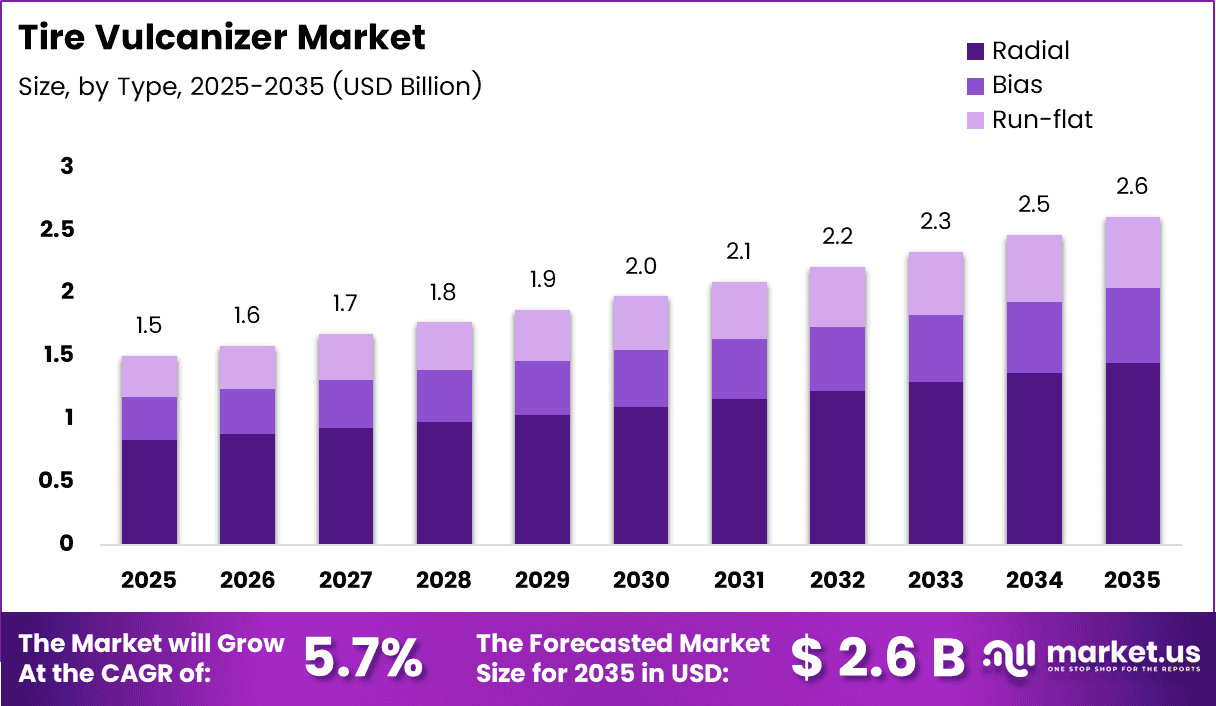
Global Tire Vulcanizer Market size is expected to be worth around USD 2.6 Billion by 2035 from USD 1.5 Billion in 2025, growing at a CAGR of 5.7% during the forecast period 2026 to 2035.
The tire vulcanizer market covers industrial machinery used to cure and bond rubber compounds into finished tires. Vulcanization applies heat and pressure to transform raw rubber into durable, road-ready products. This process is essential across passenger, commercial, and off-highway vehicle tire manufacturing globally.
The market plays a critical role in automotive supply chains. Growing vehicle production, rising tire replacement demand, and expanding transportation infrastructure are driving steady adoption. Moreover, the shift toward high-performance radial tires is increasing demand for precision vulcanization equipment worldwide.
Government investments in road infrastructure and vehicle manufacturing hubs are creating favorable conditions. Many countries are developing domestic tire production capabilities, particularly across Southeast Asia and South Asia. Consequently, manufacturers are investing in automated and energy-efficient vulcanization systems to meet rising production targets.
Regulatory frameworks focused on tire quality standards and vehicle safety compliance are pushing manufacturers toward modern curing technologies. Additionally, environmental regulations are driving demand for electric and energy-saving vulcanization systems. These policy developments are shaping procurement and technology upgrade decisions across major tire-producing regions.
According to industry estimates, Asia Pacific accounts for the largest share of global tire production and is the dominant region for vulcanizer demand. The region benefits from low manufacturing costs, government-backed industrial zones, and rising automotive sales. Therefore, capital investment in tire manufacturing plants continues to grow at a rapid pace.
The market also reflects strong momentum from the repair and retreading sector. As a general rule, a tire is repairable if the hole measures less than 0.25 inches across and within the surface patch or puncture repair area. The damage must be at least 16 inches away from other punctures, supporting steady demand for smaller vulcanizers used in tire service centers.
Additionally, the rise of smart manufacturing and Industry 4.0 integration is transforming equipment capabilities. Manufacturers are embedding digital controls, remote monitoring, and automated curing cycles into vulcanizer designs. This trend is expanding the market beyond traditional OEM buyers to include technology-forward tire retreading and repair service operators globally.
Key Takeaways
- The global Tire Vulcanizer Market was valued at USD 1.5 Billion in 2025 and is projected to reach USD 2.6 Billion by 2035.
- The market is growing at a CAGR of 5.7% during the forecast period 2026 to 2035.
- By Tire Type, Radial tires dominated the segment with a market share of 55.4% in 2025.
- By Vulcanization Method, Hot Vulcanization led the segment with a share of 70.8% in 2025.
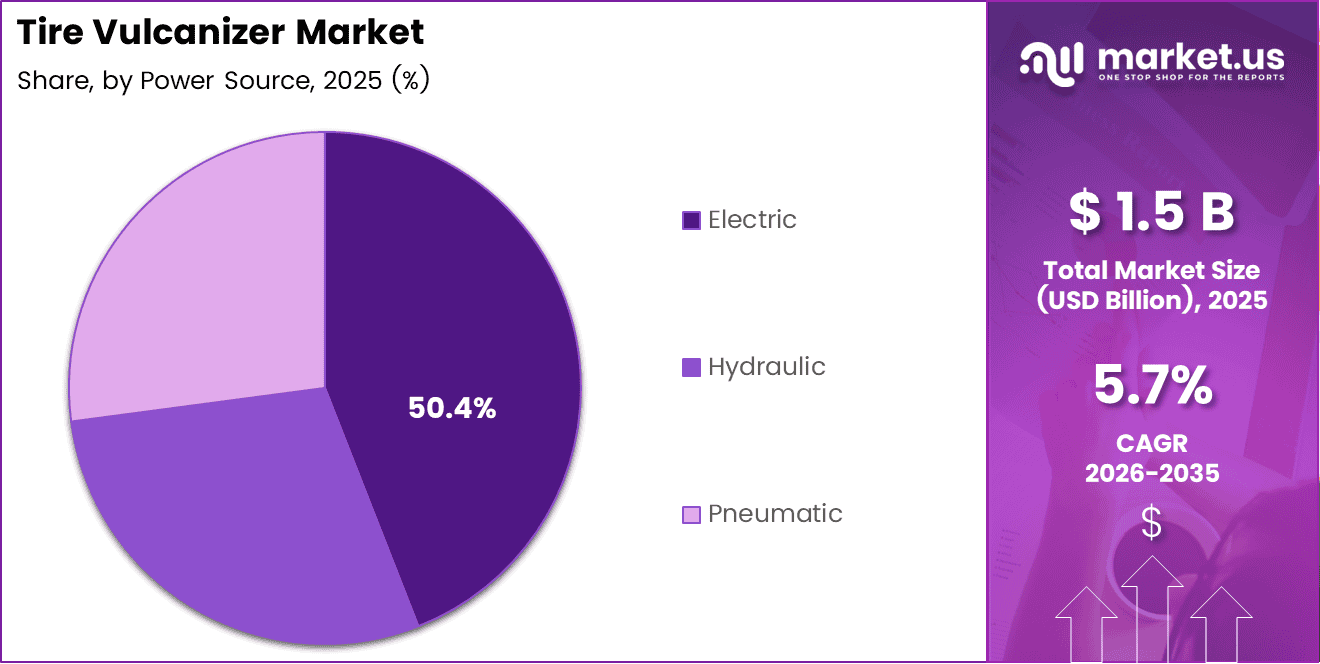
- By Power Source, Electric power source held the largest share at 50.4% in 2025.
- By Application, Passenger Cars accounted for the highest share at 45.6% in 2025.
- Asia Pacific dominated the regional landscape with a market share of 40.1%, valued at USD 0.60 Billion in 2025.
Tire Type Analysis
Radial dominates with 55.4% due to widespread adoption in passenger and commercial vehicle segments.
In 2025, Radial held a dominant market position in the Tire Type segment of the Tire Vulcanizer Market, with a 55.4% share. Radial tires require precise high-temperature curing equipment, driving consistent demand for advanced vulcanizers. Moreover, their superior fuel efficiency and longer tread life have made them the preferred choice for original equipment manufacturers globally.
Bias tires continue to maintain a stable presence in agricultural, construction, and certain off-highway applications. These tires use simpler vulcanization processes and lower tooling costs. However, their share is gradually declining as radial technology expands into commercial and utility vehicle categories, creating a slow but steady demand shift within the segment.
Run-flat tires represent a growing niche supported by premium vehicle adoption and safety regulations in developed markets. These tires require specialized vulcanization to ensure structural integrity under zero-pressure conditions. Consequently, run-flat tire production is stimulating demand for high-precision curing presses and advanced mold technologies among equipment suppliers.
Vulcanization Method Analysis
Hot Vulcanization dominates with 70.8% due to its proven performance across all major tire production types.
In 2025, Hot Vulcanization held a dominant market position in the Vulcanization Method segment of the Tire Vulcanizer Market, with a 70.8% share. Hot vulcanization uses high-pressure steam or electric heat to cure rubber compounds into finished tires. This method offers superior bonding strength, dimensional accuracy, and process reliability, making it the standard approach in large-scale tire manufacturing plants worldwide.
Cold Vulcanization is widely used in tire repair and retreading applications where portability and low energy consumption are priorities. This method uses chemical bonding agents at ambient temperatures and does not require heavy industrial equipment. Therefore, it serves a distinct market segment including small workshops, fleet operators, and field repair services across both developed and emerging economies.
Power Source Analysis
Electric dominates with 50.4% due to growing focus on energy efficiency and automation in tire manufacturing.
In 2025, Electric held a dominant market position in the Power Source segment of the Tire Vulcanizer Market, with a 50.4% share. Electric vulcanizers offer precise temperature control, lower operational costs, and compatibility with digital automation systems. Moreover, tightening energy efficiency regulations across manufacturing zones in Asia and Europe are accelerating the replacement of older hydraulic systems with electric alternatives.
Hydraulic vulcanizers remain relevant in heavy-duty commercial and off-highway tire production where high clamping forces are required. These systems provide robust pressure delivery and are well-suited for large mold formats. However, their higher energy consumption and maintenance requirements are gradually limiting new installations in favor of electric systems in modern production environments.
Pneumatic power source vulcanizers are typically used in portable or field repair applications. They offer flexibility and ease of operation in settings without dedicated electrical infrastructure. Consequently, pneumatic units continue to serve tire service stations, mining operations, and construction sites where mobility and quick setup are more important than energy optimization.
Application Analysis
Passenger Cars dominates with 45.6% due to high global vehicle production volumes and consistent tire replacement cycles.
In 2025, Passenger Cars held a dominant market position in the Application segment of the Tire Vulcanizer Market, with a 45.6% share. The passenger car segment benefits from the world’s largest vehicle fleet, driving steady demand for new tire production and repair. Additionally, consumer preferences for high-performance and fuel-efficient tires are pushing manufacturers to invest in modern curing technology.
Commercial Vehicles represent a significant share supported by growing freight transportation, logistics expansion, and construction activity globally. Commercial tires require heavy-duty vulcanization equipment due to their larger dimensions and greater structural demands. Therefore, fleet operators and tire manufacturers serving this segment continue to invest in high-capacity curing presses and industrial-grade vulcanization systems.
Off-Highway Vehicles including agricultural equipment, mining vehicles, and construction machinery represent a specialized application area. These vehicles use large-section bias and radial tires that demand customized vulcanization solutions. Consequently, off-highway applications drive demand for specialized curing molds and presses capable of handling non-standard tire geometries across a range of industrial environments.
Key Market Segments
Tire Type
- Radial
- Bias
- Run-flat
Vulcanization Method
- Hot Vulcanization
- Cold Vulcanization
Power Source
- Electric
- Hydraulic
- Pneumatic
Application
- Passenger Cars
- Commercial Vehicles
- Off-Highway Vehicles
Drivers
Rising Global Vehicle Production and Tire Replacement Demand Drive Tire Vulcanizer Market Growth
Global automotive production continues to expand, particularly across Asia, Latin America, and Africa. Growing vehicle ownership directly increases demand for new tire manufacturing capacity. Consequently, tire producers are investing in modern vulcanization equipment to scale output and meet rising OEM and aftermarket supply requirements more efficiently.
The tire replacement market is also a significant driver. Consumers replace tires based on tread wear, safety standards, and seasonal requirements. Moreover, stricter vehicle safety regulations in many countries are accelerating replacement cycles, supporting consistent demand for both large-scale industrial vulcanizers and portable repair equipment across diverse markets.
Industrial expansion in emerging economies is further fueling demand. New tire manufacturing facilities in Southeast Asia, India, and Africa require complete production line investments including vulcanization machinery. Therefore, capital expenditure in greenfield and brownfield tire plants is translating directly into procurement of advanced curing presses and hot vulcanization systems globally.
Restraints
High Capital Investment and Technical Complexity Limit Tire Vulcanizer Market Adoption
Industrial tire vulcanizers require significant upfront capital investment, creating a barrier for small and mid-sized manufacturers. Advanced curing press systems, mold tooling, and automation integration add substantial costs to production line setup. Consequently, budget-constrained operators often delay equipment upgrades or rely on older, less efficient vulcanization machinery to manage costs.
Technical complexity also poses a challenge. Modern electric and automated vulcanizers require skilled technicians for installation, calibration, and maintenance. However, many emerging markets face a shortage of qualified engineers familiar with advanced curing technology. This skills gap increases operational risk, equipment downtime, and total cost of ownership for manufacturers investing in newer systems.
Fluctuating raw material prices, particularly for steel and engineered components, add further pressure to equipment manufacturing costs. These input cost variations can delay procurement decisions and reduce profit margins for equipment suppliers. Moreover, supply chain disruptions affecting components such as sensors, drives, and hydraulic systems can extend delivery timelines and impact project schedules.
Growth Factors
Automation, Smart Manufacturing, and Expanding EV Tire Demand Accelerate Tire Vulcanizer Market Expansion
The adoption of Industry 4.0 technologies is transforming tire vulcanization processes. Smart vulcanizers equipped with IoT sensors, digital controls, and predictive maintenance capabilities improve production consistency and reduce energy waste. Moreover, integration with manufacturing execution systems allows real-time monitoring of curing cycles, helping producers achieve better quality output with lower operational costs.
Electric vehicle adoption is emerging as a meaningful growth driver. EV tires require specialized compounds and curing parameters to support heavier vehicle loads and low rolling resistance requirements. Therefore, tire manufacturers are investing in upgraded vulcanization equipment specifically designed to handle new-generation EV tire formulations, creating incremental demand across both OEM and aftermarket production lines.
Expansion of the retreading and repair sector also supports long-term market growth. Fleet operators increasingly use retreaded tires to reduce lifecycle costs, driving demand for portable and workshop-grade vulcanizers. Additionally, government sustainability initiatives in multiple regions are promoting tire retreading as an environmentally preferred alternative, further expanding the addressable market for vulcanization equipment suppliers.
Emerging Trends
Digital Integration and Sustainable Vulcanization Technologies Reshape the Tire Vulcanizer Market Landscape
Digitalization is rapidly reshaping tire vulcanizer design and functionality. Equipment manufacturers are embedding touchscreen interfaces, programmable curing profiles, and remote diagnostics into new product lines. Moreover, cloud-connected vulcanizers enable plant managers to monitor production quality and equipment health across multiple facilities simultaneously, improving efficiency and reducing unplanned downtime.
Sustainability is becoming a key differentiator in equipment development. Energy-efficient electric vulcanizers, waste heat recovery systems, and low-emission curing processes are gaining traction as tire manufacturers face growing environmental compliance requirements. Consequently, equipment suppliers are repositioning their portfolios to highlight green credentials and total lifecycle energy savings as core selling points.
Modular and flexible vulcanizer designs are also emerging as a notable trend. Manufacturers are developing compact, reconfigurable systems capable of handling multiple tire sizes and types without major tooling changes. Therefore, these versatile machines appeal to smaller producers and specialty tire makers looking to expand their product range without committing to separate, dedicated production lines for each tire format.
Regional Analysis
Asia Pacific Dominates the Tire Vulcanizer Market with a Market Share of 40.1%, Valued at USD 0.60 Billion
Asia Pacific leads the global Tire Vulcanizer Market, holding a 40.1% share valued at USD 0.60 Billion in 2025. The region benefits from the world’s largest tire manufacturing base concentrated in China, India, Japan, and South Korea. Additionally, rapid industrialization, growing vehicle fleets, and government-backed automotive manufacturing zones continue to drive strong demand for vulcanization equipment across the region.
North America Tire Vulcanizer Market Trends
North America maintains a mature but steady market supported by a large replacement tire sector and advanced manufacturing infrastructure. The US accounts for the majority of regional demand, driven by fleet operators, tire retreading services, and premium tire production. Moreover, rising EV adoption is prompting investments in updated vulcanization systems compatible with next-generation tire compounds and specifications.
Europe Tire Vulcanizer Market Trends
Europe represents a technology-forward market characterized by strong emphasis on energy efficiency and automation in tire manufacturing. Germany, Italy, and France are key markets with established tire and automotive supply chain ecosystems. Consequently, European manufacturers are leading the shift toward electric and digitally integrated vulcanizers, supported by regulatory pressure to reduce energy consumption in industrial production facilities.
Middle East and Africa Tire Vulcanizer Market Trends
The Middle East and Africa market is at an early stage of development, driven by infrastructure investment, mining activity, and growing vehicle ownership in urban centers. Off-highway and commercial vehicle tire demand is particularly relevant in this region. Therefore, portable and hydraulic vulcanization systems suited to field repair and construction applications are generating increasing procurement interest across the region.
Latin America Tire Vulcanizer Market Trends
Latin America offers emerging growth potential led by Brazil and Mexico, both of which have established domestic tire manufacturing industries. Rising commercial vehicle registrations and government road development programs are supporting demand for new tire production capacity. Additionally, a growing tire retreading culture among fleet operators is expanding the addressable market for cold and portable vulcanization equipment.
Key Regions and Countries
North America
- US
- Canada
Europe
- Germany
- France
- The UK
- Spain
- Italy
- Rest of Europe
Asia Pacific
- China
- Japan
- South Korea
- India
- Australia
- Rest of APAC
Latin America
- Brazil
- Mexico
- Rest of Latin America
Middle East & Africa
- GCC
- South Africa
- Rest of MEA
Key Company Insights
HF TireTech Group is one of the most recognized names in tire vulcanization technology, offering a comprehensive range of curing presses and complete tire production systems. The company serves major OEM tire manufacturers across multiple continents and is known for its engineering precision and process automation capabilities. Its global service network and technology partnerships reinforce its leadership position in this competitive industrial machinery market.
Larsen and Toubro (L&T Rubber Machinery) brings decades of engineering expertise to the tire vulcanizer market, providing hydraulic and electric curing presses for the South Asian and international markets. The company leverages its broader industrial manufacturing capabilities to deliver customized vulcanization solutions for passenger, commercial, and specialty tire producers. Its strong domestic presence in India positions it well within one of the fastest-growing tire manufacturing regions globally.
Guilin Rubber Machinery is a leading Chinese manufacturer of tire production equipment with a strong focus on affordable yet high-capacity vulcanization systems. The company benefits from China’s dominant position in global tire manufacturing and has expanded its export footprint across Asia, Africa, and Latin America. Its cost-competitive product range and large-scale manufacturing base make it a significant force in driving market accessibility for emerging market producers.
Herbert Tire Machinery is a well-established European supplier specializing in precision tire curing equipment for both new production and retreading applications. The company is recognized for its technical innovation in mold and press design, serving a diverse customer base across Europe and North America. Moreover, its focus on modular and flexible system design aligns well with current market trends toward versatile and digitally integrated vulcanization solutions.
Key players
- HF TireTech Group
- Larsen & Toubro (L&T Rubber Machinery)
- Guilin Rubber Machinery
- Herbert Tire Machinery
- Tianjin Saixiang Technology
- Greatoo Intelligent Equipment
- Yiyang Rubber Machinery
- Alfred Herbert Ltd.
- Buzuluk Inc.
- Santosh Rubber Machinery
- Pelmar Engineering
- Toyo Machinery & Metal
- Qingdao Yahua Machinery
- Other Key Players
Recent Developments
- February 2025 – An industrial press manufacturer acquired a tyre curing press (tire vulcanizer) producer, strengthening its portfolio in high-pressure rubber curing equipment. This acquisition reflects ongoing consolidation in the tire machinery sector as manufacturers seek to expand their technological capabilities and global market reach.
- November 2025 – Prinx Chengshan Tire began construction of a new tire manufacturing facility in Kedah Rubber City, Malaysia, with dedicated production lines for passenger and truck tires. The plant will integrate advanced curing systems and vulcanization technologies as part of its smart manufacturing infrastructure, signaling continued investment in Southeast Asia’s growing tire production capacity.
Report Scope
Report Features Description Market Value (2025) USD 1.5 Billion Forecast Revenue (2035) USD 2.6 Billion CAGR (2026-2035) 5.7% Base Year for Estimation 2025 Historic Period 2020-2024 Forecast Period 2026-2035 Report Coverage Revenue Forecast, Market Dynamics, Competitive Landscape, Recent Developments Segments Covered Tire Type (Radial, Bias, Run-flat), Vulcanization Method (Hot Vulcanization, Cold Vulcanization), Power Source (Electric, Hydraulic, Pneumatic), Application (Passenger Cars, Commercial Vehicles, Off-Highway Vehicles) Regional Analysis North America (US and Canada), Europe (Germany, France, The UK, Spain, Italy, and Rest of Europe), Asia Pacific (China, Japan, South Korea, India, Australia, and Rest of APAC), Latin America (Brazil, Mexico, and Rest of Latin America), Middle East & Africa (GCC, South Africa, and Rest of MEA) Competitive Landscape HF TireTech Group, Larsen & Toubro (L&T Rubber Machinery), Guilin Rubber Machinery, Herbert Tire Machinery, Tianjin Saixiang Technology, Greatoo Intelligent Equipment, Yiyang Rubber Machinery, Alfred Herbert Ltd., Buzuluk Inc., Santosh Rubber Machinery, Pelmar Engineering, Toyo Machinery & Metal, Qingdao Yahua Machinery, Other Key Players Customization Scope Customization for segments, region/country-level will be provided. Moreover, additional customization can be done based on the requirements. Purchase Options We have three licenses to opt for: Single User License, Multi-User License (Up to 5 Users), Corporate Use License (Unlimited User and Printable PDF) 
-
-
- HF TireTech Group
- Larsen & Toubro (L&T Rubber Machinery)
- Guilin Rubber Machinery
- Herbert Tire Machinery
- Tianjin Saixiang Technology
- Greatoo Intelligent Equipment
- Yiyang Rubber Machinery
- Alfred Herbert Ltd.
- Buzuluk Inc.
- Santosh Rubber Machinery
- Pelmar Engineering
- Toyo Machinery & Metal
- Qingdao Yahua Machinery
- Other Key Players
Our Clients

- 181058
- Mar 2026






