


Report Overview
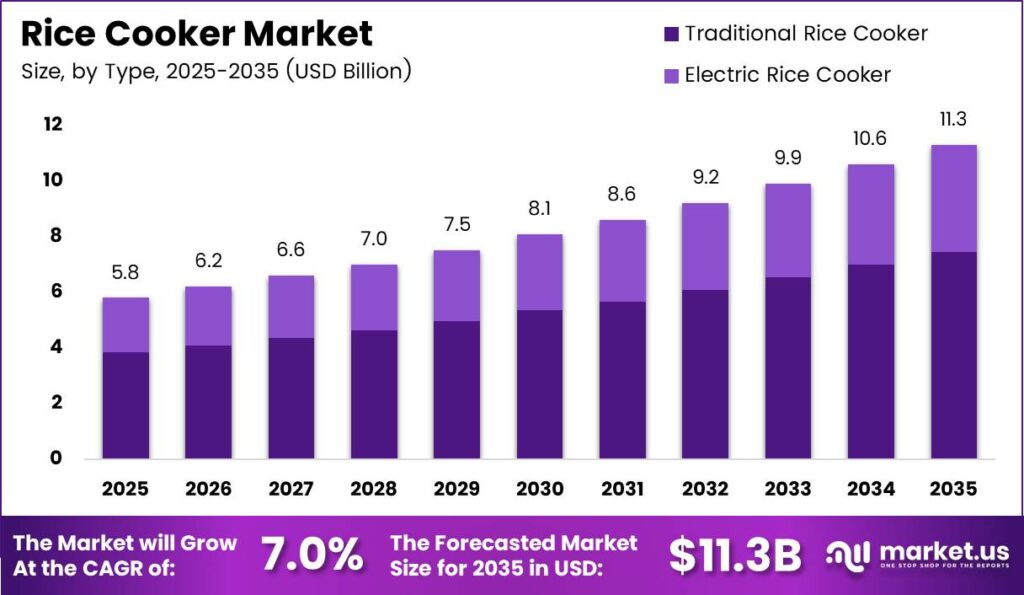
Global Rice Cooker Market size is expected to be worth around USD 11.3 Billion by 2035 from USD 5.8 Billion in 2025, growing at a CAGR of 7.0% during the forecast period 2026 to 2035.
The rice cooker market covers electric and traditional appliances designed to automate rice preparation across household and commercial settings. Product categories span basic single-function units, multi-cook models, and high-performance induction-heating systems. Distribution reaches consumers through offline retail chains, specialty kitchen stores, and online platforms. This structure creates tiered entry points for manufacturers across price-sensitive emerging markets and premium-upgrade segments in mature economies.
Key Takeaways
- The Global Rice Cooker Market is valued at USD 5.8 Billion in 2025 and is forecast to reach USD 11.3 Billion by 2035.
- The market grows at a CAGR of 7.0% during the forecast period 2026 to 2035.
- By Type, Traditional Rice Cooker dominates with a share of 65.67%.
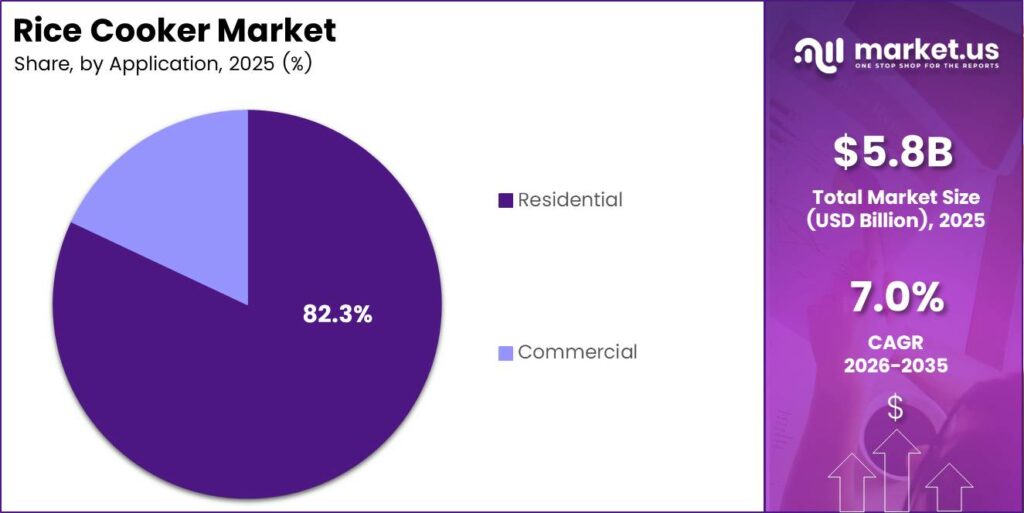
- By Application, Residential leads with a share of 82.34%.
- By Size, Above 3–8 Litres is the fastest-growing segment, holding 42.34% share.
- By Distribution Channel, Offline leads with 74.78% share.
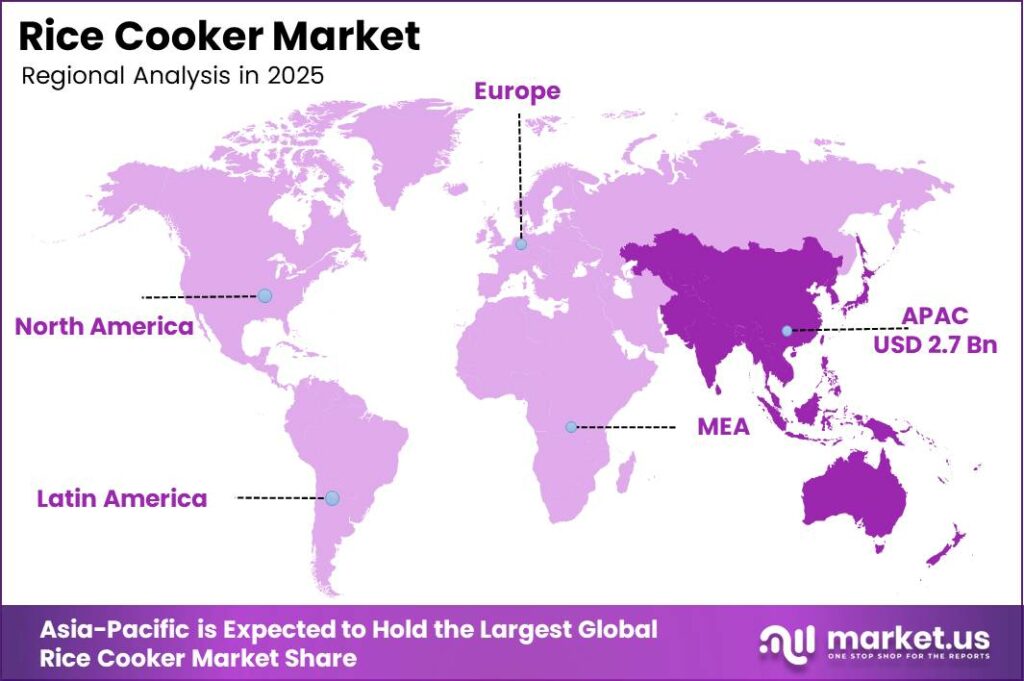
- Asia-Pacific dominates regionally with 48.56% market share, valued at USD 2.7 Billion.
- Middle East & Africa is the fastest-growing region in the global market.
Government-backed rural electrification programs and urbanization policies across South and Southeast Asia continue to expand the addressable base for electric cooking appliances. Rising household formation rates in rice-consuming nations translate directly into first-time appliance purchases. Manufacturers that align product launches with national grid expansion timelines gain early distribution advantages in newly connected communities before competitor inventory arrives.
In March 2025, Toshiba Lifestyle introduced its Japandi Series spanning five appliance categories including rice cookers, signaling a design-led premiumization strategy aimed at urban consumers. As per our research, Asia-Pacific GDP growth was projected at 4.5% in 2025, indicating income-level conditions that support consumer spending on mid-range kitchen appliances. This economic trajectory gives manufacturers a measurable window to introduce upgrade-tier products before growth rates moderate.
According to USDA data, global rice domestic and residual use in 2024/25 was projected at a record 530.5 million tons. This consumption baseline confirms the structural demand underpinning appliance penetration. Data from FAO shows Asia-Pacific rice production for 2023/24 was forecast at 469.7 million tonnes on a milled basis, with utilization expected at 442.0 million tonnes. Production volumes at this scale validate continued investment in dedicated cooking equipment across the region’s largest consumer markets.
Type Analysis
Traditional Rice Cooker dominates with 65.67% due to low price and wide availability.
In 2025, Traditional Rice Cooker held a dominant market position in the By Type segment of the Rice Cooker Market, with a 65.67% share. Traditional units run on straightforward resistive-heating technology, keeping retail prices accessible for first-time buyers across South Asia, Southeast Asia, and Sub-Saharan Africa. The IEA reported that residential electricity consumption in Asia grew to over 2,500 TWh in 2023, supporting widespread appliance use. Manufacturers targeting volume sales in price-sensitive markets rely on traditional cooker lines to maintain shelf presence and capture replacement cycles.
Electric Rice Cooker is the fastest-growing sub-segment within the By Type segment. Induction-heating and microcomputer-controlled electric models deliver precise temperature management and multiple cooking programs that traditional resistive units cannot match. In June 2025, Tiger Corporation launched five Gohobi-Daki rice-cooker models, including a compact 3.5-cup model and products with capacities extending to 10 cups. Zojirushi also launched NX-AA Enbu-Daki pressure-IH rice-cooker models in 1.0-litre and 1.8-litre capacities in June 2025. These concurrent launches reflect a competitive acceleration in premium electric product cadence that rewards early retail placement.
Application Analysis
Residential dominates with 82.34% due to daily household rice-cooking frequency.
In 2025, Residential held a dominant market position in the By Application segment of the Rice Cooker Market, with an 82.34% share. Household units account for the overwhelming majority of global unit shipments because rice remains a daily staple in Asia, the Middle East, and parts of Africa. The FAO estimated that global per-capita rice consumption averaged approximately 54 kg per year in 2023, anchoring recurring appliance use at the household level. This volume scale means residential channel management and after-sales coverage directly determine a manufacturer’s market position.
Commercial is the fastest-growing application sub-segment, driven by food service expansion across hospitality, institutional catering, and quick-service restaurants. In March 2024, KitchenAid launched its Grain and Rice Cooker with 21 preset cooking options and automated weighing and water dispensing, illustrating how product innovation targets professional kitchen efficiency. The USDA Economic Research Service reported that U.S. food-service industry revenues exceeded USD 1 trillion in 2023. This scale signals sustained procurement demand for high-output commercial cookers that can handle multiple rice varieties and volume orders consistently.
Size Analysis
Above 3–8 Litres dominates with 42.34% due to family-portion compatibility across Asia.
In 2025, Above 3–8 Litres held a dominant market position in the By Size segment of the Rice Cooker Market, with a 42.34% share. This capacity range aligns with average household sizes across China, India, Indonesia, and the Philippines, where family meals require between 2 and 5 cups of dry rice per sitting. The World Bank reported that average household sizes in South Asia remain above 4.3 persons per unit as of 2023 data. Manufacturers that anchor their core SKU ranges within the 3-to-8-litre band capture the broadest addressable replacement pool in Asia-Pacific.
The 1–3 Litres sub-segment serves single-person and two-person households, a growing demographic in urbanizing East Asian markets. UN data shows that the share of one-person households in Japan reached 38% of total households in 2023, creating measurable demand for compact units with reduced energy draw. Above 8 Litres targets institutional buyers such as canteens, schools, and catering operators where batch output per cook cycle determines operational cost. These two sub-segments together hold the remaining share not captured by the dominant mid-range band, and both are structurally linked to demographic and infrastructure shifts rather than discretionary purchasing cycles.
Distribution Channel Analysis
Offline dominates with 74.78% due to hands-on purchase behavior for appliances.
In 2025, Offline held a dominant market position in the By Distribution Channel segment of the Rice Cooker Market, with a 74.78% share. Physical retail remains the primary purchase channel because buyers prefer to assess product size, weight, and build quality before committing to a mid-ticket appliance. The ITC International Trade Centre reported that small appliance retail in Asia-Pacific was supported by over 2.3 million physical consumer electronics outlets as of 2023. This store-level density makes shelf placement and in-store demonstration capabilities direct determinants of volume share for any rice cooker brand.
Online is the fastest-growing distribution sub-segment, accelerated by platform penetration in India, Southeast Asia, and Latin America. As reported by ITU, an estimated 5.5 billion people, equal to 68% of the global population, used the internet in 2024, expanding the reachable addressable market for e-commerce appliance sales. Data from the U.S. Census Bureau shows U.S. retail e-commerce accounted for 17.1% of total retail sales in the second quarter of 2026. Brands that invest in platform storefronts, bundled delivery, and digital after-sales support now gain structural cost advantages over competitors relying exclusively on physical distribution networks.
Key Market Segments
By Type
- Traditional Rice Cooker
- Electric Rice Cooker
By Application
- Residential
- Commercial
By Size
- 1–3 Litres
- Above 3–8 Litres
- Above 8 Litres
By Distribution Channel
- Offline
- Online
Regional Analysis
Asia-Pacific Dominates the Rice Cooker Market with a Market Share of 48.56%, Valued at USD 2.7 Billion
Asia-Pacific commands nearly half of global rice cooker revenue because rice is the primary dietary staple across its largest economies. China, India, Japan, and Southeast Asian nations collectively sustain consistent replacement cycles and first-time purchase demand. The IMF projected Asia-Pacific GDP growth at 4.5% in 2025, indicating household income conditions that support mid-range appliance upgrades. This combination of dietary habit, population scale, and income growth makes the region the structural anchor for global market volume through 2035.
Middle East & Africa is the fastest-growing region in the global rice cooker market. The World Bank reported Middle East and North Africa GDP growth was expected at 2.2% in 2024, reflecting steady economic conditions that support entry-level appliance adoption. In August 2024, Tiger Corporation launched its JPV-S100 and JPV-S180 pressure-IH rice cooker models, indicating manufacturers are actively directing premium product lines toward rising-income urban markets. Brands that establish distributor relationships and after-sales service networks now will secure first-mover positioning ahead of the region’s consumer-appliance spending acceleration.
Key Regions and Countries
North America
- US
- Canada
Europe
- Germany
- France
- The UK
- Spain
- Italy
- Rest of Europe
Asia Pacific
- China
- Japan
- South Korea
- India
- Australia
- Rest of APAC
Latin America
- Brazil
- Mexico
- Rest of Latin America
Middle East and Africa
- GCC
- South Africa
- Rest of MEA
Market Dynamics
Market Opportunity Analysis - Underserved commercial, compact, and electrified-household segments offer high-return entry points for focused manufacturers
The Commercial application sub-segment remains underpenetrated relative to its structural demand base. Food service operators across Asia, the Middle East, and Africa manage high daily rice output using equipment not purpose-built for volume consistency or energy efficiency. Manufacturers that develop contract-service models alongside high-output commercial units, as Task 2 data confirms through the food-service revenue scale, can secure recurring institutional revenue streams that retail-focused competitors are not positioned to serve.
The 1–3 Litres size sub-segment presents a concentrated opportunity in urbanizing East Asian markets, where single-person and two-person household formation is accelerating. Task 2 data confirmed Japan’s one-person household share at 38% of total households in 2023. Compact cookers with energy-efficient heating and reduced counter footprint directly match this demographic’s priorities. Brands that build a dedicated compact product line rather than treating small-capacity units as entry-level fillers will capture repeat purchases from a high-frequency replacement cohort.
Electrified communities in Sub-Saharan Africa and South Asia represent a conditional but actionable opportunity, as Task 4 regional data confirms Middle East & Africa as the fastest-growing region in this market. Households in newly electrified communities represent first-time buyers with no incumbent brand loyalty and high sensitivity to accessible price points. Manufacturers that enter these markets through utility partnerships and community distribution programs before retail infrastructure matures will establish brand recognition that functions as a durable entry barrier for later-arriving competitors.
The Online distribution sub-segment is structurally undermonetized relative to its reach expansion rate. Task 2 data confirmed that internet users reached 5.5 billion people globally in 2024, yet Offline still commands 74.78% of rice cooker distribution. Brands that invest in platform storefronts, digital after-sales service, and bundled delivery programs in India, Southeast Asia, and Latin America now can convert expanding digital access into a measurable channel share gain before market-share positions in online retail consolidate around dominant incumbents.
Technology and Innovation Landscape - Induction heating, health-function engineering, and commercial IH automation define the product innovation frontier
Induction-heating technology is the primary performance differentiator separating premium electric rice cookers from traditional resistive models. IH systems heat the cooking pot directly and uniformly, delivering precise temperature control across multiple grain varieties without user adjustment. Zojirushi’s NX-AA Enbu-Daki model raised heating power from 1,200 W to 1,400 W, a 16.7% power increase that shortens cook cycles and improves crust and texture consistency. Manufacturers that cannot match this power density in the mid-range price tier risk ceding segment share to IH-equipped competitors at each replacement cycle.
Health-function engineering is emerging as a second axis of product differentiation beyond basic cooking performance. Toshiba’s digital rice cooker used a 4 mm-thick pot and a low-sugar cooking mode that claimed approximately 40% lower sugar content in the finished product. This positions the appliance within the health and wellness purchasing decision rather than the standard kitchen appliance category. Brands that document and certify health-outcome claims will command premium pricing and reduce direct price competition with entry-level and mid-range alternatives.
Commercial IH technology is reshaping the high-volume food service segment by cutting cook-cycle times that previously required large batch preparation windows. Tiger Corporation’s JIK-P180 commercial IH rice cooker introduced a soaked-rice setting capable of producing cooked rice in as little as 15 minutes, compared with 30-plus minutes for conventional commercial units. Panasonic’s SR-GB42FH produces 46 cooked cups in 30 minutes or less from a 4.2-litre raw capacity. Food service operators that adopt faster-cycle commercial IH equipment reduce kitchen labor hours and increase throughput per service period, making total cost of ownership a stronger purchase driver than upfront unit price.
Ceramic pot technology and smart-function integration represent the next wave of product development targeting both durability and convenience. Tiger Corporation’s JRT-A100 anniversary model introduced a ceramic pot construction alongside pressure-IH heating in a 1.0-litre compact form. Ceramic pots address the inner-coating durability variability that drives warranty claims on standard non-stick units. Smart-function models such as KitchenAid’s Grain and Rice Cooker, which introduced 21 preset options and automated weighing and water dispensing, indicate that sensor-driven automation is moving from the premium tier toward the mid-range competitive band.
Drivers
Rice holds a non-substitutable dietary role across South Asia, Southeast Asia, and West Africa, which means cooking frequency creates recurring appliance wear and consistent replacement demand. USDA’s December 2025 assessment identified record consumption expectations across Bangladesh, India, Nigeria, the Philippines, Thailand, and Vietnam. This consumption scale shifts the commercial proposition for rice cookers from an occasional transaction to a high-utilization household essential, rewarding brands that emphasize durability, capacity accuracy, and reliable warranties in their go-to-market messaging.
Premium induction-heating models are driving replacement purchases in Japan, South Korea, and Taiwan, where consumers are trading up from basic resistive units. Parallel to this, working households across urban Asia, North America, and Europe are selecting cookers specifically for time-saving automation rather than basic function. Online retail expansion in India, Southeast Asia, and Latin America is adding distribution reach that physical networks alone could not achieve within comparable investment timelines, directly lowering customer acquisition costs for mid-range product lines.
| Driver | (~) % Impact on CAGR Forecast | Geographic Relevance | Impact Timeline |
|---|---|---|---|
| Expanding rice consumption and cooking frequency | +0.55% | South Asia; Southeast Asia; West Africa | Short term (≤ 2 years) |
| Premium induction-heating replacement purchases | +0.45% | Japan; South Korea; Taiwan | Short term (≤ 2 years) |
| Time-saving demand from working households | +0.35% | Urban Asia; North America; Europe | Short term (≤ 2 years) |
| Online retail distribution expansion | +0.30% | India; Southeast Asia; Latin America | Short term (≤ 2 years) |
| Smaller-household demand for compact cookers | +0.25% | East Asia; urban Europe; North America | Medium term (2–4 years) |
Restraints
Absent household electricity connections represent a hard sales barrier because a standard mains-powered rice cooker cannot function without a live power source. The World Bank’s June 2026 energy-access update reported approximately 655 million people without electricity globally, with a rural electricity-access deficit in Sub-Saharan Africa of 447 million people. This population scale defines the outer boundary of the addressable market in affected regions. Manufacturers should stage distribution investment around verified connection rates rather than population growth alone to avoid premature inventory deployment.
Affordability barriers in low-income South Asia, Africa, and Latin America slow first-time appliance adoption even where electricity access exists. Dedicated-cooker displacement by multifunction pressure cookers and air fryers is removing incremental demand in North America, Europe, and affluent urban Asia. Ownership saturation in mature markets like Japan, South Korea, and Taiwan constrains replacement volumes, while mandatory electrical-safety approvals extend time-to-market for new entrants in import-regulated jurisdictions. Each of these restraints reduces the rate at which new paying customers enter the addressable pool.
| Restraint | (~) % Impact on CAGR Forecast | Geographic Relevance | Impact Timeline |
|---|---|---|---|
| Absent household electricity connections | -0.50% | Sub-Saharan Africa; underserved rural markets | Long term (≥ 4 years) |
| Unaffordable upfront appliance purchases | -0.40% | Low-income South Asia; Africa; Latin America | Short term (≤ 2 years) |
| Dedicated-cooker displacement by multifunction appliances | -0.30% | North America; Europe; affluent urban Asia | Short term (≤ 2 years) |
| Mature-market household ownership saturation | -0.25% | Japan; South Korea; Taiwan | Medium term (2–4 years) |
| Mandatory electrical-safety market-entry approvals | -0.15% | Jurisdiction-specific import markets | Short term (≤ 2 years) |
Challenges
Maritime routing disruptions extend replenishment timelines for rice cooker supply chains because most finished-goods manufacturing is concentrated in East Asia and products move through high-traffic shipping corridors. UNCTAD’s 2024 review reported that Suez Canal tonnage fell 70% by mid-2024, while Cape of Good Hope arrivals increased 89%. These rerouting pressures force manufacturers to hold 40–50% more planning stock than standard replenishment models require, raising working-capital costs and compressing margins on volume product lines already operating at thin spreads.
Electronic component qualification complexity delays premium model launches, particularly for IH control boards and microcomputer logic modules that require multi-region certification. Regional rice-texture calibration adds engineering overhead for brands selling across South Asia and Southeast Asia, where grain variety preferences differ materially between markets. After-sales technician coverage gaps in secondary cities and rural emerging markets suppress repeat purchase intent and brand loyalty scores. Inner-pot coating durability variability generates warranty claims that erode per-unit profitability on mid-range SKUs, creating an opening for manufacturers who invest in ceramic or hard-anodized alternatives.
| Challenge | (~) % CAGR Friction Drag | Geographic Relevance | Mitigation Horizon |
|---|---|---|---|
| Maritime routing and replenishment volatility | -0.35% | Asia–Europe; Africa; import-dependent markets | Short term (≤ 2 years) |
| Electronic component qualification complexity | -0.25% | East Asian manufacturing; global premium segments | Medium term (2–4 years) |
| Regional rice-texture calibration complexity | -0.20% | South Asia; Southeast Asia; export markets | Medium term (2–4 years) |
| After-sales technician coverage gaps | -0.15% | Secondary cities; rural emerging markets | Medium term (2–4 years) |
| Inner-pot coating durability variability | -0.15% | Global household markets | Medium term (2–4 years) |
Opportunities
The most immediate opportunity sits with electrified households in Africa and South Asia that still rely on polluting cooking fuels despite having grid access. The World Bank’s June 2026 update reported approximately 2 billion people without access to clean cooking, with urban access at 89% versus 56% in rural populations. Manufacturers and distributors that assemble financed purchase programs, usage demonstrations, and fuel-displacement verification will convert this conditional white space into a measurable revenue stream ahead of competitors that wait for organic demand signals.
Managed institutional cooking contracts represent a structurally different revenue model from retail. Schools, hospitals, and workplace kitchens require high-output, durable equipment under service agreements that generate recurring maintenance and replacement income. Dedicated accessibility-focused cooker designs targeting ageing populations in East Asia, Europe, and North America address a demographic cohort with consistent purchasing power and strong brand loyalty once a trusted product is adopted. Certified refurbished appliance channels in urban emerging markets and private-label manufacturing partnerships in Africa and Latin America offer lower-capital entry routes that leverage existing production capacity without requiring new brand-building expenditure.
| Opportunity | (~) % Potential CAGR Upside | Geographic Relevance | Execution Window |
|---|---|---|---|
| Financed clean-cooking conversion in connected households | +0.50% | Electrified African communities; South Asia; Southeast Asia | Medium term (2–4 years) |
| Managed institutional cooking contracts | +0.35% | Schools; hospitals; workplace kitchens globally | Medium term (2–4 years) |
| Dedicated accessibility-focused cooker designs | +0.25% | Ageing East Asia; Europe; North America | Medium term (2–4 years) |
| Certified refurbished appliance channels | +0.20% | Urban emerging markets; circular-economy channels | Medium term (2–4 years) |
| Private-label manufacturing partnerships | +0.15% | Regional retailers in Africa; Latin America; Europe | Short term (≤ 2 years) |
Key Company Insights
Toshiba Corporation reported FY2025 net sales of JPY 3,709.1 billion, a year-over-year increase of 5.6%, reflecting group-wide revenue momentum that supports continued consumer appliance investment. In March 2024, Toshiba Lifestyle launched 11 cooking-appliance products across four categories including rice cookers. Its digital rice cooker deployed a 4 mm-thick pot and a low-sugar cooking mode claiming approximately 40% lower sugar content in cooked rice. These health-positioned features differentiate Toshiba in premium urban segments where nutritional performance is a purchase driver.
Panasonic Corporation reported FY2025 consolidated net sales of JPY 8,458.2 billion, confirming its scale advantage across global appliance categories. Its SR-GB72 commercial rice cooker delivers a 7.2-litre or 40-cup raw-rice capacity, producing 80 cooked cups per cycle, while the SR-GB42FH yields 46 cooked cups from 4.2 litres in 30 minutes or less. In July 2025, Tiger Corporation launched the JIK-P180 commercial IH rice cooker with a soaked-rice setting capable of cooking in as little as 15 minutes, intensifying competitive pressure on Panasonic’s commercial segment positioning.
Key Players
- Toshiba Corporation (Japan)
- Panasonic Corporation (Japan)
- Bajaj Electricals Ltd (India)
- Pigeon Corporation (Japan)
- Zojirushi Corporation (Japan)
- Cuisinart (USA)
- Tiger Corporation (Japan)
- Sunbeam Products (USA)
- Aroma Housewares Company (USA)
- TTK Prestige Ltd. (India)
- Other Key Players
Geopolitical Impact Analysis
Trade route disruptions in the Red Sea and Panama Canal corridors are extending delivery timelines for rice cooker components and finished goods moving from East Asian factories to European, African, and Latin American markets. According to UNCTAD, maritime ton-miles rose 4.2% in 2024 because rerouting around the Suez and Panama canals added transit distance without adding proportional freight capacity. World merchandise trade volume grew only 2.9% in the same period against 6.8% commercial-services growth, confirming that physical goods logistics faced a materially tighter operating environment than digital trade channels.
As reported by UNCTAD, global maritime trade grew 2.4% to 12.3 billion tons in 2023 and was projected at 2.0% growth for 2024, signaling a deceleration in volume throughput that raises per-unit freight costs for appliance exporters. Tariff escalation between major manufacturing and consumer economies compounds this pressure by raising landed costs on Chinese-origin products in North American and European retail channels. Manufacturers exposed to single-origin production in China face a structural cost disadvantage versus competitors with diversified assembly in Vietnam, India, or Indonesia, where bilateral trade terms remain more stable and port congestion risk is lower.
Recent Developments
- May 2026: Tiger Corporation announced the JRT-A100 20th-anniversary ceramic-pot pressure-IH rice cooker with 1.0-litre capacity and 1,080 W maximum power, scheduled for release on June 21, 2026.
- September 2026: Tiger Corporation announced its “Tiger Famous Donabe Rice Restaurants” initiative involving 25 restaurants across 7 Japanese cities, launching October 7, 2026.
- February 2026: Hatco introduced an induction rice cooker capable of cooking up to 8 cups of dry rice or 20 cups of cooked rice per pan.
- September 2025: Zojirushi reported that cumulative domestic shipments of its Enbu-Daki rice-cooker series exceeded 1 million units; the new NX-AA model raised heating power from 1,200 W to 1,400 W.
- August 2024: Tiger Corporation launched JPV-S100 and JPV-S180 pressure-IH rice cooker models targeting premium household and commercial buyers.
- March 2024: KitchenAid launched its Grain and Rice Cooker featuring 21 preset cooking options alongside automated weighing and water dispensing functionality.
Report Scope
| Report Features | Description |
|---|---|
| Market Value (2025) | USD 5.8 Billion |
| Forecast Revenue (2035) | USD 11.3 Billion |
| CAGR (2026-2035) | 7.0% |
| Base Year for Estimation | 2025 |
| Historic Period | 2020-2024 |
| Forecast Period | 2026-2035 |
| Report Coverage | Revenue Forecast, Market Dynamics, Market Opportunity Analysis, Technology and Innovation Landscape, Competitive Landscape, Recent Developments |
| Segments Covered | By Type (Traditional Rice Cooker, Electric Rice Cooker), By Application (Residential, Commercial), By Size (1–3 Litres, Above 3–8 Litres, Above 8 Litres), By Distribution Channel (Offline, Online) |
| Regional Analysis | North America (US and Canada), Europe (Germany, France, The UK, Spain, Italy, and Rest of Europe), Asia Pacific (China, Japan, South Korea, India, Australia, and Rest of APAC), Latin America (Brazil, Mexico, and Rest of Latin America), Middle East and Africa (GCC, South Africa, and Rest of MEA) |
| Competitive Landscape | Toshiba Corporation, Panasonic Corporation, Bajaj Electricals Ltd, Pigeon Corporation, Zojirushi Corporation, Cuisinart, Tiger Corporation, Sunbeam Products, Aroma Housewares Company, TTK Prestige Ltd., Other Key Players |
| Customization Scope | Customization for segments, region / country-level will be provided. Additional customization can be done based on requirements. |
| Purchase Options | We have three licenses to opt for: Single User License | Multi-User License (Up to 5 Users) | Corporate Use License (Unlimited User and Printable PDF) |





































