


Global Refrigeration Oil Market Size, Share, And Enhanced Productivity By Product Type (Mineral, Synthetic, Semi-Synthetic), By Application (Air Conditioner, Refrigerators, Automotive, Coolers and Conditioners, Others), By Region and Companies - Industry Segment Outlook, Market Assessment, Competition Scenario, Trends, and Forecast 2026-2035
- Published date: February 2026
- Report ID: 179487
- Number of Pages: 312
- Format:
-
keyboard_arrow_up
Quick Navigation
Report Overview
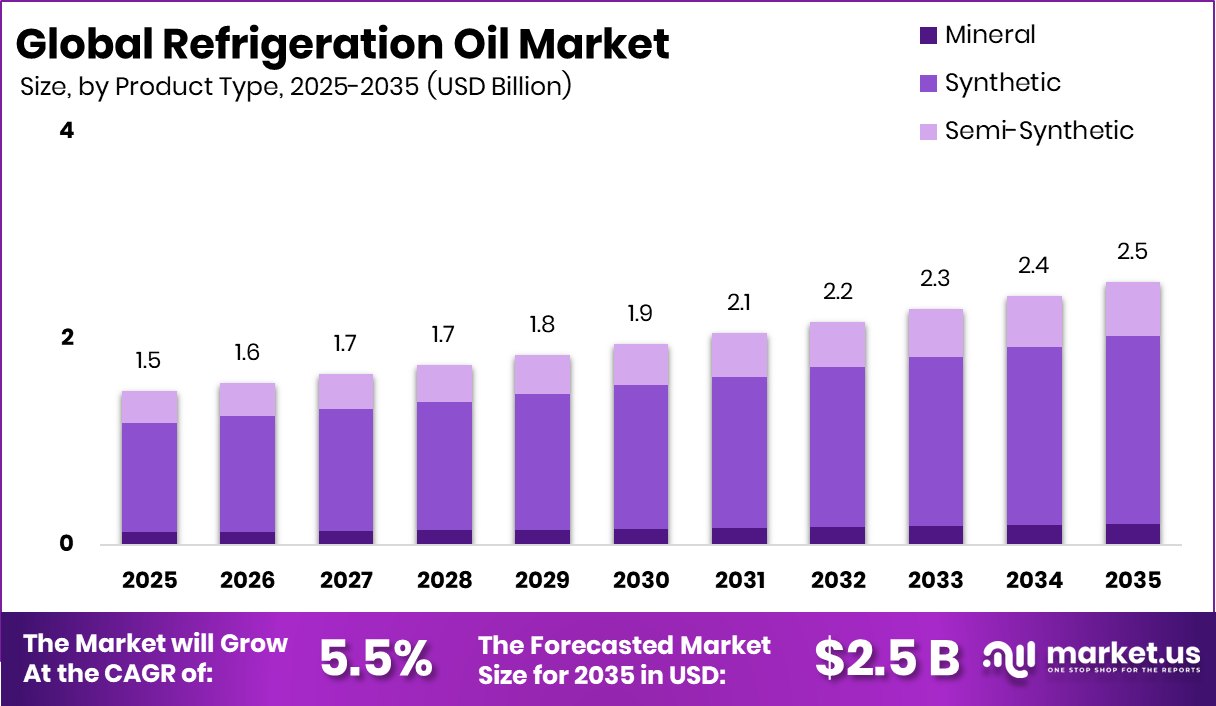
The Global Refrigeration Oil Market is expected to be worth around USD 2.5 billion by 2035, up from USD 1.5 billion in 2025, and is projected to grow at a CAGR of 5.5% from 2026 to 2035. Asia Pacific maintained leadership with a 39.7% share and a USD 0.5 Bn valuation.
The global refrigeration oil market is shaped by growing demand for efficient cooling systems across homes, vehicles, and industries. The taxonomy spans mineral, synthetic, and semi-synthetic oils, each used based on compressor type and operating conditions. On the application side, refrigeration oils support the smooth functioning of air conditioners, refrigerators, automotive cooling units, coolers and conditioners, and other temperature-control systems. These oils help reduce wear, maintain sealing, and ensure stable heat transfer, making them essential for long-term equipment performance.
Refrigeration oil is a specialized lubricant designed to work with refrigerants inside cooling and refrigeration systems. It circulates through compressors, helping them stay lubricated while managing high pressure and temperature variations. The refrigeration oil market refers to the commercial landscape involving the production, distribution, and use of these oils across residential, commercial, and industrial settings where cooling systems are installed.
One major growth factor is the rising use of energy-efficient air-conditioning systems, supported by new ideas and investment. Recently, Conry Tech secured a $3 million seed round to develop technology aimed at lowering power bills, highlighting growing interest in advanced cooling solutions. Additionally, Portland’s initiative to distribute 10,000 free air conditioners reflects how public programs continue to expand cooling infrastructure.
Demand is also strengthened by investments in essential facilities. The Grand Junction Regional Airport, receiving a $1.3 million FAA grant, indirectly supports refrigeration and HVAC use across airport operations. Such developments create steady opportunities for refrigeration oil suppliers as more equipment requires reliable lubrication. The sector also benefits from ongoing funding activity, such as Conry Tech’s additional $3 million seed round, showing the market’s continued push toward innovative cooling systems.
Key Takeaways
- The Global Refrigeration Oil Market is expected to be worth around USD 2.5 billion by 2035, up from USD 1.5 billion in 2025, and is projected to grow at a CAGR of 5.5% from 2026 to 2035.
- Synthetic oils dominate the Refrigeration Oil Market with 71.5%, driven by better stability and efficiency.
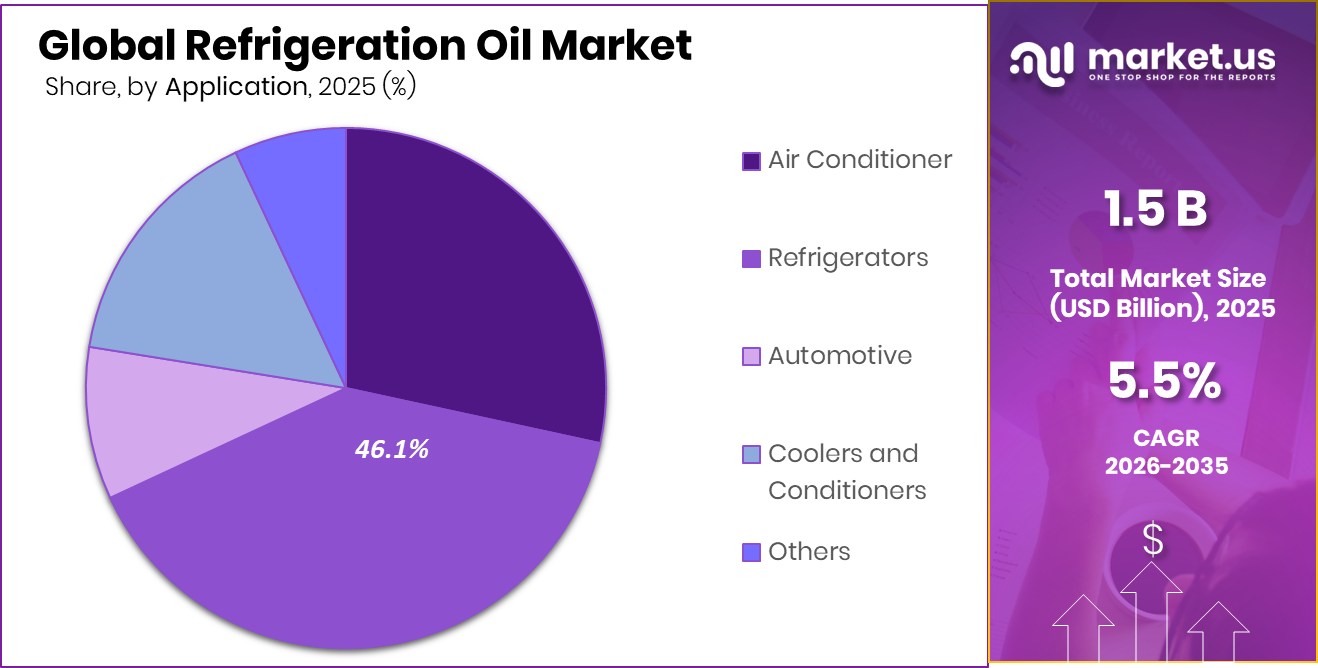
- Refrigerators hold 46.1% share in the refrigeration oil market due to widespread household adoption.
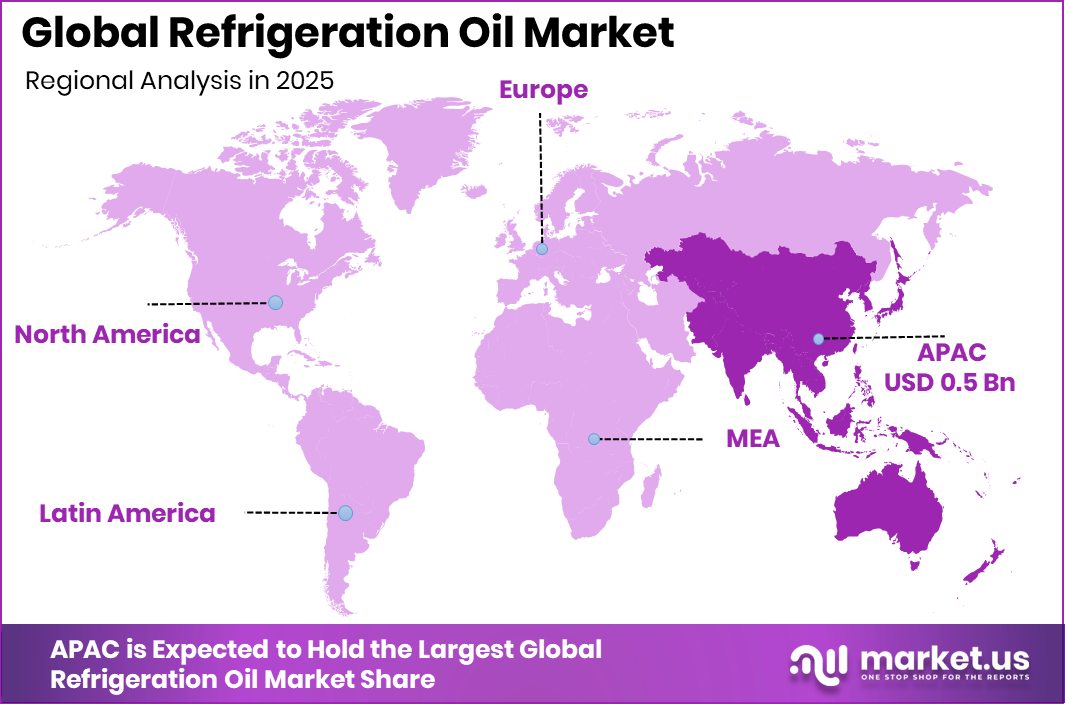
- The Asia Pacific 39.7% dominance reflects rising refrigeration oil demand worth USD 0.5 Bn.
By Product Type Analysis
Synthetic oils dominated the Refrigeration Oil Market with a strong 71.5% share.
In 2025, synthetic refrigeration oil firmly dominated the global market with a 71.5% share, reflecting its strong acceptance across commercial, industrial, and residential cooling systems. The shift toward new-generation refrigerants and higher-efficiency compressors has pushed users to select synthetic oils because they resist oxidation, reduce friction, and perform reliably under extreme temperature cycles.
Many refrigeration and HVAC manufacturers now prefer synthetic formulations as they support longer service intervals and cleaner system operation. The dominance of this segment also comes from the growing use of heat pumps, large cold-chain warehouses, and energy-efficient chillers, all of which demand stable and high-purity oils. With these factors, synthetic refrigeration oils maintained a clear lead in the 2025 product landscape.
By Application Analysis
Refrigerators dominated the Refrigeration Oil Market, capturing a notable 46.1% share.
In 2025, the refrigerators segment led the refrigeration oil market with 46.1% share, driven by rising household appliance usage, food-preservation needs, and expanding retail cold storage. Residential refrigerators and freezers rely heavily on consistent, durable compressor oils to maintain cooling efficiency and extend compressor life. The dominance of this application segment also grew with the increasing replacement of older appliances with energy-efficient models that require high-performance lubrication.
Beyond homes, small commercial refrigerators used in bakeries, convenience stores, and pharmacies also contributed to the strong demand. As reliability and quieter operation became top priorities for manufacturers, the refrigerator segment continued to anchor the application outlook, holding its leading position in the 2025 market.
Key Market Segments
By Product Type
- Mineral
- Synthetic
- Semi-Synthetic
By Application
- Air Conditioner
- Refrigerators
- Automotive
- Coolers and Conditioners
- Others
Driving Factors
Rising cooling equipment installations boost demand
Rising cooling equipment installations continue to push demand upward as households, commercial kitchens, and industrial facilities expand their refrigeration and HVAC capacities. This momentum is reinforced by ongoing investments in sustainable cooling technologies. A notable development linked to this landscape is Koolboks raising $11 million to build a solar-powered fridge assembly plant in Africa, showing how new refrigeration deployments directly increase lubricant consumption.
Such projects highlight a broader movement toward reliable and energy-efficient cooling in regions with growing electricity challenges. As more systems come online—from food storage units to climate-control appliances—the need for dependable refrigeration oils strengthens across global markets, making equipment growth a steady driver for lubricant manufacturers.
Restraining Factors
High synthetic oil costs limit adoption.
High synthetic oil costs remain a challenge for budget-sensitive markets, often slowing adoption in residential and small commercial segments. Affordability concerns become more visible in regions where cooling appliances expand faster than consumer purchasing power. Recent activities, such as CLASP and GEAPP, providing $6.1 million to improve access to energy-efficient appliances in Africa, reveal how financial support is needed to overcome cost barriers.
Additionally, advanced technologies like magnetocaloric systems are still expensive, as reflected in a €6.3 million funding round in this emerging sector. These developments illustrate the financial pressures surrounding high-performance refrigeration solutions and the oils they require.
Growth Opportunity
Expanding cold-chain infrastructure increases consumption
Expanding cold-chain infrastructure provides one of the strongest avenues for future market growth, especially as food distribution, pharmaceuticals, and agricultural exports depend on temperature-controlled logistics. This expansion aligns with funding momentum, including Beyond Appliances securing $2 million in a seed round to advance next-generation cooling systems.
Similarly, Mercer Market receiving nearly $250,000 for new refrigeration upgrades reflects growing investments in modern cold-storage capabilities. As more facilities adopt efficient, reliable cooling systems, the demand for high-quality refrigeration oil will continue increasing, opening clear opportunities for suppliers offering durable and compatible formulations.
Latest Trends
Shift toward low-viscosity synthetic formulations
A shift toward low-viscosity synthetic formulations is becoming more common as manufacturers aim for better compressor efficiency and compatibility with modern refrigerants. This trend is echoed in new funding activities across the refrigeration sector. A leading example is a refrigeration company raising $11 million from Aruwa Capital and KawiSafi Ventures, signaling investor confidence in advanced cooling technologies.
Meanwhile, Koolboks’ closing of a $2.5 million seed round to scale solar-powered refrigeration in Africa highlights the growing movement toward cleaner, smarter cooling solutions. These developments show how innovation and capital flow are shaping next-generation lubrication needs.
Regional Analysis
Asia Pacific held a strong 39.7% share, valuing the market at USD 0.5 Bn.
The Refrigeration Oil Market shows varied performance across regions, reflecting differences in industrialization, appliance penetration, and cold-chain expansion. Asia Pacific leads the global landscape with a dominant 39.7% share valued at USD 0.5 Bn, supported by strong demand in commercial cooling, residential refrigeration, and expanding food storage networks.
North America remains a steady market driven by widespread use of advanced HVAC systems and high adoption of premium synthetic oils across industrial refrigeration units. Europe follows with consistent demand from household appliances, cold logistics, and stringent efficiency standards that encourage high-quality lubrication. The Middle East & Africa region experiences gradual growth as supermarkets, hospitality cooling systems, and temperature-controlled warehouses expand.
Latin America shows stable yet rising consumption, supported by the increasing installation of refrigeration units across retail, food processing, and domestic appliance sectors. Together, these regions form a balanced global structure, with Asia Pacific clearly maintaining leadership in 2025.
Key Regions and Countries
- North America
- US
- Canada
- Europe
- Germany
- France
- The UK
- Spain
- Italy
- Rest of Europe
- Asia Pacific
- China
- Japan
- South Korea
- India
- Australia
- Rest of APAC
- Latin America
- Brazil
- Mexico
- Rest of Latin America
- Middle East & Africa
- GCC
- South Africa
- Rest of MEA
Key Players Analysis
ENEOS strengthens its position through its long-standing expertise in high-performance lubricants tailored for refrigeration systems that demand thermal stability and low volatility. Its focus on cleaner formulations places the company in a favorable position as manufacturers move toward low-GWP refrigerants.
Idemitsu Kosan Co., Ltd. brings deep chemical engineering capability into the sector, especially in synthetic refrigeration oils designed for compressors in commercial and industrial cooling equipment. The company’s commitment to precision-engineered lubricants gives it a solid foothold in regions shifting to advanced HVAC systems and tighter energy-efficiency norms. Its balanced product strategy supports the growing demand for oils that perform reliably under high-pressure and variable-load conditions.
Exxon Mobil Corporation adds global scale and technical reliability to the competitive landscape. With its wide lubricant portfolio and strong R&D orientation, the company supports refrigeration OEMs requiring oils that ensure smooth compressor operation and extended equipment life. In 2025, its ability to deliver consistent quality across diverse climatic markets reinforces its role as a key influencer in shaping performance standards.
Top Key Players in the Market
- ENEOS
- Idemitsu Kosan Co., Ltd.
- Exxon Mobil Corporation
- Shell Global
- TotalEnergies
- China Petroleum & Chemical Corporation
- FUCHS
- PETRONAS Lubricants International
- Johnson Controls
Recent Developments
- In October 2025, Idemitsu invested in Maxwell+Spark B.V., a company that makes lithium-ion battery systems for refrigerated shipping containers and forklifts used in logistics. This helps Idemitsu link its lubricant and energy technology with future electric and cooling systems. Although not directly a refrigeration oil product launch, it connects to technologies used in refrigerated transportation.
- In March 2025, ENEOS announced its Yokohama plant would phase out lubricant production between 2026 and 2028. While this affects its general lubricant output, the company said it plans to continue its lubricant business by relocating production, which could affect how and where refrigeration oils are made.
Report Scope
Report Features Description Market Value (2025) USD 1.5 Billion Forecast Revenue (2035) USD 2.5 Billion CAGR (2026-2035) 2.5 Base Year for Estimation 2025 Historic Period 2020-2024 Forecast Period 2026-2035 Report Coverage Revenue Forecast, Market Dynamics, Competitive Landscape, Recent Developments Segments Covered By Product Type (Mineral, Synthetic, Semi-Synthetic), By Application (Air Conditioner, Refrigerators, Automotive, Coolers and Conditioners, Others) Regional Analysis North America – US, Canada; Europe – Germany, France, The UK, Spain, Italy, Rest of Europe; Asia Pacific – China, Japan, South Korea, India, Australia, Singapore, Rest of APAC; Latin America – Brazil, Mexico, Rest of Latin America; Middle East & Africa – GCC, South Africa, Rest of MEA Competitive Landscape ENEOS, Idemitsu Kosan Co., Ltd., Exxon Mobil Corporation, Shell Global, TotalEnergies, China Petroleum & Chemical Corporation, FUCHS, PETRONAS Lubricants International, Johnson Controls Customization Scope Customization for segments, region/country-level will be provided. Moreover, additional customization can be done based on the requirements. Purchase Options We have three licenses to opt for: Single User License, Multi-User License (Up to 5 Users), Corporate Use License (Unlimited User and Printable PDF)  Refrigeration Oil MarketPublished date: February 2026add_shopping_cartBuy Now get_appDownload Sample
 -
-
- ENEOS
- Idemitsu Kosan Co., Ltd.
- Exxon Mobil Corporation
- Shell Global
- TotalEnergies
- China Petroleum & Chemical Corporation
- FUCHS
- PETRONAS Lubricants International
- Johnson Controls
Our Clients

- 179487
- February 2026






