


Global Recycled Base Oil Market Size, Share, And Enhanced Productivit By Type (High Viscosity Recycled Base Oil, Medium Viscosity Recycled Base Oil, Low Viscosity Recycled Base Oil), By Source (Used Oil, Synthetic Oil, Vegetable Oil), By Viscosity Grade (SAE 10W-30, SAE 5W-20, SAE 15W-40, SAE 20W-50), By Processing Method (Vacuum Distillation, Hydro-treating, Solvent Extraction), By Application (Automotive Oil, Industrial Oil, Metalworking Fluids, Others), By Region and Companies - Industry Segment Outlook, Market Assessment, Competition Scenario, Trends, and Forecast 2026-2035
- Published date: February 2026
- Report ID: 179905
- Number of Pages: 358
- Format:
-
keyboard_arrow_up
Quick Navigation
Report Overview
The Global Recycled Base Oil Market is expected to be worth around USD 10.5 billion by 2035, up from USD 5.9 billion in 2025, and is projected to grow at a CAGR of 5.9% from 2026 to 2035. Strong demand drives Asia Pacific Recycled Base Oil Market to 36.3% and USD 2.1 Bn.
Recycled base oil is produced by collecting used lubricants and processing them through cleaning, separation, and re-refining steps to remove impurities and restore performance properties. It serves as an environmentally responsible alternative to virgin base oil and supports circular resource use in automotive, industrial, and metalworking applications.
The Recycled Base Oil Market covers several categories, including High, Medium, and Low Viscosity Recycled Base Oil, sources such as used, synthetic, and vegetable oils, viscosity grades ranging from SAE 10W-30 to SAE 20W-50, processing methods like vacuum distillation and hydro-treating, and end uses including automotive oils, industrial oils, metalworking fluids, and others.
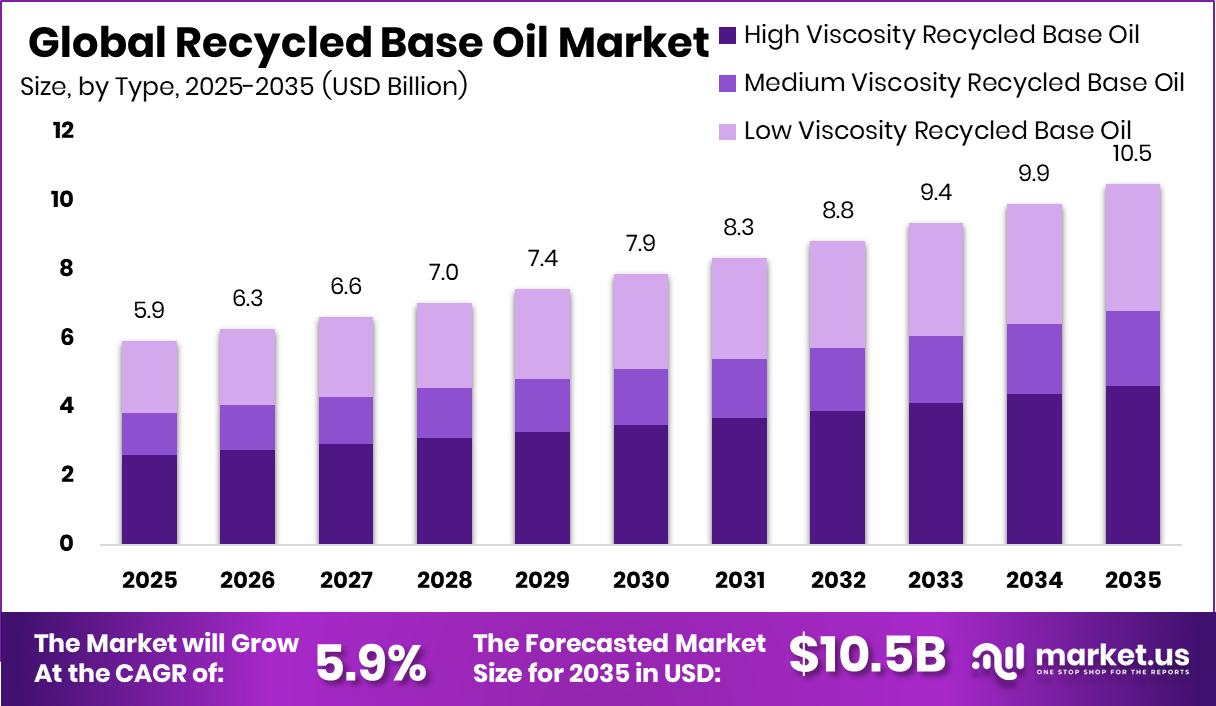
The market’s growth factors are influenced by rising waste-oil recovery programs, increasing industrial consumption, and stronger emphasis on sustainability-aligned lubrication. Supportive investment flows also encourage cleaner production methods, including activities such as Tagaddod, raising 26M USD from the Arab Energy Fund to advance recycled feedstock use.
Demand continues to rise as industries look for lower-impact lubrication choices that still meet performance needs. Innovation in alternative feedstocks is emerging, reflected in developments such as ÄIO securing €1M for greener ingredient development.
Opportunity widens as circular-economy initiatives receive new financial support. Regional ingredient and recycling startups also benefit from funding, such as AYMO Ventures launching a €52M fund and Cano-ela securing €1.6M to scale sustainable material processing—indirectly reinforcing the broader ecosystem that supports recycled base-oil adoption.
Key Takeaways
- The Global Recycled Base Oil Market is expected to be worth around USD 10.5 billion by 2035, up from USD 5.9 billion in 2025, and is projected to grow at a CAGR of 5.9% from 2026 to 2035.
- Recycled Base Oil Market grows as high-viscosity recycled base oil captures 44.1% global share.
- Strong market momentum continues, with used oil emerging as the dominant source, holding 49.7% contribution globally.
- SAE 10W-30 leads viscosity grades in the Recycled Base Oil Market with 34.5% share.
- Hydro-treating remains the preferred processing method, commanding 49.8% share in worldwide recycled base oil.
- Automotive oil applications drive demand strongly, representing 51.9% of the Recycled Base Oil Market.
- Asia Pacific leads the Recycled Base Oil Market with 36.3% and USD 2.1 Bn.
By Type Analysis
Recycled Base Oil Market is dominated by the high viscosity type with 44.1% share.
In 2025, the Recycled Base Oil Market will see High Viscosity Recycled Base Oil firmly dominating the competitive landscape with a 44.1% share, reflecting its strong acceptance across industrial lubrication, heavy-duty engines, and high-load mechanical systems where better film strength and thermal stability are required, and this leadership position is expected to deepen as manufacturers increasingly shift toward sustainable and circular-economy-aligned lubricant solutions that minimize carbon footprints, reduce dependence on virgin crude-derived base stocks, and support cost-efficient maintenance cycles for fleet operators, construction equipment owners, and large-scale mining activities, strengthening the segment’s foothold across global markets prioritizing environmental compliance and resource conservation.
By Source Analysis
The recycled base oil market is dominated by the used oil source, holding 49.7% share.
In 2025, the Recycled Base Oil Market will remain dominated by Used Oil as the primary source, holding a leading 49.7% share, driven by the expanding availability of collected waste lubricants, stronger regulatory push for mandatory oil recovery programs, and rising investments in used-oil re-refining infrastructure that enables higher yield, improved quality consistency, and lower environmental impact, while increasing participation from automotive service centers, industrial maintenance hubs, and regional collection networks ensures a steady feedstock supply, positioning the used-oil stream as the most economically viable and environmentally preferred pathway for base-oil regeneration across global re-refining facilities looking to maximize production efficiency and reduce raw-material dependency.
By Viscosity Grade Analysis
Recycled Base Oil Market is dominated by the SAE 10W-30 grade with 34.5% share.
In 2025, the Recycled Base Oil Market will see SAE 10W-30 leading the viscosity grade segment with a solid 34.5% share, reflecting its broad usage across passenger cars, light-commercial vehicles, and small industrial engines that demand balanced cold-start performance, fuel efficiency, and dependable thermal handling, and this dominance is reinforced by rapid adoption in fleet servicing operations, cost-conscious maintenance programs, and OEM-aligned lubricant replacement cycles, as end users increasingly turn toward recycled formulations that meet performance requirements while supporting sustainability goals, making SAE 10W-30 the most widely preferred grade within the rapidly expanding re-refined lubricant ecosystem across global automotive and light-duty engine markets.
By Processing Method Analysis
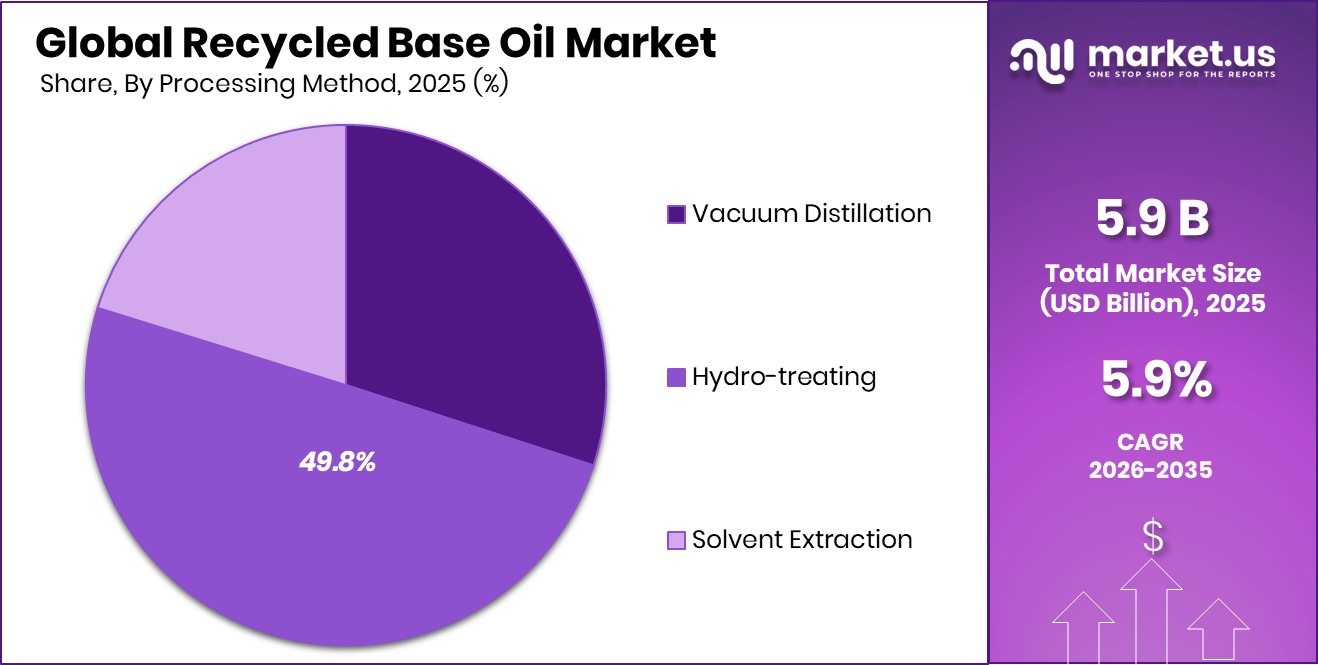
The recycled base oil market is dominated by the hydro-treating processing method, capturing 49.8% share.
In 2025, the Recycled Base Oil Market will be heavily dominated by Hydro-treating, securing a commanding 49.8% share, as refiners prioritize this process for its ability to deliver higher purity, improved oxidation resistance, and enhanced color and stability parameters that align with modern lubricant performance expectations, and the method’s efficiency in removing contaminants, sulfur, and unsaturated hydrocarbons makes it the preferred technology for producing Group I and Group II-equivalent base oils, encouraging widespread adoption by re-refineries aiming to meet increasingly strict quality standards, regulatory mandates, and sustainability metrics across global automotive, industrial, and commercial lubrication applications.
By Application Analysis
Recycled Base Oil Market is dominated by automotive oil application, commanding 51.9% share.
In 2025, the Recycled Base Oil Market will continue to be dominated by automotive oil, which secures the highest 51.9% share, driven by the immense global volume of vehicles requiring regular lubrication cycles, rapid expansion of aftermarket servicing networks, and growing preference for cost-effective and environmentally responsible re-refined oils that match performance benchmarks of conventional base stocks, while fleet operators, logistics companies, and commercial vehicle owners increasingly integrate recycled lubricants into maintenance programs to reduce operational expenses, making automotive oil the strongest and most influential application category shaping the overall growth trajectory of the recycled base oil industry worldwide.
Key Market Segments
By Source
- Used Oil
- Synthetic Oil
- Vegetable Oil
By Viscosity Grade
- SAE 10W-30
- SAE 5W-20
- SAE 15W-40
- SAE 20W-50
By Processing Method
- Vacuum Distillation
- Hydro-treating
- Solvent Extraction
By Application
- Automotive Oil
- Industrial Oil
- Metalworking Fluids
- Others
Driving Factors
Rising eco-friendly lubrication demand boosts adoption
Rising eco-friendly lubrication demand boosts adoption in the Recycled Base Oil Market as industries shift toward lower-impact lubricants that align with sustainability goals and help reduce reliance on virgin crude-based base stocks. This momentum is supported by broader investment activity in cleaner alternatives, including GrainCorp’s VC arm backing a synthetic palm oil startup’s $1.2 million pre-Seed round, which reflects a growing appetite for bio-derived and renewable feedstocks in adjacent sectors.
As companies look for cost-effective and environmentally conscious lubrication solutions, recycled base oils gain steady traction across automotive, industrial, and metalworking applications. The combined effect of environmental pressure and supportive investments strengthens the overall demand curve and keeps recycled base oil adoption on an upward trajectory.
Restraining Factors
Limited re-refining capacity restricts output
Limited refining capacity restricts output in the Recycled Base Oil Market, as many regions still operate with insufficient collection networks and aging processing infrastructure that cannot meet rising demand. While the market shows strong interest in sustainable lubricants, inconsistent waste-oil recovery systems slow production capability, particularly in developing economies.
The influence of consumer-maintenance behavior also plays a role, highlighted by discussions such as “11 Best Ways To Put $100 Toward Your Car’s Maintenance in 2026,” which points to cost-pressured vehicle owners often prioritizing immediate affordability over long-term sustainability. These structural and behavioral constraints collectively challenge the market’s ability to scale efficiently, creating supply pressures and limiting the wider availability of high-quality recycled base oils.
Growth Opportunity
Emerging circular-economy policies accelerate expansion
Emerging circular-economy policies accelerate expansion opportunities in the Recycled Base Oil Market, as governments and industries introduce stronger frameworks for waste-oil recovery, re-refining incentives, and sustainable product integration. These structural shifts align with global actions supporting energy transition efforts, such as the announcement that Trump selected three projects to be funded under Japan’s $550 billion pledge, signaling large-scale international financial commitments toward cleaner and more resource-efficient systems.
Such developments indirectly strengthen the ecosystem surrounding recycling, reprocessing, and low-impact industrial materials. As circular models grow, the demand for regenerated lubricants increases across automotive fleets, manufacturing operations, and heavy-duty machinery, paving the way for new facilities, technology upgrades, and expanded end-use applications.
Latest Trends
Shift toward cleaner hydro-treated recycled oils
Shift toward cleaner hydro-treated recycled oils defines one of the strongest trends in the Recycled Base Oil Market, as industries increasingly prefer higher-purity and more stable formulations that meet modern performance expectations. This trend is reinforced by broader technological and scientific advancements, mirrored in Europe’s deep-tech engine, which could spur $1 trillion in economic growth, emphasizing how innovation is reshaping industrial materials.
Alongside this, researchers receiving a $2.7 million NIH grant to develop next-generation synthetic blood highlight how funding for advanced chemical and material technologies is gaining momentum. These developments collectively support cleaner processing techniques and enable recycled base oils to move closer to parity with premium virgin base stocks.
Regional Analysis
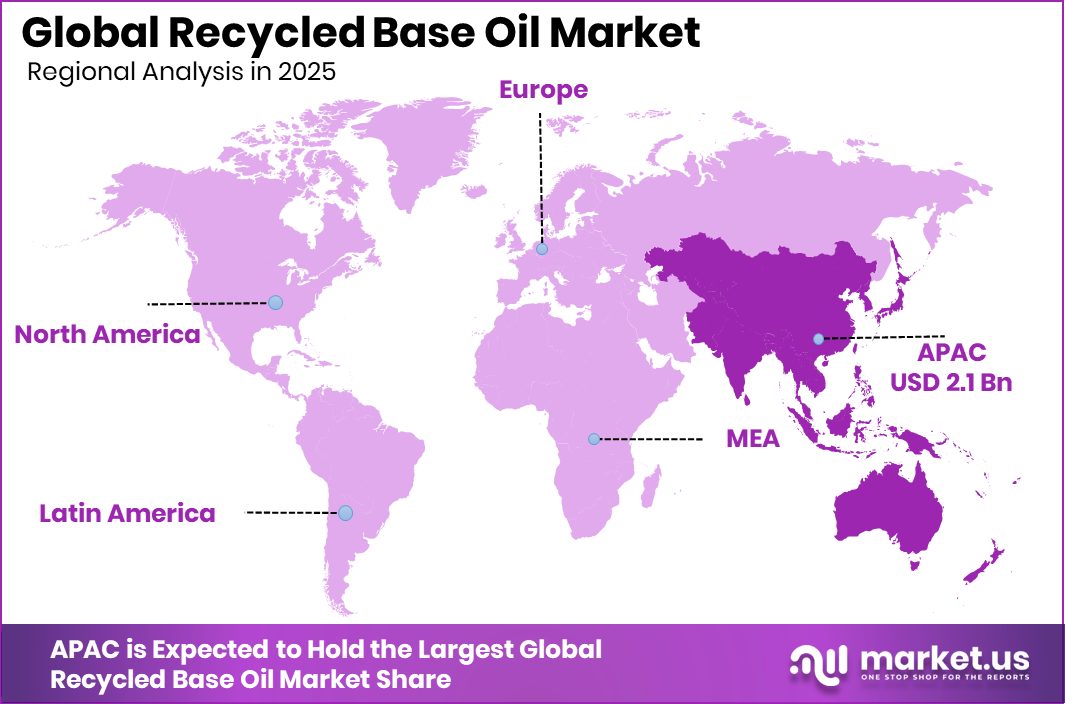
Recycled Base Oil Market Asia Pacific holds 36.3% share reaching USD 2.1 Bn.
The Recycled Base Oil Market shows varied regional performance across major global zones, with Asia Pacific standing out as the dominant region, holding 36.3% and reaching USD 2.1 Bn, supported by strong automotive servicing activity, widespread industrial operations, and rising adoption of re-refined lubricants. North America continues to maintain steady demand, driven by a mature vehicle parc and consistent waste-oil recovery systems that support stable re-refining output across key states.
Europe follows with structured environmental regulations that encourage recycling practices and maintain balanced consumption across both industrial and transportation sectors. In the Middle East & Africa, market activity grows gradually, supported by expanding automotive maintenance networks and increasing awareness of resource-efficient lubrication practices.
Latin America shows moderate progression, influenced by localized re-refining capacities and rising lubricant recovery initiatives. Overall, Asia Pacific remains the clear leader, benefiting from its large vehicle population and higher volumes of collected used oil, which together reinforce its top position in the global market.
Key Regions and Countries
- North America
- US
- Canada
- Europe
- Germany
- France
- The UK
- Spain
- Italy
- Rest of Europe
- Asia Pacific
- China
- Japan
- South Korea
- India
- Australia
- Rest of APAC
- Latin America
- Brazil
- Mexico
- Rest of Latin America
- Middle East & Africa
- GCC
- South Africa
- Rest of MEA
Key Players Analysis
Valvoline LLC remains a visible and influential participant in the recycled base oil landscape due to its long-standing presence in lubricant formulation and its ability to integrate re-refined base stocks into performance-driven automotive and industrial products. The company’s established distribution channels and strong brand identity allow it to scale recycled solutions without compromising product reliability, making it well-positioned as global demand shifts toward more sustainable lubricants.
NexLube continues to reinforce its role in the market by focusing on refining efficiency and consistent output quality. Its operational approach emphasizes producing cleaner and stable base oils suitable for automotive and industrial blends, aligning with rising expectations for recycled alternatives. NexLube’s attention to process enhancement helps it address growing regional requirements for dependable re-refined supply, particularly as more industries adopt circular-economy-aligned sourcing practices.
VISION OILS contributes to market progress through its focus on operational capability and supply reliability in recycled base oils. The company’s strength lies in serving customers seeking cost-effective and environmentally responsible lubricant ingredients, and its positioning allows it to support growing adoption of recycled formulations across multiple end-use segments. As sustainability expectations rise, VISION OILS remains an important part of the sector’s competitive structure.
Top Key Players in the Market
- Valvoline LLC
- NexLube
- VISION OILS
- Gulf Basin Petroleum Recycling Co.
- Terrapure BR Ltd.
- Hering VPT
- SHARAFCO OIL REFINERY & IND CO L.L.C
- Rahaoil, Inc.
- BENZOIL
Recent Developments
- In August 2025, Valvoline Cummins (a Valvoline joint or branded unit) partnered with Mahindra in India to adopt post-consumer recycled packaging for lubricant products, highlighting environmental responsibility and support for circular-economy efforts that align with wider recycled oil objectives.
- In May 2025, Vision Oils posted multiple blog articles explaining practical uses of recycled oil, including recycled oil in asphalt production, base oil recovery for manufacturing, fuel blending from recycled oil, and lubricant production from reused oil. These posts highlight the company’s ongoing efforts to share knowledge on recycling technology and reused oil applications.
Report Scope
Report Features Description Market Value (2025) USD 5.9 Billion Forecast Revenue (2035) USD 10.5 Billion CAGR (2026-2035) 5.9% Base Year for Estimation 2025 Historic Period 2020-2024 Forecast Period 2026-2035 Report Coverage Revenue Forecast, Market Dynamics, Competitive Landscape, Recent Developments Segments Covered By Type (High Viscosity Recycled Base Oil, Medium Viscosity Recycled Base Oil, Low Viscosity Recycled Base Oil), By Source (Used Oil, Synthetic Oil, Vegetable Oil), By Viscosity Grade (SAE 10W-30, SAE 5W-20, SAE 15W-40, SAE 20W-50), By Processing Method (Vacuum Distillation, Hydro-treating, Solvent Extraction), By Application (Automotive Oil, Industrial Oil, Metalworking Fluids, Others) Regional Analysis North America – US, Canada; Europe – Germany, France, The UK, Spain, Italy, Rest of Europe; Asia Pacific – China, Japan, South Korea, India, Australia, Singapore, Rest of APAC; Latin America – Brazil, Mexico, Rest of Latin America; Middle East & Africa – GCC, South Africa, Rest of MEA Competitive Landscape Valvoline LLC, NexLube, VISION OILS, Gulf Basin Petroleum Recycling Co., Terrapure BR Ltd., Hering VPT, SHARAFCO OIL REFINERY & IND CO L.L.C, Rahaoil, Inc., BENZOIL Customization Scope Customization for segments, region/country-level will be provided. Moreover, additional customization can be done based on the requirements. Purchase Options We have three licenses to opt for: Single User License, Multi-User License (Up to 5 Users), Corporate Use License (Unlimited User and Printable PDF)  Recycled Base Oil MarketPublished date: February 2026add_shopping_cartBuy Now get_appDownload Sample
 -
-
- Valvoline LLC
- NexLube
- VISION OILS
- Gulf Basin Petroleum Recycling Co.
- Terrapure BR Ltd.
- Hering VPT
- SHARAFCO OIL REFINERY & IND CO L.L.C
- Rahaoil, Inc.
- BENZOIL
Our Clients

- 179905
- February 2026






