


Global Process Analyzer Market Size, Share, Growth Analysis By Type (Gas Analyzer, Liquid Analyzer), By End Use Industry (Water and Wastewater, Oil and Gas, Petrochemicals, Pharmaceuticals, Power Generation, Food and Beverages, Paper and Pulp, Metals and Mining, Others), By Region and Companies - Industry Segment Outlook, Market Assessment, Competition Scenario, Statistics, Trends and Forecast 2026-2035
- Published date: Feb 2026
- Report ID: 180774
- Number of Pages: 206
- Format:
-
keyboard_arrow_up
Quick Navigation
Report Overview
The Global Process Analyzer Market size is expected to be worth around USD 13.2 Billion by 2035 from USD 7.7 Billion in 2025, growing at a CAGR of 5.4% during the forecast period 2026 to 2035.
The process analyzer market encompasses a broad range of analytical instruments used to continuously measure, monitor, and control physical and chemical properties during industrial operations. These tools deliver real-time data essential for maintaining product quality and process efficiency. Key sectors such as oil and gas, pharmaceuticals, and water treatment rely heavily on these instruments for safe and compliant operations.
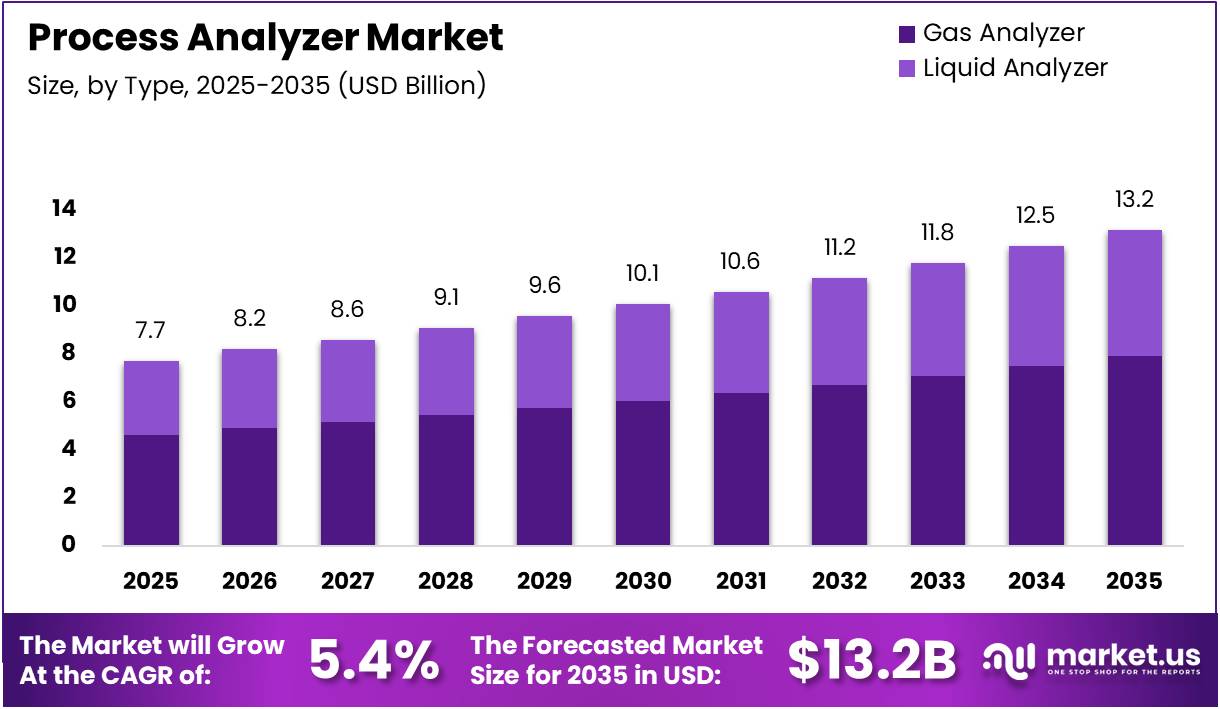
Process analyzers are available in two primary forms: gas analyzers and liquid analyzers. They operate online or at-line, providing uninterrupted measurements in demanding industrial environments. Moreover, these instruments support both quality assurance and regulatory compliance by detecting process deviations early and enabling timely corrective action across manufacturing operations.
The market is growing steadily due to rising demand for real-time monitoring and tighter quality control standards in continuous manufacturing. Industrial automation is accelerating the adoption of advanced analytical instruments across sectors. Consequently, the process analyzer market is expanding as manufacturers prioritize operational precision, data-driven decision-making, and process reliability.
Government-led environmental policies and safety mandates are compelling industries to invest in continuous emission monitoring and process analytical technology. Regulatory frameworks across North America and Europe set strict standards for emissions, water quality, and product purity. Therefore, compliance requirements remain a major and consistent driver for process analyzer adoption globally.
According to esegas.com, real-time analyzer monitoring helps maintain production efficiency levels of around 98% in industrial operations by keeping process variables within acceptable limits. Additionally, continuous process monitoring can reduce production waste by up to 30% through improved process control and early detection of operational deviations.
According to esegas.com, gas analyzers used in industrial production help maintain gas purity levels up to 99.9%, which is critical for semiconductors, pharmaceuticals, and chemicals. Furthermore, according to Springer, continuous manufacturing enabled by PAT can reduce cycle times by 70–90% and improve product quality by 40% through real-time monitoring and enhanced uniformity.
According to dutchatmpsummit.com, UF/DF processing time was reduced by 20% with PAT modeling, demonstrating the measurable efficiency gains achievable through advanced process analytics. Therefore, the process analyzer market is well-positioned for sustained growth as industries worldwide continue prioritizing operational efficiency, regulatory compliance, and quality assurance throughout the forecast period.
Key Takeaways
- The global Process Analyzer Market was valued at USD 7.7 Billion in 2025.
- The market is projected to reach USD 13.2 Billion by 2035, growing at a CAGR of 5.4% from 2026 to 2035.
- By Type, the Gas Analyzer segment dominated the market with a 58.9% share in 2025.
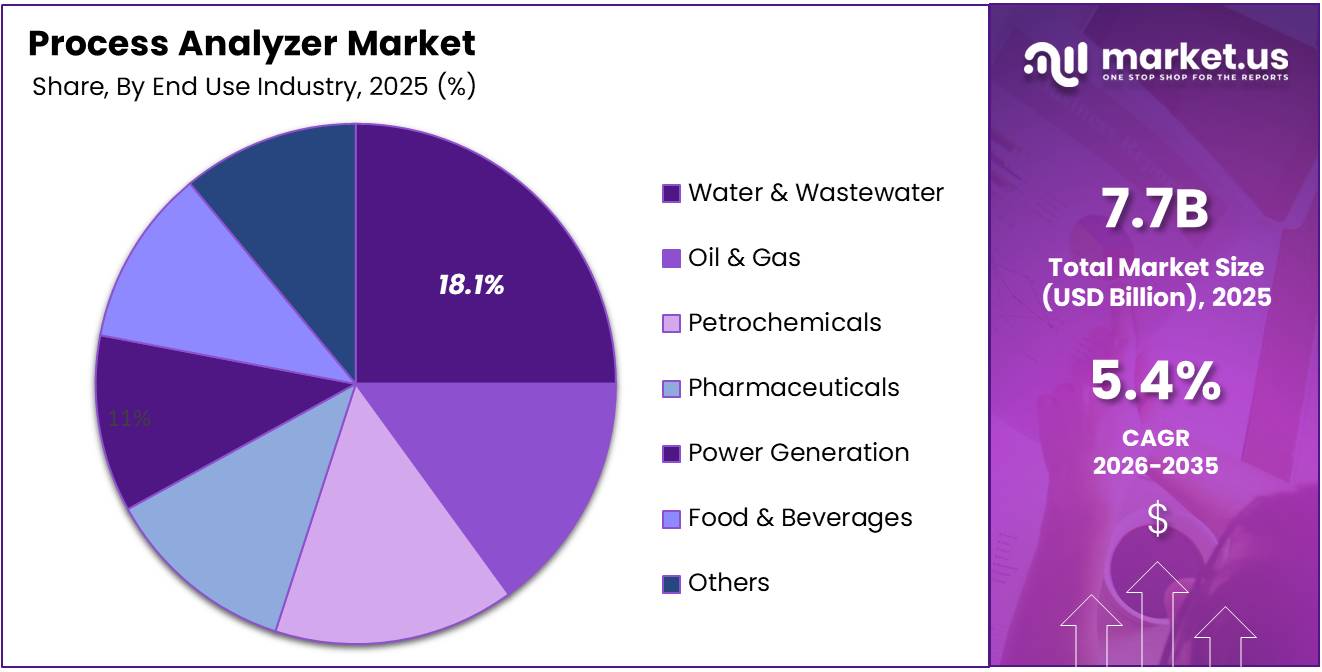
- By End Use Industry, the Water and Wastewater segment held the leading position with an 18.1% market share in 2025.
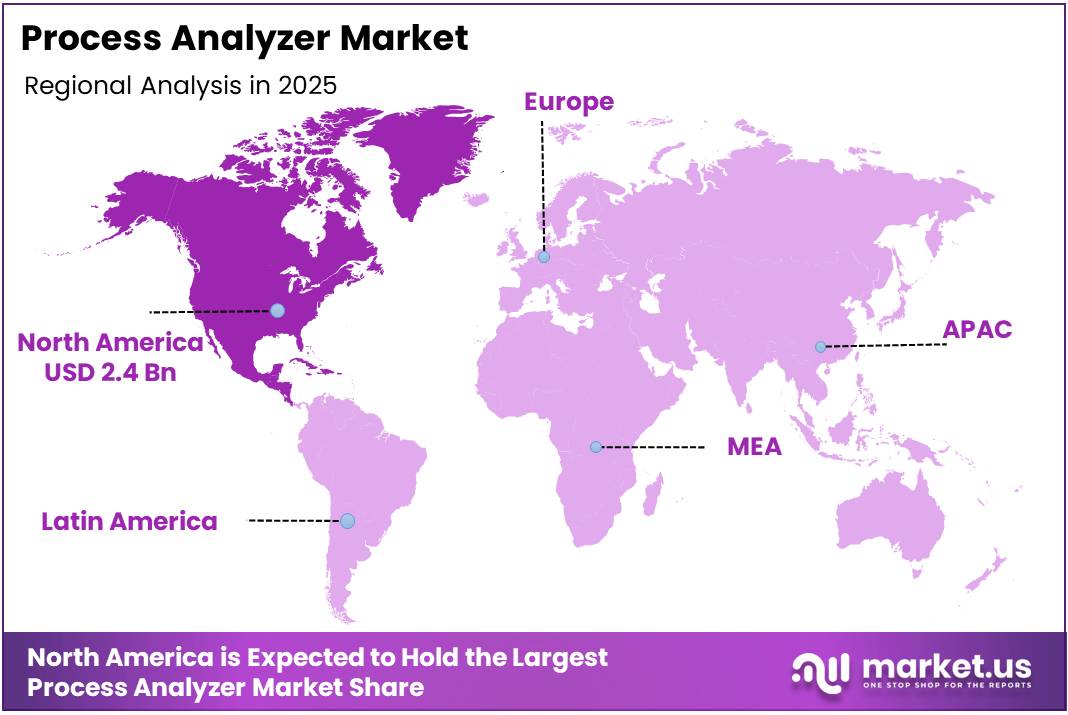
- North America led the global regional market with a 32.1% share, valued at USD 2.4 Billion in 2025.
Type Analysis
Gas Analyzer dominates with 58.9% due to its widespread use in emission monitoring, combustion control, and industrial process quality management across multiple sectors.
In 2025, Gas Analyzer held a dominant market position in the By Type segment of the Process Analyzer Market, with a 58.9% share. Gas analyzers are widely deployed across oil and gas, power generation, and chemical industries to monitor combustion efficiency, emissions, and process gas composition in real time. Moreover, advancements in laser-based and spectroscopy-based technologies are driving increased adoption of high-precision gas analyzers across demanding industrial environments.
Liquid Analyzer segment also holds a meaningful share in the process analyzer market. This segment includes pH analyzers, conductivity analyzers, dissolved oxygen analyzers, turbidity analyzers, and others. These instruments are essential in water and wastewater treatment, pharmaceuticals, and food and beverage processing. Additionally, rising water quality regulations and stricter product purity standards are expanding demand for liquid analytical instruments globally.
End Use Industry Analysis
Water and Wastewater dominates with 18.1% due to stringent water quality regulations and the growing need for continuous effluent and drinking water monitoring globally.
In 2025, Water and Wastewater held a dominant market position in the By End Use Industry segment of the Process Analyzer Market, with an 18.1% share. This sector relies on process analyzers for continuous monitoring of pH, turbidity, dissolved oxygen, and chemical contaminants to ensure compliance with environmental and public health standards.
Oil and Gas sector is a major end user, deploying process analyzers for emission monitoring, process optimization, and safety management. These instruments provide precise measurement of hydrocarbon composition and combustion gases. Consequently, increasing refinery automation and upstream exploration activities are driving sustained demand for advanced analytical instruments across this industry.
Petrochemicals industry relies on process analyzers to maintain product quality and ensure safe handling of reactive chemical streams. Real-time monitoring of sulfur content, gas purity, and reaction parameters is critical in petrochemical processing. Moreover, tightening environmental regulations are reinforcing the adoption of continuous analytical monitoring solutions across petrochemical manufacturing facilities.
Pharmaceuticals sector uses process analyzers extensively to support Process Analytical Technology frameworks and quality-by-design manufacturing. Real-time data from these instruments ensures product consistency and regulatory compliance throughout production. Additionally, the rapid growth of biopharmaceutical manufacturing is further accelerating demand for high-precision online analytical instruments in this vertical.
Power Generation industry deploys process analyzers primarily for combustion optimization and continuous emissions monitoring. Accurate measurement of flue gas composition helps power plants improve fuel efficiency and meet emission compliance standards. Furthermore, the transition toward cleaner energy sources is creating new analytical monitoring requirements across both conventional and renewable power generation facilities.
Food and Beverages sector uses process analyzers to ensure product safety, quality consistency, and regulatory compliance throughout production. Parameters such as pH, dissolved oxygen, and conductivity are routinely monitored in food and beverage processing lines. Moreover, increasingly stringent food safety standards globally are driving broader adoption of online analytical instruments across this industry.
Paper and Pulp industry utilizes process analyzers to monitor chemical dosing, water quality, and consistency parameters during production. Accurate real-time measurement helps optimize resource consumption and improve end-product quality. Consequently, the industry’s focus on reducing water usage and chemical waste is encouraging greater investment in advanced process analytical solutions.
Metals and Mining sector employs process analyzers for monitoring slurry composition, leaching processes, and effluent quality in mineral processing operations. These instruments support both operational efficiency and environmental compliance at mining and smelting facilities. Additionally, growing regulatory pressure on industrial wastewater discharge is expanding the role of process analyzers in this sector.
Others category includes industries such as semiconductors, textile, and specialty chemicals that also benefit from process analyzer deployments. These sectors require precise measurement of specific process parameters to maintain product quality and safety. Therefore, as industrial processes become more complex and regulated, demand for process analytical instruments continues to grow across a wider range of applications.
Key Market Segments
By Type
- Gas Analyzer
- Electrochemical
- Zirconia
- Tunable Diode Laser
- Infrared
- Paramagnetic
- Catalytic
- Others
- Liquid Analyzer
- pH Analyzers
- Conductivity Analyzers
- Dissolved Oxygen Analyzers
- Turbidity Analyzers
- Others
By End Use Industry
- Water and Wastewater
- Oil and Gas
- Petrochemicals
- Pharmaceuticals
- Power Generation
- Food and Beverages
- Paper and Pulp
- Metals and Mining
- Others
Drivers
Rising Demand for Real-Time Process Monitoring and Industrial Automation Drives Market Growth
The growing need for real-time process monitoring in continuous manufacturing is a primary driver of the process analyzer market. Industries require precise, uninterrupted data on process variables to maintain efficiency and product consistency. Moreover, the shift toward automated and smart manufacturing environments is accelerating the deployment of sophisticated online analytical instruments across all major process industries.
Industrial automation adoption across process industries, including chemicals, petrochemicals, and pharmaceuticals, is generating sustained demand for online and at-line analyzers. These instruments integrate directly with distributed control systems to enable closed-loop process management. Consequently, manufacturers benefit from improved process stability, reduced operational costs, and higher throughput by incorporating real-time analytical data into their production workflows.
Stringent environmental and safety regulations are compelling industries to adopt continuous emission monitoring systems. Governments across North America, Europe, and Asia Pacific have introduced strict standards for industrial emissions, effluent quality, and hazardous gas detection. Therefore, regulatory compliance requirements are creating a consistent and expanding demand for process analyzers used in environmental and industrial safety monitoring applications.
Restraints
Integration Challenges with Legacy Systems and Skilled Workforce Shortages Restrain Market Growth
One of the significant challenges facing the process analyzer market is the complexity of integrating advanced analytical instruments with existing legacy industrial control systems. Many plants operate with outdated infrastructure that lacks compatibility with modern digital analyzers. Consequently, integration requires significant retrofitting investments, often discouraging smaller manufacturers from upgrading their process monitoring capabilities in a timely manner.
Legacy automation systems may not support modern communication protocols or data formats required by new analytical instruments. The technical complexity involved in bridging older infrastructure with advanced process analyzers creates prolonged deployment timelines. Moreover, the cost and time required for system integration, testing, and validation can significantly reduce the overall return on investment for adopting firms.
A shortage of skilled personnel for calibration, operation, and maintenance of advanced process analyzers is another key restraint limiting market growth. These instruments require specialized knowledge to configure and troubleshoot effectively, which is not always available in-house. Additionally, high training and certification costs further limit adoption, particularly among mid-sized industrial firms operating in cost-sensitive or resource-constrained markets.
Growth Factors
Clean Energy Transition, Biopharmaceutical Growth, and PAT Adoption Create Significant Market Opportunities
The increasing deployment of process analyzers in hydrogen production and clean energy processing facilities presents a major growth opportunity for the market. As the global energy sector transitions toward green hydrogen and renewable fuels, precise analytical monitoring of process streams becomes essential. Consequently, this energy shift is opening new high-value application areas for process analyzer manufacturers and solution providers worldwide.
Growing utilization of online analytical instruments in biopharmaceutical and biotechnology manufacturing is another key growth factor. These industries require real-time monitoring of cell culture parameters, fermentation processes, and product purity to meet strict regulatory standards. Moreover, the rapid expansion of the global biopharmaceutical sector is generating sustained and increasing demand for high-precision process analytical technologies across production environments.
The rising implementation of Process Analytical Technology in pharmaceutical manufacturing is creating significant new opportunities for process analyzer suppliers. Regulatory bodies such as the FDA actively encourage PAT adoption to ensure consistent product quality and streamlined manufacturing operations. Therefore, pharmaceutical companies are investing in advanced online analyzers to comply with quality-by-design frameworks and enhance their overall manufacturing performance.
Emerging Trends
AI Integration, Advanced Spectroscopy, and Compact Modular Designs Are Reshaping the Process Analyzer Market
The integration of artificial intelligence and machine learning into process analyzer systems is transforming how industrial data is interpreted and acted upon. AI-powered analyzers can detect subtle process deviations, predict equipment failures, and optimize production in real time. Moreover, predictive process analytics is becoming a key competitive differentiator for manufacturers seeking operational excellence in demanding industrial environments.
Growing adoption of laser-based and spectroscopy-based process analyzer technologies is another prominent trend shaping the market. These technologies offer non-intrusive, highly accurate, and low-maintenance measurement capabilities across a wide range of industrial applications. Additionally, tunable diode laser absorption spectroscopy and Raman spectroscopy are gaining significant traction in pharmaceutical, chemical, and energy sector applications worldwide.
Development of compact, modular, and multi-component online process analyzers is redefining product design standards across the market. Manufacturers are engineering smaller, more versatile instruments capable of measuring multiple parameters simultaneously within a single unit. Consequently, these next-generation analyzers are well-suited for space-constrained environments, offering faster deployment and lower total cost of ownership compared to traditional, large-footprint analytical systems.
Regional Analysis
North America Dominates the Process Analyzer Market with a Market Share of 32.1%, Valued at USD 2.4 Billion
North America leads the global process analyzer market, holding a 32.1% share valued at USD 2.4 Billion in 2025. The region benefits from a mature industrial base, strong regulatory enforcement, and high adoption of industrial automation. Additionally, significant investments in oil and gas, pharmaceuticals, and environmental monitoring are sustaining robust and consistent demand for advanced process analyzers across the region.
Europe Process Analyzer Market Trends
Europe represents a significant market for process analyzers, driven by stringent environmental regulations and strong industrial activity across Germany, France, and the UK. The region’s chemical, pharmaceutical, and food and beverage sectors are key consumers of analytical instruments. Moreover, European regulatory standards on emissions and water quality are reinforcing continuous investment in advanced process monitoring technologies.
Asia Pacific Process Analyzer Market Trends
Asia Pacific is emerging as a fast-growing region in the process analyzer market. Rapid industrialization in China, India, and South Korea, combined with expanding oil and gas and pharmaceutical sectors, is fueling demand. Additionally, government investments in clean energy, water infrastructure, and industrial modernization are creating significant new opportunities for process analyzer deployment across the region.
Middle East and Africa Process Analyzer Market Trends
The Middle East and Africa region presents steady growth opportunities, primarily driven by oil and gas activity across GCC nations. Process analyzers are widely used in refinery and petrochemical operations to ensure product quality and regulatory compliance. Furthermore, growing investments in water treatment and industrial safety monitoring are broadening process analyzer applications across this region.
Latin America Process Analyzer Market Trends
Latin America represents a developing but growing market for process analyzers, with Brazil and Mexico as the primary contributors. The region’s expanding oil and gas, mining, and food and beverage sectors are increasing demand for online analytical instruments. However, economic constraints and limited technical infrastructure continue to moderate the overall pace of market adoption across the region.
Key Regions and Countries
North America
- US
- Canada
Europe
- Germany
- France
- The UK
- Spain
- Italy
- Rest of Europe
Asia Pacific
- China
- Japan
- South Korea
- India
- Australia
- Rest of APAC
Latin America
- Brazil
- Mexico
- Rest of Latin America
Middle East & Africa
- GCC
- South Africa
- Rest of MEA
Key Company Insights
ABB Group is a global leader in process analytics, offering a comprehensive portfolio of gas and liquid analyzers for a wide range of industrial applications. The company’s analyzers are deployed across power generation, oil and gas, and environmental monitoring sectors. ABB continues to invest in next-generation gas analysis technologies, including solutions targeting carbon capture and renewable energy processing applications.
Ametek Inc. is a prominent player in the process analyzer market, known for its advanced precision analytical instruments used across process industries. The company offers a broad range of gas analyzers and online process instruments tailored to demanding industrial environments. Moreover, Ametek’s focus on product innovation and global service capabilities positions it well among customers seeking reliable and high-performance analytical solutions.
Emerson Electric Co. is a key contributor to the process analyzer market through its comprehensive range of online analytical instruments and industrial automation technologies. The company integrates process analyzers with its digital transformation platforms to support smart manufacturing initiatives. Additionally, Emerson’s strong presence across oil and gas, chemicals, and life sciences reinforces its role as a trusted provider of process analytical solutions.
Endress+Hauser AG is a global specialist in measurement, instrumentation, and process automation, with a strong focus on liquid and gas process analyzers. The company serves water and wastewater, food and beverage, and pharmaceutical sectors with precision analytical instruments. Furthermore, Endress+Hauser’s commitment to digital connectivity and IIoT integration enhances the value of its analytical solutions for smart and connected industrial operations.
Key Players
- ABB Group
- Ametek Inc.
- Emerson Electric Co.
- Endress+Hauser AG
- Honeywell International Inc.
- Horiba Group
- Mettler Toledo SA
- Schneider Electric SE
- Siemens AG
- Teledyne Technologies, Inc.
- Thermo Fisher Scientific Inc.
- Yokogawa Electric Corporation
- KROHNE Group
- Rockwell Automation, Inc.
- Metrohm AG
- Other Key Players
Recent Developments
- February 2026 – ABB launched an integrated gas analyser package specifically designed for carbon capture, utilization, and storage (CCUS) applications. This solution enables industries to monitor and manage CO2 process streams with high accuracy as part of their broader industrial decarbonization strategies.
- December 2025 – ABB unveiled the Sensi+ NG multi-gas contaminant analyzer, tailored for the biogas and natural gas industries. The instrument provides accurate detection of multiple gas contaminants to support quality assurance and safe distribution across gas supply and processing networks.
- November 2025 – Valmet introduced the next-generation Valmet Wet End Analyzer for paper, board, and tissue production lines. This advanced instrument delivers improved real-time process data to help manufacturers enhance product consistency and optimize operational efficiency across wet-end production stages.
- May 2025 – MSA Safety Incorporated acquired M&C TechGroup in a transaction valued at approximately $200 million. This strategic acquisition strengthens MSA Safety’s portfolio of gas detection and process analyzer solutions, expanding its reach in industrial safety and emissions monitoring markets.
- April 2025 – Process Insights launched the ATOM INSTRUMENT Trace-1000 S/N Analyzer, a new precision instrument for trace-level sulfur and nitrogen analysis in industrial process streams. This product addresses the needs of industries requiring highly sensitive, low-concentration analytical measurement capabilities.
Report Scope
Report Features Description Market Value (2025) USD 7.7 Billion Forecast Revenue (2035) USD 13.2 Billion CAGR (2026-2035) 5.4% Base Year for Estimation 2025 Historic Period 2020-2024 Forecast Period 2026-2035 Report Coverage Revenue Forecast, Market Dynamics, Competitive Landscape, Recent Developments Segments Covered By Type (Gas Analyzer, Liquid Analyzer), By End Use Industry (Water and Wastewater, Oil and Gas, Petrochemicals, Pharmaceuticals, Power Generation, Food and Beverages, Paper and Pulp, Metals and Mining, Others) Regional Analysis North America (US and Canada), Europe (Germany, France, The UK, Spain, Italy, and Rest of Europe), Asia Pacific (China, Japan, South Korea, India, Australia, and Rest of APAC), Latin America (Brazil, Mexico, and Rest of Latin America), Middle East & Africa (GCC, South Africa, and Rest of MEA) Competitive Landscape ABB Group, Ametek Inc., Emerson Electric Co., Endress+Hauser AG, Honeywell International Inc., Horiba Group, Mettler Toledo SA, Schneider Electric SE, Siemens AG, Teledyne Technologies, Inc., Thermo Fisher Scientific Inc., Yokogawa Electric Corporation, KROHNE Group, Rockwell Automation, Inc., Metrohm AG Customization Scope Customization for segments, region/country-level will be provided. Moreover, additional customization can be done based on the requirements. Purchase Options We have three licenses to opt for: Single User License, Multi-User License (Up to 5 Users), Corporate Use License (Unlimited User and Printable PDF) 
-
-
- ABB Group
- Ametek Inc.
- Emerson Electric Co.
- Endress+Hauser AG
- Honeywell International Inc.
- Horiba Group
- Mettler Toledo SA
- Schneider Electric SE
- Siemens AG
- Teledyne Technologies, Inc.
- Thermo Fisher Scientific Inc.
- Yokogawa Electric Corporation
- KROHNE Group
- Rockwell Automation, Inc.
- Metrohm AG
- Other Key Players
Our Clients

- 180774
- Feb 2026






