


Global Preservatives Market Size, Share, And Enhanced Productivity By Type (Natural (Edible Oil, Rosemary Extracts, Natamycin, Vinegar, Others), Synthetic (Propionates, Sorbates, Sorbic Acid, Benzoates, Others)), By Function (Antimicrobial, Antioxidant, Others), By Application (Food (Meat and Poultry Products, Bakery Products, Dairy Products, Beverages, Snacks, Others), Feed, Pharmaceutical, Cosmetics, Detergents), By Region and Companies - Industry Segment Outlook, Market Assessment, Competition Scenario, Trends, and Forecast 2025-2034
- Published date: March 2026
- Report ID: 182318
- Number of Pages: 374
- Format:
-
keyboard_arrow_up
Quick Navigation
Report Overview
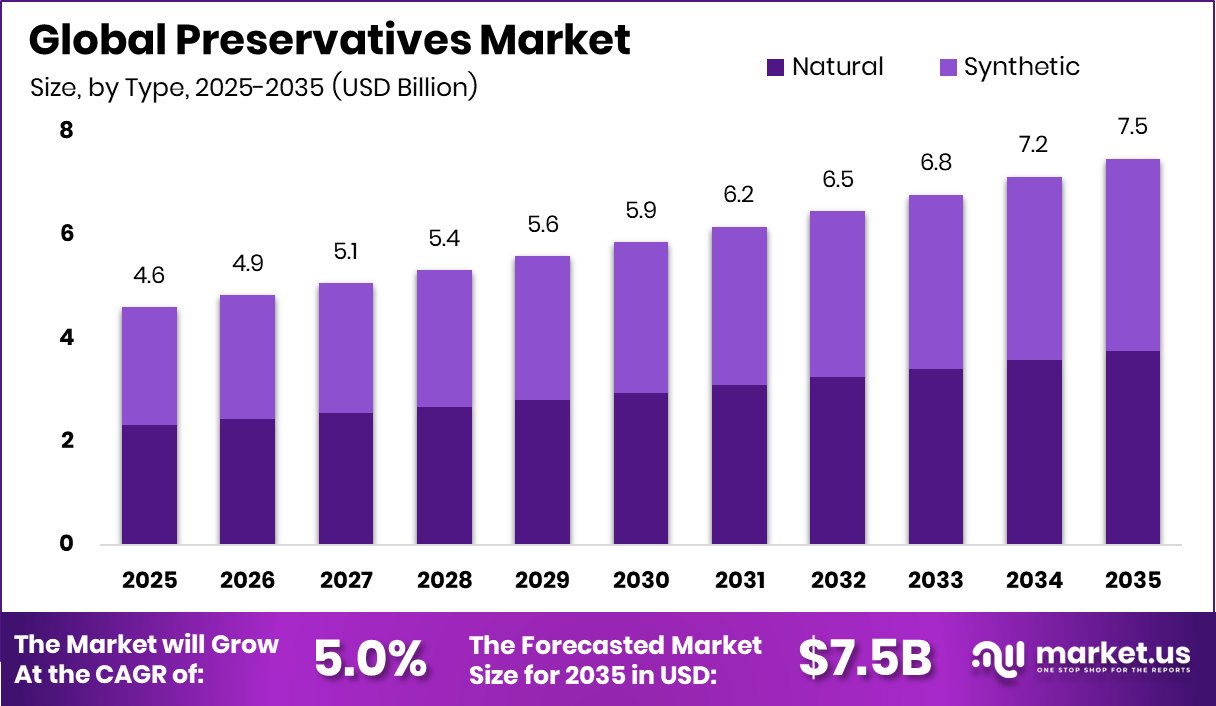
The Global Preservatives Market is expected to be worth around USD 7.5 billion by 2034, up from USD 4.6 billion in 2024. It is projected to grow at a CAGR of 5.0% from 2025 to 2034. The preservatives market in the Asia Pacific captures 38.4%, with a total value of USD 1.7 billion.
Preservatives are substances added to products to prevent spoilage, extend shelf life, and maintain safety by controlling microbial growth or oxidation. They are widely used across food, pharmaceuticals, cosmetics, and industrial products to ensure quality over time. The preservatives market refers to the global industry involved in the production and use of natural and synthetic preservatives across multiple applications. It is structured by type, including natural and synthetic; by function, such as antimicrobial, antioxidant, and others; and by application, including food, feed, pharmaceutical, cosmetics, and detergents.
Market growth is supported by rising demand for longer-lasting products and reduced waste across industries. Increasing consumption of packaged goods and the need for product stability during storage and transport continue to drive adoption. At the same time, evolving lifestyles and urbanization are strengthening the need for reliable preservation solutions.
Demand is further influenced by growing awareness of product safety and quality. Industries are focusing on maintaining consistency and preventing contamination, especially in sensitive applications. Funding activities such as Blueland securing $55 million and USC Sea Grant receiving nearly $2 million from NOAA highlight ongoing innovation in sustainable and alternative preservation-related solutions.
Opportunities are emerging through innovation and investment. SoftBank’s expansion into billion-dollar ventures and Lloyds supporting a £36m management buyout in cleaning products reflect confidence in related sectors. These developments open pathways for advanced, sustainable, and application-specific preservative solutions.
- In September 2025, Kerry introduced Smart Taste™, a solution combining food science and flavor expertise to help manufacturers improve product stability, reduce ingredient dependence, and meet regulatory needs. These solutions support longer shelf life and consistent product quality, which are key functions linked to preservatives in food systems.
Key Takeaways
- The Global Preservatives Market is expected to be worth around USD 7.5 billion by 2034, up from USD 4.6 billion in 2024. It is projected to grow at a CAGR of 5.0% from 2025 to 2034.
- In the Preservatives Market, synthetic products dominate with a significant share of 49.5% globally.
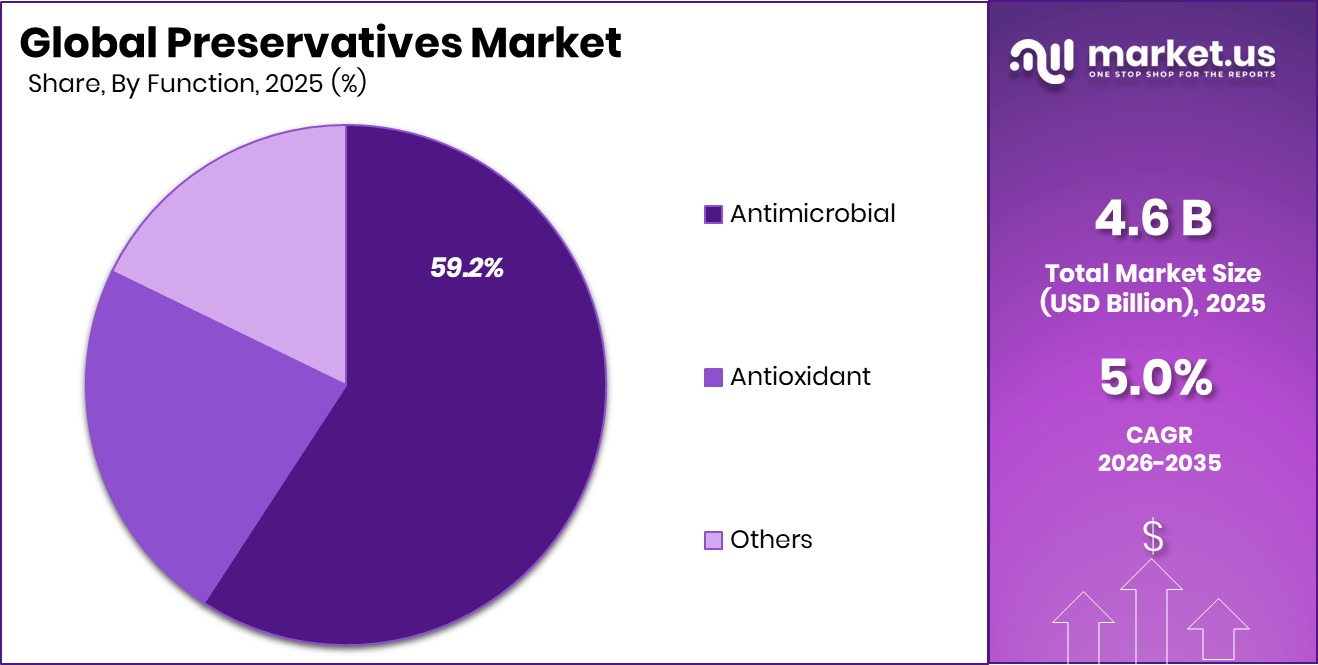
- By function, antimicrobial preservatives lead the Preservatives Market, accounting for 59.2% of total demand.
- Food applications drive the Preservatives Market strongly, representing 56.8% share across global consumption segments.
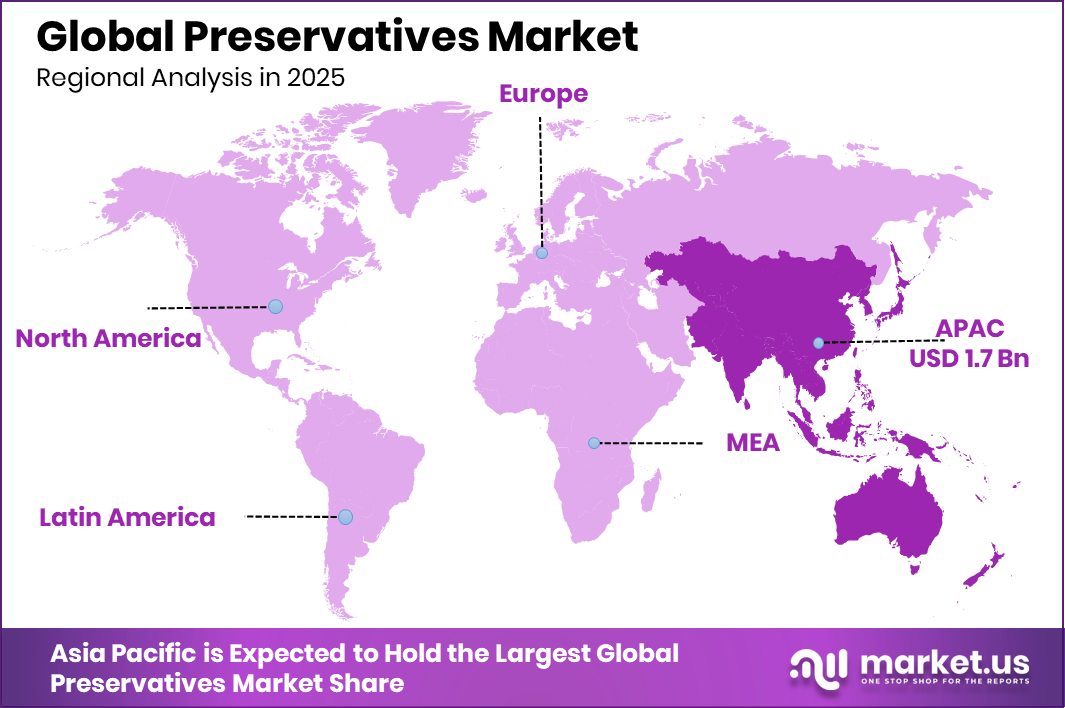
- In the Asia Pacific region, the preservatives market accounts for 38.4%, reaching USD 1.7 Bn.
By Type Analysis
The preservatives market shows 49.5% synthetic share across global production segments and key industries.
In 2025, the preservatives market shows a strong dominance of synthetic types, accounting for 49.5% of total usage. This reflects the continued reliance of manufacturers on cost-effective and highly stable chemical preservatives that offer extended shelf life and consistent performance across various conditions. Synthetic preservatives are particularly favored in large-scale production due to their efficiency in preventing microbial growth and oxidation.
Despite rising consumer awareness around clean-label products, the demand for synthetic options remains significant, especially in developing economies where affordability and supply chain stability are critical. However, increasing regulatory scrutiny and shifting consumer preferences are gradually encouraging innovation toward safer formulations within the synthetic segment.
By Function Analysis
Antimicrobial function dominates the preservatives market with 59.2% share in the overall usage demand.
In 2025, antimicrobial preservatives lead the market by function, holding a substantial 59.2% share. This highlights the critical role these preservatives play in inhibiting the growth of bacteria, yeast, and molds, thereby ensuring product safety and longevity. Industries such as food, pharmaceuticals, and cosmetics rely heavily on antimicrobial agents to maintain product integrity during storage and distribution. Their effectiveness across diverse formulations makes them indispensable, particularly in regions with varying climatic conditions.
Ongoing research continues to improve their efficiency while reducing potential health concerns. As safety standards become more stringent globally, manufacturers are focusing on optimizing antimicrobial systems that balance efficacy with regulatory compliance and consumer acceptance.
By Application Analysis
Food application leads the preservatives market, accounting for 56.8% total consumption globally today.
In 2025, the food segment dominates the preservatives market by application, contributing 56.8% of the overall share. This is driven by the growing demand for packaged and processed foods, fueled by urbanization, busy lifestyles, and expanding retail networks. Preservatives play a vital role in maintaining freshness, preventing spoilage, and ensuring food safety from production to consumption. The increasing global population further intensifies the need for longer shelf life and reduced food waste.
While synthetic preservatives remain widely used, there is a noticeable shift toward natural alternatives in premium and health-focused product lines. This evolving landscape is pushing manufacturers to innovate and adapt to changing consumer expectations without compromising product stability.
Key Market Segments
By Type
- Natural
- Edible Oil
- Rosemary Extracts
- Natamycin
- Vinegar
- Others
- Synthetic
- Propionates
- Sorbates
- Sorbic Acid
- Benzoates
- Others
By Function
- Antimicrobial
- Antioxidant
- Others
By Application
- Food
- Meat and Poultry Products
- Bakery Products
- Dairy Products
- Beverages
- Snacks
- Others
- Feed
- Pharmaceutical
- Cosmetics
- Detergents
Driving Factors
Rising demand for longer shelf life
The preservatives market is strongly driven by the increasing need to extend product shelf life across food and related industries. As supply chains become more complex and globalized, maintaining product freshness and safety over longer periods has become essential. This demand is especially visible in food systems where stability and quality directly impact consumer acceptance.
Research-backed initiatives are also supporting this direction, such as NutraMaize receiving a $650,000 USDA grant to scale research on orange corn that improves poultry health and egg yolk pigmentation. Such developments highlight how preservation-linked innovations are expanding beyond traditional use, supporting both quality enhancement and longer usability, which ultimately strengthens the role of preservatives in modern production systems.
Growth in processed food consumption
The rising consumption of processed and packaged foods continues to fuel the demand for preservatives globally. Changing lifestyles, urbanization, and convenience-driven purchasing behavior have increased reliance on ready-to-eat and long-lasting food products. This trend requires effective preservation methods to ensure safety and maintain product quality during storage and transportation.
At the same time, innovation is shaping the future of preservation, as seen with Estonian biotech developer ÄIO securing €1 million to develop greener alternatives in cosmetics products. Although focused on cosmetics, such advancements reflect a broader shift toward sustainable preservation technologies, which can also influence food applications, supporting market expansion as processed consumption continues to grow.
Restraining Factors
Health concerns over synthetic preservatives
Concerns regarding the health impact of synthetic preservatives remain a key restraint in the market. Consumers are becoming more cautious about ingredient transparency and potential long-term effects, leading to increased scrutiny of chemical-based preservation methods. This shift is influencing purchasing decisions and encouraging industries to reconsider formulation strategies.
At the same time, research efforts such as NutraMaize, receiving more than $1 million in funding to improve nutrition with orange corn, indicate a broader movement toward healthier and more natural alternatives. These developments suggest that while preservatives remain essential, the market faces pressure to evolve toward safer, nutrition-focused solutions that align with changing consumer expectations.
Strict regulations on chemical usage
Regulatory frameworks governing the use of chemical preservatives are becoming increasingly stringent across multiple industries. Compliance with safety standards, labeling requirements, and permissible limits adds complexity for manufacturers and can slow down product development. This regulatory pressure is pushing companies to explore alternative solutions that meet both safety and performance criteria.
Supporting this shift, Estonian biotech developer ÄIO secured €1 million to develop greener alternatives in cosmetics products, emphasizing the move toward environmentally friendly and compliant ingredients. Such developments highlight how regulations are not only a constraint but also a catalyst for innovation, requiring the preservatives market to adapt continuously.
Growth Opportunity
Increasing demand for natural preservatives
A growing preference for natural and clean-label products is creating strong opportunities within the preservatives market. Consumers are actively seeking products with fewer synthetic additives, encouraging manufacturers to invest in plant-based and bio-derived preservation solutions. This trend is supported by ongoing research initiatives such as NutraMaize receiving a three-year, $460,455 USDA NIFA research grant to address heat stress in laying hens, which also contributes to improved product quality and sustainability. Such advancements indicate a broader shift toward natural systems that not only preserve but also enhance nutritional value, opening new avenues for innovation and market expansion.
Expansion in emerging market applications
Emerging markets present significant opportunities for the expansion of preservative applications across food, cosmetics, and household products. Rapid urbanization, increasing disposable incomes, and evolving consumer habits are driving demand for longer-lasting and higher-quality products. This growth is supported by investment activity, such as Mexican cosmetics brand Sarelly Sarelly securing a $3 million seed round, reflecting rising interest in product development and market penetration. As these regions continue to develop, the need for effective preservation solutions will increase, providing a strong foundation for market growth across diverse applications.
Latest Trends
Shift toward clean label ingredients
The shift toward clean-label ingredients is becoming a defining trend in the preservatives market. Consumers are demanding transparency and simplicity in product formulations, pushing manufacturers to reduce synthetic additives and adopt more recognizable ingredients. This movement is reinforced by innovations like ÄIO securing €1 million to halt polluting oil use in cosmetics production, highlighting the transition toward sustainable and cleaner alternatives. Such developments indicate that clean label is no longer a niche preference but a mainstream expectation, influencing product development strategies across industries.
Innovation in multifunctional preservative solutions
There is a growing trend toward multifunctional preservative solutions that offer more than just basic preservation. Manufacturers are increasingly focusing on ingredients that provide additional benefits such as enhanced stability, improved texture, and extended product performance. These solutions help optimize formulations while reducing the need for multiple additives.
As industries continue to seek efficiency and performance, multifunctional preservatives are gaining importance, supporting product innovation and meeting evolving consumer and regulatory demands in a more integrated way.
Regional Analysis
Asia Pacific preservatives market holds a 38.4% share, valued at USD 1.7 Bn.
The preservatives market demonstrates varied regional dynamics across North America, Europe, Asia Pacific, Middle East & Africa, and Latin America, reflecting differences in consumption patterns and industrial development.
Asia Pacific emerges as the dominating region, accounting for 38.4% of the global market, with a total valuation of USD 1.7 Bn. This dominance is driven by strong demand for processed and packaged foods, expanding urban populations, and increasing industrial food production across key economies in the region. North America and Europe represent mature markets, supported by established food processing industries and consistent demand for preservation solutions, particularly in convenience and ready-to-eat products.
Meanwhile, the Middle East & Africa region shows steady growth potential, supported by rising food imports and improving distribution infrastructure. Latin America also contributes to the overall market with growing adoption of preservatives in food and beverage applications, driven by changing consumer lifestyles.
Key Regions and Countries
- North America
- US
- Canada
- Europe
- Germany
- France
- The UK
- Spain
- Italy
- Rest of Europe
- Asia Pacific
- China
- Japan
- South Korea
- India
- Australia
- Rest of APAC
- Latin America
- Brazil
- Mexico
- Rest of Latin America
- Middle East & Africa
- GCC
- South Africa
- Rest of MEA
Key Players Analysis
In 2025, Cargill, Incorporated, continues to position itself as a key participant in the preservatives space through its diversified ingredient portfolio and strong global supply chain capabilities. The company’s ability to integrate preservation solutions within broader food ingredient systems allows it to cater to large-scale manufacturers seeking consistency and efficiency. Its operational scale and deep industry relationships support steady product adoption across multiple applications, reinforcing its strategic importance among global customers.
Kerry Group plc demonstrates a focused approach toward value-added preservation solutions by aligning them with taste and nutrition platforms. The company leverages its expertise in formulation to offer solutions that meet evolving product expectations while maintaining functional performance. Its emphasis on innovation and customer-centric development enables it to support manufacturers looking to balance product stability with sensory and quality requirements in competitive markets.
DSM-Firmenich AG brings a science-driven perspective to the preservatives segment, supported by its capabilities in bioscience and ingredient development. The company’s strengths lie in advancing preservation technologies that align with modern formulation needs. Its integrated approach, combining research depth with application expertise, allows it to contribute effectively to product development pipelines while addressing changing industry preferences.
Top Key Players in the Market
- Cargill, Incorporated
- Kerry Group plc
- DSM-Firmenich AG
- Archer Daniels Midland Company
- Kemin Industries, Inc.
- Corbion N.V.
- BASF SE
- Tate & Lyle PLC
- International Flavors & Fragrances Inc.
- Givaudan SA
Recent Developments
- In March 2025, BASF announced an investment to expand production of aminic antioxidants at its Mexico site. Similar to preservation functions, these antioxidants enhance product stability and prevent degradation in industrial applications. This development strengthens BASF’s role as a supplier of stability-enhancing chemical solutions across industries.
- In July 2024, Cargill launched new food ingredient solutions designed to improve functionality and support modern food formulations, including plant-based and stability-focused applications. Food manufacturers use these solutions to enhance shelf life, texture, and product quality, which closely relate to preservative performance in processed foods.
Report Scope
Report Features Description Market Value (2025) USD 4.6 Billion Forecast Revenue (2035) USD 7.5 Billion CAGR (2026-2035) 5.0% Base Year for Estimation 2025 Historic Period 2020-2024 Forecast Period 2026-2035 Report Coverage Revenue Forecast, Market Dynamics, Competitive Landscape, Recent Developments Segments Covered By Type (Natural (Edible Oil, Rosemary Extracts, Natamycin, Vinegar, Others), Synthetic (Propionates, Sorbates, Sorbic Acid, Benzoates, Others)), By Function (Antimicrobial, Antioxidant, Others), By Application (Food (Meat and Poultry Products, Bakery Products, Dairy Products, Beverages, Snacks, Others), Feed, Pharmaceutical, Cosmetics, Detergents) Regional Analysis North America – US, Canada; Europe – Germany, France, The UK, Spain, Italy, Rest of Europe; Asia Pacific – China, Japan, South Korea, India, Australia, Singapore, Rest of APAC; Latin America – Brazil, Mexico, Rest of Latin America; Middle East & Africa – GCC, South Africa, Rest of MEA Competitive Landscape Cargill, Incorporated, Kerry Group plc, DSM-Firmenich AG, Archer Daniels Midland Company, Kemin Industries, Inc., Corbion N.V., BASF SE, Tate & Lyle PLC, International Flavors & Fragrances Inc., Givaudan SA Customization Scope Customization for segments, region/country-level will be provided. Moreover, additional customization can be done based on the requirements. Purchase Options We have three licenses to opt for: Single User License, Multi-User License (Up to 5 Users), Corporate Use License (Unlimited User and Printable PDF) 
-
-
- Cargill, Incorporated
- Kerry Group plc
- DSM-Firmenich AG
- Archer Daniels Midland Company
- Kemin Industries, Inc.
- Corbion N.V.
- BASF SE
- Tate & Lyle PLC
- International Flavors & Fragrances Inc.
- Givaudan SA
Our Clients

- 182318
- March 2026






