


Global Phosphine Fumigation Market Size, Share, And Enhanced Productivity By Type (Grain Fumigation, Processed Food Fumigation, Non-Food Fumigation), By Formulation (Aluminium Phosphide, Magnesium Phosphide), By Phosphine Release (Tablets, Pellets, Gas Generators), By Application (Pest Control, Disinfection), By End-use (Agriculture, Food Processing, Pharmaceuticals), By Region and Companies - Industry Segment Outlook, Market Assessment, Competition Scenario, Trends, and Forecast 2026-2035
- Published date: March 2026
- Report ID: 180566
- Number of Pages: 256
- Format:
-
keyboard_arrow_up
Quick Navigation
Report Overview
The Global Phosphine Fumigation Market is expected to be worth around USD 2.9 billion by 2035, up from USD 1.9 billion in 2025, and is projected to grow at a CAGR of 4.6% from 2026 to 2035. With 45.80% share, North America dominated the Phosphine Fumigation Market at USD 0.8 Bn.
Phosphine fumigation is a pest control method widely used to eliminate insects in stored commodities and enclosed spaces. The process involves releasing phosphine gas, typically generated from compounds such as aluminium phosphide or magnesium phosphide, to control pests that infest grains, processed food, and other stored materials. It is commonly applied in silos, warehouses, shipping containers, and storage facilities where maintaining product quality is critical. Phosphine fumigation is valued for its ability to penetrate deep into stored products, effectively targeting pests at different life stages without leaving significant residue when applied correctly.
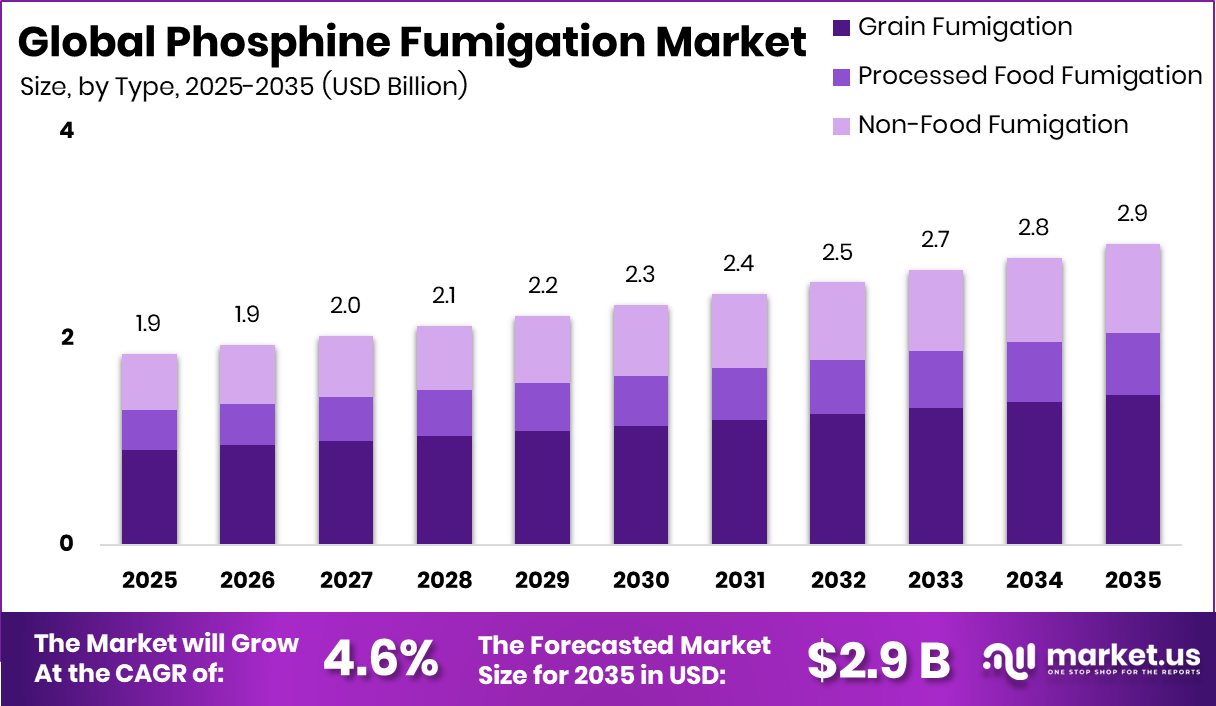
The Phosphine Fumigation Market represents the commercial ecosystem associated with fumigation solutions, products, and services used to control pests in stored commodities and industrial environments. The market is structured across segments such as type, formulation, phosphine release methods, application areas, and end-use industries, including agriculture, food processing, and pharmaceuticals. Grain fumigation remains a major component due to the need to protect large volumes of stored crops. Tablets, pellets, and gas generators are commonly used release methods, enabling controlled distribution of phosphine gas during treatment.
Market growth is strongly linked to increasing awareness of post-harvest protection and the need to reduce storage losses caused by insect infestation. Agricultural producers, storage operators, and logistics providers rely on fumigation practices to maintain product safety and meet quality standards during storage and transportation. The rising scale of global food supply chains and expanding grain storage infrastructure continue to support demand for fumigation solutions.
Demand for phosphine fumigation is also influenced by broader developments in pest management technologies and investment in agricultural protection. Initiatives such as Universal Biosecurity targeting the US$7 billion global fumigation market with patented non-toxic pest control solutions highlight growing industry attention toward pest prevention. In addition, research and innovation efforts are supported through programs like The Pest Management Foundation, announcing $55,000 available for research, while companies such as Biocentis are securing $19M in seed equity and grant funds to protect agriculture from pests reflect the ongoing focus on strengthening crop protection technologies.
Opportunities in the market are supported by technological progress and funding aimed at improving pest control systems and agricultural infrastructure. New pest management platforms and digital monitoring tools are attracting investment, illustrated by a Boise startup raising $28 million for a pest control platform and Pest Share securing $28 million to expand tech-enabled pest control services for property managers. Broader industrial investments, including government plans to invest $1 billion in solar panel manufacturing, also contribute to improved storage and infrastructure development, indirectly supporting advanced pest control practices used in modern storage and processing environments.
Key Takeaways
- The Global Phosphine Fumigation Market is expected to be worth around USD 2.9 billion by 2035, up from USD 1.9 billion in 2025, and is projected to grow at a CAGR of 4.6% from 2026 to 2035.
- Grain fumigation dominates the Phosphine Fumigation Market, accounting for 49.7% share due to storage protection.
- Aluminium Phosphide formulation leads the Phosphine Fumigation Market with 78.3% usage because of its high effectiveness.
- Tablets represent 51.4% of the Phosphine Fumigation Market due to convenient phosphine release during fumigation.
- Pest control applications hold 74.6% share in the Phosphine Fumigation Market across agricultural and storage environments.
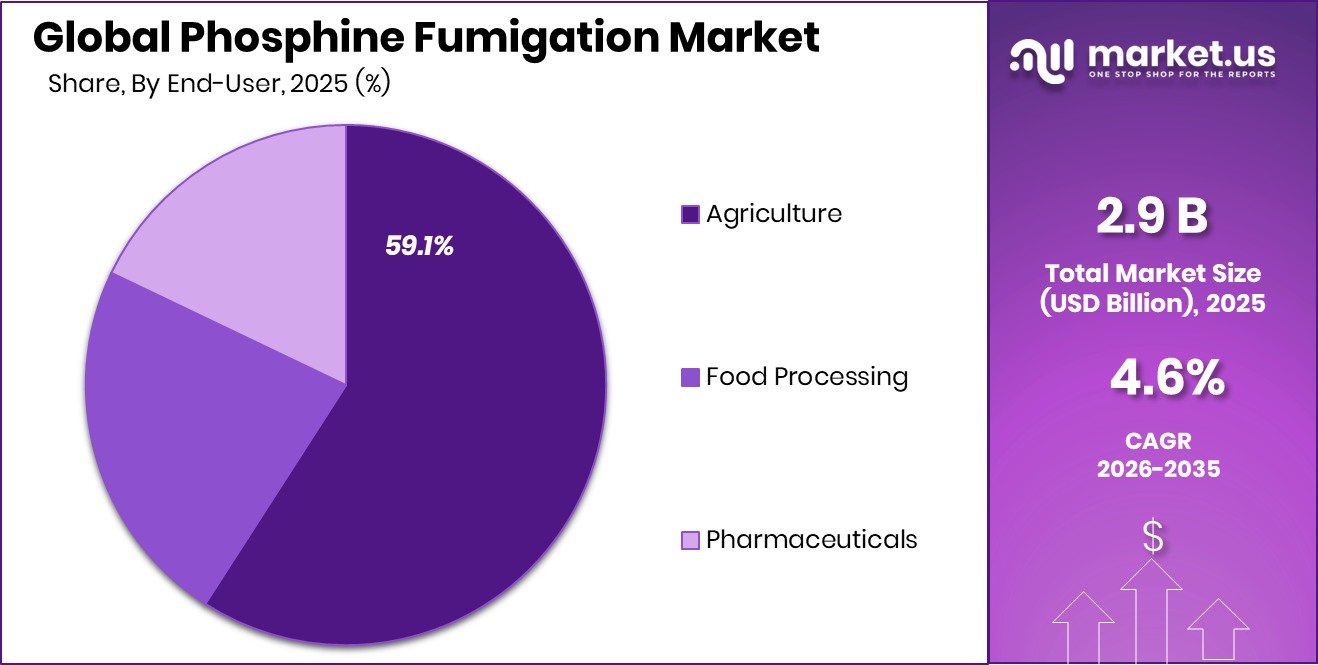
- Agriculture end-use contributes 59.1% of the Phosphine Fumigation Market demand globally for protecting stored grains.
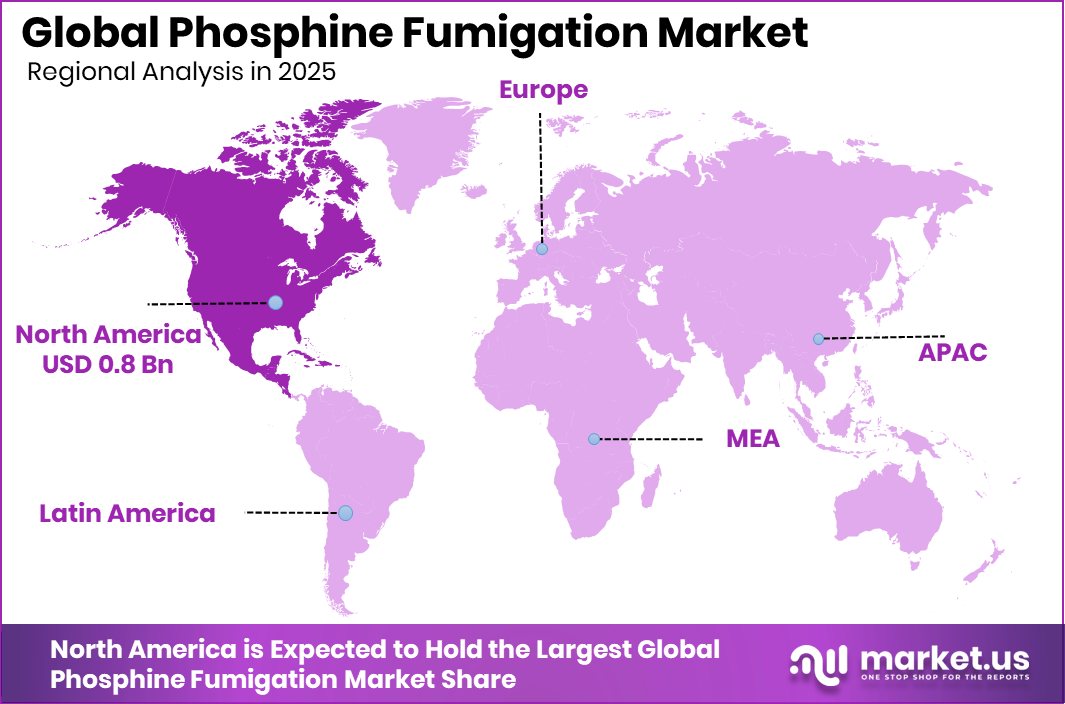
- Phosphine Fumigation Market in North America reached USD 0.8 Bn, capturing 45.80% regional share.
By Type Analysis
Phosphine Fumigation Market grows strongly through grain fumigation, holding a 49.7% share globally.
In 2025, the Phosphine Fumigation Market continued to rely heavily on grain fumigation, which accounted for 49.7% of total market demand. Grain storage facilities across major agricultural regions increasingly adopted phosphine fumigation due to its effectiveness in controlling storage pests such as beetles, weevils, and moths. The need to protect stored cereals like wheat, rice, and maize from infestation has remained a major driver for the segment.
Growing global trade in grains and the expansion of large-scale storage infrastructure have further increased the use of fumigation solutions. Governments and agricultural organisations have also promoted proper fumigation practices to reduce post-harvest losses, especially in developing economies where food storage systems are rapidly modernising.
By Formulation Analysis
Aluminium phosphide dominates the Phosphine Fumigation Market formulation segment with a 78.3% share.
In 2025, aluminium phosphide dominated the Phosphine Fumigation Market by formulation, representing 78.3% of the total share. The formulation remains widely preferred because it releases phosphine gas when it reacts with moisture, making it highly effective for pest elimination in stored commodities. Its ease of transportation, storage stability, and cost-effectiveness have contributed to its widespread adoption across agricultural and warehouse facilities.
Aluminium phosphide formulations are commonly available in tablets, pellets, and sachets, providing flexibility for different fumigation needs. The growing requirement for efficient pest management in grain warehouses, shipping containers, and silos has strengthened demand for this formulation. Regulatory approvals in several countries have also supported its continued market dominance.
By Phosphine Release Analysis
Tablets lead phosphine release methods in the Phosphine Fumigation Market with 51.4%.
In 2025, tablets represented 51.4% of the Phosphine Fumigation Market by phosphine release type, making them the most commonly used format. Tablets are widely used because they provide controlled and gradual phosphine gas release, which helps maintain effective fumigation levels over a specific time period. Their compact size allows easy placement within grain stacks, storage bags, and silos without complicated equipment.
The format is particularly useful for large grain storage operations where uniform gas distribution is necessary to eliminate pests effectively. Tablets also simplify handling procedures for trained fumigation professionals. As grain storage systems expand globally and pest management standards become stricter, the demand for tablet-based phosphine release solutions continues to grow steadily.
By Application Analysis
Pest control applications drive the Phosphine Fumigation Market, contributing about 74.6% demand.
In 2025, pest control remained the leading application segment in the Phosphine Fumigation Market, accounting for 74.6% of the total demand. Phosphine fumigation is widely recognised for its ability to control a broad range of insects that infest stored agricultural commodities and packaged food products. The method is particularly effective in eliminating pests at different life stages, including eggs, larvae, and adults.
Increasing concerns about food contamination and quality degradation during storage have made pest control a top priority for grain handlers and food supply chains. Many commercial warehouses, logistics providers, and export facilities have adopted fumigation programs to ensure product safety and compliance with international trade standards.
By End-use Analysis
Agriculture remains the primary end-use in the Phosphine Fumigation Market with 59.1% share.
In 2025, agriculture represented the largest end-use sector in the Phosphine Fumigation Market, holding 59.1% of the total share. Agricultural producers and grain storage operators rely on phosphine fumigation to safeguard harvested crops from pest damage during storage and transportation. The increasing scale of global agricultural production has intensified the need for reliable fumigation solutions to prevent economic losses.
Countries with large grain reserves have invested in modern storage silos and warehouse facilities that incorporate fumigation practices as a routine pest management measure. Additionally, rising food demand and the expansion of international agricultural trade have reinforced the importance of effective storage protection, supporting the continued growth of phosphine fumigation within the agriculture sector.
Key Market Segments
By Type
- Grain Fumigation
- Processed Food Fumigation
- Non-Food Fumigation
By Formulation
- Aluminium Phosphide
- Magnesium Phosphide
By Phosphine Release
- Tablets
- Pellets
- Gas Generators
By Application
- Pest Control
- Disinfection
By End-use
- Agriculture
- Food Processing
- Pharmaceuticals
Driving Factors
Rising Global Grain Storage Pest Control Demand
Growing demand for effective pest control in grain storage facilities continues to support the expansion of the Phosphine Fumigation Market. Large volumes of cereals such as wheat, rice, and maize require protection during long-term storage and international transportation, making fumigation an important practice for maintaining quality and preventing losses. Storage operators and agricultural supply chains increasingly focus on improving pest management systems as global food trade expands. Technology adoption in food production and storage is also strengthening these practices.
For instance, Armed with $13m in seed funding, BRAINR ramps up plans to digitise food manufacturing, highlighting the broader movement toward modernised food processing and monitoring systems. Such developments indirectly support fumigation adoption by improving storage management, traceability, and safety within global agricultural supply chains.
Restraining Factors
Strict Fumigation Safety Regulations Across Countries
Strict safety regulations related to chemical fumigants present operational challenges for the Phosphine Fumigation Market. Many countries enforce detailed guidelines regarding fumigant handling, worker safety, and application procedures to minimise health and environmental risks. Compliance requirements often demand trained professionals, specialised equipment, and strict monitoring protocols, which can increase operational costs for storage operators and pest control service providers.
Governments and institutions are also directing funding toward broader food safety and pest management initiatives. For example, USDA-NIFA Awards $9.6 Million in Grant Funding Under Food Safety Outreach Program, supporting education and safety practices across food supply chains. In addition, the Queensland government commits $4.5 million for locust control as swarms intensify, demonstrating how governments invest in alternative pest management programs that can influence how pest control strategies are implemented.
Growth Opportunity
Expanding Grain Storage Infrastructure in Developing Economies
Expanding grain storage infrastructure across developing economies creates new opportunities for the Phosphine Fumigation Market. Countries with growing agricultural production are investing in improved storage facilities, silos, and logistics networks to reduce post-harvest losses and maintain commodity quality. As grain reserves increase, the need for effective pest management during storage becomes more critical. These developments often align with broader agricultural modernisation initiatives supported by public funding and private investment.
For instance, USDA-NIFA Awards $9.6 Million in Grant Funding Under Food Safety Outreach Program contributes to improving food safety awareness and storage practices within agricultural systems. Similarly, Ontario Welcomes $24 Million Investment in Agri-Food Manufacturing, highlighting efforts to strengthen food processing and storage capacity. Such infrastructure expansion increases the need for reliable fumigation practices that protect stored commodities from infestation.
Latest Trends
Development of Safer Phosphine Fumigation Technologies
The development of safer fumigation technologies has become a significant trend influencing the Phosphine Fumigation Market. Industry participants and research institutions are focusing on improved application systems, monitoring tools, and safer formulations designed to enhance pest control efficiency while addressing safety concerns. Modern technologies aim to support controlled gas release, improved detection of fumigant levels, and better operational safety for workers.
Public funding and research programs are encouraging innovation in agricultural and food technologies that influence pest management methods. For example, £2.95m funding set to drive innovation in Agri-Tech and Food-Tech reflects the growing interest in advanced agricultural technologies. Additionally, federal funding proposed to help build a $50 million UA food science center highlights investments supporting research in food safety, storage systems, and pest management approaches.
Regional Analysis
North America held 45.80% share in the Phosphine Fumigation Market, valued at USD 0.8 Bn.
The Phosphine Fumigation Market demonstrates varied growth patterns across key regions, including North America, Europe, Asia Pacific, the Middle East & Africa, and Latin America, largely influenced by agricultural storage practices, pest management requirements, and grain trade activities.
North America dominates the global market, accounting for 45.80% of the total share and reaching a market value of USD 0.8 Bn. The region’s strong position is supported by extensive grain storage infrastructure, advanced warehouse fumigation practices, and strict pest control standards across the agricultural supply chain. The presence of large commercial grain storage facilities and export-oriented agricultural operations further strengthens demand for phosphine fumigation solutions.
In Europe, the market is supported by well-regulated storage and food safety systems that emphasize effective pest management in grain reserves and warehouses. Asia Pacific shows increasing adoption of fumigation practices due to expanding grain production and storage requirements across major agricultural economies.
Meanwhile, Latin America and the Middle East & Africa are witnessing steady use of fumigation solutions driven by grain storage expansion and the need to reduce post-harvest losses in agricultural commodities.
Key Regions and Countries
- North America
- US
- Canada
- Europe
- Germany
- France
- The UK
- Spain
- Italy
- Rest of Europe
- Asia Pacific
- China
- Japan
- South Korea
- India
- Australia
- Rest of APAC
- Latin America
- Brazil
- Mexico
- Rest of Latin America
- Middle East & Africa
- GCC
- South Africa
- Rest of MEA
Key Players Analysis
In 2025, UPL Ltd remains an influential participant in the global phosphine fumigation landscape through its strong presence in crop protection and post-harvest management solutions. The company’s portfolio and distribution capabilities allow it to support fumigation practices used in stored commodity protection. Its operational scale and international reach enable consistent supply across agricultural markets where pest control during grain storage is essential. By maintaining a broad product ecosystem related to crop protection and storage management, the company positions itself to support fumigation requirements across diverse agricultural environments.
Detia Degesch GmbH continues to maintain a specialized focus on fumigation technologies and solutions used for stored commodity protection. The company is recognized for its expertise in phosphine-based fumigation applications and associated pest control practices. Its long-standing involvement in fumigation solutions allows it to serve grain storage facilities, warehouses, and agricultural logistics systems that require effective pest elimination. Through technical specialization and established industry presence, the company contributes to maintaining reliable fumigation practices within professional pest management and storage protection operations.
Douglas Products plays a significant role in supporting fumigation solutions used for agricultural storage and pest control environments. The company’s focus on specialty chemical solutions enables it to provide products designed for protecting stored commodities from infestation. Its operational approach centers on serving professional pest control and post-harvest protection needs. With established expertise in chemical-based pest management applications, the company contributes to ensuring consistent fumigation performance within grain storage, transportation, and commodity handling systems across agricultural supply chains.
Top Key Players in the Market
- UPL Ltd
- Detia Degesch GmbH
- Douglas Products
- Draslovka
- Nufarm
- Solvay
- Syensqo
- Jaffer Group of Companies
- Intech Organics Limited
- National Fumigants Pty Ltd.
Recent Developments
- In January 2025, Detia Degesch GmbH introduced the U-Phos® cylinderized phosphine fumigant through its Degesch America unit. The product releases phosphine gas using dispensing equipment and is used to protect stored grains and commodities from pests during fumigation treatments.
- In October 2024, UPL Ltd continued the expansion of its post-harvest fumigation solutions portfolio, supplying aluminium phosphide-based fumigants such as QuickPhos tablets and powder used for releasing phosphine gas to control insects in stored grains and warehouses.
Report Scope
Report Features Description Market Value (2025) USD 1.9 Billion Forecast Revenue (2035) USD 2.9 Billion CAGR (2026-2035) 4.6% Base Year for Estimation 2025 Historic Period 2020-2024 Forecast Period 2026-2035 Report Coverage Revenue Forecast, Market Dynamics, Competitive Landscape, Recent Developments Segments Covered By Type (Grain Fumigation, Processed Food Fumigation, Non-Food Fumigation), By Formulation (Aluminium Phosphide, Magnesium Phosphide), By Phosphine Release (Tablets, Pellets, Gas Generators), By Application (Pest Control, Disinfection), By End-use (Agriculture, Food Processing, Pharmaceuticals) Regional Analysis North America – US, Canada; Europe – Germany, France, The UK, Spain, Italy, Rest of Europe; Asia Pacific – China, Japan, South Korea, India, Australia, Singapore, Rest of APAC; Latin America – Brazil, Mexico, Rest of Latin America; Middle East & Africa – GCC, South Africa, Rest of MEA Competitive Landscape By Type (Grain Fumigation, Processed Food Fumigation, Non-Food Fumigation), By Formulation (Aluminium Phosphide, Magnesium Phosphide), By Phosphine Release (Tablets, Pellets, Gas Generators), By Application (Pest Control, Disinfection), By End-use (Agriculture, Food Processing, Pharmaceuticals) Customization Scope Customization for segments, region/country-level will be provided. Moreover, additional customization can be done based on the requirements. Purchase Options We have three licenses to opt for: Single User License, Multi-User License (Up to 5 Users), Corporate Use License (Unlimited User and Printable PDF)  Phosphine Fumigation MarketPublished date: March 2026add_shopping_cartBuy Now get_appDownload Sample
 -
-
- UPL Ltd
- Detia Degesch GmbH
- Douglas Products
- Draslovka
- Nufarm
- Solvay
- Syensqo
- Jaffer Group of Companies
- Intech Organics Limited
- National Fumigants Pty Ltd.
Our Clients

- 180566
- March 2026






